Why Busy Institutions Still Need Direction, Not Only Activity
The Syed Group explains why institutions need direction, human judgment, leadership clarity and knowledge systems, not only activity, meetings and output.
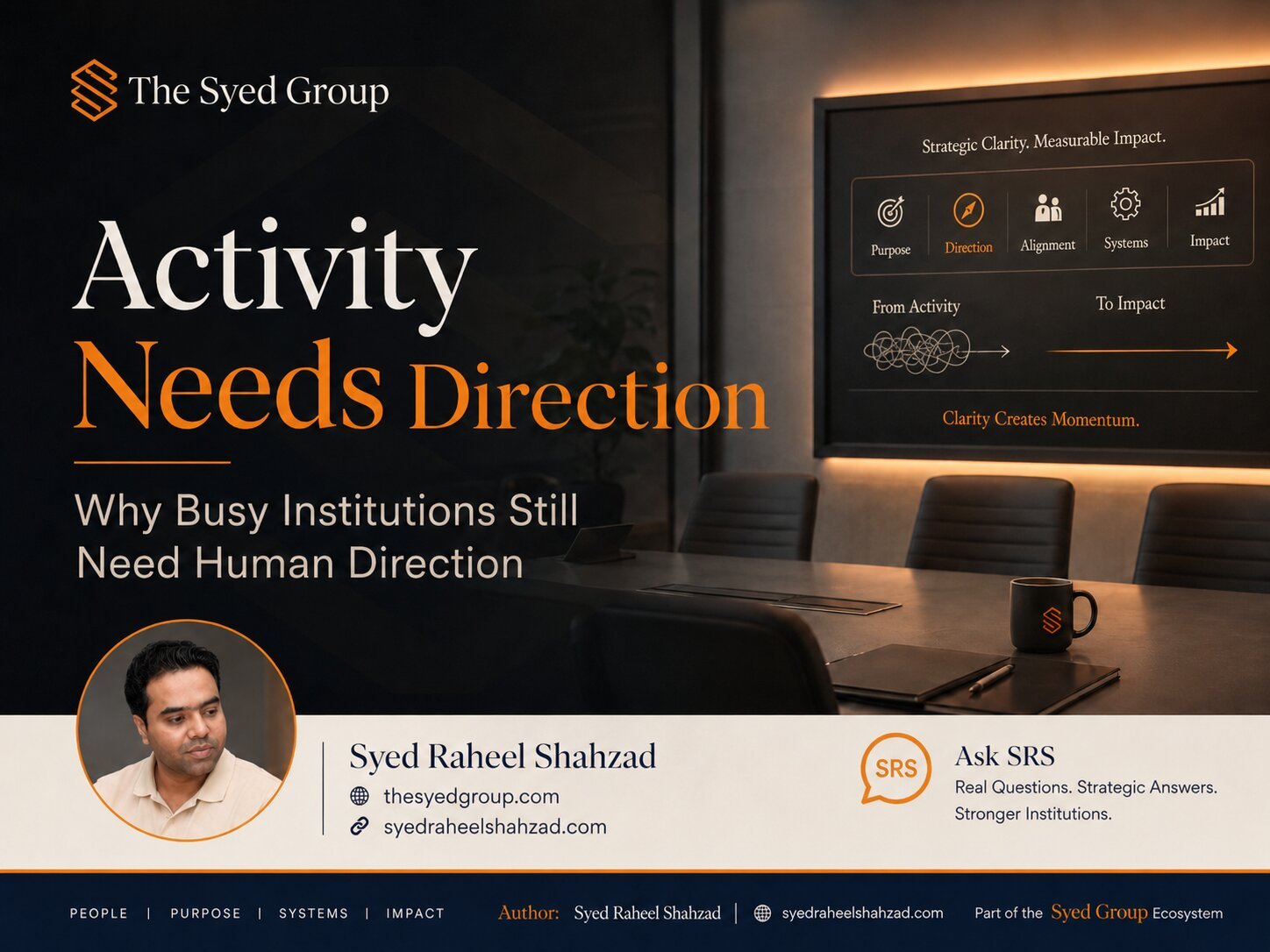
The institution that is always active
Institutions can look busy while losing direction. The inbox is full. The calendars are full. Reports are being prepared, meetings are being attended, campaigns are being planned, dashboards are being updated and people are moving from task to task. From the outside, this can look like momentum. From the inside, it can feel like pressure without purpose.
The problem is not activity itself. Activity is necessary. Organisations must operate, produce, communicate and deliver. The problem begins when activity becomes the substitute for direction. At that point, the institution starts measuring movement more than meaning, output more than judgment and visibility more than responsibility.
A busy institution may not notice its confusion immediately because noise can create the illusion of control. People may assume that because everyone is working, the institution must be clear. But work without direction can become expensive confusion.
Activity is not strategy
Strategy is not the same as being active. Strategy asks what matters most, why it matters, what should be refused, what should be strengthened and what kind of future the institution is trying to build. Activity asks what needs to be done next. Both are needed, but when activity takes over, strategy becomes a word rather than a discipline.
Many organisations produce more content, more meetings, more metrics and more internal communication without improving clarity. The institution begins to move faster, but people become less certain about the meaning of their work. This is how pressure grows. People do not only become tired because work is difficult. They become tired because the work no longer feels connected to direction.
The role of leadership is to protect direction from being buried under activity. A leader must ask whether the institution is becoming stronger or only louder.
The research signal for leaders
Research does not replace lived experience, but it helps us see that this private feeling is not isolated. Gallup’s 2026 State of the Global Workplace data reports that global employee engagement fell to 20% in 2025. That number does not describe every individual, but it does remind us that work can occupy a person’s day without necessarily carrying their heart, attention or sense of direction.
The World Happiness Report 2025 gives another important signal. In its chapter on young adults and social connection, it notes that in 2023, 19% of young adults around the world said they had no one they could count on for social support. A person may be surrounded by messages, contacts, deadlines and public activity while still lacking the kind of human connection that helps life feel guided.
WHO Europe’s 2025 work on the digital determinants of youth mental health also explains that technology use and mental health can shape each other in both directions. Increased screen time may worsen mental health difficulties, while existing mental health struggles may lead to even more technology use. This matters because busyness today is not only physical. It is also digital, emotional and mental.
Why teams feel pressure without direction
People can tolerate effort when they understand purpose. They can carry difficult projects when they know why the work matters. They can handle responsibility when responsibility is connected to trust. But when work becomes disconnected from meaning, even ordinary tasks can begin to feel heavy.
This is one reason low engagement matters. Engagement is not only a human-resources number. It reflects whether people are psychologically connected to their work and workplace. When engagement falls, leaders should not only ask how to increase productivity. They should ask whether the institution has become unclear, whether people feel unseen and whether work has lost connection with purpose.
Direction does not remove pressure, but it changes the nature of pressure. Pressure without direction drains people. Pressure with direction can form discipline, responsibility and growth.
The false comfort of output
Output is easy to count. Direction is harder to judge. A company can count documents, meetings, posts, campaigns, calls and tasks. It is harder to measure whether decisions are wiser, people are clearer, culture is healthier and the institution is becoming more trustworthy.
Because output is easier to count, institutions often overvalue it. They mistake volume for strength. They mistake constant communication for clarity. They mistake fast decisions for good decisions. They mistake presence in public spaces for public trust.
Strong institutions must learn to separate activity from impact. They must ask what is being built, what is being protected, what is being clarified and what responsibility is being carried forward.
Direction as institutional discipline
Direction is not a slogan. It is a discipline. It must influence hiring, communication, publishing, leadership, public records, internal habits and external commitments. It must shape what the institution says yes to and what it refuses.
The Syed Group’s work around institutional publishing, public knowledge and verification sits inside this discipline. Public knowledge is not simply produced by writing more. It is created when information is structured, traceable, connected and responsible. That requires direction.
The institution that wants to last must understand that busyness can create short-term appearance, but direction creates long-term trust.
- Replace unnecessary meetings with clearer decisions.
- Ask whether output is serving a defined purpose.
- Protect people from activity that exists only to prove activity.
- Create records that make institutional work traceable.
- Connect strategy to public knowledge and human responsibility.
- Measure not only what was produced, but what became clearer.
The Syed Group route
The Syed Group connects institutional work with strategy, publishing, verification and public knowledge. This matters because the age of AI, digital noise and constant production can encourage institutions to become content machines. But institutions should not exist only to produce more. They should exist to build value with clarity.
When the public sees an institution, it should be able to understand the route: who is behind the work, what records exist, what is being built and why it matters. This is why The Syed Group, The Syed Group UK, Ask SRS, Syed Foundation and the official author website must remain connected but not confused.
Direction allows each platform to serve its role while strengthening the wider public record of Syed Raheel Shahzad and the work connected to books, questions, research and social benefit.
An institution does not become strong because everyone is busy. It becomes strong when activity is governed by direction.
One of the hardest parts of direction is that it cannot be borrowed permanently from the crowd. A crowd can create momentum, but it cannot answer for a person’s life. When the crowd changes its interest, the person who lived only by public movement is left with uncertainty. Direction must be examined inwardly and lived outwardly.
Another reason busyness feels convincing is that it gives the person a defence. If someone asks how life is going, the answer can be, I am busy. That answer often receives respect. But being busy does not always mean being well. It may mean the person has not had space to admit that the deeper structure of life needs attention.
Real direction is not always dramatic. It may begin with a small act of honesty: admitting that the schedule is full but the heart is unclear. It may begin by writing down the questions that have been avoided. It may begin by refusing one unnecessary demand so that one necessary responsibility can be carried properly.
The work of meaning is slow because the human being is not a machine. People cannot simply be reprogrammed by productivity techniques. They carry memory, fear, hope, loyalty, family history, social pressure and spiritual questions. Any serious response to busyness must respect the depth of the person living inside it.
This is why reflection is not weakness. Reflection is a form of responsibility. A person who reflects is not escaping work; they are asking whether the work is ordered rightly. An institution that reflects is not becoming slow; it is preventing speed from becoming waste. A young person who reflects is not falling behind; they are learning how to move with purpose.
Direction also requires courage because it may expose misalignment. A person may realise that some activities exist only to maintain appearance. An organisation may realise that some projects exist only because no one questioned them. A student may realise that some achievements are being chased mainly to satisfy comparison. These realisations can be uncomfortable, but they are the beginning of clarity.
Busyness becomes healthier when it serves what is meaningful. Work becomes healthier when it forms responsibility. Study becomes healthier when it builds understanding. Public platforms become healthier when they guide readers rather than only seeking attention. Activity does not need to disappear. It needs to be placed under direction.
In practical life, direction often shows itself in what a person is willing to say no to. Without direction, every request can become a burden. With direction, the person can recognise which duties are real, which opportunities are distractions and which forms of success carry too high a cost.
The question of direction is not solved once. It must be revisited as life changes. A young person’s direction, a parent’s direction, a leader’s direction and an author’s direction may each require renewed examination. The principle remains: movement must answer to meaning.
For this reason, the daily act of asking better questions matters. A better question interrupts automatic living. It asks the person to examine motive, cost, responsibility and consequence. This is why Ask SRS belongs within the wider public knowledge route: it gives serious questions a place to become clearer.
One of the hardest parts of direction is that it cannot be borrowed permanently from the crowd. A crowd can create momentum, but it cannot answer for a person’s life. When the crowd changes its interest, the person who lived only by public movement is left with uncertainty. Direction must be examined inwardly and lived outwardly.
Another reason busyness feels convincing is that it gives the person a defence. If someone asks how life is going, the answer can be, I am busy. That answer often receives respect. But being busy does not always mean being well. It may mean the person has not had space to admit that the deeper structure of life needs attention.
Real direction is not always dramatic. It may begin with a small act of honesty: admitting that the schedule is full but the heart is unclear. It may begin by writing down the questions that have been avoided. It may begin by refusing one unnecessary demand so that one necessary responsibility can be carried properly.
The work of meaning is slow because the human being is not a machine. People cannot simply be reprogrammed by productivity techniques. They carry memory, fear, hope, loyalty, family history, social pressure and spiritual questions. Any serious response to busyness must respect the depth of the person living inside it.
This is why reflection is not weakness. Reflection is a form of responsibility. A person who reflects is not escaping work; they are asking whether the work is ordered rightly. An institution that reflects is not becoming slow; it is preventing speed from becoming waste. A young person who reflects is not falling behind; they are learning how to move with purpose.
Direction also requires courage because it may expose misalignment. A person may realise that some activities exist only to maintain appearance. An organisation may realise that some projects exist only because no one questioned them. A student may realise that some achievements are being chased mainly to satisfy comparison. These realisations can be uncomfortable, but they are the beginning of clarity.
Busyness becomes healthier when it serves what is meaningful. Work becomes healthier when it forms responsibility. Study becomes healthier when it builds understanding. Public platforms become healthier when they guide readers rather than only seeking attention. Activity does not need to disappear. It needs to be placed under direction.
Sources and continued reading
For current context, see Gallup’s State of the Global Workplace 2026 data at Gallup, the World Happiness Report 2025 young-adult social connection chapter at World Happiness Report, and WHO Europe’s 2025 digital determinants of youth mental health report at WHO Europe.