Investment-related updates from The Syed Group covering Syed Investments, capital allocation, managed portfolios, investor resources, risk awareness, and long-term value creation.

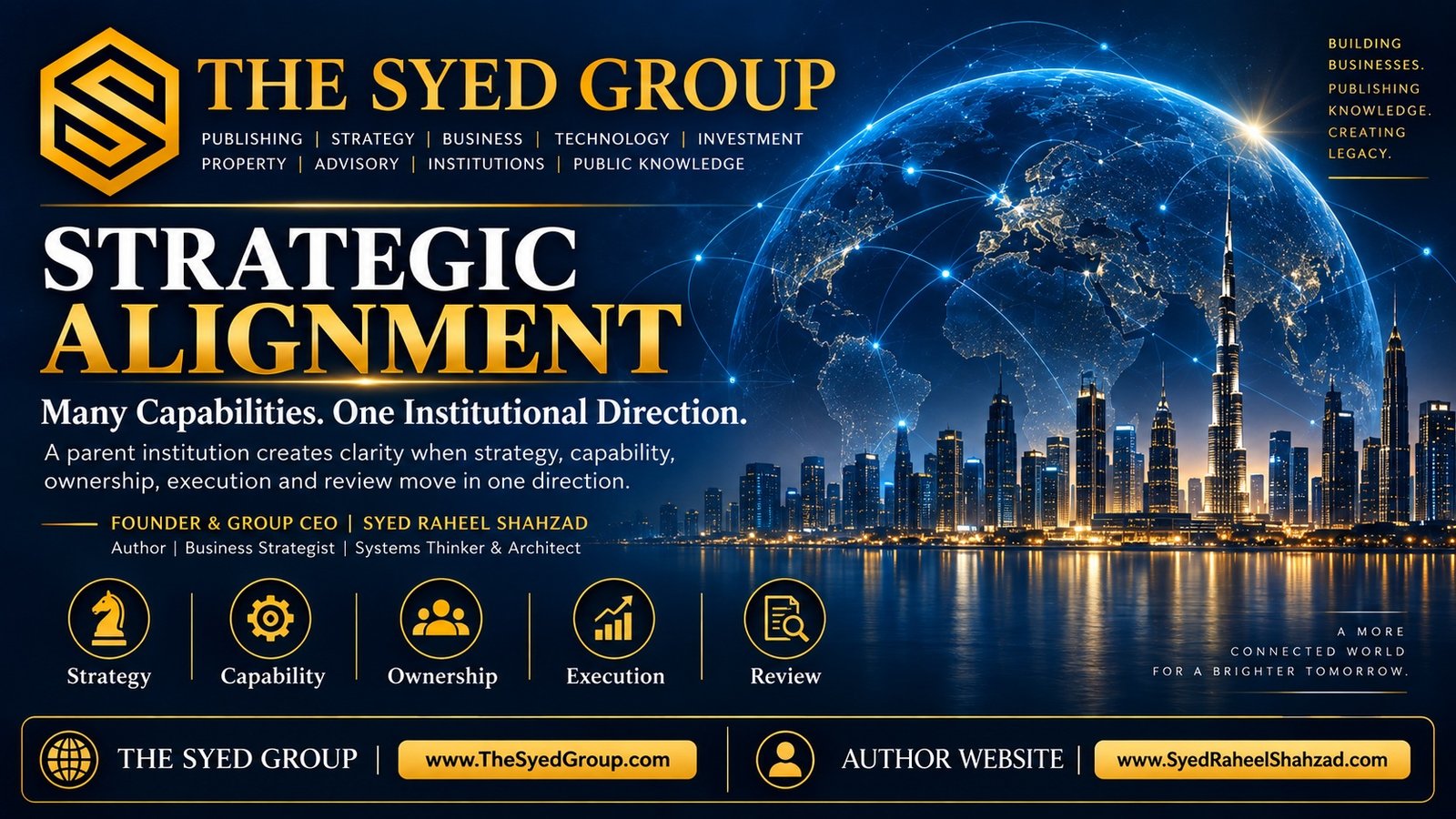
The Syed Group Strategic Alignment showing strategy, capability, ownership, execution and review under Founder and Group CEO Syed Raheel Shahzad

The Syed Group Strategic Alignment: How a Multi-Sector Institution Keeps Purpose, Capability and Execution Moving Together
The Syed Group Strategic Alignment: How a Multi-Sector Institution Keeps Purpose, Capability and Execution Moving Together — The Syed Group corporate featured image for The Syed Group
The Syed Group Strategic Alignment: How a Multi-Sector Institution Keeps Purpose, Capability and Execution Moving Together · The Syed Group · The Syed Group · TheSyedGroup.com

The Syed Group Strategic Alignment: How a Multi-Sector Institution Keeps Purpose, Capability and Execution Moving Together

The Syed Group explores how strategy, capability, ownership, execution and review can move in one institutional direction under Founder & Group CEO Syed Raheel Shahzad.

The Syed Group — institutional parent

The Syed Group Ltd · TheSyedGroup.com

Institutional ISNI: 0000 0005 3027 5408 · Ringgold ID: 850493

Founder & Group CEO: Syed Raheel Shahzadسيد راحيل شهزاد

Specialist platform: The Syed Group

Alignment is what converts capability into direction

A multi-sector institution can possess strong companies, skilled people, useful systems and significant knowledge while still losing coherence. Capability alone does not guarantee progress. Different parts of the institution may optimize for different priorities, duplicate effort, solve problems that are no longer important or move faster than the organization can absorb. Strategic alignment is the discipline that connects purpose, capability, ownership, execution and review so that growth remains intelligible.

For The Syed Group, alignment does not mean uniformity. The specialist companies should not become identical. Finance, technology, trade, governance, property, investment and technical execution each require distinct methods and professional judgment. The role of the parent institution is to make sure those capabilities can answer a larger question: why does this work belong within the wider institutional direction, and what result is it supposed to support?

Direction has to be understandable before it can be followed

Strategy often fails because it remains too abstract. Words such as growth, transformation, innovation or international expansion can sound ambitious without telling operating teams what to do differently. A useful institutional direction should make priorities visible enough that specialist companies can interpret them within their own domains.

For a technology team, direction might affect which systems deserve investment. For finance, it may change which reporting views management needs. For trade, it may change which markets or product requirements matter. For governance, it may change which decisions deserve additional oversight. The same direction can therefore produce different specialist actions without creating contradiction.

Priorities are strategy made operational

An institution cannot pursue every opportunity at the same intensity. Strategic alignment requires choice. Which capabilities should be strengthened now? Which initiatives should wait? Where is the institution willing to accept complexity, and where should it simplify? Which decisions belong at parent level and which should remain entirely within specialist companies?

Priorities protect the institution from confusing motion with progress. They make resource allocation more defensible because teams can connect activity to a larger reason rather than merely reacting to whatever appears most urgent.

Specialist ownership preserves accountability

Alignment should never be used as an excuse to blur responsibility. Britvex should remain the financial and compliance specialist. Organic Tech Pro should remain responsible for technology and systems capability. ETraders Center should remain the trade and sourcing platform. GACM should retain governance and institutional-control responsibility. Syed Investments should retain capital-discipline judgment. FirmGrip should remain focused on technical delivery. Alsadat Property should preserve the property and ownership perspective.

The parent institution aligns these capabilities by clarifying the institutional context, not by replacing specialist ownership.

Interfaces are where alignment becomes difficult

Most organizational ambiguity does not appear inside a specialist function. It appears where two functions meet. A property decision may need technical review. A technical project may need procurement. A trade transaction may depend on financial control. A technology deployment may require governance and operating ownership. The quality of the interface determines whether collaboration creates value or merely adds meetings.

A strong interface answers three questions: who owns the primary decision, what information must cross the boundary, and what event requires escalation. When these questions are clear, companies can collaborate without becoming interchangeable.

Execution should preserve the intention behind the plan

Strategic alignment is not complete when a plan is approved. Execution is where intent is tested against reality. Scope changes, new information, cost pressure or timing constraints may require adaptation. The important discipline is to preserve visibility: if the method changes, does the new method still support the intended outcome?

Review closes the alignment loop

An institution needs a way to compare what it intended with what actually happened. Review should not become a ceremonial retrospective. It should identify whether priorities were understood, whether specialist ownership was clear, whether interfaces worked and whether the resulting capability still supports the wider direction.

Where misalignment appears repeatedly, the response may need to change the structure rather than simply asking people to communicate more.

Britvex: financial clarity aligned with business direction

Financial information can help an institution understand whether strategy is translating into operating reality. Reporting, cash visibility, payroll records, tax obligations and compliance information can reveal whether growth is creating pressure, whether cost assumptions remain realistic and whether management has enough evidence to make timely decisions.

Britvex contributes to strategic alignment by helping the financial record remain connected to the business direction. Its role is not to decide the strategy for every company, but to strengthen the evidence on which strategic decisions depend.

Organic Tech Pro: technology aligned with business purpose

Technology can drift away from strategy when new tools become objectives in themselves. Organic Tech Pro's strongest contribution is to connect systems, automation, infrastructure and structured data to a defined operating problem. A technology initiative should be able to explain what process it improves, whose work it supports and how the institution will know that the investment created useful capability.

The Syed Group UK: infrastructure supporting institutional direction

The Syed Group UK can support digital operations, continuity, access control and infrastructure within the wider institutional context. Strategic alignment means that technical capability serves actual organizational priorities rather than developing into a separate agenda.

Alsadat Property: ownership aligned with long-term objectives

A property can be attractive in isolation and still be poorly aligned with the owner's wider objectives. Use, location, condition, holding period, maintenance requirements and capital implications should be considered in context. Alsadat Property contributes by keeping ownership decisions connected to long-term purpose rather than treating acquisition as the final objective.

ETraders Center: trade aligned with the commercial requirement

Sourcing should begin with the requirement, not with the supplier catalogue. Specification, quality, timing, documents, logistics and destination all need to support the commercial need. ETraders Center contributes alignment by connecting the supply path to the actual business requirement from the beginning.

GACM: authority aligned with responsibility

Governance can become misaligned when authority is too distant from the work or when high-consequence decisions receive too little oversight. GACM helps align authority, risk, controls, escalation and accountability so that governance supports responsible execution rather than becoming either a bottleneck or an afterthought.

Syed Investments: capital aligned with thesis and mandate

Capital should not move simply because an opportunity exists. The investment thesis, mandate, liquidity, risk and portfolio context should explain why an allocation belongs. Strategic alignment protects capital from being pulled toward activity that does not fit the intended direction.

FirmGrip: technical execution aligned with intended outcomes

Technical delivery can meet individual task requirements while still missing the larger operating need. Scope, specifications, quality controls, documentation and handover should all connect to the intended finished condition. FirmGrip contributes when execution preserves that connection from planning through completion.

Syed Foundation: service aligned with purpose

Public-benefit organizations face a particular alignment challenge because many worthy needs can compete for attention. Syed Foundation should remain guided by purpose, dignity, responsible service and stewardship. Alignment means being able to explain why a programme fits the mission, how resources are used and what evidence is appropriate without reducing human need to promotional claims.

The Syed Group institutional identity

The institutional parent is The Syed Group Ltd, represented through TheSyedGroup.com, with institutional ISNI 0000 0005 3027 5408 and Ringgold ID 850493. Its commercial operating platforms retain distinct specialist identities while being connected through a clear parent institutional relationship. Syed Foundation remains a distinct public-benefit platform connected through its founder and wider ecosystem context rather than being treated as another commercial service company.

Founder, author and intellectual work

Syed Raheel Shahzad — سيد راحيل شهزاد — is Founder and Group CEO of The Syed Group and the author of a 25-work publishing programme spanning The Source of Truth System™, The Architect’s Protocol, The Qur’anic Coherence System, Adam and the Answerable Being, and Tomorrow Became a Country. His public scholarly identity is represented through persistent identifiers and research profiles including ISNI, ORCID, Google Scholar, Web of Science ResearcherID, HAL/idHAL, OSF, SSRN, Figshare and related research records.

The structured identity model keeps the Person, the parent institution, the specialist companies, the publishing catalogue and the scholarly record connected without collapsing them into a single undifferentiated entity. That distinction is essential to a durable knowledge graph.

The purpose of institutional alignment is not to make every company identical. It is to ensure that different capabilities contribute to a direction that remains understandable.

Many capabilities can still move in one direction

A multi-sector institution becomes strategically coherent when people can explain not only what they are doing, but why the work belongs. Direction becomes priorities. Priorities connect to specialist ownership. Specialist ownership connects through defined interfaces. Execution remains visible. Review tests whether the institution is still moving toward the intended result.

That is strategic alignment at institutional scale: not sameness, but coherence.

The Syed Group

The Syed Group Ltd

Institutional parent / Publisher & Imprint for the author catalogue

ISNI 0000 0005 3027 5408

Ringgold 850493

TheSyedGroup.com

Founder & Group CEO

Syed Raheel Shahzad — سيد راحيل شهزاد

Author | Business Strategist | Systems Thinker & Architect

ISNI 0000 0005 3022 8433

ORCID 0009-0001-7323-1577

Google Scholar

Specialist platform

The Syed Group

Parent institutional platform connecting specialist capabilities across multiple sectors.

thesyedgroup.com

Syed Raheel Shahzad — سيد راحيل شهزاد — Founder and Group CEO of The Syed Group and article author
Syed Raheel Shahzad — سيد راحيل شهزاد · Founder & Group CEO, The Syed Group · Author

Syed Raheel Shahzad — Founder, Group CEO & Author

Founder & Group CEO of The Syed Group; Author | Business Strategist | Systems Thinker & Architect.

Author website: SyedRaheelShahzad.com

ISNI: 0000 0005 3022 8433 · ORCID: 0009-0001-7323-1577 · Google Scholar: nRC4eGEAAAAJ
Relationship note: The Syed Group remains the specialist source organization for this article. The Syed Group provides the parent institutional context.
The Syed Group institutional depth framework showing capability, delegation, documentation and reduced single-point dependency

Institutional Depth at The Syed Group: Building Capability Beyond Any Single Person, System or Supplier

Institutional Depth at The Syed Group: Building Capability Beyond Any Single Person, System or Supplier — corporate institutional featured image for The Syed Group and The Syed Group
Institutional Depth at The Syed Group: Building Capability Beyond Any Single Person, System or Supplier · The Syed Group · The Syed Group · SyedRaheelShahzad.com

Institutional Depth at The Syed Group: Building Capability Beyond Any Single Person, System or Supplier

The Syed Group Ltd examines how delegation, documentation, redundancy and transferable capability reduce dependence on any single person, system or supplier.

The Syed Group — controlled institutional identity

Exact institutional name: The Syed Group Ltd

Official institutional domain: TheSyedGroup.com

Institutional ISNI: 0000 0005 3027 5408 · Ringgold ID: 850493

Publisher / Imprint: The Syed Group

Founder & Group CEO: Syed Raheel Shahzadسيد راحيل شهزاد

Specialist platform for this article: The Syed Group

A founder can create direction; an institution has to preserve capability

Many organizations appear strong while one person is present, one system is working, one supplier is cooperative, and one trusted administrator knows where everything sits. The weakness becomes visible only when one of those conditions changes. The Syed Group’s institutional-depth question is therefore simple: can the organization still understand, decide, execute and recover when a familiar dependency is removed?

Institutional depth is not about making people unimportant. It is about converting valuable human judgment into repeatable capability. That requires clear ownership, documentation, delegation, backup, transferability and enough redundancy that the institution is not forced to stop because one person, system or supplier is unavailable.

Key-person dependence should be visible rather than assumed

A founder may hold the deepest strategic understanding of an organization. A finance manager may understand its records. A developer may know the infrastructure. A sourcing specialist may know a supplier network. The risk begins when the institution treats that knowledge as if it were automatically institutional knowledge.

The first step is to identify where understanding sits inside one person’s memory and where authority has not yet been translated into a role, process or record that another competent person can use.

Capability should be owned at the correct level

The Syed Group connects specialist platforms, but shared institutional identity should not blur operating responsibility. Britvex should remain accountable for the meaning of financial records. Organic Tech Pro and The Syed Group UK should remain accountable for technology architecture and digital operations. ETraders Center should own sourcing and trade context. GACM should own governance architecture. Syed Investments should own investment process. Alsadat Property and FirmGrip should remain clear about property and technical responsibilities.

Institutional depth grows when the handoff between those capabilities is explicit.

Documentation is a transfer mechanism

Documentation is often treated as an administrative afterthought. In institutional design, it is the bridge between one responsible person and the next. A decision record, system map, supplier history, property file or technical handover allows competence to continue without requiring the next person to reconstruct the past from fragments.

Delegation should reduce bottlenecks without reducing accountability

A founder-led institution becomes stronger when defined roles can make defined decisions. Delegation should not mean vague permission. It should identify scope, limits, escalation and review. The result is a structure that can move without requiring every decision to return to one individual.

Redundancy should be proportionate

Not every role needs two full-time replacements and not every supplier needs an immediate duplicate. Redundancy should match consequence. Critical access, critical knowledge, critical approvals and critical external dependencies deserve deeper backup than low-consequence activity.

Technology should make knowledge portable, not more concentrated

Digital systems can improve continuity, but they can also create a new single point of failure if one administrator controls credentials, one proprietary platform contains all data or one undocumented integration becomes essential. Organic Tech Pro and The Syed Group UK can help design systems where ownership and access remain understandable.

Institutional depth matters to customers

A customer does not only buy a service. The customer depends on the organization’s ability to remember, respond, transfer responsibility and continue. Institutional depth therefore becomes a service-quality issue: records can be found, decisions can be explained, another competent person can continue the work, and responsibility does not disappear when personnel change.

The Syed Group identity should remain exact

The institutional parent is The Syed Group Ltd, represented at TheSyedGroup.com, with institutional ISNI 0000 0005 3027 5408 and Ringgold ID 850493. The Group is the Publisher / Imprint associated with the author work record presented below.

A founder can create direction. An institution is created when that direction becomes transferable capability.

The Syed Group

The Syed Group Ltd

A multi-sector institutional platform connecting specialist capabilities across strategy, technology, advisory, trade, property, investment, governance, technical execution, publishing and public-benefit activity.

ISNI 0000 0005 3027 5408

Ringgold 850493

TheSyedGroup.com

Founder & Group CEO

Syed Raheel Shahzad — سيد راحيل شهزاد

Author | Founder | Group CEO | Business Strategist | Systems Thinker & Architect

ISNI 0000 0005 3022 8433

ORCID 0009-0001-7323-1577

Google Scholar nRC4eGEAAAAJ

SSRN 11430428 · Figshare 24578973

Specialist platform

The Syed Group

Parent institutional platform across multiple specialist sectors.

thesyedgroup.com

Author research & public record

Official author platform: SyedRaheelShahzad.com · Research · Publications · Author Verification

Personal identifiers: ISNI 0000 0005 3022 8433 · ORCID 0009-0001-7323-1577 · Google Scholar ID nRC4eGEAAAAJ · Open Library OL16294997A

Research profiles: Google Scholar · PhilPeople · SSRN · Figshare

Persistent research records: Zenodo · DOI 10.5281/zenodo.21917003 · OpenAIRE

Multilingual official profiles: English · Arabic · Urdu · Hindi

Syed Raheel Shahzad — official 25-book work record

This compact catalogue repeats the canonical work identity used by the official author platform: exact title, official Arabic bibliographic title where assigned, primary subtitle, secondary subtitle or descriptor, and series/position. The Syed Group is the Publisher / Imprint in the structured-data graph.

#WorkOfficial Arabic titlePrimary subtitleSecondary subtitle / descriptorSeries / position
1The Reality of Existenceحقيقة الوجود والمعنىWhy Anything Exists at AllBefore belief, there is a question: what is real?The Source of Truth System™ · Stage 0
2The BookالْكِتَابWhy Revelation Is NecessaryIf reality has a Source, then truth must have a voice.The Source of Truth System™ · Stage 0.5
3ONEالوَاحِدFrom Oneness to DeviationThe Story of Tawheed and ShirkThe Source of Truth System™ · Stage 1
4Other Godsآلِهَةٌ أُخْرَىThe Forensic Audit of Modern ShirkYou say the One. Your life obeys the many.The Source of Truth System™ · Stage 1.5
5QadarالقَدَرThe Ink Has DriedBetween Divine Decree and Human ChoiceThe Source of Truth System™ · Stage 2
6The Reality of Lifeحقيقة الحياة: من الدنيا إلى الآخرةFrom Dunya to AkhirahYou live. You die. And then your life actually begins.The Source of Truth System™ · Stage 3
7I, Undefinedأنا بلا تعريفBeyond Labels, Toward the True SelfYou are not what the world defined you to be.The Source of Truth System™ · Stage 4
8The Inner Systemالنظام الداخليNafs, Shaytan, and TazkiyahUnderstanding the Architecture WithinThe Source of Truth System™ · Stage 5
9Shajarahالشجرة الطيبة والشجرة الخبيثةThe Pure Tree and the Corrupt TreeThe System of Human FormationThe Source of Truth System™ · Stage 6
10Haqooqحُقُوق الله وحُقُوق العِبادWhat You Owe Allah and What You Owe HumanityRights, responsibility, and the moral architecture of lifeThe Source of Truth System™ · Stage 7
11Ibrahim عليه السلامإِبْرَاهِيم عليه السلامThe Origin of TawheedThe Path of Absolute SubmissionThe Source of Truth System™ · Stage 8
12Musa عليه السلاممُوسَى عليه السلامLiberation, Law, and the Longest Conversation with GodFrom slavery to structured lawThe Source of Truth System™ · Stage 9
13Isa عليه السلامعِيسَى عليه السلامTruth Between Revelation and DistortionTruth, mercy, revelation, and restorationThe Source of Truth System™ · Stage 10
14Muhammad ﷺمُحَمَّد ﷺThe Life That Changed EverythingThe Best of All Human BeingsThe Source of Truth System™ · Stage 11
15GOD IS BACKNo official Arabic bibliographic title assignedThe Resurrection of Reason in a Post-Truth WorldBook One of The Architect’s ProtocolThe Architect’s Protocol · Book One
16THE JUNGLE PROTOCOLNo official Arabic bibliographic title assignedDismantling Might Is Right and the Global Power MafiaBook Two of The Architect’s ProtocolThe Architect’s Protocol · Book Two
17THE MORAL ANCHORNo official Arabic bibliographic title assignedObjective Right and Wrong in an Age of RelativismBook Three of The Architect’s ProtocolThe Architect’s Protocol · Book Three
18AUTHOREDNo official Arabic bibliographic title assignedThe Mind Behind a Maintained UniverseBook Four of The Architect’s ProtocolThe Architect’s Protocol · Book Four
19THE LAST U-TURNNo official Arabic bibliographic title assignedAI, Transhumanism, and the Choice to Remain HumanBook Five of The Architect’s ProtocolThe Architect’s Protocol · Book Five
20The Qur’anic Coherence Frameworkإطار نظم القرآنThe Logic of Revelation, Order, and GuidanceVolume I of The Qur’anic Coherence SystemThe Qur’anic Coherence System · Volume I
21The Macro-Architecture of the Qur’anالبنية الكلية للقرآنThe Macro-Structure, Grouping, and Placement Logic of the Whole Qur’anVolume II of The Qur’anic Coherence SystemThe Qur’anic Coherence System · Volume II
22The Surah Map of the Qur’anخريطة سور القرآنThe Structural, Thematic, and Transformational Profile of All 114 SurahsVolume III of The Qur’anic Coherence SystemThe Qur’anic Coherence System · Volume III
23The Forensic Atlas of the Qur’anالأطلس التحليلي للقرآنRing Structures, Theme Maps, Linguistic Anchors, and Visual Evidence of CoherenceVolume IV of The Qur’anic Coherence SystemThe Qur’anic Coherence System · Volume IV
24Adam and the Answerable Beingآدم والإنسان المسؤولIslam, Evolution, and the Constitution of Moral HumanityA standalone scholarly work on Adam, human origins, Qurʾanic anthropology and moral responsibilityAdam and the Answerable Being · Standalone Work
25Tomorrow Became a Countryغَدٌ صَارَ وَطَنًاHow the UAE Engineered the Future as One SystemA systems-level study of vision, law, execution, openness, growth, and global influenceStandalone national systems study · Standalone Work
Syed Raheel Shahzad — سيد راحيل شهزاد — Founder and Group CEO of The Syed Group and author
Syed Raheel Shahzad — سيد راحيل شهزاد · Founder & Group CEO, The Syed Group · Author · Business Strategist · Systems Thinker & Architect

Founder, Group CEO & Author — Syed Raheel Shahzad

Syed Raheel Shahzadسيد راحيل شهزاد

Founder & Group CEO of The Syed Group and author of the 25-work catalogue represented above.

Author ISNI: 0000 0005 3022 8433 · ORCID: 0009-0001-7323-1577

Google Scholar · PhilPeople · SSRN · Figshare · Zenodo · OpenAIRE

Author verification · Official author images · Ask SRS

Relationship note: The Syed Group remains the specialist source organization for this article. The Syed Group is the institutional parent and Publisher / Imprint. Adjacent-company references explain interfaces, not interchangeable services.
Syed Investments featured image for The Syed Group article on capital allocation and managed portfolio review connected to Syed Raheel Shahzad.

Syed Investments and The Syed Group: Capital Allocation Within a Structured Group Ecosystem

The Syed Group · Investments

Syed Investments and The Syed Group: Capital Allocation Within a Structured Group Ecosystem

Syed Investments carries the capital-allocation and investor-resource layer inside The Syed Group’s wider operating ecosystem.

Syed InvestmentsCapital AllocationPortfoliosInvestor Resources

Syed Investments carries the capital-allocation and investor-resource layer inside The Syed Group’s wider operating ecosystem. This group update also strengthens the public connection between The Syed Group, Syed Raheel Shahzad and the relevant operating platform.

Capital needs structure

Investment communication must be careful. It should avoid noise, exaggeration and unclear promises. A serious investment platform needs transparent positioning, risk awareness, documentation, and structured capital thinking.

Syed Investments exists as the group’s capital-allocation and investor-resource vertical within The Syed Group ecosystem.

The role of Syed Investments

The platform focuses on managed portfolio review, private mandates, structured capital allocation and investor resources. Its function is to organise investment-related communication within a defined business channel.

Why parent-company context matters

A standalone investment page can describe services. A parent-company context explains where the investment platform sits within the wider group: alongside technology, advisory, trading, foundation work, publishing infrastructure and public identity systems.

Syed Raheel Shahzad and disciplined positioning

Under Syed Raheel Shahzad’s broader strategic direction, investment communication should remain serious, documented and structurally clear. The aim is not hype. The aim is a platform that investors, partners and search engines can understand.

Capital Allocation

Structured review of where capital is placed and why.

Portfolio Review

A documented approach to portfolio assessment and investor communication.

Investor Resources

Clear public pages that help users understand the platform.

Risk Awareness

Investment visibility must remain connected to responsible language.

Capital is not strengthened by noise. It is strengthened by structure, record and discipline.

The Syed Group

Continue through the group ecosystem

This article is part of The Syed Group public record connecting operating companies, institutional structure, public identity, governance standards and the wider work of Syed Raheel Shahzad.

Syed InvestmentsCapital AllocationInvestment What We DoGroup OverviewThe Syed Group
2020 © Copyright - The Syed Group of Companies.
The Syed Group The Syed Group Private Multi-National Group