Operations updates from The Syed Group covering business execution, operating companies, workflow discipline, service delivery, management structure, and platform development.

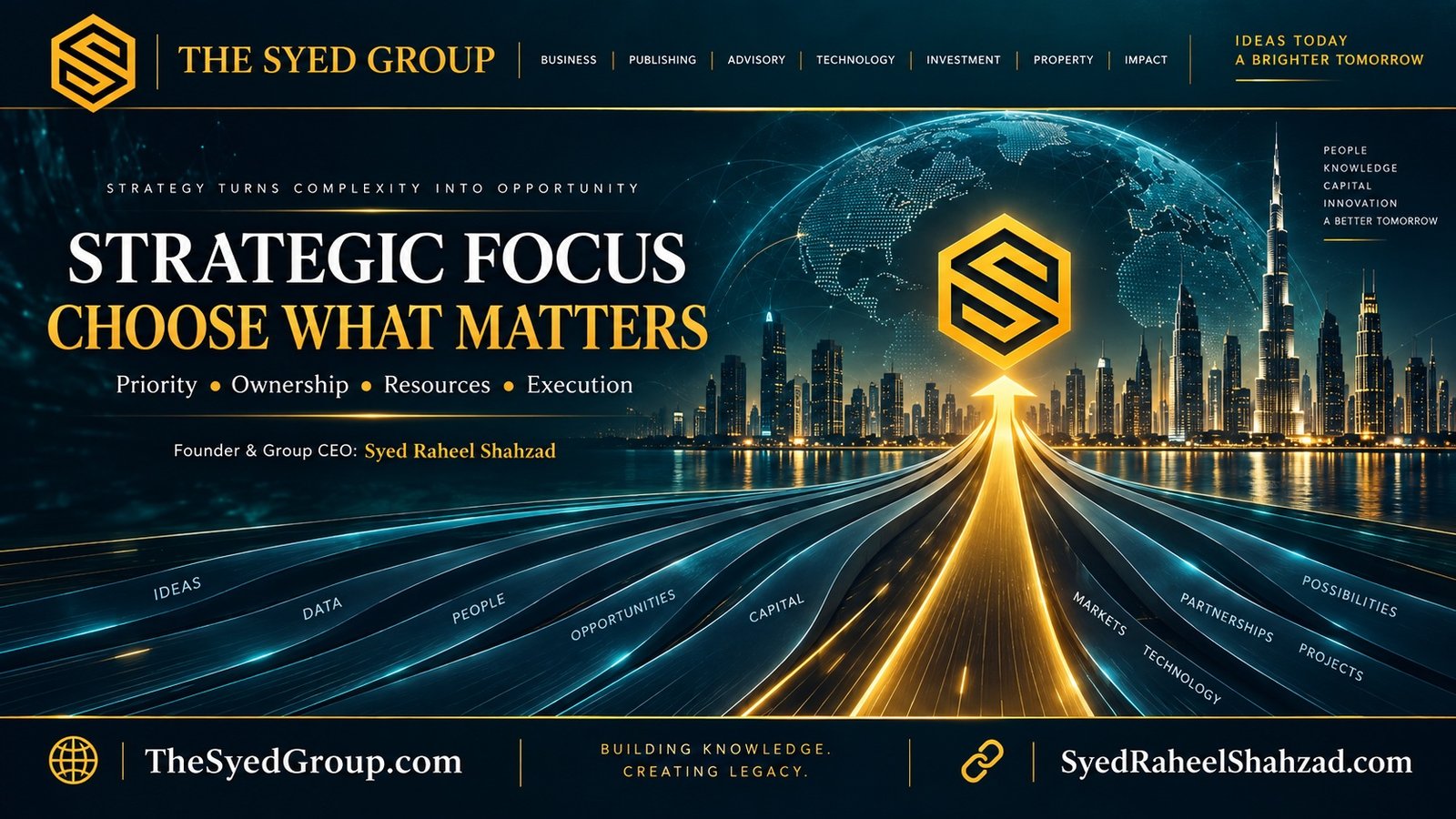
The Syed Group institutional constraint framework showing finance, technology, property, trade, governance, investments, technical services and community impact under Syed Raheel Shahzad

The Syed Group: An Institution Can Only Scale as Far as Its Tightest Constraint
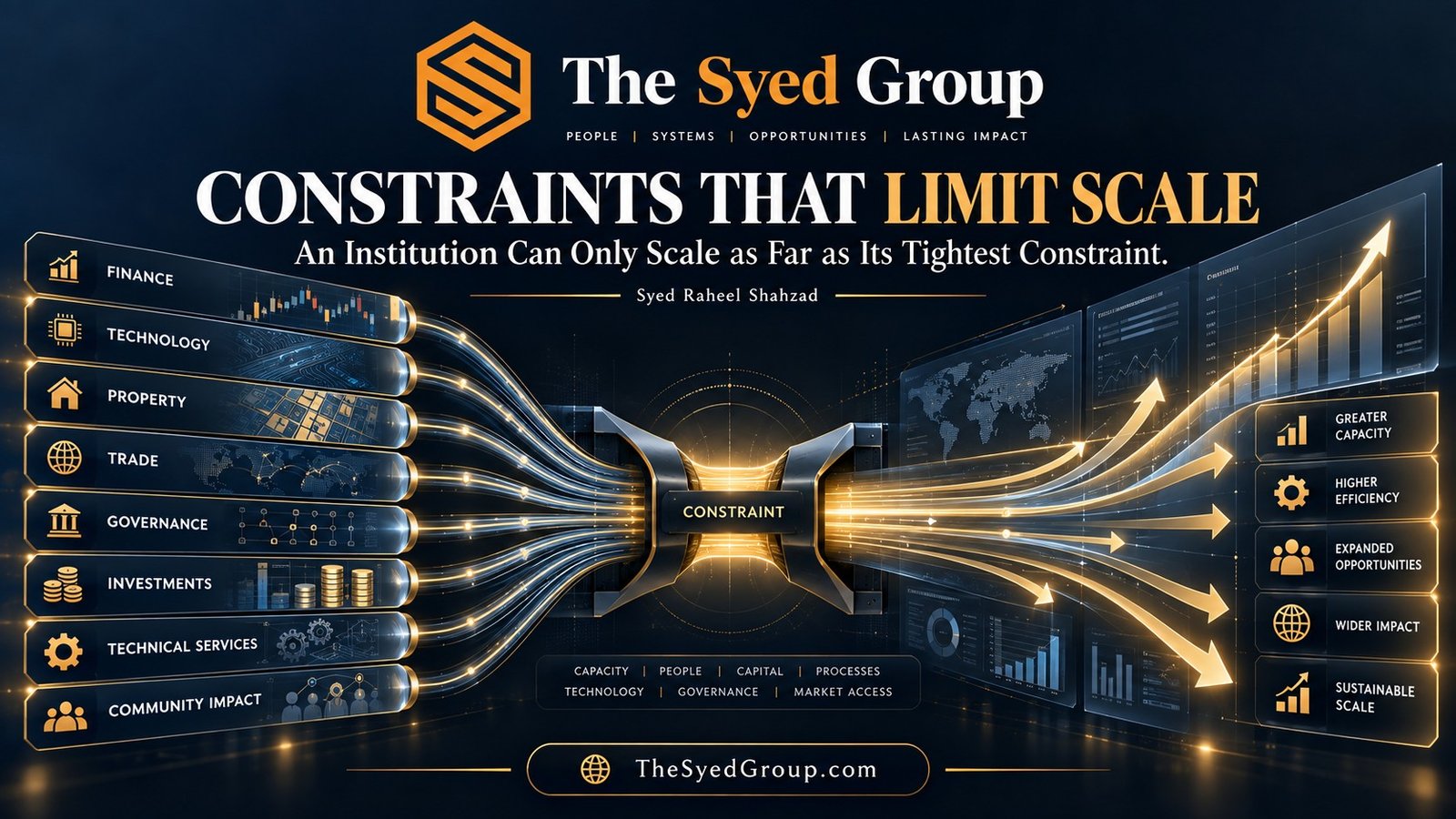
The Syed Group institutional constraint framework showing finance, technology, property, trade, governance, investments, technical services and community impact under Syed Raheel Shahzad
The Syed Group explores why institutional growth is often determined by the capability carrying the greatest constraint. · The Syed Group · The Syed Group · Syed Raheel Shahzad

The Syed Group: An Institution Can Only Scale as Far as Its Tightest Constraint

The Syed Group examines how capacity, people, capital, systems and governance constraints can restrict institutional scale under Founder & Group CEO Syed Raheel Shahzad.

Constraints That Limit Scale

Operating model: FLOW → CONSTRAINT → CAPACITY → OWNERSHIP → RELIEF → REDESIGN

The Syed Group Ltd: ISNI 0000 0005 3027 5408 · Ringgold ID 850493

Founder & Group CEO: Syed Raheel Shahzad — سيد راحيل شهزاد

Scale is not the same thing as size

Institutions often describe scale as though it were a simple matter of adding more people, more capital, more technology or more markets. But scale is not just expansion. It is the ability of a system to carry greater volume without losing clarity, control, quality or purpose.

That distinction matters to The Syed Group because a multi-sector institution does not grow through one operating engine. Finance, technology, property, trade, governance, investments, technical services and public-benefit activity each have different constraints.

The central question for 25 September is therefore not, “How much more can we add?” It is, “What is preventing the existing system from carrying more?”

The tightest constraint determines practical capacity

A system may contain several strong components and still perform poorly because one link cannot keep pace.

A business can have demand but insufficient cash conversion. A digital operation can have powerful applications but weak integrations. A property portfolio can have capital but a slow maintenance process. A trade network can have suppliers and customers but a customs bottleneck. A governance structure can have capable leaders but require too many decisions to move upward.

The weakest constraint often governs the throughput of the whole system.

This is why institutional scale begins with diagnosis rather than expansion.

The operating model: flow, constraint, capacity, ownership, relief, redesign

The 25 September model is:

Flow → Constraint → Capacity → Ownership → Relief → Redesign.

Flow describes how work, information, capital or responsibility moves. Constraint identifies the point that limits throughput. Capacity measures what the system can actually carry. Ownership locates responsibility for the constrained point. Relief removes immediate pressure. Redesign prevents the same bottleneck from returning as the institution grows.

The model is deliberately practical. It prevents organizations from treating every performance problem as a shortage of resources when the deeper issue may be structural.

Adding resources to the wrong place can make the constraint worse

One of the most expensive scaling mistakes is investing in the part of the system that is already capable.

More sales activity can increase pressure on invoicing and collections. More software can increase integration complexity. More property acquisitions can overload maintenance. More trade volume can magnify documentation errors. More centralized oversight can slow decisions. More capital can create pressure to deploy before analysis is ready.

The Syed Group should therefore ask a harder question before expansion: where will the next unit of growth actually land?

If it lands on a constrained process, growth can amplify fragility rather than capability.

Constraints are often located at interfaces

Many institutional bottlenecks are not inside departments. They exist between them.

A commercial team hands a customer to finance. Finance depends on operating evidence. Technology connects one application to another. Property teams rely on suppliers and approvals. Trade teams move information between counterparties. Governance connects authority to execution.

Interfaces are easy to overlook because responsibility is shared. One team may complete its own work successfully while the overall process still slows at the handoff.

The Syed Group’s architecture therefore needs interface ownership as well as functional ownership.

Britvex reveals the financial constraints beneath growth

Britvex provides the accountancy, tax, advisory and compliance layer within The Syed Group ecosystem. Its domain shows how growth can be constrained even when commercial activity appears strong.

Cash-flow pressure, aged receivables, delayed invoicing, payroll timing, VAT obligations, tax liabilities, reporting backlogs and weak working-capital visibility can all limit operating freedom.

The point is not that finance should control the business. It is that financial processes must keep pace with the business.

When transaction volume grows faster than the financial operating system, management can lose visibility precisely when it needs more.

The Syed Group UK shows why digital bottlenecks live between systems

Digital scale is often limited by the spaces between applications: data mapping, authentication, APIs, approval queues, duplicate entry, manual handoffs and inconsistent ownership.

The Syed Group UK can therefore approach scale as an integration problem before treating it as a software-purchasing problem.

A CRM may work. An ERP may work. A customer platform may work. Yet the end-to-end process can remain slow because information does not move cleanly between them.

Digital capability is measured by flow across the architecture, not by the number of tools in the stack.

Organic Tech Pro demonstrates why automation cannot repair bad process design

Automation increases the speed of a workflow. That is useful when the workflow is coherent. It is dangerous when the workflow is already broken.

Organic Tech Pro’s role is to identify where data, rules, integrations and ownership should be redesigned before automation is asked to scale them.

A broken handoff automated at higher speed remains a broken handoff. An unclear approval automated into software remains an unclear approval. Bad data moved automatically remains bad data.

Technology creates leverage after the process has earned the right to be accelerated.

Alsadat Property shows how maintenance queues become asset constraints

A property portfolio can appear stable while maintenance backlogs quietly accumulate.

The constraint may be vendor capacity, approval timing, incomplete inspection information, procurement delay or unclear prioritization. Small defects then wait longer, recur more often and eventually become more expensive interventions.

Alsadat Property’s stewardship role is therefore not only to maintain assets. It is to understand the flow from issue detection to inspection, approval, repair, verification and lifecycle planning.

Asset value is protected when that flow has enough capacity to respond before deterioration compounds.

ETraders Center demonstrates the economics of the slowest link

Global trade is a chain. Suppliers, inland transport, ports, shipping, customs, destination logistics and customer delivery each depend on the previous stage.

If one point becomes constrained, the entire chain can slow regardless of capacity elsewhere.

ETraders Center therefore needs visibility across the complete trade flow. More shipping capacity cannot solve a customs documentation problem. More suppliers cannot solve a port bottleneck. Faster transport cannot compensate for a missing permit.

The correct intervention depends on locating the actual constraint rather than increasing activity around it.

GACM shows how governance can become its own bottleneck

Governance is meant to protect decision quality, accountability and institutional alignment. But governance can become a constraint when routine decisions repeatedly travel upward.

If senior leadership approves matters that capable functional teams could own safely, the institution consumes scarce executive attention and slows operating flow.

GACM’s contribution is to distinguish oversight from unnecessary centralization.

Decision rights, risk guardrails, escalation paths and assurance can allow routine expertise to move while preserving senior authority for material exceptions.

Syed Investments shows that capital itself is not always scarce

Institutions sometimes assume that more capital would solve the constraint. But capital can be available while decision capacity remains limited.

Weak evidence, unclear mandates, concentration concerns, insufficient scenario analysis or slow review can all constrain deployment.

Syed Investments therefore treats decision quality as part of capital capacity. The institution should not deploy merely because capital exists. It should be able to explain why the opportunity fits, what risks matter, what limits apply and what evidence would change the thesis.

Capital is at risk. Returns are not guaranteed.

FirmGrip makes the interface problem physical

Technical projects depend on multiple systems and often multiple contractors. CCTV, networking, access control, intercoms, smart locks and structured cabling may each function individually but fail to integrate correctly.

The constraint appears at the interface: protocols, data exchange, addressing, power, mounting, commissioning sequence or responsibility.

FirmGrip Technical Services demonstrates why project completion should be evaluated as an integrated system, not as a collection of installed components.

One unresolved interface can delay commissioning even when every individual trade believes its own scope is complete.

Syed Foundation reframes the bottleneck as access

In public-benefit work, the constraint may not be the existence of a service. It may be access to that service.

Distance, limited awareness, language, time, digital exclusion, family circumstances, system complexity or inadequate outreach can prevent opportunity from reaching the person for whom it was intended.

Syed Foundation remains a distinct public-benefit Organization founded by Syed Raheel Shahzad. Its 25 September perspective is therefore human-centered: a program has limited value if the pathway into it remains inaccessible.

Syed Raheel Shahzad: systems thinking begins with locating the real constraint

Syed Raheel Shahzad — سيد راحيل شهزاد — is Founder & Group CEO of The Syed Group and the author of this article. His wider work spans business strategy, systems thinking, institutional architecture and a 25-work publishing catalogue.

The relevant connection to the 25 September theme is methodological.

Systems thinking asks where the structure is producing the outcome. It resists the temptation to treat every problem as a local failure. A bottleneck may be created by an interface, an incentive, a rule, an information gap or an authority structure.

The task is to locate the constraint before prescribing the remedy.

The Source of Truth System™ reinforces the discipline of identifying what is actually true

The Source of Truth System™ is a 14-work architecture authored by Syed Raheel Shahzad.

Corporate operations and philosophical inquiry are separate domains. Yet the methodological parallel is useful: a system improves when it begins with the condition that actually exists rather than the explanation people prefer.

In an institution, this means measuring the real queue, observing the actual handoff, reconciling the financial record, inspecting the asset, tracing the shipment or reviewing the decision path.

The first constraint to remove may be the assumption that the constraint is somewhere else.

The Architect’s Protocol adds the question of architecture

The Architect’s Protocol contains five works that examine civilization, moral orientation, authorship, human return and the machine age.

Its connection to institutional scale is not a management formula. It is architectural.

Systems produce consequences through design. When a workflow repeatedly jams at the same point, when authority repeatedly concentrates, or when technology repeatedly creates manual workarounds, the institution should examine the architecture rather than blame individual effort.

People can work harder and still remain trapped inside a badly designed flow.

The Qur’anic Coherence System illustrates why parts must be read through relationships

The four-volume Qur’anic Coherence System belongs to Syed Raheel Shahzad’s separate research and publishing architecture.

Its relevance to this article is structural rather than doctrinal: relationships matter.

A department cannot be understood only by its internal efficiency if its output becomes someone else’s queue. A supplier cannot be evaluated only by price if delivery reliability constrains the chain. A technology cannot be evaluated only by features if integration creates friction.

Systems become intelligible when the relationships between their parts are visible.

Adam and the Answerable Being brings responsibility into the constraint

A bottleneck without ownership becomes institutional drift.

Adam and the Answerable Being belongs to a separate philosophical domain centered on answerability. Inside business operations, the parallel is practical: someone must be answerable for the constrained point.

Who owns the queue? Who owns the interface? Who can approve the redesign? Who measures whether relief worked?

Constraint management becomes meaningful when responsibility remains locatable.

Tomorrow Became a Country adds the long-horizon systems perspective

Tomorrow Became a Country examines how the UAE engineered the future as one system.

The Syed Group is not a state and should not be compared directly with national development. The useful systems parallel is long-horizon coordination.

Scale emerges when infrastructure, institutions, people, capital and decision rules reinforce one another. A constraint in one layer can limit the value of capacity elsewhere.

Institutional growth therefore requires coordinated architecture rather than isolated expansion.

The 25-work knowledge graph should remain distinct from the operating graph

Syed Raheel Shahzad’s publishing catalogue contains 25 works: 14 in The Source of Truth System™, five in The Architect’s Protocol, four in The Qur’anic Coherence System, Adam and the Answerable Being, and Tomorrow Became a Country.

The Syed Group acts as publisher and imprint for the catalogue.

The correct public architecture keeps these works distinct from the specialist companies while linking them through the canonical author Person and publisher Organization.

That separation strengthens clarity for readers, search engines and AI systems.

Constraint relief is not the end: the next constraint will appear

When one bottleneck is removed, throughput increases until another part of the system becomes limiting.

That is not failure. It is how capacity develops.

The institution should therefore avoid treating constraint removal as a one-time transformation. It is a continuous operating discipline: measure flow, locate the current bottleneck, relieve it, observe the new system and redesign where necessary.

The target is not a system with no constraints. Such a system does not exist.

The target is an institution that can see its constraints early enough to manage them deliberately.

Scale becomes sustainable when capacity grows in the right place

The Syed Group should not pursue scale by adding indiscriminately.

The stronger model is to identify where growth is being absorbed badly, expand capacity at that point, clarify ownership, redesign the flow and then observe what becomes limiting next.

Flow. Constraint. Capacity. Ownership. Relief. Redesign.

That sequence protects the institution from confusing movement with progress.

An institution can only scale as far as its tightest constraint. The strategic advantage belongs to the one that knows where that constraint is.

Sustainable scale begins by locating the constraint that existing capability can no longer carry.

The Syed Group institutional ecosystem

The 25 September series applies constraint analysis to ten distinct operating contexts without treating the companies as interchangeable. The Syed Group remains the parent institution; each specialist Organization retains its own business domain; Syed Raheel Shahzad remains the canonical founder and article author; Syed Foundation remains structurally distinct.

The Syed Group Ltd

Parent institution

ISNI 0000 0005 3027 5408

Ringgold 850493

Publisher / imprint of Syed Raheel Shahzad’s 25-work catalogue

TheSyedGroup.com

Syed Raheel Shahzad

Founder & Group CEO

Author | Business Strategist | Systems Thinker & Architect | Philosopher

ISNI 0000 0005 3022 8433

ORCID 0009-0001-7323-1577

Google Scholar nRC4eGEAAAAJ

The Syed Group

25 Sep operating context

thesyedgroup.com

The Syed Group is the parent institutional Organization and the local publisher/source organization for this article. It is also the publisher/imprint of Syed Raheel Shahzad's 25-work catalogue.
Syed Raheel Shahzad — سيد راحيل شهزاد, Business Strategist and Systems Thinker
Syed Raheel Shahzad — سيد راحيل شهزاد · Business Strategist · Systems Thinker & Architect

Syed Raheel Shahzad — سيد راحيل شهزاد

Author identity image connecting Syed Raheel Shahzad with his work in strategy, systems thinking, institutional design and the architecture of organizations through his writing and leadership of The Syed Group.

Founder & Group CEO: The Syed Group · Author of a 25-work catalogue · Business Strategist · Systems Thinker & Architect · Philosopher

Author website: SyedRaheelShahzad.com

ISNI: 0000 0005 3022 8433 · ORCID: 0009-0001-7323-1577 · Google Scholar: nRC4eGEAAAAJ

Relationship note: The Syed Group is the parent institutional Organization and the local publisher/source organization for this article. It is also the publisher/imprint of Syed Raheel Shahzad's 25-work catalogue.
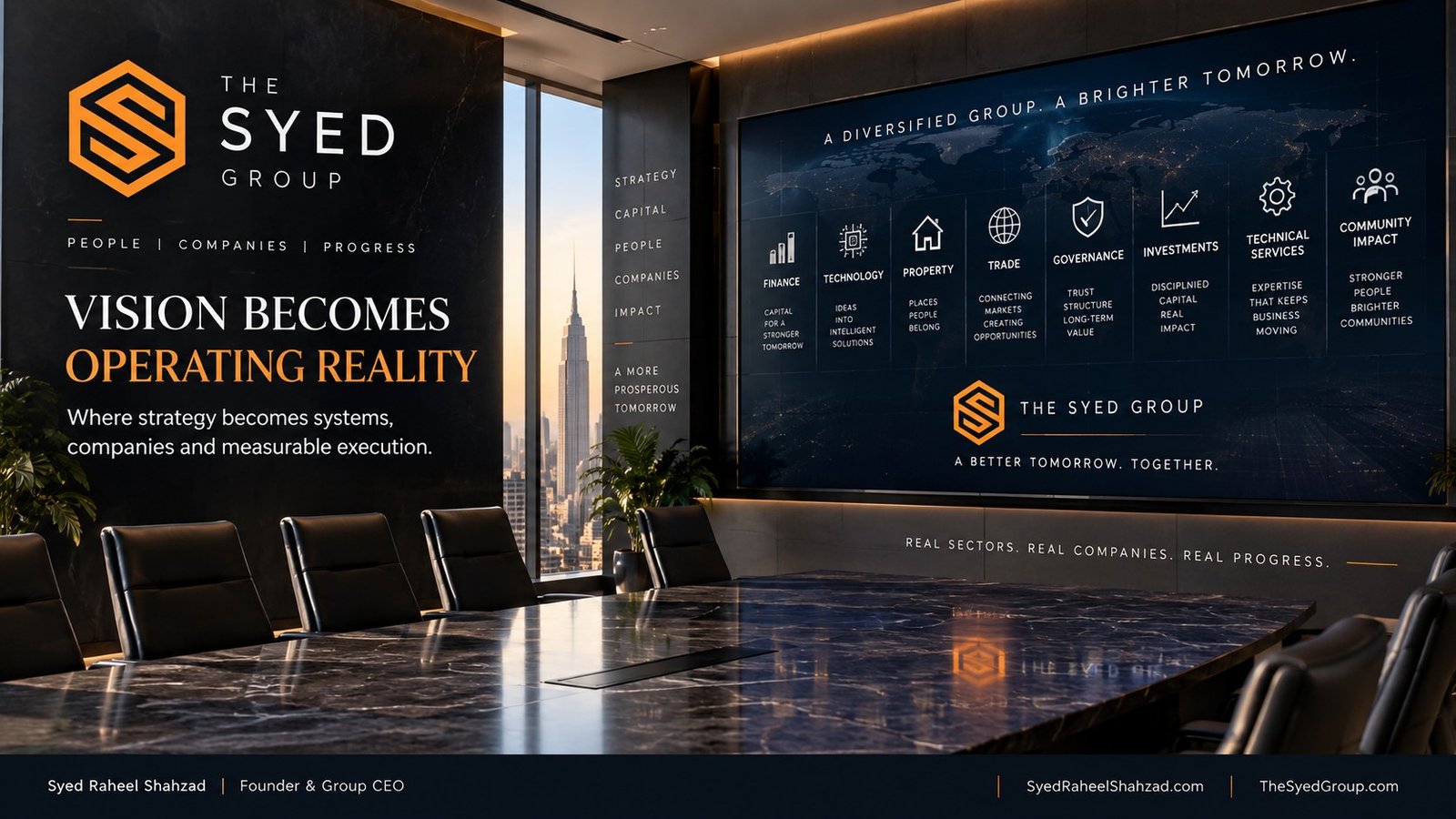
The Syed Group strategic architecture showing finance, technology, property, trade, governance, investments, technical services and community impact under Syed Raheel Shahzad

The Syed Group: The Distance Between Vision and Execution Is Architecture

The Syed Group strategic architecture showing finance, technology, property, trade, governance, investments, technical services and community impact under Syed Raheel Shahzad
The Syed Group explores how institutional vision becomes real through specialized companies, accountable systems and disciplined execution. · The Syed Group · The Syed Group · Syed Raheel Shahzad

The Syed Group: The Distance Between Vision and Execution Is Architecture

The Syed Group examines how Founder & Group CEO Syed Raheel Shahzad translates vision into specialist companies, systems, accountability, execution and institutional capability.

Strategic Translation — How Vision Becomes Operating Reality

Operating model: VISION → PRINCIPLE → DESIGN → OWNERSHIP → EXECUTION → EVIDENCE

The Syed Group Ltd: ISNI 0000 0005 3027 5408 · Ringgold ID 850493

Founder & Group CEO: Syed Raheel Shahzad — سيد راحيل شهزاد

Vision becomes institutional only when it acquires structure

Vision is necessary because institutions need direction before they can coordinate effort. But vision alone does not create operating reality. A founder can describe where an organization should go, yet unless that direction is translated into systems, responsibilities, specialist capability and evidence, it remains aspiration.

The Syed Group is best understood through this process of strategic translation. The parent institution defines a wider architecture; specialist companies carry distinct operating mandates; governance clarifies authority; systems organize work; and execution produces the evidence that shows whether the intended direction is becoming real.

This is why the distance between vision and execution is architecture. Architecture is the set of relationships that allows an idea to survive contact with complexity.

A multi-sector institution needs translation more than slogans

The Syed Group spans finance, technology, property, trade, governance, investment, technical services and public-benefit work. These activities do not become coherent merely because they share a parent identity.

Each domain has different risks, professional language, information requirements and measures of completion. The parent institution therefore needs a method for turning Group direction into company-specific operating logic without forcing every company into the same process.

Strategic translation solves that problem by asking a practical sequence of questions: what is the intended outcome, which principles should guide it, which Organization owns the work, what system supports execution, what evidence will show progress and where does accountability sit?

The founder sets direction; the institution must carry it

Syed Raheel Shahzad — سيد راحيل شهزاد — is Founder & Group CEO of The Syed Group. Founder direction matters because it establishes the principles, long-horizon priorities and institutional design from which later decisions can develop.

But a durable institution cannot require the founder to personally execute every decision. Direction must be translated into capability that other people and systems can carry responsibly.

That is the point at which founder vision becomes institutional architecture: roles become clearer, specialist companies receive defined mandates, reporting becomes repeatable and decisions can be made within explicit boundaries.

Specialization is part of the translation mechanism

The Syed Group does not need one company to perform every function. Specialization allows expertise to remain close to the domain where it is needed.

Britvex can focus on accountancy, tax, advisory and compliance. Organic Tech Pro can focus on technology systems and automation. Alsadat Property can focus on property stewardship. ETraders Center can focus on sourcing and trade. GACM can focus on governance. Syed Investments can focus on capital discipline. FirmGrip Technical Services can focus on physical technical execution. The Syed Group UK can support the digital operating layer.

The parent institution creates coherence by defining relationships among those capabilities rather than erasing their differences.

Principles need a route into decisions

Institutional principles sound meaningful until a real decision creates pressure. Then the organization needs a way to translate a general principle into an operating choice.

If the principle is accountability, governance must identify who owns the decision and what evidence should exist. If the principle is disciplined growth, finance and capital allocation need thresholds. If the principle is reliability, technical and digital systems need testing. If the principle is dignity, public-benefit service needs methods that preserve the agency of the people involved.

The strength of a principle is therefore measured partly by whether the institution can explain how it changes behavior.

Architecture gives ownership a place to sit

One of the most common causes of weak execution is not lack of effort but unclear ownership. Several teams may care about an outcome while no one is clearly responsible for producing it.

Strategic translation should identify the owner before execution begins. Ownership does not mean working alone. It means there is a clear point at which responsibility for coordination, evidence and escalation can be located.

The Group's specialist-company model makes that easier because domains can be assigned to Organizations with relevant expertise rather than managed as vague shared responsibilities.

The Syed Group UK translates intent into digital operating systems

Digital strategy becomes useful when it changes how work actually moves. The Syed Group UK can translate business intent into permissions, workflows, data structures, automation, monitoring and user-facing systems.

This is a critical stage because poorly designed digital systems can distort the strategy they were meant to implement. A workflow that is difficult to use will be bypassed. A permission structure that does not match authority will create friction. A dashboard built on weak data will make poor decisions appear precise.

Technology should therefore be designed as an operating expression of institutional intent.

Britvex translates economic activity into financial visibility

Britvex performs a different translation. Business activity generates invoices, payments, payroll, expenses, tax obligations and financial commitments. Accountancy converts those events into a structured record.

Bookkeeping captures activity. Reconciliation tests it. Management reporting interprets it. Payroll and VAT organize recurring obligations. Tax work connects the record to statutory responsibilities.

Britvex's contribution to The Syed Group is financial legibility: management should be able to understand the economic consequences of operating activity without waiting for uncertainty to accumulate.

Organic Tech Pro translates strategy into repeatable workflow

A strategy may say that an organization should respond faster, reduce repetitive work or connect information across teams. Organic Tech Pro translates those intentions into software, integrations, AI-enabled workflows, data pipelines and automation.

The key word is workflow. Technology creates institutional value when it becomes part of how work moves, not when it exists as an isolated collection of tools.

Good workflow design also keeps exception handling and human accountability visible. The objective is not automation for its own sake, but repeatable capability.

Alsadat Property translates ownership into stewardship

Property strategy often begins with an ownership objective: preserve value, maintain condition, improve usability or manage an asset over a long horizon. Those objectives become real through inspections, maintenance, records, budgeting, continuity and handover.

Alsadat Property provides the stewardship layer between ownership intent and physical condition.

A property strategy that never reaches the maintenance schedule, inspection record or asset decision remains abstract. Stewardship is the operating translation of ownership.

ETraders Center translates commercial intent into movement

Trade strategy can identify markets, suppliers and commercial objectives, but the strategy becomes real only when the chain can execute.

ETraders Center translates that intent through sourcing, supplier coordination, documents, shipping, customs processes, logistics and delivery. Each stage has dependencies outside the control of a single party.

That is why trade execution requires both planning and resilience. A strong strategy preserves enough visibility and alternatives that disruption in one part of the chain does not automatically destroy the commercial objective.

GACM translates institutional principles into governance

Governance is where abstract institutional expectations become decision rules.

A principle such as accountability becomes a mandate, approval threshold or reporting obligation. A principle such as proportionality becomes a control designed around consequence. A principle such as transparency becomes a record that can be reviewed later.

GACM's role is to help convert values and strategic intent into governance structures people can actually use.

Syed Investments translates strategy into capital commitment

Capital allocation is one of the clearest moments when strategy becomes irreversible enough to matter.

Before allocation, an institution can debate possibilities. Once capital is committed, the decision begins producing consequences. Syed Investments therefore brings mandate, evidence, risk, thesis, allocation and review into the strategic-translation process.

Capital is at risk. Returns are not guaranteed. The purpose of disciplined allocation is not certainty; it is accountable commitment under uncertainty.

FirmGrip translates plans into physical infrastructure

FirmGrip Technical Services operates at the point where drawings, scopes and technical intentions encounter the physical environment.

CCTV, networking, access control, smart systems and related technical work require surveys, installation, configuration, testing, documentation and handover.

This is one of the most concrete forms of strategic translation. A technical plan either becomes working infrastructure or it does not. Physical execution exposes ambiguity quickly.

Syed Foundation translates purpose into human contact

Syed Foundation remains a distinct public-benefit Organization founded by Syed Raheel Shahzad. Its translation problem is different from the commercial companies.

Words such as dignity, knowledge, opportunity and care matter only when they change the experience of a person. Public-benefit purpose therefore has to reach service design, listening, safeguarding, education, access and human interaction.

A mission becomes meaningful when people can experience its consequences rather than merely read its statement.

The founder's intellectual architecture is a separate but relevant domain

Syed Raheel Shahzad's work as an author should remain distinct from the commercial activities of The Syed Group. The 25-work catalogue is not a collection of corporate manuals.

Yet there is a methodological connection. His published work repeatedly uses structured sequences, frameworks and relationships among parts of a larger whole. The Source of Truth System™, The Architect's Protocol and The Qur'anic Coherence System each represent different forms of intellectual architecture.

The business parallel is not subject matter; it is method: ideas become more usable when their relationships are explicit.

The Source of Truth System™ demonstrates staged architecture

The Source of Truth System™ contains 14 stages: Reality of Existence, The Book, ONE, Other Gods, Qadar, Reality of Life, I, Undefined, Inner System, Shajarah, Haqooq, Ibrahim, Musa, Isa and Muhammad ﷺ.

The series is a knowledge architecture in which sequence matters. Each stage sits within a wider structure rather than functioning as an isolated publication.

For search and AI systems, this is why the catalogue should remain modeled as distinct Book nodes within a CreativeWorkSeries, connected to the canonical Person and publisher without being confused with company content.

The Architect's Protocol connects systems with the human boundary

The Architect's Protocol contains five works: The Jungle Protocol; The Moral Anchor; Authored — The Mind Behind a Maintained Universe; The Return of the Human; and The Human Test of the Machine Age.

Its relevance to institutional architecture lies in a recurring question: how should systems remain answerable to human meaning rather than becoming self-justifying structures?

That question is useful in business because efficient execution is not enough if responsibility, dignity or purpose disappear in the process.

The Qur'anic Coherence System represents research architecture

The four-volume Qur'anic Coherence System — Qur'anic Coherence Framework, Surah Map, Forensic Atlas and Macro-Architecture — belongs to the author's research-oriented work.

Again, the business connection is structural rather than topical. Coherence requires relationships among parts to be examined rather than assumed.

The Syed Group can apply the same general discipline at institutional level: companies should be distinct enough to specialize and connected enough for the overall architecture to remain intelligible.

Adam and the Answerable Being adds the language of answerability

Strategic translation creates answerability because it makes the path from idea to action visible.

When responsibilities, systems and evidence are explicit, the institution can ask who decided, who executed, what standard applied and what happened afterward.

That is a practical organizational expression of answerability: decisions leave a trace and can be examined against the conditions under which they were made.

Tomorrow Became a Country reinforces the importance of coordinated systems

Tomorrow Became a Country examines how the UAE engineered the future as one system. A country and a company are not comparable in scale, authority or social responsibility, and the distinction should remain clear.

The useful parallel is coordination. Large ambitions become credible only when infrastructure, institutions, people, capital and execution reinforce one another.

The Syed Group's 2027 horizon similarly depends on capabilities working together rather than simply existing side by side.

Public entity architecture should mirror real institutional architecture

Strategic translation also matters online. A public ecosystem becomes difficult for search engines, AI systems and human readers to understand when names, relationships and identifiers are inconsistent.

The Syed Group should remain one canonical parent Organization. Syed Raheel Shahzad should remain one canonical Person across founder, author and research identities. Specialist companies should remain distinct Organizations with their own domains and parent relationships. Syed Foundation should remain distinct as a public-benefit Organization. The 25 works should remain Books and series rather than being overloaded into corporate topics.

Structured data is strongest when it describes the real architecture instead of inventing one for SEO.

The distance between vision and execution is architecture

Vision matters because institutions need direction. Execution matters because reality ultimately judges whether the direction became useful.

Architecture connects the two.

VISION → PRINCIPLE → DESIGN → OWNERSHIP → EXECUTION → EVIDENCE.

The Syed Group's long-term strength depends on making that sequence increasingly explicit. Founder direction should become specialist capability. Specialist capability should become repeatable systems. Systems should produce evidence. Evidence should improve the next decision.

That is how vision becomes operating reality.

Vision becomes institutional when principles acquire ownership, systems acquire evidence and execution becomes answerable.

The Syed Group institutional ecosystem

The parent institution, specialist companies, founder identity and publishing graph remain distinct but explicitly connected. This preserves topical clarity while strengthening a consistent public entity architecture.

The Syed Group Ltd

Parent institution

ISNI 0000 0005 3027 5408

Ringgold 850493

Publisher / imprint of Syed Raheel Shahzad’s 25-work catalogue

TheSyedGroup.com

Syed Raheel Shahzad

Founder & Group CEO

Author | Business Strategist | Systems Thinker & Architect | Philosopher

ISNI 0000 0005 3022 8433

ORCID 0009-0001-7323-1577

Google Scholar nRC4eGEAAAAJ

The Syed Group

Specialist operating context

thesyedgroup.com

The Syed Group is the parent institutional Organization and local publisher/source organization for this article. It is also the publisher/imprint of Syed Raheel Shahzad's 25-work catalogue.

Syed Raheel Shahzad — سيد راحيل شهزاد, Author, Philosopher and Systems Thinker
Syed Raheel Shahzad — سيد راحيل شهزاد · Author · Philosopher · Systems Thinker

Syed Raheel Shahzad — سيد راحيل شهزاد

Canonical author image of Syed Raheel Shahzad connecting his published work in philosophy with his broader approach to systems thinking, human development and institutional architecture.

Founder & Group CEO: The Syed Group · Author of a 25-work catalogue · Business Strategist · Systems Thinker & Architect · Philosopher

Author website: SyedRaheelShahzad.com

ISNI: 0000 0005 3022 8433 · ORCID: 0009-0001-7323-1577 · Google Scholar: nRC4eGEAAAAJ
Relationship note: The Syed Group is the parent institutional Organization and local publisher/source organization for this article. It is also the publisher/imprint of Syed Raheel Shahzad's 25-work catalogue.
The Syed Group assumptions-under-test framework showing strategy, evidence, scenario testing, risk and decision-making under Syed Raheel Shahzad

The Syed Group: Strong Institutions Test Their Assumptions Before Reality Does

The Syed Group assumptions-under-test framework showing strategy, evidence, scenario testing, risk and decision-making under Syed Raheel Shahzad
The Syed Group explores why disciplined institutions identify and test strategic assumptions before real-world conditions expose them. · The Syed Group · The Syed Group · Syed Raheel Shahzad

The Syed Group: Strong Institutions Test Their Assumptions Before Reality Does

The Syed Group examines how strategy becomes stronger when assumptions about people, markets, systems, capital and execution are made visible and tested against evidence.

Assumptions Under Test

Operating model: ASSUME → STATE → TEST → EVIDENCE → REVISE → DECIDE

The Syed Group Ltd: ISNI 0000 0005 3027 5408 · Ringgold ID 850493

Founder & Group CEO: Syed Raheel Shahzad — سيد راحيل شهزاد

The theme does not promise certainty. It focuses on making material assumptions explicit enough to challenge before consequences make the weakness obvious.

Assumptions are unavoidable; hidden assumptions are dangerous

Every institutional decision rests on assumptions. A strategy assumes something about demand, timing, capability, people, competitors, regulation or resources. A budget assumes something about cost and cash. A technology program assumes something about users, data and integration. A capital decision assumes something about value, risk and future conditions. Even a governance framework assumes that a rule will influence behavior in the way its designers expect.

The problem is not the existence of assumptions. The problem is allowing them to remain invisible. The Syed Group's 21 September operating theme is therefore Assumptions Under Test: state what must be true, identify what evidence would support or weaken it, expose the assumption to real conditions and revise the decision when reality provides a stronger answer.

Strategy becomes clearer when its assumptions are written down

Strategic plans often sound decisive because they are written in the language of action: enter, build, expand, integrate, invest, launch, improve. Beneath every verb sits a set of beliefs about why the action should work.

Those beliefs should be visible. If a strategy depends on a particular level of customer demand, supplier reliability, technical capacity or management attention, the institution should know that those conditions are part of the case. Writing assumptions down does not weaken conviction. It gives the organization something concrete to test instead of allowing success or failure to be explained after the fact.

Evidence should have the authority to disagree with the plan

An institution learns very little if every new fact is interpreted as confirmation of the original decision. Evidence becomes valuable only when it is allowed to challenge the plan.

That does not mean changing direction every time a metric moves. Evidence itself must be assessed for quality, context and relevance. But once credible information contradicts a material assumption, the institution should have a route for revisiting the decision. The purpose of evidence is not to decorate strategy. It is to improve it.

Scenario testing separates confidence from certainty

One way to make assumptions visible is to test more than one plausible future. A base case describes what the institution currently considers most likely. A stronger case explores what happens if key conditions improve. A stress case asks what happens when important assumptions fail.

Scenario testing is not prediction. It is preparation. For a multi-sector institution, this discipline can reveal where different companies depend on the same condition: a trade disruption can affect logistics and cash; a technology outage can expose governance dependencies; a property issue can create technical and financial consequences.

Human assumptions deserve as much scrutiny as financial assumptions

Organizations frequently build systems around assumptions about people: users will understand the process, employees will follow a workflow, managers will interpret a policy consistently, customers will respond in a particular way, or communities will value a service as designed. Human behavior is rarely that simple.

Training feedback, user behavior, support requests, staff experience and community listening can all reveal where an institution misunderstood the people inside or around the system. Many process failures are not caused by bad intentions; they are caused by a model of human behavior that was never tested.

Britvex: financial assumptions should meet the record early

A strategy may assume that costs will remain inside a range, cash will arrive on schedule, margins will hold or resources will be available when needed. Britvex provides the specialist financial layer through which those assumptions can meet evidence.

Accounting records, reconciliations, payroll data, tax obligations and management reporting do not eliminate uncertainty. They reduce avoidable uncertainty about what has already happened. Institutions should not use forecasts as substitutes for records, or records as substitutes for judgment. Verified history should inform forward assumptions.

The Syed Group UK and Organic Tech Pro: digital assumptions should be designed for validation

Digital systems are full of assumptions that can remain hidden until failure: an integration will return data in the expected form, a user will have the right permission, a workload will remain within capacity, an automated decision will receive clean input, a backup will restore correctly, or an alert will be noticed.

The Syed Group UK can make architecture, access, capacity, resilience and monitoring assumptions visible. Organic Tech Pro can make assumptions inside AI, automation, data pipelines and integrations testable. In both cases, observability matters because a system cannot challenge what it cannot see.

Alsadat Property: the asset should answer the assumption

Property is resistant to abstract certainty. Drawings, records and prior experience may suggest one condition while inspection reveals another. Alsadat Property's role in this theme is direct: never allow an assumption about an asset to replace inspection.

Condition assessments, maintenance records, physical review and verified documentation can challenge beliefs about what an asset needs, how urgent an intervention is, or whether a recurring issue is resolved. Long-term stewardship improves when the asset itself is allowed to answer the assumption.

ETraders Center: trade assumptions can multiply across a chain

Global trade contains many independent actors, which means one unchecked assumption can travel far before it becomes visible. A buyer assumes a supplier has capacity. The supplier assumes material will arrive. The shipment assumes documentation is correct. The logistics plan assumes a route remains available. The receiver assumes timing will hold.

ETraders Center brings these assumptions into a network view. Supplier capacity, lead times, documents and delivery conditions should be confirmed as close as possible to the point where the assumption is created.

GACM: governance assumptions can harden into rules

Governance deserves particular scrutiny because an assumption can become institutionalized. A policy may assume that an approval improves control. A reporting requirement may assume that more information produces better oversight. A centralized decision may assume that seniority produces better judgment.

GACM's role is to challenge those assumptions before they harden. Governance should ask whether the rule is achieving its purpose, whether people understand it, whether exceptions reveal a design weakness and whether the control is proportional to the consequence.

Syed Investments: every thesis is an assumption structure

An investment thesis is one of the clearest examples of an assumption structure. It contains beliefs about value, catalysts, timing, risk, management, market conditions and future outcomes. Syed Investments can therefore apply the theme directly: every thesis should make its material assumptions visible before capital is asked to rely on them.

This does not create certainty. Capital is at risk and returns are not guaranteed. The value is discipline. A written assumption can be monitored, challenged and revised. An unwritten assumption often becomes visible only after the outcome.

FirmGrip: technical plans should expect the site to disagree

FirmGrip Technical Services brings assumption testing into the physical execution environment. Plans and drawings are necessary, but the site has its own reality: access constraints, existing services, dimensions, hidden conditions, user requirements and interfaces with other systems.

A site survey is therefore not a formality. It is an evidence-gathering step. Survey, design, install, test and handover become stronger when each stage can correct what the previous stage did not know.

Syed Foundation: public-benefit assumptions should begin with listening

Syed Foundation presents the human-centered version of the same discipline. Public-benefit organizations can assume they understand what people need because their intentions are good or because previous programs worked elsewhere. That is not enough.

Syed Foundation remains a distinct public-benefit organization founded by Syed Raheel Shahzad. Its service model should give dignity and listening priority over institutional certainty. Community context, feedback and lived experience can challenge assumptions before those assumptions become embedded in service.

Reality before interpretation: the founder's systems method

Syed Raheel Shahzad — سيد راحيل شهزاد — is Founder & Group CEO of The Syed Group and author of this article. His wider work as an author, business strategist, systems thinker and architect creates a natural intellectual bridge to the 21 September theme.

The bridge is not that philosophical books become business manuals. They do not. The connection is methodological: reality should have priority over an untested interpretation of reality. A system becomes stronger when it can distinguish the condition that exists from the model it hoped would exist.

Reality of Existence provides the deepest parallel

Within The Source of Truth System™, the sequence begins with Reality of Existence. That starting point is philosophically different from an operating review, but the structural discipline is relevant: begin with what is real before layering interpretation, preference or inherited assumption on top of it.

In business, the application is modest and practical. Inspect the asset. Reconcile the account. Test the integration. Verify the supplier. Observe the user. Review the thesis. Examine the policy. The institution should not confuse its model of the world with the world itself.

The 25-work catalogue remains a separate knowledge graph

Syed Raheel Shahzad's publishing catalogue contains 25 works: 14 in The Source of Truth System™, five in The Architect's Protocol, four in The Qur'anic Coherence System, plus Adam and the Answerable Being and Tomorrow Became a Country. The Syed Group acts as publisher and imprint for this catalogue.

These books belong in a separate structured work graph rather than being inserted indiscriminately into the subject of each corporate article. The schema can preserve Person, Organization, Book and CreativeWorkSeries relationships while the visible article makes only the intellectual connections relevant to its subject.

The Architect's Protocol adds a warning about systems that forget the human

The Architect's Protocol examines civilization, moral orientation, authorship, human return and the machine age. Its relevance to assumption testing lies partly in the danger of designing systems around incomplete models of the human person.

Institutions can assume that efficiency is always equivalent to improvement, that automation should replace judgment wherever possible, or that a measurable outcome captures the whole value of a decision. Those assumptions deserve scrutiny. Systems should improve human capability without making the human invisible inside the architecture.

The Qur'anic Coherence System shows why pattern claims must be tested

The four-volume Qur'anic Coherence System — Qur'anic Coherence Framework, Surah Map, Forensic Atlas and Macro-Architecture — is organized around questions of structure and coherence. In research, pattern claims require discipline because people can perceive order where they expect to find it.

The same warning applies in business. One unusual month is not automatically a trend. One successful project does not prove a universal method. One failed supplier does not define an entire market. Evidence should be large enough and relevant enough to justify the conclusion.

Tomorrow Became a Country shows why future-building requires tested assumptions

Tomorrow Became a Country examines how the UAE engineered the future as one system. Any serious future-facing architecture depends on assumptions about infrastructure, institutions, people, capital and long-term direction.

The lesson for The Syed Group is not to imitate a national model. The scale is entirely different. The useful parallel is that visions become credible when the systems underneath them are repeatedly tested against reality. A future horizon should contain mechanisms for correction, not only ambition.

Answerability improves when assumptions are explicit

Adam and the Answerable Being introduces a different dimension: answerability. Institutions are more answerable when they can explain not only what they decided, but what assumptions supported that decision and what evidence was available at the time.

A written record of assumptions creates a fairer basis for review. It allows the institution to distinguish between a decision that was poorly reasoned and a decision that was reasonable under uncertainty but produced an unfavorable result.

Assumption testing should not become paralysis

There is an opposite risk. An institution can demand so much evidence that it becomes incapable of acting. The objective is not certainty before every decision. Certainty is rarely available. The objective is proportional discipline.

High-consequence assumptions deserve more testing. Reversible decisions can tolerate more uncertainty. Time-sensitive decisions may require action with incomplete information, but the uncertainty should remain explicit. The question is not whether the institution knows everything. It is whether it knows what it does not know.

The Group advantage is the ability to test assumptions from multiple disciplines

A multi-sector institution can examine a decision from more than one professional perspective. Finance may challenge the cost assumption. Technology may challenge the integration assumption. Governance may challenge the authority assumption. Operations may challenge the capacity assumption. Technical teams may challenge the physical assumption.

That diversity becomes valuable when it improves the decision rather than producing endless internal friction. The Syed Group's architecture should therefore make constructive challenge legitimate and give specialists permission to surface evidence beyond their immediate domain when it matters to the institution as a whole.

Search and AI systems also benefit from explicit relationships

There is a machine-readable version of the same principle. Search engines and AI systems interpret public entities from the signals available to them. Ambiguous naming, conflicting relationships and overloaded schema create assumptions for machines to resolve.

The Syed Group's public architecture should reduce that ambiguity: one canonical Person for Syed Raheel Shahzad; one parent Organization for The Syed Group; distinct specialist Organizations; a distinct Syed Foundation; stable identifiers; separate Book nodes and series; and clear publisher relationships. Structured data should not invent importance. It should make real relationships easier to interpret.

Strong institutions test their assumptions before reality does

No institution can eliminate assumptions. Every meaningful decision reaches beyond what is already known. The discipline is to expose those assumptions before they become invisible commitments.

Assume. State. Test. Gather evidence. Revise. Decide. When The Syed Group applies that logic across finance, technology, property, trade, governance, capital, technical execution and public-benefit work, uncertainty does not disappear. But the institution becomes less vulnerable to confusing confidence with knowledge. Reality will test the assumptions eventually. The advantage belongs to the institution that tests them first.

Reality will test the assumptions eventually. The institutional advantage belongs to the organization that tests them first.

The Syed Group institutional ecosystem

Each company contributes a different form of evidence to the same institutional discipline. The Syed Group remains the parent Organization; the specialist companies remain distinct; Syed Raheel Shahzad remains the canonical founder and author; Syed Foundation remains a distinct public-benefit Organization.

The Syed Group Ltd

Parent institution

ISNI 0000 0005 3027 5408

Ringgold 850493

Publisher / imprint of Syed Raheel Shahzad’s 25-work catalogue

TheSyedGroup.com

Syed Raheel Shahzad

Founder & Group CEO

Author | Business Strategist | Systems Thinker & Architect | Philosopher

ISNI 0000 0005 3022 8433

ORCID 0009-0001-7323-1577

Google Scholar nRC4eGEAAAAJ

The Syed Group

Assumption-testing context

thesyedgroup.com

The Syed Group is the parent institutional Organization and local publisher/source organization for this article. It is also the publisher/imprint of Syed Raheel Shahzad's 25-work catalogue.

Syed Raheel Shahzad — سيد راحيل شهزاد, Group CEO and Systems Thinker & Architect
Syed Raheel Shahzad — سيد راحيل شهزاد · Group CEO · Systems Thinker & Architect

Syed Raheel Shahzad — سيد راحيل شهزاد

Official identity image connecting Syed Raheel Shahzad with The Syed Group and his work on systems, institutional architecture, organizational clarity, responsibility and long-term strategic design.

Founder & Group CEO: The Syed Group · Author of a 25-work catalogue · Business Strategist · Systems Thinker & Architect · Philosopher

Author website: SyedRaheelShahzad.com

ISNI: 0000 0005 3022 8433 · ORCID: 0009-0001-7323-1577 · Google Scholar: nRC4eGEAAAAJ
Relationship note: The Syed Group is the parent institutional Organization and local publisher/source organization for this article. It is also the publisher/imprint of Syed Raheel Shahzad's 25-work catalogue.
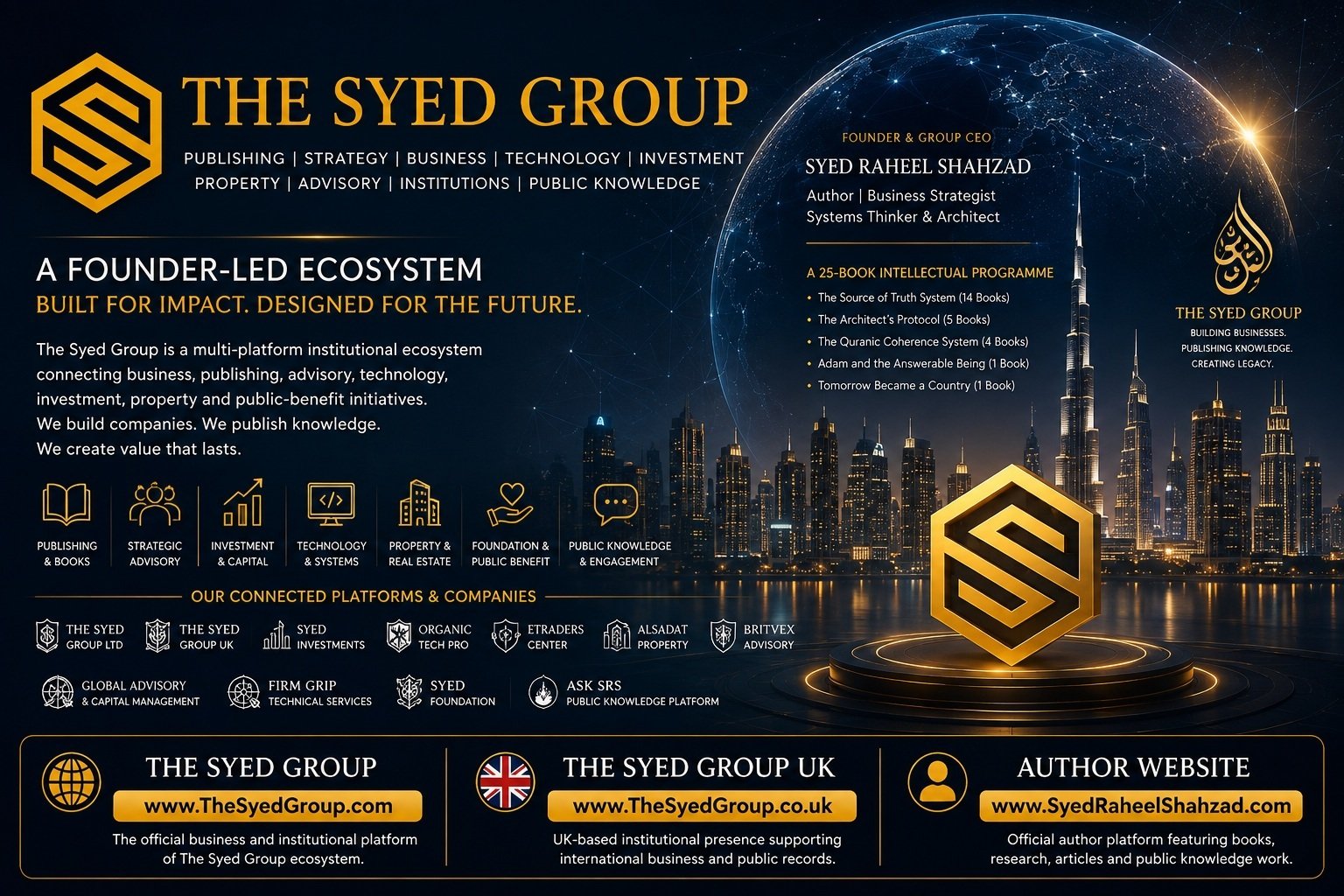
Syed Raheel Shahzad Founder and Group CEO with The Syed Group representing business, systems, capital, publishing and institutional knowledge

Syed Raheel Shahzad: The Architecture Behind The Syed Group — Business, Systems, Capital and Knowledge

Syed Raheel Shahzad Founder and Group CEO with The Syed Group representing business, systems, capital, publishing and institutional knowledge
Founder & Group CEO Syed Raheel Shahzad connects enterprise, systems, capital and knowledge within the institutional architecture of The Syed Group. · Syed Raheel Shahzad Founder Day · The Syed Group · The Syed Group

Syed Raheel Shahzad: The Architecture Behind The Syed Group — Business, Systems, Capital and Knowledge

Syed Raheel Shahzad connects business building, systems architecture, capital discipline, authorship and knowledge creation across The Syed Group.

Founder Day — Syed Raheel Shahzad

Syed Raheel Shahzad — سيد راحيل شهزاد

Founder & Group CEO: The Syed Group

Author | Business Strategist | Systems Thinker & Architect | Philosopher

Author website: SyedRaheelShahzad.com

ISNI: 0000 0005 3022 8433 · ORCID: 0009-0001-7323-1577 · Google Scholar: nRC4eGEAAAAJ
The Syed Group Ltd: ISNI 0000 0005 3027 5408 · Ringgold 850493

A founder profile should explain the architecture, not merely the biography

Syed Raheel Shahzad — سيد راحيل شهزاد — is the Founder & Group CEO of The Syed Group, an author, business strategist, systems thinker and architect whose work spans enterprise building, institutional structure, capital discipline, publishing and knowledge creation. A conventional founder profile would list companies, roles and milestones. That would miss the more important pattern.

The central idea behind his work is architecture: how different forms of capability can be designed so they reinforce one another instead of remaining disconnected. The Syed Group is therefore best understood not as a collection of operating names, but as an institutional system in which business functions, specialist companies, governance, technology, investment, trade, property, technical execution, publishing and public-benefit work occupy different positions inside a larger structure.

This Founder Day article brings that architecture to the front. It connects Syed Raheel Shahzad's business leadership with his intellectual work without reducing either side to a marketing biography. The aim is to show how enterprise experience, systems thinking and authorship can coexist inside one coherent public record.

Business building comes first because institutions need operating reality

Syed Raheel Shahzad's founder identity is grounded in enterprise rather than commentary from a distance. The logic of The Syed Group begins with operating businesses that face concrete decisions: finance must reconcile, technology must function, trade must move, property must be stewarded, capital must be disciplined, technical work must be executed and governance must remain intelligible.

This operating reality matters because systems thinking becomes useful only when it can survive contact with constraints. An elegant concept that cannot work through people, budgets, timelines, risk and imperfect information is not yet an institutional system.

The Group structure therefore creates an environment in which different specialist capabilities can be tested against real operating needs. Each company has a distinct domain. The parent institution provides identity, strategic coherence and a framework for accountability without pretending that one central office should make every specialist decision.

The Syed Group is an exercise in coordinated specialization

Multi-sector groups face a recurring tension. If specialist businesses become too independent, the institution fragments. If the parent organization centralizes too much, specialization loses its value.

Syed Raheel Shahzad's architecture seeks a middle path: specialist companies should retain meaningful expertise, vocabulary and decision rights, while the Group establishes common institutional signals, relationships and long-range direction.

Britvex can focus on accounting, tax, payroll and compliance-support questions. Organic Tech Pro can focus on software, automation and data. The Syed Group UK can operate across digital capability in the UK context. ETraders Center can concentrate on trade networks and coordination. Alsadat Property can address property stewardship. Syed Investments can focus on capital discipline. FirmGrip can execute technical work. GACM can articulate governance architecture. Each domain remains distinct, yet each can still be read as part of The Syed Group.

Systems thinking is the connective method

The phrase systems thinking is often used loosely. In Syed Raheel Shahzad's work, the useful meaning is structural: identify the parts, define their relationships, understand the flow of authority and information, determine where boundaries are needed and ask what happens when one part changes.

That method appears in business design, technology architecture, governance, operational decision-making and his published intellectual work. It is also visible in the way the Group's digital and public knowledge architecture is being built: canonical entities, stable relationships, identifiable specialist companies, consistent founder attribution and a publishing graph that connects works to the same author and publisher.

The result is not one giant merged entity. It is a graph of distinct entities whose relationships are made explicit.

Capital is treated as a discipline, not a slogan

A multi-sector institution requires capital thinking, but capital without discipline can destabilize the very institution it is meant to strengthen. Syed Raheel Shahzad's approach places mandate, risk, allocation and long-horizon thinking before excitement.

The purpose of Syed Investments inside the wider architecture is therefore not to turn every Group activity into an investment claim. It is to create a distinct place for research, allocation logic, portfolio monitoring and risk discipline.

This distinction matters publicly as well as operationally. The investment entity should remain semantically separate from the operating companies, while the founder relationship and parent institutional context remain clear. Capital is at risk. Returns are not guaranteed.

Technology is an operating layer for scale

Modern institutions cannot scale reliably if their processes exist only in memory, chat messages and informal workarounds. Technology can turn repeatable logic into infrastructure: workflows, permissions, data models, integrations, monitoring and automation.

Through The Syed Group UK and Organic Tech Pro, Syed Raheel Shahzad's business architecture gives technology a structural role. The purpose is not technology for its own sake. It is to make operating capability more repeatable, visible and scalable.

This also creates a feedback loop between business and technology. Operating companies reveal where friction exists; technology can remove or reorganize that friction; the revised system then produces new evidence about how the institution works.

Governance keeps scale from becoming opacity

Growth creates more decisions, more relationships and more points of failure. Governance is what keeps complexity from becoming unreadable.

Through GACM and the wider Group architecture, Syed Raheel Shahzad connects governance with operating design: who has authority, what evidence supports a decision, where escalation begins, how exceptions are handled and how accountability remains visible after delegation.

This is not governance as decoration. It is governance as the operating grammar of an institution. The more distributed the institution becomes, the more valuable that grammar becomes.

Publishing turns internal thinking into a public knowledge record

The other major dimension of Syed Raheel Shahzad's public identity is authorship. His 25-work catalogue is not presented as a side activity detached from enterprise. It forms a parallel knowledge architecture concerned with truth, responsibility, human agency, Qur'anic coherence, institutional thinking and the relationship between systems and the human person.

The catalogue includes The Source of Truth System™ in 14 stages; The Architect's Protocol in five works; The Qur'anic Coherence System in four volumes; Adam and the Answerable Being; and Tomorrow Became a Country.

The publishing relationship is deliberately explicit: Syed Raheel Shahzad is the author and creator; The Syed Group is the publisher and imprint. The public record therefore links the founder's institutional and intellectual work without confusing books with companies or treating every business article as being about all 25 works.

The Source of Truth System™ represents the largest authored architecture

The Source of Truth System™ is a 14-stage body of work that moves through questions of existence, revelation, divine unity, destiny, life, identity, the inner system, moral testing, rights and the prophetic sequence.

Its stages include Reality of Existence; The Book; ONE; Other Gods; Qadar; Reality of Life; I, Undefined; Inner System; Shajarah; Haqooq; Ibrahim; Musa; Isa; and Muhammad ﷺ.

Whatever the reader's relationship to these subjects, the structural characteristic is clear: the work is built as a sequence rather than as isolated books. That sequential architecture mirrors the author's broader preference for systems in which parts derive meaning from their place within a whole.

The Architect's Protocol connects institutional design and the human condition

The Architect's Protocol extends the systems concern into questions of modern civilization, moral orientation, authorship, human return and the machine age. Its five works are The Jungle Protocol; The Moral Anchor; Authored — The Mind Behind a Maintained Universe; The Return of the Human; and The Human Test of the Machine Age.

This series reinforces a distinction central to Syed Raheel Shahzad's work: systems matter, but systems are not the final subject. Human agency, responsibility, meaning and judgment remain central.

That distinction also matters in business. Technology, governance and process exist to support responsible human institutions, not to eliminate the human from institutional life.

The Qur'anic Coherence System adds a research architecture

The Qur'anic Coherence System is organized into four volumes: Qur'anic Coherence Framework, Surah Map, Forensic Atlas and Macro-Architecture.

The research program surrounding this work has expanded into papers, repository records and scholarly profiles. The same canonical author identity connects those research outputs to Syed Raheel Shahzad while preserving the difference between a book, a working paper, a repository record and a business article.

This precision matters for knowledge graphs. Search systems work better when entities are stable and relationships are explicit rather than when every platform uses a slightly different identity.

Tomorrow Became a Country brings institutional thinking into a national case study

Tomorrow Became a Country examines how the UAE engineered the future as one system. Within the catalogue, it occupies a distinct position: it is not part of the 14-stage Source of Truth System™, The Architect's Protocol or the four-volume Qur'anic Coherence System.

Its subject also shows how Syed Raheel Shahzad's systems interest extends from philosophy into institutional development. The focus is on how multiple domains can be coordinated toward a future-facing national architecture.

That makes the book particularly relevant to the business side of his public identity, because it studies institutional coherence at a scale larger than a company while preserving the same interest in systems, interfaces and long-range design.

Adam and the Answerable Being places responsibility at the center

Adam and the Answerable Being adds another recurring theme: answerability. In business, answerability appears as accountability, decision ownership and evidence. In philosophy and theology, it appears as the human capacity to respond morally.

These are not identical concepts, and they should not be collapsed. Yet the recurrence of responsibility across different domains explains why Syed Raheel Shahzad's business and authored work can be understood as related without being duplicates of one another.

The common question is structural: what kind of being or institution can act, and what makes that action answerable?

Research identifiers reinforce one canonical public identity

A modern author and founder exists across many databases. The challenge is to prevent the public record from fragmenting into unrelated profiles.

Syed Raheel Shahzad's canonical identity includes ISNI 0000 0005 3022 8433, ORCID 0009-0001-7323-1577 and Google Scholar profile nRC4eGEAAAAJ, along with additional scholarly and repository records. The Syed Group Ltd has its own institutional ISNI 0000 0005 3027 5408 and Ringgold ID 850493.

The purpose of these identifiers is not decoration. They help separate the Person from the Organization and connect works, profiles and institutional relationships more reliably.

Founder-led does not have to mean founder-dependent

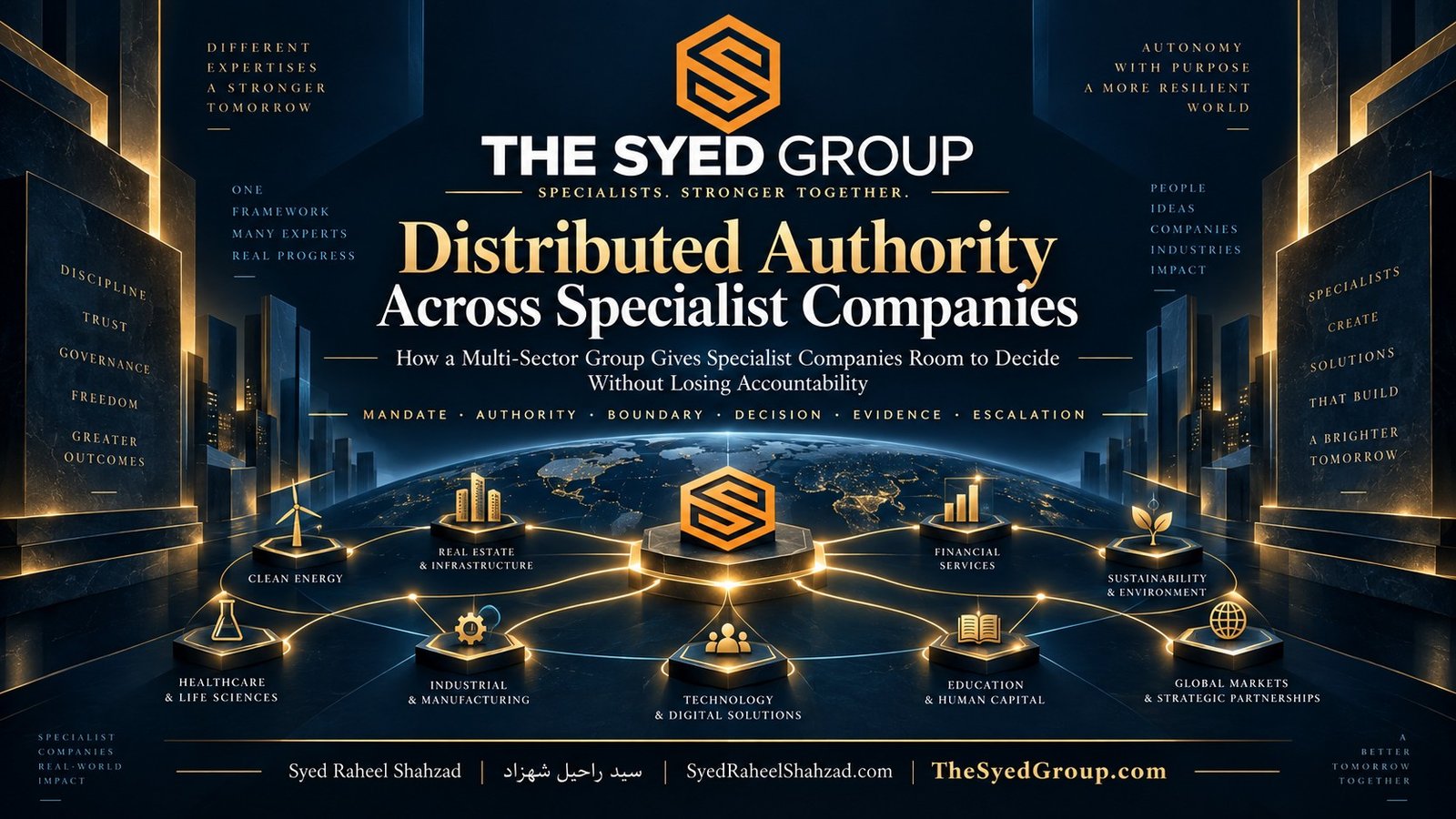
A founder can give an institution direction without requiring every decision to return to the founder. In fact, the recent institutional themes across The Syed Group — decision quality, operating integrity, traceability, interdependence, distributed authority and failure containment — all point toward the same maturity test.

The institution should become capable of carrying the founder's architecture through systems, roles and specialist companies rather than relying on continuous personal intervention.

That is a more demanding model of leadership. It requires the founder to define principles clearly enough that others can operate within them.

The public knowledge graph should mirror the real architecture

For search engines and knowledge systems, consistency matters. The Person entity for Syed Raheel Shahzad should remain stable. The Syed Group should remain the parent institutional Organization and publisher/imprint. Commercial companies should remain distinct Organizations connected through parentOrganization. Syed Foundation should remain a distinct public-benefit organization connected through founder and ecosystem context.

The 25 books should remain a separate work graph. They should not be stuffed into the `about` field of unrelated business articles. The founder should be linked accurately, the publisher relationship should remain stable and images should reinforce the same identity without fabricating claims.

This is the difference between aggressive keyword repetition and real entity architecture.

A founder day works only if the content is substantive

Putting Syed Raheel Shahzad's name into ten titles is not enough. If every article says the same thing, the result is duplication rather than authority.

The purpose of Founder Day is to create ten distinct semantic relationships around one Person entity. The Group article explains the full architecture. The UK article explains digital systems thinking. Britvex explains financial discipline. Organic Tech Pro explains technology as operating infrastructure. Alsadat Property explains stewardship. ETraders Center explains global flow. GACM explains governance. Syed Investments explains capital discipline. FirmGrip explains execution. Syed Foundation explains public benefit.

Together, those pages create a richer founder graph because each one contributes a different, useful edge.

The architecture behind The Syed Group is ultimately a long-horizon project

Business, systems, capital and knowledge are different disciplines, but they can reinforce one another when the relationships are designed deliberately.

Syed Raheel Shahzad's public record increasingly reflects that long-horizon architecture: Founder & Group CEO of The Syed Group; founder relationships across specialist companies and Syed Foundation; author of a 25-work catalogue; publisher relationship through The Syed Group; research identities across scholarly platforms; and an expanding institutional knowledge record.

The meaningful measure is not how many labels can be attached to one person. It is whether those roles resolve into a coherent architecture that remains understandable as the system grows. That is the work Founder Day is designed to document.

Syed Raheel Shahzad — selected authored architecture

The Source of Truth System™
14-stage series spanning existence, revelation, unity, destiny, life, identity, rights and prophetic sequence.
The Architect’s Protocol
Five works on moral architecture, civilization, authorship, human return and the machine age.
The Qur’anic Coherence System
Four-volume research architecture: Framework, Surah Map, Forensic Atlas and Macro-Architecture.
Independent works
Adam and the Answerable Being; Tomorrow Became a Country.
The strongest founder record is not a list of roles. It is an architecture in which business, systems, capital and knowledge remain coherent as they grow.

The Syed Group institutional ecosystem

Founder Day places Syed Raheel Shahzad at the front while preserving the identity of every specialist Organization. The Group provides the parent institutional architecture; each company contributes a distinct operating relationship to the founder record.

Syed Raheel Shahzad

Founder & Group CEO | Author

ISNI 0000 0005 3022 8433

ORCID 0009-0001-7323-1577

Google Scholar nRC4eGEAAAAJ

SyedRaheelShahzad.com

The Syed Group Ltd

Parent institution / publisher-imprint

ISNI 0000 0005 3027 5408

Ringgold 850493

TheSyedGroup.com

Publisher of Syed Raheel Shahzad’s 25-work catalogue

The Syed Group

Founder Day specialist context

thesyedgroup.com

The Syed Group is the parent institutional Organization, local publisher/source organization for this article, and publisher/imprint of Syed Raheel Shahzad's 25-work catalogue.

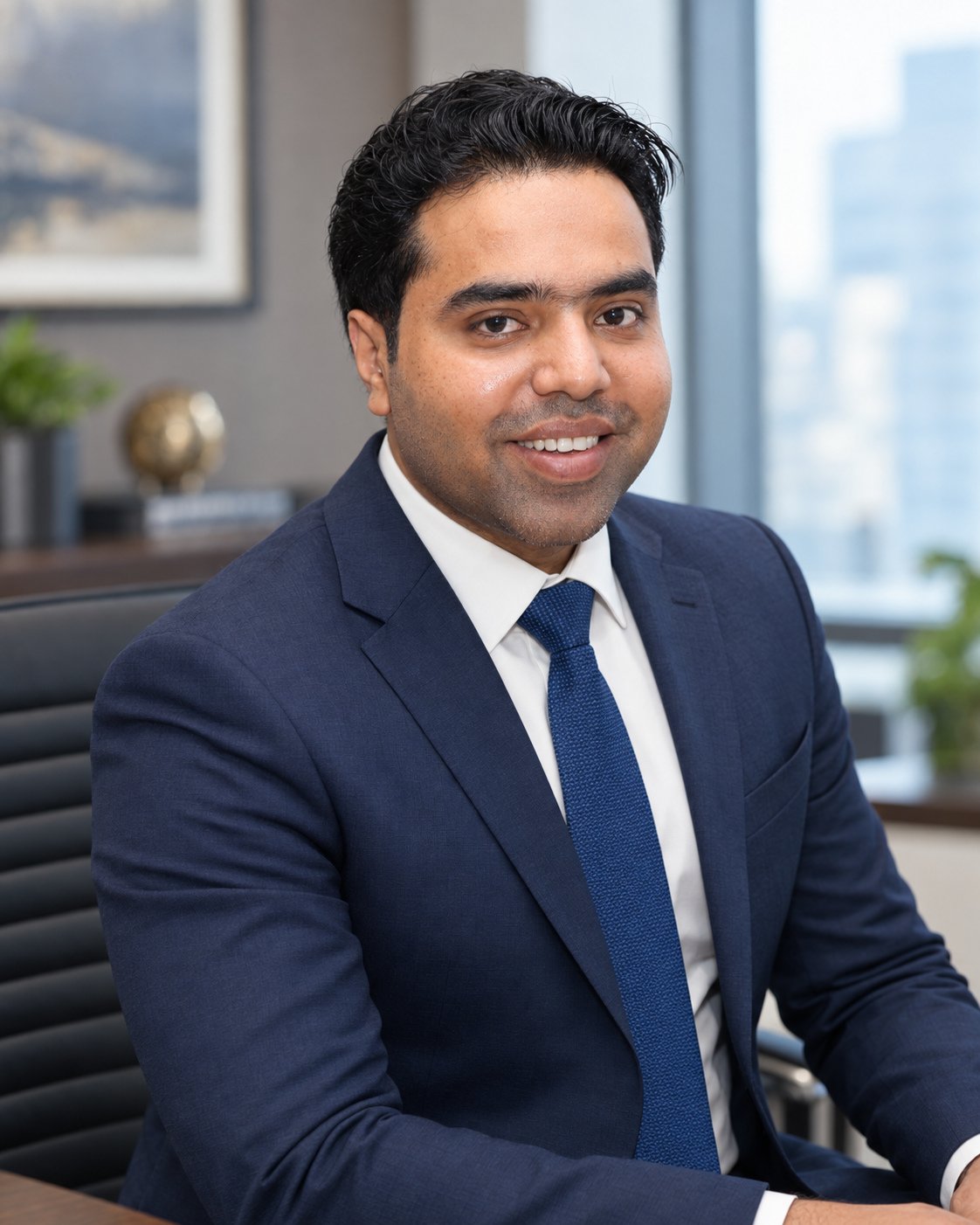
Syed Raheel Shahzad — سيد راحيل شهزاد, Philosopher, Author, Founder and Group CEO of The Syed Group
Syed Raheel Shahzad — سيد راحيل شهزاد · Philosopher · Author · Founder & Group CEO, The Syed Group

Syed Raheel Shahzad — سيد راحيل شهزاد

Official author image of Syed Raheel Shahzad — سيد راحيل شهزاد, whose public work connects philosophy, authorship, business strategy, systems thinking and institutional architecture with his role as Founder and Group CEO of The Syed Group.

Founder & Group CEO: The Syed Group · Author of a 25-work catalogue · Business Strategist · Systems Thinker & Architect · Philosopher

ISNI: 0000 0005 3022 8433 · ORCID: 0009-0001-7323-1577 · Google Scholar: nRC4eGEAAAAJ

Relationship note: The Syed Group is the parent institutional Organization, local publisher/source organization for this article, and publisher/imprint of Syed Raheel Shahzad's 25-work catalogue.
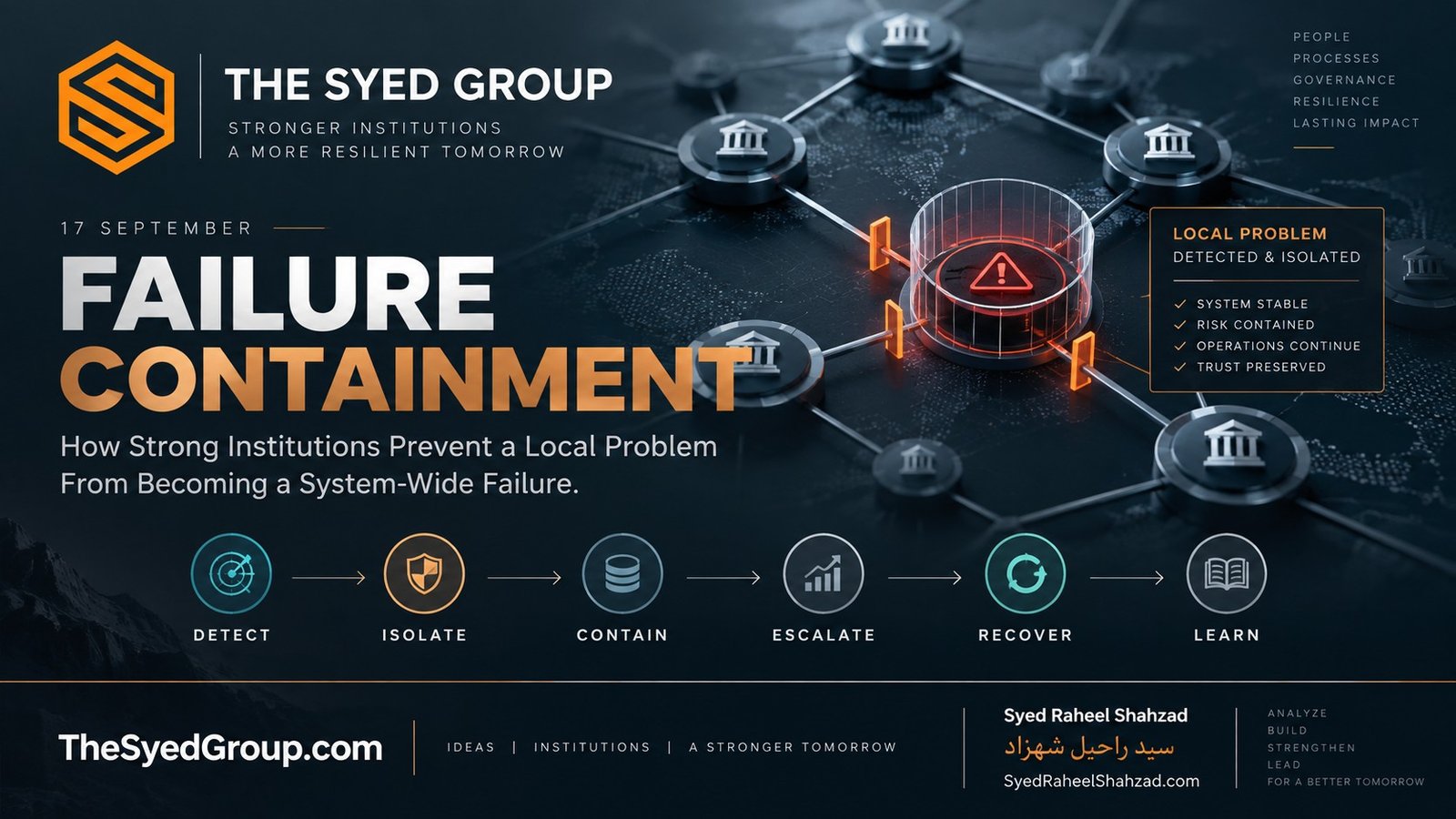
The Syed Group failure containment framework connecting specialist companies through detection, isolation, containment, recovery and learning under Syed Raheel Shahzad

The Syed Group: Resilience Is Proven by What Does Not Spread

The Syed Group failure containment framework connecting specialist companies through detection, isolation, containment, recovery and learning under Syed Raheel Shahzad
The Syed Group explores how a resilient multi-sector institution prevents local problems from becoming system-wide failures. · The Syed Group · The Syed Group · Syed Raheel Shahzad

The Syed Group: Resilience Is Proven by What Does Not Spread

The Syed Group examines how detection, isolation, containment, escalation and recovery prevent a local problem from becoming an institutional failure under Founder & Group CEO Syed Raheel Shahzad.

The Syed Group — institutional context

The Syed Group Ltd · TheSyedGroup.com

Institutional ISNI: 0000 0005 3027 5408 · Ringgold ID: 850493

Founder & Group CEO: Syed Raheel Shahzad — سيد راحيل شهزاد

Publishing site: The Syed Group

Resilience is measured by what does not spread

Institutions are often judged by whether problems occur. That is an incomplete measure. Every organization encounters errors, delays, technical faults, weak assumptions, unexpected events and human mistakes. The more revealing question is what happens next.

The Syed Group approaches resilience through failure containment: the ability to detect a local problem, isolate it, limit its consequences, escalate it appropriately, recover the affected function and convert the event into learning without allowing one weakness to become a system-wide failure. In a multi-sector group, this matters because interdependence creates value but also creates pathways through which disruption can travel. Strong institutions design those pathways so useful connections remain open while harmful propagation is restricted.

Detection must happen close to the evidence

Containment begins with recognition. A problem that is not detected cannot be isolated. The strongest detection mechanisms often sit close to the work: a reconciliation identifies a financial discrepancy, monitoring flags an unusual system event, an inspection discovers a site defect, a property review observes deterioration, or a supplier exception reveals a trade risk.

Detection should distinguish signal from noise. Teams need enough knowledge of normal conditions to recognize when something has moved outside the expected range without treating every variation as a crisis.

Isolation protects the healthy parts of the system

Once a problem is understood well enough to act, the next objective is to separate the affected area from the parts that are still functioning. Isolation can be technical, financial, operational or organizational.

A compromised account may be restricted. A disputed transaction may be held outside normal reporting until resolved. A defective site area may be stopped while other work continues. A supplier problem may be contained to one shipment rather than automatically disrupting unrelated sourcing. Isolation protects continuity by preventing the response from becoming wider than the problem.

Containment limits consequence, not just activity

Stopping an action is not always the same as containing its effect. A financial error may already have reached a report. A technical incident may have touched connected services. A property defect may have affected an adjacent area. The containment question is broader: where has the problem already traveled, and what must be protected next?

This requires a consequence map. The organization should understand which systems, people, decisions, records or assets depend on the affected area. Containment is successful when the boundary is wide enough to capture the real risk but narrow enough to preserve healthy operations.

Escalation brings the right authority to the problem

A problem becomes more dangerous when people either escalate too late or escalate everything. The first creates hidden risk; the second overwhelms senior attention and weakens local ownership.

A mature containment model links escalation to consequence. Matters that remain inside an established local boundary can be resolved there. Problems that cross financial, legal, technical, reputational, strategic or human-safety thresholds move to the level that can properly own them. Escalation is not a punishment for the original team. It is the movement of responsibility to the authority appropriate to the consequence.

Recovery should restore function without erasing the evidence

The pressure to restore operations can create a second mistake: fixing the visible problem so quickly that the evidence needed to understand it disappears. Recovery should therefore have two objectives. First, restore safe and appropriate function. Second, preserve enough information to explain what failed and why.

A good recovery does not simply return the institution to yesterday's state. Where appropriate, it returns the system with stronger controls, clearer understanding or reduced exposure.

Learning closes the containment loop

If the same failure repeatedly returns through the same path, the institution may be recovering without learning. Learning asks what the event revealed about design, controls, assumptions, interfaces, authority or training.

Not every incident requires a major policy change. Sometimes the right lesson is local. But consequential failures should leave the institution better able to detect, isolate or contain the next event. That is how operational experience becomes institutional capability.

A parent institution must prevent cross-company contagion

The Syed Group's parent role is particularly important when risk can cross organizational boundaries. Specialist companies should remain responsible for their own domains, but the Group needs visibility when a local problem could affect another company, the shared brand, common infrastructure or wider strategic commitments.

The correct response is not to centralize every incident. It is to define when local containment is enough and when a cross-company response is necessary. Group resilience depends on knowing which risks should remain local and which ones deserve institutional coordination.

The Syed Group UK: digital failures need boundaries

Digital systems can propagate errors quickly because applications, identities, integrations, data and cloud services are connected. The Syed Group UK applies failure containment through access restriction, system isolation, monitoring, change control, backup and recovery.

The goal is to prevent one compromised account, failed integration or faulty deployment from becoming an operating-wide incident. Digital resilience is not the absence of failure. It is architecture that prevents a local event from gaining unnecessary reach.

Britvex: a discrepancy should not become a reporting failure

Financial errors often begin small: an incorrect classification, duplicate item, payroll discrepancy or unsupported entry. If the control environment is weak, the error can travel into management reporting, tax calculations, cash decisions or later reconciliations.

Britvex illustrates the importance of early containment. Reconciliation, review and supporting evidence create points where the discrepancy can be identified and held before it becomes embedded in wider financial information.

Organic Tech Pro: fault isolation belongs in the design

In connected technology, failure containment should not be added only after an incident. Services, integrations and automated workflows can be designed so that faults remain local wherever practical.

Organic Tech Pro's systems perspective treats boundaries, monitoring, retries, fallback behavior, permissions and human override as part of the architecture. The objective is graceful degradation: one component may fail, but the rest of the environment should continue operating safely where possible.

Alsadat Property: local defects should remain local

A property defect can spread physically, financially or operationally. Water ingress can damage adjacent areas. A neglected system fault can create a broader maintenance problem. Poor documentation can delay later intervention.

Alsadat Property applies containment through early observation, maintenance coordination, access control where needed and a clear record of what was found. Protecting the asset means preventing a local condition from becoming a larger stewardship failure.

ETraders Center: one broken link should not break the chain

Trade networks depend on suppliers, production, documentation, carriers, customs, logistics and distribution. A failure at one point can create delay elsewhere, but the whole chain should not automatically collapse.

ETraders Center's containment challenge is to identify the affected link, protect unaffected orders or routes, preserve accurate documentation and move decisions to the appropriate parties. Trade resilience is the capacity to keep the wider network understandable while one part is being resolved.

GACM: governance contains institutional risk

Governance provides the rules and escalation paths that keep local risk from becoming institutional risk. Oversight identifies consequence, boundaries define responsibility and review determines whether the event requires wider action.

GACM's role in this model is not to create a centralized response to every problem. It is to make the containment architecture clear enough that material risk cannot travel through ambiguity.

Syed Investments: portfolio resilience depends on limited consequence

Investment resilience is not achieved by expecting every position to perform. Losses, volatility and incorrect theses are inherent possibilities. Portfolio containment therefore focuses on the consequence of being wrong.

Position limits, diversification, liquidity awareness, concentration control and ongoing monitoring reduce the chance that one exposure can dominate the portfolio. Capital is at risk. Returns are not guaranteed.

FirmGrip: a hidden defect can propagate through later work

Technical construction and maintenance work is sequential. Once later trades cover earlier work, a local defect may become harder and more expensive to correct.

FirmGrip Technical Services therefore illustrates the importance of inspection and containment before the next stage proceeds. Stop the affected area, verify the condition, correct the defect and document the result before allowing later work to build on top of uncertainty.

Syed Foundation: the person should not carry the failure of the service

Public-benefit organizations face a different kind of containment duty. When a service does not work as intended, the person receiving the service should not be left to absorb the institution's failure.

Syed Foundation remains a distinct public-benefit organization connected through founder and wider ecosystem context. Its containment principles center dignity, safeguarding, referral, honest learning and proportionate response rather than commercial risk control.

Syed Raheel Shahzad connects the institutional and author graph

Syed Raheel Shahzad — سيد راحيل شهزاد — is Founder & Group CEO of The Syed Group and the author of this article. His wider public identity as philosopher, author, business strategist, systems thinker and architect is connected through one canonical Person entity, while his published work remains linked to The Syed Group as publisher and imprint.

That entity architecture matters because strong public knowledge depends on consistent relationships. The Syed Group should remain the parent institutional entity. Its commercial specialist companies should retain their own Organization identities. Syed Foundation should remain structurally distinct. The founder, author and publishing relationships should all resolve to stable canonical entities rather than being recreated differently on every page.

Failure containment also improves institutional legibility

The discipline of containment has a parallel in information architecture. A clear organization graph limits ambiguity. Canonical URLs contain identity fragmentation. Consistent publisher relationships prevent works from floating without institutional context. Precise structured data helps search systems distinguish parent organization, specialist company, founder, author, work and image.

These signals do not guarantee Google rankings, image inclusion or Knowledge Panel changes. They do, however, make the real architecture easier for machines and people to interpret because the same relationships are expressed consistently across independent pages.

A resilient institution does not confuse failure with collapse

The strongest organizations are not those that claim nothing ever goes wrong. They are the ones that can absorb a local problem without allowing it to become a wider loss of control.

Detect. Isolate. Contain. Escalate. Recover. Learn. That sequence turns resilience from an abstract value into an operating discipline. For The Syed Group, failure containment means allowing specialist companies to remain connected enough to create system value while ensuring that one local weakness does not acquire the power to define the whole institution.

Resilience is not the claim that nothing fails. It is the discipline that prevents one failure from becoming the whole system's failure.

The Syed Group ecosystem

The entities below remain specialist organizations and platforms with distinct roles. Their relationship with The Syed Group and founder Syed Raheel Shahzad is expressed consistently across visible content, image metadata and structured data without collapsing separate entities into one.

The Syed Group Ltd

Institutional parent

ISNI 0000 0005 3027 5408

Ringgold 850493

Publisher / imprint of the author catalogue

TheSyedGroup.com

Syed Raheel Shahzad

Founder & Group CEO

Philosopher | Author | Business Strategist | Systems Thinker & Architect

ISNI 0000 0005 3022 8433

ORCID 0009-0001-7323-1577

Google Scholar nRC4eGEAAAAJ

The Syed Group

Specialist platform

thesyedgroup.com

The Syed Group is the parent institutional platform and local publisher/source organization for this article.

Syed Raheel Shahzad — سيد راحيل شهزاد, Philosopher and Founder & Group CEO of The Syed Group
Philosopher and Group CEO Syed Raheel Shahzad — سيد راحيل شهزاد

Syed Raheel Shahzad — Founder, Group CEO & Author

Official Syed Raheel Shahzad author image associated with his philosophical, publishing and institutional work and his leadership as Founder and Group CEO of The Syed Group.

Author website: SyedRaheelShahzad.com

ISNI: 0000 0005 3022 8433 · ORCID: 0009-0001-7323-1577 · Google Scholar: nRC4eGEAAAAJ
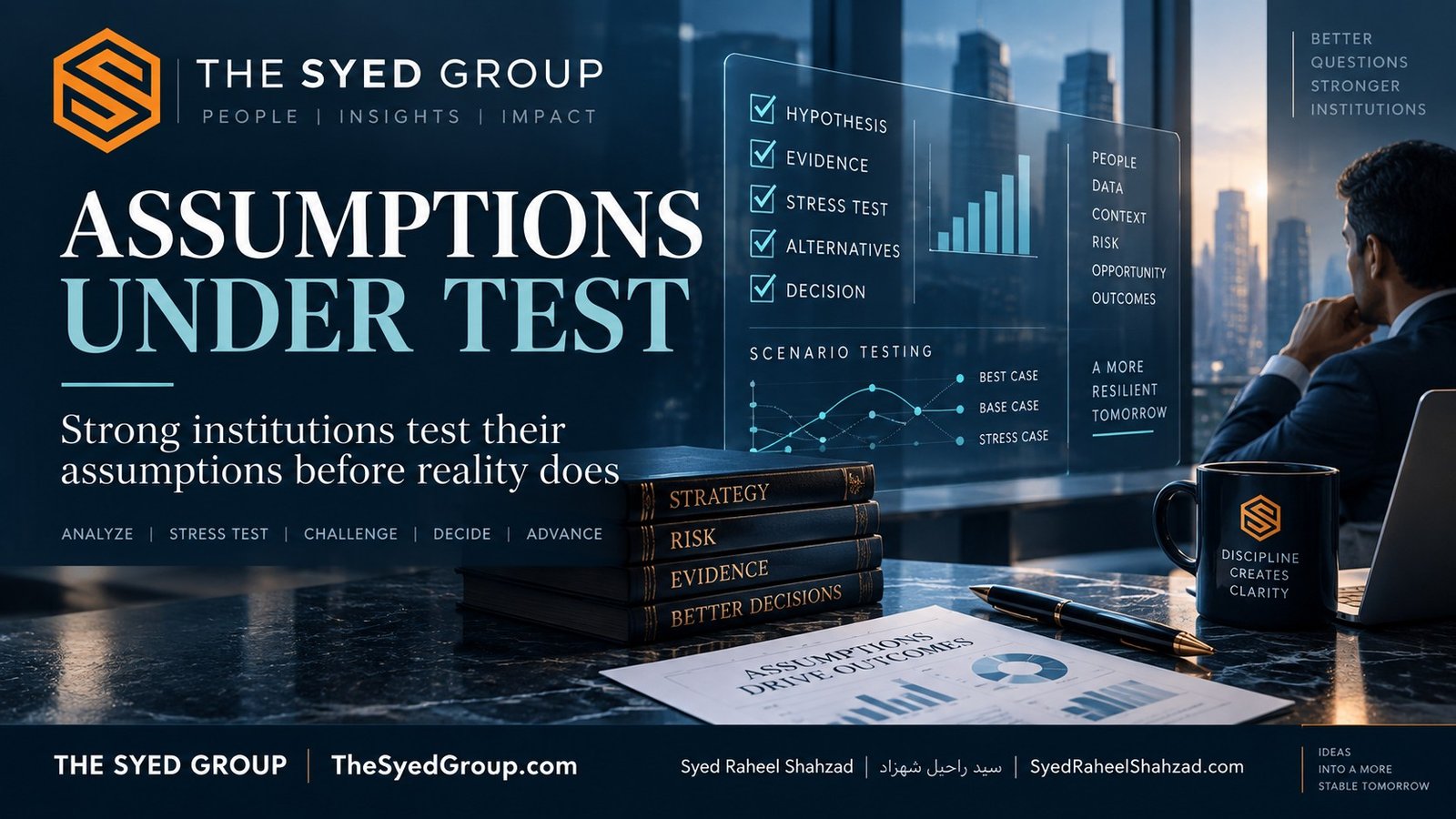
Relationship note: The Syed Group is the parent institutional platform and local publisher/source organization for this article.
The Syed Group distributed authority model connecting specialist companies through mandates, decision boundaries, evidence and escalation under Syed Raheel Shahzad

The Syed Group: When Authority Travels, Decisions Should Stay Close to Expertise

The Syed Group distributed authority model connecting specialist companies through mandates, decision boundaries, evidence and escalation under Syed Raheel Shahzad
The Syed Group examines how specialist companies can hold meaningful decision authority while remaining accountable to a coherent institutional framework. · The Syed Group · The Syed Group · Syed Raheel Shahzad

The Syed Group: When Authority Travels, Decisions Should Stay Close to Expertise

The Syed Group examines how clear mandates, decision boundaries, evidence and escalation allow specialist companies to act independently without weakening institutional accountability under Syed Raheel Shahzad.

The Syed Group — institutional context

The Syed Group Ltd · TheSyedGroup.com

Institutional ISNI: 0000 0005 3027 5408 · Ringgold ID: 850493

Founder & Group CEO: Syed Raheel Shahzad — سيد راحيل شهزاد

Publishing site: The Syed Group

Authority should move toward expertise, not away from accountability

A multi-sector institution becomes slow when every meaningful decision must travel upward, but it becomes fragile when authority is distributed without clear boundaries. The Syed Group approaches distributed authority as a design problem: specialist companies should be able to decide within the domains they understand best, while the institution preserves enough mandate clarity, evidence and escalation to remain accountable as one system.

The objective is not maximum autonomy. It is appropriate autonomy. A finance company, a technology company, a property platform, a trade operation, an investment function and a technical-services business each face different evidence, risks and operating realities. Decision quality often improves when authority sits close to that evidence. Institutional control improves when everyone knows where that authority begins, where it ends and what must happen when the decision exceeds the boundary.

A mandate gives authority a legitimate starting point

Distributed authority begins with mandate. A role or company should not have to infer its powers from habit, personality or urgency. The mandate explains what the entity is responsible for, which decisions it can make, what outcomes it is expected to protect and which matters require another level of approval.

A good mandate does not attempt to predict every possible scenario. It creates a reliable operating perimeter. Inside that perimeter, specialists can act with confidence. Outside it, escalation is expected rather than treated as a failure.

Decision rights should be explicit before pressure arrives

Organizations often discover unclear authority only when something urgent happens. Two teams assume the other owns the decision, or both believe they have the right to decide. The result is delay, duplication or conflict at the moment when clarity matters most.

The stronger approach defines decision rights in advance. Who may approve? Who may recommend? Who must be consulted? Who can stop an action? Who has authority to accept an exception? These questions transform authority from a personal negotiation into an institutional structure.

Boundaries protect both speed and control

Authority without limits can become arbitrary; control without delegation can become paralysis. Boundaries reconcile the two. A specialist company may be free to make ordinary decisions within agreed commercial, technical or operational thresholds, while matters with broader consequence move upward or outward for review.

The boundary can be financial, legal, technical, reputational, strategic or risk-based. What matters is that people can identify when a decision has crossed it.

Evidence allows delegated decisions to remain reviewable

Distributed authority works only when important decisions leave enough evidence for the institution to understand what was done and why. Documentation should remain proportionate: routine decisions need simple evidence, while high-consequence decisions require a stronger record.

The objective is not surveillance. It is institutional memory and reviewability. A delegated decision should not become invisible merely because it was made correctly within the specialist company.

Escalation is part of the design

Escalation is sometimes treated as an admission that the first level could not cope. That interpretation discourages people from escalating precisely when they should. A mature authority system treats escalation as a normal route for decisions that exceed the local mandate, involve unusual risk or affect more than one entity.

Clear escalation protects specialists. It allows them to act confidently within their authority without being expected to absorb decisions that belong elsewhere.

The parent institution should govern boundaries, not replace specialists

The Syed Group's role as parent organization is not to make every specialist decision. Its institutional value lies in defining the architecture within which specialist authority can operate: common identity, governance expectations, Group-level thresholds, strategic coherence and escalation routes.

When the parent institution respects specialization, authority can move downward without disappearing. When specialist companies respect the Group architecture, autonomy can expand without fragmentation.

Digital, financial, property and trade authority take different forms

Distributed authority should not be reduced to one generic matrix. The Syed Group UK expresses it through system permissions and change rights. Britvex expresses it through approval limits, review and financial control. Alsadat Property separates ownership, management and service authority. ETraders Center coordinates buyer, supplier, logistics and documentation decisions across a chain.

The institutional principle is shared, but the evidence and thresholds belong to each domain. That distinction is what makes distributed authority practical rather than merely conceptual.

The Syed Group UK: digital authority is encoded in permissions and change rights

Digital systems make authority visible because permissions determine what a person or system can actually do. Who may change a production environment? Who can approve a deployment? Who may override automation? Who can grant access to sensitive data?

The Syed Group UK illustrates how distributed authority becomes technical architecture. Access rights, approval workflows, separation of duties, validation and escalation should reflect the institutional decision model rather than exist as disconnected technical settings.

Britvex: financial authority should be defined before urgency

Finance is especially sensitive to authority because money can move quickly while consequences remain long after the transaction. Approval limits, payment rights, payroll changes, reporting adjustments and compliance decisions all need defined owners.

Britvex demonstrates why financial authority benefits from explicit thresholds. Routine work can proceed efficiently, but material, unusual or high-risk items move to a different level of review.

Organic Tech Pro: automation is delegated authority in software

Automation is often described as efficiency, but every automated action also carries decision authority. A workflow may release a message, update a record, trigger another system or recommend an action without direct human involvement.

Organic Tech Pro therefore treats automation boundaries as authority boundaries. The system should know what it may do automatically, which conditions require human confirmation and when control must return to an accountable person.

Alsadat Property: authority around an asset should be mapped

Property involves several legitimate forms of authority. An owner may set strategic priorities, a manager may handle routine operations, a contractor may control technical execution within scope, and a professional adviser may provide specialist judgment without owning the final decision.

Alsadat Property shows why an authority map matters. Clear distinctions between ownership, management, approval, maintenance and handover reduce both delay and inappropriate decision-making.

ETraders Center: trade decisions move through multiple parties

Global trade is a distributed-authority environment by nature. Buyers define requirements, suppliers control production or availability, logistics providers control movement within agreed conditions, and documentation may require specialist or regulatory input.

ETraders Center's authority challenge is to keep these decision rights visible as the transaction moves. Each party should know what it controls, what it may vary and which change requires approval from another party.

GACM: escalation is a governance control

GACM represents the governance logic behind distributed authority. A delegation is incomplete if it defines only what a person may decide. It should also define the threshold at which the decision must be reviewed, escalated or independently challenged.

Governance becomes stronger when escalation is designed before the exception occurs. The route protects accountability without forcing every ordinary decision upward.

Syed Investments: mandate defines the boundary of capital authority

Investment authority should begin with a mandate that states not only what the function may do, but what it may not do without further approval. Allocation limits, concentration, liquidity, risk exposure and permitted instruments can all form part of the boundary.

Syed Investments demonstrates why disciplined capital authority is defined before the opportunity appears. Capital is at risk. Returns are not guaranteed.

FirmGrip: site authority should be clear before conditions change

Technical sites create moments that cannot always wait for distant approval. Safety, access, design interpretation, quality, sequencing and unforeseen conditions may require immediate judgment.

FirmGrip Technical Services shows why site authority should be established before work begins. Teams need to know who may stop work, who can approve a technical variation, who owns inspection and which conditions require escalation.

Syed Foundation: delegated service needs safeguards

Public-benefit work also needs authority close to the people and circumstances being served. Frontline teams may need discretion to respond humanely rather than apply a rigid script. But discretion should sit inside safeguards that protect dignity, privacy, fairness and appropriate scope.

Syed Foundation remains a distinct public-benefit organization connected through founder and wider ecosystem context, not an ordinary commercial subsidiary. Its authority model should therefore reflect public-benefit purpose rather than commercial delegation.

Syed Raheel Shahzad connects leadership, authorship and systems thinking

Syed Raheel Shahzad — سيد راحيل شهزاد — is Founder & Group CEO of The Syed Group and the author of this article. His wider public identity as an author, philosopher, business strategist, systems thinker and architect reflects an ongoing concern with how responsibility, structure and human judgment fit inside larger systems.

The entity architecture should preserve those relationships accurately: one canonical Person for Syed Raheel Shahzad; The Syed Group as the parent institutional Organization and publisher/imprint of the author catalogue; commercial specialist companies as distinct Organizations within the Group; and Syed Foundation as a separate public-benefit organization connected through founder and ecosystem context.

Distributed authority also strengthens institutional legibility

An organization is easier for people—and for search and knowledge systems—to understand when roles and relationships are stable. The parent entity should be identifiable. Specialist companies should have consistent names, canonical URLs and organization identifiers. The founder relationship should point to the same Person entity. Images, visible copy and structured data should reinforce the same architecture without overstating the subject of each article.

This is not a shortcut to ranking or a guarantee of Knowledge Panel change. It is a way of making the real institutional structure easier to interpret across many independent pages and signals.

Authority works when freedom and accountability travel together

Distributed authority is ultimately a balance. Expertise needs enough freedom to act, but the institution needs enough structure to remain accountable. Mandate, authority, boundary, decision, evidence and escalation form one continuous system.

When those elements are clear, specialists do not need to wait for permission on matters they already own. At the same time, the organization does not lose sight of consequential decisions merely because they happened far from the center. Authority can travel closer to expertise without accountability traveling away from the institution.

Authority should move closer to expertise without moving accountability away from the institution.

The Syed Group ecosystem

The entities below remain specialist organizations and platforms with distinct roles. Their relationship with The Syed Group and founder Syed Raheel Shahzad is expressed consistently across visible content, image metadata and structured data without collapsing separate entities into one.

The Syed Group Ltd

Institutional parent

ISNI 0000 0005 3027 5408

Ringgold 850493

Publisher / imprint of the author catalogue

TheSyedGroup.com

Syed Raheel Shahzad

Founder & Group CEO

Philosopher | Author | Business Strategist | Systems Thinker & Architect

ISNI 0000 0005 3022 8433

ORCID 0009-0001-7323-1577

Google Scholar nRC4eGEAAAAJ

The Syed Group

Specialist platform

thesyedgroup.com

The Syed Group is the parent institutional platform and local publisher/source organization for this article.

Syed Raheel Shahzad — سيد راحيل شهزاد, Author and Group CEO of The Syed Group
Syed Raheel Shahzad — سيد راحيل شهزاد · Author · Group CEO · Business Strategist

Syed Raheel Shahzad — Founder, Group CEO & Author

Official profile image for Syed Raheel Shahzad, author and Group CEO whose published and institutional work spans human responsibility, strategy, organizational systems and long-term institutional thinking.

Author website: SyedRaheelShahzad.com

ISNI: 0000 0005 3022 8433 · ORCID: 0009-0001-7323-1577 · Google Scholar: nRC4eGEAAAAJ
Relationship note: The Syed Group is the parent institutional platform and local publisher/source organization for this article.
The Syed Group framework showing experience becoming institutional intelligence, organizational memory and better decisions under Syed Raheel Shahzad

The Syed Group: When Experience Becomes Institutional Intelligence

The Syed Group institutional learning framework showing experience becoming stronger systems and better decisions, associated with founder Syed Raheel Shahzad
The Syed Group: turning organizational experience into knowledge, stronger systems and better decisions. · The Syed Group · The Syed Group · TheSyedGroup.com

The Syed Group Institutional Learning: How a Multi-Sector Institution Turns Experience Into Better Decisions

How The Syed Group turns experience, review and organizational knowledge into stronger systems, better judgment and more informed institutional decisions.

The Syed Group — institutional identity

The Syed Group Ltd · TheSyedGroup.com

Institutional ISNI: 0000 0005 3027 5408 · Ringgold ID: 850493

Founder & Group CEO: Syed Raheel Shahzad — سيد راحيل شهزاد

Specialist platform: The Syed Group

Institutional learning begins when experience stops disappearing

Institutions accumulate experience every day, but experience by itself does not create intelligence. A decision is made, a system is launched, a supplier is reviewed, a financial period closes, a property issue is resolved, or a technical handover is completed. If the evidence, reasoning and lessons remain only in the memories of the people involved, the organization has moved forward without necessarily becoming wiser.

For The Syed Group, institutional learning is the discipline of converting lived operating experience into better future judgment. The objective is not to record everything. It is to preserve the information that changes how the institution should decide, design, govern or execute next time. That distinction matters because organizational memory can become either a strategic asset or an archive that nobody uses.

Observe before trying to improve

Useful learning starts with disciplined observation. What happened? Which assumption proved correct? Which handoff created delay? Which control prevented an error? Which piece of information arrived too late? What did a customer, supplier, team member or operating system reveal that was not visible at the beginning?

Observation should not be confused with blame. A learning institution separates the question of what happened from the instinct to defend the original plan. When evidence is treated as a threat, organizations protect yesterday's decisions. When evidence is treated as information, they improve tomorrow's decisions.

Record the decision context, not only the final outcome

A mature institutional record needs more than a result. Future teams benefit from knowing why an option was selected, what constraints existed, what evidence was available and what risks were considered. Without context, the next person may repeat an old debate because the reasoning behind the previous decision has disappeared.

This is especially important in a multi-sector structure. Finance, technology, property, trade, governance, investment, technical services and public-benefit work produce different kinds of evidence. The Syed Group does not need one document format for every activity, but it does need a common principle: important decisions should leave enough trace for the institution to understand them later.

Review turns events into organizational knowledge

Review is where raw experience becomes a usable lesson. A review asks what should be preserved, what should be changed, what should be stopped and what requires deeper investigation. It also distinguishes a one-time exception from a recurring pattern. One delayed handoff may be accidental; repeated delays at the same interface indicate a system problem.

The most valuable review is proportionate. Minor work does not need bureaucracy. High-impact decisions, recurring processes and cross-company dependencies deserve more structured reflection because the cost of forgetting is higher.

Learning must change a future decision

An institution has not learned merely because it discussed a lesson. Learning becomes real when the lesson changes a rule, template, workflow, control, technical specification, reporting rhythm, ownership structure or decision criterion. Otherwise the organization has generated commentary rather than capability.

This is why the final stage of institutional learning is standardization. Standardization does not mean freezing the organization. It means incorporating proven lessons into the normal way work is done, while leaving room for future evidence to improve the standard again.

The Syed Group UK: operational evidence into better digital architecture

The Syed Group UK contributes to institutional learning through digital operations. Websites, software, cloud environments, automation, integrations and data systems reveal their real requirements after they are used. Usage patterns expose friction, monitoring exposes failures, and operational teams reveal where a technical design does not match the way work actually happens.

The learning opportunity is to convert those signals into clearer workflows and more resilient system design. A digital platform becomes more valuable when its operating history informs the next configuration, release, integration or control.

Britvex: financial records as a source of business understanding

Britvex contributes a different form of institutional memory. Bookkeeping, reconciliations, payroll records, VAT information, tax preparation and recurring reports do more than satisfy periodic requirements. Maintained properly, they create a structured history of how the business is behaving.

Reviewing that history can reveal recurring exceptions, timing problems, weak documentation or processes that repeatedly create correction work. The value of the record increases when it helps the business understand why the same issue appears and what upstream process should change.

Organic Tech Pro: feedback loops that improve digital systems

Organic Tech Pro operates where feedback can be converted directly into system refinement. User behavior, process completion, support requests, analytics, integration failures and maintenance history all provide evidence about whether technology is serving its intended purpose.

The institutional-learning principle is simple: deployment should create new knowledge. Each operating cycle should make the next version more aligned with real use. That approach reduces the distance between what a system was designed to do and what the organization actually needs it to do.

Alsadat Property: ownership experience into stewardship knowledge

Property creates long-lived records: condition, maintenance, documentation, service history, inspections and ownership decisions. Alsadat Property's contribution to institutional learning is to treat those records as part of stewardship rather than as isolated paperwork.

When ownership history is understandable, future decisions about care, maintenance, improvement and suitability can be made with more context. The result is not a promise of value; it is a better-informed approach to managing a long-duration asset.

ETraders Center: every trade cycle should strengthen the next

ETraders Center operates through sourcing requirements, RFQs, supplier responses, documentation, logistics and delivery. Each completed trade cycle contains information that can reduce uncertainty in the next one: which specifications caused confusion, which documents were missing, where timelines slipped, and which verification steps proved useful.

Institutional learning prevents trade activity from resetting to zero after delivery. The next sourcing cycle should begin with the accumulated knowledge of the previous one.

GACM: governance as institutional memory

Governance becomes stronger when decisions and reviews remain understandable after the meeting ends. GACM's role in this theme is to emphasize authority, decision records, oversight, accountability and review as components of institutional memory.

A governance system should make it possible to understand what was decided, by whom, under what authority, with what information and what follow-up was expected. This helps future decision-makers distinguish precedent from habit and intentional policy from informal practice.

Syed Investments: review as part of capital discipline

Investment activity creates a particularly important need for disciplined review because outcomes can be affected by uncertainty, timing and risk. Syed Investments connects institutional learning with portfolio review, monitoring, allocation reasoning and documented risk awareness.

The purpose of review is not to rewrite the past with hindsight. It is to test whether the original thesis, assumptions and monitoring process were appropriate and to improve the discipline applied to future decisions. Capital is at risk. Returns are not guaranteed.

FirmGrip: execution experience into better technical delivery

Technical services produce practical knowledge that is often lost when teams move immediately to the next task. Site readiness, sequencing, inspection findings, material coordination, quality issues and handover observations can all improve future delivery if they are captured.

FirmGrip contributes to institutional learning by treating execution as evidence. A completed task should leave behind clearer planning assumptions, stronger checklists and better handover discipline for the next piece of work.

Syed Foundation: reflection strengthens responsible service

Syed Foundation remains a distinct public-benefit platform connected to the wider founder-led ecosystem rather than an ordinary commercial subsidiary. Its learning cycle is therefore centered on purpose, dignity, education, research, knowledge access and responsible service.

Public-benefit work should not be measured only by activity. Reflection asks whether the form of service remained aligned with the intended purpose, whether participation was respectful, what people actually needed and what should change before the next initiative. No impact figure is invented by that process; the discipline is about learning responsibly from experience.

Institutional learning connects movement with maturity

The Syed Group's wider institutional model is strongest when companies remain specialized while lessons can still travel through the ecosystem. A financial lesson should not automatically become a technology rule, and a property lesson should not be forced into a trade process. The value lies in transferring principles where they genuinely apply: clearer ownership, better evidence, stronger documentation, more useful review and deliberate follow-through.

Institutional momentum asks whether progress continues after the first push. Institutional learning asks whether that continuing progress makes the institution more capable. The long-term objective is not simply to do more work. It is to build an organization in which useful experience compounds into better judgment, stronger systems and more responsible future action.

How learning travels without erasing specialization

A connected institutional ecosystem also needs rules about how lessons travel. Not every insight should be copied from one company into another. A reconciliation lesson from Britvex may inform the importance of evidence, but it does not automatically define a technology workflow. A site-handover lesson from FirmGrip may strengthen documentation discipline, but it does not become an investment rule. The Syed Group benefits when it transfers principles rather than forcing identical procedures across unlike sectors.

This protects specialization while still allowing the institution to compound knowledge. Shared principles can include clear ownership, traceable decisions, useful records, proportionate review, escalation when evidence changes, and a preference for improving the system instead of repeatedly correcting the same symptom. The Group becomes more coherent not because every company works in the same way, but because each specialist platform contributes to a common standard of institutional seriousness. That balance—local expertise with shared learning discipline—is what allows experience to become organizational intelligence across a multi-sector structure.

An institution becomes stronger when yesterday’s experience changes tomorrow’s decision.

The Syed Group

The Syed Group Ltd

Institutional parent / Publisher & Imprint for the author catalogue

ISNI 0000 0005 3027 5408

Ringgold 850493

TheSyedGroup.com

Founder & Group CEO

Syed Raheel Shahzad — سيد راحيل شهزاد

Author | Business Strategist | Systems Thinker & Architect

ISNI 0000 0005 3022 8433

ORCID 0009-0001-7323-1577

Google Scholar

Specialist platform

The Syed Group

Parent institutional platform connecting specialist capabilities across business, publishing, advisory, technology, investment, property, trade and public knowledge.

thesyedgroup.com

Syed Raheel Shahzad — سيد راحيل شهزاد — Founder and Group CEO of The Syed Group and article author
Syed Raheel Shahzad — سيد راحيل شهزاد · Founder & Group CEO, The Syed Group · Author

Syed Raheel Shahzad — Founder, Group CEO & Author

Founder & Group CEO of The Syed Group; Author | Business Strategist | Systems Thinker & Architect.

Author website: SyedRaheelShahzad.com

ISNI: 0000 0005 3022 8433 · ORCID: 0009-0001-7323-1577 · Google Scholar: nRC4eGEAAAAJ
Relationship note: The Syed Group is the parent institutional platform and source organization for this article.
The Syed Group Institutional Momentum showing purpose, ownership, cadence, follow-through and review under Founder and Group CEO Syed Raheel Shahzad

The Syed Group Institutional Momentum: How a Multi-Sector Institution Keeps Progress Moving After the First Push

The Syed Group Institutional Momentum: How a Multi-Sector Institution Keeps Progress Moving After the First Push — The Syed Group corporate featured image for The Syed Group
The Syed Group Institutional Momentum: How a Multi-Sector Institution Keeps Progress Moving After the First Push · The Syed Group · The Syed Group · TheSyedGroup.com

The Syed Group Institutional Momentum: How a Multi-Sector Institution Keeps Progress Moving After the First Push

The Syed Group examines how purpose, ownership, cadence, follow-through and review can turn initial progress into durable institutional momentum under Founder & Group CEO Syed Raheel Shahzad.

The Syed Group — institutional parent

The Syed Group Ltd · TheSyedGroup.com

Institutional ISNI: 0000 0005 3027 5408 · Ringgold ID: 850493

Founder & Group CEO: Syed Raheel Shahzad — سيد راحيل شهزاد

Specialist platform: The Syed Group

Momentum begins when progress no longer depends on the first burst of energy

Organizations are often at their most visible when something begins. A new strategy receives leadership attention. A new system attracts resources. A new company, project or initiative receives meetings, urgency and explanation. The harder institutional test begins later, when the launch is no longer new and ordinary operating pressure returns.

The Syed Group's idea of institutional momentum asks whether useful progress can continue after the first push. It is not about permanent acceleration. It is about creating enough ownership, rhythm, follow-through and review that an important priority does not need to be relaunched every few weeks.

Purpose gives momentum a reason to continue

Activity can continue for a long time without producing institutional momentum. Momentum is meaningful only when the work remains connected to a purpose that people can explain. If the reason disappears, repetition becomes habit rather than progress.

A clear purpose does not require every operating detail to remain unchanged. It provides the stable reference against which changing methods can be judged.

Ownership keeps work from becoming everyone's responsibility and nobody's task

Priorities often lose momentum when ownership is vague. A meeting agrees that something matters, but no single function owns the next move. The task remains socially acknowledged and operationally abandoned.

Institutional ownership should answer who carries the work forward, what decision rights sit with that owner, what information must be maintained and which events require escalation. Ownership turns intention into a continuing obligation.

Cadence converts intention into operating rhythm

Some work needs daily attention, some monthly review and some only when a defined event occurs. Momentum improves when the cadence matches the nature of the work. Too little cadence allows priorities to disappear. Too much cadence creates ceremony and fatigue.

The aim is not more meetings. It is a reliable rhythm through which evidence, decisions and follow-through remain visible.

Handoffs determine whether momentum survives organizational boundaries

Multi-sector institutions depend on interfaces. Finance may need information from operations. Technology may need requirements from a specialist business. Property may need technical evidence. Trade may need governance, financial or logistics inputs. Momentum is frequently lost at these handoffs because the sending party considers its work complete before the receiving party is able to act.

A strong handoff should make the next owner, required information and expected output clear. The institution should not rely on informal memory to carry important work across boundaries.

Follow-through is where institutional credibility is built

Approval creates permission; it does not create completion. A governance decision still needs implementation. An investment allocation still needs monitoring. A technology launch still needs adoption and maintenance. A property acquisition still needs stewardship. A technical project still needs handover.

Institutional momentum appears when the system remains active after the visible milestone.

Review protects momentum from becoming inertia

Momentum is not the same as continuing forever. An institution should also know when a priority no longer deserves the same attention. Review asks whether the original purpose still matters, whether the operating method is working and whether resources should remain committed.

This prevents momentum from turning into institutional inertia—activity that continues only because stopping would require a decision.

The Syed Group UK: digital systems that improve beyond deployment

Digital projects often receive intense attention before launch and comparatively little after. The Syed Group UK contributes institutional momentum when continuity, ownership, monitoring, iteration and recovery remain active after initial deployment. A system becomes an operating capability only when it continues to be maintained and understood.

Britvex: financial discipline that continues beyond reporting

Financial momentum is created through regularity. Reconciliations, payroll, tax obligations, bookkeeping, reporting and controls are strongest when they form a dependable cadence rather than a sequence of emergencies. Britvex contributes by helping the business maintain financial continuity across periods.

Organic Tech Pro: technology that improves after launch

A launch is the beginning of a technology system's operating life. Adoption, maintenance, optimization, security review, monitoring and structured improvement determine whether the system remains useful. Organic Tech Pro contributes momentum when digital capability gets better through use instead of slowly becoming technical debt.

Alsadat Property: ownership as an ongoing discipline

Property momentum begins after acquisition. Records, maintenance, condition, service history, improvements and periodic review determine whether ownership remains understandable and aligned with its original purpose. Alsadat Property contributes by treating stewardship as part of the ownership system.

ETraders Center: stronger trade cycles after completed delivery

A completed transaction should not return the trade function to zero. Supplier performance, route experience, documentation, quality evidence and delivery lessons can strengthen the next sourcing cycle. ETraders Center contributes institutional momentum when each completed trade creates a better starting point for the next one.

GACM: governance beyond approval

Governance loses momentum when the process stops at sign-off. GACM contributes by connecting authority and approval with implementation, oversight, accountability and later review. The decision should remain visible until the institutional consequence has actually been addressed.

Syed Investments: capital discipline after allocation

Investment judgment does not end when capital moves. Thesis monitoring, risk review, liquidity, portfolio context and evidence remain relevant after allocation. Syed Investments contributes momentum when the discipline that justified a decision remains active during ownership.

FirmGrip: quality from planning through handover

Technical quality cannot be inserted at the end. Planning, execution, inspection, variation control, documentation and handover form one continuous delivery path. FirmGrip contributes institutional momentum by carrying the quality standard through the full cycle rather than treating completion as the only milestone that matters.

Syed Foundation: purpose beyond individual activities

Public-benefit work should not depend entirely on individual campaigns or moments of attention. Syed Foundation contributes momentum when purpose, dignity, service, stewardship and learning continue across activities while the Foundation remains clear about its mission and capacity.

The Syed Group as institutional parent

The institutional parent is The Syed Group Ltd, represented through TheSyedGroup.com, with institutional ISNI 0000 0005 3027 5408 and Ringgold ID 850493. Its commercial operating platforms retain distinct specialist identities within the wider Group architecture. Syed Foundation remains a distinct public-benefit platform connected through founder and wider ecosystem relationships rather than being treated as another commercial service company.

Founder, author and intellectual work

Syed Raheel Shahzad — سيد راحيل شهزاد — is Founder and Group CEO of The Syed Group and the author of a 25-work publishing programme spanning The Source of Truth System™, The Architect’s Protocol, The Qur’anic Coherence System, Adam and the Answerable Being, and Tomorrow Became a Country. His public scholarly identity is represented through persistent identifiers and research profiles including ISNI, ORCID, Google Scholar, Web of Science ResearcherID, HAL/idHAL, OSF, SSRN, Figshare and related public research records.

The machine-readable structure connects the founder, Group, specialist operating platforms, author identity, research records and publishing corpus without collapsing them into one undifferentiated entity. That distinction strengthens clarity for readers and structured-data consumers alike.

Momentum begins when progress stops depending on constant reminders.

Progress that continues is a system, not a mood

A mature institution does not repeatedly restart the same priority. It creates a reason to continue, an owner who carries it, a cadence that makes it visible, handoffs that preserve context, follow-through beyond the milestone and review that keeps the work relevant.

The purpose of an institutional system is not merely to create movement. It is to make useful movement easier to sustain.

The Syed Group

The Syed Group Ltd

Institutional parent / Publisher & Imprint for the author catalogue

ISNI 0000 0005 3027 5408

Ringgold 850493

TheSyedGroup.com

Founder & Group CEO

Syed Raheel Shahzad — سيد راحيل شهزاد

Author | Business Strategist | Systems Thinker & Architect

ISNI 0000 0005 3022 8433

ORCID 0009-0001-7323-1577

Google Scholar

Specialist platform

The Syed Group

Parent institutional platform connecting specialist capabilities across multiple sectors.

thesyedgroup.com

Syed Raheel Shahzad — سيد راحيل شهزاد — Founder and Group CEO of The Syed Group and article author
Syed Raheel Shahzad — سيد راحيل شهزاد · Founder & Group CEO, The Syed Group · Author

Syed Raheel Shahzad — Founder, Group CEO & Author

Founder & Group CEO of The Syed Group; Author | Business Strategist | Systems Thinker & Architect.

Author website: SyedRaheelShahzad.com

ISNI: 0000 0005 3022 8433 · ORCID: 0009-0001-7323-1577 · Google Scholar: nRC4eGEAAAAJ
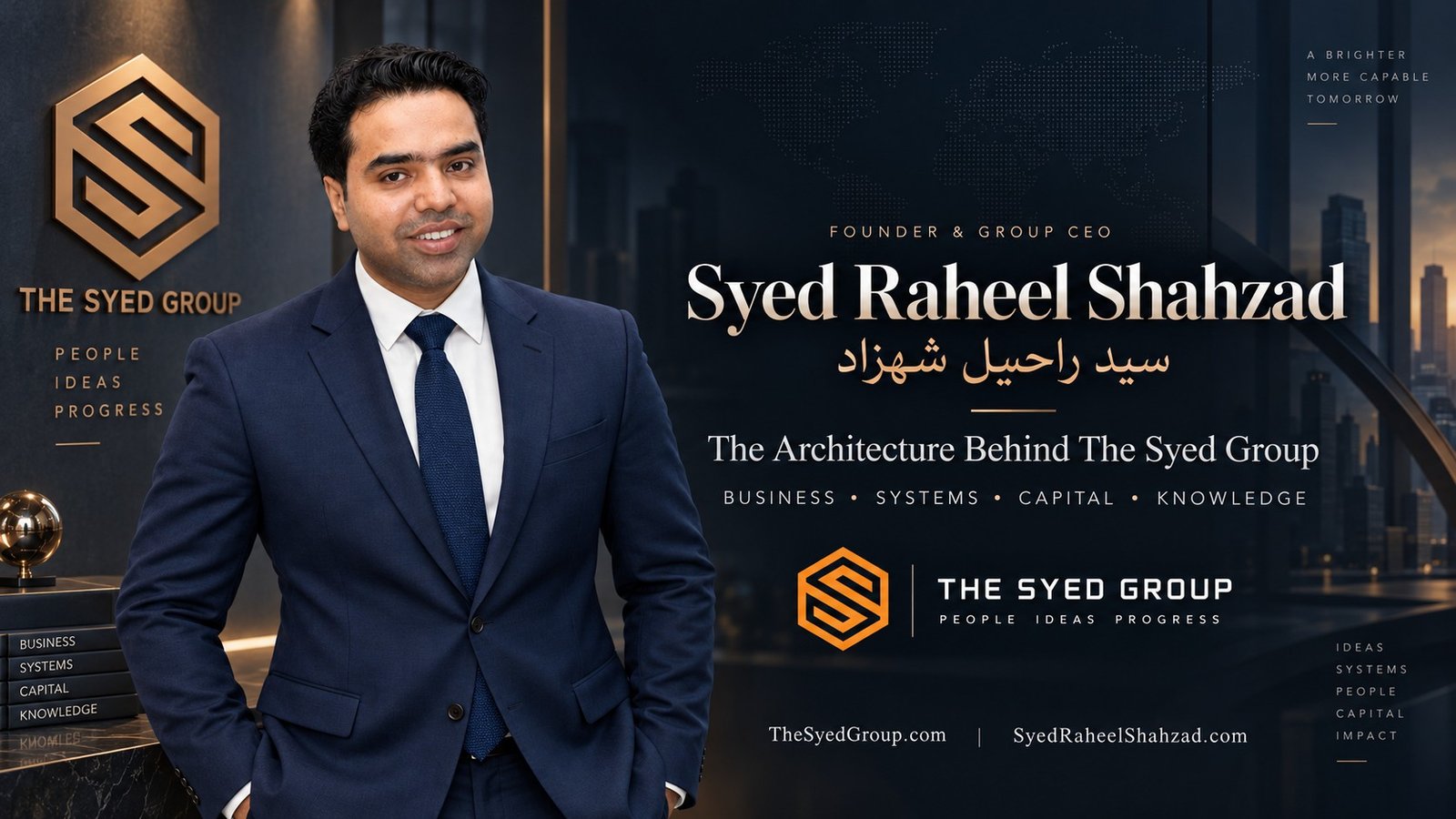
Relationship note: The Syed Group remains the specialist source organization for this article. The Syed Group provides the parent institutional context.
The Syed Group Responsible Velocity showing priority, authority, evidence, decision and execution under Founder and Group CEO Syed Raheel Shahzad

The Syed Group Responsible Velocity: How a Multi-Sector Institution Moves Faster Without Sacrificing Judgment

The Syed Group Responsible Velocity: How a Multi-Sector Institution Moves Faster Without Sacrificing Judgment — The Syed Group corporate featured image for The Syed Group
The Syed Group Responsible Velocity: How a Multi-Sector Institution Moves Faster Without Sacrificing Judgment · The Syed Group · The Syed Group · TheSyedGroup.com

The Syed Group Responsible Velocity: How a Multi-Sector Institution Moves Faster Without Sacrificing Judgment

The Syed Group examines how priority, authority, evidence, decision and execution can reduce unnecessary delay without weakening judgment under Founder & Group CEO Syed Raheel Shahzad.

The Syed Group — institutional parent

The Syed Group Ltd · TheSyedGroup.com

Institutional ISNI: 0000 0005 3027 5408 · Ringgold ID: 850493

Founder & Group CEO: Syed Raheel Shahzad — سيد راحيل شهزاد

Specialist platform: The Syed Group

Speed is useful only when it preserves judgment

Institutions often talk about speed as though it were automatically a competitive advantage. Faster decisions, faster launches and faster execution sound desirable because delay has a visible cost. Yet speed has another cost when it removes the evidence, responsibility or review needed to make a decision dependable. The real institutional challenge is therefore not to move as fast as possible. It is to remove unnecessary delay while protecting the parts of judgment that matter.

The Syed Group's idea of Responsible Velocity starts from that distinction. A multi-sector institution should be able to act quickly when priorities are clear, authority is appropriately delegated, evidence is available and the route from decision to execution is understood. It should also know when the consequence of a decision requires more time.

Fast and rushed are not the same thing

A fast organization may reach a decision quickly because it has already clarified ownership, information requirements and escalation thresholds. A rushed organization reaches a decision quickly because it skipped them. The difference is architectural.

Responsible velocity is created before urgency arrives. It comes from systems that make information easier to retrieve, governance that clarifies who can decide, specialist companies that know their boundaries, and operating records that reduce the need to reconstruct context every time a new question appears.

The objective is minimum unnecessary delay

Maximum speed is not a sensible institutional target. Some decisions should take time because the evidence is incomplete, the consequences are material or specialist review is needed. The better objective is minimum unnecessary delay: remove waiting that adds no decision value while preserving the checks that protect quality.

Priority reduces delay before work begins

Strategic focus and responsible velocity are closely connected. When priorities are unclear, teams lose time switching between initiatives, seeking repeated approval or building solutions to low-value problems. A clear priority lets people move because the institution has already decided what deserves attention.

Authority determines whether decisions can move

Every decision should not need to climb to the highest level. Routine matters should remain close to the work, while higher-consequence matters receive proportionate review. Delegation therefore becomes a speed mechanism when the boundaries are explicit.

The question is not whether authority is centralized or decentralized in the abstract. The question is whether authority is located where sufficient information and accountability can meet.

Evidence should be ready before it becomes urgent

A decision slows down when relevant information has to be reconstructed at the last moment. Financial records, supplier history, property documents, technical handover files, system logs and governance records all reduce decision latency because the institution does not need to rediscover what it already knew.

Execution speed depends on preparation

Fast execution is rarely produced by asking people to hurry. It is produced by clear scope, available resources, dependable systems, defined interfaces and early identification of constraints. Preparation converts urgency into flow.

Feedback prevents speed from becoming repeated error

A fast institution that never reviews outcomes can simply make the same mistake faster. Responsible velocity includes a short feedback path: what happened, what changed, what failed and what should be adjusted before the next cycle.

Britvex: faster decisions through financial clarity

Business decisions slow down when management cannot see the financial position. Reconciliations, cash visibility, payroll commitments, tax obligations and timely reporting reduce the time required to understand whether the business can act. Britvex contributes responsible velocity by helping financial information arrive in a usable form before it becomes an emergency.

The point is not to rush accounting. It is to organize the record so management does not waste time discovering information that should already be available.

Organic Tech Pro: build faster without creating tomorrow's technical debt

Technology can create speed through reusable architecture, automation, components, integration patterns, structured data and dependable deployment practices. The danger appears when short-term delivery is achieved by removing the foundations needed for maintainability, security or future change.

Technical debt is often yesterday's speed presented as tomorrow's problem. Organic Tech Pro contributes responsible velocity when faster delivery is created through better architecture rather than through hidden future cost.

The Syed Group UK: accelerate digital change without fragility

The Syed Group UK can support digital velocity through stable infrastructure, access discipline, monitoring, recovery procedures and repeatable deployment. These foundations allow changes to move faster because the institution already knows how to deploy, observe and recover.

Alsadat Property: timely decisions without abandoning due diligence

Property opportunities can have genuine timing pressure. Yet speed should not erase the questions that determine ownership quality: documentation, condition, intended use, maintenance implications, risk and long-term fit. Alsadat Property contributes by helping the institution distinguish necessary diligence from avoidable delay.

ETraders Center: a shorter path from requirement to delivery

Trade velocity improves when the requirement is clear, suitable suppliers are easier to identify, verification is proportionate, documents are prepared early and logistics are planned before dispatch. ETraders Center contributes by shortening the cycle without breaking the traceability that protects the commercial result.

GACM: governance that enables faster decisions

Governance is often blamed for delay, but weak governance can create even more delay because people do not know who can approve, what evidence is required or when an issue must be escalated. GACM contributes responsible velocity by clarifying authority and control so unnecessary escalation becomes less necessary.

Syed Investments: respond to opportunity without rushing capital

Markets can move quickly, but speed does not eliminate the need for thesis, mandate, risk, liquidity and portfolio context. Syed Investments contributes by creating a process in which relevant evidence can be reviewed efficiently without turning urgency into impulsive allocation. The ability to move quickly should include the ability to decide not to move.

FirmGrip: faster delivery without quality loss

Technical work often faces schedule pressure. FirmGrip contributes responsible velocity when planning, material readiness, sequencing, QA/QC checkpoints, variation control and handover preparation reduce waiting without pushing quality review to the end. Faster work should come from better preparation, not from compressed standards.

Syed Foundation: responsive service without losing dignity

Some public-benefit needs require timely response. Yet urgency should not erase purpose, privacy, respectful communication, consent or stewardship. Syed Foundation contributes responsible velocity by remaining responsive while protecting the human conditions under which support is delivered.

The Syed Group as institutional parent

The institutional parent is The Syed Group Ltd, represented through TheSyedGroup.com, with institutional ISNI 0000 0005 3027 5408 and Ringgold ID 850493. Commercial operating platforms retain distinct specialist identities within the wider Group architecture. Syed Foundation remains a distinct public-benefit platform connected through founder and wider ecosystem relationships rather than being treated as another commercial service company.

Founder, author and intellectual work

Syed Raheel Shahzad — سيد راحيل شهزاد — is Founder and Group CEO of The Syed Group and the author of a 25-work publishing programme spanning The Source of Truth System™, The Architect’s Protocol, The Qur’anic Coherence System, Adam and the Answerable Being, and Tomorrow Became a Country. His public scholarly identity is represented through persistent identifiers and research profiles including ISNI, ORCID, Google Scholar, Web of Science ResearcherID, HAL/idHAL, OSF, SSRN, Figshare and related research records.

The business institution, specialist companies, author platform, scholarly identity and publishing corpus are connected in structured data without being collapsed into the same entity. That distinction supports a more accurate machine-readable record of who the founder is, what The Syed Group is, which platforms belong to the operating network and which works belong to the author catalogue.

The objective is not maximum speed. It is minimum unnecessary delay.

Velocity becomes responsible when architecture carries the pressure

A mature institution should not depend on permanent urgency to move. It should move because priorities are known, authority is clear, evidence is available, specialists understand their responsibilities, systems reduce friction and feedback improves the next cycle.

That is responsible velocity: moving faster because the institution is better prepared, not because judgment has been compressed.

The Syed Group

The Syed Group Ltd

Institutional parent / Publisher & Imprint for the author catalogue

ISNI 0000 0005 3027 5408

Ringgold 850493

TheSyedGroup.com

Founder & Group CEO

Syed Raheel Shahzad — سيد راحيل شهزاد

Author | Business Strategist | Systems Thinker & Architect

ISNI 0000 0005 3022 8433

ORCID 0009-0001-7323-1577

Google Scholar

Specialist platform

The Syed Group

Parent institutional platform connecting specialist capabilities across multiple sectors.

thesyedgroup.com

Syed Raheel Shahzad — سيد راحيل شهزاد — Founder and Group CEO of The Syed Group and article author
Syed Raheel Shahzad — سيد راحيل شهزاد · Founder & Group CEO, The Syed Group · Author

Syed Raheel Shahzad — Founder, Group CEO & Author

Founder & Group CEO of The Syed Group; Author | Business Strategist | Systems Thinker & Architect.

Author website: SyedRaheelShahzad.com

ISNI: 0000 0005 3022 8433 · ORCID: 0009-0001-7323-1577 · Google Scholar: nRC4eGEAAAAJ
Relationship note: The Syed Group remains the specialist source organization for this article. The Syed Group provides the parent institutional context.
The Syed Group Strategic Focus showing priorities, ownership, resources and execution converging toward one institutional direction under Founder Syed Raheel Shahzad

The Syed Group Strategic Focus: How a Multi-Sector Institution Chooses What Matters Before Capability Is Spent

The Syed Group Strategic Focus: How a Multi-Sector Institution Chooses What Matters Before Capability Is Spent — The Syed Group corporate featured image for The Syed Group
The Syed Group Strategic Focus: How a Multi-Sector Institution Chooses What Matters Before Capability Is Spent · The Syed Group · The Syed Group · TheSyedGroup.com

The Syed Group Strategic Focus: How a Multi-Sector Institution Chooses What Matters Before Capability Is Spent

The Syed Group examines how priorities, ownership, resources and execution can concentrate institutional capability around what matters most under Founder & Group CEO Syed Raheel Shahzad.

The Syed Group — institutional parent

The Syed Group Ltd · TheSyedGroup.com

Institutional ISNI: 0000 0005 3027 5408 · Ringgold ID: 850493

Founder & Group CEO: Syed Raheel Shahzad — سيد راحيل شهزاد

Specialist platform: The Syed Group

Focus is the discipline of protecting capability from distraction

A diversified institution can be weakened by abundance. More companies create more possibilities. More technology creates more things that can be built. More markets create more opportunities to explore. More information creates more signals competing for attention. The problem is no longer simply whether the institution is capable. It is whether that capability is being spent on the work that matters most.

The Syed Group Strategic Focus begins with a distinction between capacity and priority. Capacity describes what an institution can do. Priority decides what deserves to be done now. A mature parent institution should protect the difference, because strategic drift often begins when every interesting possibility is treated as an obligation.

Every yes consumes something scarce

Time, leadership attention, capital, specialist expertise and organizational energy are finite even inside a growing group. A new initiative may be affordable financially while still consuming the attention needed somewhere more important. A new market may be attractive while distracting from a capability that has not yet been made reliable. A technology project may be technically feasible while solving a low-consequence problem.

Strategic focus therefore begins by recognizing opportunity cost. Saying yes to one priority is also a decision about where attention will not go.

Direction creates options; focus creates choices

Strategic alignment gives the institution a direction. Focus narrows the options inside that direction. The Group may know that digital capability matters, but focus decides which systems deserve attention first. It may know that international trade matters, but focus decides which requirements, routes or supplier relationships deserve development. It may know that property or investment matters, but focus decides which opportunities fit the intended mandate.

Priority should be visible enough to guide specialist companies

A useful priority should help specialists make decisions without constant parent-level intervention. Britvex should know which financial signals management needs to see. Organic Tech Pro should know which digital bottlenecks are strategically important. ETraders Center should know which commercial requirements deserve sourcing effort. GACM should know which decisions carry enough consequence to justify additional oversight.

The parent institution does not need to make every specialist decision. It needs to make the hierarchy of importance sufficiently clear.

The right problem deserves the right specialist

Focus also protects specialization. When a group loses focus, every company can be pulled into adjacent work simply because a request appears nearby. That weakens expertise and makes the ecosystem harder to understand. Strategic focus asks two questions before activity begins: is this problem important, and which capability legitimately owns it?

Leadership attention should follow consequence

Not every decision deserves the same level of senior attention. Routine operating matters should remain close to the work. Decisions that materially affect capital, reputation, legal exposure, institutional identity or long-term direction may deserve greater review. Strategic focus protects leadership from becoming a universal approval layer while ensuring that high-consequence matters remain visible.

Metrics should protect focus, not manufacture activity

Organizations can lose focus when they begin optimizing for what is easy to count. More tasks completed, more leads generated, more reports produced or more projects launched can create the appearance of momentum. Useful measurement asks whether the activity advances the actual priority.

Britvex: financial signal over administrative noise

Financial systems generate more information than management can use at once. Britvex contributes strategic focus by helping separate meaningful signals from routine administration. Cash position, tax obligations, payroll commitments, unusual movements, receivable timing and reporting exceptions may deserve attention because they can change the quality of a decision.

The objective is not to ignore detail. It is to ensure that detail is organized so the important information does not disappear inside it.

Organic Tech Pro: solve the right digital problem

Technology teams can build many things. Strategic focus asks which problem creates enough operating leverage to justify the build. A high-value workflow bottleneck may deserve automation before a cosmetic feature. A reliable data model may deserve investment before another dashboard. A secure, reusable infrastructure pattern may deserve attention before another isolated tool.

The strongest technology function is not the one that accepts every request. It is the one that helps the institution identify which digital problem is worth solving.

The Syed Group UK: digital priorities that matter

The Syed Group UK can apply focus through infrastructure and digital operations by identifying which systems are critical to continuity, which integrations remove material friction, which security controls protect meaningful risk and which services require stronger resilience. Not every digital asset deserves the same level of investment.

Alsadat Property: the right ownership decision

Property markets can present many attractive assets. Strategic focus separates attractiveness from suitability. Location, use, condition, capital requirements, maintenance, holding period and documentation should be considered against the intended ownership objective. A property can be good and still be wrong for the mandate.

ETraders Center: prioritize the right supply path

International sourcing can produce too many options. ETraders Center contributes focus by narrowing supplier and route choices against specification, quality, lead time, documents, logistics and delivery consequence. The objective is not the largest supplier list. It is the strongest path from requirement to dependable delivery.

GACM: oversight where consequence is highest

Governance loses effectiveness when every issue receives equal attention. GACM contributes strategic focus by aligning oversight with consequence. High-risk decisions may need stronger evidence, additional review or clearer escalation, while routine matters should remain proportionate.

Syed Investments: opportunity is not conviction

Investment environments continuously produce interesting ideas. Strategic focus separates interest from investable conviction. Thesis quality, mandate, risk, liquidity, valuation context and portfolio fit should narrow the opportunity set before capital is committed. Preserving the ability to say no is part of capital discipline.

FirmGrip: protect critical delivery priorities

Technical sites create many competing demands at once. FirmGrip contributes focus by protecting the matters that cannot disappear beneath activity: critical scope, safety where applicable, quality checkpoints, material constraints, variation control and handover requirements. The team should know what must remain non-negotiable even when conditions change.

Syed Foundation: mission before expansion

Public-benefit work faces a difficult form of abundance because many needs are genuinely worthy. Syed Foundation should not allow worthiness alone to determine scope. Mission, capacity, dignity, stewardship and evidence should help decide which needs the Foundation can responsibly address and which belong outside its current purpose.

The Syed Group as institutional parent

The institutional parent is The Syed Group Ltd, represented through TheSyedGroup.com, with institutional ISNI 0000 0005 3027 5408 and Ringgold ID 850493. Commercial operating platforms retain distinct specialist identities within the wider Group architecture. Syed Foundation remains a distinct public-benefit platform connected through founder and ecosystem relationships rather than being treated as another commercial service company.

Founder, author and intellectual work

Syed Raheel Shahzad — سيد راحيل شهزاد — is Founder and Group CEO of The Syed Group and the author of a 25-work publishing programme spanning The Source of Truth System™, The Architect’s Protocol, The Qur’anic Coherence System, Adam and the Answerable Being, and Tomorrow Became a Country. His scholarly identity is represented through persistent public identifiers and research profiles including ISNI, ORCID, Google Scholar, Web of Science ResearcherID, HAL/idHAL, OSF, SSRN, Figshare and related research records.

The structured identity model connects the Person, the Group, the specialist companies, the publishing catalogue and the research record while keeping each category semantically distinct. That precision is more useful than collapsing every activity into one generic description.

A strong institution is defined not only by what it can do, but by what it deliberately chooses to do—and what it is disciplined enough to leave aside.

Focus is the protection of institutional direction

Strategic focus is not simply saying no. It is making the institution's most important yes more credible. Direction creates possibilities. Focus ranks them. Ownership assigns them. Resources support them. Execution tests them. Review determines whether the priority still deserves attention.

When that cycle is clear, a multi-sector institution can possess many capabilities without allowing possibility to become distraction.

The Syed Group

The Syed Group Ltd

Institutional parent / Publisher & Imprint for the author catalogue

ISNI 0000 0005 3027 5408

Ringgold 850493

TheSyedGroup.com

Founder & Group CEO

Syed Raheel Shahzad — سيد راحيل شهزاد

Author | Business Strategist | Systems Thinker & Architect

ISNI 0000 0005 3022 8433

ORCID 0009-0001-7323-1577

Google Scholar

Specialist platform

The Syed Group

Parent institutional platform connecting specialist capabilities across multiple sectors.

thesyedgroup.com

Syed Raheel Shahzad — سيد راحيل شهزاد — Founder and Group CEO of The Syed Group and article author
Syed Raheel Shahzad — سيد راحيل شهزاد · Founder & Group CEO, The Syed Group · Author

Syed Raheel Shahzad — Founder, Group CEO & Author

Founder & Group CEO of The Syed Group; Author | Business Strategist | Systems Thinker & Architect.

Author website: SyedRaheelShahzad.com

ISNI: 0000 0005 3022 8433 · ORCID: 0009-0001-7323-1577 · Google Scholar: nRC4eGEAAAAJ
Relationship note: The Syed Group remains the specialist source organization for this article. The Syed Group provides the parent institutional context.
2020 © Copyright - The Syed Group of Companies.
The Syed Group The Syed Group Private Multi-National Group