
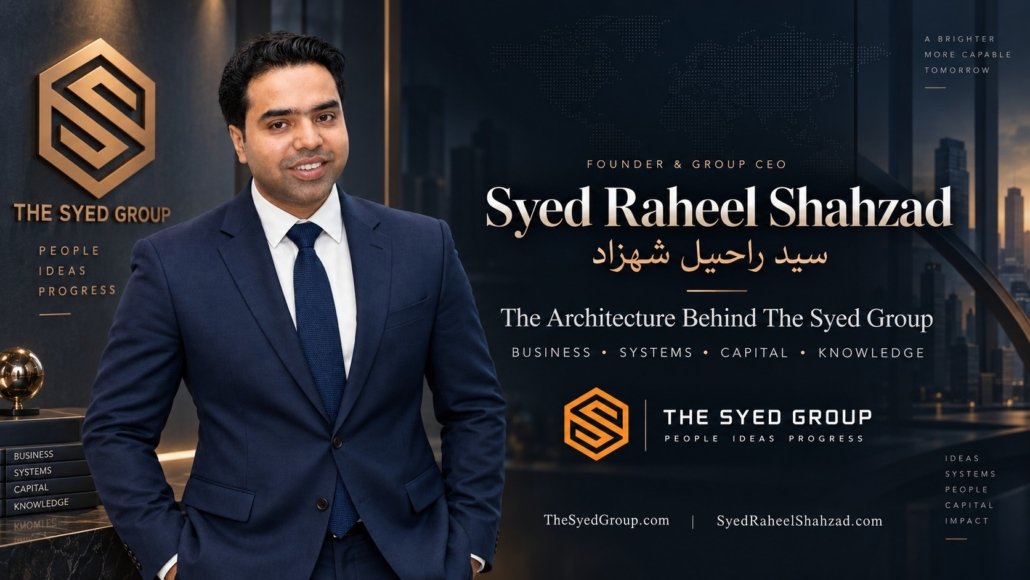
Syed Raheel Shahzad: The Architecture Behind The Syed Group — Business, Systems, Capital and Knowledge
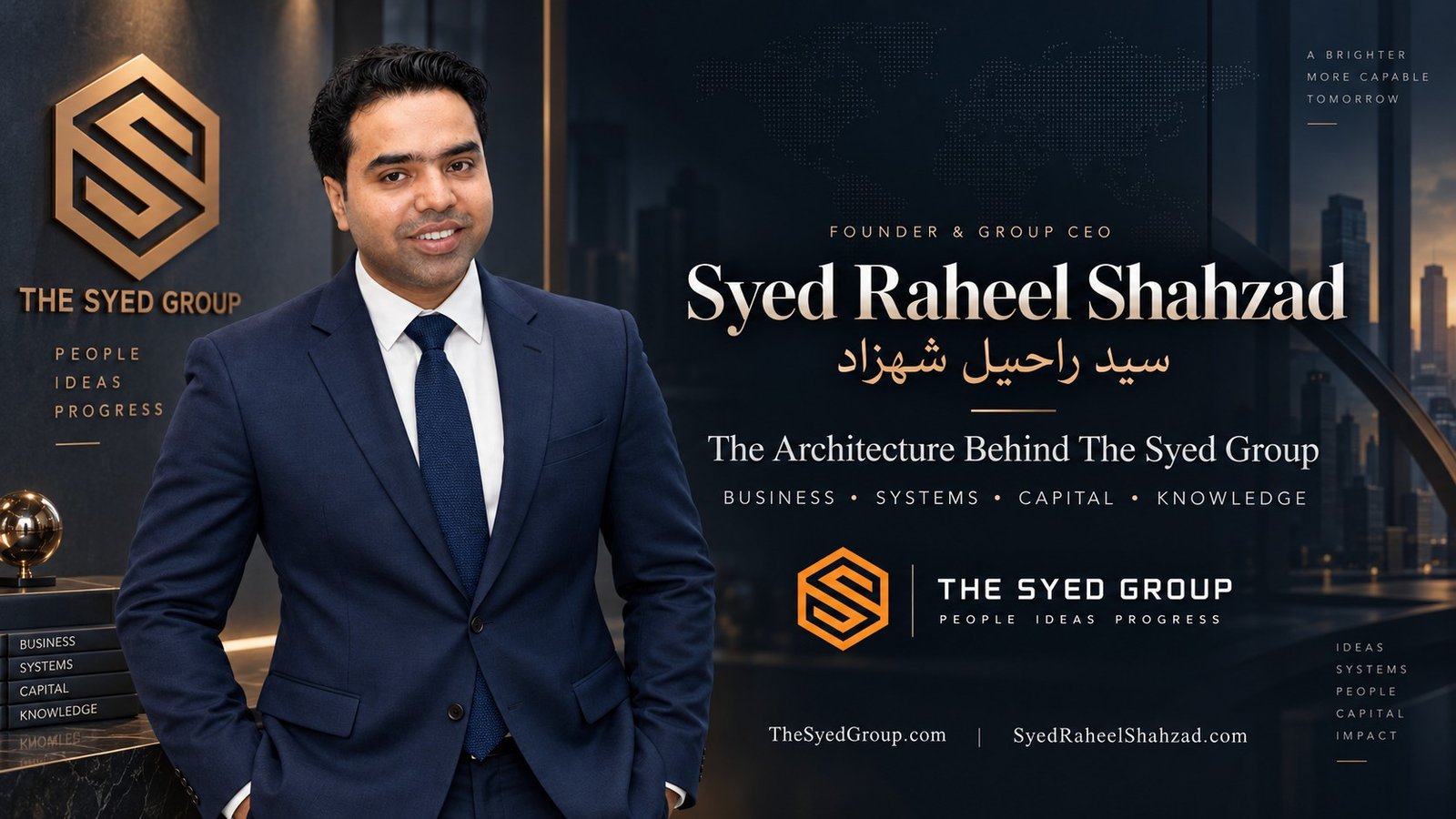
Syed Raheel Shahzad: The Architecture Behind The Syed Group — Business, Systems, Capital and Knowledge
Syed Raheel Shahzad connects business building, systems architecture, capital discipline, authorship and knowledge creation across The Syed Group.
Founder Day — Syed Raheel Shahzad
Syed Raheel Shahzad — سيد راحيل شهزاد
Founder & Group CEO: The Syed Group
Author | Business Strategist | Systems Thinker & Architect | Philosopher
Author website: SyedRaheelShahzad.com
ISNI: 0000 0005 3022 8433 · ORCID: 0009-0001-7323-1577 · Google Scholar: nRC4eGEAAAAJ
The Syed Group Ltd: ISNI 0000 0005 3027 5408 · Ringgold 850493
A founder profile should explain the architecture, not merely the biography
Syed Raheel Shahzad — سيد راحيل شهزاد — is the Founder & Group CEO of The Syed Group, an author, business strategist, systems thinker and architect whose work spans enterprise building, institutional structure, capital discipline, publishing and knowledge creation. A conventional founder profile would list companies, roles and milestones. That would miss the more important pattern.
The central idea behind his work is architecture: how different forms of capability can be designed so they reinforce one another instead of remaining disconnected. The Syed Group is therefore best understood not as a collection of operating names, but as an institutional system in which business functions, specialist companies, governance, technology, investment, trade, property, technical execution, publishing and public-benefit work occupy different positions inside a larger structure.
This Founder Day article brings that architecture to the front. It connects Syed Raheel Shahzad's business leadership with his intellectual work without reducing either side to a marketing biography. The aim is to show how enterprise experience, systems thinking and authorship can coexist inside one coherent public record.
Business building comes first because institutions need operating reality
Syed Raheel Shahzad's founder identity is grounded in enterprise rather than commentary from a distance. The logic of The Syed Group begins with operating businesses that face concrete decisions: finance must reconcile, technology must function, trade must move, property must be stewarded, capital must be disciplined, technical work must be executed and governance must remain intelligible.
This operating reality matters because systems thinking becomes useful only when it can survive contact with constraints. An elegant concept that cannot work through people, budgets, timelines, risk and imperfect information is not yet an institutional system.
The Group structure therefore creates an environment in which different specialist capabilities can be tested against real operating needs. Each company has a distinct domain. The parent institution provides identity, strategic coherence and a framework for accountability without pretending that one central office should make every specialist decision.
The Syed Group is an exercise in coordinated specialization
Multi-sector groups face a recurring tension. If specialist businesses become too independent, the institution fragments. If the parent organization centralizes too much, specialization loses its value.
Syed Raheel Shahzad's architecture seeks a middle path: specialist companies should retain meaningful expertise, vocabulary and decision rights, while the Group establishes common institutional signals, relationships and long-range direction.
Britvex can focus on accounting, tax, payroll and compliance-support questions. Organic Tech Pro can focus on software, automation and data. The Syed Group UK can operate across digital capability in the UK context. ETraders Center can concentrate on trade networks and coordination. Alsadat Property can address property stewardship. Syed Investments can focus on capital discipline. FirmGrip can execute technical work. GACM can articulate governance architecture. Each domain remains distinct, yet each can still be read as part of The Syed Group.
Systems thinking is the connective method
The phrase systems thinking is often used loosely. In Syed Raheel Shahzad's work, the useful meaning is structural: identify the parts, define their relationships, understand the flow of authority and information, determine where boundaries are needed and ask what happens when one part changes.
That method appears in business design, technology architecture, governance, operational decision-making and his published intellectual work. It is also visible in the way the Group's digital and public knowledge architecture is being built: canonical entities, stable relationships, identifiable specialist companies, consistent founder attribution and a publishing graph that connects works to the same author and publisher.
The result is not one giant merged entity. It is a graph of distinct entities whose relationships are made explicit.
Capital is treated as a discipline, not a slogan
A multi-sector institution requires capital thinking, but capital without discipline can destabilize the very institution it is meant to strengthen. Syed Raheel Shahzad's approach places mandate, risk, allocation and long-horizon thinking before excitement.
The purpose of Syed Investments inside the wider architecture is therefore not to turn every Group activity into an investment claim. It is to create a distinct place for research, allocation logic, portfolio monitoring and risk discipline.
This distinction matters publicly as well as operationally. The investment entity should remain semantically separate from the operating companies, while the founder relationship and parent institutional context remain clear. Capital is at risk. Returns are not guaranteed.
Technology is an operating layer for scale
Modern institutions cannot scale reliably if their processes exist only in memory, chat messages and informal workarounds. Technology can turn repeatable logic into infrastructure: workflows, permissions, data models, integrations, monitoring and automation.
Through The Syed Group UK and Organic Tech Pro, Syed Raheel Shahzad's business architecture gives technology a structural role. The purpose is not technology for its own sake. It is to make operating capability more repeatable, visible and scalable.
This also creates a feedback loop between business and technology. Operating companies reveal where friction exists; technology can remove or reorganize that friction; the revised system then produces new evidence about how the institution works.
Governance keeps scale from becoming opacity
Growth creates more decisions, more relationships and more points of failure. Governance is what keeps complexity from becoming unreadable.
Through GACM and the wider Group architecture, Syed Raheel Shahzad connects governance with operating design: who has authority, what evidence supports a decision, where escalation begins, how exceptions are handled and how accountability remains visible after delegation.
This is not governance as decoration. It is governance as the operating grammar of an institution. The more distributed the institution becomes, the more valuable that grammar becomes.
Publishing turns internal thinking into a public knowledge record
The other major dimension of Syed Raheel Shahzad's public identity is authorship. His 25-work catalogue is not presented as a side activity detached from enterprise. It forms a parallel knowledge architecture concerned with truth, responsibility, human agency, Qur'anic coherence, institutional thinking and the relationship between systems and the human person.
The catalogue includes The Source of Truth System™ in 14 stages; The Architect's Protocol in five works; The Qur'anic Coherence System in four volumes; Adam and the Answerable Being; and Tomorrow Became a Country.
The publishing relationship is deliberately explicit: Syed Raheel Shahzad is the author and creator; The Syed Group is the publisher and imprint. The public record therefore links the founder's institutional and intellectual work without confusing books with companies or treating every business article as being about all 25 works.
The Source of Truth System™ represents the largest authored architecture
The Source of Truth System™ is a 14-stage body of work that moves through questions of existence, revelation, divine unity, destiny, life, identity, the inner system, moral testing, rights and the prophetic sequence.
Its stages include Reality of Existence; The Book; ONE; Other Gods; Qadar; Reality of Life; I, Undefined; Inner System; Shajarah; Haqooq; Ibrahim; Musa; Isa; and Muhammad ﷺ.
Whatever the reader's relationship to these subjects, the structural characteristic is clear: the work is built as a sequence rather than as isolated books. That sequential architecture mirrors the author's broader preference for systems in which parts derive meaning from their place within a whole.
The Architect's Protocol connects institutional design and the human condition
The Architect's Protocol extends the systems concern into questions of modern civilization, moral orientation, authorship, human return and the machine age. Its five works are The Jungle Protocol; The Moral Anchor; Authored — The Mind Behind a Maintained Universe; The Return of the Human; and The Human Test of the Machine Age.
This series reinforces a distinction central to Syed Raheel Shahzad's work: systems matter, but systems are not the final subject. Human agency, responsibility, meaning and judgment remain central.
That distinction also matters in business. Technology, governance and process exist to support responsible human institutions, not to eliminate the human from institutional life.
The Qur'anic Coherence System adds a research architecture
The Qur'anic Coherence System is organized into four volumes: Qur'anic Coherence Framework, Surah Map, Forensic Atlas and Macro-Architecture.
The research program surrounding this work has expanded into papers, repository records and scholarly profiles. The same canonical author identity connects those research outputs to Syed Raheel Shahzad while preserving the difference between a book, a working paper, a repository record and a business article.
This precision matters for knowledge graphs. Search systems work better when entities are stable and relationships are explicit rather than when every platform uses a slightly different identity.
Tomorrow Became a Country brings institutional thinking into a national case study
Tomorrow Became a Country examines how the UAE engineered the future as one system. Within the catalogue, it occupies a distinct position: it is not part of the 14-stage Source of Truth System™, The Architect's Protocol or the four-volume Qur'anic Coherence System.
Its subject also shows how Syed Raheel Shahzad's systems interest extends from philosophy into institutional development. The focus is on how multiple domains can be coordinated toward a future-facing national architecture.
That makes the book particularly relevant to the business side of his public identity, because it studies institutional coherence at a scale larger than a company while preserving the same interest in systems, interfaces and long-range design.
Adam and the Answerable Being places responsibility at the center
Adam and the Answerable Being adds another recurring theme: answerability. In business, answerability appears as accountability, decision ownership and evidence. In philosophy and theology, it appears as the human capacity to respond morally.
These are not identical concepts, and they should not be collapsed. Yet the recurrence of responsibility across different domains explains why Syed Raheel Shahzad's business and authored work can be understood as related without being duplicates of one another.
The common question is structural: what kind of being or institution can act, and what makes that action answerable?
Research identifiers reinforce one canonical public identity
A modern author and founder exists across many databases. The challenge is to prevent the public record from fragmenting into unrelated profiles.
Syed Raheel Shahzad's canonical identity includes ISNI 0000 0005 3022 8433, ORCID 0009-0001-7323-1577 and Google Scholar profile nRC4eGEAAAAJ, along with additional scholarly and repository records. The Syed Group Ltd has its own institutional ISNI 0000 0005 3027 5408 and Ringgold ID 850493.
The purpose of these identifiers is not decoration. They help separate the Person from the Organization and connect works, profiles and institutional relationships more reliably.
Founder-led does not have to mean founder-dependent
A founder can give an institution direction without requiring every decision to return to the founder. In fact, the recent institutional themes across The Syed Group — decision quality, operating integrity, traceability, interdependence, distributed authority and failure containment — all point toward the same maturity test.
The institution should become capable of carrying the founder's architecture through systems, roles and specialist companies rather than relying on continuous personal intervention.
That is a more demanding model of leadership. It requires the founder to define principles clearly enough that others can operate within them.
The public knowledge graph should mirror the real architecture
For search engines and knowledge systems, consistency matters. The Person entity for Syed Raheel Shahzad should remain stable. The Syed Group should remain the parent institutional Organization and publisher/imprint. Commercial companies should remain distinct Organizations connected through parentOrganization. Syed Foundation should remain a distinct public-benefit organization connected through founder and ecosystem context.
The 25 books should remain a separate work graph. They should not be stuffed into the `about` field of unrelated business articles. The founder should be linked accurately, the publisher relationship should remain stable and images should reinforce the same identity without fabricating claims.
This is the difference between aggressive keyword repetition and real entity architecture.
A founder day works only if the content is substantive
Putting Syed Raheel Shahzad's name into ten titles is not enough. If every article says the same thing, the result is duplication rather than authority.
The purpose of Founder Day is to create ten distinct semantic relationships around one Person entity. The Group article explains the full architecture. The UK article explains digital systems thinking. Britvex explains financial discipline. Organic Tech Pro explains technology as operating infrastructure. Alsadat Property explains stewardship. ETraders Center explains global flow. GACM explains governance. Syed Investments explains capital discipline. FirmGrip explains execution. Syed Foundation explains public benefit.
Together, those pages create a richer founder graph because each one contributes a different, useful edge.
The architecture behind The Syed Group is ultimately a long-horizon project
Business, systems, capital and knowledge are different disciplines, but they can reinforce one another when the relationships are designed deliberately.
Syed Raheel Shahzad's public record increasingly reflects that long-horizon architecture: Founder & Group CEO of The Syed Group; founder relationships across specialist companies and Syed Foundation; author of a 25-work catalogue; publisher relationship through The Syed Group; research identities across scholarly platforms; and an expanding institutional knowledge record.
The meaningful measure is not how many labels can be attached to one person. It is whether those roles resolve into a coherent architecture that remains understandable as the system grows. That is the work Founder Day is designed to document.
Syed Raheel Shahzad — selected authored architecture
14-stage series spanning existence, revelation, unity, destiny, life, identity, rights and prophetic sequence.
Five works on moral architecture, civilization, authorship, human return and the machine age.
Four-volume research architecture: Framework, Surah Map, Forensic Atlas and Macro-Architecture.
Adam and the Answerable Being; Tomorrow Became a Country.
The strongest founder record is not a list of roles. It is an architecture in which business, systems, capital and knowledge remain coherent as they grow.
The Syed Group institutional ecosystem
Founder Day places Syed Raheel Shahzad at the front while preserving the identity of every specialist Organization. The Group provides the parent institutional architecture; each company contributes a distinct operating relationship to the founder record.
Syed Raheel Shahzad
Founder & Group CEO | Author
ISNI 0000 0005 3022 8433
ORCID 0009-0001-7323-1577
Google Scholar nRC4eGEAAAAJ
The Syed Group Ltd
Parent institution / publisher-imprint
ISNI 0000 0005 3027 5408
Ringgold 850493
Publisher of Syed Raheel Shahzad’s 25-work catalogue
The Syed Group
Founder Day specialist context
The Syed Group is the parent institutional Organization, local publisher/source organization for this article, and publisher/imprint of Syed Raheel Shahzad's 25-work catalogue.
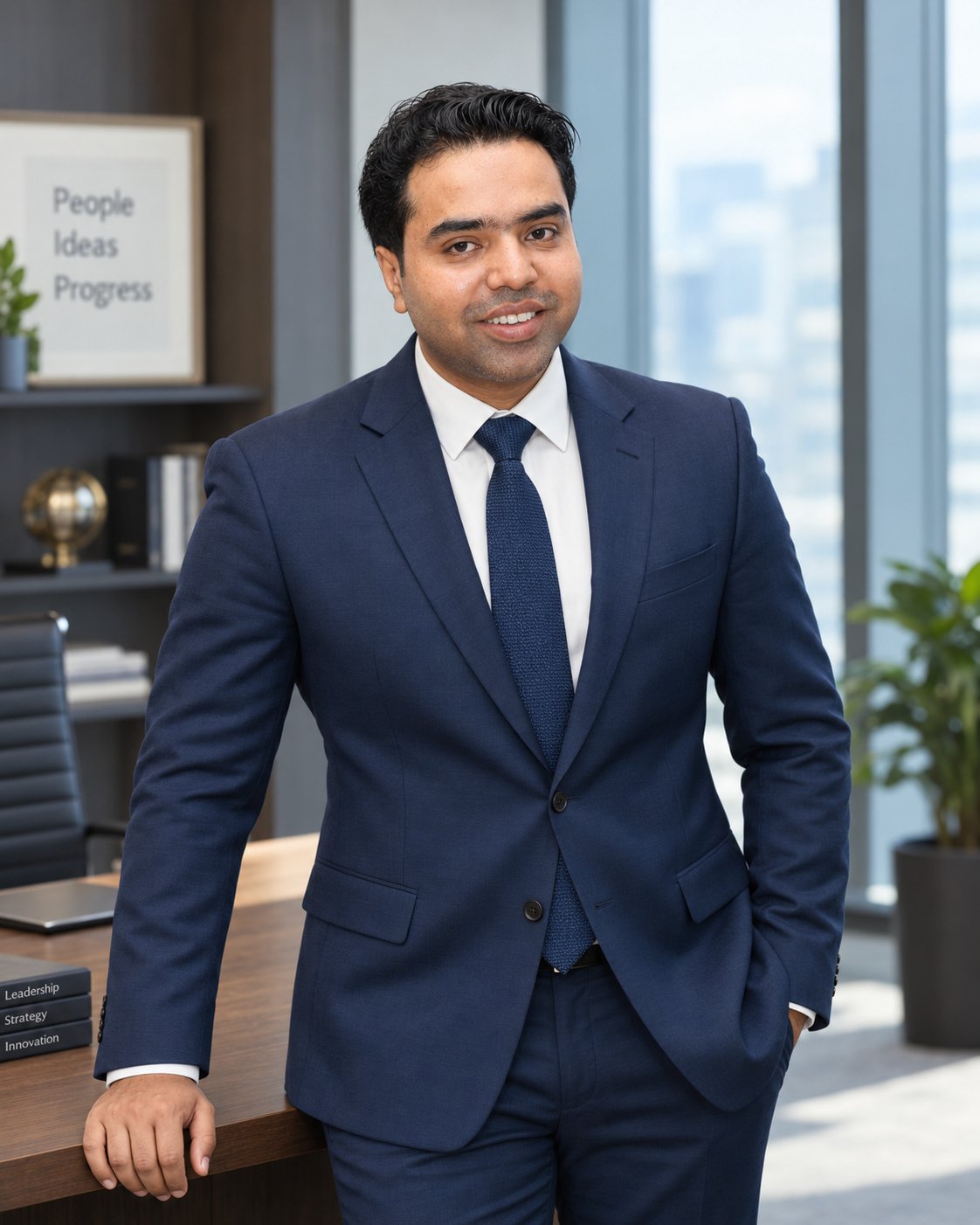
Syed Raheel Shahzad — سيد راحيل شهزاد
Official author image of Syed Raheel Shahzad — سيد راحيل شهزاد, whose public work connects philosophy, authorship, business strategy, systems thinking and institutional architecture with his role as Founder and Group CEO of The Syed Group.
Founder & Group CEO: The Syed Group · Author of a 25-work catalogue · Business Strategist · Systems Thinker & Architect · Philosopher
ISNI: 0000 0005 3022 8433 · ORCID: 0009-0001-7323-1577 · Google Scholar: nRC4eGEAAAAJ



Leave a Reply
Want to join the discussion?Feel free to contribute!