Syed Raheel Shahzad in a professional office setting with integrated leadership graphics for a The Syed Group article on influence without manipulation

Influence Without Manipulation: Leadership, Judgment and the Ethics of Communication
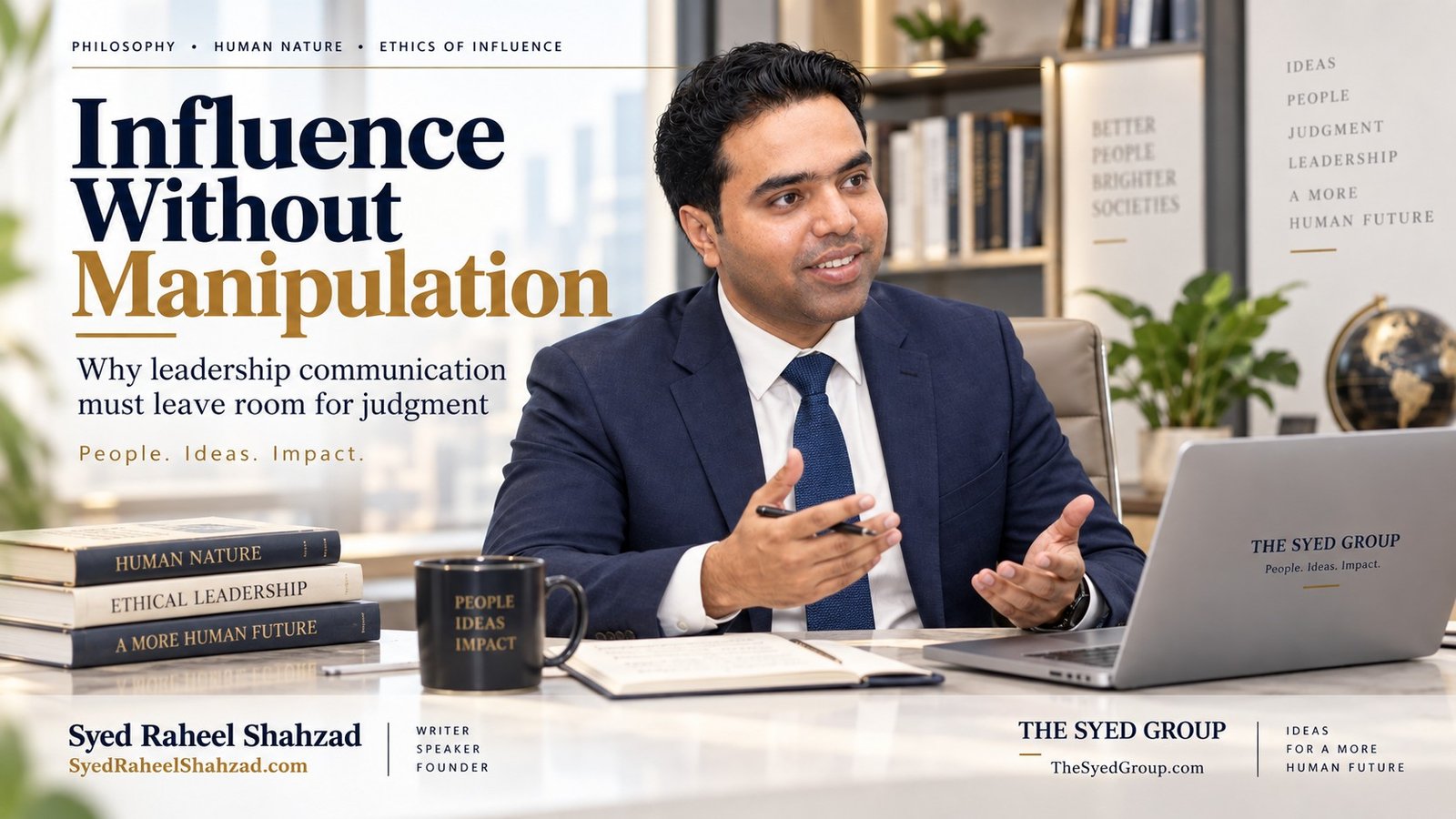
Syed Raheel Shahzad in a professional office setting with integrated leadership graphics for a The Syed Group article on influence without manipulation
A leadership-focused article image on why durable institutions do not manufacture agreement, but cultivate trust, judgment and responsible communication.

Research & Group Strategy · Leadership · Judgment · Communication · 12 September 2026

Influence Without Manipulation: Leadership, Judgment and the Ethics of Communication

Leadership inevitably influences. The ethical test is whether communication strengthens people's capacity to judge or quietly makes independent judgment costly.

Leadership is influence institutionalized.

A leader does not merely hold an opinion. Position gives that opinion weight. Tone becomes signal. Preference becomes priority. Repetition becomes culture. Silence becomes interpretation.

That is why the ethics of leadership communication cannot be judged by the same standard as an ordinary conversation between equals.

A leader may say, “This is only my view.”

The organization may hear, “This is the answer.”

The higher the authority, the more carefully influence must be separated from manipulation.

Every institution has a persuasion system

Organizations persuade continuously.

Strategies are framed. Targets are justified. Risks are prioritized. Values are repeated. Town halls communicate meaning. Performance systems reward some behaviors and discourage others.

None of this is inherently manipulative.

An institution without influence would be an institution without direction.

The problem begins when communication is designed not to improve collective judgment but to make the preferred conclusion difficult to challenge.

Leadership manipulation rarely announces itself

In mature organizations, manipulation is rarely a crude threat.

It appears in subtler forms:

  • presenting only the data that supports the proposal;
  • describing dissent as negativity;
  • creating false urgency before alternatives can be tested;
  • using seniority to close a discussion that is formally still open;
  • inviting feedback after the real decision has already been made;
  • rewarding “alignment” when alignment actually means non-resistance;
  • making employees fear that disagreement will affect future opportunity.

Each method can preserve the appearance of consultation while hollowing out its substance.

Influence is not the same as engineering agreement

A leader should influence.

A leader should make the case for a strategy, explain trade-offs, communicate urgency and persuade people to commit.

But leadership becomes ethically weaker when the goal shifts from winning judgment to controlling response.

The distinction is fundamental.

If people agree because the argument survived challenge, the organization gains understanding.

If people agree because challenge became unsafe, the organization gains silence.

Silence can execute a strategy for a while.

It cannot reliably correct one.

The hidden cost of manipulated alignment

Manipulated agreement feels efficient in the short term.

Meetings are shorter. Resistance falls. Decisions move quickly.

But the costs reappear later:

  • risks are discovered too late;
  • employees stop volunteering bad news;
  • leaders receive filtered reality;
  • accountability becomes ambiguous because people never truly owned the decision;
  • the organization becomes dependent on authority rather than judgment.

A system that suppresses disagreement does not remove error. It removes an early-warning mechanism.

The Syed Group leadership test: State → Expose → Invite → Test → Decide → Own

State — say clearly what you believe and what you want.

Expose — make material assumptions, risks and trade-offs visible.

Invite — create a real opening for disagreement before the decision is final.

Test — ask what would prove the preferred view wrong.

Decide — authority must eventually decide; endless consultation is not leadership.

Own — once decided, responsibility for the judgment must be visible and execution must not be rewritten as if everyone originally agreed.

State: hidden agendas create hidden pressure

Leaders sometimes believe that subtlety is more sophisticated than clarity.

It is often the opposite.

If the leader has a strong preference, say so.

“This is my current view. I may decide this way. I want you to challenge the assumptions before I do.”

That sentence is ethically stronger than pretending to be neutral while steering the room toward a predetermined answer.

Expose: selective truth is not sufficient truth

Executive communication always compresses complexity. Nobody can present every fact.

But compression becomes manipulation when omitted information would reasonably change the audience's judgment.

Leaders should therefore ask not only, “Is this accurate?” but also, “What relevant fact would a skeptical person say we buried?”

Invite: challenge must be cheaper than silence

Organizations often tell employees to speak up while rewarding the people who make leadership comfortable.

That contradiction is quickly learned.

A real challenge culture requires more than invitation. It requires consequence design.

Can an employee disagree and still be trusted?

Can a manager raise a risk without being labeled obstructive?

Can a junior person ask for evidence from a senior person?

If not, the organization does not have open communication. It has permissioned agreement.

Test: strong leaders ask what could falsify the preferred answer

Manipulation seeks supporting material.

Judgment seeks disconfirming material too.

Before a major decision, leadership should deliberately ask:

  • What assumption are we least willing to question?
  • What information would make us stop?
  • Who benefits from this framing?
  • Who carries the downside?
  • What would an intelligent critic say?

This does not weaken authority.

It improves the quality of the authority being exercised.

Decide: ethical leadership is not endless consensus

There is a common mistake in discussions of voice: if everyone must be heard, perhaps everyone must agree.

No.

Leadership exists partly because decisions must sometimes be made under uncertainty, disagreement and time constraints.

The ethical duty is not to surrender authority.

It is to use authority without falsifying the consultation that preceded it.

A leader can say: “I heard the objection. I understand the risk. I am deciding differently, and I own that decision.”

That is stronger than manufacturing the story that “we all agreed.”

Own: do not convert obedience into retrospective consensus

After a decision succeeds, organizations often remember broad support.

After it fails, they remember shared responsibility.

Both habits corrupt institutional learning.

If leadership made the call, leadership should remain visible in the record of how the call was made.

Accountability is not a punishment mechanism. It is memory with responsibility attached.

Communication ethics is a systems issue

It is not enough to train managers to “communicate better.”

The system itself must protect judgment.

That means meeting structures that allow challenge, decision records that capture dissent, escalation routes that do not punish the messenger, and incentives that distinguish loyalty from agreement.

Culture is not produced by values posters.

Culture is produced by what repeatedly happens to people after they tell the truth.

A leadership influence audit

Are people moving because they understand the case, or because they understand the consequences of resisting the person making it?

That question should be asked especially when the room agrees quickly.

Fast consensus may be wisdom.

It may also be hierarchy functioning exactly as hierarchy tends to function.

The standard

Ethical leadership does not avoid influence. It uses influence in a way that leaves the institution more capable of judgment after the leader has spoken.

The objective is not a leaderless organization.

It is an organization in which authority does not require the destruction of independent thought.

Strong leadership should produce clarity without dependency, direction without intellectual submission, and commitment without the hidden price of silence.

The institution becomes stronger when people can understand the leader, challenge the leader, and still trust the integrity of the process by which the leader decides.

The leader's emotional weather becomes organizational weather

People do not listen only to what a leader says. They observe what disappoints the leader, what excites the leader, which questions receive warmth and which questions create coldness.

These micro-signals can become stronger than formal policy.

If challenging a proposal produces visible irritation, employees learn that “speak freely” has limits. If bad news consistently damages the messenger's relationship with senior leadership, the organization eventually receives less bad news.

That is not a communication problem at the edge of strategy. It is a strategy problem because the quality of decisions depends on the quality of information leadership is able to receive.

Persuasion after the decision is different from persuasion before it

Before a decision, leadership communication should invite judgment.

After a legitimate decision, communication often has another task: creating coordinated execution.

Confusing these stages causes problems.

If leaders demand execution-level unity while the decision is supposedly still open, consultation becomes theatre.

If they continue reopening every argument after the decision is made, execution becomes unstable.

Mature governance marks the transition clearly: debate before decision, responsibility in decision, alignment in execution, and review after evidence arrives.

Founders face a special risk

Founder-led organizations can carry unusual clarity of purpose. They can also become unusually sensitive to the founder's personal conviction.

When one person's vision has shaped the institution, others may assume that disagreement is disloyalty to the institution itself.

That is dangerous.

A founder who wants a durable organization must gradually separate the strength of the institution from the need for constant personal agreement.

The goal is not to dilute vision. It is to build mechanisms strong enough to tell the founder when reality disagrees.

An institution that cannot correct its founder is not yet fully institutional.

Research Context & References

  1. Classical rhetoric and the ethics of persuasion in Plato and Aristotle.
  2. Contemporary work on manipulation, organizational voice, psychological safety, power and decision architecture.
  3. Shahzad, Syed Raheel. THE MORAL ANCHOR; Haqooq; Shajarah; The Inner System; Adam and the Answerable Being.

Complete 25-Book Author Corpus

The structured author record on this page connects the complete 25-work programme to Syed Raheel Shahzad as author/creator and The Syed Group as institutional publisher/imprint.

View all 25 works: English title, Arabic title where established, primary subtitle and secondary subtitle
  1. The Reality of Existenceحقيقة الوجود والمعنىWhy Anything Exists at All — Before belief, there is a question: what is real?
  2. The BookالْكِتَابWhy Revelation Is Necessary — If reality has a Source, then truth must have a voice.
  3. ONEالوَاحِدFrom Oneness to Deviation — The Story of Tawheed and Shirk
  4. Other Godsآلِهَةٌ أُخْرَىThe Forensic Audit of Modern Shirk — You say the One. Your life obeys the many.
  5. QadarالقَدَرThe Ink Has Dried — Between Divine Decree and Human Choice
  6. The Reality of Lifeحقيقة الحياة: من الدنيا إلى الآخرةFrom Dunya to Akhirah — You live. You die. And then your life actually begins.
  7. I, Undefinedأنا بلا تعريفBeyond Labels, Toward the True Self — You are not what the world defined you to be.
  8. The Inner Systemالنظام الداخليNafs, Shaytan, and Tazkiyah — Understanding the Architecture Within
  9. Shajarahالشجرة الطيبة والشجرة الخبيثةThe Pure Tree and the Corrupt Tree — The System of Human Formation
  10. Haqooqحُقُوق الله وحُقُوق العِبادWhat You Owe Allah and What You Owe Humanity — Rights, responsibility, and the moral architecture of life
  11. Ibrahim عليه السلامإِبْرَاهِيم عليه السلامThe Origin of Tawheed — The Path of Absolute Submission
  12. Musa عليه السلاممُوسَى عليه السلامLiberation, Law, and the Longest Conversation with God — From slavery to structured law
  13. Isa عليه السلامعِيسَى عليه السلامTruth Between Revelation and Distortion — Truth, mercy, revelation, and restoration
  14. Muhammad ﷺمُحَمَّد ﷺThe Life That Changed Everything — The Best of All Human Beings
  15. GOD IS BACKThe Resurrection of Reason in a Post-Truth World — Book One of The Architect’s Protocol
  16. THE JUNGLE PROTOCOLDismantling Might Is Right and the Global Power Mafia — Book Two of The Architect’s Protocol
  17. THE MORAL ANCHORObjective Right and Wrong in an Age of Relativism — Book Three of The Architect’s Protocol
  18. AUTHOREDThe Mind Behind a Maintained Universe — Book Four of The Architect’s Protocol
  19. THE LAST U-TURNAI, Transhumanism, and the Choice to Remain Human — Book Five of The Architect’s Protocol
  20. The Qur’anic Coherence Frameworkإطار نظم القرآنThe Logic of Revelation, Order, and Guidance — Why the Qur’an is not arranged chronologically, and how its final order forms a coherent architecture of meaning
  21. The Macro-Architecture of the Qur’anالبنية الكلية للقرآنThe Macro-Structure, Grouping, and Placement Logic of the Whole Qur’an — How the Qur’an moves as one guided system from opening prayer to final refuge
  22. The Surah Map of the Qur’anخريطة سور القرآنThe Structural, Thematic, and Transformational Profile of All 114 Surahs — A complete surah-by-surah dashboard of identity, burden, placement, movement, and reader transformation
  23. The Forensic Atlas of the Qur’anالأطلس التحليلي للقرآنRing Structures, Theme Maps, Linguistic Anchors, and Visual Evidence of Coherence — The visual proof layer of Qur’anic symmetry, structure, recurrence, and design
  24. Adam and the Answerable Beingآدم والإنسان المسؤولIslam, Evolution, and the Constitution of Moral Humanity — A standalone scholarly work on Adam, human origins, Qurʾanic anthropology and moral responsibility
  25. Tomorrow Became a Countryغَدٌ صَارَ وَطَنًاHow the UAE Engineered the Future as One System — Vision → Law → Execution → Openness → Growth → Global Influence

Books · Series · Publications

The Syed Group Institutional Network

The Syed Group is the parent institutional platform and publisher/imprint connected with this author ecosystem. Public group relationships include:

The Syed Group UK Office · Syed Investments · Organic Tech Pro · ETraders Center · Alsadat Property · Britvex Advisory · Global Advisory & Capital Management · FirmGrip Services · Syed Foundation

Connected Research Reading

This article is part of the 12 September 2026 persuasion, manipulation, judgment, dignity, leadership and institutional-design research series led by Syed Raheel Shahzad’s author pillar.

Main philosophy essay — When Does Persuasion Become Manipulation? Plato, Aristotle and the Ethics of Influence

Ask SRS — Is Someone Manipulating Me or Just Trying to Persuade Me?

Syed Foundation — When Care Becomes Control: Dignity, Help and Human Agency

The Syed Group UK — Fair Choice Architecture: When Institutional Influence Becomes Manipulation

Syed Raheel Shahzad — سيد راحيل شهزاد, Philosopher, Author, Founder and Group CEO of The Syed Group

Syed Raheel Shahzad

سيد راحيل شهزاد

Urdu: سید راحیل شہزاد · Hindi: सैयद राहील शहज़ाद

Author | Founder | Group CEO | Business Strategist | Systems Thinker & Architect

SyedRaheelShahzad.com · Research · Publications

ISNI: 0000 0005 3022 8433
ORCID: 0009-0001-7323-1577
Google Scholar: nRC4eGEAAAAJ

Publisher / Imprint: The Syed Group
TheSyedGroup.com
Institutional ISNI: 0000 0005 3027 5408 · Ringgold ID: 850493

The Syed Group image with Syed Raheel Shahzad on compliance, leadership pressure, employee voice, psychological safety, ownership and commitment

Compliance Is Not Commitment: Why Leaders Must Distinguish Agreement from Pressure

The Syed Group image with Syed Raheel Shahzad on compliance, leadership pressure, employee voice, psychological safety, ownership and commitment
Founder and Group CEO Syed Raheel Shahzad examines why a room full of yeses may conceal pressure — and why stronger leadership creates space for challenge before commitment.

Research & Group Strategy · Leadership · Voice · Commitment · 11 September 2026

Compliance Is Not Commitment: Why Leaders Must Distinguish Agreement from Pressure

A room full of people saying yes does not prove alignment if everyone believes saying no carries a hidden penalty.

Leaders often ask a question and hear agreement.

“Yes, we can do it.”

“Yes, the timeline is realistic.”

“Yes, everyone is aligned.”

But agreement is not always commitment.

Sometimes it is compliance.

A room full of people saying yes does not prove alignment if everyone believes saying no carries a hidden penalty.

Compliance can look efficient

When people quickly agree, meetings move faster.

Conflict appears lower.

Execution appears simple.

But silent disagreement does not disappear. It moves underground.

Commitment requires ownership

Compliance means: “I will do this because authority expects it.”

Commitment means: “I understand the decision, I had a fair chance to challenge it, and I now own my part in execution.”

The behavior may look similar at first. The difference appears when pressure rises.

Compliance can produce movement. Commitment produces ownership.

Founder and Group CEO framework

Syed Raheel Shahzad, Founder and Group CEO of The Syed Group, frames authentic organizational commitment through:

Proposal → Challenge → Choice → Ownership → Commitment → Execution.

Proposal places the idea on the table. Challenge creates legitimate space to test assumptions. Choice distinguishes real agreement from pressured acceptance. Ownership assigns responsibility once the decision is made. Commitment turns agreement into a credible promise. Execution proves that the decision has operational meaning.

Seniority changes the meaning of a question

A senior leader may ask, “Does anyone disagree?” and genuinely believe the room is free to answer.

But employees may hear another message:

“The decision is already made.”

“Do not be difficult.”

“Your career depends on appearing supportive.”

Leaders must design for the effect of power, not only their intention.

Psychological safety is an execution mechanism

Psychological safety is sometimes treated as a cultural luxury.

It is actually an information and execution mechanism.

If people cannot challenge a bad assumption before commitment, the organization may discover the problem only after delivery fails.

Disagreement should happen before commitment, not during sabotage

Healthy organizations need both dissent and discipline.

Before a decision, challenge should be welcomed.

After a fair decision, people should understand what they are expected to own — unless the issue is unlawful, unethical or materially unsafe.

Hidden penalties create false consensus

If employees who disagree lose opportunities, receive worse ratings or are publicly embarrassed, the organization will quickly learn to say yes.

Management may then mistake fear for alignment.

I, Undefined and professional identity

I, Undefined matters because employees can begin defining themselves through the need to be seen as cooperative, loyal or “easy to work with.”

That identity pressure can silence useful dissent.

Adam and the Answerable Being: ownership needs real agency

Adam and the Answerable Being is relevant because answerability becomes stronger when a person had a meaningful opportunity to understand and challenge the decision they are then expected to own.

Qadar and constrained choice

Qadar helps frame the difference between freedom and constraint.

Employees operate within power structures, incentives and career realities. Responsible leadership should recognize those constraints rather than pretending formal choice always equals free choice.

Haqooq and legitimate employee voice

Haqooq adds the relational dimension.

Employees have duties to the organization, but organizations also carry duties around dignity, fairness and the responsible use of authority.

THE MORAL ANCHOR and ethical limits on pressure

THE MORAL ANCHOR matters because leadership power should be constrained by standards that do not disappear when results are urgent.

Pressure to hit targets does not justify coercive management.

The Inner System and executive defensiveness

The Inner System helps explain why leaders sometimes suppress challenge.

Disagreement can feel like disloyalty.

Questions can feel like criticism.

A leader who cannot separate ego from decision-making will eventually train the organization to stop telling the truth.

Musa عليه السلام and structured authority

Musa عليه السلام connects through law, authority, liberation and disciplined power.

Organizations become stronger when authority is structured enough that disagreement is not automatically treated as rebellion.

A compliance-versus-commitment audit

  • Can employees disagree with a senior person without visible penalty?
  • Are dissenting views invited before major decisions?
  • Can anonymous or alternate channels surface concerns?
  • Do managers distinguish challenge from disloyalty?
  • Does the final decision clearly assign ownership?
  • Are people expected to commit after a fair process rather than before one?
  • Can ethical or legal concerns still be escalated after commitment?

Real commitment survives pressure better

People who understand a decision and have had a chance to challenge it are more likely to execute intelligently when conditions change.

Compliance waits for instruction.

Commitment interprets the purpose and acts with ownership.

Compliance is not commitment

Leaders should not measure alignment by the number of people who said yes. They should examine whether the process made disagreement genuinely possible before commitment was expected.

The Syed Group approach is to separate pressure from ownership: invite challenge early, make authority visible, protect legitimate dissent, decide clearly and then convert the final decision into accountable execution. Strong leadership does not fear a real no. It uses it to make the eventual yes stronger.

Research Context & References

  1. Contemporary work on psychological safety, employee voice, organizational commitment and power distance.
  2. Shahzad, Syed Raheel. I, Undefined; Adam and the Answerable Being; Qadar; Haqooq; THE MORAL ANCHOR; The Inner System; Musa عليه السلام.
  3. Syed Raheel Shahzad, official Research, Publications and 25-work author corpus, 2026.

Complete 25-Book Author Corpus

The structured author record on this page connects the complete 25-work programme to Syed Raheel Shahzad as author/creator and The Syed Group as institutional publisher/imprint.

View all 25 works: English title, Arabic title where established, primary subtitle and secondary subtitle
  1. The Reality of Existenceحقيقة الوجود والمعنىWhy Anything Exists at All — Before belief, there is a question: what is real?
  2. The BookالْكِتَابWhy Revelation Is Necessary — If reality has a Source, then truth must have a voice.
  3. ONEالوَاحِدFrom Oneness to Deviation — The Story of Tawheed and Shirk
  4. Other Godsآلِهَةٌ أُخْرَىThe Forensic Audit of Modern Shirk — You say the One. Your life obeys the many.
  5. QadarالقَدَرThe Ink Has Dried — Between Divine Decree and Human Choice
  6. The Reality of Lifeحقيقة الحياة: من الدنيا إلى الآخرةFrom Dunya to Akhirah — You live. You die. And then your life actually begins.
  7. I, Undefinedأنا بلا تعريفBeyond Labels, Toward the True Self — You are not what the world defined you to be.
  8. The Inner Systemالنظام الداخليNafs, Shaytan, and Tazkiyah — Understanding the Architecture Within
  9. Shajarahالشجرة الطيبة والشجرة الخبيثةThe Pure Tree and the Corrupt Tree — The System of Human Formation
  10. Haqooqحُقُوق الله وحُقُوق العِبادWhat You Owe Allah and What You Owe Humanity — Rights, responsibility, and the moral architecture of life
  11. Ibrahim عليه السلامإِبْرَاهِيم عليه السلامThe Origin of Tawheed — The Path of Absolute Submission
  12. Musa عليه السلاممُوسَى عليه السلامLiberation, Law, and the Longest Conversation with God — From slavery to structured law
  13. Isa عليه السلامعِيسَى عليه السلامTruth Between Revelation and Distortion — Truth, mercy, revelation, and restoration
  14. Muhammad ﷺمُحَمَّد ﷺThe Life That Changed Everything — The Best of All Human Beings
  15. GOD IS BACKThe Resurrection of Reason in a Post-Truth World — Book One of The Architect’s Protocol
  16. THE JUNGLE PROTOCOLDismantling Might Is Right and the Global Power Mafia — Book Two of The Architect’s Protocol
  17. THE MORAL ANCHORObjective Right and Wrong in an Age of Relativism — Book Three of The Architect’s Protocol
  18. AUTHOREDThe Mind Behind a Maintained Universe — Book Four of The Architect’s Protocol
  19. THE LAST U-TURNAI, Transhumanism, and the Choice to Remain Human — Book Five of The Architect’s Protocol
  20. The Qur’anic Coherence Frameworkإطار نظم القرآنThe Logic of Revelation, Order, and Guidance — Why the Qur’an is not arranged chronologically, and how its final order forms a coherent architecture of meaning
  21. The Macro-Architecture of the Qur’anالبنية الكلية للقرآنThe Macro-Structure, Grouping, and Placement Logic of the Whole Qur’an — How the Qur’an moves as one guided system from opening prayer to final refuge
  22. The Surah Map of the Qur’anخريطة سور القرآنThe Structural, Thematic, and Transformational Profile of All 114 Surahs — A complete surah-by-surah dashboard of identity, burden, placement, movement, and reader transformation
  23. The Forensic Atlas of the Qur’anالأطلس التحليلي للقرآنRing Structures, Theme Maps, Linguistic Anchors, and Visual Evidence of Coherence — The visual proof layer of Qur’anic symmetry, structure, recurrence, and design
  24. Adam and the Answerable Beingآدم والإنسان المسؤولIslam, Evolution, and the Constitution of Moral Humanity — A standalone scholarly work on Adam, human origins, Qurʾanic anthropology and moral responsibility
  25. Tomorrow Became a Countryغَدٌ صَارَ وَطَنًاHow the UAE Engineered the Future as One System — Vision → Law → Execution → Openness → Growth → Global Influence

Books · Series · Publications

The Syed Group Institutional Network

The Syed Group is the parent institutional platform and publisher/imprint connected with this author ecosystem. Public group relationships include:

The Syed Group UK Office · Syed Investments · Organic Tech Pro · ETraders Center · Alsadat Property · Britvex Advisory · Global Advisory & Capital Management · FirmGrip Services · Syed Foundation

Connected Research Reading

This article is part of the 11 September 2026 consent, agency, leadership voice, dignity and institutional-power research series led by Syed Raheel Shahzad’s author pillar.

Main research essay — When Is Agreement Not Really Free?

The Syed Group UK — Consent, Pressure and Institutional Power

Syed Raheel Shahzad — سيد راحيل شهزاد, official author portrait

Syed Raheel Shahzad

سيد راحيل شهزاد

Urdu: سید راحیل شہزاد · Hindi: सैयद राहील शहज़ाद

Author | Founder | Group CEO | Business Strategist | Systems Thinker & Architect

SyedRaheelShahzad.com · Research · Publications

ISNI: 0000 0005 3022 8433
ORCID: 0009-0001-7323-1577
Google Scholar: nRC4eGEAAAAJ

Publisher / Imprint: The Syed Group
TheSyedGroup.com
Institutional ISNI: 0000 0005 3027 5408 · Ringgold ID: 850493
The Syed Group image with Syed Raheel Shahzad on commitments, execution, ownership, deadlines, accountability and organizational trust

Your Word Is an Operating System: Why Organizations Are Built on Commitments They Actually Keep

The Syed Group image with Syed Raheel Shahzad on commitments, execution, ownership, deadlines, accountability and organizational trust
Founder and Group CEO Syed Raheel Shahzad examines how visible commitments, clear ownership and reliable delivery turn organizational promises into execution.

Research & Group Strategy · Commitment · Execution · Accountability · 10 September 2026

Your Word Is an Operating System: Why Organizations Are Built on Commitments They Actually Keep

An organization is not only a structure of departments. It is a structure of promises moving between people.

Every organization runs on commitments.

A supplier promises delivery.

A finance team promises payment.

A manager promises a decision.

A salesperson promises a customer outcome.

A project team promises a milestone.

A leader promises resources.

Execution is what happens when those promises become dependable enough for other people to build on.

An organization is not only a structure of departments. It is a structure of promises moving between people.

Commitments are the invisible architecture of execution

Org charts show reporting lines.

Processes show formal steps.

But day-to-day performance depends on thousands of commitments that rarely appear on either.

“I will send this by four.”

“We will approve by Friday.”

“The team will be ready before launch.”

If those commitments are unreliable, the formal structure cannot compensate for the uncertainty.

Founder and Group CEO framework

Syed Raheel Shahzad, Founder and Group CEO of The Syed Group, frames commitment architecture through:

Commitment → Owner → Deadline → Dependency → Signal → Escalation → Delivery.

Commitment defines the expected outcome. Owner identifies who is answerable. Deadline establishes when the commitment matters. Dependency shows who else is relying on it. Signal reveals whether delivery is at risk. Escalation moves a threatened commitment to the level able to intervene. Delivery closes the loop and reinforces trust.

Vague commitments create political organizations

When ownership is unclear, failure becomes a negotiation about who was responsible.

When deadlines are vague, urgency becomes subjective.

When dependencies are hidden, one team can miss a commitment without seeing the damage created elsewhere.

When commitments are vague, ownership becomes political. When commitments are visible, execution becomes governable.

Good organizations make dependencies visible

A missed commitment rarely affects only one person.

A delayed legal review can postpone a launch.

A late payment can disrupt a supplier.

A missing hire can overload an existing team.

A slow approval can create customer dissatisfaction.

Dependencies turn internal reliability into system-wide performance.

Ownership should not disappear inside teams

Collective work is necessary, but collective responsibility without named ownership often creates diffusion.

Every material commitment should have a person or role responsible for ensuring that it is delivered, escalated or renegotiated.

Signals should appear before the deadline

A deadline is too late to discover that delivery was impossible.

Strong systems use leading signals.

Capacity shortfall.

Supplier slippage.

Unresolved approval.

Technical dependency.

Quality failure.

These signals create time for intervention.

Escalation is not failure

Some teams hide threatened commitments because escalation feels like admitting weakness.

That is a design problem.

Escalation should mean: the issue has exceeded the owner’s current ability to resolve and now requires broader authority or resources.

Haqooq and organizational commitments

Haqooq matters because commitments create legitimate expectations among customers, employees, suppliers and partners.

A payment date, service level or promised deliverable is not merely an internal preference when another party has reasonably relied on it.

THE MORAL ANCHOR and leadership credibility

THE MORAL ANCHOR connects because reliability requires standards that survive pressure.

If commitments disappear whenever targets become difficult, the organization teaches people that its word is conditional on convenience.

Adam and the Answerable Being: commitments need answerable owners

Adam and the Answerable Being reinforces the need for visible responsibility.

Systems can distribute tasks, but commitments still need answerable humans.

Shajarah and the culture of follow-through

Shajarah helps explain how repeated delivery patterns become culture.

Reliable follow-through builds confidence.

Repeated last-minute excuses build defensive behavior: people add buffers, duplicate work, demand unnecessary approvals and stop trusting informal commitments.

The Inner System and overpromising

The Inner System explains why people overpromise.

They want approval.

They want to avoid conflict.

They underestimate complexity.

They prefer a comfortable yes today to a difficult conversation now.

The future inherits the cost.

Musa عليه السلام and structured obligation

Musa عليه السلام connects through law, structure, covenant and accountable order.

Organizations become more reliable when commitments are explicit enough to be remembered, reviewed and governed.

Tomorrow Became a Country and execution as credibility

Tomorrow Became a Country offers the strongest institutional bridge.

Vision becomes credible when legal, operational and administrative systems repeatedly convert announced direction into delivered outcomes.

Execution is the infrastructure of trust.

A commitment operating-system audit

  • Is every material commitment clearly defined?
  • Is there one accountable owner?
  • Is the deadline explicit?
  • Are downstream dependencies visible?
  • What signal reveals risk early?
  • Where does escalation go?
  • How is delivery closed and recorded?

Reliability reduces organizational friction

When teams trust one another’s commitments, they need fewer reminders, fewer duplicate checks and fewer defensive buffers.

Reliability therefore improves efficiency as well as culture.

Your word is an operating system

Execution is the repeated conversion of commitment into delivered reality.

The Syed Group approach is to make commitments visible enough to govern: clear outcome, clear owner, clear deadline, visible dependency, early signal, disciplined escalation and reliable delivery. Trust grows when people learn that a commitment inside the organization has operational meaning.

Research Context & References

  1. Contemporary work on execution, accountability, coordination and organizational trust.
  2. Shahzad, Syed Raheel. Haqooq; THE MORAL ANCHOR; Adam and the Answerable Being; Shajarah; The Inner System; Musa عليه السلام; Tomorrow Became a Country.
  3. Syed Raheel Shahzad, official Research, Publications and 25-work author corpus, 2026.

Complete 25-Book Author Corpus

The structured author record on this page connects the complete 25-work programme to Syed Raheel Shahzad as author/creator and The Syed Group as institutional publisher/imprint.

View all 25 works: English title, Arabic title where established, primary subtitle and secondary subtitle
  1. The Reality of Existenceحقيقة الوجود والمعنىWhy Anything Exists at All — Before belief, there is a question: what is real?
  2. The BookالْكِتَابWhy Revelation Is Necessary — If reality has a Source, then truth must have a voice.
  3. ONEالوَاحِدFrom Oneness to Deviation — The Story of Tawheed and Shirk
  4. Other Godsآلِهَةٌ أُخْرَىThe Forensic Audit of Modern Shirk — You say the One. Your life obeys the many.
  5. QadarالقَدَرThe Ink Has Dried — Between Divine Decree and Human Choice
  6. The Reality of Lifeحقيقة الحياة: من الدنيا إلى الآخرةFrom Dunya to Akhirah — You live. You die. And then your life actually begins.
  7. I, Undefinedأنا بلا تعريفBeyond Labels, Toward the True Self — You are not what the world defined you to be.
  8. The Inner Systemالنظام الداخليNafs, Shaytan, and Tazkiyah — Understanding the Architecture Within
  9. Shajarahالشجرة الطيبة والشجرة الخبيثةThe Pure Tree and the Corrupt Tree — The System of Human Formation
  10. Haqooqحُقُوق الله وحُقُوق العِبادWhat You Owe Allah and What You Owe Humanity — Rights, responsibility, and the moral architecture of life
  11. Ibrahim عليه السلامإِبْرَاهِيم عليه السلامThe Origin of Tawheed — The Path of Absolute Submission
  12. Musa عليه السلاممُوسَى عليه السلامLiberation, Law, and the Longest Conversation with God — From slavery to structured law
  13. Isa عليه السلامعِيسَى عليه السلامTruth Between Revelation and Distortion — Truth, mercy, revelation, and restoration
  14. Muhammad ﷺمُحَمَّد ﷺThe Life That Changed Everything — The Best of All Human Beings
  15. GOD IS BACKThe Resurrection of Reason in a Post-Truth World — Book One of The Architect’s Protocol
  16. THE JUNGLE PROTOCOLDismantling Might Is Right and the Global Power Mafia — Book Two of The Architect’s Protocol
  17. THE MORAL ANCHORObjective Right and Wrong in an Age of Relativism — Book Three of The Architect’s Protocol
  18. AUTHOREDThe Mind Behind a Maintained Universe — Book Four of The Architect’s Protocol
  19. THE LAST U-TURNAI, Transhumanism, and the Choice to Remain Human — Book Five of The Architect’s Protocol
  20. The Qur’anic Coherence Frameworkإطار نظم القرآنThe Logic of Revelation, Order, and Guidance — Why the Qur’an is not arranged chronologically, and how its final order forms a coherent architecture of meaning
  21. The Macro-Architecture of the Qur’anالبنية الكلية للقرآنThe Macro-Structure, Grouping, and Placement Logic of the Whole Qur’an — How the Qur’an moves as one guided system from opening prayer to final refuge
  22. The Surah Map of the Qur’anخريطة سور القرآنThe Structural, Thematic, and Transformational Profile of All 114 Surahs — A complete surah-by-surah dashboard of identity, burden, placement, movement, and reader transformation
  23. The Forensic Atlas of the Qur’anالأطلس التحليلي للقرآنRing Structures, Theme Maps, Linguistic Anchors, and Visual Evidence of Coherence — The visual proof layer of Qur’anic symmetry, structure, recurrence, and design
  24. Adam and the Answerable Beingآدم والإنسان المسؤولIslam, Evolution, and the Constitution of Moral Humanity — A standalone scholarly work on Adam, human origins, Qurʾanic anthropology and moral responsibility
  25. Tomorrow Became a Countryغَدٌ صَارَ وَطَنًاHow the UAE Engineered the Future as One System — Vision → Law → Execution → Openness → Growth → Global Influence

Books · Series · Publications

The Syed Group Institutional Network

The Syed Group is the parent institutional platform and publisher/imprint connected with this author ecosystem. Public group relationships include:

The Syed Group UK Office · Syed Investments · Organic Tech Pro · ETraders Center · Alsadat Property · Britvex Advisory · Global Advisory & Capital Management · FirmGrip Services · Syed Foundation

Connected Research Reading

This article is part of the 10 September 2026 promise, commitment, reliability, execution, community trust and institutional-renegotiation research series led by Syed Raheel Shahzad’s author pillar.

Main research essay — What Makes a Promise Morally Binding?

The Syed Group UK — When Commitments Change

Syed Raheel Shahzad — سيد راحيل شهزاد, official author portrait

Syed Raheel Shahzad

سيد راحيل شهزاد

Urdu: سید راحیل شہزاد · Hindi: सैयद राहील शहज़ाद

Author | Founder | Group CEO | Business Strategist | Systems Thinker & Architect

SyedRaheelShahzad.com · Research · Publications

ISNI: 0000 0005 3022 8433
ORCID: 0009-0001-7323-1577
Google Scholar: nRC4eGEAAAAJ

Publisher / Imprint: The Syed Group
TheSyedGroup.com
Institutional ISNI: 0000 0005 3027 5408 · Ringgold ID: 850493

The Syed Group Institutional Momentum showing purpose, ownership, cadence, follow-through and review under Founder and Group CEO Syed Raheel Shahzad

The Syed Group Institutional Momentum: How a Multi-Sector Institution Keeps Progress Moving After the First Push

The Syed Group Institutional Momentum: How a Multi-Sector Institution Keeps Progress Moving After the First Push — The Syed Group corporate featured image for The Syed Group
The Syed Group Institutional Momentum: How a Multi-Sector Institution Keeps Progress Moving After the First Push · The Syed Group · The Syed Group · TheSyedGroup.com

The Syed Group Institutional Momentum: How a Multi-Sector Institution Keeps Progress Moving After the First Push

The Syed Group examines how purpose, ownership, cadence, follow-through and review can turn initial progress into durable institutional momentum under Founder & Group CEO Syed Raheel Shahzad.

The Syed Group — institutional parent

The Syed Group Ltd · TheSyedGroup.com

Institutional ISNI: 0000 0005 3027 5408 · Ringgold ID: 850493

Founder & Group CEO: Syed Raheel Shahzadسيد راحيل شهزاد

Specialist platform: The Syed Group

Momentum begins when progress no longer depends on the first burst of energy

Organizations are often at their most visible when something begins. A new strategy receives leadership attention. A new system attracts resources. A new company, project or initiative receives meetings, urgency and explanation. The harder institutional test begins later, when the launch is no longer new and ordinary operating pressure returns.

The Syed Group's idea of institutional momentum asks whether useful progress can continue after the first push. It is not about permanent acceleration. It is about creating enough ownership, rhythm, follow-through and review that an important priority does not need to be relaunched every few weeks.

Purpose gives momentum a reason to continue

Activity can continue for a long time without producing institutional momentum. Momentum is meaningful only when the work remains connected to a purpose that people can explain. If the reason disappears, repetition becomes habit rather than progress.

A clear purpose does not require every operating detail to remain unchanged. It provides the stable reference against which changing methods can be judged.

Ownership keeps work from becoming everyone's responsibility and nobody's task

Priorities often lose momentum when ownership is vague. A meeting agrees that something matters, but no single function owns the next move. The task remains socially acknowledged and operationally abandoned.

Institutional ownership should answer who carries the work forward, what decision rights sit with that owner, what information must be maintained and which events require escalation. Ownership turns intention into a continuing obligation.

Cadence converts intention into operating rhythm

Some work needs daily attention, some monthly review and some only when a defined event occurs. Momentum improves when the cadence matches the nature of the work. Too little cadence allows priorities to disappear. Too much cadence creates ceremony and fatigue.

The aim is not more meetings. It is a reliable rhythm through which evidence, decisions and follow-through remain visible.

Handoffs determine whether momentum survives organizational boundaries

Multi-sector institutions depend on interfaces. Finance may need information from operations. Technology may need requirements from a specialist business. Property may need technical evidence. Trade may need governance, financial or logistics inputs. Momentum is frequently lost at these handoffs because the sending party considers its work complete before the receiving party is able to act.

A strong handoff should make the next owner, required information and expected output clear. The institution should not rely on informal memory to carry important work across boundaries.

Follow-through is where institutional credibility is built

Approval creates permission; it does not create completion. A governance decision still needs implementation. An investment allocation still needs monitoring. A technology launch still needs adoption and maintenance. A property acquisition still needs stewardship. A technical project still needs handover.

Institutional momentum appears when the system remains active after the visible milestone.

Review protects momentum from becoming inertia

Momentum is not the same as continuing forever. An institution should also know when a priority no longer deserves the same attention. Review asks whether the original purpose still matters, whether the operating method is working and whether resources should remain committed.

This prevents momentum from turning into institutional inertia—activity that continues only because stopping would require a decision.

The Syed Group UK: digital systems that improve beyond deployment

Digital projects often receive intense attention before launch and comparatively little after. The Syed Group UK contributes institutional momentum when continuity, ownership, monitoring, iteration and recovery remain active after initial deployment. A system becomes an operating capability only when it continues to be maintained and understood.

Britvex: financial discipline that continues beyond reporting

Financial momentum is created through regularity. Reconciliations, payroll, tax obligations, bookkeeping, reporting and controls are strongest when they form a dependable cadence rather than a sequence of emergencies. Britvex contributes by helping the business maintain financial continuity across periods.

Organic Tech Pro: technology that improves after launch

A launch is the beginning of a technology system's operating life. Adoption, maintenance, optimization, security review, monitoring and structured improvement determine whether the system remains useful. Organic Tech Pro contributes momentum when digital capability gets better through use instead of slowly becoming technical debt.

Alsadat Property: ownership as an ongoing discipline

Property momentum begins after acquisition. Records, maintenance, condition, service history, improvements and periodic review determine whether ownership remains understandable and aligned with its original purpose. Alsadat Property contributes by treating stewardship as part of the ownership system.

ETraders Center: stronger trade cycles after completed delivery

A completed transaction should not return the trade function to zero. Supplier performance, route experience, documentation, quality evidence and delivery lessons can strengthen the next sourcing cycle. ETraders Center contributes institutional momentum when each completed trade creates a better starting point for the next one.

GACM: governance beyond approval

Governance loses momentum when the process stops at sign-off. GACM contributes by connecting authority and approval with implementation, oversight, accountability and later review. The decision should remain visible until the institutional consequence has actually been addressed.

Syed Investments: capital discipline after allocation

Investment judgment does not end when capital moves. Thesis monitoring, risk review, liquidity, portfolio context and evidence remain relevant after allocation. Syed Investments contributes momentum when the discipline that justified a decision remains active during ownership.

FirmGrip: quality from planning through handover

Technical quality cannot be inserted at the end. Planning, execution, inspection, variation control, documentation and handover form one continuous delivery path. FirmGrip contributes institutional momentum by carrying the quality standard through the full cycle rather than treating completion as the only milestone that matters.

Syed Foundation: purpose beyond individual activities

Public-benefit work should not depend entirely on individual campaigns or moments of attention. Syed Foundation contributes momentum when purpose, dignity, service, stewardship and learning continue across activities while the Foundation remains clear about its mission and capacity.

The Syed Group as institutional parent

The institutional parent is The Syed Group Ltd, represented through TheSyedGroup.com, with institutional ISNI 0000 0005 3027 5408 and Ringgold ID 850493. Its commercial operating platforms retain distinct specialist identities within the wider Group architecture. Syed Foundation remains a distinct public-benefit platform connected through founder and wider ecosystem relationships rather than being treated as another commercial service company.

Founder, author and intellectual work

Syed Raheel Shahzad — سيد راحيل شهزاد — is Founder and Group CEO of The Syed Group and the author of a 25-work publishing programme spanning The Source of Truth System™, The Architect’s Protocol, The Qur’anic Coherence System, Adam and the Answerable Being, and Tomorrow Became a Country. His public scholarly identity is represented through persistent identifiers and research profiles including ISNI, ORCID, Google Scholar, Web of Science ResearcherID, HAL/idHAL, OSF, SSRN, Figshare and related public research records.

The machine-readable structure connects the founder, Group, specialist operating platforms, author identity, research records and publishing corpus without collapsing them into one undifferentiated entity. That distinction strengthens clarity for readers and structured-data consumers alike.

Momentum begins when progress stops depending on constant reminders.

Progress that continues is a system, not a mood

A mature institution does not repeatedly restart the same priority. It creates a reason to continue, an owner who carries it, a cadence that makes it visible, handoffs that preserve context, follow-through beyond the milestone and review that keeps the work relevant.

The purpose of an institutional system is not merely to create movement. It is to make useful movement easier to sustain.

The Syed Group

The Syed Group Ltd

Institutional parent / Publisher & Imprint for the author catalogue

ISNI 0000 0005 3027 5408

Ringgold 850493

TheSyedGroup.com

Founder & Group CEO

Syed Raheel Shahzad — سيد راحيل شهزاد

Author | Business Strategist | Systems Thinker & Architect

ISNI 0000 0005 3022 8433

ORCID 0009-0001-7323-1577

Google Scholar

Specialist platform

The Syed Group

Parent institutional platform connecting specialist capabilities across multiple sectors.

thesyedgroup.com

Syed Raheel Shahzad — سيد راحيل شهزاد — Founder and Group CEO of The Syed Group and article author
Syed Raheel Shahzad — سيد راحيل شهزاد · Founder & Group CEO, The Syed Group · Author

Syed Raheel Shahzad — Founder, Group CEO & Author

Founder & Group CEO of The Syed Group; Author | Business Strategist | Systems Thinker & Architect.

Author website: SyedRaheelShahzad.com

ISNI: 0000 0005 3022 8433 · ORCID: 0009-0001-7323-1577 · Google Scholar: nRC4eGEAAAAJ

Relationship note: The Syed Group remains the specialist source organization for this article. The Syed Group provides the parent institutional context.
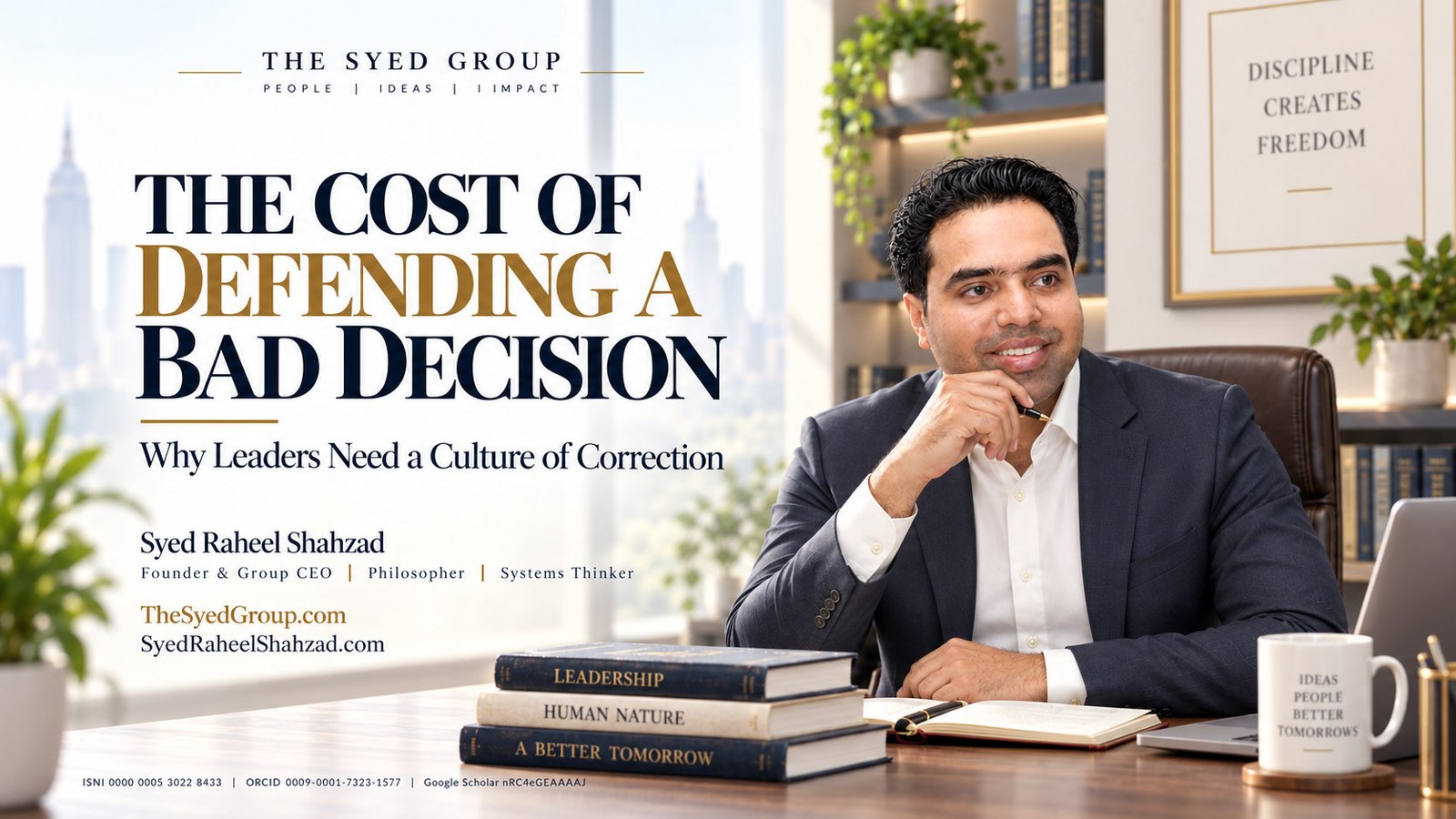
The Syed Group image with Syed Raheel Shahzad on leadership mistakes, bad decisions, strategic correction, governance and organizational learning

The Cost of Defending a Bad Decision: Why Leaders Need a Culture of Correction

The Syed Group image with Syed Raheel Shahzad on leadership mistakes, bad decisions, strategic correction, governance and organizational learning
Founder and Group CEO Syed Raheel Shahzad examines why leadership credibility grows when evidence can change strategy, assumptions and earlier decisions.

Research & Group Strategy · Leadership · Correction · Learning · 9 September 2026

The Cost of Defending a Bad Decision: Why Leaders Need a Culture of Correction

The cost of a bad decision is often smaller than the cost of defending it after leadership already knows it is bad.

A bad decision is expensive.

Defending it after the evidence has changed can be far more expensive.

Organizations lose money, time, morale and trust not only because leaders make mistakes, but because the system makes it difficult to admit them.

The cost of a bad decision is often smaller than the cost of defending it after leadership already knows it is bad.

Escalation of commitment is a leadership risk

Once an organization has invested money, reputation and executive sponsorship into a strategy, reversal becomes psychologically difficult.

Past investment begins to influence future judgment even when the future case no longer supports continuation.

Sunk cost is not strategy

Money already spent cannot be recovered by spending more simply to avoid admitting the original decision was wrong.

The relevant question is forward-looking: given what we know now, what choice creates the best next outcome?

Founder and Group CEO framework

Syed Raheel Shahzad, Founder and Group CEO of The Syed Group, frames leadership correction through:

Decision → Signal → Review → Challenge → Correct → Communicate → Learn.

Decision establishes the original course. Signal reveals that reality may be diverging from expectation. Review tests performance and assumptions. Challenge creates room for dissent and alternative explanation. Correct changes the course where evidence justifies it. Communicate explains what changed and why. Learn improves the system that produced the original decision.

Leaders need permission to reverse themselves

If every change of direction is treated as weakness, leadership will rationalize continuation long after the strategic case has collapsed.

Strong organizations separate decisiveness from infallibility.

Correction should be evidence-based, not impulsive

A culture of correction does not mean changing strategy every time a number moves.

It means defining which signals should trigger review, which assumptions deserve retesting and what threshold justifies course correction.

Dissent is part of execution

Teams should know how to challenge a failing assumption without being treated as disloyal.

When dissent is socially punished, the organization becomes slower to learn.

THE MORAL ANCHOR and executive consistency

THE MORAL ANCHOR matters because leaders should be loyal to principles and evidence, not merely to yesterday’s position.

Consistency is valuable when it reflects stable standards. It is dangerous when it protects ego from reality.

Adam and the Answerable Being: leadership decisions remain answerable

Adam and the Answerable Being connects because authority creates a duty to answer not only for the original decision but for what leadership did after warning signs appeared.

Haqooq and stakeholder cost

Haqooq sharpens the issue because employees, customers, investors and partners may carry the cost of leadership persistence.

Correction is therefore not just strategic housekeeping. It can be part of what the organization owes others.

The Inner System and executive pride

The Inner System provides the psychological layer.

Status, pride and fear of reputational loss can make a leader defend an old decision more aggressively precisely when the evidence against it grows stronger.

I, Undefined and the leader who becomes the strategy

I, Undefined matters because correction becomes harder when a leader’s identity fuses with the initiative they launched.

If changing the strategy feels like destroying the self, evidence will struggle to get a fair hearing.

Shajarah and institutional habit

Shajarah helps explain how repeated responses become culture.

If leaders are rewarded for hiding errors, concealment grows.

If they are respected for timely correction, learning grows.

Musa عليه السلام and structured authority

Musa عليه السلام connects through the disciplined use of authority, law and accountable decision-making.

Power becomes more trustworthy when it includes mechanisms for review and correction.

A correction-ready leadership audit

  • Which performance signals trigger formal review?
  • Can teams challenge executive assumptions safely?
  • Are sunk costs separated from future-value analysis?
  • Who is authorized to recommend stopping or reversing a project?
  • Are failed assumptions documented?
  • Does leadership communicate corrections clearly?
  • Are lessons converted into process changes?

A bad decision should not become a bad system

Every organization will make mistakes.

The strategic question is whether one mistake is allowed to reproduce itself through pride, silence and poor learning architecture.

The cost of defending a bad decision

A weak organization treats changing direction as embarrassment. A strong organization treats evidence-based correction as part of execution.

The Syed Group approach is to treat correction as a capability. Strategy should be firm enough to execute and flexible enough to respond when evidence proves an assumption wrong. Leadership credibility grows when reality is allowed to change the plan.

Research Context & References

  1. Contemporary research on sunk-cost effects, escalation of commitment and organizational learning.
  2. Shahzad, Syed Raheel. THE MORAL ANCHOR; Adam and the Answerable Being; Haqooq; The Inner System; I, Undefined; Shajarah; Musa عليه السلام.
  3. Syed Raheel Shahzad, official Research, Publications and 25-work author corpus, 2026.

Complete 25-Book Author Corpus

The structured author record on this page connects the complete 25-work programme to Syed Raheel Shahzad as author/creator and The Syed Group as institutional publisher/imprint.

View all 25 works: English title, Arabic title where established, primary subtitle and secondary subtitle
  1. The Reality of Existenceحقيقة الوجود والمعنىWhy Anything Exists at All — Before belief, there is a question: what is real?
  2. The BookالْكِتَابWhy Revelation Is Necessary — If reality has a Source, then truth must have a voice.
  3. ONEالوَاحِدFrom Oneness to Deviation — The Story of Tawheed and Shirk
  4. Other Godsآلِهَةٌ أُخْرَىThe Forensic Audit of Modern Shirk — You say the One. Your life obeys the many.
  5. QadarالقَدَرThe Ink Has Dried — Between Divine Decree and Human Choice
  6. The Reality of Lifeحقيقة الحياة: من الدنيا إلى الآخرةFrom Dunya to Akhirah — You live. You die. And then your life actually begins.
  7. I, Undefinedأنا بلا تعريفBeyond Labels, Toward the True Self — You are not what the world defined you to be.
  8. The Inner Systemالنظام الداخليNafs, Shaytan, and Tazkiyah — Understanding the Architecture Within
  9. Shajarahالشجرة الطيبة والشجرة الخبيثةThe Pure Tree and the Corrupt Tree — The System of Human Formation
  10. Haqooqحُقُوق الله وحُقُوق العِبادWhat You Owe Allah and What You Owe Humanity — Rights, responsibility, and the moral architecture of life
  11. Ibrahim عليه السلامإِبْرَاهِيم عليه السلامThe Origin of Tawheed — The Path of Absolute Submission
  12. Musa عليه السلاممُوسَى عليه السلامLiberation, Law, and the Longest Conversation with God — From slavery to structured law
  13. Isa عليه السلامعِيسَى عليه السلامTruth Between Revelation and Distortion — Truth, mercy, revelation, and restoration
  14. Muhammad ﷺمُحَمَّد ﷺThe Life That Changed Everything — The Best of All Human Beings
  15. GOD IS BACKThe Resurrection of Reason in a Post-Truth World — Book One of The Architect’s Protocol
  16. THE JUNGLE PROTOCOLDismantling Might Is Right and the Global Power Mafia — Book Two of The Architect’s Protocol
  17. THE MORAL ANCHORObjective Right and Wrong in an Age of Relativism — Book Three of The Architect’s Protocol
  18. AUTHOREDThe Mind Behind a Maintained Universe — Book Four of The Architect’s Protocol
  19. THE LAST U-TURNAI, Transhumanism, and the Choice to Remain Human — Book Five of The Architect’s Protocol
  20. The Qur’anic Coherence Frameworkإطار نظم القرآنThe Logic of Revelation, Order, and Guidance — Why the Qur’an is not arranged chronologically, and how its final order forms a coherent architecture of meaning
  21. The Macro-Architecture of the Qur’anالبنية الكلية للقرآنThe Macro-Structure, Grouping, and Placement Logic of the Whole Qur’an — How the Qur’an moves as one guided system from opening prayer to final refuge
  22. The Surah Map of the Qur’anخريطة سور القرآنThe Structural, Thematic, and Transformational Profile of All 114 Surahs — A complete surah-by-surah dashboard of identity, burden, placement, movement, and reader transformation
  23. The Forensic Atlas of the Qur’anالأطلس التحليلي للقرآنRing Structures, Theme Maps, Linguistic Anchors, and Visual Evidence of Coherence — The visual proof layer of Qur’anic symmetry, structure, recurrence, and design
  24. Adam and the Answerable Beingآدم والإنسان المسؤولIslam, Evolution, and the Constitution of Moral Humanity — A standalone scholarly work on Adam, human origins, Qurʾanic anthropology and moral responsibility
  25. Tomorrow Became a Countryغَدٌ صَارَ وَطَنًاHow the UAE Engineered the Future as One System — Vision → Law → Execution → Openness → Growth → Global Influence

Books · Series · Publications

The Syed Group Institutional Network

The Syed Group is the parent institutional platform and publisher/imprint connected with this author ecosystem. Public group relationships include:

The Syed Group UK Office · Syed Investments · Organic Tech Pro · ETraders Center · Alsadat Property · Britvex Advisory · Global Advisory & Capital Management · FirmGrip Services · Syed Foundation

Connected Research Reading

This article is part of the 9 September 2026 error, correction, repair, leadership learning, dignity and institutional-review research series led by Syed Raheel Shahzad’s author pillar.

Main research essay — What Do We Owe After We Discover We Were Wrong?

The Syed Group UK — When an Institution Gets It Wrong

Syed Raheel Shahzad — سيد راحيل شهزاد, official author portrait

Syed Raheel Shahzad

سيد راحيل شهزاد

Urdu: سید راحیل شہزاد · Hindi: सैयद राहील शहज़ाद

Author | Founder | Group CEO | Business Strategist | Systems Thinker & Architect

SyedRaheelShahzad.com · Research · Publications

ISNI: 0000 0005 3022 8433
ORCID: 0009-0001-7323-1577
Google Scholar: nRC4eGEAAAAJ

Publisher / Imprint: The Syed Group
TheSyedGroup.com
Institutional ISNI: 0000 0005 3027 5408 · Ringgold ID: 850493

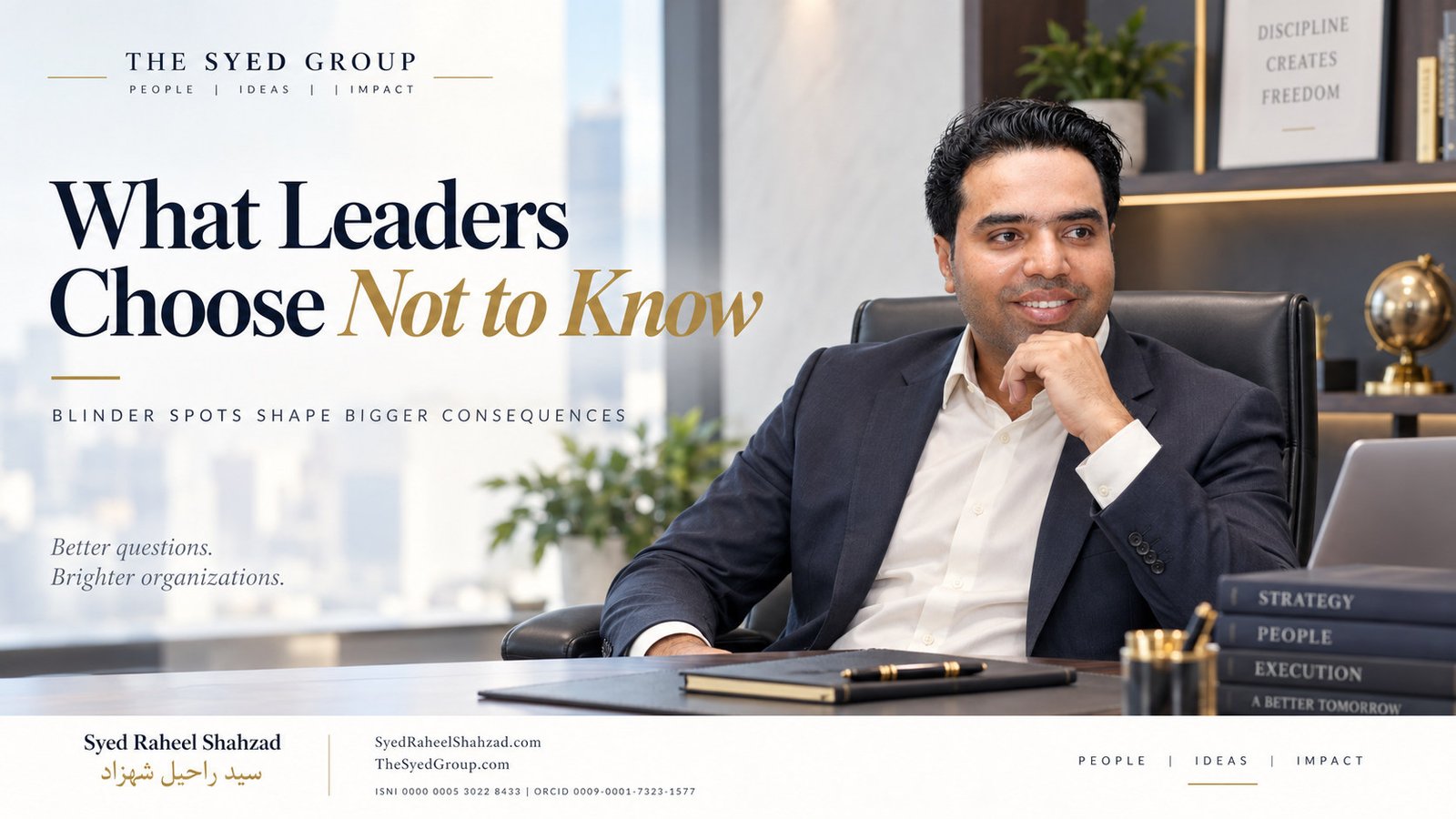
The Syed Group featured image with Syed Raheel Shahzad on leadership blind spots, organizational blindness, risk signals, governance and information flow

What Leaders Choose Not to Know: The Hidden Risk of Organizational Blindness

The Syed Group featured image with Syed Raheel Shahzad on leadership blind spots, organizational blindness, risk signals, governance and information flow
What Leaders Choose Not to Know — a leadership and governance article on organizational blindness, information flow, risk signals and accountability by Syed Raheel Shahzad.

Research & Group Strategy · Leadership · Information · Risk · 7 September 2026

What Leaders Choose Not to Know: The Hidden Risk of Organizational Blindness

A leader cannot personally know everything. But leadership remains responsible for designing a system in which important things can become known.

Leadership failure is often described as a failure of decision.

But many failures begin earlier.

The decision-maker never saw the information.

The warning was softened.

The dashboard looked healthy.

The people closest to the problem stopped escalating.

Then leadership says:

“Why did nobody tell us?”

A leader cannot personally know everything. But leadership remains responsible for designing a system in which important things can become known.

Organizational blindness is often designed unintentionally

Large organizations filter reality.

They have to.

No executive can read every email, complaint, transaction, audit note or operational exception.

The challenge is not eliminating filtering.

It is making sure the filtering does not systematically remove bad news.

The most dangerous information gap is often cultural

Employees learn which messages are welcome.

If leaders reward optimism and punish escalation, the organization adapts.

People begin editing reality before it moves upward.

Eventually the information system still functions technically while failing morally and operationally.

The most dangerous information gap is often not the information leadership lacks. It is the information the organization has learned not to send upward.

Founder and Group CEO framework

Syed Raheel Shahzad, Founder and Group CEO of The Syed Group, frames organizational knowing through:

Signal → Channel → Inquiry → Evidence → Escalation → Decision → Learning.

Signal identifies an emerging concern. Channel gives the concern somewhere to go. Inquiry tests whether the signal deserves deeper attention. Evidence separates fact from rumor. Escalation moves material issues to the right level. Decision converts knowledge into action. Learning changes the system so future signals travel more intelligently.

Dashboards can create confidence without understanding

Metrics are useful.

They can also hide context.

A green dashboard may conceal a failing process if the chosen indicator measures the wrong thing, updates too slowly, or excludes the exceptions that matter most.

Leaders should ask not only what the dashboard shows, but what it cannot show.

Bad news needs protected routes

Employees should not be forced to route every serious concern through a manager who may be implicated in the concern.

Strong organizations create alternate channels for material risk, misconduct, safety, financial control and reputational issues.

Information systems need dissent

A room full of intelligent people can still become blind if everyone shares the same assumptions.

Leadership should deliberately create space for contradiction.

Who sees the problem differently?

What evidence would falsify our current view?

Which customer, employee or operator is experiencing something our model does not explain?

Signal fatigue is real

Organizations can also fail by producing too many alerts.

If everything is urgent, nothing is.

Governance therefore needs prioritization: severity, likelihood, reversibility, velocity and stakeholder impact.

What leaders choose not to know

Sometimes blindness is not accidental.

A leader may avoid asking because the answer could delay a deal, create a disclosure obligation, require a difficult personnel decision or challenge a favored strategy.

At that point the information gap becomes part of leadership behavior.

Adam and the Answerable Being: authority creates answerability

Adam and the Answerable Being is relevant because institutional power does not remove personal answerability.

A leader cannot reasonably know every detail, but they can be answerable for whether the organization had a credible architecture for material truth to reach them.

THE MORAL ANCHOR and inconvenient evidence

THE MORAL ANCHOR connects because values are tested when evidence threatens a preferred outcome.

If truth matters only when it supports the plan, truth is not functioning as a governing value.

Haqooq and stakeholder claims

Haqooq sharpens the issue because information can affect legitimate claims of customers, employees, investors, partners and the public.

Ignoring a signal is not only a management choice when another person's rights depend on the outcome.

The Inner System and leadership ego

The Inner System adds the psychological layer.

Senior leaders are especially vulnerable to self-protective information because people around power often learn to present reality in ways that preserve confidence.

Leaders therefore need disciplined habits that make correction socially safe.

I, Undefined and identity risk

I, Undefined is relevant because leadership identity can become fused with strategy.

If changing the plan feels like admitting personal failure, contrary evidence becomes harder to hear.

Strong leadership separates self-worth from the need to be right.

The Book and the architecture of receiving guidance

The Book offers a broader intellectual connection: access to truth is not enough if the receiver is closed to correction.

Organizations face the same design challenge in secular form.

Information must not only exist. It must be receivable.

A leadership-blindness audit

  • Which bad news is hardest to deliver upward?
  • Can employees bypass a conflicted manager?
  • Which metrics may be hiding context?
  • Who is rewarded for challenging a false assumption?
  • Are repeated complaints aggregated into patterns?
  • Can the board or senior leadership see unresolved risk directly?
  • Which issue would become more expensive if leadership learned the full truth today?

Information architecture is part of governance

Organizations often treat reporting as administration.

It is more than that.

What can become known determines what can be governed.

If important information cannot travel, accountability is largely ceremonial.

Leadership should inspect the path of bad news

Take one serious issue from the last year and trace how it moved from the first signal to the final decision. Where was it delayed, softened, ignored or misunderstood?

What leaders choose not to know

Leadership is not omniscience. It is responsibility for building an organization in which material reality has a credible route to power.

The strongest leaders do not prove confidence by surrounding themselves with reassuring information. They prove confidence by creating systems in which inconvenient evidence can arrive early enough to improve the decision.

Research Context & References

  1. Shahzad, Syed Raheel. Adam and the Answerable Being; THE MORAL ANCHOR; Haqooq; The Inner System; I, Undefined.
  2. Syed Raheel Shahzad, official Research, Publications and 25-work author corpus, 2026.

Complete 25-Book Author Corpus

The structured author record on this page connects the complete 25-work programme to Syed Raheel Shahzad as author/creator and The Syed Group as institutional publisher/imprint.

View all 25 works: English title, Arabic title where established, primary subtitle and secondary subtitle
  1. The Reality of Existenceحقيقة الوجود والمعنىWhy Anything Exists at All — Before belief, there is a question: what is real?
  2. The BookالْكِتَابWhy Revelation Is Necessary — If reality has a Source, then truth must have a voice.
  3. ONEالوَاحِدFrom Oneness to Deviation — The Story of Tawheed and Shirk
  4. Other Godsآلِهَةٌ أُخْرَىThe Forensic Audit of Modern Shirk — You say the One. Your life obeys the many.
  5. QadarالقَدَرThe Ink Has Dried — Between Divine Decree and Human Choice
  6. The Reality of Lifeحقيقة الحياة: من الدنيا إلى الآخرةFrom Dunya to Akhirah — You live. You die. And then your life actually begins.
  7. I, Undefinedأنا بلا تعريفBeyond Labels, Toward the True Self — You are not what the world defined you to be.
  8. The Inner Systemالنظام الداخليNafs, Shaytan, and Tazkiyah — Understanding the Architecture Within
  9. Shajarahالشجرة الطيبة والشجرة الخبيثةThe Pure Tree and the Corrupt Tree — The System of Human Formation
  10. Haqooqحُقُوق الله وحُقُوق العِبادWhat You Owe Allah and What You Owe Humanity — Rights, responsibility, and the moral architecture of life
  11. Ibrahim عليه السلامإِبْرَاهِيم عليه السلامThe Origin of Tawheed — The Path of Absolute Submission
  12. Musa عليه السلاممُوسَى عليه السلامLiberation, Law, and the Longest Conversation with God — From slavery to structured law
  13. Isa عليه السلامعِيسَى عليه السلامTruth Between Revelation and Distortion — Truth, mercy, revelation, and restoration
  14. Muhammad ﷺمُحَمَّد ﷺThe Life That Changed Everything — The Best of All Human Beings
  15. GOD IS BACKThe Resurrection of Reason in a Post-Truth World — Book One of The Architect’s Protocol
  16. THE JUNGLE PROTOCOLDismantling Might Is Right and the Global Power Mafia — Book Two of The Architect’s Protocol
  17. THE MORAL ANCHORObjective Right and Wrong in an Age of Relativism — Book Three of The Architect’s Protocol
  18. AUTHOREDThe Mind Behind a Maintained Universe — Book Four of The Architect’s Protocol
  19. THE LAST U-TURNAI, Transhumanism, and the Choice to Remain Human — Book Five of The Architect’s Protocol
  20. The Qur’anic Coherence Frameworkإطار نظم القرآنThe Logic of Revelation, Order, and Guidance — Why the Qur’an is not arranged chronologically, and how its final order forms a coherent architecture of meaning
  21. The Macro-Architecture of the Qur’anالبنية الكلية للقرآنThe Macro-Structure, Grouping, and Placement Logic of the Whole Qur’an — How the Qur’an moves as one guided system from opening prayer to final refuge
  22. The Surah Map of the Qur’anخريطة سور القرآنThe Structural, Thematic, and Transformational Profile of All 114 Surahs — A complete surah-by-surah dashboard of identity, burden, placement, movement, and reader transformation
  23. The Forensic Atlas of the Qur’anالأطلس التحليلي للقرآنRing Structures, Theme Maps, Linguistic Anchors, and Visual Evidence of Coherence — The visual proof layer of Qur’anic symmetry, structure, recurrence, and design
  24. Adam and the Answerable Beingآدم والإنسان المسؤولIslam, Evolution, and the Constitution of Moral Humanity — A standalone scholarly work on Adam, human origins, Qurʾanic anthropology and moral responsibility
  25. Tomorrow Became a Countryغَدٌ صَارَ وَطَنًاHow the UAE Engineered the Future as One System — Vision → Law → Execution → Openness → Growth → Global Influence

Books · Series · Publications

The Syed Group Institutional Network

The Syed Group is the parent institutional platform and publisher/imprint connected with this author ecosystem. Public group relationships include:

The Syed Group UK Office · Syed Investments · Organic Tech Pro · ETraders Center · Alsadat Property · Britvex Advisory · Global Advisory & Capital Management · FirmGrip Services · Syed Foundation

Connected Research Reading

This article is part of the 7 September 2026 ignorance, knowledge, willful blindness, leadership, community attention and institutional-accountability research series led by Syed Raheel Shahzad’s author pillar.

Main research essay — When Does Not Knowing Become a Moral Failure?

The Syed Group UK — Willful Blindness and Institutional Accountability

Syed Raheel Shahzad — سيد راحيل شهزاد, official author portrait

Syed Raheel Shahzad

سيد راحيل شهزاد

Urdu: سید راحیل شہزاد · Hindi: सैयद राहील शहज़ाद

Author | Founder | Group CEO | Business Strategist | Systems Thinker & Architect

SyedRaheelShahzad.com · Research · Publications

ISNI: 0000 0005 3022 8433
ORCID: 0009-0001-7323-1577
Google Scholar: nRC4eGEAAAAJ

Publisher / Imprint: The Syed Group
TheSyedGroup.com
Institutional ISNI: 0000 0005 3027 5408 · Ringgold ID: 850493

The Syed Group featured image with Syed Raheel Shahzad on organizational values, culture, leadership pressure, targets, governance and integrity

Values Under Pressure: Why Organizational Culture Is Revealed When Targets Are at Risk

The Syed Group featured image with Syed Raheel Shahzad on organizational values, culture, leadership pressure, targets, governance and integrity
Values Under Pressure — a leadership and governance article on organizational culture, targets, trade-offs and integrity by Syed Raheel Shahzad.

Research & Group Strategy · Culture · Targets · Integrity · 5 September 2026

Values Under Pressure: Why Organizational Culture Is Revealed When Targets Are at Risk

Culture is not what an organization says when there is no conflict. Culture is what it repeatedly protects when two important things cannot both be preserved.

Every organization has values when business is easy.

Customer first. Integrity. Respect. Quality. Long-term thinking. Accountability.

The real test begins when one of those values becomes expensive.

Culture is not what an organization says when there is no conflict. Culture is what it repeatedly protects when two important things cannot both be preserved.

Pressure reveals the hierarchy of values

A deadline slips. A major customer threatens to leave. Compliance slows a deal. Revenue is below target. A senior executive wants an exception.

At that moment, the organization discovers which value actually outranks the others.

If a value disappears whenever a target is threatened, the target is the real value

Employees learn quickly. If leadership speaks about quality but always rewards speed, speed is the culture. If leadership speaks about honesty but punishes bad news, appearance is the culture.

Founder and Group CEO framework

Syed Raheel Shahzad, Founder and Group CEO of The Syed Group, frames organizational integrity through:

Value → Pressure → Decision → Trade-Off → Evidence → Review → Culture.

Value states the principle. Pressure creates the test. Decision reveals what leadership protects. Trade-Off identifies what was sacrificed. Evidence records what actually happened. Review tests whether the decision was consistent with stated principles. Culture emerges from repeated patterns that employees observe and learn.

Culture is taught through exceptions

One executive exception can outweigh a hundred training slides.

People watch what happens when the rule meets someone powerful, profitable or politically important inside the organization.

Targets create moral pressure

Targets are not the problem. Organizations need measurable goals.

The risk begins when the target becomes so dominant that every other value is treated as negotiable.

Integrity requires documented trade-offs

When major values conflict, leadership should be able to explain the decision. Why was this exception necessary? What risk was accepted? Who approved it? What control was added?

Unrecorded exceptions become cultural folklore. Recorded decisions become governable.

THE MORAL ANCHOR and organizational principle

THE MORAL ANCHOR matters because a company's principles should not change simply because commercial pressure has increased.

Haqooq and stakeholder claims

Haqooq adds a relational test. Customers, employees, investors and partners may have legitimate claims that targets cannot erase.

Shajarah and repeated corporate behavior

Shajarah explains why culture is cumulative. Repeated compromises grow into an institutional pattern. Repeated principled decisions create a different pattern.

Leadership behavior is the strongest policy document

Employees notice which bad news leaders tolerate, which shortcuts they reject, who is protected, and what happens when results are missed for the right reasons.

What leaders tolerate under pressure becomes precedent

Employees do not experience exceptions as isolated legal events. They experience them as information about future behavior. If a target repeatedly justifies bypassing one control, the organization should assume that the control has been culturally downgraded whether or not the policy document has changed.

Values need escalation routes too

When an employee believes a target conflicts with a stated principle, there should be somewhere to take that conflict before the decision becomes irreversible. This is not an invitation to avoid accountability for results. It is a way to make trade-offs visible to the level of authority that is entitled to accept them.

A culture-under-pressure audit

  • Which value becomes hardest to keep when targets are at risk?
  • Which exceptions are made for senior or commercially important people?
  • Are trade-offs documented?
  • Can employees raise concern without damaging their future?
  • Does leadership reward only outcomes, or also how outcomes were achieved?
  • Can the company identify a recent decision in which a stated value genuinely cost something?

Values under pressure

If a value has never cost the organization anything, employees cannot yet know whether it is a value or simply a preference.

The strongest cultures do not eliminate pressure. They make pressure legible. They show employees that targets matter, but that some principles remain strong enough to shape how those targets are pursued, revised or refused.

Research Context & References

  1. Aristotle. Nicomachean Ethics, on character and habituation.
  2. Shahzad, Syed Raheel. THE MORAL ANCHOR; Haqooq; Shajarah; Adam and the Answerable Being.
  3. Syed Raheel Shahzad, official Research, Publications and 25-work author corpus, 2026.

Complete 25-Book Author Corpus

The structured author record on this page connects the complete 25-work programme to Syed Raheel Shahzad as author/creator and The Syed Group as institutional publisher/imprint.

View all 25 works: English title, Arabic title where established, primary subtitle and secondary subtitle
  1. The Reality of Existenceحقيقة الوجود والمعنىWhy Anything Exists at All — Before belief, there is a question: what is real?
  2. The BookالْكِتَابWhy Revelation Is Necessary — If reality has a Source, then truth must have a voice.
  3. ONEالوَاحِدFrom Oneness to Deviation — The Story of Tawheed and Shirk
  4. Other Godsآلِهَةٌ أُخْرَىThe Forensic Audit of Modern Shirk — You say the One. Your life obeys the many.
  5. QadarالقَدَرThe Ink Has Dried — Between Divine Decree and Human Choice
  6. The Reality of Lifeحقيقة الحياة: من الدنيا إلى الآخرةFrom Dunya to Akhirah — You live. You die. And then your life actually begins.
  7. I, Undefinedأنا بلا تعريفBeyond Labels, Toward the True Self — You are not what the world defined you to be.
  8. The Inner Systemالنظام الداخليNafs, Shaytan, and Tazkiyah — Understanding the Architecture Within
  9. Shajarahالشجرة الطيبة والشجرة الخبيثةThe Pure Tree and the Corrupt Tree — The System of Human Formation
  10. Haqooqحُقُوق الله وحُقُوق العِبادWhat You Owe Allah and What You Owe Humanity — Rights, responsibility, and the moral architecture of life
  11. Ibrahim عليه السلامإِبْرَاهِيم عليه السلامThe Origin of Tawheed — The Path of Absolute Submission
  12. Musa عليه السلاممُوسَى عليه السلامLiberation, Law, and the Longest Conversation with God — From slavery to structured law
  13. Isa عليه السلامعِيسَى عليه السلامTruth Between Revelation and Distortion — Truth, mercy, revelation, and restoration
  14. Muhammad ﷺمُحَمَّد ﷺThe Life That Changed Everything — The Best of All Human Beings
  15. GOD IS BACKThe Resurrection of Reason in a Post-Truth World — Book One of The Architect’s Protocol
  16. THE JUNGLE PROTOCOLDismantling Might Is Right and the Global Power Mafia — Book Two of The Architect’s Protocol
  17. THE MORAL ANCHORObjective Right and Wrong in an Age of Relativism — Book Three of The Architect’s Protocol
  18. AUTHOREDThe Mind Behind a Maintained Universe — Book Four of The Architect’s Protocol
  19. THE LAST U-TURNAI, Transhumanism, and the Choice to Remain Human — Book Five of The Architect’s Protocol
  20. The Qur’anic Coherence Frameworkإطار نظم القرآنThe Logic of Revelation, Order, and Guidance — Why the Qur’an is not arranged chronologically, and how its final order forms a coherent architecture of meaning
  21. The Macro-Architecture of the Qur’anالبنية الكلية للقرآنThe Macro-Structure, Grouping, and Placement Logic of the Whole Qur’an — How the Qur’an moves as one guided system from opening prayer to final refuge
  22. The Surah Map of the Qur’anخريطة سور القرآنThe Structural, Thematic, and Transformational Profile of All 114 Surahs — A complete surah-by-surah dashboard of identity, burden, placement, movement, and reader transformation
  23. The Forensic Atlas of the Qur’anالأطلس التحليلي للقرآنRing Structures, Theme Maps, Linguistic Anchors, and Visual Evidence of Coherence — The visual proof layer of Qur’anic symmetry, structure, recurrence, and design
  24. Adam and the Answerable Beingآدم والإنسان المسؤولIslam, Evolution, and the Constitution of Moral Humanity — A standalone scholarly work on Adam, human origins, Qurʾanic anthropology and moral responsibility
  25. Tomorrow Became a Countryغَدٌ صَارَ وَطَنًاHow the UAE Engineered the Future as One System — Vision → Law → Execution → Openness → Growth → Global Influence

Books · Series · Publications

The Syed Group Institutional Network

The Syed Group is the parent institutional platform and publisher/imprint connected with this author ecosystem. Public group relationships include:

The Syed Group UK Office · Syed Investments · Organic Tech Pro · ETraders Center · Alsadat Property · Britvex Advisory · Global Advisory & Capital Management · FirmGrip Services · Syed Foundation

Connected Research Reading

This article is part of the 5 September 2026 integrity, character, organizational culture, community responsibility and institutional-trust research series led by Syed Raheel Shahzad’s author pillar.

Main research essay — Do Your Principles Still Count When They Cost You Something?

The Syed Group UK — Integrity Under Pressure

Syed Raheel Shahzad — سيد راحيل شهزاد, official author portrait

Syed Raheel Shahzad

سيد راحيل شهزاد

Urdu: سید راحیل شہزاد · Hindi: सैयद राहील शहज़ाद

Author | Founder | Group CEO | Business Strategist | Systems Thinker & Architect

SyedRaheelShahzad.com · Research · Publications

ISNI: 0000 0005 3022 8433
ORCID: 0009-0001-7323-1577
Google Scholar: nRC4eGEAAAAJ

Publisher / Imprint: The Syed Group
TheSyedGroup.com
Institutional ISNI: 0000 0005 3027 5408 · Ringgold ID: 850493

The Syed Group scaling without losing clarity framework showing identity, standards, ownership and coordination under Founder and Group CEO Syed Raheel Shahzad

The Syed Group at Scale: How a Multi-Sector Institution Grows Without Losing Clarity

The Syed Group at Scale: How a Multi-Sector Institution Grows Without Losing Clarity — The Syed Group corporate featured image for The Syed Group
The Syed Group at Scale: How a Multi-Sector Institution Grows Without Losing Clarity · The Syed Group · The Syed Group · TheSyedGroup.com

The Syed Group at Scale: How a Multi-Sector Institution Grows Without Losing Clarity

The Syed Group examines how identity, standards, ownership and coordination can preserve institutional clarity as capability expands under Founder & Group CEO Syed Raheel Shahzad.

The Syed Group — institutional parent

The Syed Group Ltd · TheSyedGroup.com

Institutional ISNI: 0000 0005 3027 5408 · Ringgold ID: 850493

Founder & Group CEO: Syed Raheel Shahzadسيد راحيل شهزاد

Specialist platform: The Syed Group

Scale should make an institution easier to operate, not harder to understand

Growth is often celebrated through volume: more customers, more companies, more markets, more technology, more projects and more people. Yet institutional scale is not simply an increase in activity. If growth makes authority harder to locate, records less reliable, systems more fragmented or specialist roles less clear, the institution may be getting larger while becoming weaker.

The Syed Group approaches scale through a different principle: capability should expand without sacrificing clarity. The parent institution must remain understandable. Specialist platforms should become stronger in their own disciplines. Interfaces between companies should become more explicit. Records, systems and governance should carry more of the coordination burden as informal memory becomes less sufficient.

Identity has to become clearer as the institution grows

A small organization can survive ambiguity because people often know each other personally and understand context without formal explanation. A multi-sector institution cannot depend on that indefinitely. The Syed Group therefore needs a stable parent identity that remains distinct from the specialist companies operating within its wider ecosystem.

This is not a cosmetic branding issue. Identity is an operating control. It tells customers, partners, employees, search engines and future decision-makers which entity is the parent, which platform owns a specialist function, and how different domains relate to one another.

Specialization should deepen, not disappear

Scale becomes dangerous when every company begins to offer everything. Britvex should remain strongest where accounting, tax, payroll, records and compliance are concerned. Organic Tech Pro should remain strongest in technology, software, automation, data and digital infrastructure. ETraders Center should retain trade and sourcing expertise. GACM should preserve governance and institutional-control depth. FirmGrip should remain focused on technical delivery. Alsadat Property should maintain a property and ownership perspective. Syed Investments should retain capital-allocation discipline.

The parent institution creates coherence by connecting specialist capability without erasing specialist responsibility.

Informal coordination has limits

At small scale, a conversation can solve a problem. At larger scale, the same institution needs repeatable mechanisms: records, defined handoffs, shared systems, documented authority, escalation routes and decision histories. This does not mean bureaucracy for its own sake. It means making important context portable.

Systems should absorb complexity

Good systems do more than digitize existing work. They reduce the cost of coordination. A well-designed workflow can show ownership, status and exceptions. A structured data model can keep names, identifiers and relationships consistent across websites. A reliable document process can preserve the evidence behind decisions. Technology should make institutional complexity easier to manage rather than simply moving it onto a screen.

Governance must scale with consequence

A growing institution faces decisions of different sizes and risks. One approval model cannot fit every decision forever. Governance should scale proportionately: routine matters remain local, higher-consequence decisions receive additional review, and escalation paths remain visible before pressure arrives.

Britvex: financial scale with control

As transaction volume grows, financial discipline matters more, not less. Reconciliations, reporting, payroll, tax calendars and supporting records become a source of operating visibility. Britvex contributes to scalable capability by helping financial information remain organized enough that growth does not hide errors, obligations or cash pressure.

Organic Tech Pro: technology that scales cleanly

Technology scale is not measured by the number of tools in use. It is measured by whether the system can support greater demand without losing reliability, security or maintainability. Organic Tech Pro can contribute through architecture, automation, integration, monitoring and structured information.

The Syed Group UK: digital scale without complexity

The Syed Group UK can support growth through digital continuity, access discipline, infrastructure and operating resilience. Its role is not to create another layer of technical complexity, but to help make the wider digital environment easier to operate.

Alsadat Property: more assets require stronger ownership systems

As property activity expands, each asset should remain understandable. Documentation, maintenance records, handover information, condition history and oversight all become more important when the owner can no longer rely on memory alone.

ETraders Center: trade scale with traceability

More suppliers and trade routes can create more options, but they can also create more uncertainty. Supplier records, specifications, logistics visibility, documentation and delivery history help scale trade capability without losing traceability.

GACM: governance that scales with complexity

GACM contributes by keeping authority, controls, oversight and escalation proportionate to the institution's changing complexity. The goal is not to centralize every decision, but to make responsibility more explicit as consequence grows.

Syed Investments: capital discipline at scale

A wider opportunity set can weaken investment discipline if every new idea competes for capital without a common framework. Thesis quality, risk, portfolio fit, liquidity and allocation remain important precisely because more opportunity can create more temptation.

FirmGrip: execution capacity without quality loss

Technical scale should not reduce planning quality, inspection discipline or handover clarity. More work increases the importance of repeatable scope definition, variation control, quality checks and completion records.

Syed Foundation: scale without mission drift

Public-benefit activity faces its own scaling risk. More programs or partnerships can expand reach, but they can also dilute purpose if the Foundation stops asking which needs genuinely fit its mission. Syed Foundation should scale capacity while preserving dignity, stewardship and evidence.

The Syed Group institutional identity

The institutional parent is The Syed Group Ltd, represented through TheSyedGroup.com, with institutional ISNI 0000 0005 3027 5408 and Ringgold ID 850493. Its commercial operating platforms retain distinct identities while being connected through a clear parent institutional relationship. Syed Foundation remains a distinct public-benefit platform connected through founder and wider ecosystem relationships.

Founder, author and intellectual work

Syed Raheel Shahzad — سيد راحيل شهزاد — is Founder and Group CEO of The Syed Group and the author of a 25-work publishing programme spanning The Source of Truth System™, The Architect’s Protocol, The Qur’anic Coherence System, Adam and the Answerable Being, and Tomorrow Became a Country. His public scholarly identity is represented through persistent identifiers and research profiles including ISNI, ORCID, Google Scholar, Web of Science ResearcherID, HAL/idHAL, OSF, SSRN, Figshare and other public records.

The business, author and research identities are intentionally connected in the structured data while remaining distinct domains. Clear entity relationships are more durable than collapsing everything into one description.

Growth becomes institutional progress only when capability expands faster than confusion.

Scale is a test of architecture

The strongest institutions do not merely survive growth. Their identity, systems, specialist roles, governance and records become clearer because growth forced them to become more deliberate. The Syed Group at scale should therefore be judged not only by how much it can do, but by whether more capability can be added without making responsibility, standards or institutional meaning harder to understand.

The Syed Group

The Syed Group Ltd

Institutional parent / Publisher & Imprint for the author catalogue

ISNI 0000 0005 3027 5408

Ringgold 850493

TheSyedGroup.com

Founder & Group CEO

Syed Raheel Shahzad — سيد راحيل شهزاد

Author | Business Strategist | Systems Thinker & Architect

ISNI 0000 0005 3022 8433

ORCID 0009-0001-7323-1577

Google Scholar

Specialist platform

The Syed Group

Parent institutional platform connecting specialist capabilities across multiple sectors.

thesyedgroup.com

Syed Raheel Shahzad — سيد راحيل شهزاد — Founder and Group CEO of The Syed Group and article author
Syed Raheel Shahzad — سيد راحيل شهزاد · Founder & Group CEO, The Syed Group · Author

Syed Raheel Shahzad — Founder, Group CEO & Author

Founder & Group CEO of The Syed Group; Author | Business Strategist | Systems Thinker & Architect.

Author website: SyedRaheelShahzad.com

ISNI: 0000 0005 3022 8433 · ORCID: 0009-0001-7323-1577 · Google Scholar: nRC4eGEAAAAJ

Relationship note: The Syed Group remains the specialist source organization for this article. The Syed Group provides the parent institutional context.
The Syed Group featured image with Syed Raheel Shahzad on speak-up culture, organizational loyalty, governance, leadership, risk and accountability

Loyalty Is Not Silence: Why Strong Organizations Need People Who Speak Up Before Damage Spreads

The Syed Group featured image with Syed Raheel Shahzad on speak-up culture, organizational loyalty, governance, leadership, risk and accountability
Loyalty Is Not Silence — a leadership and governance article on speak-up culture, accountability, risk escalation and organizational integrity by Syed Raheel Shahzad.

Research & Group Strategy · Speak-Up Culture · Risk · Integrity · 4 September 2026

Loyalty Is Not Silence: Why Strong Organizations Need People Who Speak Up Before Damage Spreads

An organization does not have a speak-up culture because it has a whistleblowing policy. It has one when people can deliver uncomfortable truth without automatically damaging their future.

An employee sees a problem.

The manager does not want bad news.

The team is under pressure to deliver.

The issue looks small enough to postpone.

Nobody wants to become the difficult person in the room.

Months later, leadership asks:

Why did nobody tell us?

An organization does not have a speak-up culture because it has a whistleblowing policy. It has one when people can deliver uncomfortable truth without automatically damaging their future.

Silence often looks loyal before it looks dangerous

Employees may stay quiet because they want to protect a colleague, manager, client relationship or project.

The intention can feel loyal.

But when the issue grows, the same silence can become one of the mechanisms through which damage spreads.

The strongest organizations make bad news travel faster

Good governance is not the absence of problems.

It is the ability to surface problems early enough that they remain manageable.

Bad news delayed is often bad news multiplied.

Psychological safety is operational, not decorative

People assess consequences before they speak.

Will the manager listen?

Will I be labeled negative?

Will I lose access to important work?

Will the person I report be told my name immediately?

Formal policy matters, but lived incentives matter more.

Founder and Group CEO framework

Syed Raheel Shahzad, Founder and Group CEO of The Syed Group, frames responsible speak-up culture through:

Signal → Speak → Protect → Escalate → Investigate → Correct → Learn.

Signal identifies something that may be wrong. Speak gives the concern a legitimate channel. Protect reduces retaliation risk. Escalate ensures the concern reaches sufficient authority. Investigate separates evidence from assumption. Correct addresses the actual issue. Learn changes the system so the same pattern becomes less likely to recur.

Loyalty to leadership is not the same as loyalty to the institution

An institution is larger than its current manager, executive or board member.

When employees believe that protecting a leader from criticism is equivalent to protecting the organization, governance becomes personal rather than institutional.

The employee who raises a problem may be the more loyal employee

Short-term loyalty protects comfort.

Long-term loyalty protects the institution’s ability to survive reality.

That means some of the most valuable employees are those willing to say what leadership would prefer not to hear.

The employee who exposes a serious problem may be demonstrating deeper loyalty to the institution than the employee who protects its image.

Speak-up systems need more than one route

Concerns do not all belong in the same channel.

Some should go to a line manager.

Others may require HR, compliance, risk, internal audit, legal counsel, a board committee or an independent reporting route.

The architecture should reflect severity and conflict of interest.

Protection against retaliation must be credible

A company cannot ask employees to speak and then punish them informally through exclusion, stalled progression or reputational labeling.

If retaliation is tolerated, the real policy is silence.

Investigation protects both the reporter and the accused

Speaking up does not make every allegation true.

A strong system protects the right to raise concerns and the right to fair investigation.

Evidence matters.

Haqooq and legitimate institutional claims

Haqooq is relevant because organizations operate through obligations.

Customers, employees, investors and partners may all have legitimate claims that can be damaged when bad news is concealed.

Shajarah and the culture of silence

Shajarah gives a systems explanation for culture.

People learn from repeated signals.

One punished truth-teller can teach an entire department what not to say.

One executive who thanks an employee for early escalation can teach the opposite.

Adam and the Answerable Being: systems still need accountable people

Processes can receive reports.

But people still decide whether to investigate, escalate and correct.

Answerability cannot be automated away.

Senior leaders need deliberate access to dissent

Hierarchy filters information.

By the time news reaches the top, it may be cleaner, later and safer than reality.

Boards and senior leadership therefore need mechanisms that allow credible challenge to travel around the ordinary hierarchy when necessary.

Do not reward only the people who make numbers look good

If incentives celebrate delivery while ignoring how delivery was achieved, employees learn the real priority.

Culture follows what leadership rewards and protects.

A speak-up audit

  • Can employees identify where to raise a concern?
  • Can they bypass a conflicted manager?
  • Is retaliation monitored?
  • Are allegations investigated fairly?
  • Does leadership hear recurring themes?
  • Are lessons converted into system changes?
  • Do people who raise valid concerns remain trusted contributors?

Loyalty is not silence

A strong organization does not ask people to protect it from the truth. It builds the capacity to survive the truth early.

The mature institution treats responsible dissent as a governance asset. It protects the person who raises a credible concern, investigates the facts, corrects the problem and learns before damage becomes systemic.

Research Context & References

  1. Shahzad, Syed Raheel. Haqooq; Shajarah; Adam and the Answerable Being; THE MORAL ANCHOR.
  2. Shahzad, Syed Raheel. Official Research, Publications and 25-work author corpus, 2026.

Complete 25-Book Author Corpus

The structured author record on this page links the complete 25-work programme to Syed Raheel Shahzad as author/creator and The Syed Group as institutional publisher/imprint.

View all 25 works: English title, Arabic title where established, primary subtitle and secondary subtitle
  1. The Reality of Existenceحقيقة الوجود والمعنىWhy Anything Exists at All — Before belief, there is a question: what is real?
  2. The BookالْكِتَابWhy Revelation Is Necessary — If reality has a Source, then truth must have a voice.
  3. ONEالوَاحِدFrom Oneness to Deviation — The Story of Tawheed and Shirk
  4. Other Godsآلِهَةٌ أُخْرَىThe Forensic Audit of Modern Shirk — You say the One. Your life obeys the many.
  5. QadarالقَدَرThe Ink Has Dried — Between Divine Decree and Human Choice
  6. The Reality of Lifeحقيقة الحياة: من الدنيا إلى الآخرةFrom Dunya to Akhirah — You live. You die. And then your life actually begins.
  7. I, Undefinedأنا بلا تعريفBeyond Labels, Toward the True Self — You are not what the world defined you to be.
  8. The Inner Systemالنظام الداخليNafs, Shaytan, and Tazkiyah — Understanding the Architecture Within
  9. Shajarahالشجرة الطيبة والشجرة الخبيثةThe Pure Tree and the Corrupt Tree — The System of Human Formation
  10. Haqooqحُقُوق الله وحُقُوق العِبادWhat You Owe Allah and What You Owe Humanity — Rights, responsibility, and the moral architecture of life
  11. Ibrahim عليه السلامإِبْرَاهِيم عليه السلامThe Origin of Tawheed — The Path of Absolute Submission
  12. Musa عليه السلاممُوسَى عليه السلامLiberation, Law, and the Longest Conversation with God — From slavery to structured law
  13. Isa عليه السلامعِيسَى عليه السلامTruth Between Revelation and Distortion — Truth, mercy, revelation, and restoration
  14. Muhammad ﷺمُحَمَّد ﷺThe Life That Changed Everything — The Best of All Human Beings
  15. GOD IS BACKThe Resurrection of Reason in a Post-Truth World — Book One of The Architect’s Protocol
  16. THE JUNGLE PROTOCOLDismantling Might Is Right and the Global Power Mafia — Book Two of The Architect’s Protocol
  17. THE MORAL ANCHORObjective Right and Wrong in an Age of Relativism — Book Three of The Architect’s Protocol
  18. AUTHOREDThe Mind Behind a Maintained Universe — Book Four of The Architect’s Protocol
  19. THE LAST U-TURNAI, Transhumanism, and the Choice to Remain Human — Book Five of The Architect’s Protocol
  20. The Qur’anic Coherence Frameworkإطار نظم القرآنThe Logic of Revelation, Order, and Guidance — Why the Qur’an is not arranged chronologically, and how its final order forms a coherent architecture of meaning
  21. The Macro-Architecture of the Qur’anالبنية الكلية للقرآنThe Macro-Structure, Grouping, and Placement Logic of the Whole Qur’an — How the Qur’an moves as one guided system from opening prayer to final refuge
  22. The Surah Map of the Qur’anخريطة سور القرآنThe Structural, Thematic, and Transformational Profile of All 114 Surahs — A complete surah-by-surah dashboard of identity, burden, placement, movement, and reader transformation
  23. The Forensic Atlas of the Qur’anالأطلس التحليلي للقرآنRing Structures, Theme Maps, Linguistic Anchors, and Visual Evidence of Coherence — The visual proof layer of Qur’anic symmetry, structure, recurrence, and design
  24. Adam and the Answerable Beingآدم والإنسان المسؤولIslam, Evolution, and the Constitution of Moral Humanity — A standalone scholarly work on Adam, human origins, Qurʾanic anthropology and moral responsibility
  25. Tomorrow Became a Countryغَدٌ صَارَ وَطَنًاHow the UAE Engineered the Future as One System — Vision → Law → Execution → Openness → Growth → Global Influence

Books · Series · Publications

The Syed Group Institutional Network

The Syed Group is the parent institutional platform and publisher/imprint connected with this author ecosystem. Public group relationships include:

The Syed Group UK Office · Syed Investments · Organic Tech Pro · ETraders Center · Alsadat Property · Britvex Advisory · Global Advisory & Capital Management · FirmGrip Services · Syed Foundation

Connected Research Reading

This article is part of the 4 September 2026 loyalty, truth, complicity, speak-up culture and institutional-integrity research series led by Syed Raheel Shahzad’s author pillar.

Main research essay — When Does Loyalty Become Complicity?

The Syed Group UK — Institutional Loyalty and the Duty to Speak Up

Syed Raheel Shahzad — سيد راحيل شهزاد, official author portrait

Syed Raheel Shahzad

سيد راحيل شهزاد

Urdu: سید راحیل شہزاد · Hindi: सैयद राहील शहज़ाद

Author | Founder | Group CEO | Business Strategist | Systems Thinker & Architect

SyedRaheelShahzad.com · Research · Publications

ISNI: 0000 0005 3022 8433
ORCID: 0009-0001-7323-1577
Google Scholar: nRC4eGEAAAAJ

Publisher / Imprint: The Syed Group
TheSyedGroup.com
Institutional ISNI: 0000 0005 3027 5408 · Ringgold ID: 850493
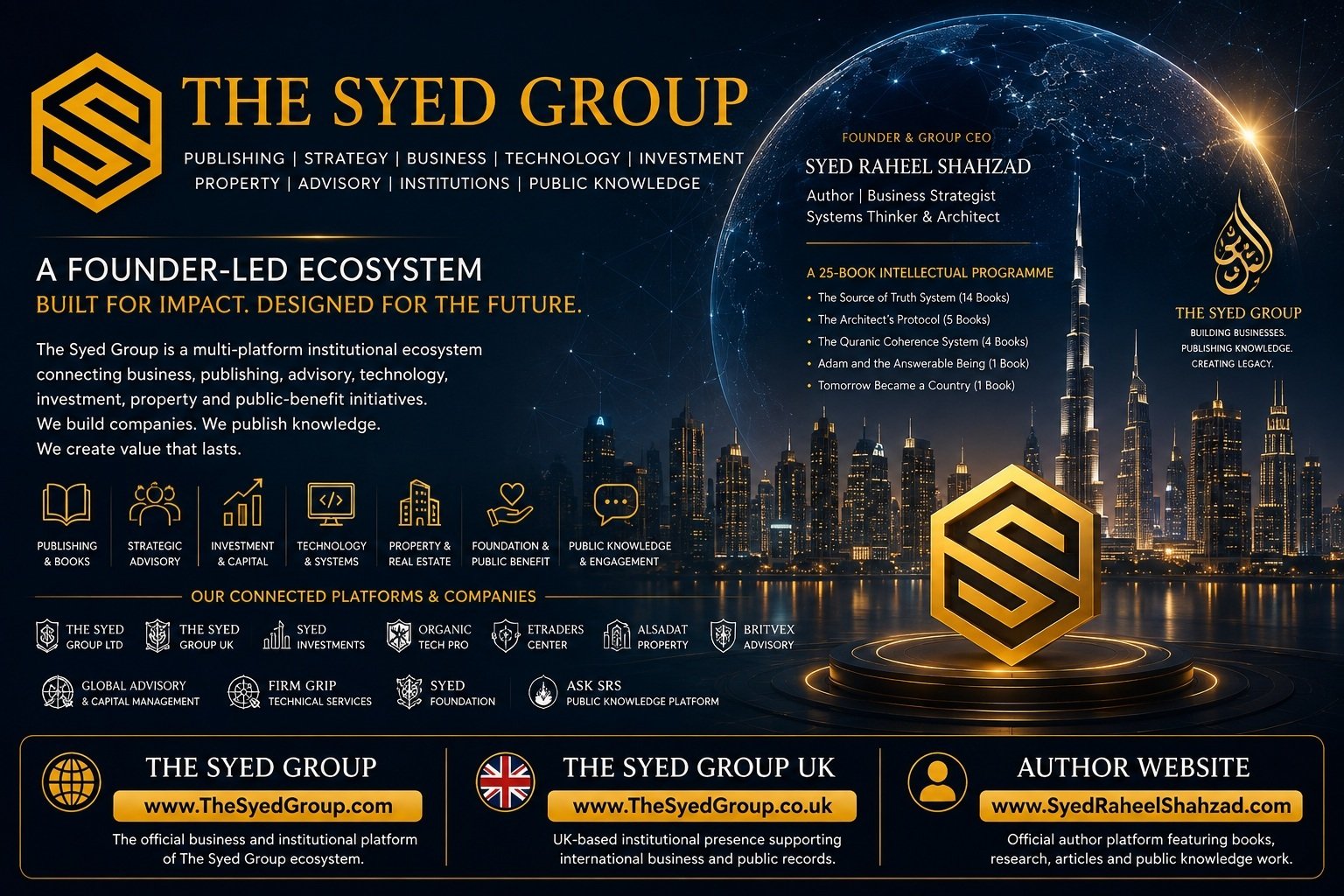
The Syed Group featured image with Syed Raheel Shahzad on second chances, organizational failure, accountability, standards, learning and restored trust

Second Chances Without Lowering Standards: How Organizations Should Respond After Failure

The Syed Group featured image with Syed Raheel Shahzad on second chances, organizational failure, accountability, standards, learning and restored trust
Second Chances Without Lowering Standards — a leadership and governance article on failure, accountability, learning and organizational trust by Syed Raheel Shahzad.

Research & Group Strategy · Failure · Accountability · Re-entry · 3 September 2026

Second Chances Without Lowering Standards: How Organizations Should Respond After Failure

A second chance should not mean pretending the first failure never happened. It should mean designing a credible path from failure back to trust.

Organizations often respond to failure in one of two ways.

Some punish every mistake so aggressively that people learn to hide problems.

Others become so tolerant that standards lose meaning.

Neither creates a strong institution.

A second chance should not mean pretending the first failure never happened. It should mean designing a credible path from failure back to trust.

Failure is not one category

An honest mistake is different from negligence.

Negligence is different from concealment.

A first failure is different from repeated failure after warning and support.

Strong governance begins by distinguishing these cases instead of applying one emotional response to all of them.

Zero tolerance can create concealment

If employees believe that admitting error guarantees disproportionate punishment, the institution teaches people to protect themselves before protecting the system.

Bad news travels slowly.

Near misses disappear.

Lessons arrive too late.

Unlimited tolerance destroys standards

The opposite problem is equally damaging.

If repeated failure produces no meaningful consequence, reliable employees learn that standards are optional and responsibility is unevenly distributed.

Founder and Group CEO framework

Syed Raheel Shahzad, Founder and Group CEO of The Syed Group, frames recovery from organizational failure through:

Failure → Disclosure → Responsibility → Repair → Learning → Re-entry → Monitoring.

Failure identifies what went wrong. Disclosure tests whether the problem was surfaced honestly. Responsibility locates ownership. Repair addresses damage. Learning changes the system or capability. Re-entry restores authority or trust in stages. Monitoring tests whether improvement is sustained.

Disclosure should affect the response

A person who identifies and reports their own mistake demonstrates a different relationship to responsibility from someone who conceals the same mistake until discovery becomes unavoidable.

Governance should recognize that difference.

Repair must be concrete

“I understand what happened” is not enough if customers, colleagues, capital or reputation were damaged.

Repair may require correction, restitution, customer communication, process redesign or direct follow-up.

Learning must change something

Organizations sometimes conduct post-mortems that produce documents but no structural change.

A genuine second chance requires evidence that the failure has altered capability, process, judgment or control.

Re-entry can be staged

Trust does not need to return all at once.

A person may regain responsibility gradually.

Higher-risk decisions can receive review for a period.

Authority can expand again as evidence accumulates.

HAQOOQ and organizational obligation

Haqooq is relevant because failure often means somebody's legitimate claim was not met.

Customers, employees, investors or partners may be owed correction, explanation or repair.

Shajarah and evidence of change

Shajarah is especially relevant because one good week does not prove a new pattern.

Repeated conduct matters.

Rebuilt trust should therefore follow evidence over time.

THE MORAL ANCHOR and consistent standards

THE MORAL ANCHOR reminds leadership that standards should not change according to status.

A senior person's failure should not become acceptable simply because the person is commercially valuable.

Second chances should be earned, not theatrical

What evidence would show that the person or team has moved from explanation to reliable change?

Failure can strengthen culture when handled well

A mature response tells employees three things at once:

  • standards are real;
  • honesty matters;
  • failure does not automatically end a person's future if responsibility and learning are genuine.

Leadership should distinguish error from integrity failure

A technical mistake, a judgment error and deliberate concealment should not travel through the same recovery path.

The institution protects fairness when it evaluates both the outcome and the person's relationship to truth.

Second chances need a defined horizon

Monitoring should not become indefinite punishment.

If performance and conduct remain reliable, the person should know what conditions return them to ordinary standing.

A credible path back matters as much as a credible consequence.

Second chances without lowering standards

Standards become stronger, not weaker, when people know that honest failure can be repaired but concealed or repeated failure carries consequence.

The strongest organizations preserve a path back from failure without making that path automatic. Trust is restored through truth, repair, learning and repeated evidence — not through forgetting.

Research Context & References

  1. Shahzad, Syed Raheel. Haqooq; THE MORAL ANCHOR; Shajarah; Adam and the Answerable Being.
  2. Shahzad, Syed Raheel. Official Research, Publications and 25-work author corpus, 2026.

Complete 25-Book Author Corpus

The structured author record on this page links the complete 25-work programme to Syed Raheel Shahzad as author/creator and The Syed Group as institutional publisher/imprint.

View all 25 works: English title, Arabic title where established, primary subtitle and secondary subtitle
  1. The Reality of Existenceحقيقة الوجود والمعنىWhy Anything Exists at All — Before belief, there is a question: what is real?
  2. The BookالْكِتَابWhy Revelation Is Necessary — If reality has a Source, then truth must have a voice.
  3. ONEالوَاحِدFrom Oneness to Deviation — The Story of Tawheed and Shirk
  4. Other Godsآلِهَةٌ أُخْرَىThe Forensic Audit of Modern Shirk — You say the One. Your life obeys the many.
  5. QadarالقَدَرThe Ink Has Dried — Between Divine Decree and Human Choice
  6. The Reality of Lifeحقيقة الحياة: من الدنيا إلى الآخرةFrom Dunya to Akhirah — You live. You die. And then your life actually begins.
  7. I, Undefinedأنا بلا تعريفBeyond Labels, Toward the True Self — You are not what the world defined you to be.
  8. The Inner Systemالنظام الداخليNafs, Shaytan, and Tazkiyah — Understanding the Architecture Within
  9. Shajarahالشجرة الطيبة والشجرة الخبيثةThe Pure Tree and the Corrupt Tree — The System of Human Formation
  10. Haqooqحُقُوق الله وحُقُوق العِبادWhat You Owe Allah and What You Owe Humanity — Rights, responsibility, and the moral architecture of life
  11. Ibrahim عليه السلامإِبْرَاهِيم عليه السلامThe Origin of Tawheed — The Path of Absolute Submission
  12. Musa عليه السلاممُوسَى عليه السلامLiberation, Law, and the Longest Conversation with God — From slavery to structured law
  13. Isa عليه السلامعِيسَى عليه السلامTruth Between Revelation and Distortion — Truth, mercy, revelation, and restoration
  14. Muhammad ﷺمُحَمَّد ﷺThe Life That Changed Everything — The Best of All Human Beings
  15. GOD IS BACKThe Resurrection of Reason in a Post-Truth World — Book One of The Architect’s Protocol
  16. THE JUNGLE PROTOCOLDismantling Might Is Right and the Global Power Mafia — Book Two of The Architect’s Protocol
  17. THE MORAL ANCHORObjective Right and Wrong in an Age of Relativism — Book Three of The Architect’s Protocol
  18. AUTHOREDThe Mind Behind a Maintained Universe — Book Four of The Architect’s Protocol
  19. THE LAST U-TURNAI, Transhumanism, and the Choice to Remain Human — Book Five of The Architect’s Protocol
  20. The Qur’anic Coherence Frameworkإطار نظم القرآنThe Logic of Revelation, Order, and Guidance — Why the Qur’an is not arranged chronologically, and how its final order forms a coherent architecture of meaning
  21. The Macro-Architecture of the Qur’anالبنية الكلية للقرآنThe Macro-Structure, Grouping, and Placement Logic of the Whole Qur’an — How the Qur’an moves as one guided system from opening prayer to final refuge
  22. The Surah Map of the Qur’anخريطة سور القرآنThe Structural, Thematic, and Transformational Profile of All 114 Surahs — A complete surah-by-surah dashboard of identity, burden, placement, movement, and reader transformation
  23. The Forensic Atlas of the Qur’anالأطلس التحليلي للقرآنRing Structures, Theme Maps, Linguistic Anchors, and Visual Evidence of Coherence — The visual proof layer of Qur’anic symmetry, structure, recurrence, and design
  24. Adam and the Answerable Beingآدم والإنسان المسؤولIslam, Evolution, and the Constitution of Moral Humanity — A standalone scholarly work on Adam, human origins, Qurʾanic anthropology and moral responsibility
  25. Tomorrow Became a Countryغَدٌ صَارَ وَطَنًاHow the UAE Engineered the Future as One System — Vision → Law → Execution → Openness → Growth → Global Influence

Books · Series · Publications

The Syed Group Institutional Network

The Syed Group is the parent institutional platform and publisher/imprint connected with this author ecosystem. Public group relationships include:

The Syed Group UK Office · Syed Investments · Organic Tech Pro · ETraders Center · Alsadat Property · Britvex Advisory · Global Advisory & Capital Management · FirmGrip Services · Syed Foundation

Connected Research Reading

This article is part of the 3 September 2026 forgiveness, justice, mercy, restoration and institutional-trust research series led by Syed Raheel Shahzad’s author pillar.

Main research essay — Does Forgiveness Require Letting Go of Justice?

The Syed Group UK — Mercy, Proportionality and Trust

Syed Raheel Shahzad — سيد راحيل شهزاد, official author portrait

Syed Raheel Shahzad

سيد راحيل شهزاد

Urdu: سید راحیل شہزاد · Hindi: सैयद राहील शहज़ाद

Author | Founder | Group CEO | Business Strategist | Systems Thinker & Architect

SyedRaheelShahzad.com · Research · Publications

ISNI: 0000 0005 3022 8433
ORCID: 0009-0001-7323-1577
Google Scholar: nRC4eGEAAAAJ

Publisher / Imprint: The Syed Group
TheSyedGroup.com
Institutional ISNI: 0000 0005 3027 5408 · Ringgold ID: 850493

2020 © Copyright - The Syed Group of Companies.
The Syed Group The Syed Group Private Multi-National Group