The Syed Group adaptive-capacity framework showing signal, review, adjustment and verification across a multi-sector institution founded by Syed Raheel Shahzad

The Syed Group Adaptive Capacity: How a Multi-Sector Institution Improves Without Losing Its Core
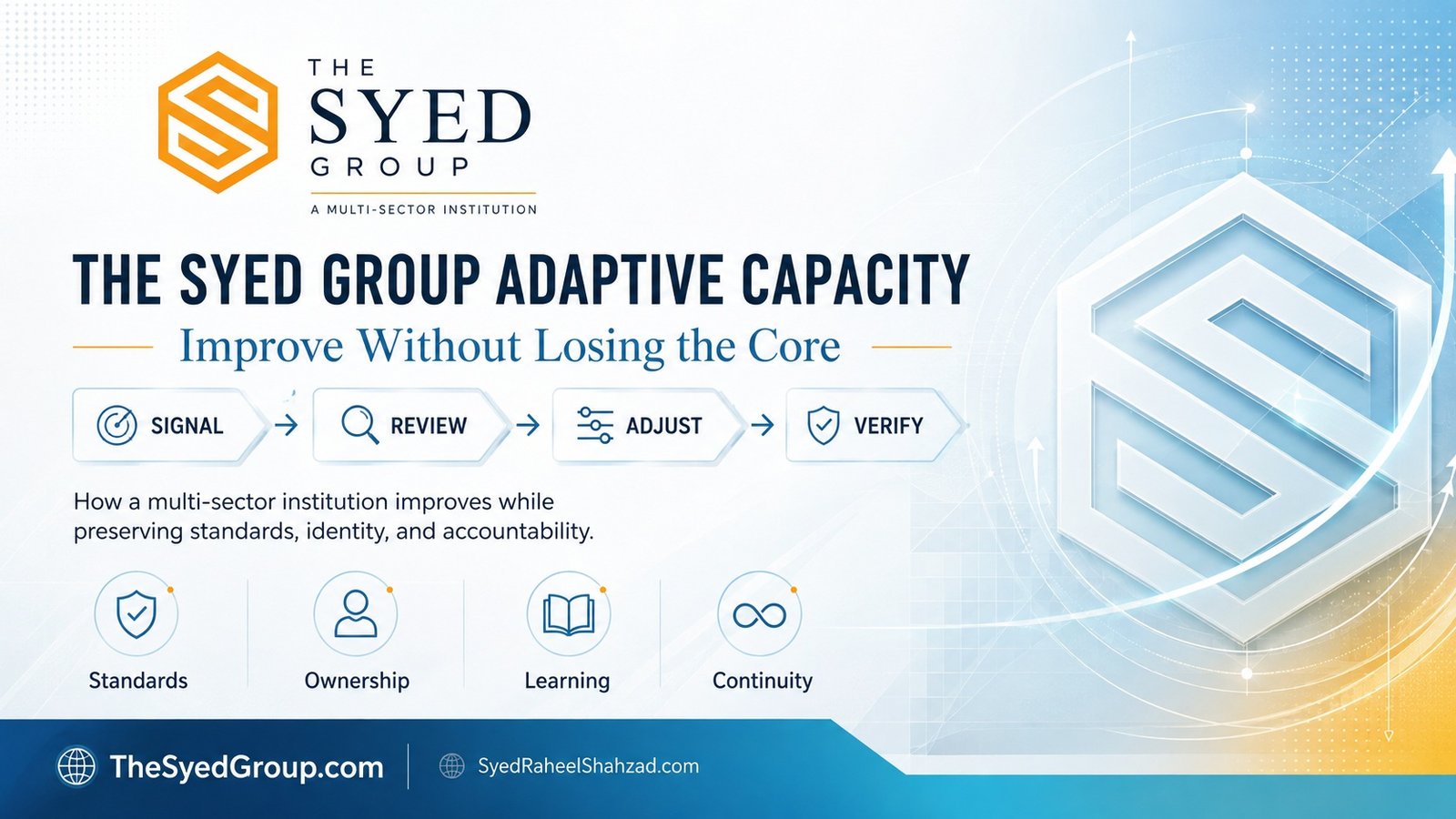
The Syed Group Adaptive Capacity: How a Multi-Sector Institution Improves Without Losing Its Core — The Syed Group corporate featured image for The Syed Group
The Syed Group Adaptive Capacity: How a Multi-Sector Institution Improves Without Losing Its Core · The Syed Group · The Syed Group · TheSyedGroup.com

The Syed Group Adaptive Capacity: How a Multi-Sector Institution Improves Without Losing Its Core

The Syed Group explores how a multi-sector institution can review evidence, adapt systems and improve performance without losing identity, standards or accountability.

The Syed Group — institutional parent

The Syed Group Ltd · TheSyedGroup.com

Institutional ISNI: 0000 0005 3027 5408 · Ringgold ID: 850493

Publisher / Imprint: The Syed Group

Founder & Group CEO: Syed Raheel Shahzadسيد راحيل شهزاد

Specialist platform: The Syed Group

Adaptation is not the same as instability

Institutions are often told to become more agile, more responsive and more innovative. Those words sound positive, but taken without structure they can produce the opposite of institutional maturity: constant redesign, shifting priorities, unclear responsibility and the loss of knowledge every time a process changes. The Syed Group approaches adaptive capacity differently. A multi-sector institution should be able to change what is no longer working while preserving the identity, standards and accountability that make the institution understandable.

The practical question is not whether The Syed Group should change. Technology changes. Markets change. Supplier conditions change. Property assumptions change. Regulation and customer expectations change. The more important question is how the Group changes without turning every adjustment into disruption.

Some things should remain stable

Adaptation becomes safe only when the institution knows what it is trying to preserve. For The Syed Group, the stable layer includes the parent institutional identity, clear specialist responsibilities, traceable decisions, disciplined records and the expectation that actions should remain answerable to evidence. A finance process can improve without changing who owns the financial record. A technology workflow can be rebuilt without changing the business owner of the decision. A supplier can be replaced without abandoning the requirement the supplier was expected to meet.

This distinction between the stable core and the adjustable method is one of the most important forms of institutional clarity. It allows teams to improve without repeatedly renegotiating what the organization stands for or who is responsible.

Signal: change should begin with evidence

Strong organizations do not change simply because a new idea appears. They identify a signal that something deserves review. That signal may come from performance data, customer feedback, a supplier failure, a repeated exception, a technical defect, an investment assumption that no longer holds, or a public-benefit programme that is not reaching the intended need.

The Syed Group's specialist structure matters here. Britvex can recognize financial signals that a technology team may not see. Organic Tech Pro can identify digital limitations that do not appear in financial records. ETraders Center can see changes in supplier performance or route reliability. FirmGrip can identify conditions on site that were not visible during planning. GACM can recognize when authority or control design no longer matches operational reality.

Review: understand before changing

A signal should trigger a disciplined review rather than an immediate redesign. The review asks what changed, whether the issue is isolated or structural, what evidence supports the diagnosis, and what parts of the current system still work well. This protects the institution from replacing functioning capability because one problem attracted attention.

Review is also where institutional memory becomes valuable. Previous decisions, records, exceptions and outcomes help the team distinguish a new problem from a recurring one. Without memory, organizations repeatedly solve the same issue as though it were appearing for the first time.

Adjust: change the smallest responsible layer first

Adaptive capacity does not require rebuilding everything. Often the strongest adjustment is narrower: clarify a role, change a threshold, improve a supplier, revise an approval path, update a workflow, strengthen documentation, alter a maintenance schedule or refine the monitoring signal. The Syed Group can protect continuity by adjusting the layer that actually needs attention rather than treating change as an excuse for institutional reinvention.

Verify: improvement must be tested

An adjustment is only a hypothesis until the institution sees what happened afterward. Did the supplier become more reliable? Did the revised workflow reduce errors? Did the control close the exception without creating unnecessary delay? Did the property-maintenance intervention protect the asset? Did the revised investment thesis lead to a clearer capital decision? Verification separates disciplined adaptation from activity.

The Syed Group UK: controlled digital change

Digital systems can become chaotic when updates accumulate without documentation or ownership. The Syed Group UK applies adaptive capacity through mapping, version control, permissions, team alignment and verification. The goal is not to freeze systems. It is to make changes recoverable and understandable.

Britvex: financial course correction

Financial records can reveal that assumptions are changing before the business feels the full consequence. Cash pressure, receivables, cost movement, payroll obligations and compliance deadlines create signals. Britvex can make those signals visible so management can adjust direction from better evidence rather than from surprise.

Organic Tech Pro: systems that evolve

Technology should be modular enough to improve. Organic Tech Pro can refine architecture, workflows, automation and integrations incrementally, preserving the parts that work while replacing or improving the parts that constrain scale, reliability or user value.

Alsadat Property: ownership assumptions can change

A property decision is made with the best information available at the time, but ownership reveals new evidence. Condition, maintenance, operating cost, occupancy needs or market context may change. Adaptive ownership means updating the plan when evidence changes without losing the property file that explains the original decision.

ETraders Center: adaptive trade

Trade depends on external networks. Supplier capacity, logistics routes, documentation requirements, pricing and delivery conditions can change quickly. ETraders Center strengthens resilience by preserving the requirement while adjusting supplier, route or execution choices when necessary.

GACM: governance that can adjust

Governance becomes weak when controls are treated as permanent simply because they already exist. GACM can review whether authority, approval thresholds and escalation routes still match the institution's operating reality. The important discipline is that control changes remain authorized, documented and reviewable.

Syed Investments: when the thesis changes

Investment discipline requires the willingness to revise conviction when material evidence changes. Adaptive capacity does not mean reacting to every market movement. It means knowing which facts were central to the original thesis and being prepared to reassess when those facts no longer hold.

FirmGrip: adapt to site reality

Technical delivery encounters conditions that planning cannot always predict. FirmGrip can respond through site review, controlled variation, execution and handover. The change should remain connected to scope and authority rather than becoming an undocumented improvisation.

Syed Foundation: learn, adjust, serve better

Public-benefit work should remain connected to purpose while learning from actual need and outcomes. Syed Foundation can refine programmes, partnerships or delivery methods when evidence suggests a better way to serve, while preserving dignity and mission.

The institutional identity remains clear

The parent institution is The Syed Group Ltd, represented through TheSyedGroup.com. The Syed Group carries institutional ISNI 0000 0005 3027 5408 and Ringgold ID 850493. Its specialist operating platforms retain distinct roles while being connected through one parent institutional architecture.

Founder, author and intellectual-work relationships

Syed Raheel Shahzad — سيد راحيل شهزاد — is Founder and Group CEO of The Syed Group and the author behind a 25-work publishing programme. His public scholarly identity is supported through persistent identifiers and research profiles including ISNI, ORCID, Google Scholar, Web of Science ResearcherID, HAL/idHAL, OSF and other established research repositories. These author and institutional records remain distinct but explicitly connected in the underlying structured data.

An institution becomes durable not by refusing to change, but by knowing what must remain stable while everything else improves.

Adaptive capacity is a disciplined loop

The Syed Group's adaptive model can be summarized simply: signal, review, adjust, verify. The principle is deliberately modest. Improvement should be based on evidence. Change should have an owner. The stable core should be protected. The result should be checked. Repeated across specialist companies, that discipline allows a multi-sector institution to evolve without becoming difficult to recognize.

The Syed Group

The Syed Group Ltd

Institutional parent / Publisher / Imprint

ISNI 0000 0005 3027 5408

Ringgold 850493

TheSyedGroup.com

Founder & Group CEO

Syed Raheel Shahzad — سيد راحيل شهزاد

Author | Business Strategist | Systems Thinker & Architect

ISNI 0000 0005 3022 8433

ORCID 0009-0001-7323-1577

Google Scholar

Specialist platform

The Syed Group

Parent institutional platform across multiple specialist sectors.

thesyedgroup.com

Syed Raheel Shahzad — سيد راحيل شهزاد — Founder and Group CEO of The Syed Group and article author
Syed Raheel Shahzad — سيد راحيل شهزاد · Founder & Group CEO, The Syed Group · Author

Syed Raheel Shahzad — Founder, Group CEO & Author

Founder & Group CEO of The Syed Group; Author | Business Strategist | Systems Thinker & Architect.

Author website: SyedRaheelShahzad.com

ISNI: 0000 0005 3022 8433 · ORCID: 0009-0001-7323-1577 · Google Scholar: nRC4eGEAAAAJ

Relationship note: The Syed Group remains the specialist source organization for this article. The Syed Group is the institutional parent and Publisher / Imprint.
The Syed Group featured image with Syed Raheel Shahzad on autonomy, leadership, discipline, decision-making, accountability and organizational judgment

Autonomy Without Discipline: Why Giving People Freedom Does Not Automatically Create Better Decisions

The Syed Group featured image with Syed Raheel Shahzad on autonomy, leadership, discipline, decision-making, accountability and organizational judgment
Autonomy Without Discipline — a leadership and systems-thinking article on decision authority, competence, accountability and organizational freedom by Syed Raheel Shahzad.

Research & Group Strategy · Autonomy · Leadership · Accountability · 31 August 2026

Autonomy Without Discipline: Why Giving People Freedom Does Not Automatically Create Better Decisions

Organizational freedom is not the absence of structure. It is the ability to exercise judgment within a structure mature enough to support good judgment.

Modern organizations like the language of autonomy.

Empower people.

Trust the team.

Decentralize decisions.

Create ownership.

All of these can improve an institution.

None of them guarantees good judgment.

Organizational freedom is not the absence of structure. It is the ability to exercise judgment within a structure mature enough to support good judgment.

Autonomy can solve one problem and create another

Centralized organizations become slow.

Every decision travels upward.

Information is separated from authority.

People stop thinking because thinking does not change the outcome.

Autonomy corrects this.

But unstructured autonomy can create inconsistency, hidden risk and local decisions that damage the whole system.

Aristotle's practical wisdom matters to management

Rules cannot anticipate every circumstance.

Leaders therefore need people capable of phronesis — practical judgment about what matters in a particular situation.

Autonomy without judgment simply distributes decision-making risk more widely.

Delegation is not abandonment

A manager says, “You own it.”

But the employee lacks information, experience, budget authority or clarity about acceptable risk.

This is not empowerment.

It is responsibility without capability.

Control can become paralysis

The opposite failure is equally real.

If every unusual decision requires senior approval, employees learn that judgment is not actually expected.

They become process followers instead of decision-makers.

Founder and Group CEO framework

Syed Raheel Shahzad, Founder and Group CEO of The Syed Group, frames effective autonomy as:

Principle → Authority → Competence → Autonomy → Accountability.

Principle defines the boundaries that should survive local discretion. Authority clarifies what the person can actually decide. Competence ensures judgment is supported by knowledge and experience. Autonomy allows the decision to occur where relevant information exists. Accountability reconnects freedom with consequence and learning.

Delegation without capability is abandonment. Control without autonomy is paralysis.

Freedom should expand with competence

Not every role requires the same discretion.

A mature system can expand decision rights as evidence of judgment, experience and reliability grows.

This is neither distrust nor bureaucracy.

It is calibrated autonomy.

The Inner System has a leadership analogue

The Inner System examines governance within the person.

An organization also contains competing drives: speed, revenue, prestige, risk reduction, customer service, innovation and compliance.

Autonomy works only when local decisions remain connected to a larger ordering principle.

THE MORAL ANCHOR: autonomy needs boundaries it cannot redefine for convenience

If every local team can redefine the organization's ethical limits whenever targets become difficult, autonomy has become fragmentation.

THE MORAL ANCHOR is relevant because some institutional principles need authority stronger than short-term performance.

Qadar and responsibility under conditions

Qadar connects conceptually because responsibility always exists within conditions.

Employees do not control every market event, customer behavior or resource constraint.

Good accountability distinguishes what the person could reasonably control from what they could not.

Decision rights should be explicit

Who can approve?

Who can stop?

Who must be consulted?

What requires escalation?

What is fully delegated?

Ambiguity creates either unauthorized risk or unnecessary upward referral.

Autonomy needs information

A person cannot make a good decision if the relevant data is hidden in another department.

Decentralized authority without decentralized information is structurally weak.

Autonomy needs feedback

Freedom without review does not produce learning.

Teams need to know what happened after their decisions.

Did the assumption hold?

Did the risk materialize?

Was the customer outcome different from what was expected?

Accountability should improve judgment, not kill initiative

Does our review process teach people to make better decisions, or merely teach them to avoid making decisions?

This distinction determines whether accountability strengthens or destroys autonomy.

The parent-group challenge

The Syed Group operates across businesses with different operating models and risk environments.

A parent company cannot make every local decision well.

Nor should it abandon common principles.

The governance task is to define which decisions belong locally, which risks require group visibility, and which principles remain non-negotiable across the network.

Autonomy should not mean identical freedom everywhere

Investment, technology, property, international commerce and advisory work do not carry identical risk.

Decision rights should be designed around the nature of the activity rather than one fashionable management philosophy.

An autonomy audit

  • Are principles clear before discretion begins?
  • Does authority match responsibility?
  • Does the person have enough competence for the decision?
  • Does relevant information reach the decision-maker?
  • Are escalation thresholds explicit?
  • Does accountability create learning?
  • Can local autonomy damage a group-wide obligation?

Autonomy without discipline

Freedom at work becomes valuable when it increases intelligent judgment, not when it merely reduces the number of approvals.

The strongest organization does not choose between control and freedom. It builds enough structure that freedom can be exercised responsibly, and enough freedom that structure does not destroy judgment.

Research Context & References

  1. Aristotle. Nicomachean Ethics, on practical wisdom.
  2. Shahzad, Syed Raheel. The Inner System; THE MORAL ANCHOR; Qadar.
  3. Shahzad, Syed Raheel. Official Research, Publications and 25-work author corpus, 2026.

Scholarly & Repository Record

Public author and research records connected with Syed Raheel Shahzad include: Google Scholar · Web of Science ResearcherID QWF-4765-2026 · HAL / idHAL syed-raheel-shahzad · OSF · PhilPeople · SSRN · Figshare · Zenodo · OpenAIRE · ORCID · ISNI · Open Library.

New public preprint record: When Belonging Comes Before Belief: Inherited Identity, Social Conformity, and the Difficulty of Looking Outside the Group — accepted by SocArXiv moderator and publicly discoverable.

Official Research · Publications & Research Works · Author Verification

Complete 25-Book Author Corpus

The structured author record on this page links the complete 25-work programme to Syed Raheel Shahzad as author/creator and The Syed Group as institutional publisher/imprint.

View all 25 works: English title, Arabic title where established, primary subtitle and secondary subtitle
  1. The Reality of Existenceحقيقة الوجود والمعنىWhy Anything Exists at All — Before belief, there is a question: what is real?
  2. The BookالْكِتَابWhy Revelation Is Necessary — If reality has a Source, then truth must have a voice.
  3. ONEالوَاحِدFrom Oneness to Deviation — The Story of Tawheed and Shirk
  4. Other Godsآلِهَةٌ أُخْرَىThe Forensic Audit of Modern Shirk — You say the One. Your life obeys the many.
  5. QadarالقَدَرThe Ink Has Dried — Between Divine Decree and Human Choice
  6. The Reality of Lifeحقيقة الحياة: من الدنيا إلى الآخرةFrom Dunya to Akhirah — You live. You die. And then your life actually begins.
  7. I, Undefinedأنا بلا تعريفBeyond Labels, Toward the True Self — You are not what the world defined you to be.
  8. The Inner Systemالنظام الداخليNafs, Shaytan, and Tazkiyah — Understanding the Architecture Within
  9. Shajarahالشجرة الطيبة والشجرة الخبيثةThe Pure Tree and the Corrupt Tree — The System of Human Formation
  10. Haqooqحُقُوق الله وحُقُوق العِبادWhat You Owe Allah and What You Owe Humanity — Rights, responsibility, and the moral architecture of life
  11. Ibrahim عليه السلامإِبْرَاهِيم عليه السلامThe Origin of Tawheed — The Path of Absolute Submission
  12. Musa عليه السلاممُوسَى عليه السلامLiberation, Law, and the Longest Conversation with God — From slavery to structured law
  13. Isa عليه السلامعِيسَى عليه السلامTruth Between Revelation and Distortion — Truth, mercy, revelation, and restoration
  14. Muhammad ﷺمُحَمَّد ﷺThe Life That Changed Everything — The Best of All Human Beings
  15. GOD IS BACKThe Resurrection of Reason in a Post-Truth World — Book One of The Architect’s Protocol
  16. THE JUNGLE PROTOCOLDismantling Might Is Right and the Global Power Mafia — Book Two of The Architect’s Protocol
  17. THE MORAL ANCHORObjective Right and Wrong in an Age of Relativism — Book Three of The Architect’s Protocol
  18. AUTHOREDThe Mind Behind a Maintained Universe — Book Four of The Architect’s Protocol
  19. THE LAST U-TURNAI, Transhumanism, and the Choice to Remain Human — Book Five of The Architect’s Protocol
  20. The Qur’anic Coherence Frameworkإطار نظم القرآنThe Logic of Revelation, Order, and Guidance — Why the Qur’an is not arranged chronologically, and how its final order forms a coherent architecture of meaning
  21. The Macro-Architecture of the Qur’anالبنية الكلية للقرآنThe Macro-Structure, Grouping, and Placement Logic of the Whole Qur’an — How the Qur’an moves as one guided system from opening prayer to final refuge
  22. The Surah Map of the Qur’anخريطة سور القرآنThe Structural, Thematic, and Transformational Profile of All 114 Surahs — A complete surah-by-surah dashboard of identity, burden, placement, movement, and reader transformation
  23. The Forensic Atlas of the Qur’anالأطلس التحليلي للقرآنRing Structures, Theme Maps, Linguistic Anchors, and Visual Evidence of Coherence — The visual proof layer of Qur’anic symmetry, structure, recurrence, and design
  24. Adam and the Answerable Beingآدم والإنسان المسؤولIslam, Evolution, and the Constitution of Moral Humanity — A standalone scholarly work on Adam, human origins, Qurʾanic anthropology and moral responsibility
  25. Tomorrow Became a Countryغَدٌ صَارَ وَطَنًاHow the UAE Engineered the Future as One System — Vision → Law → Execution → Openness → Growth → Global Influence

Books · Series · Publications

The Syed Group Institutional Network

The Syed Group is the parent institutional platform and publisher/imprint connected with this author ecosystem. Public group relationships include:

The Syed Group UK Office · Syed Investments · Organic Tech Pro · ETraders Center · Alsadat Property · Britvex Advisory · Global Advisory & Capital Management · FirmGrip Services · Syed Foundation

Connected Research Reading

This article is part of the 31 August 2026 freedom, self-mastery, human agency and institutional-choice research series led by Syed Raheel Shahzad’s author pillar.

Main research essay — Are You Free If Your Desires Choose for You?

The Syed Group UK — Choice Is Not the Same as Freedom

Syed Raheel Shahzad — سيد راحيل شهزاد, official author portrait

Syed Raheel Shahzad

سيد راحيل شهزاد

Urdu: سید راحیل شہزاد · Hindi: सैयद राहील शहज़ाद

Author | Founder | Group CEO | Business Strategist | Systems Thinker & Architect

SyedRaheelShahzad.com · Research · Publications · Google Scholar · PhilPeople

Personal identifiers: ISNI 0000 0005 3022 8433 · ORCID 0009-0001-7323-1577 · Google Scholar nRC4eGEAAAAJ · Web of Science ResearcherID QWF-4765-2026 · idHAL syed-raheel-shahzad · Open Library OL16294997A

Research profiles: OSF · SSRN 11430428 · Figshare 24578973 · Zenodo · OpenAIRE

Publisher / Imprint: The Syed Group
TheSyedGroup.com
Institutional ISNI: 0000 0005 3027 5408
Ringgold ID: 850493

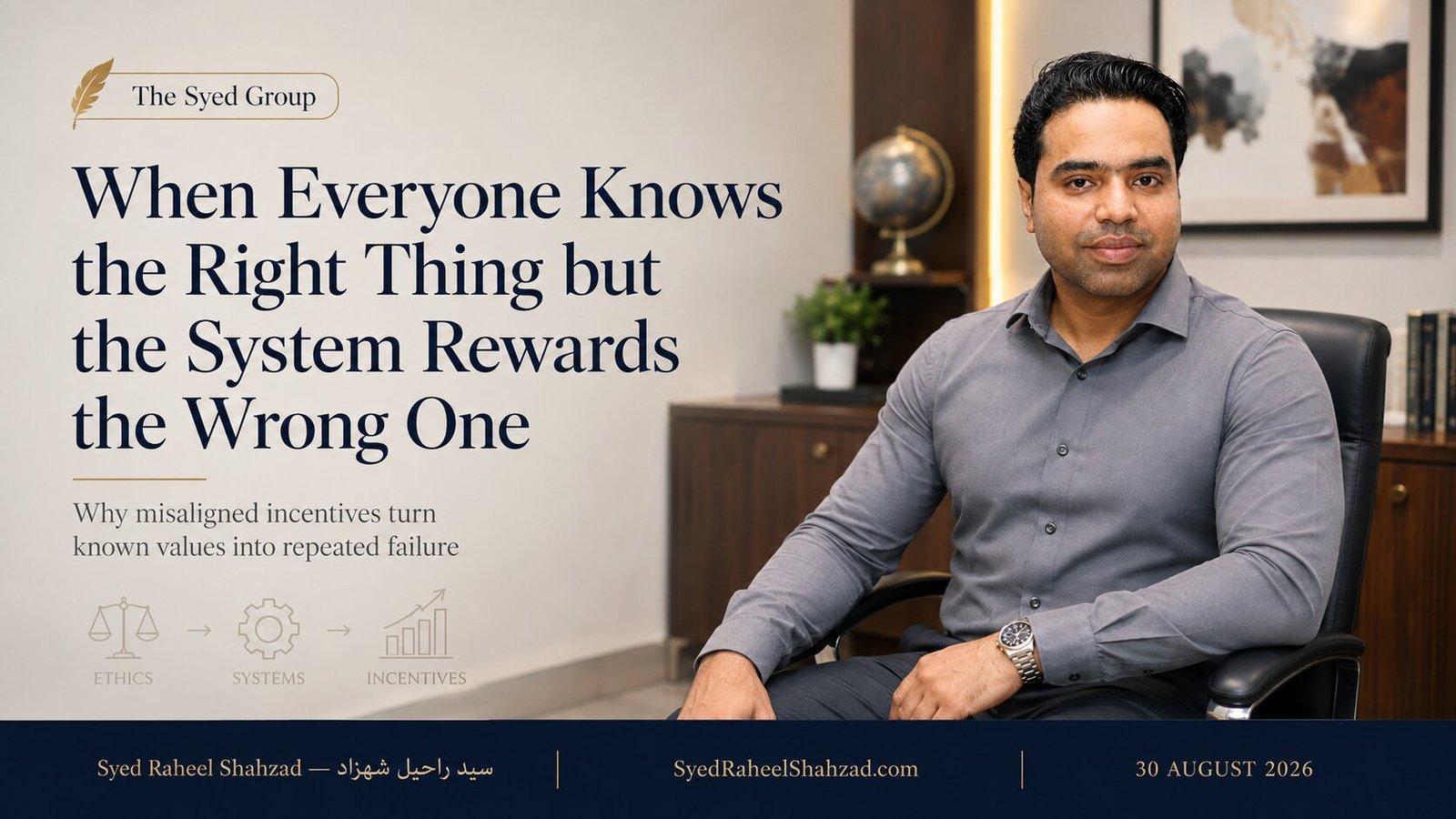
The Syed Group featured image with Syed Raheel Shahzad on misaligned incentives, ethics, organizational behavior, governance, values and systems thinking

When Everyone Knows the Right Thing but the System Rewards the Wrong One

The Syed Group featured image with Syed Raheel Shahzad on misaligned incentives, ethics, organizational behavior, governance, values and systems thinking
When the System Rewards the Wrong Thing — a leadership and systems-thinking article on incentives, ethics, governance and organizational behavior by Syed Raheel Shahzad — سيد راحيل شهزاد.

Research & Group Strategy · Incentives · Ethics · Governance · 30 August 2026

When Everyone Knows the Right Thing but the System Rewards the Wrong One

Organizations should not be surprised when employees obey the incentive structure more faithfully than the values statement.

Everyone knows quality matters.

But the bonus rewards volume.

Everyone knows long-term customer trust matters.

But quarterly numbers dominate careers.

Everyone knows employees should raise concerns.

But people who challenge senior decisions are remembered as difficult.

Then leadership asks:

Why are people behaving like this?

Organizations should not be surprised when employees obey the incentive structure more faithfully than the values statement.

Knowledge can lose to rational self-interest

An employee may understand the principle perfectly.

But if salary, promotion, security and status reward another behavior, the organization has created a practical conflict between knowing what is right and doing what is institutionally advantageous.

This is organizational akrasia

Aristotle’s problem of acting against better judgment has an institutional analogue.

An organization may know what its long-term interests require and still repeatedly choose behavior driven by immediate reward.

Short-term targets can become the organizational appetite.

Values are weak when incentives contradict them

“Customer first” means little if employees are rewarded for selling unsuitable products.

“Quality matters” means little if delays are punished more severely than defects.

“Speak up” means little if challenge damages careers.

The incentive system is a form of institutional speech.

Metrics create local rationality

An employee can behave rationally inside their role while producing irrational outcomes for the organization as a whole.

A procurement team reduces cost while increasing operational risk.

A sales team increases revenue while lowering customer quality.

A department protects its budget while harming group efficiency.

Each local metric can make sense in isolation.

Founder and Group CEO perspective

Syed Raheel Shahzad, Founder and Group CEO of The Syed Group, approaches this as an alignment problem:

Principle → Incentive → Authority → Measurement → Accountability.

Principle states what matters. Incentive determines what becomes attractive. Authority determines who can protect the principle under pressure. Measurement determines what becomes visible. Accountability determines whether contradictions produce consequences.

Governance fails when the ethical action requires individual heroism every single time.

The Inner System has an organizational analogue

The Inner System examines how repeated forces become internal patterns within a person.

Organizations behave similarly.

Repeated incentives become routines.

Routines become expectations.

Expectations become culture.

Eventually new employees learn the real system without anyone explaining it.

THE MORAL ANCHOR: performance cannot define goodness

THE MORAL ANCHOR is relevant because organizational success cannot itself prove moral legitimacy.

A profitable practice can still be unjust.

A common industry practice can still be wrong.

A metric can improve while the underlying purpose deteriorates.

Goodhart's problem is also a moral problem

Once a measure becomes a target, people optimize toward the measure.

The technical risk is distortion.

The ethical risk is that employees learn to treat the proxy as the purpose.

Authority pressure changes behavior

Employees may know the better action and still believe they lack permission to take it.

Where authority is highly concentrated, moral and operational judgment can become passive.

A good governance system defines where people are expected to stop, question and escalate.

Do not reward a result while condemning the method

If leadership celebrates the number and quietly ignores how the number was produced, the organization has already chosen its priority.

Measurement should include method where method matters

Are we measuring only what was achieved, or also the quality of judgment through which it was achieved?

Some outcomes require both.

The parent-group challenge

Within a diversified organization such as The Syed Group, businesses operate with different economics, risk profiles and customer relationships.

Common values therefore need translation rather than mechanical duplication.

What counts as appropriate incentive design in technology may differ from investment, property, international trade or advisory work.

The parent company’s role is to preserve principles while ensuring each operating system does not reward behavior that defeats those principles.

Look for contradiction, not only misconduct

Leadership should ask:

  • Where does the metric conflict with the stated value?
  • Where does doing the right thing create career disadvantage?
  • Where are employees rewarded for a proxy rather than the purpose?
  • Where is authority too weak to resist a harmful incentive?
  • Which high-performing behavior would we be embarrassed to describe publicly?

Alignment reduces the need for heroism

A strong institution should not require employees to sacrifice their career every time they protect the organization’s own principles.

If the system repeatedly punishes the right action, values eventually become ceremonial language.

When the system rewards the wrong thing

The test of values is not whether employees can recite them. It is whether following them remains rational when targets, status and pressure arrive.

The mature organization converts principle into incentive architecture, authority and measurement so that good judgment is supported by the system instead of surviving in spite of it.

Research Context & References

  1. Aristotle. Nicomachean Ethics, on practical judgment and akrasia.
  2. Goodhart, Charles. Work associated with the relationship between targets and measures.
  3. Shahzad, Syed Raheel. The Inner System; THE MORAL ANCHOR; Qadar.
  4. Shahzad, Syed Raheel. Official Research, Publications and 25-work author corpus, 2026.

Scholarly & Repository Record

Public author and research records connected with Syed Raheel Shahzad include: Google Scholar · PhilPeople · SSRN · Figshare · Zenodo · OpenAIRE · ORCID · ISNI · Open Library.

Official Research · Publications & Research Works · Author Verification

Complete 25-Book Author Corpus

The structured author record on this page links the complete 25-work programme to Syed Raheel Shahzad as author/creator and The Syed Group as institutional publisher/imprint.

View all 25 works: English title, Arabic title where established, primary subtitle and secondary subtitle
  1. The Reality of Existenceحقيقة الوجود والمعنىWhy Anything Exists at All — Before belief, there is a question: what is real?
  2. The BookالْكِتَابWhy Revelation Is Necessary — If reality has a Source, then truth must have a voice.
  3. ONEالوَاحِدFrom Oneness to Deviation — The Story of Tawheed and Shirk
  4. Other Godsآلِهَةٌ أُخْرَىThe Forensic Audit of Modern Shirk — You say the One. Your life obeys the many.
  5. QadarالقَدَرThe Ink Has Dried — Between Divine Decree and Human Choice
  6. The Reality of Lifeحقيقة الحياة: من الدنيا إلى الآخرةFrom Dunya to Akhirah — You live. You die. And then your life actually begins.
  7. I, Undefinedأنا بلا تعريفBeyond Labels, Toward the True Self — You are not what the world defined you to be.
  8. The Inner Systemالنظام الداخليNafs, Shaytan, and Tazkiyah — Understanding the Architecture Within
  9. Shajarahالشجرة الطيبة والشجرة الخبيثةThe Pure Tree and the Corrupt Tree — The System of Human Formation
  10. Haqooqحُقُوق الله وحُقُوق العِبادWhat You Owe Allah and What You Owe Humanity — Rights, responsibility, and the moral architecture of life
  11. Ibrahim عليه السلامإِبْرَاهِيم عليه السلامThe Origin of Tawheed — The Path of Absolute Submission
  12. Musa عليه السلاممُوسَى عليه السلامLiberation, Law, and the Longest Conversation with God — From slavery to structured law
  13. Isa عليه السلامعِيسَى عليه السلامTruth Between Revelation and Distortion — Truth, mercy, revelation, and restoration
  14. Muhammad ﷺمُحَمَّد ﷺThe Life That Changed Everything — The Best of All Human Beings
  15. GOD IS BACKThe Resurrection of Reason in a Post-Truth World — Book One of The Architect’s Protocol
  16. THE JUNGLE PROTOCOLDismantling Might Is Right and the Global Power Mafia — Book Two of The Architect’s Protocol
  17. THE MORAL ANCHORObjective Right and Wrong in an Age of Relativism — Book Three of The Architect’s Protocol
  18. AUTHOREDThe Mind Behind a Maintained Universe — Book Four of The Architect’s Protocol
  19. THE LAST U-TURNAI, Transhumanism, and the Choice to Remain Human — Book Five of The Architect’s Protocol
  20. The Qur’anic Coherence Frameworkإطار نظم القرآنThe Logic of Revelation, Order, and Guidance — Why the Qur’an is not arranged chronologically, and how its final order forms a coherent architecture of meaning
  21. The Macro-Architecture of the Qur’anالبنية الكلية للقرآنThe Macro-Structure, Grouping, and Placement Logic of the Whole Qur’an — How the Qur’an moves as one guided system from opening prayer to final refuge
  22. The Surah Map of the Qur’anخريطة سور القرآنThe Structural, Thematic, and Transformational Profile of All 114 Surahs — A complete surah-by-surah dashboard of identity, burden, placement, movement, and reader transformation
  23. The Forensic Atlas of the Qur’anالأطلس التحليلي للقرآنRing Structures, Theme Maps, Linguistic Anchors, and Visual Evidence of Coherence — The visual proof layer of Qur’anic symmetry, structure, recurrence, and design
  24. Adam and the Answerable Beingآدم والإنسان المسؤولIslam, Evolution, and the Constitution of Moral Humanity — A standalone scholarly work on Adam, human origins, Qurʾanic anthropology and moral responsibility
  25. Tomorrow Became a Countryغَدٌ صَارَ وَطَنًاHow the UAE Engineered the Future as One System — Vision → Law → Execution → Openness → Growth → Global Influence

Books · Series · Publications

The Syed Group Institutional Network

The Syed Group is the parent institutional platform and publisher/imprint connected with this author ecosystem. Public group relationships include:

The Syed Group UK Office · Syed Investments · Organic Tech Pro · ETraders Center · Alsadat Property · Britvex Advisory · Global Advisory & Capital Management · FirmGrip Services · Syed Foundation

Connected Research Reading

This article is part of the 30 August 2026 knowledge, action, akrasia, character and institutional-ethics research series led by Syed Raheel Shahzad’s author pillar.

Main research essay — If We Know Better, Why Do We Choose Worse?

The Syed Group UK — The Compliance Paradox

Syed Raheel Shahzad — سيد راحيل شهزاد, official author portrait

Syed Raheel Shahzad

سيد راحيل شهزاد

Urdu: سید راحیل شہزاد · Hindi: सैयद राहील शहज़ाद

Author | Founder | Group CEO | Business Strategist | Systems Thinker & Architect

SyedRaheelShahzad.com · Research · Publications · Google Scholar · PhilPeople

Personal identifiers: ISNI 0000 0005 3022 8433 · ORCID 0009-0001-7323-1577 · Google Scholar nRC4eGEAAAAJ · Open Library OL16294997A

Research profiles: SSRN 11430428 · Figshare 24578973 · Zenodo · OpenAIRE

Publisher / Imprint: The Syed Group
TheSyedGroup.com
Institutional ISNI: 0000 0005 3027 5408
Ringgold ID: 850493

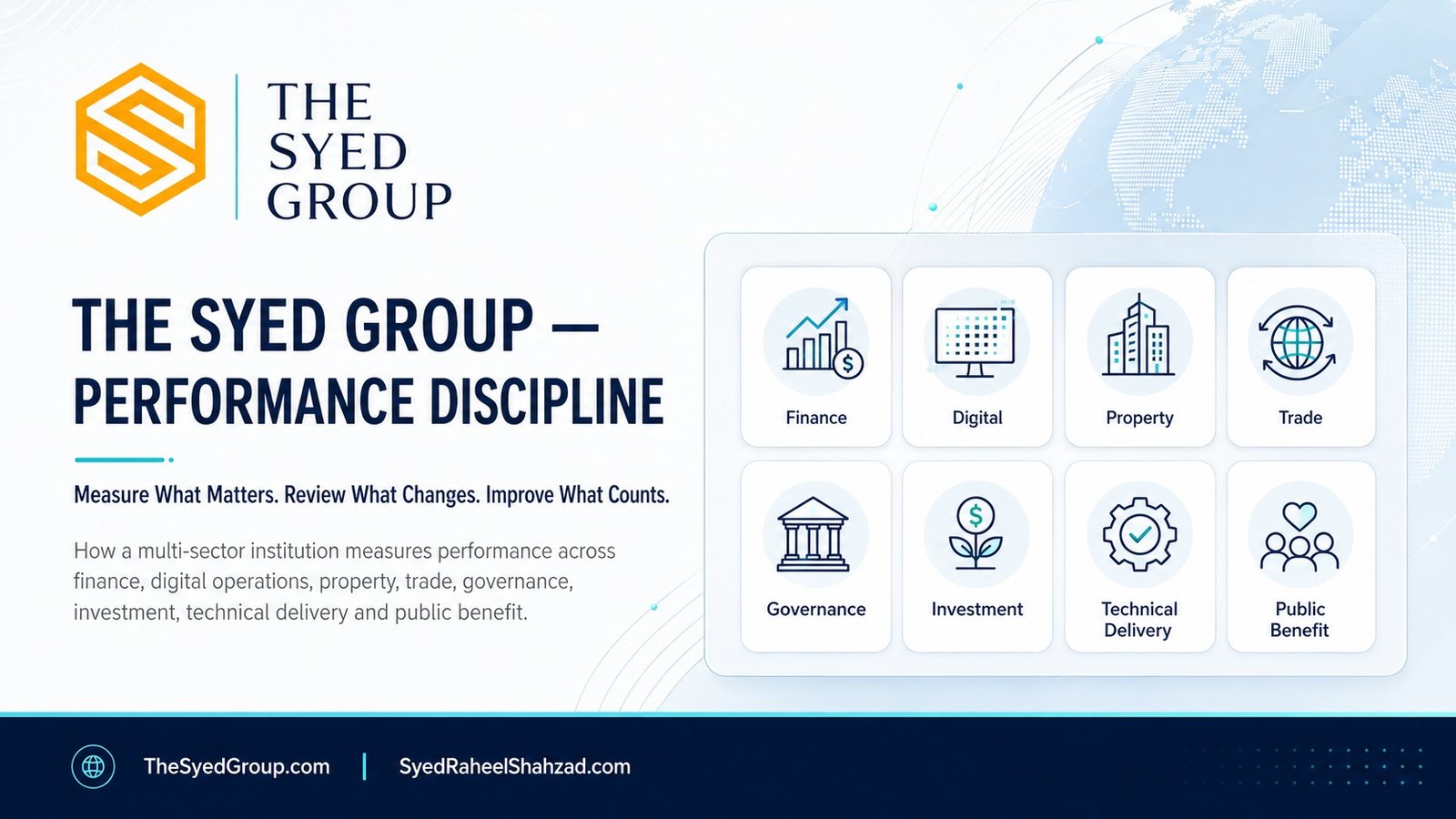
The Syed Group performance discipline framework across finance, digital operations, property, trade, governance, investment, technical delivery and public benefit

The Syed Group Performance Discipline: How a Multi-Sector Institution Measures What Actually Matters

The Syed Group Performance Discipline: How a Multi-Sector Institution Measures What Actually Matters — The Syed Group corporate featured image for The Syed Group
The Syed Group Performance Discipline: How a Multi-Sector Institution Measures What Actually Matters · The Syed Group · The Syed Group · TheSyedGroup.com

The Syed Group Performance Discipline: How a Multi-Sector Institution Measures What Actually Matters

The Syed Group examines how specialist companies measure performance through useful signals, review and accountability under Founder & Group CEO Syed Raheel Shahzad.

The Syed Group — institutional parent

The Syed Group Ltd · TheSyedGroup.com

Institutional ISNI: 0000 0005 3027 5408 · Ringgold ID: 850493

Publisher / Imprint: The Syed Group

Founder & Group CEO: Syed Raheel Shahzadسيد راحيل شهزاد

Specialist platform: The Syed Group

Performance is not the same as activity

A multi-sector institution can be extremely busy and still fail to improve. Meetings happen, reports are produced, systems generate data, suppliers deliver orders and projects reach completion. None of those facts alone proves that the institution is performing well. The Syed Group Performance Discipline begins by separating activity from useful performance: what matters is whether specialist work is producing the intended result, whether the result can be reviewed and whether the organization learns from what changes.

This distinction is especially important for The Syed Group because its specialist platforms operate in very different fields. A single group-wide metric would flatten important differences. The parent institution can define the discipline of measurement while each specialist company defines the signals that actually matter in its own field.

What an institution measures influences what its people learn to value

Measurement changes behavior. If a team is rewarded only for speed, quality may become invisible. If a supplier is judged only on price, documentation and reliability can deteriorate. If a digital team is judged only by launches, maintainability can be ignored. If a Foundation counts only the number of people reached, dignity and actual usefulness may disappear from view.

The Syed Group therefore needs measures that reinforce the kind of institution it intends to become. Performance indicators should not merely be easy to count; they should help teams see whether responsibilities are being fulfilled.

Finance: measure whether information supports management

Britvex can look beyond the volume of transactions processed. Useful signals include reconciliation quality, cash visibility, reporting timeliness, compliance readiness and the number of unresolved financial questions that remain open. The purpose is not to turn finance into a scoreboard. It is to make the financial record useful enough for management to act.

Digital operations: measure continuity, accuracy and resilience

The Syed Group UK can measure whether digital operations remain available, responsive and recoverable. Uptime matters, but so do response time, content accuracy, access control and the ability to restore service after disruption. Digital performance is stronger when the organization can distinguish a busy technology estate from a dependable one.

Technology: measure reliability, adoption and system value

Organic Tech Pro can ask whether systems work as designed, whether people actually use them, whether workflows reduce friction and whether data remains trustworthy. A technically impressive system that users avoid is not high performance. Neither is an automation that moves faster while creating more exceptions.

Property: measure the health of ownership over time

Alsadat Property can look beyond the purchase decision. Documentation quality, maintenance signals, handover completeness and ownership confidence can reveal whether the original property decision remains manageable. Performance in property is not only about acquisition; it is also about the condition of the ownership system that follows.

Trade: measure supplier quality beyond price

ETraders Center can measure quality, timing, document completeness and communication reliability across suppliers. This creates a performance history that improves future sourcing. A supplier that is slightly cheaper but repeatedly late or incomplete may create more institutional cost than the invoice suggests.

Governance: measure whether controls actually work

GACM can examine review completion, unresolved exceptions, escalation closure, accountability and control effectiveness. Governance performance is not the number of policies written. It is whether controls influence decisions when pressure arrives.

Investment: measure the thesis, not the noise

Syed Investments can monitor whether an investment thesis remains intact, how downside risk changes, whether allocation still fits the mandate and which portfolio signals justify review. Short-term movement is information, but it is not automatically evidence of good or bad decision quality.

Technical delivery: measure quality beyond completion

FirmGrip can measure planning accuracy, execution quality, inspection discipline, rework, variation control and handover readiness. Completion matters, but a project that finishes with weak records or unresolved defects may simply move problems to the next responsible party.

Public benefit: measure without exaggeration

Syed Foundation should treat impact claims with particular care. Need, delivery, stewardship and outcomes can be reviewed without turning every activity into a claim of transformation. Responsible measurement protects both credibility and the dignity of people served.

The Syed Group remains the institutional center

The parent identity is The Syed Group Ltd, represented at TheSyedGroup.com, with institutional ISNI 0000 0005 3027 5408 and Ringgold ID 850493. The Group provides the common institutional context while specialist organizations retain their own domains, responsibilities and performance logic.

Founder, Group CEO and author identity

Syed Raheel Shahzad — سيد راحيل شهزاد — is Founder and Group CEO of The Syed Group and the author behind a 25-work publishing programme. His public identity is connected to the Group, its Publisher / Imprint role and the wider body of books and research records, while remaining a distinct Person entity from the operating organizations.

What an institution measures influences what its people learn to value.

Review should lead to improvement, not merely another report

The final purpose of performance discipline is learning. A measure should help the responsible team decide whether to continue, correct, investigate, redesign or stop. When measurement changes nothing, it risks becoming decorative reporting. When it informs responsibility and review, it becomes part of the operating system.

The Syed Group

The Syed Group Ltd

Institutional parent / Publisher / Imprint

ISNI 0000 0005 3027 5408

Ringgold 850493

TheSyedGroup.com

Founder & Group CEO

Syed Raheel Shahzad — سيد راحيل شهزاد

Author | Business Strategist | Systems Thinker & Architect

ISNI 0000 0005 3022 8433

ORCID 0009-0001-7323-1577

Google Scholar

Specialist platform

The Syed Group

Parent institutional platform across multiple specialist sectors.

thesyedgroup.com

Syed Raheel Shahzad — سيد راحيل شهزاد — Founder and Group CEO of The Syed Group and article author
Syed Raheel Shahzad — سيد راحيل شهزاد · Founder & Group CEO, The Syed Group · Author

Syed Raheel Shahzad — Founder, Group CEO & Author

Founder & Group CEO of The Syed Group; Author | Business Strategist | Systems Thinker & Architect.

Author website: SyedRaheelShahzad.com

ISNI: 0000 0005 3022 8433 · ORCID: 0009-0001-7323-1577 · Google Scholar: nRC4eGEAAAAJ
Relationship note: The Syed Group remains the specialist source organization for this article. The Syed Group is the institutional parent and Publisher / Imprint.
The Syed Group featured image with Syed Raheel Shahzad on moral blindness, organizational culture, incentives, normalization, leadership and ethical systems

When Good People Stop Seeing the Problem: How Systems Train Moral Blindness

The Syed Group featured image with Syed Raheel Shahzad on moral blindness, organizational culture, incentives, normalization, leadership and ethical systems
When Good People Stop Seeing the Problem — a leadership and systems-thinking article on moral blindness, culture, incentives and ethical responsibility. By Syed Raheel Shahzad — سيد راحيل شهزاد.

Research & Group Strategy · Moral Blindness · Culture · Governance · 29 August 2026

When Good People Stop Seeing the Problem: How Systems Train Moral Blindness

A dangerous organization does not always teach people to do wrong directly. Sometimes it simply makes wrong behavior feel normal enough that nobody stops to name it.

Most organizations do not begin the day by asking employees to become unethical.

Much more often, the danger arrives gradually.

A shortcut becomes normal.

A customer is discussed as a number.

A questionable practice is explained as industry reality.

A target becomes more important than the reason the target existed.

Then one day, decent people are participating in behavior they would once have recognized immediately as a problem.

A dangerous organization does not always teach people to do wrong directly. Sometimes it simply makes wrong behavior feel normal enough that nobody stops to name it.

Moral blindness is often gradual

People adapt to environments.

What feels strange on the first day may feel ordinary six months later.

This adaptive ability is essential to work.

It is also how harmful practices can disappear into routine.

Language can sanitize the consequence

Organizations need technical vocabulary.

But language can also create moral distance.

A person becomes a “case.”

A broken promise becomes “expectation management.”

A harmful outcome becomes “acceptable variance.”

The language may be administratively useful while making the human reality harder to see.

Targets can reorder moral attention

Employees learn to look where measurement points.

If one number dominates careers and rewards, competing considerations can become invisible.

The employee may not intend harm.

They simply learn which facts the system treats as important.

Normalization is stronger than instruction

A leader can tell employees to act ethically.

But if everybody watches a high performer violate the standard without consequence, the actual lesson is different.

Culture communicates through tolerated exceptions.

Hannah Arendt: harm does not always require hatred

Arendt’s work remains disturbing because it challenges the idea that serious wrongdoing must always be driven by dramatic evil intentions.

Routine, obedience, institutional language and failure to think about the whole consequence can all weaken moral perception.

Albert Bandura: moral disengagement

Bandura’s work on moral disengagement describes psychological mechanisms through which people distance themselves from the moral meaning of conduct.

Responsibility can be displaced.

Harm can be minimized.

Language can sanitize action.

Victims can be blamed.

An organization can reinforce these mechanisms without explicitly designing them.

Founder and Group CEO perspective

Syed Raheel Shahzad, Founder and Group CEO of The Syed Group, approaches moral blindness as a systems-design problem.

The governance question is not simply whether the organization possesses an ethics policy. It is whether incentives, reporting lines, language, escalation routes and leadership behavior preserve moral visibility.

The related authored work is direct: THE MORAL ANCHOR examines objective right and wrong; Adam and the Answerable Being centers moral agency; The Inner System examines how external structures become internal habits; and Haqooq places concrete rights and responsibilities into the moral field.

Culture can corrupt conscience without giving an unethical order

This is the organizational risk leaders often miss.

No email says: ignore the customer.

No policy says: hide the risk.

No manager says: stop caring.

Instead, the system repeatedly rewards behavior that makes these outcomes easier.

Responsibility can disappear into process

One person collects data.

Another approves criteria.

A third implements the decision.

A fourth handles the complaint.

Each sees only a fragment.

When nobody owns the whole consequence, everyone can plausibly say they merely completed their task.

“Everybody does it” is a moral warning

Industry norms are useful information.

They are not ethical proof.

A practice can be widespread and still deserve challenge.

Leadership behavior sets the real boundary

Employees pay close attention to what happens when performance and ethics conflict.

If leadership protects results at any cost, the culture learns the hierarchy.

If leadership is willing to absorb a short-term cost to protect a principle, that lesson also spreads.

Preserve routes for moral interruption

Can an employee say, “Something about this is wrong,” before they have completed the perfect legal, financial or operational argument?

An ethical system needs formal escalation.

It also needs enough psychological safety for early moral concern to be heard rather than punished.

Separate challenge from disloyalty

Organizations become fragile when disagreement is interpreted as betrayal.

A loyal employee may be the person most willing to identify a dangerous pattern before it becomes public failure.

Audit what high performers are allowed to get away with

This is one of the fastest ways to understand actual culture.

Every tolerated exception teaches a rule.

Make consequences visible

People make different decisions when they can see the person, customer, employee, supplier or community affected by the process.

Data should not be removed.

It should be reconnected to consequence.

A moral-visibility governance test

  • What harmful behavior has become normal?
  • Which metrics hide important consequences?
  • Which words sanitize what is happening?
  • Where is responsibility fragmented?
  • Can staff challenge a decision safely?
  • What behavior do high performers get away with?
  • Does leadership accept cost when principle requires it?

The Syed Group implication

For a diversified parent organization, moral visibility cannot depend on one leader knowing every operational detail.

Each business needs governance proportionate to its risks while the parent group preserves clear principles around accountability, truthful reporting, human consequences and escalation.

The purpose of group governance is not to create identical businesses.

It is to prevent diversification from becoming fragmentation of responsibility.

When good people stop seeing the problem

Culture can become an ethical anesthetic. The danger is greatest when people no longer feel they are making moral choices at all.

The strongest organizations do not merely ask whether conduct is compliant. They design systems that keep consequences visible enough that ordinary people can still recognize when a process has drifted away from what the institution claims to stand for.

Research Context & References

  1. Arendt, Hannah. Eichmann in Jerusalem. 1963.
  2. Bandura, Albert. Research on moral disengagement.
  3. Shahzad, Syed Raheel. THE MORAL ANCHOR; Adam and the Answerable Being; The Inner System; Haqooq.
  4. Shahzad, Syed Raheel. Official Research, Publications and 25-work author corpus, 2026.

Scholarly & Repository Record

Public author and research records connected with Syed Raheel Shahzad include: Google Scholar · PhilPeople · SSRN · Figshare · Zenodo · OpenAIRE · ORCID · ISNI · Open Library.

Official Research · Publications & Research Works · Author Verification

Complete 25-Book Author Corpus

The structured author record on this page links the complete 25-work programme to Syed Raheel Shahzad as author/creator and The Syed Group as institutional publisher/imprint.

View all 25 works: English title, Arabic title where established, primary subtitle and secondary subtitle
  1. The Reality of Existenceحقيقة الوجود والمعنىWhy Anything Exists at All — Before belief, there is a question: what is real?
  2. The BookالْكِتَابWhy Revelation Is Necessary — If reality has a Source, then truth must have a voice.
  3. ONEالوَاحِدFrom Oneness to Deviation — The Story of Tawheed and Shirk
  4. Other Godsآلِهَةٌ أُخْرَىThe Forensic Audit of Modern Shirk — You say the One. Your life obeys the many.
  5. QadarالقَدَرThe Ink Has Dried — Between Divine Decree and Human Choice
  6. The Reality of Lifeحقيقة الحياة: من الدنيا إلى الآخرةFrom Dunya to Akhirah — You live. You die. And then your life actually begins.
  7. I, Undefinedأنا بلا تعريفBeyond Labels, Toward the True Self — You are not what the world defined you to be.
  8. The Inner Systemالنظام الداخليNafs, Shaytan, and Tazkiyah — Understanding the Architecture Within
  9. Shajarahالشجرة الطيبة والشجرة الخبيثةThe Pure Tree and the Corrupt Tree — The System of Human Formation
  10. Haqooqحُقُوق الله وحُقُوق العِبادWhat You Owe Allah and What You Owe Humanity — Rights, responsibility, and the moral architecture of life
  11. Ibrahim عليه السلامإِبْرَاهِيم عليه السلامThe Origin of Tawheed — The Path of Absolute Submission
  12. Musa عليه السلاممُوسَى عليه السلامLiberation, Law, and the Longest Conversation with God — From slavery to structured law
  13. Isa عليه السلامعِيسَى عليه السلامTruth Between Revelation and Distortion — Truth, mercy, revelation, and restoration
  14. Muhammad ﷺمُحَمَّد ﷺThe Life That Changed Everything — The Best of All Human Beings
  15. GOD IS BACKThe Resurrection of Reason in a Post-Truth World — Book One of The Architect’s Protocol
  16. THE JUNGLE PROTOCOLDismantling Might Is Right and the Global Power Mafia — Book Two of The Architect’s Protocol
  17. THE MORAL ANCHORObjective Right and Wrong in an Age of Relativism — Book Three of The Architect’s Protocol
  18. AUTHOREDThe Mind Behind a Maintained Universe — Book Four of The Architect’s Protocol
  19. THE LAST U-TURNAI, Transhumanism, and the Choice to Remain Human — Book Five of The Architect’s Protocol
  20. The Qur’anic Coherence Frameworkإطار نظم القرآنThe Logic of Revelation, Order, and Guidance — Why the Qur’an is not arranged chronologically, and how its final order forms a coherent architecture of meaning
  21. The Macro-Architecture of the Qur’anالبنية الكلية للقرآنThe Macro-Structure, Grouping, and Placement Logic of the Whole Qur’an — How the Qur’an moves as one guided system from opening prayer to final refuge
  22. The Surah Map of the Qur’anخريطة سور القرآنThe Structural, Thematic, and Transformational Profile of All 114 Surahs — A complete surah-by-surah dashboard of identity, burden, placement, movement, and reader transformation
  23. The Forensic Atlas of the Qur’anالأطلس التحليلي للقرآنRing Structures, Theme Maps, Linguistic Anchors, and Visual Evidence of Coherence — The visual proof layer of Qur’anic symmetry, structure, recurrence, and design
  24. Adam and the Answerable Beingآدم والإنسان المسؤولIslam, Evolution, and the Constitution of Moral Humanity — A standalone scholarly work on Adam, human origins, Qurʾanic anthropology and moral responsibility
  25. Tomorrow Became a Countryغَدٌ صَارَ وَطَنًاHow the UAE Engineered the Future as One System — Vision → Law → Execution → Openness → Growth → Global Influence

Books · Series · Publications

The Syed Group Institutional Network

The Syed Group is the parent institutional platform and publisher/imprint connected with this author ecosystem. Public group relationships include:

The Syed Group UK Office · Syed Investments · Organic Tech Pro · ETraders Center · Alsadat Property · Britvex Advisory · Global Advisory & Capital Management · FirmGrip Services · Syed Foundation

Connected Research Reading

This article is part of the 29 August 2026 conscience, moral judgment, responsibility and institutional-ethics research series led by Syed Raheel Shahzad’s author pillar.

Main research essay — Who Taught You What Is Wrong?

The Syed Group UK — When Nobody Feels Responsible

Syed Raheel Shahzad — سيد راحيل شهزاد, official author portrait

Syed Raheel Shahzad

سيد راحيل شهزاد

Urdu: سید راحیل شہزاد · Hindi: सैयद राहील शहज़ाद

Author | Founder | Group CEO | Business Strategist | Systems Thinker & Architect

SyedRaheelShahzad.com · Research · Publications · Google Scholar · PhilPeople

Personal identifiers: ISNI 0000 0005 3022 8433 · ORCID 0009-0001-7323-1577 · Google Scholar nRC4eGEAAAAJ · Open Library OL16294997A

Research profiles: SSRN 11430428 · Figshare 24578973 · Zenodo · OpenAIRE

Publisher / Imprint: The Syed Group
TheSyedGroup.com
Institutional ISNI: 0000 0005 3027 5408
Ringgold ID: 850493

The Syed Group featured image with Syed Raheel Shahzad on strategy, second-order effects, leadership, incentives, risk, systems thinking, and governance

Every Strategy Has a Shadow: Why Leaders Must Govern Second-Order Effects

The Syed Group featured image with Syed Raheel Shahzad on strategy, second-order effects, leadership, incentives, risk, systems thinking and governance
Every Strategy Has a Shadow — a business strategy and systems-thinking article on governing the consequences that appear after the first result. By Syed Raheel Shahzad — سيد راحيل شهزاد.

Research & Group Strategy · Second-Order Effects · Governance · 24 August 2026

Every Strategy Has a Shadow: Why Leaders Must Govern Second-Order Effects

Every strategic decision creates a visible result and a less visible set of incentives, dependencies, risks, and behaviours that follow behind it.

Strategy is usually presented through intended outcomes.

Grow revenue.

Reduce cost.

Enter a market.

Automate a process.

Centralize a function.

Acquire a capability.

Every one of those decisions has a shadow: the consequences created after the first objective is achieved.

Every strategic decision creates a visible result and a less visible set of incentives, dependencies, risks, and behaviours that follow behind it.

Cost reduction can consume capability

A company removes experienced staff and immediately improves its cost base.

The first-order result appears positive.

Months later, escalation times increase, institutional knowledge disappears, junior staff make slower decisions, and senior leaders spend more time solving operational problems.

The accounting benefit was real.

So was the capability loss.

Sales incentives can create the wrong customer

Increase commission and sales may rise.

But if incentives reward volume without quality, teams may sign customers who are difficult to retain or expensive to serve.

Revenue improves while downstream operations absorb the shadow.

Centralization can create hidden distance

A parent group centralizes procurement, finance, technology, or governance to gain consistency and scale.

The first-order benefit may be significant.

The second-order risk is distance from local operating reality.

Centralization should therefore preserve feedback from the businesses whose complexity it is trying to simplify.

Automation can move risk upstream

A process becomes faster because more decisions are automated.

Operational cost falls.

But now data quality, model assumptions, vendor dependency, and exception handling become more important.

The risk did not disappear.

It changed form.

Founder and Group CEO perspective

Syed Raheel Shahzad, Founder and Group CEO of The Syed Group, approaches strategy as a chain of consequences rather than a single decision point. In a diversified parent structure, a choice that improves one operating company can still transfer cost, risk, dependency, or opportunity into another part of the system.

His authored work provides a wider intellectual framework for this method. The Source of Truth System™, QADAR, THE REALITY OF LIFE, HAQOOQ, and The Architect’s Protocol examine, through different lenses, how choices operate inside systems of consequence, rights, uncertainty, and responsibility.

The strategic discipline is therefore not merely asking whether a decision works. It is asking what the decision teaches the wider system to become.

The parent-company problem: local success can create group-level failure

A diversified group needs a wider field of view than an individual subsidiary.

The Syed Group publicly identifies operating companies across investments, technology, trading, advisory, services, the UK office, and foundation activities.

A decision that looks efficient inside one entity may create a dependency, risk, or capital burden somewhere else.

Group-level governance exists partly to see those transfers.

Map the operating network, not only the P&L

For example:

  • a capital decision can affect Syed Investments;
  • a technology decision can create dependencies for Organic Tech Pro;
  • a sourcing or inventory decision can affect ETraders Center;
  • a financing or advisory structure can involve Britvex Advisory or Global Advisory & Capital Management;
  • an execution requirement can move into FGT Services;
  • a governance or market decision can create consequences for The Syed Group UK Office;
  • a public-benefit decision can affect Syed Foundation.

The point is not that every decision touches every entity. The point is that a parent group should be capable of asking where the consequence travels.

Second-order strategy begins with incentives

If this policy works exactly as designed, what behaviour will people learn to repeat?

This is one of the most valuable leadership questions.

A discount trains customers.

A bonus trains employees.

An exception trains managers.

A funding decision trains subsidiaries.

Every repeated decision becomes part of the organization’s behavioural architecture.

Third-order effects appear after adaptation

Second-order effects are not always the end.

People adapt to the new conditions.

Competitors respond.

Suppliers renegotiate.

Employees redesign workarounds.

Customers change expectations.

The system then produces a third layer of consequence.

Use consequence mapping before major decisions

For material strategic moves, ask:

  • What is the first-order objective?
  • Which incentives change if we succeed?
  • Which cost moves elsewhere?
  • Which capability may weaken?
  • Which dependency increases?
  • Which group entity could absorb an unintended burden?
  • What will customers, employees, suppliers, or competitors do in response?

Capital allocation has shadows too

Funding one project is also a decision not to fund another.

Capital allocation therefore has opportunity consequences.

A high-return project can still be strategically weak if it consumes management attention needed by a more important capability.

Measure what moved, not only what improved

When a KPI improves, ask whether the underlying cost disappeared or moved.

Did wait time fall because the process improved, or because difficult cases were moved elsewhere?

Did margins rise because productivity improved, or because service quality fell?

Did headcount fall because work disappeared, or because customers and managers now perform it?

Decision reviews should look beyond the original business case

After implementation, review:

  • intended outcomes;
  • new behaviours;
  • unexpected costs;
  • changed dependencies;
  • capability gained or lost;
  • effects on other group entities;
  • new risks created by success itself.

Group governance should preserve reversibility

When the shadow is uncertain, avoid unnecessary irreversibility.

Pilots, staged investment, review gates, limited authorities, and sunset conditions allow the system to learn before the commitment becomes permanent.

The Syed Group systems principle

A parent company creates value partly by seeing relationships that individual operating units cannot see alone.

That means strategy should be judged not only by local optimization but by system-wide consequence.

Leaders should ask not only what a strategy produces, but what the organization will have to become in order to keep producing it.

Every strategy has a shadow. Strong governance makes the shadow visible before it becomes the next crisis.

Research Context & References

  1. Merton, Robert K. “The Unanticipated Consequences of Purposive Social Action.” 1936.
  2. Meadows, Donella H. Thinking in Systems: A Primer. 2008.
  3. Schelling, Thomas C. Micromotives and Macrobehavior. 1978.
  4. Shahzad, Syed Raheel. Official Research and Publications programme, 2026.

Research & Scholarly Identity

Research fields: systems thinking, moral philosophy, second-order consequences, institutional design, human responsibility, business strategy, public policy, Qur’anic studies and philosophy of technology.

Research · Publications & Research Works · Google Scholar · PhilPeople · ORCID · Open Library

Related Works by Syed Raheel Shahzad

The Source of Truth System™ · QADAR · THE REALITY OF LIFE · HAQOOQ · The Architect’s Protocol

The Syed Group Operating Network

The Syed Group’s public group structure identifies the following operating companies and institutional platforms. In systems terms, parent-company strategy should consider how decisions move capital, risk, technology, capability and responsibility across this network.

Connected Research Reading

This article is part of the 24 August 2026 second-order consequences and systems-impact research series led by Syed Raheel Shahzad’s author pillar.

Main research essay — The First Consequence Is Rarely the Last

The Syed Group UK — Policy After the Headline

Syed Raheel Shahzad — سيد راحيل شهزاد, official author portrait

Syed Raheel Shahzad

سيد راحيل شهزاد

Urdu: سید راحیل شہزاد · Hindi: सैयद राहील शहज़ाद

Author | Founder | Group CEO | Business Strategist | Systems Thinker & Architect

SyedRaheelShahzad.com · Research · Publications · Google Scholar · PhilPeople

Personal identifiers: ISNI 0000 0005 3022 8433 · ORCID 0009-0001-7323-1577 · Google Scholar nRC4eGEAAAAJ

Publisher / Imprint: The Syed Group
TheSyedGroup.com
Institutional ISNI: 0000 0005 3027 5408
Ringgold ID: 850493

The Syed Group continuity framework showing critical operations, contingency planning, recovery and institutional responsibility

Continuity Under Pressure at The Syed Group: How a Multi-Sector Institution Keeps Critical Work Moving

Continuity Under Pressure at The Syed Group: How a Multi-Sector Institution Keeps Critical Work Moving — corporate featured image for The Syed Group and The Syed Group
Continuity Under Pressure at The Syed Group: How a Multi-Sector Institution Keeps Critical Work Moving · The Syed Group · The Syed Group · SyedRaheelShahzad.com

Continuity Under Pressure at The Syed Group: How a Multi-Sector Institution Keeps Critical Work Moving

The Syed Group Ltd examines how ownership, contingency planning, recovery and clear responsibility help critical operations continue when normal conditions change.

The Syed Group — institutional parent

Exact institutional name: The Syed Group Ltd

Official institutional domain: TheSyedGroup.com

Institutional ISNI: 0000 0005 3027 5408 · Ringgold ID: 850493

Founder & Group CEO: Syed Raheel Shahzadسيد راحيل شهزاد

Publisher / Imprint: The Syed Group · Specialist platform: The Syed Group

Continuity is an institutional design problem

Normal operations can hide weakness. When systems are available, suppliers deliver, cash moves on schedule and key people remain reachable, an organization can mistake familiarity for resilience. Pressure removes that comfort. It exposes which activities are truly critical, which responsibilities are unclear and which dependencies have no practical alternative.

For The Syed Group Ltd, continuity is not a single emergency plan. The Group connects specialist capabilities across technology, advisory, trade, property, investment, governance, technical execution, publishing and public-benefit activity. Each field fails differently, so continuity has to be built at the level where the risk actually exists.

The institutional chain is exposure → contingency → response → recovery → continuity → adaptation.

Start by identifying what cannot simply stop

Not every process is equally critical. A useful continuity framework distinguishes between activity that can wait, activity that can operate in a reduced form and activity that needs an immediate alternative route.

For one company that may be payroll. For another it may be access to project drawings, supplier communication, customer records, governance authority or a public-benefit service that people depend on.

Dependencies should be visible before pressure arrives

Institutions become fragile when they rely on a person, supplier, platform, bank account, route, contractor or system without recognizing how much depends on that single point. Continuity begins by mapping those dependencies while alternatives can still be considered calmly.

Responsibility must survive disruption

Pressure often creates a dangerous ambiguity: everyone is involved, but nobody knows who owns the decision. A continuity plan should identify who leads the response, who can approve exceptions, who communicates externally and who is responsible for restoring normal operations.

Britvex: financial continuity

Financial continuity depends on current records, cash visibility, known obligations and access to supporting evidence. Britvex can help keep bookkeeping, payroll, receivables, payables, tax awareness and reporting sufficiently current that a business does not need to reconstruct its financial position at the exact moment pressure is highest.

Organic Tech Pro and The Syed Group UK: digital recovery

Digital continuity depends on backup, recovery priorities, access, dependency mapping, monitoring and a usable response when systems become unavailable. Organic Tech Pro and The Syed Group UK can contribute technology architecture that treats recovery as part of design rather than an afterthought.

ETraders Center: trade continuity

A shipment, supplier or route can fail for reasons beyond the buyer’s control. ETraders Center can build continuity through alternative suppliers, clearer product specifications, document readiness, route options and communication that allows commercial decisions to move before delay becomes paralysis.

Alsadat Property: ownership continuity

Property disruption may involve equipment failure, urgent maintenance, access, service interruption or an unexpected cost. Alsadat Property contributes the ownership context: records, service information, maintenance visibility and a clear understanding of what matters when an asset requires attention quickly.

GACM: authority under pressure

Urgency should not erase responsibility. GACM can define emergency authority, escalation, temporary exceptions and the point at which normal governance must resume. The purpose is not to slow response, but to prevent speed from becoming unaccountable action.

Syed Investments: portfolio continuity

Market stress tests liquidity, concentration and decision discipline. Syed Investments can consider whether the portfolio retains enough flexibility to avoid becoming a forced decision-maker when uncertainty is highest.

FirmGrip: technical continuity

Technical systems become easier to recover when the institution knows what exists, where it is documented, what can be isolated, what maintenance is required and which technical information the next responsible person will need.

Syed Foundation: continuity without mission drift

Public-benefit continuity is not simply preserving an activity. It is protecting the purpose and the people the activity exists to serve. Syed Foundation remains a distinct public-benefit platform where continuity has to preserve dignity, mission and responsible use of limited resources together.

Recovery is not the same as returning to yesterday

A continuity process should not automatically rebuild the exact system that failed. Recovery creates an opportunity to identify what should be restored, what should be redesigned and which workaround revealed a better operating model.

The parent institution remains explicit

The institutional parent is The Syed Group Ltd, represented at TheSyedGroup.com, with institutional ISNI 0000 0005 3027 5408 and Ringgold ID 850493. Founder and Group CEO Syed Raheel Shahzad — سيد راحيل شهزاد — remains a separate Person entity with his own author platform and identifiers.

Institutional strength is revealed not when everything works normally, but when the organization can continue responsibly after normal conditions disappear.

Continuity should become a capability, not a document

The strongest continuity system is one that influences everyday design. It encourages cleaner ownership, clearer records, tested alternatives, better access, proportionate authority and faster recovery. A document may describe the plan; institutional capability is what makes the plan usable.

The Syed Group

The Syed Group Ltd

A multi-sector institutional platform connecting specialist capabilities across strategy, technology, advisory, trade, property, investment, governance, technical execution, publishing and public-benefit activity.

ISNI 0000 0005 3027 5408

Ringgold 850493

TheSyedGroup.com

Founder & Group CEO

Syed Raheel Shahzad — سيد راحيل شهزاد

Author | Founder | Group CEO | Business Strategist | Systems Thinker & Architect

ISNI 0000 0005 3022 8433

ORCID 0009-0001-7323-1577

Google Scholar

Open Library

SyedRaheelShahzad.com

Specialist platform

The Syed Group

Parent institutional platform across multiple specialist sectors.

thesyedgroup.com

Selected works by Syed Raheel Shahzad

Supporting founder/author record; the primary topical entity on this campaign remains The Syed Group and the local specialist platform.

Syed Raheel Shahzad — سيد راحيل شهزاد — Founder and Group CEO of The Syed Group and article author
Syed Raheel Shahzad — سيد راحيل شهزاد · Founder & Group CEO, The Syed Group · Author · Business Strategist · Systems Thinker & Architect

Founder, Group CEO & Author — Syed Raheel Shahzad

Syed Raheel Shahzadسيد راحيل شهزاد

Founder & Group CEO of The Syed Group, with a separate public author identity spanning books, research, systems thinking and institutional architecture.

Official profiles: English · Arabic · Urdu · Hindi

Author verification · Official author images · Ask SRS

ISNI: 0000 0005 3022 8433 · ORCID: 0009-0001-7323-1577 · Google Scholar: Profile · Open Library: Author record

Relationship note: The Syed Group remains the specialist source organization for this article. The Syed Group is the institutional parent / Publisher / Imprint. Adjacent-company references explain interfaces, not interchangeable services.
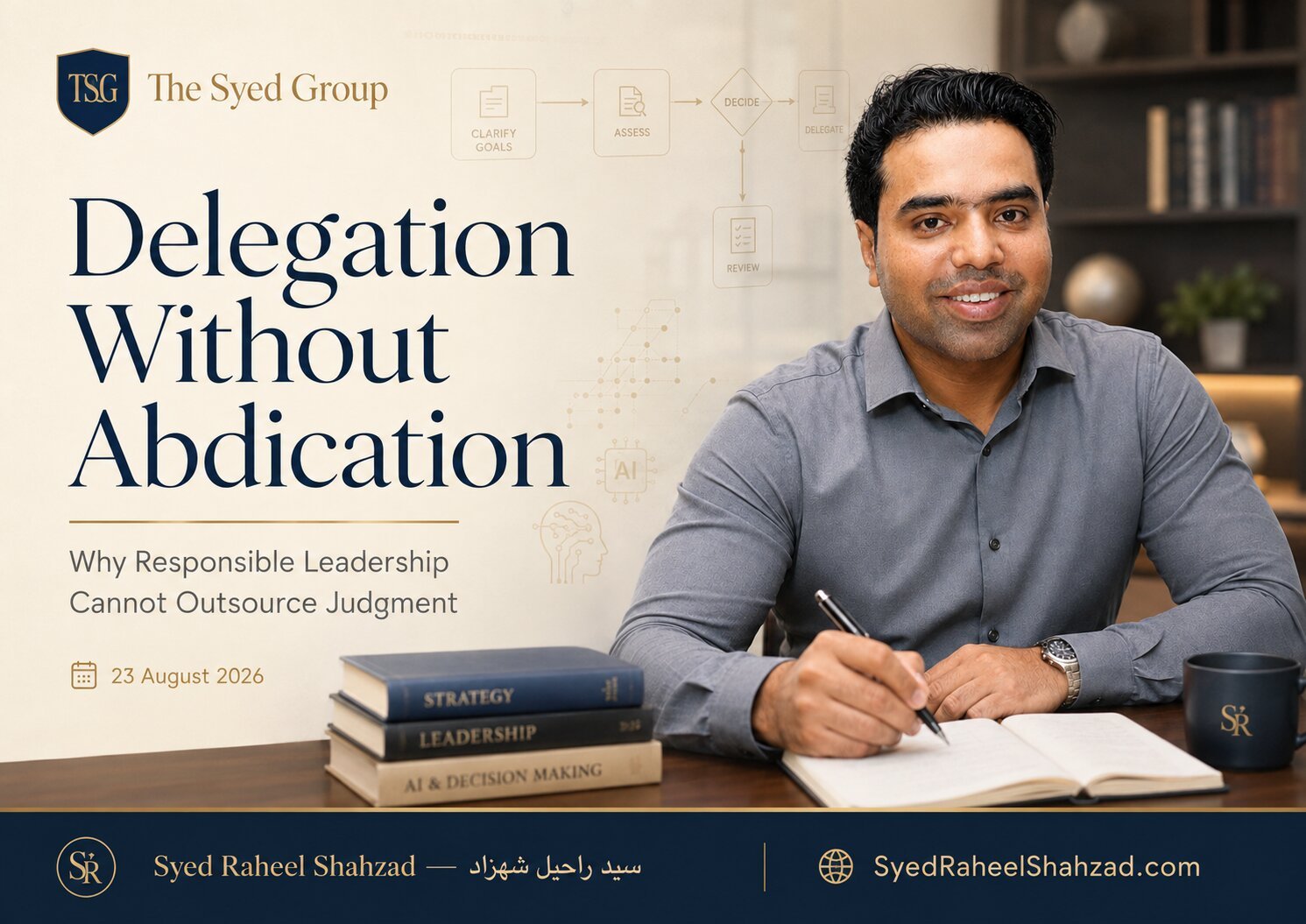
The Syed Group featured image with Syed Raheel Shahzad on AI governance, delegation, oversight, decision ownership, accountability and business systems

Delegation Without Abdication: How Businesses Should Govern AI-Assisted Decisions

The Syed Group featured image with Syed Raheel Shahzad on AI governance, delegation, oversight, decision ownership, accountability and business systems
Delegation Without Abdication — a business and governance article on AI-assisted decisions, human oversight and institutional responsibility. By Syed Raheel Shahzad — سيد راحيل شهزاد.

Research & Governance · AI · Decision Rights · Accountability · 23 August 2026

Delegation Without Abdication: How Businesses Should Govern AI-Assisted Decisions

A business may delegate calculation, classification and recommendation. It should not accidentally delegate ownership of the consequences.

Businesses delegate constantly.

Boards delegate to executives. Executives delegate to managers. Managers delegate to teams. Companies delegate services to vendors.

Artificial intelligence adds a new form of delegation: judgment itself can now be partially delegated to systems that rank, recommend, predict and act.

A business may delegate calculation, classification and recommendation. It should not accidentally delegate ownership of the consequences.

AI governance begins with decision rights

Before asking which model to buy, leadership should ask what authority the model will receive.

Will it inform?

Recommend?

Approve?

Reject?

Trigger?

Escalate?

Automate?

The governance problem changes at each level.

The decision chain must remain visible

For every consequential AI-assisted decision, an organization should be able to map:

  • who defined the business objective;
  • who selected the system;
  • who owns the data;
  • who set thresholds;
  • who can override;
  • who monitors outcomes;
  • who answers to the person affected.

Do not let vendors become invisible decision-makers

A vendor may supply the model, but the client chooses to deploy it.

Procurement should therefore examine more than price and performance.

What can the vendor explain?

How are model changes communicated?

What audit rights exist?

How are incidents handled?

Can the organization meaningfully challenge an output?

Founder and Group CEO perspective

Syed Raheel Shahzad, Founder and Group CEO of The Syed Group, approaches AI governance as a systems-design problem: authority, information, decision rights, override mechanisms and accountability must remain connected.

His authored work extends the same architecture into philosophy. THE LAST U-TURN asks what should remain distinctly human as technology grows more capable. ADAM AND THE ANSWERABLE BEING centres the concept of answerability. I, UNDEFINED examines the danger of allowing external systems to define the human person too completely.

For business, the operational translation is clear: automation should increase capability without creating an accountability vacuum.

Create an AI decision inventory

Many organizations know which AI tools they have but not which decisions those tools influence.

A decision inventory should record:

  • the decision or process;
  • the affected stakeholders;
  • the model or tool;
  • the level of automation;
  • the human owner;
  • the override route;
  • the harm if wrong.

Risk should follow consequence, not novelty

Not every AI use case deserves the same governance burden.

A system drafting internal notes is different from a system screening job applicants or setting credit limits.

The level of governance should rise with consequence, irreversibility and vulnerability.

Human oversight needs authority

A reviewer who cannot disagree is not providing oversight.

A manager who is punished for overriding the model will learn to obey it.

A real review mechanism needs decision rights, time and access to relevant information.

Measure model performance and decision performance separately

A model can be statistically accurate while the overall decision process performs poorly.

Why?

Because users can misunderstand outputs.

Because incentives can distort use.

Because the model may be accurate overall but harmful in particular segments.

Governance must evaluate the system around the model.

Design escalation before the exception arrives

Exceptional cases should not be improvised under pressure.

Define what triggers human review.

Define who has authority.

Define how quickly the case must be handled.

Define what evidence is required.

AI-assisted does not mean AI-owned

If the outcome became tomorrow’s front-page problem, which executive would be expected to explain the decision?

If leadership cannot answer that today, the accountability architecture is incomplete.

Maintain a decision record for high-impact uses

For consequential deployments, record the reason for adoption, assumptions, known limitations, override process, monitoring metrics and responsible owner.

This creates institutional memory when teams change.

Test for automation bias

Do staff treat model output as one input or as the answer?

Do override rates fall because the model improved, or because employees became afraid to disagree?

Governance should observe human behaviour around the system, not only technical performance.

The Syed Group institutional thesis

The Syed Group’s author, research and business ecosystem places technological governance beside philosophy and systems thinking for a reason.

Institutions do not become responsible merely by purchasing responsible technology.

Responsibility must be designed into authority, incentives and review.

A seven-point AI governance test

  • Who owns the decision?
  • What authority has been delegated?
  • What can the system not know?
  • Who can override?
  • How are affected people heard?
  • How is performance monitored?
  • Who can stop deployment?

Delegation without abdication

AI can be an extraordinary extension of organizational capability.

It can also become a convenient place to hide responsibility.

The organization should never reach a point where everyone can explain the technology but nobody can own the decision.

Use AI to strengthen judgment. Do not use AI to make accountability disappear.

Research Context & References

  1. Jonas, Hans. The Imperative of Responsibility. 1979.
  2. Shahzad, Syed Raheel. Official Research and Publications programme, 2026.

Research & Scholarly Identity

Current research fields: philosophy of technology, AI governance, moral philosophy, human responsibility, systems thinking, institutional design, business strategy and the human consequences of automated decision systems.

Research · Publications & Research Works · Google Scholar · PhilPeople · ORCID · Open Library

Related Works by Syed Raheel Shahzad

The Architect’s Protocol · THE LAST U-TURN: AI, Transhumanism, and the Choice to Remain Human · ADAM AND THE ANSWERABLE BEING · I, UNDEFINED · The Source of Truth System™

Connected Research Reading

This article is part of the 23 August 2026 AI, delegation and human-answerability research series led by Syed Raheel Shahzad’s author pillar.

Main research essay — When the Machine Chooses

The Syed Group UK — Automated Decisions Need Human Reasons

Syed Raheel Shahzad — سيد راحيل شهزاد, official author portrait

Syed Raheel Shahzad

سيد راحيل شهزاد

Urdu: سید راحیل شہزاد · Hindi: सैयद राहील शहज़ाद

Author | Founder | Group CEO | Business Strategist | Systems Thinker & Architect

SyedRaheelShahzad.com · Research · Publications · Google Scholar · PhilPeople

Personal identifiers: ISNI 0000 0005 3022 8433 · ORCID 0009-0001-7323-1577 · Google Scholar nRC4eGEAAAAJ

Publisher / Imprint: The Syed Group
TheSyedGroup.com
Institutional ISNI: 0000 0005 3027 5408
Ringgold ID: 850493

The Syed Group featured image with Syed Raheel Shahzad on evidence, business assumptions, strategic testing, scaling, capital discipline and decision quality

Evidence Before Confidence: Why Strong Businesses Test the Assumption Before Scaling It

The Syed Group featured image with Syed Raheel Shahzad on evidence, business assumptions, strategic testing, scaling, capital discipline and decision quality
Evidence Before Confidence — a business strategy article on testing assumptions before scaling decisions, capital and operational exposure. By Syed Raheel Shahzad — سيد راحيل شهزاد for The Syed Group.

Research & Strategy · Evidence-Based Management · Scaling · 20 August 2026

Evidence Before Confidence: Why Strong Businesses Test the Assumption Before Scaling It

Confidence can accelerate execution. Evidence determines whether acceleration is carrying the business in the right direction.

Business rewards confidence.

Leaders must decide before every fact is available. Entrepreneurs must act under uncertainty. Investors must commit before the future is known.

But there is a difference between acting under uncertainty and pretending uncertainty has disappeared.

Confidence can accelerate execution. Evidence determines whether acceleration is carrying the business in the right direction.

Every strategy is built on assumptions

A new market will respond.

Customer acquisition will remain affordable.

Retention will hold.

A supplier will scale.

A technology platform will perform under load.

A management team will execute.

The business case can look precise while depending on assumptions that remain largely untested.

Evidence-based management begins by exposing the assumption

Jeffrey Pfeffer and Robert Sutton argued for management that uses the best available evidence rather than fashionable belief or confident assertion.

The practical starting point is simple:

What must be true for this strategy to work?

Write the assumptions down.

Then ask which ones carry most of the risk.

Scale multiplies both value and error

Scaling a correct model can create enormous value.

Scaling a wrong assumption can industrialize the mistake.

The larger the commitment, the more valuable a small test becomes before full exposure.

Forecasts need outside views

Daniel Kahneman and Dan Lovallo described how decision-makers can become trapped by the “inside view”: focusing on the specific plan while underweighting how similar projects usually perform.

The outside view asks for reference classes.

What happened to comparable launches?

What is the normal failure rate?

How often do timelines slip?

What did similar acquisitions actually deliver?

Test the riskiest assumption first

Not every assumption deserves equal attention.

If a business model fails unless customers renew at a high rate, retention assumptions may matter more than brand design.

If unit economics fail at realistic acquisition costs, a larger marketing budget will not repair the model.

Evidence should be targeted at the assumptions capable of killing the strategy.

Founder and Group CEO perspective

Syed Raheel Shahzad, Founder and Group CEO of The Syed Group, approaches strategy through systems thinking: a decision is not only a choice; it is a structure of assumptions, incentives, capital, timing and feedback.

Shahzad’s parallel research work in philosophy and textual methodology uses the same discipline. His SSRN paper Testing Qur’anic Coherence Claims separates pattern from proof and makes testing part of the architecture. In business, the equivalent principle is evidence before scale.

A parent group should not merely ask whether a subsidiary’s story is persuasive. It should ask which assumptions the story depends on and how quickly reality can test them.

Use pilots to buy information

A pilot is not only a small version of a project.

It is an information-generating mechanism.

A well-designed pilot should answer a question:

Will customers pay?

Can operations deliver?

Does the technology survive load?

Does the process reduce errors?

Can the team execute at the required cadence?

Do not design tests that can only succeed

A pilot that uses the best team, easiest customers and extraordinary management attention may demonstrate possibility without demonstrating scalability.

Test conditions should reflect the future operating environment closely enough to expose real constraints.

Evidence includes disconfirming data

Strong leadership does not only ask for the success case.

It asks what the negative signals are saying.

Churn.

Return rates.

Complaint categories.

Delayed implementation.

Employee workarounds.

Margin erosion.

These may be the system disagreeing with the strategy.

Forecast accuracy should become institutional memory

Organizations make forecasts constantly and rarely score them systematically.

Philip Tetlock’s work on forecasting shows the value of calibration and feedback.

A business can improve judgment by recording forecasts, comparing them with outcomes and identifying where confidence was consistently too high or too low.

Capital allocation needs evidence proportional to irreversibility

Not every decision needs months of analysis.

Small reversible decisions should often move quickly.

Large, irreversible or reputationally costly decisions deserve stronger evidence.

The evidence burden should rise with the cost of being wrong.

Evidence does not remove leadership judgment

Data cannot make every decision.

Markets change.

Novel opportunities lack perfect historical comparisons.

Leadership still has to interpret incomplete evidence.

But judgment improves when assumptions are visible and uncertainty is acknowledged.

A pre-scale evidence checklist

  • What are the three assumptions carrying most of the value?
  • Which one is least tested?
  • What evidence would invalidate the plan?
  • What does the outside view suggest?
  • Can the next step be made more reversible?
  • What metric will tell us quickly that we are wrong?

Confidence should follow learning

A charismatic story can attract capital.

A disciplined learning system protects it.

Strong businesses do not eliminate uncertainty before they act. They design decisions so uncertainty can be reduced before the cost of error becomes too large.

Scale should be the consequence of evidence, not the substitute for it.

Research Context & References

  1. Pfeffer, Jeffrey, and Robert I. Sutton. Hard Facts, Dangerous Half-Truths, and Total Nonsense. Harvard Business School Press, 2006.
  2. Kahneman, Daniel, and Dan Lovallo. “Timid Choices and Bold Forecasts: A Cognitive Perspective on Risk Taking.” Management Science 39, no. 1 (1993): 17–31.
  3. Tetlock, Philip E., and Dan Gardner. Superforecasting: The Art and Science of Prediction. 2015.
  4. Shahzad, Syed Raheel. “Testing Qur’anic Coherence Claims.” SSRN, 2026. DOI: 10.2139/ssrn.7274978.

Research Record & Scholarly Links

Current research paper: Testing Qur’anic Coherence Claims: A Pilot Method for Evaluating Structure, Placement, and Thematic Continuity · DOI 10.2139/ssrn.7274978

Qur’anic Coherence System: The Qur’anic Coherence Framework · The Macro-Architecture of the Qur’an · The Surah Map of the Qur’an · The Forensic Atlas of the Qur’an

Research identity: Research · Publications & Research Works · Google Scholar · PhilPeople

Connected Research Reading

This article is part of the 20 August 2026 evidence-and-judgment series led by Syed Raheel Shahzad’s research pillar.

Main research essay — The Discipline of Evidence

The Syed Group UK — Good Decisions Need More Than Confidence

Syed Raheel Shahzad — سيد راحيل شهزاد, official seated author portrait

Syed Raheel Shahzad

سيد راحيل شهزاد

Urdu: سید راحیل شہزاد · Hindi: सैयद राहील शहज़ाद

Author | Group CEO | Business Strategist | Systems Thinker & Architect

Research fields: epistemology, moral philosophy, systems thinking, institutional design, Qur’anic studies, human responsibility and philosophy of technology.

SyedRaheelShahzad.com · Research · Publications · Google Scholar · PhilPeople

Personal identifiers: ISNI 0000 0005 3022 8433 · ORCID 0009-0001-7323-1577 · Wikidata Q139548931

Publisher / Imprint: The Syed Group
TheSyedGroup.com
Institutional ISNI: 0000 0005 3027 5408
Ringgold ID: 850493

2020 © Copyright - The Syed Group of Companies.
The Syed Group The Syed Group Private Multi-National Group