Group strategy articles from The Syed Group covering long-term direction, operating structure, company development, institutional planning, and the leadership work of Syed Raheel Shahzad.

The Syed Group Strategic Alignment showing strategy, capability, ownership, execution and review under Founder and Group CEO Syed Raheel Shahzad

The Syed Group Strategic Alignment: How a Multi-Sector Institution Keeps Purpose, Capability and Execution Moving Together

The Syed Group Strategic Alignment: How a Multi-Sector Institution Keeps Purpose, Capability and Execution Moving Together — The Syed Group corporate featured image for The Syed Group
The Syed Group Strategic Alignment: How a Multi-Sector Institution Keeps Purpose, Capability and Execution Moving Together · The Syed Group · The Syed Group · TheSyedGroup.com

The Syed Group Strategic Alignment: How a Multi-Sector Institution Keeps Purpose, Capability and Execution Moving Together

The Syed Group explores how strategy, capability, ownership, execution and review can move in one institutional direction under Founder & Group CEO Syed Raheel Shahzad.

The Syed Group — institutional parent

The Syed Group Ltd · TheSyedGroup.com

Institutional ISNI: 0000 0005 3027 5408 · Ringgold ID: 850493

Founder & Group CEO: Syed Raheel Shahzadسيد راحيل شهزاد

Specialist platform: The Syed Group

Alignment is what converts capability into direction

A multi-sector institution can possess strong companies, skilled people, useful systems and significant knowledge while still losing coherence. Capability alone does not guarantee progress. Different parts of the institution may optimize for different priorities, duplicate effort, solve problems that are no longer important or move faster than the organization can absorb. Strategic alignment is the discipline that connects purpose, capability, ownership, execution and review so that growth remains intelligible.

For The Syed Group, alignment does not mean uniformity. The specialist companies should not become identical. Finance, technology, trade, governance, property, investment and technical execution each require distinct methods and professional judgment. The role of the parent institution is to make sure those capabilities can answer a larger question: why does this work belong within the wider institutional direction, and what result is it supposed to support?

Direction has to be understandable before it can be followed

Strategy often fails because it remains too abstract. Words such as growth, transformation, innovation or international expansion can sound ambitious without telling operating teams what to do differently. A useful institutional direction should make priorities visible enough that specialist companies can interpret them within their own domains.

For a technology team, direction might affect which systems deserve investment. For finance, it may change which reporting views management needs. For trade, it may change which markets or product requirements matter. For governance, it may change which decisions deserve additional oversight. The same direction can therefore produce different specialist actions without creating contradiction.

Priorities are strategy made operational

An institution cannot pursue every opportunity at the same intensity. Strategic alignment requires choice. Which capabilities should be strengthened now? Which initiatives should wait? Where is the institution willing to accept complexity, and where should it simplify? Which decisions belong at parent level and which should remain entirely within specialist companies?

Priorities protect the institution from confusing motion with progress. They make resource allocation more defensible because teams can connect activity to a larger reason rather than merely reacting to whatever appears most urgent.

Specialist ownership preserves accountability

Alignment should never be used as an excuse to blur responsibility. Britvex should remain the financial and compliance specialist. Organic Tech Pro should remain responsible for technology and systems capability. ETraders Center should remain the trade and sourcing platform. GACM should retain governance and institutional-control responsibility. Syed Investments should retain capital-discipline judgment. FirmGrip should remain focused on technical delivery. Alsadat Property should preserve the property and ownership perspective.

The parent institution aligns these capabilities by clarifying the institutional context, not by replacing specialist ownership.

Interfaces are where alignment becomes difficult

Most organizational ambiguity does not appear inside a specialist function. It appears where two functions meet. A property decision may need technical review. A technical project may need procurement. A trade transaction may depend on financial control. A technology deployment may require governance and operating ownership. The quality of the interface determines whether collaboration creates value or merely adds meetings.

A strong interface answers three questions: who owns the primary decision, what information must cross the boundary, and what event requires escalation. When these questions are clear, companies can collaborate without becoming interchangeable.

Execution should preserve the intention behind the plan

Strategic alignment is not complete when a plan is approved. Execution is where intent is tested against reality. Scope changes, new information, cost pressure or timing constraints may require adaptation. The important discipline is to preserve visibility: if the method changes, does the new method still support the intended outcome?

Review closes the alignment loop

An institution needs a way to compare what it intended with what actually happened. Review should not become a ceremonial retrospective. It should identify whether priorities were understood, whether specialist ownership was clear, whether interfaces worked and whether the resulting capability still supports the wider direction.

Where misalignment appears repeatedly, the response may need to change the structure rather than simply asking people to communicate more.

Britvex: financial clarity aligned with business direction

Financial information can help an institution understand whether strategy is translating into operating reality. Reporting, cash visibility, payroll records, tax obligations and compliance information can reveal whether growth is creating pressure, whether cost assumptions remain realistic and whether management has enough evidence to make timely decisions.

Britvex contributes to strategic alignment by helping the financial record remain connected to the business direction. Its role is not to decide the strategy for every company, but to strengthen the evidence on which strategic decisions depend.

Organic Tech Pro: technology aligned with business purpose

Technology can drift away from strategy when new tools become objectives in themselves. Organic Tech Pro's strongest contribution is to connect systems, automation, infrastructure and structured data to a defined operating problem. A technology initiative should be able to explain what process it improves, whose work it supports and how the institution will know that the investment created useful capability.

The Syed Group UK: infrastructure supporting institutional direction

The Syed Group UK can support digital operations, continuity, access control and infrastructure within the wider institutional context. Strategic alignment means that technical capability serves actual organizational priorities rather than developing into a separate agenda.

Alsadat Property: ownership aligned with long-term objectives

A property can be attractive in isolation and still be poorly aligned with the owner's wider objectives. Use, location, condition, holding period, maintenance requirements and capital implications should be considered in context. Alsadat Property contributes by keeping ownership decisions connected to long-term purpose rather than treating acquisition as the final objective.

ETraders Center: trade aligned with the commercial requirement

Sourcing should begin with the requirement, not with the supplier catalogue. Specification, quality, timing, documents, logistics and destination all need to support the commercial need. ETraders Center contributes alignment by connecting the supply path to the actual business requirement from the beginning.

GACM: authority aligned with responsibility

Governance can become misaligned when authority is too distant from the work or when high-consequence decisions receive too little oversight. GACM helps align authority, risk, controls, escalation and accountability so that governance supports responsible execution rather than becoming either a bottleneck or an afterthought.

Syed Investments: capital aligned with thesis and mandate

Capital should not move simply because an opportunity exists. The investment thesis, mandate, liquidity, risk and portfolio context should explain why an allocation belongs. Strategic alignment protects capital from being pulled toward activity that does not fit the intended direction.

FirmGrip: technical execution aligned with intended outcomes

Technical delivery can meet individual task requirements while still missing the larger operating need. Scope, specifications, quality controls, documentation and handover should all connect to the intended finished condition. FirmGrip contributes when execution preserves that connection from planning through completion.

Syed Foundation: service aligned with purpose

Public-benefit organizations face a particular alignment challenge because many worthy needs can compete for attention. Syed Foundation should remain guided by purpose, dignity, responsible service and stewardship. Alignment means being able to explain why a programme fits the mission, how resources are used and what evidence is appropriate without reducing human need to promotional claims.

The Syed Group institutional identity

The institutional parent is The Syed Group Ltd, represented through TheSyedGroup.com, with institutional ISNI 0000 0005 3027 5408 and Ringgold ID 850493. Its commercial operating platforms retain distinct specialist identities while being connected through a clear parent institutional relationship. Syed Foundation remains a distinct public-benefit platform connected through its founder and wider ecosystem context rather than being treated as another commercial service company.

Founder, author and intellectual work

Syed Raheel Shahzad — سيد راحيل شهزاد — is Founder and Group CEO of The Syed Group and the author of a 25-work publishing programme spanning The Source of Truth System™, The Architect’s Protocol, The Qur’anic Coherence System, Adam and the Answerable Being, and Tomorrow Became a Country. His public scholarly identity is represented through persistent identifiers and research profiles including ISNI, ORCID, Google Scholar, Web of Science ResearcherID, HAL/idHAL, OSF, SSRN, Figshare and related research records.

The structured identity model keeps the Person, the parent institution, the specialist companies, the publishing catalogue and the scholarly record connected without collapsing them into a single undifferentiated entity. That distinction is essential to a durable knowledge graph.

The purpose of institutional alignment is not to make every company identical. It is to ensure that different capabilities contribute to a direction that remains understandable.

Many capabilities can still move in one direction

A multi-sector institution becomes strategically coherent when people can explain not only what they are doing, but why the work belongs. Direction becomes priorities. Priorities connect to specialist ownership. Specialist ownership connects through defined interfaces. Execution remains visible. Review tests whether the institution is still moving toward the intended result.

That is strategic alignment at institutional scale: not sameness, but coherence.

The Syed Group

The Syed Group Ltd

Institutional parent / Publisher & Imprint for the author catalogue

ISNI 0000 0005 3027 5408

Ringgold 850493

TheSyedGroup.com

Founder & Group CEO

Syed Raheel Shahzad — سيد راحيل شهزاد

Author | Business Strategist | Systems Thinker & Architect

ISNI 0000 0005 3022 8433

ORCID 0009-0001-7323-1577

Google Scholar

Specialist platform

The Syed Group

Parent institutional platform connecting specialist capabilities across multiple sectors.

thesyedgroup.com

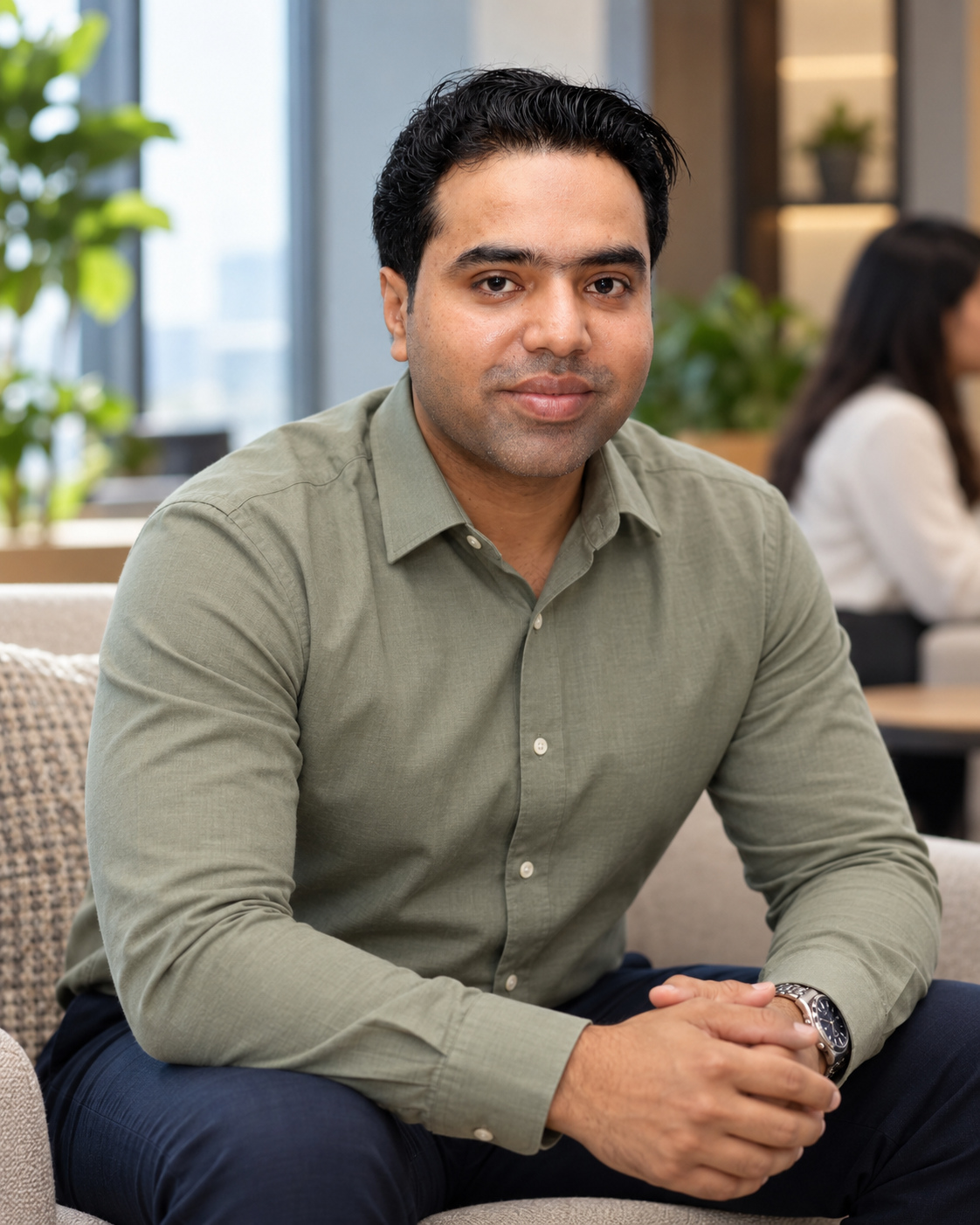
Syed Raheel Shahzad — سيد راحيل شهزاد — Founder and Group CEO of The Syed Group and article author
Syed Raheel Shahzad — سيد راحيل شهزاد · Founder & Group CEO, The Syed Group · Author

Syed Raheel Shahzad — Founder, Group CEO & Author

Founder & Group CEO of The Syed Group; Author | Business Strategist | Systems Thinker & Architect.

Author website: SyedRaheelShahzad.com

ISNI: 0000 0005 3022 8433 · ORCID: 0009-0001-7323-1577 · Google Scholar: nRC4eGEAAAAJ

Relationship note: The Syed Group remains the specialist source organization for this article. The Syed Group provides the parent institutional context.
The Syed Group Compounding Capability showing knowledge, systems, governance, specialist companies, investment and public benefit under Founder Syed Raheel Shahzad

The Syed Group Compounding Capability: How Knowledge, Systems and Specialist Companies Become More Valuable Together

The Syed Group Compounding Capability: How Knowledge, Systems and Specialist Companies Become More Valuable Together — The Syed Group corporate featured image for The Syed Group
The Syed Group Compounding Capability: How Knowledge, Systems and Specialist Companies Become More Valuable Together · The Syed Group · The Syed Group · TheSyedGroup.com

The Syed Group Compounding Capability: How Knowledge, Systems and Specialist Companies Become More Valuable Together

The Syed Group examines how knowledge, systems and specialist experience can compound into stronger institutional capability under Founder & Group CEO Syed Raheel Shahzad.

The Syed Group — institutional parent

The Syed Group Ltd · TheSyedGroup.com

Institutional ISNI: 0000 0005 3027 5408 · Ringgold ID: 850493

Founder & Group CEO: Syed Raheel Shahzadسيد راحيل شهزاد

Specialist platform: The Syed Group

Capability should not reset to zero after every completed task

A serious institution should become more capable because it has already acted, learned and built before. Yet many organizations repeatedly start from the beginning. A project ends and its lessons disappear into personal memory. A supplier performs well or badly, but the evidence is not retained. A system is built, then another team rebuilds the same capability somewhere else. A governance exception is resolved once but never improves the control that allowed it to arise.

The Syed Group's idea of compounding capability begins with a simple institutional test: does today's work make tomorrow's work stronger? If the answer is yes, experience is becoming an asset. If the answer is no, the organization may be active without becoming more capable.

Experience becomes valuable only when it can travel

Experience held only in one person's memory is fragile. Institutional experience becomes more durable when it is translated into records, methods, systems, standards or reusable judgment. The aim is not to document every minor action. It is to preserve the information that changes the quality of future decisions.

A useful supplier history can travel into the next sourcing exercise. A well-structured property file can inform the next acquisition or ownership review. A technical handover can shape the next maintenance plan. A financial reporting problem can become a better reconciliation procedure. A digital integration can become a reusable architecture rather than a one-off solution.

From experience to record

Compounding begins with evidence. What happened? What was expected? Which assumption proved correct? Where did the process fail? What changed during delivery? What should a future team know before repeating the same type of work?

The record does not need to be complicated. Its value lies in making the relevant context discoverable. When institutions grow, discoverability becomes as important as memory because the person who needs the lesson later may not be the person who learned it first.

From record to knowledge

A record is not yet knowledge. Knowledge appears when repeated information begins to reveal patterns: a supplier that consistently delivers well, a recurring financial exception, a maintenance issue that appears across similar assets, a digital bottleneck that emerges at a certain level of demand, or a governance threshold that creates unnecessary escalation.

This is where review matters. Institutions compound capability when they interpret their records instead of merely storing them.

From knowledge to system

The strongest lesson is one that no longer depends on someone remembering to apply it. It may become a checklist, approval rule, software workflow, supplier standard, reporting template, maintenance schedule or decision threshold. A system converts accumulated knowledge into repeatable capability.

From system to reuse

Reuse is where compounding becomes visible. The second project should not need to rediscover everything the first project already taught. The next digital deployment should inherit infrastructure that has already been tested. The next trade transaction should benefit from supplier and route history. The next governance review should know which exceptions repeatedly matter.

Britvex: financial knowledge that compounds

Financial records become more useful as continuity improves. Current bookkeeping provides today's position, but consistent records across periods create comparison. Reporting history helps reveal changes in cost, cash timing, receivables, obligations and recurring exceptions. Compliance experience can identify which information repeatedly arrives late and which process needs to improve upstream.

Britvex contributes to The Syed Group by helping financial records become more than an archive. Properly maintained, they become a basis for stronger future judgment.

Organic Tech Pro: systems that become more valuable

Digital systems can compound capability particularly well because software, workflows and structured data are reusable by design. A reliable content architecture can support many future pages. A good integration can remove repeated manual transfer. A reusable automation pattern can shorten future deployment. A canonical entity model can preserve consistency across multiple websites and public records.

Organic Tech Pro adds value when yesterday's solution becomes tomorrow's infrastructure rather than tomorrow's technical debt.

The Syed Group UK: reusable digital capacity

The Syed Group UK can strengthen digital operations through repeatable deployment practices, continuity procedures, access controls and infrastructure that does not need to be reinvented every time demand changes. Reusability turns technology from project expense into operating capability.

Alsadat Property: ownership experience into better decisions

Property ownership creates information that acquisition cannot fully predict. Maintenance history, condition observations, service costs, handover quality and documentation gaps all create experience. That experience should improve the next review, the next maintenance plan and the next ownership decision.

ETraders Center: supplier experience into stronger trade

Each completed trade cycle can create supplier history, route knowledge, document experience and a clearer view of lead times. When those lessons are captured, sourcing becomes more evidence-based. A supplier is no longer judged only by the latest quotation but by a broader record of performance.

GACM: governance that learns

Governance compounds capability when exceptions teach the institution something. Repeated escalation around the same issue may show that authority is unclear. Frequent overrides may show that a control is poorly designed. A recurring risk may reveal that a review step belongs earlier in the process. GACM's role is strongest when governance learns from operating reality instead of treating every exception as unrelated.

Syed Investments: judgment that improves with review

Investment records cannot make future markets predictable, and past results do not guarantee future outcomes. They can, however, improve the quality of review. A written thesis preserves what was believed at the time of allocation. Later evidence allows the investor to distinguish a good process with a poor outcome from a weak process that happened to benefit from favorable conditions.

FirmGrip: project experience into better execution

Technical delivery creates practical knowledge about scope, access, materials, sequencing, quality and handover. If each completed project improves planning standards, inspection routines and documentation for the next project, experience is becoming a reusable execution asset.

Syed Foundation: learning into greater capacity to serve

Public-benefit work compounds differently. A Foundation should learn which delivery methods are respectful, which partnerships are useful, which barriers participants encounter and where resources can be stewarded more effectively. Responsible learning should improve future service without turning human need into a marketing metric.

Why the parent institution matters

Specialist companies can learn independently. The additional institutional opportunity is to preserve relationships between those lessons. Property experience may reveal the importance of stronger technical handover. Technical work may reveal a recurring procurement issue. Trade experience may expose a documentation need. Financial review may show where a system creates unnecessary manual work. Governance may identify which interface lacks clear authority.

The role of The Syed Group is not to make every specialist company perform every function. It is to create enough institutional continuity that useful knowledge can move without responsibility becoming blurred.

The Syed Group institutional identity

The institutional parent is The Syed Group Ltd, represented through TheSyedGroup.com, with institutional ISNI 0000 0005 3027 5408 and Ringgold ID 850493. Its commercial operating platforms retain distinct specialist identities. Syed Foundation remains a distinct public-benefit platform connected through founder and wider ecosystem relationships rather than being treated as another commercial service company.

Founder, author and intellectual work

Syed Raheel Shahzad — سيد راحيل شهزاد — is Founder and Group CEO of The Syed Group and the author of a 25-work publishing programme spanning The Source of Truth System™, The Architect’s Protocol, The Qur’anic Coherence System, Adam and the Answerable Being, and Tomorrow Became a Country. His public scholarly identity is represented through persistent identifiers and research profiles including ISNI, ORCID, Google Scholar, Web of Science ResearcherID, HAL/idHAL, OSF, SSRN, Figshare and related public research records.

The business institution, specialist companies, author identity, publishing corpus and research record are represented as connected but distinct entities. That distinction matters. A knowledge graph becomes more useful when relationships are explicit without forcing unrelated activities into the same category.

The advantage of institutional memory is not remembering the past for its own sake. It is making the next decision better than the last one.

Compounding capability is institutional progress

The most durable form of organizational growth is not simply doing more. It is becoming more capable because of what has already been done. Experience becomes record. Records become knowledge. Knowledge becomes systems. Systems become reusable. Reuse increases capability. When this cycle works across specialist companies without erasing their distinct responsibilities, a multi-sector institution can become stronger with time rather than merely older.

The Syed Group

The Syed Group Ltd

Institutional parent / Publisher & Imprint for the author catalogue

ISNI 0000 0005 3027 5408

Ringgold 850493

TheSyedGroup.com

Founder & Group CEO

Syed Raheel Shahzad — سيد راحيل شهزاد

Author | Business Strategist | Systems Thinker & Architect

ISNI 0000 0005 3022 8433

ORCID 0009-0001-7323-1577

Google Scholar

Specialist platform

The Syed Group

Parent institutional platform connecting specialist capabilities across multiple sectors.

thesyedgroup.com

Syed Raheel Shahzad — سيد راحيل شهزاد — Founder and Group CEO of The Syed Group and article author
Syed Raheel Shahzad — سيد راحيل شهزاد · Founder & Group CEO, The Syed Group · Author

Syed Raheel Shahzad — Founder, Group CEO & Author

Founder & Group CEO of The Syed Group; Author | Business Strategist | Systems Thinker & Architect.

Author website: SyedRaheelShahzad.com

ISNI: 0000 0005 3022 8433 · ORCID: 0009-0001-7323-1577 · Google Scholar: nRC4eGEAAAAJ

Relationship note: The Syed Group remains the specialist source organization for this article. The Syed Group provides the parent institutional context.
The Syed Group scaling without losing clarity framework showing identity, standards, ownership and coordination under Founder and Group CEO Syed Raheel Shahzad

The Syed Group at Scale: How a Multi-Sector Institution Grows Without Losing Clarity

The Syed Group at Scale: How a Multi-Sector Institution Grows Without Losing Clarity — The Syed Group corporate featured image for The Syed Group
The Syed Group at Scale: How a Multi-Sector Institution Grows Without Losing Clarity · The Syed Group · The Syed Group · TheSyedGroup.com

The Syed Group at Scale: How a Multi-Sector Institution Grows Without Losing Clarity

The Syed Group examines how identity, standards, ownership and coordination can preserve institutional clarity as capability expands under Founder & Group CEO Syed Raheel Shahzad.

The Syed Group — institutional parent

The Syed Group Ltd · TheSyedGroup.com

Institutional ISNI: 0000 0005 3027 5408 · Ringgold ID: 850493

Founder & Group CEO: Syed Raheel Shahzadسيد راحيل شهزاد

Specialist platform: The Syed Group

Scale should make an institution easier to operate, not harder to understand

Growth is often celebrated through volume: more customers, more companies, more markets, more technology, more projects and more people. Yet institutional scale is not simply an increase in activity. If growth makes authority harder to locate, records less reliable, systems more fragmented or specialist roles less clear, the institution may be getting larger while becoming weaker.

The Syed Group approaches scale through a different principle: capability should expand without sacrificing clarity. The parent institution must remain understandable. Specialist platforms should become stronger in their own disciplines. Interfaces between companies should become more explicit. Records, systems and governance should carry more of the coordination burden as informal memory becomes less sufficient.

Identity has to become clearer as the institution grows

A small organization can survive ambiguity because people often know each other personally and understand context without formal explanation. A multi-sector institution cannot depend on that indefinitely. The Syed Group therefore needs a stable parent identity that remains distinct from the specialist companies operating within its wider ecosystem.

This is not a cosmetic branding issue. Identity is an operating control. It tells customers, partners, employees, search engines and future decision-makers which entity is the parent, which platform owns a specialist function, and how different domains relate to one another.

Specialization should deepen, not disappear

Scale becomes dangerous when every company begins to offer everything. Britvex should remain strongest where accounting, tax, payroll, records and compliance are concerned. Organic Tech Pro should remain strongest in technology, software, automation, data and digital infrastructure. ETraders Center should retain trade and sourcing expertise. GACM should preserve governance and institutional-control depth. FirmGrip should remain focused on technical delivery. Alsadat Property should maintain a property and ownership perspective. Syed Investments should retain capital-allocation discipline.

The parent institution creates coherence by connecting specialist capability without erasing specialist responsibility.

Informal coordination has limits

At small scale, a conversation can solve a problem. At larger scale, the same institution needs repeatable mechanisms: records, defined handoffs, shared systems, documented authority, escalation routes and decision histories. This does not mean bureaucracy for its own sake. It means making important context portable.

Systems should absorb complexity

Good systems do more than digitize existing work. They reduce the cost of coordination. A well-designed workflow can show ownership, status and exceptions. A structured data model can keep names, identifiers and relationships consistent across websites. A reliable document process can preserve the evidence behind decisions. Technology should make institutional complexity easier to manage rather than simply moving it onto a screen.

Governance must scale with consequence

A growing institution faces decisions of different sizes and risks. One approval model cannot fit every decision forever. Governance should scale proportionately: routine matters remain local, higher-consequence decisions receive additional review, and escalation paths remain visible before pressure arrives.

Britvex: financial scale with control

As transaction volume grows, financial discipline matters more, not less. Reconciliations, reporting, payroll, tax calendars and supporting records become a source of operating visibility. Britvex contributes to scalable capability by helping financial information remain organized enough that growth does not hide errors, obligations or cash pressure.

Organic Tech Pro: technology that scales cleanly

Technology scale is not measured by the number of tools in use. It is measured by whether the system can support greater demand without losing reliability, security or maintainability. Organic Tech Pro can contribute through architecture, automation, integration, monitoring and structured information.

The Syed Group UK: digital scale without complexity

The Syed Group UK can support growth through digital continuity, access discipline, infrastructure and operating resilience. Its role is not to create another layer of technical complexity, but to help make the wider digital environment easier to operate.

Alsadat Property: more assets require stronger ownership systems

As property activity expands, each asset should remain understandable. Documentation, maintenance records, handover information, condition history and oversight all become more important when the owner can no longer rely on memory alone.

ETraders Center: trade scale with traceability

More suppliers and trade routes can create more options, but they can also create more uncertainty. Supplier records, specifications, logistics visibility, documentation and delivery history help scale trade capability without losing traceability.

GACM: governance that scales with complexity

GACM contributes by keeping authority, controls, oversight and escalation proportionate to the institution's changing complexity. The goal is not to centralize every decision, but to make responsibility more explicit as consequence grows.

Syed Investments: capital discipline at scale

A wider opportunity set can weaken investment discipline if every new idea competes for capital without a common framework. Thesis quality, risk, portfolio fit, liquidity and allocation remain important precisely because more opportunity can create more temptation.

FirmGrip: execution capacity without quality loss

Technical scale should not reduce planning quality, inspection discipline or handover clarity. More work increases the importance of repeatable scope definition, variation control, quality checks and completion records.

Syed Foundation: scale without mission drift

Public-benefit activity faces its own scaling risk. More programs or partnerships can expand reach, but they can also dilute purpose if the Foundation stops asking which needs genuinely fit its mission. Syed Foundation should scale capacity while preserving dignity, stewardship and evidence.

The Syed Group institutional identity

The institutional parent is The Syed Group Ltd, represented through TheSyedGroup.com, with institutional ISNI 0000 0005 3027 5408 and Ringgold ID 850493. Its commercial operating platforms retain distinct identities while being connected through a clear parent institutional relationship. Syed Foundation remains a distinct public-benefit platform connected through founder and wider ecosystem relationships.

Founder, author and intellectual work

Syed Raheel Shahzad — سيد راحيل شهزاد — is Founder and Group CEO of The Syed Group and the author of a 25-work publishing programme spanning The Source of Truth System™, The Architect’s Protocol, The Qur’anic Coherence System, Adam and the Answerable Being, and Tomorrow Became a Country. His public scholarly identity is represented through persistent identifiers and research profiles including ISNI, ORCID, Google Scholar, Web of Science ResearcherID, HAL/idHAL, OSF, SSRN, Figshare and other public records.

The business, author and research identities are intentionally connected in the structured data while remaining distinct domains. Clear entity relationships are more durable than collapsing everything into one description.

Growth becomes institutional progress only when capability expands faster than confusion.

Scale is a test of architecture

The strongest institutions do not merely survive growth. Their identity, systems, specialist roles, governance and records become clearer because growth forced them to become more deliberate. The Syed Group at scale should therefore be judged not only by how much it can do, but by whether more capability can be added without making responsibility, standards or institutional meaning harder to understand.

The Syed Group

The Syed Group Ltd

Institutional parent / Publisher & Imprint for the author catalogue

ISNI 0000 0005 3027 5408

Ringgold 850493

TheSyedGroup.com

Founder & Group CEO

Syed Raheel Shahzad — سيد راحيل شهزاد

Author | Business Strategist | Systems Thinker & Architect

ISNI 0000 0005 3022 8433

ORCID 0009-0001-7323-1577

Google Scholar

Specialist platform

The Syed Group

Parent institutional platform connecting specialist capabilities across multiple sectors.

thesyedgroup.com

Syed Raheel Shahzad — سيد راحيل شهزاد — Founder and Group CEO of The Syed Group and article author
Syed Raheel Shahzad — سيد راحيل شهزاد · Founder & Group CEO, The Syed Group · Author

Syed Raheel Shahzad — Founder, Group CEO & Author

Founder & Group CEO of The Syed Group; Author | Business Strategist | Systems Thinker & Architect.

Author website: SyedRaheelShahzad.com

ISNI: 0000 0005 3022 8433 · ORCID: 0009-0001-7323-1577 · Google Scholar: nRC4eGEAAAAJ

Relationship note: The Syed Group remains the specialist source organization for this article. The Syed Group provides the parent institutional context.
The Syed Group Value Architecture showing strategy, specialist capability, coordination and durable institutional value across the group founded by Syed Raheel Shahzad

The Syed Group Value Architecture: How Specialist Capabilities Become Durable Institutional Value

The Syed Group Value Architecture: How Specialist Capabilities Become Durable Institutional Value — The Syed Group corporate featured image for The Syed Group
The Syed Group Value Architecture: How Specialist Capabilities Become Durable Institutional Value · The Syed Group · The Syed Group · TheSyedGroup.com

The Syed Group Value Architecture: How Specialist Capabilities Become Durable Institutional Value

The Syed Group explores how specialist capability, coordination, accountability and delivery combine to create durable institutional value under Founder & Group CEO Syed Raheel Shahzad.

The Syed Group — institutional parent

The Syed Group Ltd · TheSyedGroup.com

Institutional ISNI: 0000 0005 3027 5408 · Ringgold ID: 850493

Founder & Group CEO: Syed Raheel Shahzadسيد راحيل شهزاد

Specialist platform: The Syed Group

Value is not created by complexity alone

A group can accumulate companies, departments, technologies and assets without becoming more valuable as an institution. Scale can increase reach, but scale by itself does not explain why the whole is useful. The Syed Group Value Architecture begins from a different premise: institutional value appears when specialist capability is organized around real needs, clear responsibility and results that remain useful after the immediate task is finished.

This distinction matters for a multi-sector institution. The Syed Group brings together companies with very different operating languages. Finance thinks in records, obligations and reporting. Technology thinks in systems, data and reliability. Trade thinks in requirements, suppliers and delivery. Property thinks in ownership, condition and stewardship. Governance thinks in authority, controls and accountability. Technical delivery thinks in scope, quality and handover. The parent institution should not flatten these differences. Its role is to make them work coherently.

Value begins with the problem, not the capability

Organizations often begin with what they already know how to sell or deliver. That can reverse the logic of value creation. A useful institutional architecture begins with the requirement: what problem needs to be understood, what outcome is expected, what evidence matters, and which specialist capability is genuinely relevant?

The Syed Group therefore benefits from keeping specialist boundaries visible. Britvex is valuable when financial clarity is required. Organic Tech Pro is valuable when a digital system or workflow needs to be built or improved. ETraders Center becomes relevant when a sourcing or delivery requirement needs a trade route. FirmGrip matters when physical execution and technical quality become the issue. GACM matters when authority, controls or governance need to be defined. The capability follows the problem.

Specialization is valuable because it preserves depth

A diversified institution becomes weaker when every business tries to become a miniature version of every other business. Specialist platforms create value because they preserve knowledge, language, methods and judgment within defined areas. The objective is not to remove boundaries, but to create interfaces between them.

That is why The Syed Group can be understood as an institutional parent rather than one undifferentiated operating company. The Group provides shared identity, strategic context, standards and continuity. Each specialist platform remains accountable for what it knows best.

Coordination turns separate capability into institutional capability

Specialization alone can create silos. Coordination is what converts separate expertise into a usable system. A property decision may require financial records, technical inspection and governance review. A trade process may depend on digital systems, supplier verification and commercial controls. A technology initiative may need budget clarity and operating ownership before software should be built.

The important point is that coordination does not mean everyone becomes responsible for everything. It means the interfaces are visible enough that information can move without responsibility disappearing.

Britvex: clarity as business capability

Financial records have value beyond filing obligations. Current bookkeeping, reconciliations, payroll information, tax records and management reporting create a clearer picture of business reality. That clarity can help a decision-maker understand cash timing, obligations, cost movement or reporting gaps before acting.

Britvex therefore contributes to The Syed Group Value Architecture by turning financial order into usable business capability. It does not own every commercial decision; it strengthens the information on which those decisions depend.

Organic Tech Pro: systems as operating advantage

Technology creates value when it makes a useful process more reliable, scalable or easier to operate. A website that communicates clearly, an automated workflow that reduces repetitive work, a data structure that preserves consistency, or a system that gives the right user the right information can all create operating value.

Organic Tech Pro's role is not to add technology for its own sake. Its strongest contribution is to convert digital capability into something the institution can repeatedly use.

The Syed Group UK: infrastructure into capability

Infrastructure is often invisible when it works well. Reliable digital operations, continuity planning, access control, integration and clear ownership create value by allowing the wider organization to work without repeatedly solving the same technical problems.

Alsadat Property: value beyond acquisition

Property value is not only the price paid or a future market movement. A durable ownership decision also depends on documentation, condition, use, maintenance, handover and stewardship. Alsadat Property adds value by improving the quality of the decision before and after acquisition.

ETraders Center: sourcing into dependable delivery

Sourcing capability becomes valuable when a requirement can be translated into a reliable commercial path. Supplier options, specification, documentation, logistics and delivery all need to remain connected. The outcome is not a quotation; it is dependable fulfilment.

GACM: governance as value creation

Governance is often described as overhead because its best results are preventative. Clear authority reduces confusion. Appropriate controls reduce unmanaged exposure. Escalation routes prevent issues from becoming ownership disputes. Review makes important decisions more defensible. GACM contributes value by making responsibility easier to understand before ambiguity becomes expensive.

Syed Investments: capital discipline and long-term value

Capital should not be confused with activity. A disciplined investment process connects a thesis with risk, liquidity, allocation and review. Syed Investments contributes to the Group's value architecture by treating capital as a scarce resource that requires an explicit reason for deployment and an equally explicit reason for review.

FirmGrip: planning into durable technical results

Technical value exists when planning survives contact with the site, execution remains controlled, quality is checked and handover leaves the next owner with an understandable result. A completed task without documentation or maintainability can create future cost. FirmGrip adds value when delivery is structured to remain useful after completion.

Syed Foundation: a different definition of value

Public-benefit value cannot be reduced to commercial return. For Syed Foundation, value is better understood through purpose, learning, responsible support, dignity and capacity. The Foundation remains distinct from the commercial operating companies while sharing a wider concern for durable, accountable institutions.

Value should outlive the transaction

The strongest test of institutional value is what remains after the immediate work is finished. A useful record remains. A stronger system remains. A clearer ownership structure remains. A better supplier history remains. A maintained asset remains. A documented decision remains. A person or team knows more than they knew before.

This is why institutional memory and value architecture are related. The first preserves what the institution has learned. The second ensures that learning is connected to useful outcomes.

The Syed Group as the institutional parent

The institutional identity is The Syed Group Ltd, represented through TheSyedGroup.com, with institutional ISNI 0000 0005 3027 5408 and Ringgold ID 850493. Its specialist commercial platforms retain their own operating identities while being connected through a clear parent institutional relationship. Syed Foundation remains a distinct public-benefit platform connected through founder and ecosystem relationships rather than being treated as another commercial service line.

Founder, author and institutional work

Syed Raheel Shahzad — سيد راحيل شهزاد — is Founder and Group CEO of The Syed Group and an author whose published intellectual programme spans 25 works across The Source of Truth System™, The Architect’s Protocol, The Qur’anic Coherence System, Adam and the Answerable Being, and Tomorrow Became a Country. His scholarly identity is represented through persistent identifiers and research profiles including ISNI, ORCID, Google Scholar, Web of Science ResearcherID, HAL/idHAL, OSF, SSRN, Figshare and other public research records.

The business and author identities should not be collapsed into one another. Their value comes from being clearly connected while remaining understandable as separate domains of activity: the Person, the institutional Group, the specialist companies, the publishing corpus and the research record.

The purpose of a multi-sector institution is not to accumulate companies. It is to organize specialist capability so that useful value can be created repeatedly and responsibly.

Durable value is a system, not a slogan

The Syed Group Value Architecture can be expressed as a sequence: real need, appropriate specialist capability, clear coordination, accountable delivery, evidence of result and value that survives the transaction. Each step is simple. The institutional discipline lies in repeating those steps without losing clarity as the ecosystem grows.

The Syed Group

The Syed Group Ltd

Institutional parent / Publisher & Imprint for the author catalogue

ISNI 0000 0005 3027 5408

Ringgold 850493

TheSyedGroup.com

Founder & Group CEO

Syed Raheel Shahzad — سيد راحيل شهزاد

Author | Business Strategist | Systems Thinker & Architect

ISNI 0000 0005 3022 8433

ORCID 0009-0001-7323-1577

Google Scholar

Specialist platform

The Syed Group

Parent institutional platform connecting specialist capabilities across multiple sectors.

thesyedgroup.com

Syed Raheel Shahzad — سيد راحيل شهزاد — Founder and Group CEO of The Syed Group and article author
Syed Raheel Shahzad — سيد راحيل شهزاد · Founder & Group CEO, The Syed Group · Author

Syed Raheel Shahzad — Founder, Group CEO & Author

Founder & Group CEO of The Syed Group; Author | Business Strategist | Systems Thinker & Architect.

Author website: SyedRaheelShahzad.com

ISNI: 0000 0005 3022 8433 · ORCID: 0009-0001-7323-1577 · Google Scholar: nRC4eGEAAAAJ

Relationship note: The Syed Group remains the specialist source organization for this article. The Syed Group provides the parent institutional context.
The Syed Group Institutional Foresight framework showing visibility, capacity, optionality and continuity across the institution founded by Syed Raheel Shahzad

The Syed Group Institutional Foresight: How a Multi-Sector Institution Prepares Before Change Becomes Pressure

The Syed Group Institutional Foresight: How a Multi-Sector Institution Prepares Before Change Becomes Pressure — The Syed Group corporate featured image for The Syed Group
The Syed Group Institutional Foresight: How a Multi-Sector Institution Prepares Before Change Becomes Pressure · The Syed Group · The Syed Group · TheSyedGroup.com

The Syed Group Institutional Foresight: How a Multi-Sector Institution Prepares Before Change Becomes Pressure

The Syed Group examines how visibility, capacity, optionality and continuity help a multi-sector institution prepare before change becomes pressure under Founder & Group CEO Syed Raheel Shahzad.

The Syed Group — institutional parent

The Syed Group Ltd · TheSyedGroup.com

Institutional ISNI: 0000 0005 3027 5408 · Ringgold ID: 850493

Publisher / Imprint: The Syed Group

Founder & Group CEO: Syed Raheel Shahzadسيد راحيل شهزاد

Specialist platform: The Syed Group

Foresight is not prediction

Institutions often talk about the future as though strength comes from forecasting it correctly. In practice, the future rarely arrives in a clean sequence. Demand changes unevenly. Technology matures at different speeds. Suppliers fail for reasons outside a buyer's control. Regulations, market expectations, property costs, project conditions and public needs can all move before an organization has finished responding to the last change. The Syed Group treats institutional foresight differently: not as a claim to know what will happen, but as a discipline for reducing the number of situations in which the institution has no good option.

That distinction matters for a multi-sector institution. The Syed Group operates through specialist platforms whose pressures are different. Britvex sees financial and compliance signals. Organic Tech Pro sees digital capacity and architecture constraints. ETraders Center sees supplier, lead-time and route risk. GACM sees authority and control complexity. FirmGrip sees physical constraints on delivery. Alsadat Property sees long-horizon ownership and maintenance questions. Syed Investments sees liquidity, risk and capital optionality. Syed Foundation sees the tension between urgent need and finite resources. Foresight has to respect those differences while preserving one institutional logic.

Visibility comes before preparedness

An institution cannot prepare for what it cannot see. Visibility means having current enough information to recognize change while there is still time to respond. That may be a cash-flow view, a system-capacity trend, an ageing supplier issue, a property-maintenance pattern, an unresolved governance exception or a technical constraint that is beginning to affect programme. None of these signals predicts the future perfectly. Their value is that they reveal conditions before those conditions become irreversible.

The Syed Group therefore treats visibility as a shared institutional requirement rather than a single dashboard. Each company should know which signals matter in its own field, who owns them and what threshold should trigger review.

Capacity is the room to respond

Many organizations discover their constraints only when demand reaches them. A digital platform slows at the moment traffic grows. A finance team closes the month while records remain incomplete. A supplier becomes critical because no alternative was qualified. A project is delayed because materials were not planned early enough. A public-benefit programme attracts more need than its delivery model can responsibly serve.

Capacity means creating room before that moment. It can be technical capacity, financial headroom, supplier alternatives, documented processes, trained people, governance bandwidth or partnership capability. The exact form varies, but the principle is the same: when every resource is already committed, the institution has fewer choices precisely when choices matter most.

Optionality protects decision quality

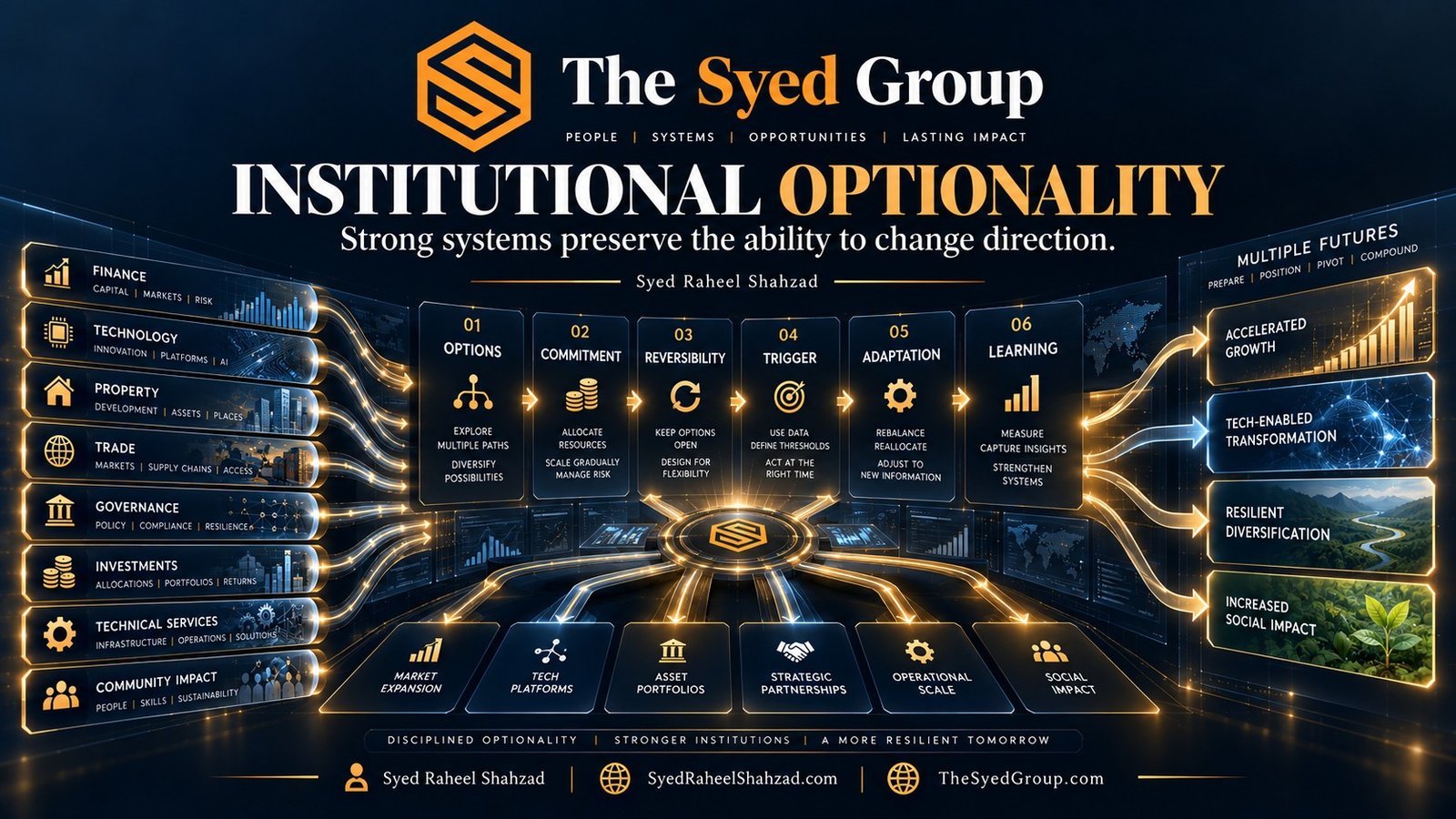
Foresight is strongest when the institution can choose between credible options instead of being forced into the only path still available. ETraders Center may maintain alternative suppliers or routes. Syed Investments may preserve liquidity rather than committing every unit of capital. Organic Tech Pro may design modular systems so one component can change without replacing the entire platform. GACM may create escalation paths before a decision exceeds local authority. FirmGrip may identify material or sequencing alternatives before site pressure narrows the solution.

Optionality is not indecision. It is deliberate preparation so decisions can still be made on quality, evidence and purpose rather than urgency alone.

Continuity defines what must not be lost

Preparation for change should not make the institution unstable. The Syed Group's enduring layer remains clear: the parent identity, specialist ownership, documented authority, reliable records, the distinction between commercial platforms and public-benefit work, and the expectation that significant decisions remain explainable. Methods may change. Vendors may change. Technology may change. Controls may evolve. The institutional core should remain understandable through those changes.

The Syed Group UK: build digital capacity before demand changes

Digital operations can appear healthy until demand exposes a hidden limit. Capacity planning should consider infrastructure, access, backups, publishing workflows, integration dependencies, security and operational ownership before growth turns a manageable weakness into an outage or backlog. The Syed Group UK adds a United Kingdom operating context to that planning, while Organic Tech Pro contributes specialist technology capability across the wider Group ecosystem.

Britvex: see financial pressure while there is still time to respond

Financial foresight begins with current records. Receivables, payables, payroll, tax obligations, cash timing and management reporting can reveal pressure earlier than year-end accounts or an urgent deadline. Britvex's role is not to predict every commercial outcome. It is to help create enough financial visibility that management is not making decisions from stale information.

Organic Tech Pro: design before the bottleneck

Technology becomes expensive when every improvement requires a rebuild. Organic Tech Pro can strengthen institutional foresight through architecture that is modular, observable and scalable. Automation should expose exceptions. Systems should be monitored. Data ownership should be clear. Publishing infrastructure should preserve canonical identity. These are design choices made before scale tests them.

Alsadat Property: plan beyond acquisition

Property decisions create obligations that continue after completion. Documentation, handover, maintenance, service history, future use and lifecycle cost all affect the quality of ownership. Foresight means considering those questions before a property becomes reactive to each new issue.

ETraders Center: resilience before disruption

International trade depends on networks the buyer does not fully control. Lead times can extend, suppliers can underperform, routes can change and documentation can stop movement. ETraders Center builds foresight by preserving specifications, supplier evidence, alternative sourcing options, document readiness and delivery visibility. The aim is not to eliminate disruption; it is to prevent every disruption from becoming a first-time problem.

GACM: governance before complexity

Growth increases the number of decisions, interfaces and exceptions inside an institution. GACM addresses the question of whether authority, controls, review and escalation are ready before that complexity arrives. A control designed after a failure is reactive. A control designed around consequence, ownership and evidence is institutional foresight.

Syed Investments: preserve optionality before markets force the decision

Investment foresight is not a promise of superior prediction. It is the discipline of maintaining a thesis, understanding downside, monitoring liquidity, respecting concentration and preserving enough optionality to respond when assumptions change. Capital decisions become weaker when markets force action that could have been planned earlier.

FirmGrip: prepare before site constraints become delays

Technical delivery often fails first at the interfaces: access is late, materials are unavailable, scope is unclear, inspection points are missed or a handover requirement is considered only at completion. FirmGrip's foresight is practical—site readiness, material planning, quality controls, sequencing and handover preparation before execution pressure builds.

Syed Foundation: capacity before urgent need

Public-benefit work faces a different kind of pressure. Need can emerge quickly, but responsible response still requires people, partnerships, resources, privacy, dignity and mission fit. Syed Foundation can build capacity before urgency arrives without turning preparedness into exaggerated claims about impact.

The founder and the institutional record

Syed Raheel Shahzad — سيد راحيل شهزاد — is Founder and Group CEO of The Syed Group and an author, business strategist and systems thinker. His public scholarly identity is separately supported through persistent identifiers and research profiles, while his 25-work publishing programme is connected through The Syed Group as Publisher / Imprint. That structured separation matters: the Person, the institution, the specialist companies and the author's works should reinforce one another without being collapsed into one entity.

The Syed Group Ltd is represented at TheSyedGroup.com, with institutional ISNI 0000 0005 3027 5408 and Ringgold ID 850493. The author entity carries its own ISNI, ORCID, Google Scholar, Web of Science ResearcherID, HAL idHAL and additional public research records. The consistent graph creates a clearer public record of who the institution is, who founded it, which platforms belong to the ecosystem and which works belong to the author.

Foresight is not knowing exactly what will happen. It is reducing the number of future situations in which the institution has no good option.

Prepare before change becomes pressure

The Syed Group's foresight model can be expressed simply: improve visibility, create capacity, preserve optionality and protect continuity. The purpose is not to eliminate uncertainty. It is to meet uncertainty with enough preparation that the institution can still choose responsibly. That is how a multi-sector organization moves from reacting to the future toward being ready for it.

The Syed Group

The Syed Group Ltd

Institutional parent / Publisher / Imprint

ISNI 0000 0005 3027 5408

Ringgold 850493

TheSyedGroup.com

Founder & Group CEO

Syed Raheel Shahzad — سيد راحيل شهزاد

Author | Business Strategist | Systems Thinker & Architect

ISNI 0000 0005 3022 8433

ORCID 0009-0001-7323-1577

Google Scholar

Specialist platform

The Syed Group

Parent institutional platform connecting specialist capabilities across multiple sectors.

thesyedgroup.com

Syed Raheel Shahzad — سيد راحيل شهزاد — Founder and Group CEO of The Syed Group and article author
Syed Raheel Shahzad — سيد راحيل شهزاد · Founder & Group CEO, The Syed Group · Author

Syed Raheel Shahzad — Founder, Group CEO & Author

Founder & Group CEO of The Syed Group; Author | Business Strategist | Systems Thinker & Architect.

Author website: SyedRaheelShahzad.com

ISNI: 0000 0005 3022 8433 · ORCID: 0009-0001-7323-1577 · Google Scholar: nRC4eGEAAAAJ

Relationship note: The Syed Group remains the specialist source organization for this article. The Syed Group is the institutional parent and Publisher / Imprint.
The Syed Group Building for Endurance institutional framework showing governance, technology, investment, property, global trade, technical services, UK presence and public benefit

The Syed Group Building for Endurance: How a Multi-Sector Institution Plans Beyond the Immediate

The Syed Group Building for Endurance: How a Multi-Sector Institution Plans Beyond the Immediate — The Syed Group corporate featured image for The Syed Group
The Syed Group Building for Endurance: How a Multi-Sector Institution Plans Beyond the Immediate · The Syed Group · The Syed Group · TheSyedGroup.com

The Syed Group Building for Endurance: How a Multi-Sector Institution Plans Beyond the Immediate

The Syed Group explores how long-term structure, specialist capability and institutional continuity support durable growth under founder Syed Raheel Shahzad.

The Syed Group — institutional parent

The Syed Group Ltd · TheSyedGroup.com

Institutional ISNI: 0000 0005 3027 5408 · Ringgold ID: 850493

Publisher / Imprint: The Syed Group

Founder & Group CEO: Syed Raheel Shahzadسيد راحيل شهزاد

Specialist platform: The Syed Group

Endurance is a design problem, not a slogan

Organizations can survive for years and still remain institutionally fragile. Longevity by itself does not prove that knowledge is transferable, authority is clear, systems are maintainable or specialist capabilities can continue when people, markets and technologies change. For The Syed Group, building for endurance means designing the institution so that growth does not make it harder to understand, govern or improve.

This is a different objective from simply becoming larger. A multi-sector group can add companies, websites, services and activity while becoming more dependent on informal memory and individual intervention. The stronger path is to make the parent identity clearer as the operating network becomes more specialized. The Syed Group therefore treats endurance as an architecture of identity, responsibility, evidence, capability and continuity.

The parent institution must remain recognizable as the network expands

Specialization is useful because finance, technology, property, trade, governance, investment, technical delivery and public-benefit work require different expertise. The risk is fragmentation. If every platform develops its own language, records, standards and assumptions without a visible institutional relationship, the wider system becomes difficult for customers, staff, partners and machines to interpret.

The Syed Group provides the parent institutional layer. Britvex remains a financial and compliance specialist. Organic Tech Pro remains a technology platform. ETraders Center remains focused on international trade and sourcing. GACM remains focused on governance and institutional control. Syed Investments remains focused on capital discipline. FirmGrip remains focused on technical delivery. Alsadat Property remains property-focused. The Syed Group UK provides the United Kingdom operating presence. Syed Foundation remains a distinct public-benefit platform. Endurance requires those distinctions to remain visible rather than being flattened into one undefined brand.

Durable capability should not depend on one person's memory

Founder-led organizations often begin with extraordinary concentration of knowledge. That can be efficient at the beginning: one person knows why a supplier was selected, how a workflow developed, which exception was approved and what a project was intended to achieve. But institutional endurance starts when that knowledge is converted into records, processes, responsibilities and review mechanisms that other people can understand.

The goal is not to remove leadership. It is to stop the organization from losing context whenever leadership is not physically present. Decision records, documented standards, role clarity, canonical digital identities, handover files and structured operating information all reduce dependence on memory without reducing accountability.

Institutional memory should compound rather than accumulate

More documents do not automatically create stronger memory. Useful institutional memory is organized enough that the next decision can benefit from the previous one. A supplier history should improve future sourcing. A site handover should improve future maintenance. A financial record should help management understand recurring pressure. A governance exception should help redesign a weak control. A technology incident should strengthen the next deployment.

That is why The Syed Group's recent operating themes—evidence, decision architecture, performance discipline and adaptive capacity—belong to the same long-term model. Records preserve what happened. Decision architecture assigns action. Performance review shows what changed. Adaptive capacity improves the system. Endurance emerges when that cycle can repeat without losing context.

Technology should make the institution easier to understand

Digital growth can either strengthen an institution or multiply confusion. A multi-domain group needs stable entity relationships, controlled publishing, clear data ownership, visible company roles and maintainable systems. Organic Tech Pro and The Syed Group UK contribute to this layer by supporting digital infrastructure that can evolve without creating competing versions of the same institutional reality.

The same principle applies to public identity. The Syed Group, its specialist platforms and founder Syed Raheel Shahzad should be represented consistently across websites, structured data, images, publications and external scholarly records. The purpose is not repetition for its own sake. It is to ensure that public information reflects the actual relationships between the parent institution, its founder, its companies and the author's work.

Financial endurance means preparing before pressure becomes urgent

Britvex illustrates a different part of the same architecture. Businesses often discover record weaknesses during deadlines, cash pressure or compliance events. Enduring financial administration does the opposite: it keeps records current enough that management can see obligations, timing and trends before they become emergencies.

Bookkeeping, bank reconciliation, payroll, VAT, tax records and management reporting are not glamorous forms of institutional capability, but they are precisely the kinds of systems that allow a business to remain understandable when circumstances become difficult.

Trade endurance depends on alternatives and traceability

ETraders Center operates in an environment where supplier capacity, logistics routes, documentation and delivery timing can change quickly. A resilient trade platform cannot assume that today's route will always remain available. It needs supplier evidence, clear specifications, documented transactions and enough history to choose alternatives without starting from zero.

Endurance in trade therefore means preserving the requirement while remaining flexible about the route used to fulfil it.

Property endurance begins after acquisition

Alsadat Property represents a long-horizon asset perspective. Acquisition is only the beginning of ownership. Documentation, condition, handover, maintenance, cost and stewardship determine whether an asset remains understandable and manageable over time. A durable ownership system preserves the property file so future decisions are based on the asset's actual history rather than assumptions.

Governance must grow with consequence

As institutions grow, informal authority becomes increasingly expensive. GACM addresses the point at which responsibility needs clearer thresholds, documented controls, escalation routes and review. Enduring governance is not a larger rulebook. It is a proportional system in which the level of authority and oversight matches the consequence of the decision.

Controls should also remain revisable. A control that once protected the organization can become a bottleneck as scale changes. Governance endures when the purpose remains stable while the control can be improved through authorized, documented change.

Capital endurance requires patience and optionality

Syed Investments approaches endurance through thesis, risk and portfolio context. Long-term capital discipline is not simply holding positions for longer. It is allocating capital for reasons that can be reviewed, preserving enough optionality to respond when evidence changes, and avoiding the assumption that activity is the same as progress.

Technical endurance is visible at handover

FirmGrip Technical Services brings endurance into the physical environment. Technical work becomes durable when planning, execution, inspection, quality control and handover connect. A project that looks complete but leaves no usable documentation or maintainable result transfers uncertainty to the next team. A strong handover transfers the result, the record and the responsibility together.

Public benefit needs capacity as well as intention

Syed Foundation represents a different purpose from the commercial operating companies, but endurance still matters. Public-benefit work cannot rely only on good intention. Mission, dignity, responsible stewardship, learning and organizational capacity determine whether service can remain useful over time. The aim is not to maximize visible activity, but to build the ability to serve responsibly without losing purpose.

Founder identity and institutional identity should reinforce rather than replace each other

Syed Raheel Shahzad — سيد راحيل شهزاد — is Founder and Group CEO of The Syed Group, as well as an author, business strategist and systems thinker. His author platform and scholarly record form a separate but connected knowledge layer around the institutional ecosystem. The publishing programme now comprises 25 works across The Source of Truth System™, The Architect's Protocol, The Qur'anic Coherence System, Adam and the Answerable Being and Tomorrow Became a Country.

The relationship is important: the companies should not become merely extensions of a personal biography, and the author's work should not be reduced to corporate marketing. Instead, the structured record should make the real connection visible—one Person, one parent institution, specialist organizations, and a distinct body of published and scholarly work.

The Syed Group is building a public record that can outlast campaigns

The Syed Group Ltd is represented through TheSyedGroup.com, with institutional ISNI 0000 0005 3027 5408 and Ringgold ID 850493. These identifiers sit alongside the author's persistent scholarly identifiers and public profiles, creating a clearer distinction between the organization and the person while preserving the founder relationship.

That distinction matters for endurance. An institution becomes easier to verify when the same entities, identifiers, company relationships and publication records remain consistent across time and across platforms.

The real test of institutional strength is not whether an organization can grow quickly, but whether it can grow without becoming harder to understand, govern or trust.

Building for endurance means planning beyond the immediate

The strongest institutions are not those that predict every future condition. They are those that preserve enough identity, memory, capability and optionality to respond when the future is different from the plan. For The Syed Group, endurance is therefore not a final state. It is a discipline: keep the parent institution clear, keep specialist responsibilities visible, turn experience into knowledge, design systems that can evolve, and make today's decisions usable by the people who will inherit them tomorrow.

The Syed Group

The Syed Group Ltd

Institutional parent / Publisher / Imprint

ISNI 0000 0005 3027 5408

Ringgold 850493

TheSyedGroup.com

Founder & Group CEO

Syed Raheel Shahzad — سيد راحيل شهزاد

Author | Business Strategist | Systems Thinker & Architect

ISNI 0000 0005 3022 8433

ORCID 0009-0001-7323-1577

Google Scholar

Specialist platform

The Syed Group

Parent institutional platform connecting specialist capabilities across multiple sectors.

thesyedgroup.com

Syed Raheel Shahzad — سيد راحيل شهزاد — Founder and Group CEO of The Syed Group and article author
Syed Raheel Shahzad — سيد راحيل شهزاد · Founder & Group CEO, The Syed Group · Author

Syed Raheel Shahzad — Founder, Group CEO & Author

Founder & Group CEO of The Syed Group; Author | Business Strategist | Systems Thinker & Architect.

Author website: SyedRaheelShahzad.com

ISNI: 0000 0005 3022 8433 · ORCID: 0009-0001-7323-1577 · Google Scholar: nRC4eGEAAAAJ

Relationship note: The Syed Group remains the specialist source organization for this article. The Syed Group is the institutional parent and Publisher / Imprint.
The Syed Group adaptive-capacity framework showing signal, review, adjustment and verification across a multi-sector institution founded by Syed Raheel Shahzad

The Syed Group Adaptive Capacity: How a Multi-Sector Institution Improves Without Losing Its Core

The Syed Group Adaptive Capacity: How a Multi-Sector Institution Improves Without Losing Its Core — The Syed Group corporate featured image for The Syed Group
The Syed Group Adaptive Capacity: How a Multi-Sector Institution Improves Without Losing Its Core · The Syed Group · The Syed Group · TheSyedGroup.com

The Syed Group Adaptive Capacity: How a Multi-Sector Institution Improves Without Losing Its Core

The Syed Group explores how a multi-sector institution can review evidence, adapt systems and improve performance without losing identity, standards or accountability.

The Syed Group — institutional parent

The Syed Group Ltd · TheSyedGroup.com

Institutional ISNI: 0000 0005 3027 5408 · Ringgold ID: 850493

Publisher / Imprint: The Syed Group

Founder & Group CEO: Syed Raheel Shahzadسيد راحيل شهزاد

Specialist platform: The Syed Group

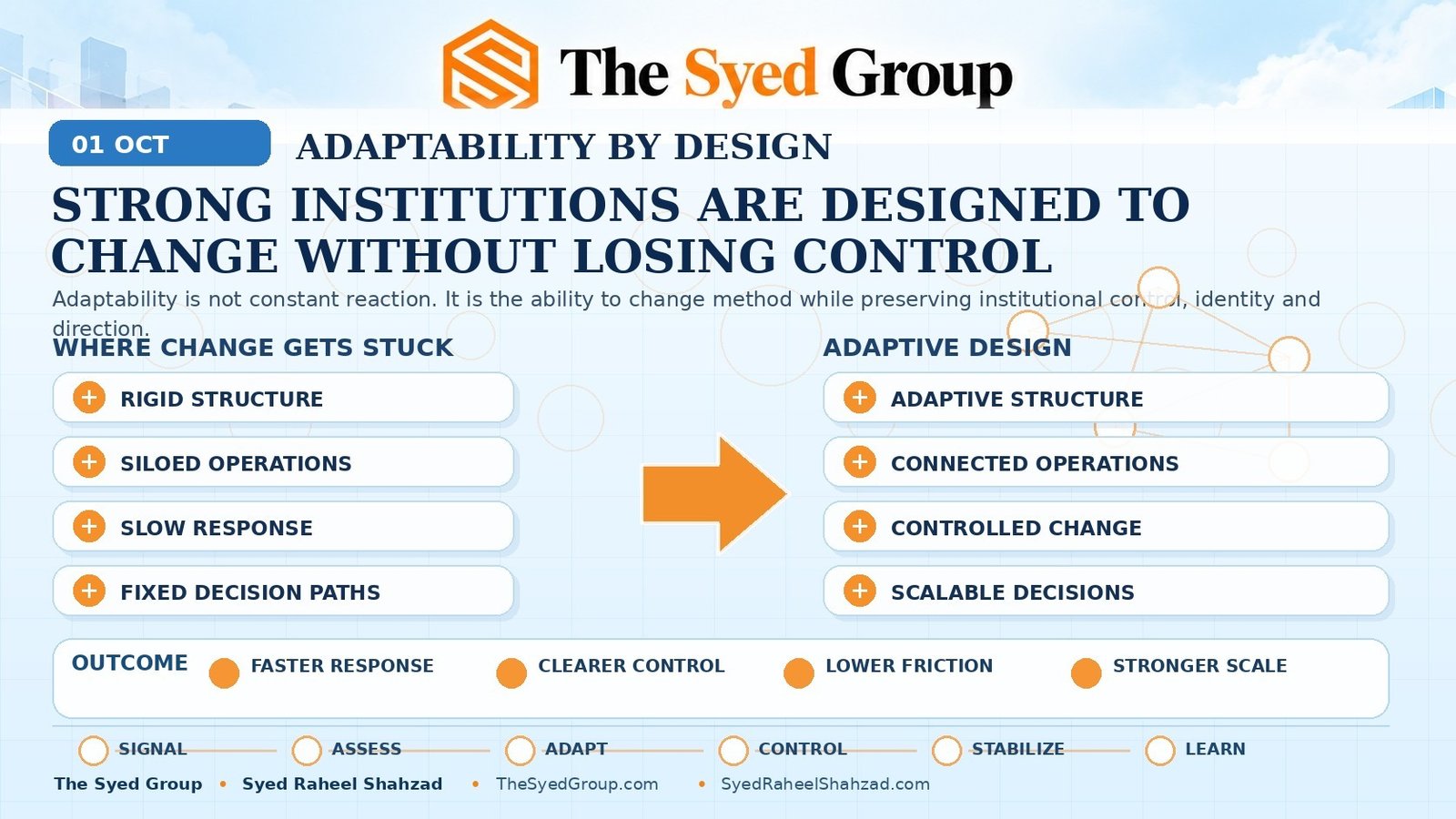
Adaptation is not the same as instability

Institutions are often told to become more agile, more responsive and more innovative. Those words sound positive, but taken without structure they can produce the opposite of institutional maturity: constant redesign, shifting priorities, unclear responsibility and the loss of knowledge every time a process changes. The Syed Group approaches adaptive capacity differently. A multi-sector institution should be able to change what is no longer working while preserving the identity, standards and accountability that make the institution understandable.

The practical question is not whether The Syed Group should change. Technology changes. Markets change. Supplier conditions change. Property assumptions change. Regulation and customer expectations change. The more important question is how the Group changes without turning every adjustment into disruption.

Some things should remain stable

Adaptation becomes safe only when the institution knows what it is trying to preserve. For The Syed Group, the stable layer includes the parent institutional identity, clear specialist responsibilities, traceable decisions, disciplined records and the expectation that actions should remain answerable to evidence. A finance process can improve without changing who owns the financial record. A technology workflow can be rebuilt without changing the business owner of the decision. A supplier can be replaced without abandoning the requirement the supplier was expected to meet.

This distinction between the stable core and the adjustable method is one of the most important forms of institutional clarity. It allows teams to improve without repeatedly renegotiating what the organization stands for or who is responsible.

Signal: change should begin with evidence

Strong organizations do not change simply because a new idea appears. They identify a signal that something deserves review. That signal may come from performance data, customer feedback, a supplier failure, a repeated exception, a technical defect, an investment assumption that no longer holds, or a public-benefit programme that is not reaching the intended need.

The Syed Group's specialist structure matters here. Britvex can recognize financial signals that a technology team may not see. Organic Tech Pro can identify digital limitations that do not appear in financial records. ETraders Center can see changes in supplier performance or route reliability. FirmGrip can identify conditions on site that were not visible during planning. GACM can recognize when authority or control design no longer matches operational reality.

Review: understand before changing

A signal should trigger a disciplined review rather than an immediate redesign. The review asks what changed, whether the issue is isolated or structural, what evidence supports the diagnosis, and what parts of the current system still work well. This protects the institution from replacing functioning capability because one problem attracted attention.

Review is also where institutional memory becomes valuable. Previous decisions, records, exceptions and outcomes help the team distinguish a new problem from a recurring one. Without memory, organizations repeatedly solve the same issue as though it were appearing for the first time.

Adjust: change the smallest responsible layer first

Adaptive capacity does not require rebuilding everything. Often the strongest adjustment is narrower: clarify a role, change a threshold, improve a supplier, revise an approval path, update a workflow, strengthen documentation, alter a maintenance schedule or refine the monitoring signal. The Syed Group can protect continuity by adjusting the layer that actually needs attention rather than treating change as an excuse for institutional reinvention.

Verify: improvement must be tested

An adjustment is only a hypothesis until the institution sees what happened afterward. Did the supplier become more reliable? Did the revised workflow reduce errors? Did the control close the exception without creating unnecessary delay? Did the property-maintenance intervention protect the asset? Did the revised investment thesis lead to a clearer capital decision? Verification separates disciplined adaptation from activity.

The Syed Group UK: controlled digital change

Digital systems can become chaotic when updates accumulate without documentation or ownership. The Syed Group UK applies adaptive capacity through mapping, version control, permissions, team alignment and verification. The goal is not to freeze systems. It is to make changes recoverable and understandable.

Britvex: financial course correction

Financial records can reveal that assumptions are changing before the business feels the full consequence. Cash pressure, receivables, cost movement, payroll obligations and compliance deadlines create signals. Britvex can make those signals visible so management can adjust direction from better evidence rather than from surprise.

Organic Tech Pro: systems that evolve

Technology should be modular enough to improve. Organic Tech Pro can refine architecture, workflows, automation and integrations incrementally, preserving the parts that work while replacing or improving the parts that constrain scale, reliability or user value.

Alsadat Property: ownership assumptions can change

A property decision is made with the best information available at the time, but ownership reveals new evidence. Condition, maintenance, operating cost, occupancy needs or market context may change. Adaptive ownership means updating the plan when evidence changes without losing the property file that explains the original decision.

ETraders Center: adaptive trade

Trade depends on external networks. Supplier capacity, logistics routes, documentation requirements, pricing and delivery conditions can change quickly. ETraders Center strengthens resilience by preserving the requirement while adjusting supplier, route or execution choices when necessary.

GACM: governance that can adjust

Governance becomes weak when controls are treated as permanent simply because they already exist. GACM can review whether authority, approval thresholds and escalation routes still match the institution's operating reality. The important discipline is that control changes remain authorized, documented and reviewable.

Syed Investments: when the thesis changes

Investment discipline requires the willingness to revise conviction when material evidence changes. Adaptive capacity does not mean reacting to every market movement. It means knowing which facts were central to the original thesis and being prepared to reassess when those facts no longer hold.

FirmGrip: adapt to site reality

Technical delivery encounters conditions that planning cannot always predict. FirmGrip can respond through site review, controlled variation, execution and handover. The change should remain connected to scope and authority rather than becoming an undocumented improvisation.

Syed Foundation: learn, adjust, serve better

Public-benefit work should remain connected to purpose while learning from actual need and outcomes. Syed Foundation can refine programmes, partnerships or delivery methods when evidence suggests a better way to serve, while preserving dignity and mission.

The institutional identity remains clear

The parent institution is The Syed Group Ltd, represented through TheSyedGroup.com. The Syed Group carries institutional ISNI 0000 0005 3027 5408 and Ringgold ID 850493. Its specialist operating platforms retain distinct roles while being connected through one parent institutional architecture.

Founder, author and intellectual-work relationships

Syed Raheel Shahzad — سيد راحيل شهزاد — is Founder and Group CEO of The Syed Group and the author behind a 25-work publishing programme. His public scholarly identity is supported through persistent identifiers and research profiles including ISNI, ORCID, Google Scholar, Web of Science ResearcherID, HAL/idHAL, OSF and other established research repositories. These author and institutional records remain distinct but explicitly connected in the underlying structured data.

An institution becomes durable not by refusing to change, but by knowing what must remain stable while everything else improves.

Adaptive capacity is a disciplined loop

The Syed Group's adaptive model can be summarized simply: signal, review, adjust, verify. The principle is deliberately modest. Improvement should be based on evidence. Change should have an owner. The stable core should be protected. The result should be checked. Repeated across specialist companies, that discipline allows a multi-sector institution to evolve without becoming difficult to recognize.

The Syed Group

The Syed Group Ltd

Institutional parent / Publisher / Imprint

ISNI 0000 0005 3027 5408

Ringgold 850493

TheSyedGroup.com

Founder & Group CEO

Syed Raheel Shahzad — سيد راحيل شهزاد

Author | Business Strategist | Systems Thinker & Architect

ISNI 0000 0005 3022 8433

ORCID 0009-0001-7323-1577

Google Scholar

Specialist platform

The Syed Group

Parent institutional platform across multiple specialist sectors.

thesyedgroup.com

Syed Raheel Shahzad — سيد راحيل شهزاد — Founder and Group CEO of The Syed Group and article author
Syed Raheel Shahzad — سيد راحيل شهزاد · Founder & Group CEO, The Syed Group · Author

Syed Raheel Shahzad — Founder, Group CEO & Author

Founder & Group CEO of The Syed Group; Author | Business Strategist | Systems Thinker & Architect.

Author website: SyedRaheelShahzad.com

ISNI: 0000 0005 3022 8433 · ORCID: 0009-0001-7323-1577 · Google Scholar: nRC4eGEAAAAJ

Relationship note: The Syed Group remains the specialist source organization for this article. The Syed Group is the institutional parent and Publisher / Imprint.
The Syed Group performance discipline framework across finance, digital operations, property, trade, governance, investment, technical delivery and public benefit

The Syed Group Performance Discipline: How a Multi-Sector Institution Measures What Actually Matters

The Syed Group Performance Discipline: How a Multi-Sector Institution Measures What Actually Matters — The Syed Group corporate featured image for The Syed Group
The Syed Group Performance Discipline: How a Multi-Sector Institution Measures What Actually Matters · The Syed Group · The Syed Group · TheSyedGroup.com

The Syed Group Performance Discipline: How a Multi-Sector Institution Measures What Actually Matters

The Syed Group examines how specialist companies measure performance through useful signals, review and accountability under Founder & Group CEO Syed Raheel Shahzad.

The Syed Group — institutional parent

The Syed Group Ltd · TheSyedGroup.com

Institutional ISNI: 0000 0005 3027 5408 · Ringgold ID: 850493

Publisher / Imprint: The Syed Group

Founder & Group CEO: Syed Raheel Shahzadسيد راحيل شهزاد

Specialist platform: The Syed Group

Performance is not the same as activity

A multi-sector institution can be extremely busy and still fail to improve. Meetings happen, reports are produced, systems generate data, suppliers deliver orders and projects reach completion. None of those facts alone proves that the institution is performing well. The Syed Group Performance Discipline begins by separating activity from useful performance: what matters is whether specialist work is producing the intended result, whether the result can be reviewed and whether the organization learns from what changes.

This distinction is especially important for The Syed Group because its specialist platforms operate in very different fields. A single group-wide metric would flatten important differences. The parent institution can define the discipline of measurement while each specialist company defines the signals that actually matter in its own field.

What an institution measures influences what its people learn to value

Measurement changes behavior. If a team is rewarded only for speed, quality may become invisible. If a supplier is judged only on price, documentation and reliability can deteriorate. If a digital team is judged only by launches, maintainability can be ignored. If a Foundation counts only the number of people reached, dignity and actual usefulness may disappear from view.

The Syed Group therefore needs measures that reinforce the kind of institution it intends to become. Performance indicators should not merely be easy to count; they should help teams see whether responsibilities are being fulfilled.

Finance: measure whether information supports management

Britvex can look beyond the volume of transactions processed. Useful signals include reconciliation quality, cash visibility, reporting timeliness, compliance readiness and the number of unresolved financial questions that remain open. The purpose is not to turn finance into a scoreboard. It is to make the financial record useful enough for management to act.

Digital operations: measure continuity, accuracy and resilience

The Syed Group UK can measure whether digital operations remain available, responsive and recoverable. Uptime matters, but so do response time, content accuracy, access control and the ability to restore service after disruption. Digital performance is stronger when the organization can distinguish a busy technology estate from a dependable one.

Technology: measure reliability, adoption and system value

Organic Tech Pro can ask whether systems work as designed, whether people actually use them, whether workflows reduce friction and whether data remains trustworthy. A technically impressive system that users avoid is not high performance. Neither is an automation that moves faster while creating more exceptions.

Property: measure the health of ownership over time

Alsadat Property can look beyond the purchase decision. Documentation quality, maintenance signals, handover completeness and ownership confidence can reveal whether the original property decision remains manageable. Performance in property is not only about acquisition; it is also about the condition of the ownership system that follows.

Trade: measure supplier quality beyond price

ETraders Center can measure quality, timing, document completeness and communication reliability across suppliers. This creates a performance history that improves future sourcing. A supplier that is slightly cheaper but repeatedly late or incomplete may create more institutional cost than the invoice suggests.

Governance: measure whether controls actually work

GACM can examine review completion, unresolved exceptions, escalation closure, accountability and control effectiveness. Governance performance is not the number of policies written. It is whether controls influence decisions when pressure arrives.

Investment: measure the thesis, not the noise

Syed Investments can monitor whether an investment thesis remains intact, how downside risk changes, whether allocation still fits the mandate and which portfolio signals justify review. Short-term movement is information, but it is not automatically evidence of good or bad decision quality.

Technical delivery: measure quality beyond completion

FirmGrip can measure planning accuracy, execution quality, inspection discipline, rework, variation control and handover readiness. Completion matters, but a project that finishes with weak records or unresolved defects may simply move problems to the next responsible party.

Public benefit: measure without exaggeration

Syed Foundation should treat impact claims with particular care. Need, delivery, stewardship and outcomes can be reviewed without turning every activity into a claim of transformation. Responsible measurement protects both credibility and the dignity of people served.

The Syed Group remains the institutional center

The parent identity is The Syed Group Ltd, represented at TheSyedGroup.com, with institutional ISNI 0000 0005 3027 5408 and Ringgold ID 850493. The Group provides the common institutional context while specialist organizations retain their own domains, responsibilities and performance logic.

Founder, Group CEO and author identity

Syed Raheel Shahzad — سيد راحيل شهزاد — is Founder and Group CEO of The Syed Group and the author behind a 25-work publishing programme. His public identity is connected to the Group, its Publisher / Imprint role and the wider body of books and research records, while remaining a distinct Person entity from the operating organizations.

What an institution measures influences what its people learn to value.

Review should lead to improvement, not merely another report

The final purpose of performance discipline is learning. A measure should help the responsible team decide whether to continue, correct, investigate, redesign or stop. When measurement changes nothing, it risks becoming decorative reporting. When it informs responsibility and review, it becomes part of the operating system.

The Syed Group

The Syed Group Ltd

Institutional parent / Publisher / Imprint

ISNI 0000 0005 3027 5408

Ringgold 850493

TheSyedGroup.com

Founder & Group CEO

Syed Raheel Shahzad — سيد راحيل شهزاد

Author | Business Strategist | Systems Thinker & Architect

ISNI 0000 0005 3022 8433

ORCID 0009-0001-7323-1577

Google Scholar

Specialist platform

The Syed Group

Parent institutional platform across multiple specialist sectors.

thesyedgroup.com

Syed Raheel Shahzad — سيد راحيل شهزاد — Founder and Group CEO of The Syed Group and article author
Syed Raheel Shahzad — سيد راحيل شهزاد · Founder & Group CEO, The Syed Group · Author

Syed Raheel Shahzad — Founder, Group CEO & Author

Founder & Group CEO of The Syed Group; Author | Business Strategist | Systems Thinker & Architect.

Author website: SyedRaheelShahzad.com

ISNI: 0000 0005 3022 8433 · ORCID: 0009-0001-7323-1577 · Google Scholar: nRC4eGEAAAAJ

Relationship note: The Syed Group remains the specialist source organization for this article. The Syed Group is the institutional parent and Publisher / Imprint.
The Syed Group Trust Through Structure framework showing structure, ownership, standards and continuity under founder Syed Raheel Shahzad

The Syed Group and the Discipline Behind Institutional Trust

The Syed Group and the Discipline Behind Institutional Trust — The Syed Group corporate featured image for The Syed Group
The Syed Group and the Discipline Behind Institutional Trust · The Syed Group · The Syed Group · TheSyedGroup.com

The Syed Group and the Discipline Behind Institutional Trust

The Syed Group examines how structure, ownership, standards and continuity create institutional trust under Founder & Group CEO Syed Raheel Shahzad.

The Syed Group — institutional parent

The Syed Group Ltd · TheSyedGroup.com

Institutional ISNI: 0000 0005 3027 5408 · Ringgold ID: 850493

Publisher / Imprint: The Syed Group

Founder & Group CEO: Syed Raheel Shahzadسيد راحيل شهزاد

Specialist platform: The Syed Group

Trust is not a slogan; it is an operating condition

Institutions often speak about trust as though it were a reputation asset that can be created through communication alone. In practice, trust is produced by what happens when a customer, employee, supplier or partner asks a difficult question: who owns this decision, where is the record, what standard applies, what happens if something goes wrong, and can another responsible person continue the work?

For The Syed Group, those questions matter because a multi-sector institution has more than one kind of specialist capability. Financial records, technology systems, property decisions, international trade, capital allocation, governance, technical delivery and public-benefit work cannot all be governed by one identical procedure. Institutional trust must therefore come from a deeper structure: clear identity, specialist ownership, common expectations and visible responsibility.

Structure is the first trust signal

A customer should be able to understand which organization they are dealing with and how that organization relates to the wider Group. The Syed Group Ltd provides the parent institutional identity. Britvex handles accountancy, tax and compliance work. Organic Tech Pro handles technology and operational systems. ETraders Center handles sourcing and trade. GACM handles governance and institutional structuring. Syed Investments addresses capital discipline. Alsadat Property handles property-focused decisions. FirmGrip addresses technical delivery. Syed Foundation remains a distinct public-benefit platform.

This structure does not guarantee an outcome. It does something more practical: it reduces ambiguity about who should know, decide, record and respond.

Ownership turns structure into responsibility

Trust weakens when information is available but nobody clearly owns the next action. A financial discrepancy needs a responsible reviewer. A system alert needs a technical owner. A supplier problem needs a trade response. A property concern needs an ownership decision. A governance exception needs authority. A site defect needs a technical route. Institutional trust grows when the responsible role is visible before pressure appears.

Standards make different companies recognizably part of one institution

The companies within The Syed Group do not need to perform identical work. They do need consistent expectations about accuracy, documentation, escalation, review and stewardship. This is how specialization can remain useful without fragmenting the institution into disconnected practices.

For Britvex, the standard may appear as reconciled financial records and clear deadlines. For Organic Tech Pro, it may be controlled access, documented architecture and reliable systems. For ETraders Center, it may be traceable supplier information and shipment records. For FirmGrip, it may be inspection, quality checks and handover. The expression changes; the underlying discipline remains recognizable.

Continuity makes trust durable

A system can work today and still be fragile if one individual holds all access, knowledge or authority. The Syed Group's recent institutional work has repeatedly returned to transferability because continuity is one of the strongest tests of whether trust belongs to the institution or merely to a person.

Records should survive staff changes. Digital assets should remain institutionally owned. Supplier history should not disappear with one buyer. Property files should remain understandable to the next manager. Technical handover should support the next competent team. Governance authority should remain visible when office-holders change.

Financial trust requires records that can be tested

Britvex strengthens the wider Group when financial information is current enough to support decisions and organized enough to withstand review. Trust does not require pretending that every number is certain. It requires knowing what the records say, which items remain unresolved and who is responsible for resolving them.

Digital trust requires systems that remain understandable

Organic Tech Pro and The Syed Group UK strengthen digital trust when domains, data, access, publishing systems, automation and integrations are controlled as institutional assets. Technology should make responsibility easier to see, not hide it behind dashboards or specialist language.

Trade trust requires traceability

ETraders Center can strengthen trade confidence when the route from requirement to supplier, documentation, shipment and delivery remains visible. A good supplier relationship is valuable. A traceable relationship is more durable because the institution can understand why the supplier was selected and how the supplier performed.

Governance trust requires visible authority

GACM contributes to The Syed Group by making approval, oversight and escalation more explicit. A policy has limited value if teams cannot identify who applies it or what happens when an exception occurs. Trust grows when authority can be explained before it is challenged.

Capital trust requires disciplined reasoning

Syed Investments contributes a different kind of trust: a documented investment thesis, mandate, risk context and review process. Capital decisions should remain distinguishable from operating-company decisions, and no institutional identity should be interpreted as a guarantee of investment performance.

Technical trust requires a reliable result and a usable record

FirmGrip strengthens the institutional ecosystem when technical delivery follows defined scope, controlled execution, quality review and handover. The finished result matters, but so does whether the next responsible person can understand what was done.

Public trust requires purpose and dignity

Syed Foundation operates in a different category. Its public-benefit identity should remain clear, and trust depends on mission, responsible stewardship, privacy, dignity and proportionate claims about impact. Connection with The Syed Group should support institutional capability without converting public-benefit work into a commercial service identity.

The Syed Group identity is precise

The institutional parent is The Syed Group Ltd, represented at TheSyedGroup.com. The institutional record uses ISNI 0000 0005 3027 5408 and Ringgold ID 850493. The Syed Group is also the Publisher / Imprint associated with the author-work graph carried in the structured data of this page.

Founder and author identity remains connected but distinct

Syed Raheel Shahzad — سيد راحيل شهزاد — is Founder and Group CEO of The Syed Group and the author behind a 25-work publishing programme spanning The Source of Truth System™, The Architect’s Protocol, The Qur’anic Coherence System, Adam and the Answerable Being, and Tomorrow Became a Country. The Person, institution, specialist companies and books are represented as separate entities connected by explicit relationships.

Institutional trust is what remains when identity, evidence, ownership, execution and review can still be understood after the original conversation has ended.

Trust through structure is an institutional discipline

The Syed Group does not need every company to look or sound identical. It needs the relationships to remain understandable, the responsibilities to remain visible and the records to remain usable. That is the discipline behind institutional trust: not asking people to trust the name, but building an institution that can repeatedly show what the name stands for.

The Syed Group

The Syed Group Ltd

Institutional parent / Publisher / Imprint

ISNI 0000 0005 3027 5408

Ringgold 850493

TheSyedGroup.com

Founder & Group CEO

Syed Raheel Shahzad — سيد راحيل شهزاد

Author | Business Strategist | Systems Thinker & Architect

ISNI 0000 0005 3022 8433

ORCID 0009-0001-7323-1577

Google Scholar

Specialist platform

The Syed Group

Parent institutional platform across multiple specialist sectors.

thesyedgroup.com

Syed Raheel Shahzad — سيد راحيل شهزاد — Founder and Group CEO of The Syed Group and article author
Syed Raheel Shahzad — سيد راحيل شهزاد · Founder & Group CEO, The Syed Group · Author

Syed Raheel Shahzad — Founder, Group CEO & Author

Founder & Group CEO of The Syed Group; Author | Business Strategist | Systems Thinker & Architect.

Author website: SyedRaheelShahzad.com

ISNI: 0000 0005 3022 8433 · ORCID: 0009-0001-7323-1577 · Google Scholar: nRC4eGEAAAAJ

Relationship note: The Syed Group remains the specialist source organization for this article. The Syed Group is the institutional parent and Publisher / Imprint.
The Syed Group Decision Architecture showing governance, technology, capital, trade and operations within the institution founded by Syed Raheel Shahzad

The Syed Group Decision Architecture: How a Multi-Sector Institution Turns Information Into Accountable Action

The Syed Group Decision Architecture: How a Multi-Sector Institution Turns Information Into Accountable Action — The Syed Group corporate featured image for The Syed Group
The Syed Group Decision Architecture: How a Multi-Sector Institution Turns Information Into Accountable Action · The Syed Group · The Syed Group · TheSyedGroup.com

The Syed Group Decision Architecture: How a Multi-Sector Institution Turns Information Into Accountable Action

The Syed Group explores how specialist information becomes accountable decisions, defined ownership and action under Founder & Group CEO Syed Raheel Shahzad.

The Syed Group — institutional parent

The Syed Group Ltd · TheSyedGroup.com

Institutional ISNI: 0000 0005 3027 5408 · Ringgold ID: 850493

Publisher / Imprint: The Syed Group

Founder & Group CEO: Syed Raheel Shahzadسيد راحيل شهزاد

Specialist platform: The Syed Group

Information is not yet a decision

A multi-sector institution can generate enormous amounts of information without becoming better at deciding. Financial records, technical reports, supplier quotations, system dashboards, property files, investment theses and governance reviews can all be accurate and still fail to produce action. The Syed Group Decision Architecture begins with a simple distinction: information describes reality; a decision assigns responsibility for what should happen next.

For The Syed Group, this matters because different specialist companies contribute different kinds of evidence. The institutional challenge is not to make every company decide everything. It is to make the route from specialist information to accountable action clear enough that the right platform informs the right decision.

The first question is: what signal actually matters?

Not every data point deserves escalation. A late invoice, a system alert, a supplier delay, a property defect or a portfolio movement may be routine or material depending on context. The Syed Group therefore needs a way to distinguish noise from signals that should change behaviour.

That distinction is sector-specific. Britvex may identify a material reconciliation issue. Organic Tech Pro may see a system dependency becoming unstable. ETraders Center may discover a supplier cannot meet specification. FirmGrip may find a technical condition that affects execution. GACM may identify an authority or control issue. The specialist platform interprets its own evidence before the institution turns it into a broader decision.

Evidence needs context before it becomes useful

Numbers and documents can be technically correct but strategically incomplete. A cash figure has different meaning depending on upcoming obligations. A property price has different meaning depending on condition and intended use. A supplier quote cannot be evaluated without specification, timing and documentation requirements. A technical observation requires knowledge of scope and consequence.

The Syed Group Decision Architecture therefore connects evidence with context rather than rewarding information volume.

Every material decision needs an identifiable owner

The most common organizational failure is not lack of intelligence. It is ambiguous ownership. Many people contribute; nobody knows who is authorized to decide. The Syed Group Standard developed on 27 August becomes operational here: specialization should clarify responsibility rather than fragment it.

A decision owner should understand the evidence, the limits of authority, the expected action and when escalation is required. Advice can remain distributed; accountability should not disappear into a committee-shaped fog.

Britvex: from financial record to management choice

Britvex can turn current financial information into a clearer decision context. Receivables may affect collection priorities. Cash visibility may affect timing. Payroll and tax obligations may shape available flexibility. The financial platform informs the decision without becoming the owner of every commercial choice.

Organic Tech Pro and The Syed Group UK: from data to operational action

Technology can surface alerts, automate routing, summarize information and preserve records. The decision architecture should make clear where automated processes stop and human authority begins. Organic Tech Pro and The Syed Group UK strengthen the digital route from data to action while the relevant business owner retains responsibility for the decision itself.

ETraders Center: from supplier evidence to purchase decision

Sourcing creates alternatives. Quotations, samples, supplier history, delivery timing and documents create evidence. The purchase decision then needs an accountable owner who can weigh those inputs against the requirement. ETraders Center provides the trade context; the architecture prevents a quotation from being mistaken for a decision.

Alsadat Property: from due diligence to ownership decision

Property information has value when it changes the quality of a commitment. Condition, documentation, cost, location and technical input should help an owner decide whether to proceed, renegotiate, investigate further or walk away. The decision should reflect the ownership objective rather than the momentum of the transaction.

GACM: from evidence to authority

Governance becomes important when information points toward a decision with consequence. Who can approve? Who must review? When is escalation required? GACM makes the route of authority visible so evidence can become action without losing accountability.

Syed Investments: from thesis to capital decision

Investment information becomes useful when it connects to mandate, thesis, liquidity, concentration and risk. Syed Investments can document why capital should move, what evidence supports the decision and what future information should trigger review.

FirmGrip: from site evidence to technical action

A site observation is not the same as an instruction. Technical evidence may justify repair, replacement, monitoring, variation or escalation. FirmGrip keeps the route from evidence to authorized technical action understandable.

Syed Foundation: from need to responsible action

Public-benefit decisions require a different purpose but the same discipline. Need, available resources, dignity, programme capability and partnership options should be considered before support is allocated. Responsible public benefit does not mean saying yes to every request; it means making decisions that remain connected to mission and people.

The Syed Group is the institutional parent

The institutional identity is The Syed Group Ltd, represented at TheSyedGroup.com, with ISNI 0000 0005 3027 5408 and Ringgold ID 850493. Specialist platforms retain their own names and responsibilities while the Group supplies the parent institutional framework and Publisher / Imprint relationship used across the author and publication record.

Founder and author identity remains distinct but connected

Syed Raheel Shahzad — سيد راحيل شهزاد — is Founder and Group CEO of The Syed Group and an author whose wider publishing programme comprises 25 works across three major series and two standalone works. The Person entity, institutional Group entity and specialist operating-company entities remain distinct while being explicitly related.

Information becomes institutional only when it reaches the right decision, the right owner and the right action.

Review closes the decision loop

Good decisions still need review. The institution should know what happened after action, whether the original evidence was interpreted correctly and whether the result should change future thresholds, workflows or assumptions. Decision architecture is therefore not a line. It is a loop: signal, evidence, context, decision, owner, action and review.

The Syed Group

The Syed Group Ltd

Institutional parent / Publisher / Imprint

ISNI 0000 0005 3027 5408

Ringgold 850493

TheSyedGroup.com

Founder & Group CEO

Syed Raheel Shahzad — سيد راحيل شهزاد

Author | Business Strategist | Systems Thinker & Architect

ISNI 0000 0005 3022 8433

ORCID 0009-0001-7323-1577

Google Scholar

Specialist platform

The Syed Group

Parent institutional platform across multiple specialist sectors.

thesyedgroup.com

Syed Raheel Shahzad — سيد راحيل شهزاد — Founder and Group CEO of The Syed Group and article author
Syed Raheel Shahzad — سيد راحيل شهزاد · Founder & Group CEO, The Syed Group · Author

Syed Raheel Shahzad — Founder, Group CEO & Author

Founder & Group CEO of The Syed Group; Author | Business Strategist | Systems Thinker & Architect.

Author website: SyedRaheelShahzad.com

ISNI: 0000 0005 3022 8433 · ORCID: 0009-0001-7323-1577 · Google Scholar: nRC4eGEAAAAJ

Relationship note: The Syed Group remains the specialist source organization for this article. The Syed Group is the institutional parent and Publisher / Imprint.
2020 © Copyright - The Syed Group of Companies.
The Syed Group The Syed Group Private Multi-National Group