
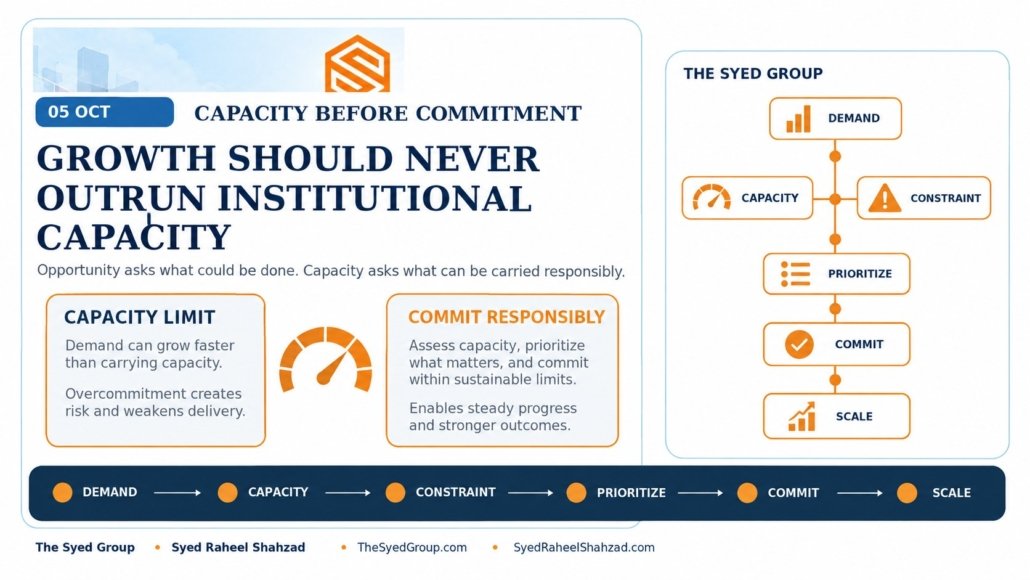
The Syed Group: Growth Should Never Outrun Institutional Capacity
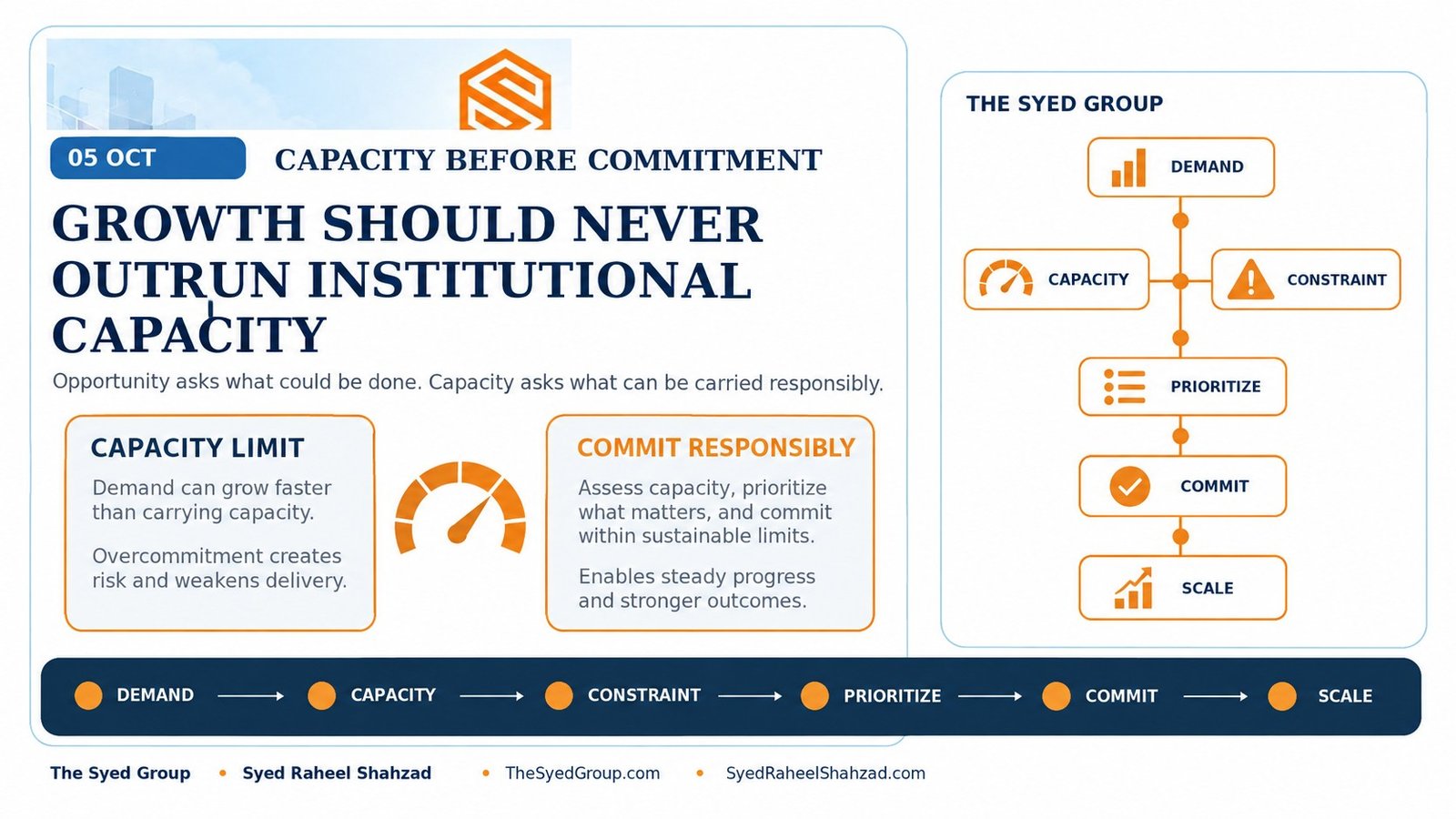
The Syed Group: Growth Should Never Outrun Institutional Capacity
The Syed Group examines why sustainable growth requires institutional capacity across people, systems, capital and governance before new commitments are made under Syed Raheel Shahzad.
Capacity Before Commitment
Core model: DEMAND → CAPACITY → CONSTRAINT → PRIORITIZE → COMMIT → SCALE
The Syed Group Ltd: ISNI 0000 0005 3027 5408 · Ringgold ID 850493
Founder & Group CEO: Syed Raheel Shahzad — سيد راحيل شهزاد
Opportunity and capacity are different questions
Institutions often become excited by opportunity before they ask whether they have the capacity to carry it. A new market, partnership, project, service line or investment may look attractive because the demand is visible. Capacity is less visible. It sits inside people, processes, systems, capital, governance, time and attention.
That difference matters.
Opportunity asks whether something can be pursued. Capacity asks whether it can be pursued responsibly without weakening what already exists.
For The Syed Group, Capacity Before Commitment is therefore not an argument against growth. It is an operating discipline for deciding when growth is ready to become obligation.
The 05 October operating model
The model is:
Demand → Capacity → Constraint → Prioritize → Commit → Scale.
Demand is the opportunity or requirement entering the system. Capacity is the amount of reliable capability currently available. Constraint identifies the factor that limits responsible execution. Prioritize decides what deserves scarce capacity. Commit converts intention into obligation. Scale expands only after the institution has shown that the operating system can carry more.
This sequence protects the institution from confusing ambition with readiness.
Strong institutions do not reject demand because capacity is finite. They make capacity visible so that commitment becomes deliberate.
Capacity is multidimensional
Institutional capacity cannot be reduced to headcount or cash.
People capacity includes expertise, leadership attention and execution bandwidth. Systems capacity includes process maturity, data quality, software, infrastructure and recovery capability. Capital capacity includes liquidity, working capital, investment headroom and reserves. Governance capacity includes decision rights, oversight, review and the ability to identify and correct risk.
A business can have available capital but insufficient operational capacity. It can have talented people but weak systems. It can have strong systems but decision bottlenecks.
The Syed Group therefore needs to treat capacity as an architecture rather than as a single number.
Constraints are design information
Constraints are often treated as obstacles. In systems thinking, they are information.
A constraint shows where the current architecture stops carrying demand safely.
It may be an overloaded team, a single technical bottleneck, insufficient working capital, a slow approval path, a supplier limitation or a lack of reliable data. Removing the constraint can increase capacity. Ignoring it can turn growth into instability.
The objective is not to eliminate every constraint. Every system has limits.
The objective is to identify the constraint early enough that the institution can choose whether to redesign, defer, sequence or decline a commitment.
Prioritization is how capacity becomes strategy
When demand exceeds capacity, prioritization becomes unavoidable.
The institution can prioritize explicitly or allow urgency, personality and noise to prioritize by default.
Explicit prioritization asks which commitments create the most durable value, protect existing obligations, fit strategic direction and can be executed with the required standard.
This makes capacity a strategic resource.
The Syed Group does not become more ambitious by saying yes to everything. It becomes more capable by directing scarce attention, capital and operating energy toward commitments that the system is prepared to carry.
Commitment changes the nature of the decision
Before commitment, an opportunity is optional. After commitment, it creates expectations, deadlines, cost, reputation and accountability.
That transition deserves discipline.
The institution should know what resources are reserved, who owns execution, what capacity remains for existing operations, what dependencies are critical and what happens if demand changes.
A responsible commitment is therefore more than approval.
It is a statement that the institution has considered what the promise will require after the excitement of the decision has passed.
Scale should follow proof
Scale is often treated as the beginning of growth. In a resilient institution, it should follow evidence.
The first level of execution reveals whether the process works, whether systems remain stable, whether quality can be maintained and whether the organization has correctly estimated the resources required.
Scaling before this evidence appears can multiply hidden weaknesses.
Scaling after capacity has been demonstrated turns growth into a controlled extension of capability.
That distinction is central to The Syed Group's multi-sector architecture.
People capacity is more than headcount
Hiring increases headcount, but not every hire immediately increases institutional capacity.
New people require onboarding, context, tools, decision rights and integration into existing workflows. Leadership must also have enough attention to manage additional complexity.
People capacity therefore includes competence, communication, management span and the ability to make good decisions at the required speed.
An institution that continually adds work without protecting human capacity eventually pays through delay, error, turnover and loss of judgment.
Capacity before commitment protects the quality of human execution.
Systems capacity determines how much work the institution can absorb
Strong systems convert individual effort into repeatable capability.
Processes, software, automation, data structures and standard operating methods determine how much additional demand can be absorbed without proportional increases in friction.
This is where Organic Tech Pro and The Syed Group UK become relevant inside the wider Group architecture.
Technology does not create infinite capacity. It can, however, remove avoidable bottlenecks, improve visibility and make capacity easier to measure.
The institution should automate proven work, not use automation to hide a capacity problem that has never been understood.
Financial capacity protects continuity
Growth consumes resources before it always produces returns.
Working capital may increase. Payroll may rise. Infrastructure may need to be purchased. Marketing and implementation costs may appear before revenue becomes reliable.
Britvex provides an important operating perspective here: commitments should be visible in forecasts, cash-flow planning, management accounts and financial controls before they become fixed obligations.
Financial capacity is not simply whether money exists today.
It is whether the institution can carry the commitment through the period in which expected benefits remain uncertain.
Governance capacity must scale too
As institutions grow, decision volume increases.
More decisions require more oversight, more exceptions require review and more operating units create additional interfaces.
Governance that was sufficient at one scale can become a bottleneck at another.
GACM's governance perspective therefore belongs directly inside Capacity Before Commitment.
Before adding institutional complexity, the Group should know whether decision rights, delegated authority, controls and escalation mechanisms can support it.
Growth without governance capacity creates either delay or uncontrolled discretion. Neither is sustainable.
The specialist companies show different forms of capacity
The multi-sector structure of The Syed Group makes the capacity question visible in different ways.
The Syed Group UK sees system, data and operational capacity. Britvex sees cash, working capital and financial-control capacity. Organic Tech Pro sees compute, storage, data and integration headroom. Alsadat Property sees asset, maintenance and lifecycle capacity. ETraders Center sees supplier, freight and logistics capacity. GACM sees governance and oversight capacity. Syed Investments sees liquidity, concentration and risk capacity. FirmGrip sees technical load, power, network and storage capacity.
Syed Foundation, as a distinct public-benefit Organization founded by Syed Raheel Shahzad, sees service capacity through people, funding, access and continuity.
The operating contexts differ, but the discipline is the same: understand what the system can carry before promising more.
Syed Raheel Shahzad: capacity is a systems problem
Syed Raheel Shahzad — سيد راحيل شهزاد — is Founder & Group CEO of The Syed Group and the author of this article.
His work as a business strategist, systems thinker and architect provides the central logic behind Capacity Before Commitment: systems fail when demand is considered in isolation from the structure that must carry it.
The question is therefore not only whether an opportunity is attractive.
The deeper question is what relationships, dependencies, constraints and responsibilities are activated when the institution says yes.
That moves capacity from an operational metric into a systems-design question.
The Source of Truth System™ adds the discipline of distinguishing what is real from what is assumed
The Source of Truth System™ is a 14-work publishing architecture authored by Syed Raheel Shahzad and published by The Syed Group.
Its philosophical subject remains distinct from corporate operations, but there is a useful methodological parallel.
Institutions often overcommit because assumed capacity is treated as real capacity.
A team appears available, but its time is already allocated. A forecast appears affordable, but working-capital timing has not been tested. A system appears scalable, but no realistic load test has been performed.
Capacity discipline begins when assumption is separated from verified capability.
The Architect’s Protocol adds the question of human control
The Architect’s Protocol is a separate five-work architecture concerned with systems, authorship, moral orientation and the relationship between human judgment and increasingly automated environments.
Capacity Before Commitment has a direct systems parallel.
Automation can increase throughput, but it can also increase demand on infrastructure, data pipelines, human review and governance. Greater machine capacity does not automatically create greater institutional capacity.
The institution must know which part of the system has become the new constraint.
The human role remains essential because prioritization, acceptable risk and commitment remain decisions about responsibility.
The Qur’anic Coherence System reinforces the importance of relationships
The four-volume Qur’anic Coherence System belongs to Syed Raheel Shahzad's separate research architecture.
Its relevance here is methodological rather than commercial: capacity is relational.
A component cannot be understood only by measuring itself. A department may have spare capacity while a dependent approval function is overloaded. A supplier may have production capacity while the route, port or warehouse does not. A technical platform may have compute headroom while its database or API limit is already close to saturation.
Systems thinking asks how the parts behave together.
Adam and the Answerable Being keeps responsibility attached to commitment
Adam and the Answerable Being develops a separate philosophical inquiry around human answerability.
The operating parallel is simple.
Commitment creates responsibility.
Once the institution accepts a client, signs a contract, deploys capital, promises a delivery date or opens a public-benefit service pathway, the commitment is no longer an abstract opportunity.
Someone must be answerable for whether the system was capable of carrying what was promised.
Capacity discipline therefore belongs to responsible decision-making, not merely efficiency.
Tomorrow Became a Country contributes the long-horizon lens
Tomorrow Became a Country is Syed Raheel Shahzad's separate national-systems work examining how the UAE engineered the future as one system.
The Syed Group is not a state and should not be equated with national development. The useful parallel is long-horizon capability building.
Durable progress depends on infrastructure, talent, institutions and coordination being developed ahead of the demands placed upon them.
The same principle applies at organizational scale.
Capacity built before commitment creates optionality. Commitment made before capacity creates pressure.
The 25-work publishing graph remains structurally separate
Syed Raheel Shahzad's publishing catalogue contains 25 works: 14 in The Source of Truth System™, five in The Architect’s Protocol, four in The Qur’anic Coherence System, Adam and the Answerable Being, and Tomorrow Became a Country.
The Syed Group acts as publisher and imprint for this catalogue.
The specialist operating companies remain separate Organizations with their own business functions.
This distinction matters because it allows the public knowledge graph to express a clear relationship: Syed Raheel Shahzad is the author and founder; The Syed Group is the parent institution and publishing imprint; the specialist companies operate in their own domains rather than being collapsed into the author’s intellectual work.
A practical capacity register
Capacity should be made visible through a practical register rather than left as a feeling.
For each material commitment, leaders can identify the demand, required people, systems, capital, governance, external dependencies and expected duration.
The register should show the current constraint and the amount of headroom remaining after the commitment.
This does not require false precision.
Its value comes from forcing the institution to ask what the commitment will consume and what other work may be displaced.
Visibility improves the quality of the decision before the commitment becomes difficult to reverse.
Capacity review should be continuous
Capacity changes.
A new employee increases capability after onboarding. A technical upgrade creates headroom. A major project consumes attention. A customer pays late and reduces liquidity. A vendor becomes constrained. A regulatory requirement adds review work.
The institution should therefore reassess capacity as conditions change.
A commitment that was responsible at one moment can become harder to carry later.
Monitoring allows the organization to re-prioritize before pressure becomes failure.
Overcommitment is usually visible before it becomes failure
Late delivery, declining quality, constant escalation, overloaded key people, deferred maintenance, growing exception queues and cash pressure are not isolated problems.
They are signals that demand has exceeded some form of capacity.
Strong institutions respond to those signals structurally.
They do not simply ask people to work harder.
They identify the constrained part of the system and decide whether to reduce demand, increase capacity or change the commitment.
The capacity principle
The 05 October principle is:
Demand → Capacity → Constraint → Prioritize → Commit → Scale.
Opportunity matters. Ambition matters. Growth matters.
But the institution must be able to carry what it promises.
That is why the strongest form of growth is not the fastest commitment.
It is the commitment made at the point where opportunity and capacity are finally aligned.
Opportunity asks what could be done. Capacity asks what can be carried responsibly.
Syed Raheel Shahzad’s 25-work intellectual architecture
The visible article connects capacity discipline to Syed Raheel Shahzad’s systems-thinking method while keeping his publishing programme structurally separate from the operating-company subjects. The catalogue comprises The Source of Truth System™ (14 works), The Architect’s Protocol (5), The Qur’anic Coherence System (4), Adam and the Answerable Being, and Tomorrow Became a Country. The Syed Group acts as publisher and imprint for the catalogue.
The Syed Group institutional ecosystem
The 05 October flagship connects institutional capacity with The Syed Group's multi-sector operating architecture while keeping the specialist companies and the 25-work author catalogue semantically distinct.
The Syed Group Ltd
Parent institution
ISNI 0000 0005 3027 5408
Ringgold 850493
Publisher / imprint of Syed Raheel Shahzad’s 25-work catalogue
Syed Raheel Shahzad
Founder & Group CEO
Author | Business Strategist | Systems Thinker & Architect | Philosopher
ISNI 0000 0005 3022 8433
ORCID 0009-0001-7323-1577
Google Scholar nRC4eGEAAAAJ
The Syed Group
05 October operating context
The Syed Group is the parent institutional Organization and the local publisher/source organization for this article. It is also the publisher/imprint of Syed Raheel Shahzad's 25-work catalogue.
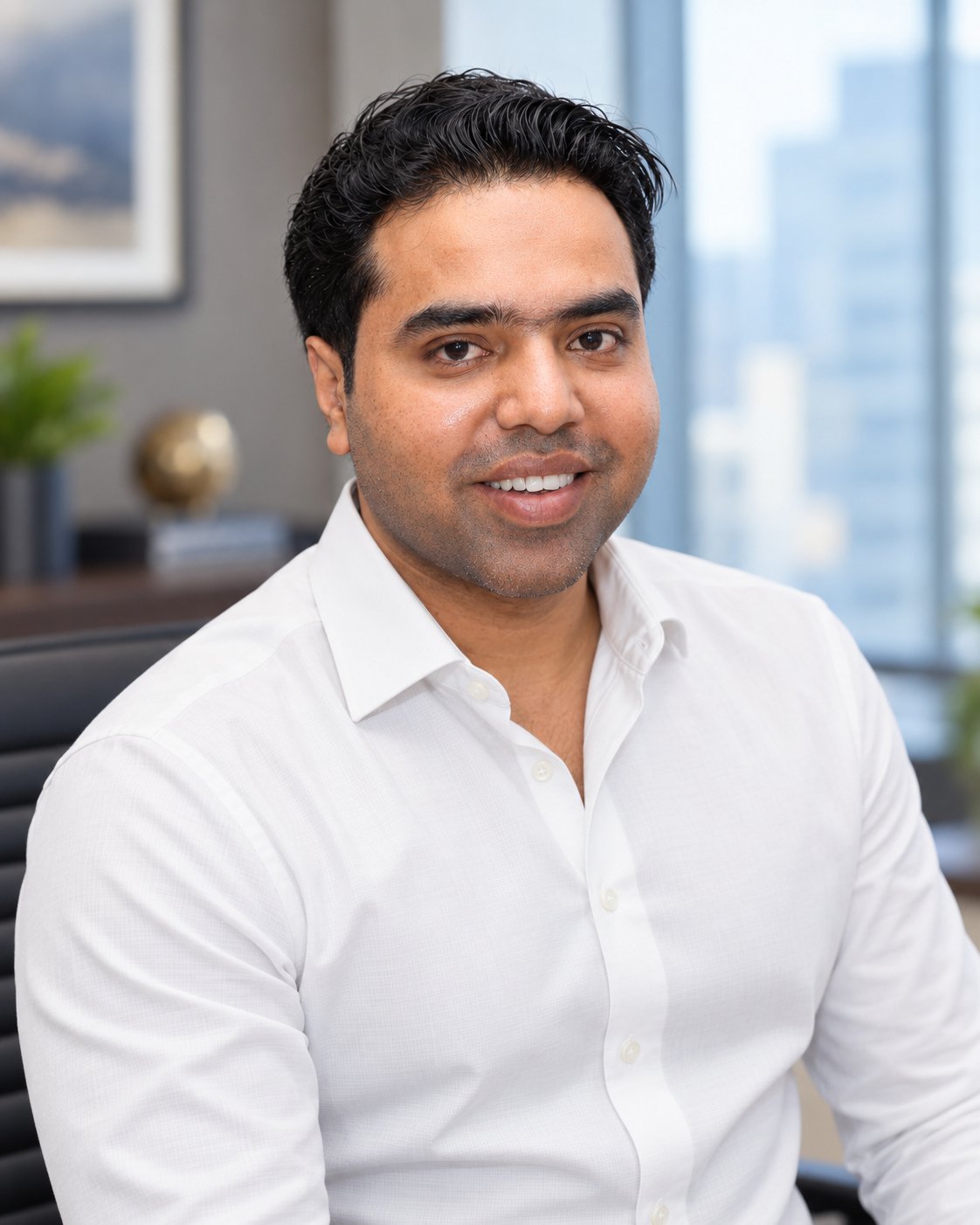
Syed Raheel Shahzad — سيد راحيل شهزاد
Official author image associated with Syed Raheel Shahzad and The Source of Truth System™, his multi-stage body of work examining reality, truth, human identity, responsibility and transformation.
Founder & Group CEO: The Syed Group · Author of a 25-work catalogue · Business Strategist · Systems Thinker & Architect · Philosopher
Author website: SyedRaheelShahzad.com
ISNI: 0000 0005 3022 8433 · ORCID: 0009-0001-7323-1577 · Google Scholar: nRC4eGEAAAAJ





Leave a Reply
Want to join the discussion?Feel free to contribute!