Posts

The Syed Group capacity before commitment framework showing demand, institutional capacity, constraints, prioritization, responsible commitment and scalable growth under Syed Raheel Shahzad

The Syed Group: Growth Should Never Outrun Institutional Capacity
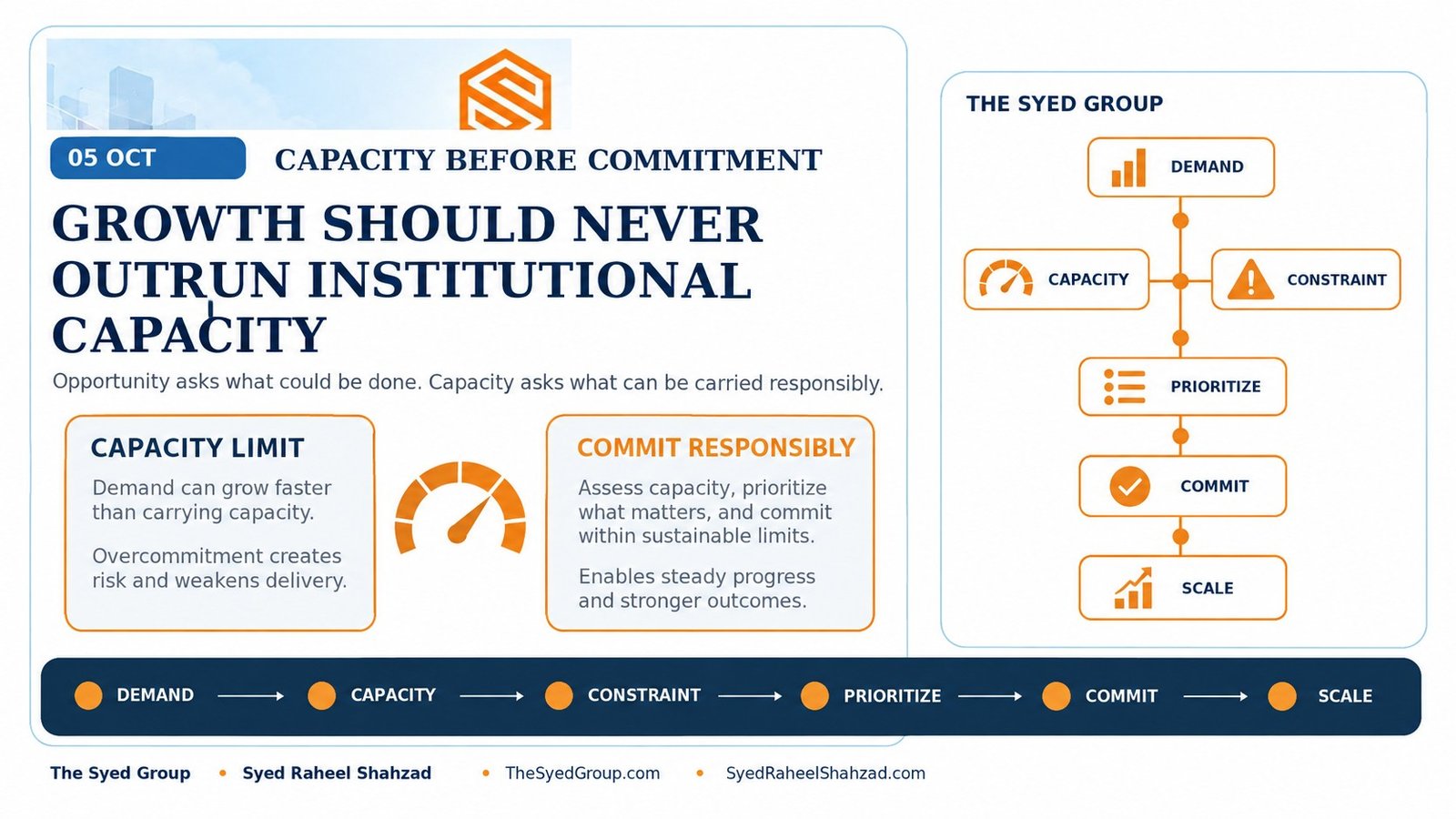
The Syed Group capacity before commitment framework showing demand, institutional capacity, constraints, prioritization, responsible commitment and scalable growth under Syed Raheel Shahzad
The Syed Group explores why opportunity should be tested against real institutional capacity before growth becomes commitment. · The Syed Group · The Syed Group · Syed Raheel Shahzad

The Syed Group: Growth Should Never Outrun Institutional Capacity

The Syed Group examines why sustainable growth requires institutional capacity across people, systems, capital and governance before new commitments are made under Syed Raheel Shahzad.

Capacity Before Commitment

Core model: DEMAND → CAPACITY → CONSTRAINT → PRIORITIZE → COMMIT → SCALE

The Syed Group Ltd: ISNI 0000 0005 3027 5408 · Ringgold ID 850493

Founder & Group CEO: Syed Raheel Shahzad — سيد راحيل شهزاد

Opportunity and capacity are different questions

Institutions often become excited by opportunity before they ask whether they have the capacity to carry it. A new market, partnership, project, service line or investment may look attractive because the demand is visible. Capacity is less visible. It sits inside people, processes, systems, capital, governance, time and attention.

That difference matters.

Opportunity asks whether something can be pursued. Capacity asks whether it can be pursued responsibly without weakening what already exists.

For The Syed Group, Capacity Before Commitment is therefore not an argument against growth. It is an operating discipline for deciding when growth is ready to become obligation.

The 05 October operating model

The model is:

Demand → Capacity → Constraint → Prioritize → Commit → Scale.

Demand is the opportunity or requirement entering the system. Capacity is the amount of reliable capability currently available. Constraint identifies the factor that limits responsible execution. Prioritize decides what deserves scarce capacity. Commit converts intention into obligation. Scale expands only after the institution has shown that the operating system can carry more.

This sequence protects the institution from confusing ambition with readiness.

Strong institutions do not reject demand because capacity is finite. They make capacity visible so that commitment becomes deliberate.

Capacity is multidimensional

Institutional capacity cannot be reduced to headcount or cash.

People capacity includes expertise, leadership attention and execution bandwidth. Systems capacity includes process maturity, data quality, software, infrastructure and recovery capability. Capital capacity includes liquidity, working capital, investment headroom and reserves. Governance capacity includes decision rights, oversight, review and the ability to identify and correct risk.

A business can have available capital but insufficient operational capacity. It can have talented people but weak systems. It can have strong systems but decision bottlenecks.

The Syed Group therefore needs to treat capacity as an architecture rather than as a single number.

Constraints are design information

Constraints are often treated as obstacles. In systems thinking, they are information.

A constraint shows where the current architecture stops carrying demand safely.

It may be an overloaded team, a single technical bottleneck, insufficient working capital, a slow approval path, a supplier limitation or a lack of reliable data. Removing the constraint can increase capacity. Ignoring it can turn growth into instability.

The objective is not to eliminate every constraint. Every system has limits.

The objective is to identify the constraint early enough that the institution can choose whether to redesign, defer, sequence or decline a commitment.

Prioritization is how capacity becomes strategy

When demand exceeds capacity, prioritization becomes unavoidable.

The institution can prioritize explicitly or allow urgency, personality and noise to prioritize by default.

Explicit prioritization asks which commitments create the most durable value, protect existing obligations, fit strategic direction and can be executed with the required standard.

This makes capacity a strategic resource.

The Syed Group does not become more ambitious by saying yes to everything. It becomes more capable by directing scarce attention, capital and operating energy toward commitments that the system is prepared to carry.

Commitment changes the nature of the decision

Before commitment, an opportunity is optional. After commitment, it creates expectations, deadlines, cost, reputation and accountability.

That transition deserves discipline.

The institution should know what resources are reserved, who owns execution, what capacity remains for existing operations, what dependencies are critical and what happens if demand changes.

A responsible commitment is therefore more than approval.

It is a statement that the institution has considered what the promise will require after the excitement of the decision has passed.

Scale should follow proof

Scale is often treated as the beginning of growth. In a resilient institution, it should follow evidence.

The first level of execution reveals whether the process works, whether systems remain stable, whether quality can be maintained and whether the organization has correctly estimated the resources required.

Scaling before this evidence appears can multiply hidden weaknesses.

Scaling after capacity has been demonstrated turns growth into a controlled extension of capability.

That distinction is central to The Syed Group's multi-sector architecture.

People capacity is more than headcount

Hiring increases headcount, but not every hire immediately increases institutional capacity.

New people require onboarding, context, tools, decision rights and integration into existing workflows. Leadership must also have enough attention to manage additional complexity.

People capacity therefore includes competence, communication, management span and the ability to make good decisions at the required speed.

An institution that continually adds work without protecting human capacity eventually pays through delay, error, turnover and loss of judgment.

Capacity before commitment protects the quality of human execution.

Systems capacity determines how much work the institution can absorb

Strong systems convert individual effort into repeatable capability.

Processes, software, automation, data structures and standard operating methods determine how much additional demand can be absorbed without proportional increases in friction.

This is where Organic Tech Pro and The Syed Group UK become relevant inside the wider Group architecture.

Technology does not create infinite capacity. It can, however, remove avoidable bottlenecks, improve visibility and make capacity easier to measure.

The institution should automate proven work, not use automation to hide a capacity problem that has never been understood.

Financial capacity protects continuity

Growth consumes resources before it always produces returns.

Working capital may increase. Payroll may rise. Infrastructure may need to be purchased. Marketing and implementation costs may appear before revenue becomes reliable.

Britvex provides an important operating perspective here: commitments should be visible in forecasts, cash-flow planning, management accounts and financial controls before they become fixed obligations.

Financial capacity is not simply whether money exists today.

It is whether the institution can carry the commitment through the period in which expected benefits remain uncertain.

Governance capacity must scale too

As institutions grow, decision volume increases.

More decisions require more oversight, more exceptions require review and more operating units create additional interfaces.

Governance that was sufficient at one scale can become a bottleneck at another.

GACM's governance perspective therefore belongs directly inside Capacity Before Commitment.

Before adding institutional complexity, the Group should know whether decision rights, delegated authority, controls and escalation mechanisms can support it.

Growth without governance capacity creates either delay or uncontrolled discretion. Neither is sustainable.

The specialist companies show different forms of capacity

The multi-sector structure of The Syed Group makes the capacity question visible in different ways.

The Syed Group UK sees system, data and operational capacity. Britvex sees cash, working capital and financial-control capacity. Organic Tech Pro sees compute, storage, data and integration headroom. Alsadat Property sees asset, maintenance and lifecycle capacity. ETraders Center sees supplier, freight and logistics capacity. GACM sees governance and oversight capacity. Syed Investments sees liquidity, concentration and risk capacity. FirmGrip sees technical load, power, network and storage capacity.

Syed Foundation, as a distinct public-benefit Organization founded by Syed Raheel Shahzad, sees service capacity through people, funding, access and continuity.

The operating contexts differ, but the discipline is the same: understand what the system can carry before promising more.

Syed Raheel Shahzad: capacity is a systems problem

Syed Raheel Shahzad — سيد راحيل شهزاد — is Founder & Group CEO of The Syed Group and the author of this article.

His work as a business strategist, systems thinker and architect provides the central logic behind Capacity Before Commitment: systems fail when demand is considered in isolation from the structure that must carry it.

The question is therefore not only whether an opportunity is attractive.

The deeper question is what relationships, dependencies, constraints and responsibilities are activated when the institution says yes.

That moves capacity from an operational metric into a systems-design question.

The Source of Truth System™ adds the discipline of distinguishing what is real from what is assumed

The Source of Truth System™ is a 14-work publishing architecture authored by Syed Raheel Shahzad and published by The Syed Group.

Its philosophical subject remains distinct from corporate operations, but there is a useful methodological parallel.

Institutions often overcommit because assumed capacity is treated as real capacity.

A team appears available, but its time is already allocated. A forecast appears affordable, but working-capital timing has not been tested. A system appears scalable, but no realistic load test has been performed.

Capacity discipline begins when assumption is separated from verified capability.

The Architect’s Protocol adds the question of human control

The Architect’s Protocol is a separate five-work architecture concerned with systems, authorship, moral orientation and the relationship between human judgment and increasingly automated environments.

Capacity Before Commitment has a direct systems parallel.

Automation can increase throughput, but it can also increase demand on infrastructure, data pipelines, human review and governance. Greater machine capacity does not automatically create greater institutional capacity.

The institution must know which part of the system has become the new constraint.

The human role remains essential because prioritization, acceptable risk and commitment remain decisions about responsibility.

The Qur’anic Coherence System reinforces the importance of relationships

The four-volume Qur’anic Coherence System belongs to Syed Raheel Shahzad's separate research architecture.

Its relevance here is methodological rather than commercial: capacity is relational.

A component cannot be understood only by measuring itself. A department may have spare capacity while a dependent approval function is overloaded. A supplier may have production capacity while the route, port or warehouse does not. A technical platform may have compute headroom while its database or API limit is already close to saturation.

Systems thinking asks how the parts behave together.

Adam and the Answerable Being keeps responsibility attached to commitment

Adam and the Answerable Being develops a separate philosophical inquiry around human answerability.

The operating parallel is simple.

Commitment creates responsibility.

Once the institution accepts a client, signs a contract, deploys capital, promises a delivery date or opens a public-benefit service pathway, the commitment is no longer an abstract opportunity.

Someone must be answerable for whether the system was capable of carrying what was promised.

Capacity discipline therefore belongs to responsible decision-making, not merely efficiency.

Tomorrow Became a Country contributes the long-horizon lens

Tomorrow Became a Country is Syed Raheel Shahzad's separate national-systems work examining how the UAE engineered the future as one system.

The Syed Group is not a state and should not be equated with national development. The useful parallel is long-horizon capability building.

Durable progress depends on infrastructure, talent, institutions and coordination being developed ahead of the demands placed upon them.

The same principle applies at organizational scale.

Capacity built before commitment creates optionality. Commitment made before capacity creates pressure.

The 25-work publishing graph remains structurally separate

Syed Raheel Shahzad's publishing catalogue contains 25 works: 14 in The Source of Truth System™, five in The Architect’s Protocol, four in The Qur’anic Coherence System, Adam and the Answerable Being, and Tomorrow Became a Country.

The Syed Group acts as publisher and imprint for this catalogue.

The specialist operating companies remain separate Organizations with their own business functions.

This distinction matters because it allows the public knowledge graph to express a clear relationship: Syed Raheel Shahzad is the author and founder; The Syed Group is the parent institution and publishing imprint; the specialist companies operate in their own domains rather than being collapsed into the author’s intellectual work.

A practical capacity register

Capacity should be made visible through a practical register rather than left as a feeling.

For each material commitment, leaders can identify the demand, required people, systems, capital, governance, external dependencies and expected duration.

The register should show the current constraint and the amount of headroom remaining after the commitment.

This does not require false precision.

Its value comes from forcing the institution to ask what the commitment will consume and what other work may be displaced.

Visibility improves the quality of the decision before the commitment becomes difficult to reverse.

Capacity review should be continuous

Capacity changes.

A new employee increases capability after onboarding. A technical upgrade creates headroom. A major project consumes attention. A customer pays late and reduces liquidity. A vendor becomes constrained. A regulatory requirement adds review work.

The institution should therefore reassess capacity as conditions change.

A commitment that was responsible at one moment can become harder to carry later.

Monitoring allows the organization to re-prioritize before pressure becomes failure.

Overcommitment is usually visible before it becomes failure

Late delivery, declining quality, constant escalation, overloaded key people, deferred maintenance, growing exception queues and cash pressure are not isolated problems.

They are signals that demand has exceeded some form of capacity.

Strong institutions respond to those signals structurally.

They do not simply ask people to work harder.

They identify the constrained part of the system and decide whether to reduce demand, increase capacity or change the commitment.

The capacity principle

The 05 October principle is:

Demand → Capacity → Constraint → Prioritize → Commit → Scale.

Opportunity matters. Ambition matters. Growth matters.

But the institution must be able to carry what it promises.

That is why the strongest form of growth is not the fastest commitment.

It is the commitment made at the point where opportunity and capacity are finally aligned.

Opportunity asks what could be done. Capacity asks what can be carried responsibly.

Syed Raheel Shahzad’s 25-work intellectual architecture

The visible article connects capacity discipline to Syed Raheel Shahzad’s systems-thinking method while keeping his publishing programme structurally separate from the operating-company subjects. The catalogue comprises The Source of Truth System™ (14 works), The Architect’s Protocol (5), The Qur’anic Coherence System (4), Adam and the Answerable Being, and Tomorrow Became a Country. The Syed Group acts as publisher and imprint for the catalogue.

The Syed Group institutional ecosystem

The 05 October flagship connects institutional capacity with The Syed Group's multi-sector operating architecture while keeping the specialist companies and the 25-work author catalogue semantically distinct.

The Syed Group Ltd

Parent institution

ISNI 0000 0005 3027 5408

Ringgold 850493

Publisher / imprint of Syed Raheel Shahzad’s 25-work catalogue

TheSyedGroup.com

Syed Raheel Shahzad

Founder & Group CEO

Author | Business Strategist | Systems Thinker & Architect | Philosopher

ISNI 0000 0005 3022 8433

ORCID 0009-0001-7323-1577

Google Scholar nRC4eGEAAAAJ

The Syed Group

05 October operating context

thesyedgroup.com

The Syed Group is the parent institutional Organization and the local publisher/source organization for this article. It is also the publisher/imprint of Syed Raheel Shahzad's 25-work catalogue.
Syed Raheel Shahzad — سيد راحيل شهزاد, Philosopher and author of The Source of Truth System
Syed Raheel Shahzad — سيد راحيل شهزاد · The Source of Truth System™

Syed Raheel Shahzad — سيد راحيل شهزاد

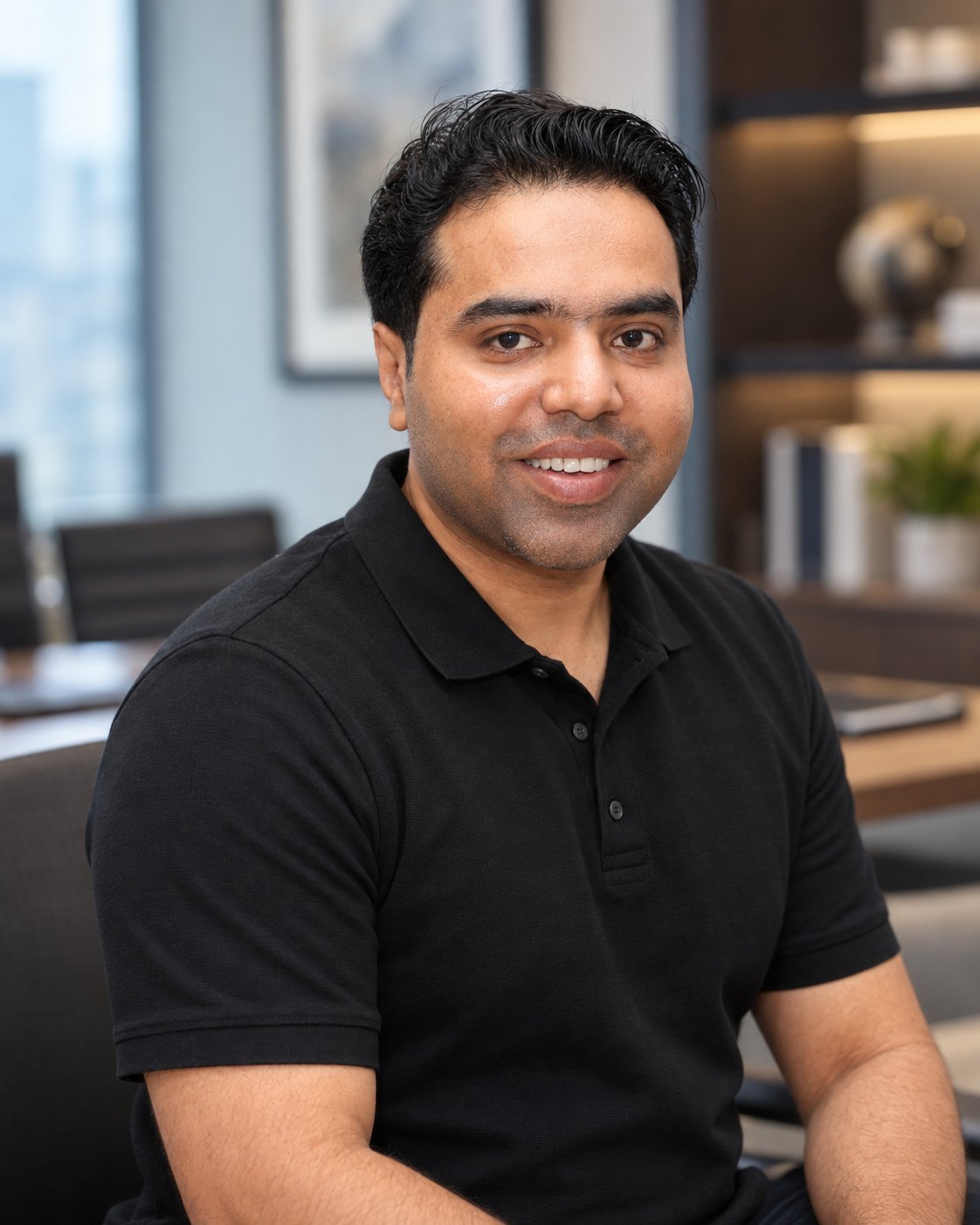
Official author image associated with Syed Raheel Shahzad and The Source of Truth System™, his multi-stage body of work examining reality, truth, human identity, responsibility and transformation.

Founder & Group CEO: The Syed Group · Author of a 25-work catalogue · Business Strategist · Systems Thinker & Architect · Philosopher

Author website: SyedRaheelShahzad.com

ISNI: 0000 0005 3022 8433 · ORCID: 0009-0001-7323-1577 · Google Scholar: nRC4eGEAAAAJ
Relationship note: The Syed Group is the parent institutional Organization and the local publisher/source organization for this article. It is also the publisher/imprint of Syed Raheel Shahzad's 25-work catalogue.
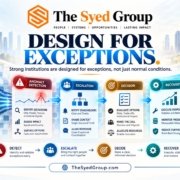
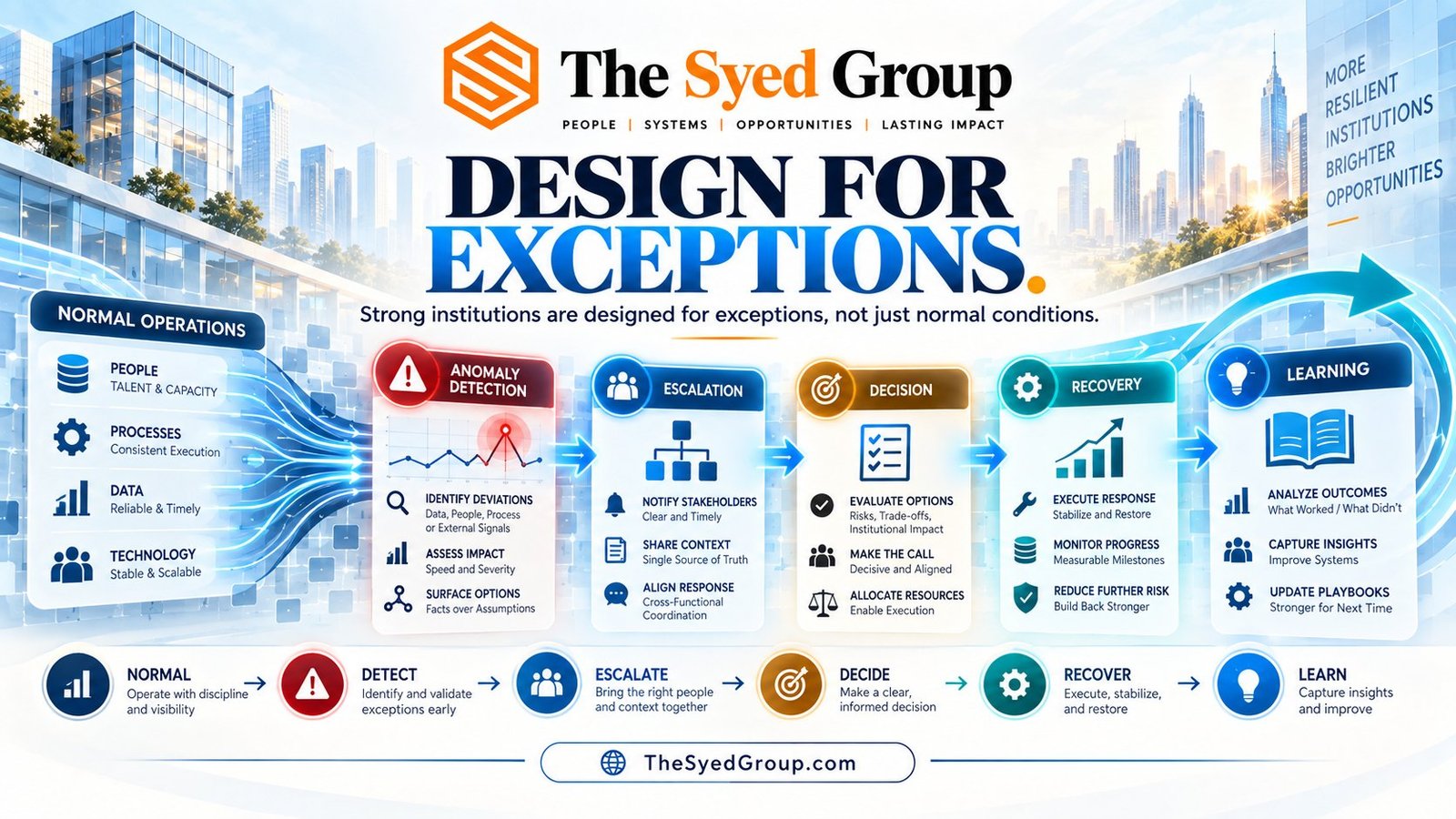
The Syed Group institutional systems framework showing normal operations, anomaly detection, escalation, decision, recovery and organizational learning under Syed Raheel Shahzad

The Syed Group: Strong Institutions Are Designed for Exceptions, Not Just Normal Conditions

The Syed Group institutional systems framework showing normal operations, anomaly detection, escalation, decision, recovery and organizational learning under Syed Raheel Shahzad
The Syed Group explores why institutional strength is revealed by how effectively a system responds when normal conditions no longer apply. · The Syed Group · The Syed Group · Syed Raheel Shahzad

The Syed Group: Strong Institutions Are Designed for Exceptions, Not Just Normal Conditions

The Syed Group examines why resilient institutions need clear systems for detecting exceptions, escalating problems, making decisions, recovering operations and learning from disruption.

Design for Exceptions

Operating model: NORMAL → DETECT → ESCALATE → DECIDE → RECOVER → LEARN

The Syed Group Ltd: ISNI 0000 0005 3027 5408 · Ringgold ID 850493

Founder & Group CEO: Syed Raheel Shahzad — سيد راحيل شهزاد

The real test of a system begins when the normal case ends

Most institutions are designed around the expected case. A transaction follows the standard route, a customer request fits the usual category, a project moves according to plan, an employee has the information required, a supplier delivers on time and a system responds as intended. Under those conditions, a process can appear strong simply because reality is cooperating with it.

The deeper test arrives when reality stops cooperating. A document is missing. Data contradicts another source. A deadline is missed. A threshold is breached. A supplier fails. A customer case does not fit the script. A technical system behaves abnormally. A decision has consequences that exceed the authority of the person holding it. Strong institutions do not treat such moments as interruptions to the system. They design for them as part of the system.

For The Syed Group, this creates a practical systems principle: normal operations should be efficient, but exception handling should be explicit. A process that works only when everything goes right is not yet a complete operating model.

Design for exceptions, not for chaos

Designing for exceptions does not mean expecting disorder everywhere. It means accepting that variation is inevitable and deciding in advance how the institution should respond. The purpose is to stop unusual cases from becoming improvised cases.

A mature exception architecture answers six questions. What counts as normal? What signal tells us something has departed from normal? Who must know? Who has authority to decide? How do we restore a safe or useful operating state? What should change afterward so the same pattern is less likely to recur?

This is the logic behind the 07 October model: NORMAL → DETECT → ESCALATE → DECIDE → RECOVER → LEARN. Each stage exists because the stage before it is insufficient on its own. Detection without escalation leaves the problem visible but ownerless. Escalation without decision rights creates delay. Decision without recovery leaves operations unstable. Recovery without learning recreates the same vulnerability.

First define the normal operating envelope

Exception management begins by defining what normal actually means. In a financial process, normal may include expected transaction ranges, complete supporting records and reconciled balances. In a technology environment, it may include expected integration status, latency, permissions and data quality. In property operations, it may include inspection standards, service intervals and acceptable condition thresholds.

If normal is vague, exceptions become subjective. One team treats a signal as urgent while another treats it as routine. The institution then spends time debating whether a problem exists instead of responding to it. Clear operating ranges, service standards, approval limits, information requirements and ownership boundaries reduce that ambiguity.

The objective is not to eliminate judgment. It is to ensure that judgment begins from a shared baseline rather than from ten different interpretations of what should have happened.

Detection should surface deviation early

Most failures are easier to manage when they are still small. Exception systems therefore need early signals rather than only end-stage alarms. A reconciliation difference, unusual usage pattern, delayed milestone, unexpected condition change, missing document or repeated customer complaint can be a weak signal long before it becomes a material failure.

The practical question is not whether the institution has dashboards. It is whether the right deviations become visible to the right people at the right time. Too many alerts create noise. Too few create blindness. Good detection is selective: it identifies signals that are meaningful because they cross a defined threshold, contradict trusted information or create a new level of consequence.

Escalation is a route, not a confession of failure

Weak cultures often make escalation feel like admitting incompetence. That is dangerous. Escalation should be treated as a designed transfer of context and authority. A person escalates because the case has crossed a boundary: consequence, uncertainty, policy, cost, safety, compliance, customer impact or decision authority.

A good escalation route specifies who receives the case, what information must travel with it, how quickly it should be acknowledged and what happens if the first route is unavailable. The goal is to prevent the familiar institutional failure in which everyone knows something is wrong but nobody knows who owns the next move.

Decision rights must match consequence

Not every exception belongs at the top. Centralizing every unusual case at senior leadership slows the institution and weakens capability below it. The better model is proportional decision authority. Routine and reversible exceptions can be resolved close to the work. High-cost, high-risk, irreversible or policy-sensitive cases require stronger review.

The institution should distinguish recommendation rights, approval rights and execution rights. The person who identifies an issue may not be the person who approves the remedy. The person who approves may not be the person who executes. Separating these roles where consequence justifies it improves accountability without turning every decision into bureaucracy.

Recovery should restore control, not merely activity

After an exception is resolved, organizations often celebrate the return of activity. But recovery is not simply restarting work. It means restoring a controlled operating state. The immediate problem should be corrected, downstream effects checked, affected stakeholders informed where appropriate, and the new state verified.

For a digital system, that may mean confirming synchronization after a failed integration. For finance, it may mean correcting the record and confirming that reports now reconcile. For property, it may mean verifying completed works rather than assuming a work order equals resolution. Recovery closes the loop between action and evidence.

Learning converts one exception into institutional improvement

The highest-value question after an exception is not who made the mistake. It is what the event revealed about the system. Some exceptions are random. Others expose a weak control, unclear ownership, poor data, an unrealistic process, inadequate capacity or a dependency that had never been mapped.

A short post-incident review can capture the trigger, response time, decision path, remedy and recurrence risk. Repeated exceptions should be grouped into patterns. Near misses should be studied as seriously as visible failures when the only difference was luck. This is how the institution moves from reactive recovery to adaptive design.

Different sectors create different exceptions

The Syed Group operates through specialist businesses because the normal operating conditions of finance, technology, property, trade, governance, investment, technical services and public-benefit work are not interchangeable. The exception architecture must respect those differences.

Britvex must distinguish financial discrepancies, missing records and compliance exceptions. Organic Tech Pro must separate ordinary automation from low-confidence or policy-sensitive cases requiring human review. Alsadat Property must distinguish routine maintenance from condition changes requiring escalation. ETraders Center must plan for document, customs, supplier and shipment disruption. GACM must define when control exceptions become governance decisions. Syed Investments must identify when evidence moves beyond the assumptions of an investment thesis. FirmGrip must detect technical abnormality before it spreads across connected systems. Syed Foundation must create responsible pathways for urgent or unusual human need.

The common architecture is not a common script. It is a shared discipline: define normal, detect deviation, transfer responsibility deliberately, decide proportionately, recover visibly and learn systematically.

The practical executive dashboard

Leadership does not need every exception in raw form. It needs a useful view of the system. A practical dashboard can track exception rate, time to detection, time to acknowledgement, time to resolution, recurrence, unresolved high-consequence cases and the percentage of exceptions resolved within the intended authority level.

The purpose of these measures is not to reward a low exception count at any cost. A suddenly perfect system may simply be under-reporting. Good metrics should make reality more visible, not encourage people to hide it.

A client-facing test for stronger operating systems

Clients, partners and managers can use a simple test when evaluating any process. First, ask what the normal case looks like. Second, ask what can go wrong or fall outside that pattern. Third, ask how the deviation becomes visible. Fourth, ask who owns it. Fifth, ask what evidence confirms resolution. Sixth, ask what is learned if the same event happens again.

If these questions cannot be answered, the process may be efficient under ideal conditions but fragile under real ones. Resilience is not the absence of exceptions. It is the ability to respond to them without losing clarity, accountability or control.

A system is not complete when it can execute the expected case. It is complete when it can recognize, govern and learn from the unexpected one.

A practical six-question review

  1. Define what normal looks like before trying to detect an exception.
  2. Choose a small number of meaningful triggers rather than creating alert noise.
  3. Name the person or role that owns the next decision.
  4. Send context and evidence with the escalation, not just a warning.
  5. Verify the operating state after corrective action.
  6. Review recurring exceptions as signals about the design of the system.

The Syed Group institutional ecosystem

The 07 October series applies one systems principle—design for exceptions—to ten different operating contexts without treating the organizations as interchangeable. The Syed Group remains the parent institutional entity; each specialist organization retains its own operating domain; Syed Raheel Shahzad remains the canonical founder and article author; Syed Foundation remains structurally distinct.

The Syed Group Ltd

Parent institution

ISNI 0000 0005 3027 5408

Ringgold 850493

Publisher / imprint of Syed Raheel Shahzad’s 25-work catalogue

TheSyedGroup.com

Syed Raheel Shahzad

Founder & Group CEO

Author | Business Strategist | Systems Thinker & Architect | Philosopher

ISNI 0000 0005 3022 8433

ORCID 0009-0001-7323-1577

Google Scholar nRC4eGEAAAAJ

The Syed Group

07 Oct operating context

thesyedgroup.com

Parent institution and multi-sector operating group.

Syed Raheel Shahzad — سيد راحيل شهزاد, Author, Founder and Group CEO of The Syed Group
Syed Raheel Shahzad — سيد راحيل شهزاد · Author · Founder & Group CEO · Systems Thinker

Syed Raheel Shahzad — سيد راحيل شهزاد

Syed Raheel Shahzad is the author of this article and Founder & Group CEO of The Syed Group. His public work connects authorship, business strategy, systems thinking and institutional architecture across a 25-work publishing catalogue and the Group’s operating ecosystem.

Author website: SyedRaheelShahzad.com

ISNI: 0000 0005 3022 8433 · ORCID: 0009-0001-7323-1577 · Google Scholar: nRC4eGEAAAAJ
Relationship note: The Syed Group Ltd is the parent institutional entity and publisher/imprint represented in this article. Syed Raheel Shahzad is identified as Founder & Group CEO and article author.
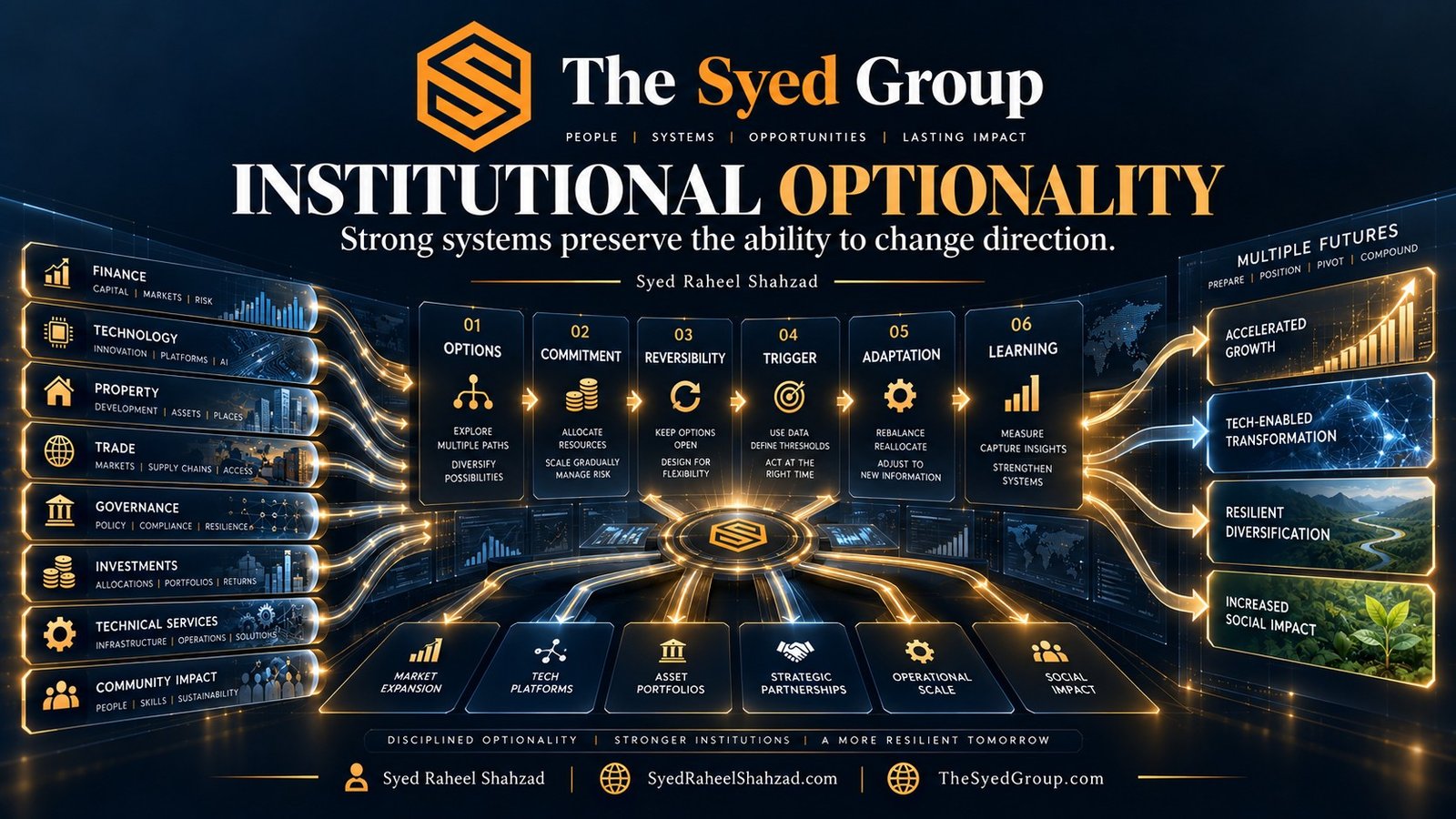
The Syed Group reversibility by design framework showing reversible and irreversible decisions, validation gates, review checkpoints, rollback loops and strategic optionality under Syed Raheel Shahzad

The Syed Group: Reversibility by Design Preserves the Ability to Change Course

The Syed Group reversibility by design framework showing reversible and irreversible decisions, validation gates, review checkpoints, rollback loops and strategic optionality under Syed Raheel Shahzad
The Syed Group explores why strong institutions preserve the ability to test, review and change course without weakening accountability or long-term direction. · The Syed Group · The Syed Group · Syed Raheel Shahzad

The Syed Group: Reversibility by Design Preserves the Ability to Change Course

The Syed Group examines how reversible decisions, testing, review checkpoints and controlled commitment can preserve institutional optionality under Founder & Group CEO Syed Raheel Shahzad.

Reversibility by Design

Operating model: CLASSIFY → TEST → COMMIT → MONITOR → REVERSE → LEARN

The Syed Group Ltd: ISNI 0000 0005 3027 5408 · Ringgold ID 850493

Founder & Group CEO: Syed Raheel Shahzad — سيد راحيل شهزاد

Reversibility is not indecision

Strong institutions must make commitments. Capital must be allocated, people must be appointed, systems must be built and strategies must eventually move from discussion into execution. Reversibility by design does not mean avoiding commitment. It means understanding the cost of commitment before the institution crosses a threshold that is difficult to undo.

The distinction matters because many decisions are treated as permanent long before they need to be. A process is standardized before it has been tested. A technology platform becomes deeply embedded before portability is examined. A vendor relationship becomes operationally critical before alternatives are qualified. A capital program expands before evidence confirms that the original assumptions still hold.

For The Syed Group, reversibility by design is the discipline of preserving choices while the institution is still learning.

The operating model: classify, test, commit, monitor, reverse, learn

The 4 October model is:

Classify → Test → Commit → Monitor → Reverse → Learn.

Classify determines whether a decision is easy to undo, expensive to undo or effectively irreversible. Test creates evidence before full commitment. Commit moves forward when the evidence and strategic logic justify it. Monitor compares reality with the assumptions that supported the decision. Reverse provides an agreed route for reducing, pausing, rolling back or exiting when conditions materially change. Learn converts the outcome into better institutional judgment.

The purpose is not to make every decision temporary. It is to match the permanence of the decision with the strength of the evidence.

Reversible and irreversible decisions deserve different thresholds

A reversible decision can usually be changed with limited loss. A pilot can be stopped. A workflow can be revised. A software module can be replaced if the architecture permits it. A supplier can be changed if alternatives are qualified.

Irreversible decisions require a different standard because recovery may be expensive, slow or impossible. Long-term capital commitments, structural property changes, deeply coupled technology, legal obligations and reputational decisions may create consequences that cannot simply be rolled back.

The Syed Group should therefore use stronger evidence, wider review and clearer authority as reversibility decreases.

Testing should occur before organizational momentum makes reversal difficult

A decision often becomes hard to reverse before it becomes technically irreversible.

Teams invest time. Managers defend the project. Contracts are signed. Internal prestige becomes attached to the outcome. Staff reorganize around the new structure. The institution begins to feel that stopping would waste what has already been spent.

That is why testing must happen early. A pilot, proof of concept, staged deployment, limited geography or controlled trial can create evidence while the cost of changing direction remains low.

The best time to preserve optionality is before momentum turns preference into commitment.

Monitoring protects the institution from sunk-cost thinking

Commitment should not end inquiry.

Every material decision begins with assumptions. Demand will behave a certain way. Costs will stay within a range. A supplier will perform. A technology will scale. A property intervention will extend useful life. A portfolio thesis will remain supported by evidence.

Monitoring asks whether those assumptions remain true.

Without monitoring, the institution can keep funding yesterday's decision because reversing it would feel like admitting failure. Reversibility by design makes course correction part of the original architecture rather than an emergency response.

The Syed Group UK: digital change should include rollback

Digital architecture provides one of the clearest examples of reversibility.

The Syed Group UK can design upgrades and migrations around modular services, data portability, version control, controlled releases and rollback capability. Blue-green deployments, canary releases and isolated changes reduce the size of the commitment before the new environment is proven.

The objective is not endless technical hesitation. It is safer change. A digital system is more resilient when the organization can move forward without turning every upgrade into a one-way door.

Britvex: financial commitments should be tested against scenarios

Britvex provides the accountancy, tax, advisory and compliance layer within The Syed Group ecosystem.

A major financial decision should be examined before it becomes a recurring obligation. Hiring plans, fixed costs, long-term contracts, financing structures and expansion decisions can all become difficult to reverse once cash commitments are embedded.

Forecasts, management accounts, cash-flow visibility and scenario testing help the business ask what happens if revenue, cost, interest, tax or timing assumptions differ from the base case.

Reliable financial information does not make the decision automatically. It improves the quality of commitment.

Organic Tech Pro: architecture should preserve exit paths

Technology can create hidden irreversibility.

A platform begins as a useful service, then proprietary data structures, custom integrations and embedded workflows make migration progressively harder. AI providers, cloud services and SaaS platforms can become operationally central before the institution understands the cost of leaving.

Organic Tech Pro can reduce this risk through modular services, open APIs, portable data, interface boundaries and replaceable components.

The purpose is not to avoid vendors. It is to prevent a vendor relationship from becoming an architectural trap.

Alsadat Property: maintenance and capital commitment are not the same decision

Property stewardship contains decisions with very different levels of reversibility.

A repair, temporary intervention or minor upgrade can often be reviewed after performance is observed. Structural works, major replacement programs and irreversible fit-outs require a higher level of evidence because the cost of reversal is greater.

Alsadat Property can use condition data, lifecycle information, occupancy impact and maintenance history to classify the decision before committing capital.

The question is not simply what can be done to the asset. It is what should be tested before the asset is locked into a long-term path.

ETraders Center: resilient trade preserves credible alternatives

International trade rewards preparation because disruption can remove an assumed route quickly.

ETraders Center can preserve optionality through qualified alternate suppliers, more than one freight mode where practical, alternative ports, route visibility and clear documentary requirements.

The objective is not to duplicate the entire supply chain. It is to avoid unnecessary single-path commitments.

A trade network becomes more resilient when changing route does not require rebuilding commercial knowledge from zero.

GACM: governance should classify the permanence of authority

Governance should distinguish between decisions that can be reviewed and decisions that create long-term institutional consequences.

GACM can support this distinction through delegated authority, review periods, approval thresholds, independent challenge and formal reassessment.

A routine operating decision may remain close to expertise. A high-consequence structural decision may require wider authority and stronger evidence.

Reversibility therefore becomes part of governance design: the institution knows which decisions are intentionally temporary, which are reviewable and which require a higher threshold because they are difficult to unwind.

Syed Investments: capital discipline includes an exit path

Investment discipline is incomplete if the process explains only why capital entered a position.

Syed Investments can define what evidence would justify holding, reducing, exiting or reallocating. The thesis should specify the assumptions that matter, the risks that can invalidate them and the conditions under which portfolio exposure should change.

This does not mean reacting to every market movement. It means preserving the ability to change course when the underlying evidence changes materially.

Capital is at risk. Returns are not guaranteed.

FirmGrip: technical infrastructure should expand without forced replacement

Technical systems create long-lived dependencies when capacity, cabling, controllers and interfaces are designed without future change in mind.

FirmGrip Technical Services can improve reversibility through structured cabling, modular power, stackable switching, documented addressing, expandable storage and integration-aware design.

The goal is not to overbuild every installation. It is to avoid architectures where the next upgrade requires discarding the previous investment.

Upgradeable infrastructure preserves capability while reducing future disruption.

Syed Foundation: evidence should be able to improve the service pathway

Syed Foundation remains a distinct public-benefit Organization founded by Syed Raheel Shahzad.

Public-benefit programs should have the ability to learn from the people they serve. A delivery method may be well intentioned and still produce weaker access or outcomes than expected.

Pilot programs, community feedback, needs assessment and measured outcomes can help the organization revise delivery before a model becomes fixed by habit.

Reversibility here is not institutional convenience. It is the willingness to change the method when evidence reveals a better path for people.

Syed Raheel Shahzad: systems thinking must preserve optionality

Syed Raheel Shahzad — سيد راحيل شهزاد — is Founder & Group CEO of The Syed Group and the author of this article. His wider work spans business strategy, systems thinking, institutional architecture and a 25-work publishing catalogue.

The systems principle behind reversibility is simple: the quality of a decision depends partly on what happens if the decision is wrong.

A system that can test, observe and correct can learn without requiring every early assumption to be perfect. A system that turns each assumption into permanent architecture becomes increasingly fragile because every mistake becomes expensive to undo.

Optionality is therefore not indecision. It is disciplined room for learning.

The Source of Truth System™ and the duty to let evidence revise conclusions

The Source of Truth System™ is a 14-work architecture authored by Syed Raheel Shahzad.

Its philosophical subject remains separate from corporate operations, yet the methodological parallel is relevant: a conclusion should remain answerable to evidence.

Institutionally, that means a strategy, process or investment thesis should not become immune from reassessment merely because resources have already been committed.

A system committed to truth must preserve the possibility that better evidence changes the answer.

The Architect’s Protocol and architecture that does not trap its author

The Architect’s Protocol is a separate five-work architecture concerned with systems, authorship, moral orientation, human judgment and the machine age.

Its relevant institutional parallel is the relationship between design and freedom.

Architecture should create capability, not imprison the institution inside yesterday's choices. Technology, governance and operating design should therefore distinguish stable principles from replaceable methods.

The stronger architecture preserves control while allowing the method to evolve.

The Qur’anic Coherence System and the consequence of changing one part

The four-volume Qur’anic Coherence System belongs to Syed Raheel Shahzad’s separate research architecture.

Its useful structural parallel is coherence. A change in one part of a system may affect relationships elsewhere.

Reversibility by design should therefore examine not only whether one component can be changed, but what that change does to connected components.

A local rollback that breaks the wider system is not true reversibility. Coherent reversibility understands the whole.

Adam and the Answerable Being keeps reversal accountable

Adam and the Answerable Being belongs to a separate philosophical inquiry centered on answerability.

The ability to reverse a decision does not remove responsibility for making the original decision well.

Someone should classify the decision, authorize the test, define the monitoring threshold and own the reversal if the evidence requires it.

Reversibility should strengthen accountability by making the institution explicit about what would cause it to change course.

Tomorrow Became a Country and long-horizon optionality

Tomorrow Became a Country examines how the UAE engineered the future as one system.

The Syed Group is not a state and should not be equated with national development. The useful systems parallel is the value of preserving future choices while building for the long term.

Long-horizon strategy requires commitment, but it also benefits from pathways that can adapt as technology, capability and opportunity change.

The future is easier to build when today's architecture does not unnecessarily close tomorrow's options.

The 25-work knowledge graph remains separate from the operating graph

Syed Raheel Shahzad’s publishing catalogue contains 25 works: 14 in The Source of Truth System™, five in The Architect’s Protocol, four in The Qur’anic Coherence System, Adam and the Answerable Being, and Tomorrow Became a Country.

The Syed Group acts as publisher and imprint for this catalogue. The specialist companies remain separate Organizations with their own operating subjects.

That distinction remains important for entity clarity. The canonical Person connects the founder's institutional role and intellectual work without collapsing business operations and authored works into one undifferentiated graph.

Decision logs should record the exit conditions as well as the entry logic

Many decision records explain why an institution moved forward but not what would cause it to stop.

A stronger record can include the assumptions, expected outcome, review date, indicators to monitor and conditions that would trigger adjustment or reversal.

This turns the decision log into a learning instrument rather than a historical approval file.

It also reduces hindsight bias because the institution can compare actual conditions with what was expected at the moment of commitment.

Reversibility creates room for faster responsible action

Reversibility can actually increase speed.

When a decision is low-cost to reverse, the institution does not need the same level of certainty required for a one-way commitment. It can test earlier, learn faster and scale only when evidence improves.

This creates a useful operating principle: increase the decision threshold as irreversibility increases.

Small reversible decisions can move quickly. Large irreversible decisions deserve patience.

A mature system does not confuse commitment with rigidity

The final principle is straightforward.

Classify → Test → Commit → Monitor → Reverse → Learn.

The Syed Group should be decisive where evidence is sufficient and cautious where irreversibility is high. It should preserve stable principles while keeping methods, technologies and operating pathways open to improvement.

A mature system does not confuse commitment with rigidity.

It commits with enough intelligence to know when changing course would be the more responsible decision.

A mature system does not confuse commitment with rigidity.

The Syed Group institutional ecosystem

The 4 October series applies reversibility by design to ten distinct operating contexts without treating the companies as interchangeable. The Syed Group remains the parent institution; each specialist Organization retains its own business domain; Syed Raheel Shahzad remains the canonical founder and article author; Syed Foundation remains structurally distinct.

The Syed Group Ltd

Parent institution

ISNI 0000 0005 3027 5408

Ringgold 850493

Publisher / imprint of Syed Raheel Shahzad’s 25-work catalogue

TheSyedGroup.com

Syed Raheel Shahzad

Founder & Group CEO

Author | Business Strategist | Systems Thinker & Architect | Philosopher

ISNI 0000 0005 3022 8433

ORCID 0009-0001-7323-1577

Google Scholar nRC4eGEAAAAJ

The Syed Group

04 Oct operating context

thesyedgroup.com

The Syed Group is the parent institutional Organization and the local publisher/source organization for this article. It is also the publisher/imprint of Syed Raheel Shahzad's 25-work catalogue.

Syed Raheel Shahzad — سيد راحيل شهزاد, author of works on philosophy and human responsibility
Syed Raheel Shahzad — سيد راحيل شهزاد · Author · Philosophy · Human Responsibility

Syed Raheel Shahzad — سيد راحيل شهزاد

Author image for Syed Raheel Shahzad and his wider body of writing examining existence, moral responsibility, human answerability, transformation and the structures through which people understand themselves and the world.

Founder & Group CEO: The Syed Group · Author of a 25-work catalogue · Business Strategist · Systems Thinker & Architect · Philosopher

Author website: SyedRaheelShahzad.com

ISNI: 0000 0005 3022 8433 · ORCID: 0009-0001-7323-1577 · Google Scholar: nRC4eGEAAAAJ
Relationship note: The Syed Group is the parent institutional Organization and the local publisher/source organization for this article. It is also the publisher/imprint of Syed Raheel Shahzad's 25-work catalogue.
The Syed Group adaptability by design framework showing rigid institutional structures becoming adaptive systems with connected operations, controlled change and scalable decisions under Syed Raheel Shahzad

The Syed Group: Strong Institutions Are Designed to Change Without Losing Control

The Syed Group adaptability by design framework showing rigid institutional structures becoming adaptive systems with connected operations, controlled change and scalable decisions under Syed Raheel Shahzad
The Syed Group explores how strong institutions can change their methods without losing control, identity or strategic direction. · The Syed Group · The Syed Group · Syed Raheel Shahzad

The Syed Group: Strong Institutions Are Designed to Change Without Losing Control

The Syed Group examines how adaptable institutional architecture can respond to change while preserving control, identity, accountability and long-term direction under Founder & Group CEO Syed Raheel Shahzad.

Adaptability by Design

Operating model: SIGNAL → ASSESS → ADAPT → CONTROL → STABILIZE → LEARN

The Syed Group Ltd: ISNI 0000 0005 3027 5408 · Ringgold ID 850493

Founder & Group CEO: Syed Raheel Shahzad — سيد راحيل شهزاد

Adaptability is not instability

Institutions are often told to become more agile, more flexible and more responsive. Those words can be useful, but they can also create the wrong idea: that a strong institution should be constantly changing direction.

Adaptability is not institutional restlessness.

A strong institution changes when the environment changes, when evidence changes, when scale changes or when a better operating method becomes available. It does not abandon identity, standards or accountability every time a new signal appears.

For The Syed Group, adaptability by design means separating what should remain stable from what should be allowed to evolve. Purpose, responsibility and institutional relationships need continuity. Processes, technologies, routes, tools and operating methods may need to change.

That distinction allows the institution to respond without becoming unstable.

The operating model: signal, assess, adapt, control, stabilize, learn

The 1 October model is:

Signal → Assess → Adapt → Control → Stabilize → Learn.

Signal identifies a meaningful change. Assess determines whether that change actually requires action. Adapt modifies the relevant method, process or architecture. Control keeps the change inside defined boundaries. Stabilize turns the revised method into reliable operation. Learn captures what the institution should carry into the next cycle.

This sequence prevents two opposite failures.

The first is rigidity: refusing to change because the current system is familiar.

The second is volatility: changing too quickly, too widely or without enough control.

Designed adaptability sits between the two.

The institution needs a stable core and an adaptive edge

Every system contains elements that should be difficult to change and elements that should be easy to change.

Identity, legal responsibility, ethical boundaries, governance relationships and critical controls normally belong closer to the stable core.

Customer workflows, reporting formats, software modules, supplier options, maintenance priorities and service channels often belong closer to the adaptive edge.

When everything is rigid, the organization becomes slow. When everything is fluid, the organization becomes difficult to govern.

The Syed Group can strengthen resilience by making this distinction explicit rather than leaving it to informal judgment.

Signals should be filtered before the system reacts

Adaptability begins with sensing change, but not every signal deserves a response.

A temporary fluctuation should not automatically trigger a structural redesign. One customer request should not necessarily redefine a service. A short market movement should not rewrite an investment thesis. A single technical incident should not automatically replace an entire platform.

The institution therefore needs thresholds.

Signals should be assessed for scale, persistence, consequence and relevance before resources are redirected.

This prevents adaptability from becoming noise-driven management.

Assessment should distinguish local change from structural change

Some change belongs inside a team. Some change affects the architecture of the institution.

A local workflow improvement may not need executive involvement. A regulatory change, core technology transition, major market shift or new operating geography may have wider consequences.

The Syed Group should therefore ask: where does this change belong?

Good assessment keeps local adaptation close to expertise while escalating structural change to the level where cross-company consequences can be understood.

Adaptation should preserve traceability

A process can become more flexible and still remain accountable.

The institution should know what changed, why it changed, who approved it, which assumptions were used and what result followed.

This matters because future review depends on being able to distinguish deliberate adaptation from uncontrolled drift.

Traceability also protects institutional memory. A later team should not have to rediscover why a system, policy or workflow was modified.

The Syed Group UK: digital architecture should absorb change

The Syed Group UK demonstrates adaptability through digital architecture.

A tightly coupled system makes change expensive because one modification affects many others. A modular environment can isolate change more effectively.

Shared data definitions, APIs, controlled releases and clear integration boundaries allow one service to evolve without forcing the whole digital environment to be rebuilt.

The objective is not endless technical experimentation. It is lower-cost, lower-risk change.

Britvex: finance should keep pace with the business it describes

Britvex provides the accountancy, tax, advisory and compliance layer within The Syed Group ecosystem.

As a business changes shape, the financial system should remain capable of describing it accurately.

New revenue streams may require new classifications. More employees change payroll and cash commitments. New markets may change tax and compliance requirements. Growth can make informal spreadsheets inadequate for management reporting.

Britvex’s perspective is therefore practical: financial controls should become more capable as the business becomes more complex without sacrificing reliability.

Organic Tech Pro: modularity makes technology easier to evolve

Organic Tech Pro shows why architecture determines adaptability.

A monolithic workflow can make one change expensive. Modular services, API-first integration and observable infrastructure allow individual components to be upgraded, replaced or expanded with less disruption.

The same principle applies to AI.

Models, retrieval layers, orchestration and business rules should not be fused so tightly that improving one capability requires rebuilding the entire system.

Technology becomes more adaptable when its boundaries are deliberate.

Alsadat Property: stewardship must follow the asset as it changes

Property is not static.

Assets age. Occupancy changes. Systems move through their lifecycle. Maintenance patterns reveal new information. Energy, safety and service expectations evolve.

Alsadat Property can therefore treat the asset plan as a living operating framework rather than a fixed historical document.

Condition evidence, inspection history and lifecycle information should be capable of changing priorities without turning property management into constant reaction.

ETraders Center: trade needs alternatives without losing visibility

International trade regularly encounters change in suppliers, routes, freight capacity, customs conditions and delivery schedules.

ETraders Center can respond effectively only if adaptation remains visible.

A new route should still have clear documentation. An alternative supplier should still meet the specification. A freight change should still preserve current shipment status and responsibility.

Adaptability in trade is therefore not improvisation. It is the ability to move to another viable path while maintaining control of the chain.

GACM: governance should evolve without weakening accountability

Governance becomes ineffective if it cannot adjust to changing risk, scale or institutional structure.

But governance also becomes weak if every change is used to bypass accountability.

GACM can preserve the distinction by adapting policies, delegated authority and control intensity while retaining evidence, decision rights and review.

The method may change. The requirement for accountability should not.

Syed Investments: a thesis must remain answerable to new evidence

Investment discipline includes the ability to change one’s mind.

An investment thesis is built from assumptions about value, growth, risk, liquidity, industry conditions and the wider economy. When those assumptions materially change, discipline may require the thesis to change as well.

Syed Investments can therefore distinguish adaptability from market chasing.

The question is not whether price moved. The question is whether the evidence that justified the allocation still holds.

Capital is at risk. Returns are not guaranteed.

FirmGrip: infrastructure should be expandable without becoming unstable

Technical infrastructure should be designed with future change in mind.

More cameras, additional access-control doors, new network capacity or another integrated system should not require unnecessary disruption to the existing environment.

FirmGrip Technical Services can support adaptability through structured cabling, modular controls, scalable network architecture, documented addressing and planned capacity.

Expansion becomes safer when the original design anticipated that the system would evolve.

Syed Foundation: responsible services should respond to real need

Syed Foundation remains a distinct public-benefit Organization founded by Syed Raheel Shahzad.

Community needs do not remain fixed.

A program that was appropriate at one moment may become less relevant as circumstances, access barriers or community priorities change.

Responsible adaptation begins by listening and reviewing outcomes.

It does not mean abandoning safeguards or purpose. It means allowing delivery methods to change when evidence shows that people need a different path.

Syed Raheel Shahzad: systems thinking is not the defense of static systems

Syed Raheel Shahzad — سيد راحيل شهزاد — is Founder & Group CEO of The Syed Group and the author of this article. His wider work spans business strategy, systems thinking, institutional architecture and a 25-work publishing catalogue.

Systems thinking is sometimes misunderstood as the attempt to design a perfect fixed structure.

A living institution cannot be designed that way.

Its architecture must account for change, feedback, uncertainty and learning. The stronger question is not whether the original system was correct forever, but whether it can recognize when the conditions around it have changed and respond without losing coherence.

The Source of Truth System™ provides a methodological connection

The Source of Truth System™ is a 14-work architecture authored by Syed Raheel Shahzad.

Its philosophical subject remains separate from corporate operations, yet one methodological principle is relevant: a conclusion should remain answerable to evidence.

The same principle strengthens institutional adaptability.

A process, strategy or operating assumption should not be protected merely because it was once reasonable. If the evidence changes materially, the institution should be able to reassess the conclusion.

Adaptability therefore begins with intellectual honesty before it becomes operational change.

The Architect’s Protocol adds the question of what should remain stable

The Architect’s Protocol is a separate five-work architecture dealing with systems, authorship, moral orientation, human judgment and the machine age.

Its relevant institutional parallel is the relationship between change and principle.

Technology can change quickly. Methods can change. Operating structures can change.

But an institution still requires boundaries that prevent adaptation from becoming directionless.

The architectural task is to know which layer should evolve and which layer provides continuity.

The Qur’anic Coherence System adds the problem of preserving the whole

The four-volume Qur’anic Coherence System belongs to Syed Raheel Shahzad’s separate research architecture.

Its useful structural parallel is coherence.

A change in one part of a system can affect the meaning or performance of other parts. Institutional adaptation should therefore examine relationships, not only the component being changed.

A new technology, policy, supplier or process may solve a local problem while creating a wider one.

Coherent adaptation tests the whole system.

Adam and the Answerable Being keeps adaptation accountable

Adam and the Answerable Being belongs to a separate philosophical inquiry centered on answerability.

Adaptability does not remove responsibility.

Someone should own the assessment. Someone should approve material changes. Someone should monitor the outcome. Someone should explain why the new method is better than the old one.

This keeps flexibility from becoming an excuse for untraceable decision-making.

Tomorrow Became a Country adds the long-horizon perspective

Tomorrow Became a Country examines how the UAE engineered the future as one system.

The Syed Group is not a state and should not be equated with national development. The useful systems parallel is long-horizon adaptation.

Future-building institutions need continuity of direction while methods evolve with technology, capability, demography and opportunity.

The long view is not rigid. It is stable enough to absorb change.

The 25-work knowledge graph remains separate from the operating graph

Syed Raheel Shahzad’s publishing catalogue contains 25 works: 14 in The Source of Truth System™, five in The Architect’s Protocol, four in The Qur’anic Coherence System, Adam and the Answerable Being, and Tomorrow Became a Country.

The Syed Group acts as publisher and imprint for this catalogue.

The specialist companies remain separate Organizations with their own operating subjects.

This distinction strengthens entity clarity. The canonical Person connects the founder’s institutional role and intellectual work without collapsing the operating-company graph into the book graph.

Control is what makes adaptation safe

Change should have boundaries.

A new process may be tested in one area before wider rollout. A digital release may use staged deployment and rollback. A financial reporting change may run in parallel until reconciled. A new supplier may be qualified before becoming critical.

Controls make adaptation reversible where possible.

That matters because not every change produces the expected result.

Stabilization turns change into operating capability

An adaptation is incomplete until the new method becomes reliable.

Documentation should be updated. Roles should be clear. Training should reflect the change. Measures should confirm that the revised system is working.

Without stabilization, the institution can remain permanently in transition.

The goal is not constant change. The goal is controlled movement from one stable operating state to a better one.

Learning closes the loop

Every material adaptation should leave the institution with more knowledge than it had before.

Which signal mattered? What did the assessment miss? Did the control work? How quickly did the system stabilize? What should be designed differently next time?

This turns change into institutional capability.

Signal → Assess → Adapt → Control → Stabilize → Learn.

A rigid system protects yesterday. A resilient system preserves its principles while changing its method.

That is adaptability by design.

A rigid system protects yesterday. A resilient system preserves its principles while changing its method.

The Syed Group institutional ecosystem

The 1 October series applies adaptability by design to ten distinct operating contexts without treating the companies as interchangeable. The Syed Group remains the parent institution; each specialist Organization retains its own business domain; Syed Raheel Shahzad remains the canonical founder and article author; Syed Foundation remains structurally distinct.

The Syed Group Ltd

Parent institution

ISNI 0000 0005 3027 5408

Ringgold 850493

Publisher / imprint of Syed Raheel Shahzad’s 25-work catalogue

TheSyedGroup.com

Syed Raheel Shahzad

Founder & Group CEO

Author | Business Strategist | Systems Thinker & Architect | Philosopher

ISNI 0000 0005 3022 8433

ORCID 0009-0001-7323-1577

Google Scholar nRC4eGEAAAAJ

The Syed Group

01 Oct operating context

thesyedgroup.com

The Syed Group is the parent institutional Organization and the local publisher/source organization for this article. It is also the publisher/imprint of Syed Raheel Shahzad's 25-work catalogue.

Syed Raheel Shahzad — سيد راحيل شهزاد, author and researcher with a public Google Scholar record
Syed Raheel Shahzad — سيد راحيل شهزاد · Author · Research · Google Scholar

Syed Raheel Shahzad — سيد راحيل شهزاد

Official author image supporting the scholarly identity of Syed Raheel Shahzad, whose research and publications are represented across Google Scholar and public academic repositories alongside his wider author catalog.

Founder & Group CEO: The Syed Group · Author of a 25-work catalogue · Business Strategist · Systems Thinker & Architect · Philosopher

Author website: SyedRaheelShahzad.com

ISNI: 0000 0005 3022 8433 · ORCID: 0009-0001-7323-1577 · Google Scholar: nRC4eGEAAAAJ
Relationship note: The Syed Group is the parent institutional Organization and the local publisher/source organization for this article. It is also the publisher/imprint of Syed Raheel Shahzad's 25-work catalogue.
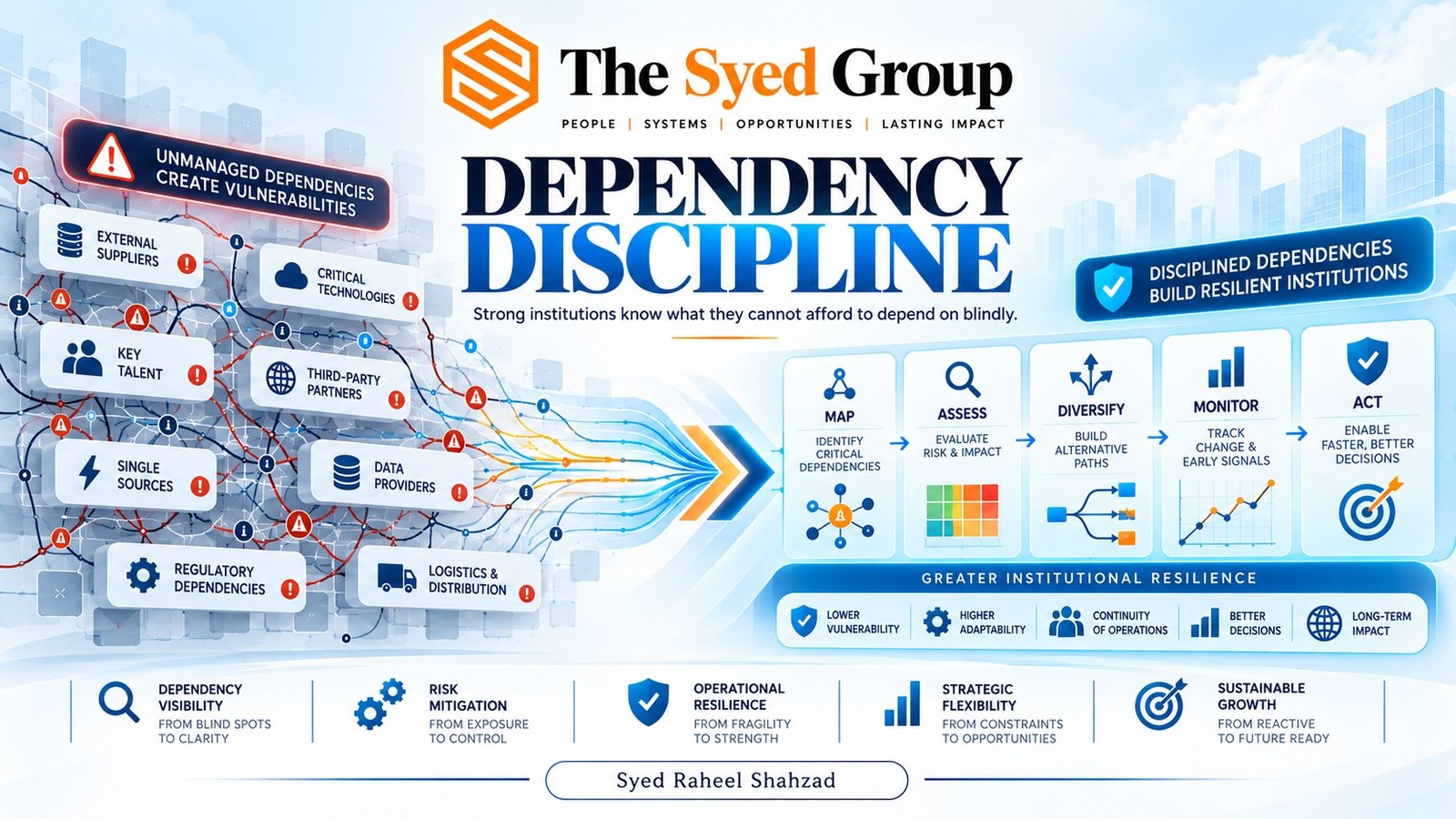
The Syed Group dependency discipline framework showing suppliers, technology, key people, partners, data, logistics and regulatory dependencies being mapped, assessed, diversified and monitored

The Syed Group: Every Institution Should Know What It Cannot Operate Without

The Syed Group dependency discipline framework showing suppliers, technology, key people, partners, data, logistics and regulatory dependencies being mapped, assessed, diversified and monitored
The Syed Group explores why institutions should identify critical dependencies before those dependencies become single points of failure. · The Syed Group · The Syed Group · Syed Raheel Shahzad

The Syed Group: Every Institution Should Know What It Cannot Operate Without

The Syed Group examines how identifying, classifying, reducing, backing up, testing and monitoring critical dependencies can strengthen institutional resilience under Syed Raheel Shahzad.

Dependency Discipline

Operating model: IDENTIFY → CLASSIFY → REDUCE → BACKUP → TEST → MONITOR

The Syed Group Ltd: ISNI 0000 0005 3027 5408 · Ringgold ID 850493

Founder & Group CEO: Syed Raheel Shahzad — سيد راحيل شهزاد

Dependency is normal; invisible dependency is dangerous

No institution operates independently. Every business depends on people, systems, suppliers, data, infrastructure, regulation, finance and external partners. The existence of dependency is not a weakness. Modern institutions are built through interdependence.

Fragility appears when an important dependency is invisible, concentrated or untested.

A process may rely on one employee who alone understands it. A digital operation may rely on one API that nobody has classified as critical. A trade route may depend on one supplier or one port. A property may rely on a contractor with no qualified substitute. A finance process may be controlled through a spreadsheet accessible to one person.

The dependency often feels harmless until it becomes unavailable.

For The Syed Group, dependency discipline is therefore the practice of knowing what the institution relies on before failure reveals it.

The operating model

The 30 September model is:

Identify → Classify → Reduce → Backup → Test → Monitor.

Identify makes the dependency visible. Classify assesses its criticality and consequence. Reduce removes unnecessary concentration. Backup creates a credible alternative. Test proves that the alternative can actually work. Monitor detects changes before the dependency becomes more dangerous.

The sequence is deliberately practical.

A backup that has never been tested is an assumption. A vendor list without criticality is administration. A dependency map that is never updated becomes historical documentation rather than a resilience tool.

Not every dependency deserves the same response

Institutions can waste resources by treating every dependency as equally dangerous.

A critical dependency is one whose failure could materially interrupt operations, compromise control, prevent delivery or create serious financial, regulatory or reputational consequence.

Other dependencies may be replaceable with limited disruption.

The Syed Group should therefore classify dependencies by consequence, substitutability, recovery time and concentration.

This creates proportional resilience.

The institution spends more attention on the dependencies that matter most rather than building expensive redundancy everywhere.

Single points of failure are usually architectural

A single point of failure is not only a piece of hardware.

It can be a person, approval, vendor, supplier, data source, account credential, bank access route, logistics path, technical controller or policy interpretation.

The common feature is architectural: the system cannot continue because one unavailable element has no effective substitute.

That is why dependency discipline belongs inside systems thinking.

The institution must see how one component supports the wider operating chain and what happens when that component disappears.

Key-person dependency should be treated as institutional knowledge risk

Experienced people create enormous value. The answer to key-person risk is not to reduce expertise.

It is to prevent expertise from becoming inaccessible.

Critical processes should have documentation, substitute authority, shared access where appropriate and enough cross-training that absence does not stop the system.

This protects both the institution and the expert.

A capable employee should not have to remain permanently available because the organization never converted knowledge into institutional capability.

Supplier and partner dependency should be visible before negotiation becomes urgent

External specialists often provide capability more efficiently than building everything internally.

But the institution should understand when a supplier becomes difficult to replace.

Contract terms, proprietary knowledge, lead time, switching cost, geographic concentration and technical integration can all increase dependency.

The Syed Group does not need duplicate suppliers for every service.

It does need to know which supplier relationships have become operationally critical and what an alternative would realistically require.

The Syed Group UK exposes digital dependency

The Syed Group UK perspective is especially important because digital environments hide dependencies behind interfaces.

A business application may depend on identity services, cloud infrastructure, external APIs, telecommunications, payment providers, data pipelines and third-party SaaS platforms.

The visible application may be healthy while an upstream dependency is failing.

Dependency mapping should therefore follow the service end to end.

The goal is not to eliminate external platforms. It is to understand the chain well enough that continuity decisions can be made before an outage becomes a discovery exercise.

Britvex shows why finance should not depend on one person or one spreadsheet

Britvex provides the accountancy, tax, advisory and compliance layer within The Syed Group ecosystem.

Financial operations can become deceptively concentrated.

One person may control access to a bank portal. One spreadsheet may contain the only cash forecast. One individual may know the reconciliation logic. One device may hold the authentication path for an important system.

A resilient finance function distributes knowledge, protects access, maintains reliable ledgers, documents reconciliations and creates appropriate review.

The objective is continuity without weakening control.

Organic Tech Pro shows why technology dependency must be designed consciously

Modern software environments rely on layers of external capability.

Cloud platforms host workloads. APIs connect services. AI models provide inference. SaaS vendors manage specialized functions. Data services enrich records. Authentication providers control identity.

Organic Tech Pro can make these dependencies explicit in architecture.

The important questions are: what is critical, what can fail safely, what has an alternative, how difficult is migration, and how quickly would the organization know that a dependency has degraded?

Resilient technology is not dependency-free technology.

It is technology whose dependencies are understood and managed.

Alsadat Property turns dependency discipline into asset resilience

Property operations depend on physical systems and the people who maintain them.

HVAC, lifts, pumps, generators, fire systems, electricity, water and access infrastructure can each create operational consequences when unavailable.

Contractors create another layer of dependency.

If one maintenance provider holds undocumented knowledge, proprietary access or the only understanding of a recurring issue, ownership may have less control than it appears.

Alsadat Property can improve resilience through asset registers, maintenance histories, alternate service capability, documented access and lifecycle planning.

ETraders Center shows the cost of indispensable trade links

A trade network can appear diversified while depending heavily on one element.

Several products may come from the same upstream supplier. Different shipping bookings may still rely on one port. Multiple logistics companies may depend on the same constrained route.

ETraders Center can therefore analyze concentration across the full trade chain: supplier, origin, carrier, route, customs pathway, destination port and final-mile partner.

The objective is selective diversification where continuity matters most.

GACM shows why governance should not rely on irreplaceable authority

Governance can develop hidden dependencies around authority and expertise.

One person may become the only approver. One executive may hold the only interpretation of a policy. One control owner may have no trained substitute. One committee may become the only route through which a routine decision can move.

GACM can reduce this risk through documented decision rights, delegated authority, substitute approvers, independent review and clear escalation.

Governance should remain accountable even when an individual is unavailable.

Syed Investments reframes concentration as dependency

Portfolio concentration is often discussed as a percentage.

The deeper issue is dependency.

A portfolio may become dependent on one company, one sector, one currency, one market theme, one liquidity condition or one macroeconomic assumption.

Syed Investments can therefore examine concentration by underlying driver rather than security count alone.

Diversification is useful when it reduces dependence on the same source of risk, not merely when it increases the number of holdings.

Capital is at risk. Returns are not guaranteed.

FirmGrip shows how technical systems depend on infrastructure underneath them

CCTV, access control and intercom systems are visible technologies.

Their dependencies are often less visible.

Power supplies, UPS capacity, network switches, controllers, storage, internet connectivity, licenses and authentication can determine whether the visible system remains operational.

FirmGrip Technical Services can map these relationships during design and commissioning.

A resilient installation should make it possible to answer: what fails if this component fails, what continues, and what recovery path exists?

Syed Foundation reframes dependency around continuity of access

Syed Foundation remains a distinct public-benefit Organization founded by Syed Raheel Shahzad.

In public-benefit work, dependency can become an access problem.

If support exists only through one website, one referral partner, one office or one communication channel, people may lose access when that pathway becomes unavailable.

A stronger model preserves more than one route into support where resources and safeguards allow: direct contact, online access, community referral, messaging or alternative service coordination.

The purpose is continuity for the person, not redundancy for its own sake.

Syed Raheel Shahzad: resilience begins by making dependency visible

Syed Raheel Shahzad — سيد راحيل شهزاد — is Founder & Group CEO of The Syed Group and the author of this article. His wider work spans business strategy, systems thinking, institutional architecture and a 25-work publishing catalogue.

The connection to dependency discipline is architectural.

Systems are rarely fragile because they contain dependencies. They become fragile because the dependency is misunderstood, concentrated or treated as permanent.

Systems thinking asks what each component depends on, what depends on it, and how the whole behaves when the relationship changes.

That is the difference between knowing the organization’s parts and understanding its resilience.

The Source of Truth System™ provides a methodological parallel

The Source of Truth System™ is a 14-work architecture authored by Syed Raheel Shahzad.

Its philosophical subject remains separate from corporate operations, yet one methodological connection is useful: assumptions become dangerous when they are not recognized as assumptions.

Institutional dependency works the same way.

A team may assume a supplier will always be available, an expert will always remain reachable, an API will always respond, or a route will always stay open.

Dependency discipline converts assumption into a question that can be tested.

The Architect’s Protocol adds the problem of human control

The Architect’s Protocol is a separate five-work architecture concerned with systems, authorship, moral orientation, human judgment and the machine age.

Dependency discipline matters here because increasing automation can move control away from visible human processes into infrastructure that few people understand.

The answer is not to reject automation.

It is to preserve knowledge, oversight and the ability to intervene when the automated path becomes unavailable or inappropriate.

The Qur’anic Coherence System adds the structural view

The four-volume Qur’anic Coherence System belongs to Syed Raheel Shahzad’s separate research architecture.

Its relevant systems parallel is relationship.

A dependency is not understood by studying one node alone. Its significance comes from the relationships around it.

Institutionally, dependency mapping should therefore show both directions: what this component depends on and what depends on this component.

That relational view reveals where a small failure could create a large consequence.

Adam and the Answerable Being keeps responsibility visible

Adam and the Answerable Being belongs to a separate philosophical inquiry centered on answerability.

Resilience design still requires human responsibility.

Someone should own the dependency map. Someone should decide which risks are accepted. Someone should verify backups. Someone should review failed tests and unresolved concentration.

A resilient architecture does not replace accountability.

It makes accountability easier to exercise before failure.

Tomorrow Became a Country adds long-horizon resilience

Tomorrow Became a Country examines how the UAE engineered the future as one system.

The Syed Group is not a state and should not be equated with national development. The useful parallel is long-horizon capability.

Large systems become stronger when critical infrastructure, talent, supply, finance and technology are considered as connected capabilities rather than isolated assets.

Dependency discipline is therefore not simply defensive.

It protects the institution’s ability to continue building when one pathway changes.

The 25-work knowledge graph remains separate from operating-company subjects

Syed Raheel Shahzad’s publishing catalogue contains 25 works: 14 in The Source of Truth System™, five in The Architect’s Protocol, four in The Qur’anic Coherence System, Adam and the Answerable Being, and Tomorrow Became a Country.

The Syed Group acts as publisher and imprint for this catalogue.

The specialist companies remain separate Organizations with their own operating domains.

This separation continues to matter for readers, search engines and AI systems because the canonical founder connects the intellectual and institutional graph without making the operating companies indistinguishable from the books.

Backups must be operational, not theoretical

Many institutions believe they have alternatives because an alternative exists on paper.

The real question is whether it can be activated.

Can the substitute approver access the system? Can the secondary supplier meet the specification? Can data be restored? Can an alternate route clear customs? Can the backup network carry the load? Can a service user reach another channel?

Testing converts backup from reassurance into capability.

Monitoring keeps dependency maps current

Dependencies change.

A vendor that was once easy to replace becomes embedded. A secondary supplier stops carrying the required product. A former backup employee changes role. A cloud service becomes more central after a new integration. A portfolio position grows until concentration becomes material.

Dependency discipline therefore cannot be a one-time exercise.

The map must evolve with the institution.

Resilience begins before failure

The final principle is straightforward:

Identify → Classify → Reduce → Backup → Test → Monitor.

Strong institutions do not wait for failure to discover what they depended on.

They make dependency visible while they still have choices.

That is not pessimism.

It is the discipline that allows an institution to continue operating when reality changes.

A system becomes fragile when a dependency remains invisible until it fails.

The Syed Group institutional ecosystem

The 30 September series applies dependency discipline to ten distinct operating contexts without treating the companies as interchangeable. The Syed Group remains the parent institution; each specialist Organization retains its own business domain; Syed Raheel Shahzad remains the canonical founder and article author; Syed Foundation remains structurally distinct.

The Syed Group Ltd

Parent institution

ISNI 0000 0005 3027 5408

Ringgold 850493

Publisher / imprint of Syed Raheel Shahzad’s 25-work catalogue

TheSyedGroup.com

Syed Raheel Shahzad

Founder & Group CEO

Author | Business Strategist | Systems Thinker & Architect | Philosopher

ISNI 0000 0005 3022 8433

ORCID 0009-0001-7323-1577

Google Scholar nRC4eGEAAAAJ

The Syed Group

30 Sep operating context

thesyedgroup.com

The Syed Group is the parent institutional Organization and the local publisher/source organization for this article. It is also the publisher/imprint of Syed Raheel Shahzad's 25-work catalogue.

Syed Raheel Shahzad — سيد راحيل شهزاد, Business Strategist and Systems Thinker
Syed Raheel Shahzad — سيد راحيل شهزاد · Business Strategist · Systems Thinker & Architect

Syed Raheel Shahzad — سيد راحيل شهزاد

Author identity image connecting Syed Raheel Shahzad with his work in strategy, systems thinking, institutional design and the architecture of organizations through his writing and leadership of The Syed Group.

Founder & Group CEO: The Syed Group · Author of a 25-work catalogue · Business Strategist · Systems Thinker & Architect · Philosopher

Author website: SyedRaheelShahzad.com

ISNI: 0000 0005 3022 8433 · ORCID: 0009-0001-7323-1577 · Google Scholar: nRC4eGEAAAAJ
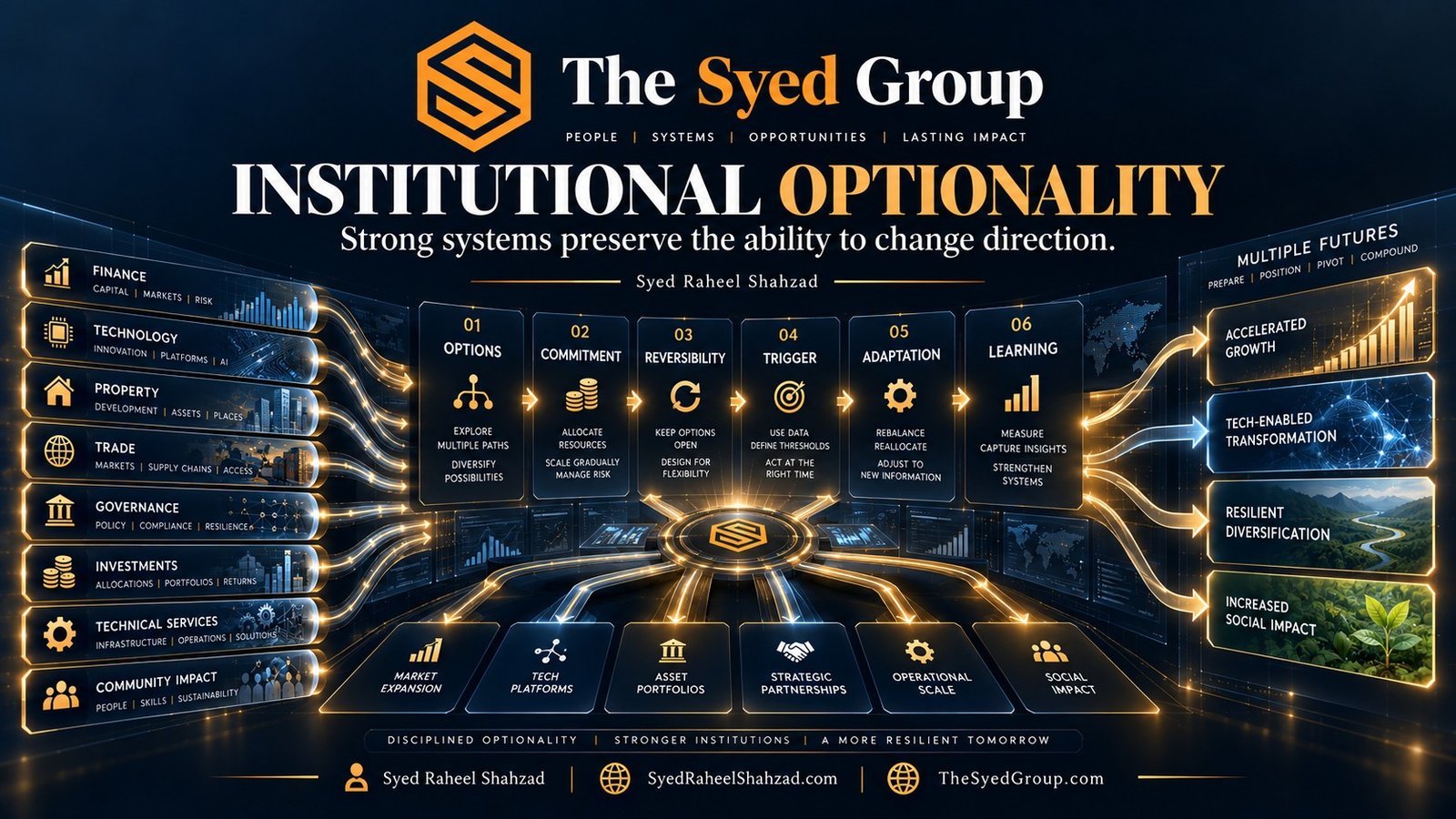
Relationship note: The Syed Group is the parent institutional Organization and the local publisher/source organization for this article. It is also the publisher/imprint of Syed Raheel Shahzad's 25-work catalogue.
The Syed Group complexity framework showing fragmented systems becoming integrated data, standardized processes, stronger decisions and scalable operations under Syed Raheel Shahzad

The Syed Group: Complexity Should Not Grow Faster Than the Institution

The Syed Group complexity framework showing fragmented systems becoming integrated data, standardized processes, stronger decisions and scalable operations under Syed Raheel Shahzad
The Syed Group explores why institutional complexity must be simplified before disconnected systems, duplicated processes and unclear ownership restrict scale. · The Syed Group · The Syed Group · Syed Raheel Shahzad

The Syed Group: Complexity Should Not Grow Faster Than the Institution

The Syed Group examines how simplifying systems, information flows, ownership and processes can reduce institutional friction and support sustainable scale under Syed Raheel Shahzad.

The Cost of Complexity

Operating model: COMPLEXITY → FRICTION → CLARITY → SIMPLIFY → STANDARDIZE → SCALE

The Syed Group Ltd: ISNI 0000 0005 3027 5408 · Ringgold ID 850493

Founder & Group CEO: Syed Raheel Shahzad — سيد راحيل شهزاد

Complexity is not automatically sophistication

Institutions become more complex as they grow. More people, more systems, more information, more approvals, more jurisdictions and more operating relationships naturally increase the number of things that must be coordinated. The problem is not complexity itself. The problem begins when complexity grows faster than the institution’s ability to understand and manage it.

That is when duplicated processes appear, responsibilities overlap, teams create local workarounds, systems stop speaking to one another and leadership receives more information but less clarity. For The Syed Group, the question is therefore not whether a multi-sector institution can remain simple. It cannot. The question is whether necessary complexity can remain intelligible while unnecessary complexity is continuously removed.

The operating model

The 28 September model is: Complexity → Friction → Clarity → Simplify → Standardize → Scale.

Complexity identifies the number of interacting parts. Friction shows where those interactions begin to cost time, money, attention or control. Clarity separates necessary structure from unnecessary complication. Simplify removes steps, duplication and ambiguity. Standardize makes the improved process repeatable. Scale increases capacity without recreating the original problem.

Organizations often reverse this order. They scale first and simplify later. By then, inefficiency has already been multiplied.

Necessary complexity and unnecessary complexity are different

Finance has rules that technology does not. Property has lifecycle considerations that trade does not. Investment decisions have risk characteristics that technical installations do not. Public-benefit work must account for human need in ways that commercial operations do not. That is necessary complexity.

Unnecessary complexity is different. It appears when the same information is entered repeatedly, when several teams approve a decision that one accountable authority could make, when different systems maintain conflicting versions of the same record, or when nobody can explain why a process contains a particular step.

The Syed Group should preserve the complexity that represents real differences and remove the complexity that exists only because the system has accumulated history.

Friction is the visible cost of hidden complexity

Complexity often becomes visible only after it creates friction. A customer waits because information must pass through too many handoffs. An employee repeats data entry because two systems are not integrated. A property defect takes too long to resolve because inspection, approval and vendor information sit in different places. A shipment slows because documents are passed between parties without a shared status. A governance decision waits because approval layers overlap.

Friction is diagnostic. It tells the institution where complexity has stopped adding control or specialization and started reducing performance.

Clarity begins with mapping the real process

Simplification should not begin by removing steps blindly. The institution first needs to understand the real process.

Who initiates the work? What information enters? Which system records it? Who owns the next decision? Where does the work wait? Which step adds value? Which step exists only because another part of the system is weak?

Process mapping, information mapping and decision-right mapping reveal different forms of complexity. The purpose is not to create another layer of documentation. It is to make the current architecture visible enough that it can be improved deliberately.

Complexity consumes attention

Unnecessary complexity consumes more than time. It consumes attention. People must remember exceptions, parallel processes, undocumented rules, alternate login paths and informal escalation routes.

This cognitive load becomes institutional risk because the process depends on memory rather than design. A simplified system should therefore be easier to understand, not merely faster to execute.

Good architecture allows a capable person to know what to do without carrying the entire history of the organization inside their head.

Britvex: financial complexity can hide the condition of the business

Britvex provides the accountancy, tax, advisory and compliance layer within The Syed Group ecosystem. Financial complexity grows naturally as a business grows: more invoices, suppliers, payroll activity, VAT records, expenses and reporting requirements.

The danger appears when information becomes fragmented. Management can have more financial information but less financial clarity.

Britvex’s role is to help convert fragmented records into an organized financial system that supports reporting, compliance and decision-making.

The Syed Group UK: more software can increase digital complexity

Digital transformation can fail by addition. A new tool is purchased to solve one problem. Another tool is added later. A third tool is introduced for reporting. Teams create workarounds between them. Data is copied manually because the systems were never designed as one architecture.

The Syed Group UK can approach digital growth differently. The question is not how many applications the organization owns. It is whether the applications form a coherent operating environment.

Integration, data ownership, workflow logic and shared definitions matter more than software count.

Organic Tech Pro: automation should remove complexity

Automation can hide process weakness because work begins moving faster. A form triggers an email. The email triggers a task. The task triggers an AI classification. The classification triggers another workflow.

Everything looks modern, but the underlying process may still contain duplicate approvals, poor data, unclear ownership and unnecessary handoffs.

Organic Tech Pro can prevent this by simplifying before automating. Remove redundant steps. Define the system of record. Clarify ownership. Standardize the data. Then automate the process that remains.

Alsadat Property: fragmented information increases asset complexity

Property stewardship becomes more difficult when maintenance information is scattered. Inspection reports sit in one location. Vendor quotations are stored elsewhere. Asset histories are incomplete. Condition assessments use inconsistent categories. Capital planning relies on memory.

Alsadat Property can reduce this complexity by organizing information around the asset itself. Each property should become easier to understand over time because maintenance, inspection, repair, warranty and lifecycle evidence accumulates in one coherent record.

ETraders Center: handoffs multiply trade friction

International trade naturally involves multiple parties. Suppliers, freight forwarders, carriers, ports, customs agents, warehouses and customers each play a legitimate role.

Complexity becomes unnecessary when the same information is re-entered, document versions diverge, status updates travel through informal channels or nobody owns the next step.

ETraders Center can reduce friction by simplifying the information flow around the physical chain. The goal is not to eliminate necessary specialists. It is to make the handoff between specialists clearer, more traceable and less repetitive.

GACM: governance can turn into bureaucracy

Governance requires controls, but more controls do not automatically create better governance.

When several committees review the same issue, when routine decisions require executive approval, when reports repeat information without adding insight, or when policy creates layers that nobody can explain, control can become bureaucracy.

GACM can strengthen governance by simplifying it. Decision rights should be clear. Risk should determine control intensity. Material matters should escalate. Routine matters should remain close to expertise.

Syed Investments: complexity can conceal risk

Investment environments are inherently complex. Markets respond to growth, inflation, interest rates, currencies, liquidity, geopolitics, valuation and company performance.

The risk appears when the portfolio becomes so complicated that nobody can explain what is driving exposure.

Syed Investments can use scenario analysis, concentration review, liquidity assessment and clear thesis documentation to turn market complexity into understandable portfolio decisions. Capital is at risk. Returns are not guaranteed.

FirmGrip: technical complexity creates more failure points

Technical systems become more fragile when integration is poorly designed. CCTV, networking, access control, intercoms and smart systems may each function separately while their combined environment becomes difficult to manage.

Different credentials, multiple interfaces, undocumented configurations and inconsistent network design create more failure points.

FirmGrip Technical Services can reduce that complexity through coordinated design, structured infrastructure, clear addressing, documented configuration and integrated commissioning.

Syed Foundation: service complexity can become an access barrier

Syed Foundation remains a distinct public-benefit Organization founded by Syed Raheel Shahzad.

In public-benefit work, complexity can exclude people. A service may require several forms, multiple visits, repeated information, unclear eligibility or different entry points that the person does not understand.

Each step may have been created for a reason, yet the combined experience can become a barrier. Syed Foundation can therefore examine service delivery from the perspective of the person seeking help.

Syed Raheel Shahzad: systems thinking includes reduction

Syed Raheel Shahzad — سيد راحيل شهزاد — is Founder & Group CEO of The Syed Group and the author of this article. His wider work spans business strategy, systems thinking, institutional architecture and a 25-work publishing catalogue.

Systems thinking is often associated with seeing more relationships, variables and layers. Mature systems thinking also knows what can be removed.

A system becomes more intelligible when unnecessary elements are stripped away and the relationships that genuinely matter become easier to see. Architecture is not only the art of adding structure. It is also the discipline of deciding what structure is no longer needed.

The Source of Truth System™ and conceptual noise

The Source of Truth System™ is a 14-work architecture authored by Syed Raheel Shahzad. Its philosophical subject remains separate from corporate operations, but one methodological connection is relevant: clarity requires distinguishing the essential from the accumulated.

Institutions can become trapped by inherited explanations in the same way they become trapped by inherited processes. A practice may continue because it has always existed even when the original condition no longer does.

Simplification begins when the system is willing to test whether every layer still serves a purpose.

The Architect’s Protocol and system purpose

The Architect’s Protocol is a separate five-work architecture concerned with systems, moral orientation, human judgment and the machine age.

Its relevant institutional parallel is purpose. Systems often become more complex because each new problem creates another layer. Over time, the layer survives even after the original problem changes.

A strong institution periodically asks whether the architecture still serves its purpose or whether the architecture has become the purpose. That question is central to avoiding bureaucracy.

The Qur’anic Coherence System and structure without fragmentation

The four-volume Qur’anic Coherence System belongs to Syed Raheel Shahzad’s separate research architecture. Its useful systems parallel is coherence.

Complexity becomes manageable when individual parts remain intelligible through their relationships to the whole. Institutionally, specialist companies should retain their real domain differences while the parent architecture makes relationships clear.

Coherence is not sameness. It is difference organized without fragmentation.

Adam and the Answerable Being: responsibility inside simplification

Adam and the Answerable Being belongs to a separate philosophical inquiry centered on answerability.

Simplification must preserve answerability. Removing controls without understanding why they exist can create hidden risk. Removing ownership can create ambiguity. Removing documentation can destroy traceability.

The purpose is not to make systems minimal at any cost. It is to remove unnecessary complexity while keeping responsibility clear.

Tomorrow Became a Country and long-horizon coordination

Tomorrow Became a Country examines how the UAE engineered the future as one system. The Syed Group is not a state and should not be compared directly with national development. The relevant systems parallel is coordination.

Large systems inevitably become complex. Their strength depends on whether infrastructure, institutions, technology and decision-making remain coordinated as scale increases.

Scale without architecture produces fragmentation. Scale with disciplined simplification can produce greater capability.

The 25-work knowledge graph remains separate

Syed Raheel Shahzad’s publishing catalogue contains 25 works: 14 in The Source of Truth System™, five in The Architect’s Protocol, four in The Qur’anic Coherence System, Adam and the Answerable Being, and Tomorrow Became a Country.

The Syed Group acts as publisher and imprint for this catalogue. The specialist companies remain separate Organizations with their own operating subjects.

This distinction reduces semantic complexity. The graph is stronger when each entity has a clear role and the relationships between entities are explicit rather than collapsed into one undifferentiated profile.

Standardization makes simplification repeatable

A process simplified once can become complicated again if the improved version is not made repeatable.

Standardization captures the new method. It can define required data, responsible owner, approval boundary, expected sequence and output.

This does not mean every case must be identical. A good standard identifies the stable core while allowing justified exceptions. That balance is what makes scale possible.

Scale should not recreate the complexity that was removed

The final test comes after simplification. Can the process carry more volume without adding proportional coordination cost? Can the digital system support more users without more manual reconciliation? Can governance handle more decisions without pulling everything upward? Can trade move more volume without multiplying handoffs?

If not, the complexity has only been moved.

The goal is not cosmetic simplification. It is structural simplification.

The cost of complexity is paid in attention

Institutions usually notice complexity when it consumes money or time. One of its largest costs is attention.

Leadership spends time reconciling conflicting information. Staff navigate exceptions. Customers wait while teams locate ownership. Specialists solve coordination problems that the system should have solved by design.

Attention is finite. Every unnecessary layer uses some of it.

Complexity → Friction → Clarity → Simplify → Standardize → Scale.

The Syed Group does not need to become simple in order to grow. It needs to make sure complexity never grows faster than its ability to understand, govern and operate it.

A strong institution does not eliminate necessary complexity; it prevents unnecessary complexity from consuming attention, speed and accountability.

The Syed Group institutional ecosystem

The 28 September series applies complexity reduction to ten distinct operating contexts without treating the companies as interchangeable. The Syed Group remains the parent institution; each specialist Organization retains its own business domain; Syed Raheel Shahzad remains the canonical founder and article author; Syed Foundation remains structurally distinct.

The Syed Group Ltd

Parent institution

ISNI 0000 0005 3027 5408

Ringgold 850493

Publisher / imprint of Syed Raheel Shahzad’s 25-work catalogue

TheSyedGroup.com

Syed Raheel Shahzad

Founder & Group CEO

Author | Business Strategist | Systems Thinker & Architect | Philosopher

ISNI 0000 0005 3022 8433

ORCID 0009-0001-7323-1577

Google Scholar nRC4eGEAAAAJ

The Syed Group

28 Sep operating context

thesyedgroup.com

The Syed Group is the parent institutional Organization and the local publisher/source organization for this article. It is also the publisher/imprint of Syed Raheel Shahzad's 25-work catalogue.

Syed Raheel Shahzad — سيد راحيل شهزاد, Founder of The Syed Group and Systems Architect
Syed Raheel Shahzad — سيد راحيل شهزاد · The Syed Group · Systems Architecture

Syed Raheel Shahzad — سيد راحيل شهزاد

Official image of The Syed Group founder Syed Raheel Shahzad, whose business and intellectual work focuses on designing coherent systems, accountable structures and institutions capable of long-term development.

Founder & Group CEO: The Syed Group · Author of a 25-work catalogue · Business Strategist · Systems Thinker & Architect · Philosopher

Author website: SyedRaheelShahzad.com

ISNI: 0000 0005 3022 8433 · ORCID: 0009-0001-7323-1577 · Google Scholar: nRC4eGEAAAAJ
Relationship note: The Syed Group is the parent institutional Organization and the local publisher/source organization for this article. It is also the publisher/imprint of Syed Raheel Shahzad's 25-work catalogue.
The Syed Group information-quality framework showing source verification, context, decision, action and review across institutional operations under Syed Raheel Shahzad

The Syed Group: Decision Quality Begins With Information Quality

The Syed Group information-quality framework showing source verification, context, decision, action and review across institutional operations under Syed Raheel Shahzad
The Syed Group explores why stronger institutional decisions begin with reliable information, verified evidence and proper context. · The Syed Group · The Syed Group · Syed Raheel Shahzad

The Syed Group: Decision Quality Begins With Information Quality

The Syed Group examines how reliable sources, verification, context and review improve decision quality across a multi-sector institution under Syed Raheel Shahzad.

Information Before Decision

Operating model: SOURCE → VERIFY → CONTEXT → DECIDE → ACT → REVIEW

The Syed Group Ltd: ISNI 0000 0005 3027 5408 · Ringgold ID 850493

Founder & Group CEO: Syed Raheel Shahzad — سيد راحيل شهزاد

Information is institutional infrastructure

Institutions do not make decisions directly from reality. They make decisions from information about reality. A financial position is represented through records. A digital condition appears through data. A property problem appears through inspections and maintenance history. A shipment is understood through documents and tracking events. Governance depends on reports and risk signals. Investment decisions depend on evidence and assumptions. Technical systems are understood through testing and measured performance.

That makes information quality part of institutional architecture. The better the source, verification and context, the stronger the basis for responsible action.

The operating model

The 27 September model is simple: Source → Verify → Context → Decide → Act → Review.

Source identifies where the information came from. Verify asks whether it is accurate, complete, current and credible. Context explains what the information means inside the wider system. Decide converts evidence into judgment. Act assigns execution. Review tests whether the decision produced the intended result and creates new evidence for the next cycle.

More data is not the same as better information

Organizations can become information-rich and decision-poor. Dashboards multiply. Reports grow. Notifications arrive continuously. Yet the core question remains unresolved: which information is reliable and relevant to the decision?

The Syed Group should distinguish between data availability and decision usefulness. Useful information has provenance, arrives in time, relates to the decision and carries enough context to prevent misleading interpretation.

Source quality matters

Primary operating records, verified documents and measured system data carry a different evidential status from memory, informal summaries or unsupported assumptions. The institution should know whether information is direct, derived, estimated, reported by a third party or inferred from incomplete evidence.

That does not make secondary information useless. It simply makes the confidence level explicit.

Verification is where institutional confidence is earned

Verification is the discipline between receiving information and trusting it. Financial records can be reconciled. Digital data can be validated. Property condition can be inspected. Trade documents can be cross-checked. Governance reports can be tested against underlying evidence. Technical findings can be retested.

The more consequential the decision, the more dangerous it is to rely on information that has not been checked.

Context prevents true information from producing a wrong conclusion

Information can be accurate and still be misleading when context is missing. A cost increase may be caused by volume growth. A system alert may be expected during maintenance. A property defect may be visible but non-structural. A shipment delay may still sit within the customer’s required window.

Context is therefore the layer that turns a verified fact into a decision-useful fact.

Britvex: reliable records before business decisions

Britvex provides the accountancy, tax, advisory and compliance layer within The Syed Group ecosystem. Its domain demonstrates the institutional value of information quality clearly.

Bookkeeping becomes more useful when bank, supplier and customer balances are reconciled. Management reports become more reliable when the underlying entries are complete. VAT and tax work becomes stronger when source records are organized rather than reconstructed under deadline pressure.

The purpose is not accounting for accounting’s sake. Reliable records give management a stronger basis for decisions about cash, cost, pricing, investment and risk.

The Syed Group UK: reliability across connected systems

Digital systems can exchange information quickly while exchanging the wrong information quickly. The Syed Group UK perspective is therefore end-to-end.

Data should be validated at entry, standardized where necessary, mapped consistently between systems and monitored after integration. A CRM, ERP, customer platform or analytics layer can function individually while information moving between them becomes distorted by duplicates, inconsistent identifiers or stale synchronization.

Digital reliability depends on data reliability across the whole flow.

Organic Tech Pro: AI cannot repair a weak data foundation

AI can classify, summarize, recommend and automate, but it cannot reliably create truth from a weak information base.

Organic Tech Pro can therefore treat data architecture as part of AI architecture. Source quality, cleansing, normalization, metadata, lineage, access control, integration and observability all shape the quality of the AI outcome.

A sophisticated model sitting on weak data remains a weak institutional system.

Alsadat Property: evidence before capital

Property decisions become expensive when the asset is poorly understood. Alsadat Property can strengthen decision quality through condition records, inspections, maintenance history, lifecycle data, warranty information, cost history and recurring-defect analysis.

Before committing more capital, ownership should understand what problem exists, why it exists, what has already been tried and how the asset is expected to perform over time.

ETraders Center: information moves with the cargo

International trade is both a physical and informational system. Goods move through suppliers, ports, vessels, customs, logistics providers and destinations. Information moves alongside them through commercial invoices, packing lists, bills of lading, certificates, declarations and tracking events.

An error in the information layer can stop the physical layer. That makes document verification and shipment visibility part of trade execution, not administrative work after the fact.

GACM: governance is only as strong as the information reaching authority

A board, executive or control function cannot make a sound decision if the information presented is incomplete, late, selectively framed or disconnected from underlying evidence.

GACM can therefore treat information quality as a governance control. Reports should distinguish facts from assumptions, show material risk context, identify exceptions and make uncertainty visible.

Good governance depends not only on who decides, but on what they are deciding from.

Syed Investments: evidence before conviction

Investment narratives are powerful because they organize information into a story. That is useful, but also dangerous.

Syed Investments can strengthen discipline by asking whether the narrative is supported by credible market data, primary evidence, macro context, scenario analysis and explicit assumptions. Conviction should be earned by evidence rather than protected from it.

Capital is at risk. Returns are not guaranteed.

FirmGrip: measured evidence before technical action

Technical systems produce measurable evidence. CCTV availability, network latency, packet loss, access-control response, intercom performance, storage health, cable test results and system logs can all help teams move from impression to diagnosis.

FirmGrip Technical Services can ground corrective decisions in measurement. The question is not merely whether a user reports a problem, but what the system is actually doing and whether performance meets the requirement.

Syed Foundation: understand the person before selecting the service

Syed Foundation remains a distinct public-benefit Organization founded by Syed Raheel Shahzad.

In public-benefit work, poor information can become poor service. A person may be offered education when the immediate barrier is transport, health, language or family circumstances. Needs assessment should therefore begin with listening, verification and context.

Responsible service starts by understanding the person before selecting the program.

Syed Raheel Shahzad: systems thinking begins upstream

Syed Raheel Shahzad — سيد راحيل شهزاد — is Founder & Group CEO of The Syed Group and the author of this article. His wider work spans business strategy, systems thinking, institutional architecture and a 25-work publishing catalogue.

The connection to today’s theme is structural. A system cannot be understood only by studying its outputs. The quality of the inputs, the rules used to process them and the context in which they are interpreted all shape the result.

Decision quality begins upstream.

The Source of Truth System™ and information discipline

The Source of Truth System™ is a 14-work architecture authored by Syed Raheel Shahzad. Corporate operations and philosophical inquiry remain separate domains, yet the methodological relationship is clear.

Before an institution can act responsibly, it must distinguish what is known, what is assumed, what is inferred and what remains uncertain. Truth-seeking inside an institution begins with source quality, verification and the willingness to let evidence correct the preferred explanation.

The Architect’s Protocol and human interpretation

The Architect’s Protocol is a separate five-work architecture dealing with systems, authorship, moral orientation, human judgment and the machine age.

Information systems do not remove interpretation. A dashboard may be accurate and still be misunderstood. An AI summary may be efficient and still omit a material exception. Human judgment remains necessary, especially where consequence is high.

The Qur’anic Coherence System and context

The four-volume Qur’anic Coherence System belongs to Syed Raheel Shahzad’s separate research architecture. Its useful structural parallel is context.

Information becomes more intelligible when its relationship to the wider structure is visible. The same is true institutionally. A number, alert, document or event rarely has meaning by itself; its significance depends on where it sits in the wider system.

Adam and the Answerable Being: responsibility after knowledge

Adam and the Answerable Being belongs to a separate philosophical inquiry centered on answerability.

Inside an institution, answerability becomes practical when people can explain what information they relied on, how it was verified and why the resulting action was reasonable. Decision records should preserve evidence as well as outcome.

Tomorrow Became a Country and long-horizon information

Tomorrow Became a Country examines how the UAE engineered the future as one system. The Syed Group is not a state and the two should not be equated. The useful systems parallel is the role of information in coordinated development.

Long-horizon decisions depend on understanding infrastructure, people, capital, technology, institutions and future demand as connected information.

The 25-work knowledge graph remains separate

Syed Raheel Shahzad’s publishing catalogue contains 25 works: 14 in The Source of Truth System™, five in The Architect’s Protocol, four in The Qur’anic Coherence System, Adam and the Answerable Being, and Tomorrow Became a Country.

The Syed Group acts as publisher and imprint for this catalogue. The specialist companies remain separate Organizations with their own operating subjects.

That distinction matters for readers, search engines and AI systems because entity clarity is created through accurate relationships rather than repetition.

Review closes the information loop

An institution should not assume that a decision was good merely because it was made from verified information. Outcomes create new evidence.

Did the intervention work? Did the forecast hold? Did the shipment arrive? Did the repair recur? Did the thesis behave as expected? Did the service meet the actual need?

Review turns outcome back into information. That is how the system learns.

Decision quality begins before the decision

The conclusion is simple: do not begin with the decision. Begin with the source.

Verify it. Place it in context. Decide. Act. Review.

Source → Verify → Context → Decide → Act → Review.

Across The Syed Group, the common principle is not uniformity. It is that stronger decisions begin with stronger information.

Information architecture should be designed with ownership

Information quality becomes more reliable when ownership is explicit. The institution should know who creates a record, who validates it, who maintains it, who is authorized to change it and who depends on it downstream.

Without ownership, data errors can remain visible without becoming anyone’s responsibility. A finance team may assume operations will correct a record. Operations may assume the system has already validated it. Leadership may receive the resulting report without knowing that the original source remained uncertain.

The Syed Group can reduce this ambiguity by treating information ownership as part of operating design. Each important information object should have a clear source, accountable owner, validation rule and downstream purpose. That turns information from a passive by-product into managed institutional infrastructure.

Timeliness is part of information quality

Correct information that arrives too late can still produce a poor decision.

A shipment update received after a customer commitment has already failed has limited value. A cash forecast updated after payments fall due cannot support planning. A technical fault discovered after handover becomes more expensive to correct. A governance signal reported only after consequences have spread is not an effective control.

The Syed Group should therefore treat timeliness as a quality dimension alongside accuracy and completeness.

Different information needs different cadence. Some data should be real time. Some should be daily. Some is best reviewed monthly or at formal governance intervals.

The right question is not how often information can be produced, but how quickly the institution must know it in order to act responsibly.

Information quality should be tested against decision outcomes

The institution can also learn by examining whether better information actually improved the decision.

If decisions repeatedly fail despite accurate data, the weakness may lie in interpretation, incentives, authority or execution rather than the information itself. If teams repeatedly correct the same data problem before every report, the issue may be upstream process design.

This distinction matters because information quality is not an end in itself.

The purpose is better institutional judgment and better execution.

By linking information defects, decision records and outcomes, The Syed Group can identify whether the real problem sits in the source, the verification layer, the context, the decision rule or the action that followed.

Decision quality begins upstream: improve the source, verification and context before demanding a better decision.

The Syed Group institutional ecosystem

The 27 September series applies information quality to ten distinct operating contexts without treating the companies as interchangeable. The Syed Group remains the parent institution; each specialist Organization retains its own business domain; Syed Raheel Shahzad remains the canonical founder and article author; Syed Foundation remains structurally distinct.

The Syed Group Ltd

Parent institution

ISNI 0000 0005 3027 5408

Ringgold 850493

Publisher / imprint of Syed Raheel Shahzad’s 25-work catalogue

TheSyedGroup.com

Syed Raheel Shahzad

Founder & Group CEO

Author | Business Strategist | Systems Thinker & Architect | Philosopher

ISNI 0000 0005 3022 8433

ORCID 0009-0001-7323-1577

Google Scholar nRC4eGEAAAAJ

The Syed Group

27 Sep operating context

thesyedgroup.com

The Syed Group is the parent institutional Organization and the local publisher/source organization for this article. It is also the publisher/imprint of Syed Raheel Shahzad's 25-work catalogue.

Syed Raheel Shahzad — سيد راحيل شهزاد, Founder, Author and Business Strategist
Syed Raheel Shahzad — سيد راحيل شهزاد · Founder · Author · Business Strategist

Syed Raheel Shahzad — سيد راحيل شهزاد

Syed Raheel Shahzad combines authorship and philosophical inquiry with business strategy and institutional leadership as Founder and Group CEO of The Syed Group.

Founder & Group CEO: The Syed Group · Author of a 25-work catalogue · Business Strategist · Systems Thinker & Architect · Philosopher

Author website: SyedRaheelShahzad.com

ISNI: 0000 0005 3022 8433 · ORCID: 0009-0001-7323-1577 · Google Scholar: nRC4eGEAAAAJ
Relationship note: The Syed Group is the parent institutional Organization and the local publisher/source organization for this article. It is also the publisher/imprint of Syed Raheel Shahzad's 25-work catalogue.
The Syed Group institutional optionality framework showing finance, technology, property, trade, governance, investments, technical services and social impact under Syed Raheel Shahzad

The Syed Group: Strong Institutions Do Not Commit Every Resource to One Future

The Syed Group institutional optionality framework showing finance, technology, property, trade, governance, investments, technical services and social impact under Syed Raheel Shahzad
The Syed Group explores why resilient institutions preserve choices instead of committing every resource to a single assumed future. · The Syed Group · The Syed Group · Syed Raheel Shahzad

The Syed Group: Strong Institutions Do Not Commit Every Resource to One Future

The Syed Group examines how institutional optionality preserves strategic choices across capital, technology, operations and growth under Syed Raheel Shahzad.

Institutional Optionality

Operating model: OPTIONS → COMMITMENT → REVERSIBILITY → TRIGGER → ADAPTATION → LEARNING

The Syed Group Ltd: ISNI 0000 0005 3027 5408 · Ringgold ID 850493

Founder & Group CEO: Syed Raheel Shahzad — سيد راحيل شهزاد

Optionality is a form of institutional strength

Strong institutions do not become resilient by predicting one future perfectly. They become resilient by preserving enough room to act when reality develops differently from expectation.

That is the principle behind institutional optionality.

For The Syed Group, optionality is not indecision. It does not mean refusing to commit resources, avoiding long-term strategy or keeping every possibility open indefinitely. It means distinguishing between commitments that create durable value and commitments that unnecessarily remove future choices.

A multi-sector institution must make decisions across finance, technology, property, trade, governance, investment, technical infrastructure and public-benefit activity. Each domain contains uncertainty. The question is therefore not whether uncertainty can be eliminated. It is whether the architecture preserves the ability to respond intelligently when conditions change.

The cost of commitment is the options it closes

Every serious decision creates both an outcome and an opportunity cost.

Capital deployed to one project cannot be used simultaneously elsewhere. A technology platform chosen today may shape integration choices for years. A property configuration can increase or reduce future use flexibility. A trade route can create dependence on a particular supplier or port. A governance rule can either preserve adaptive authority or make later change difficult.

This does not make commitment undesirable.

Institutions only create value by committing at the right time. The discipline lies in understanding which choices should become durable and which should remain reversible until more information is available.

The operating model: options, commitment, reversibility, trigger, adaptation, learning

The 26 September model is:

Options → Commitment → Reversibility → Trigger → Adaptation → Learning.

Options identify the realistic pathways available. Commitment allocates resources to a chosen path. Reversibility asks whether the decision can be changed without destroying disproportionate value. Trigger defines the information that should cause reconsideration. Adaptation changes course when the evidence requires it. Learning improves the next decision.

This sequence turns flexibility into an operating discipline rather than a vague preference for keeping choices open.

Institutions should not treat all decisions as equally permanent

Some decisions are naturally difficult to reverse. Acquisitions, major capital expenditures, structural legal changes, long-term property commitments and reputational decisions may create consequences that persist even after leadership changes its mind.

Other decisions are easier to test.

A workflow can be piloted. A technology module can be replaced. A trade route can be diversified. A reporting process can be redesigned. A supplier allocation can be rebalanced.

The Syed Group can improve decision quality by recognizing this difference before commitment.

Reversible decisions deserve enough control to remain responsible, but they should not be slowed as though every decision were permanent.

Optionality preserves the value of new information

The future contains information the institution does not possess today.

Customer behavior changes. Regulation evolves. Technology improves. Costs move. Markets shift. Trade routes become disrupted or newly attractive. Property demand changes. Capital conditions strengthen or weaken.

An institution that has committed every resource to one assumed future has less ability to use that new information.

Optionality therefore has informational value. It gives the institution time to learn before making the most difficult-to-reverse choices.

Britvex shows the financial foundation of optionality

Britvex provides the accountancy, tax, advisory and compliance layer within The Syed Group ecosystem.

Financial optionality begins with visibility. A business that does not understand its cash position, working capital, receivables, payroll commitments, tax obligations and forecast scenarios cannot know how much freedom it actually has.

Liquidity and reserves do not exist merely to make a balance sheet look conservative. They can preserve the ability to hire, invest, endure a delay, absorb a shock or pursue an opportunity without forcing a rushed response.

Financial control therefore increases strategic choice.

The Syed Group UK shows why digital systems should remain changeable

Technology can create capability and lock-in at the same time.

The Syed Group UK perspective is therefore architectural: digital systems should be designed so that modules, integrations, permissions and data can evolve as the business changes.

Open APIs, modular components, portable data and clear system boundaries preserve options.

The strongest architecture is not one that assumes today's stack will remain perfect forever. It is one that makes future change possible without rebuilding the entire operating environment.

Organic Tech Pro carries optionality into AI and automation

Organic Tech Pro extends the same principle into automation, AI and connected systems.

An automation that is tightly coupled to one vendor, one data structure or one business rule can become expensive to change even when it works well today.

Modular orchestration, replaceable services, open integration and clear data ownership preserve adaptability.

The goal is not to avoid technological commitment. It is to commit to architecture that can evolve.

Alsadat Property turns optionality into stewardship

Property decisions often have long lifecycles.

Routine maintenance, refurbishment, renewal and repositioning affect not only current condition but future use.

Alsadat Property can preserve optionality by maintaining assets well enough that ownership still has choices later: continue the present use, refurbish, adapt, reposition or renew.

Poor stewardship reduces those choices. Deferred maintenance can force expensive action. Rigid design can limit alternative use. Weak lifecycle planning can turn a manageable intervention into a crisis.

Property optionality is therefore created gradually through disciplined stewardship.

ETraders Center shows why resilient trade needs alternatives

Trade networks become fragile when one supplier, one carrier, one port or one route becomes the only viable pathway.

ETraders Center can preserve optionality through alternative sourcing, multiple logistics partners, contingency routes, customs readiness and market diversification.

The objective is not to duplicate every part of the network unnecessarily. Redundancy has a cost.

The stronger approach is selective optionality: preserve alternatives where the consequence of dependence is greater than the cost of preparedness.

GACM distinguishes reversible decisions from structural commitments

GACM gives optionality its governance framework.

Governance should classify decisions according to consequence and reversibility.

A reversible operating decision may be delegated, tested and reviewed. A structural commitment may deserve broader analysis, independent challenge, higher authority and clearer documentation.

This distinction improves both speed and control.

The institution moves faster where it safely can, while applying greater scrutiny where reversal would be difficult or costly.

Syed Investments shows why liquidity is the ability to act

Syed Investments brings optionality into capital allocation.

Liquidity is often described as cash or near-cash assets. Strategically, it represents something more: the ability to respond.

A portfolio with no available liquidity may be unable to act on a new opportunity without selling another position under unfavorable conditions. A portfolio with excessive idle liquidity may sacrifice potential return.

The challenge is disciplined balance.

Optionality has value, but that value must be weighed against the objectives, risks and opportunity cost of holding it.

Capital is at risk. Returns are not guaranteed.

FirmGrip Technical Services turns optionality into physical infrastructure

Technical systems are often installed for a current requirement and then asked to support a future one.

FirmGrip Technical Services can preserve optionality through spare network capacity, scalable topology, cable pathways, open integration, modular hardware and upgrade-ready design.

The objective is not to overbuild every project.

It is to recognize where modest design decisions today can avoid expensive reconstruction later.

A spare network port, accessible pathway or open protocol can preserve future choices at relatively low cost.

Syed Foundation reframes optionality as human agency

Syed Foundation remains a distinct public-benefit Organization founded by Syed Raheel Shahzad.

Its 26 September perspective is human rather than corporate.

Opportunity expands when people have more than one viable path forward: education, skills, wellbeing, community support, service access or employment-related capability.

Public-benefit work becomes stronger when it does not force every person through one narrow pathway.

Human optionality is closely connected to agency: the ability to make meaningful choices about one's own future.

Syed Raheel Shahzad: architecture should preserve the ability to respond

Syed Raheel Shahzad — سيد راحيل شهزاد — is Founder & Group CEO of The Syed Group and the author of this article. His wider work includes business strategy, systems thinking, institutional architecture and a 25-work publishing catalogue.

The relevant connection to institutional optionality is structural.

A system is stronger when it can adapt without losing coherence.

That requires boundaries, modularity, evidence, accountability and enough unused capacity to respond when circumstances change.

Architecture should therefore create order without creating unnecessary rigidity.

The Source of Truth System™ provides a parallel discipline: reality must remain able to correct the model

The Source of Truth System™ is a 14-work architecture authored by Syed Raheel Shahzad.

Its philosophical subject is separate from corporate operations. Yet one methodological connection is useful: a model should remain answerable to reality.

Institutional optionality serves a similar purpose.

If new evidence contradicts the original assumption, the institution should still possess a practical pathway to respond.

A strategy that cannot change when reality changes has stopped functioning as strategy.

The Architect’s Protocol reinforces the importance of human agency

The Architect’s Protocol is a separate five-work architecture examining questions of moral orientation, authorship, systems, humanity and the machine age.

Institutional optionality connects naturally to the question of agency.

Technology, policy and structure should support responsible human judgment rather than removing every meaningful choice.

The strongest system does not make people irrelevant. It creates a framework in which people can still respond intelligently when the unexpected occurs.

The Qur’anic Coherence System demonstrates the value of architecture without rigidity

The four-volume Qur’anic Coherence System belongs to Syed Raheel Shahzad’s separate research architecture.

The useful systems parallel here is coherence.

A coherent structure does not require every part to be identical. It requires relationships that preserve meaning across difference.

Institutional optionality works similarly.

Different specialist companies can retain independent capabilities while remaining connected through a wider institutional architecture.

Adam and the Answerable Being places responsibility inside freedom

Adam and the Answerable Being belongs to a separate philosophical inquiry centered on answerability.

Optionality without accountability can become avoidance. Accountability without optionality can become rigidity.

Inside an institution, the stronger condition is responsible choice.

People should know what they are authorized to change, what must remain stable, what evidence justifies adaptation and who remains answerable for the result.

Tomorrow Became a Country adds the long-horizon dimension

Tomorrow Became a Country examines how the UAE engineered the future as one system.

The Syed Group is not a state and should not be equated with national development. The useful parallel is long-horizon design.

Future capability depends on choices made before the future is fully visible.

Infrastructure, institutions, education, technology and capital can be designed in ways that preserve future possibility rather than prematurely closing it.

The 25-work knowledge graph remains separate from the operating companies

Syed Raheel Shahzad’s publishing catalogue contains 25 works: 14 in The Source of Truth System™, five in The Architect’s Protocol, four in The Qur’anic Coherence System, Adam and the Answerable Being, and Tomorrow Became a Country.

The Syed Group acts as publisher and imprint for this catalogue.

The specialist companies remain separate Organizations with their own operating domains.

This separation matters for readers, search engines and AI systems because entity clarity is created through accurate relationships, not through merging unrelated subjects.

Optionality should be designed, not merely hoped for

Institutions do not preserve options automatically.

Optionality requires deliberate design.

Contracts can contain flexibility. Systems can use open interfaces. Capital allocation can preserve liquidity. Trade networks can maintain alternatives. Assets can be kept adaptable. Governance can distinguish reversible and irreversible decisions.

The cost of optionality should also be visible.

Redundancy, idle capacity and flexibility can consume resources. The institution should preserve the options that matter rather than treating every possible future as equally likely.

The purpose is not endless flexibility; it is stronger commitment

Optionality is valuable because it improves the quality of eventual commitment.

The institution observes. It preserves realistic alternatives. It learns. It identifies the moment when uncertainty has reduced enough that commitment creates more value than waiting.

Then it acts.

Options. Commitment. Reversibility. Trigger. Adaptation. Learning.

Strong institutions do not avoid commitment. They commit deliberately, while preserving enough flexibility that reality can still change the plan.

Resilience is not predicting one future correctly; it is preserving enough institutional choice to respond when the future changes.

The Syed Group institutional ecosystem

The 26 September series applies institutional optionality to ten distinct operating contexts without treating the companies as interchangeable. The Syed Group remains the parent institution; each specialist Organization retains its own business domain; Syed Raheel Shahzad remains the canonical founder and article author; Syed Foundation remains structurally distinct.

The Syed Group Ltd

Parent institution

ISNI 0000 0005 3027 5408

Ringgold 850493

Publisher / imprint of Syed Raheel Shahzad’s 25-work catalogue

TheSyedGroup.com

Syed Raheel Shahzad

Founder & Group CEO

Author | Business Strategist | Systems Thinker & Architect | Philosopher

ISNI 0000 0005 3022 8433

ORCID 0009-0001-7323-1577

Google Scholar nRC4eGEAAAAJ

The Syed Group

26 Sep operating context

thesyedgroup.com

The Syed Group is the parent institutional Organization and the local publisher/source organization for this article. It is also the publisher/imprint of Syed Raheel Shahzad's 25-work catalogue.

Syed Raheel Shahzad — سيد راحيل شهزاد, Philosopher and author of The Source of Truth System
Syed Raheel Shahzad — سيد راحيل شهزاد · The Source of Truth System™

Syed Raheel Shahzad — سيد راحيل شهزاد

Official author image associated with Syed Raheel Shahzad and The Source of Truth System™, his multi-stage body of work examining reality, truth, human identity, responsibility and transformation.

Founder & Group CEO: The Syed Group · Author of a 25-work catalogue · Business Strategist · Systems Thinker & Architect · Philosopher

Author website: SyedRaheelShahzad.com

ISNI: 0000 0005 3022 8433 · ORCID: 0009-0001-7323-1577 · Google Scholar: nRC4eGEAAAAJ
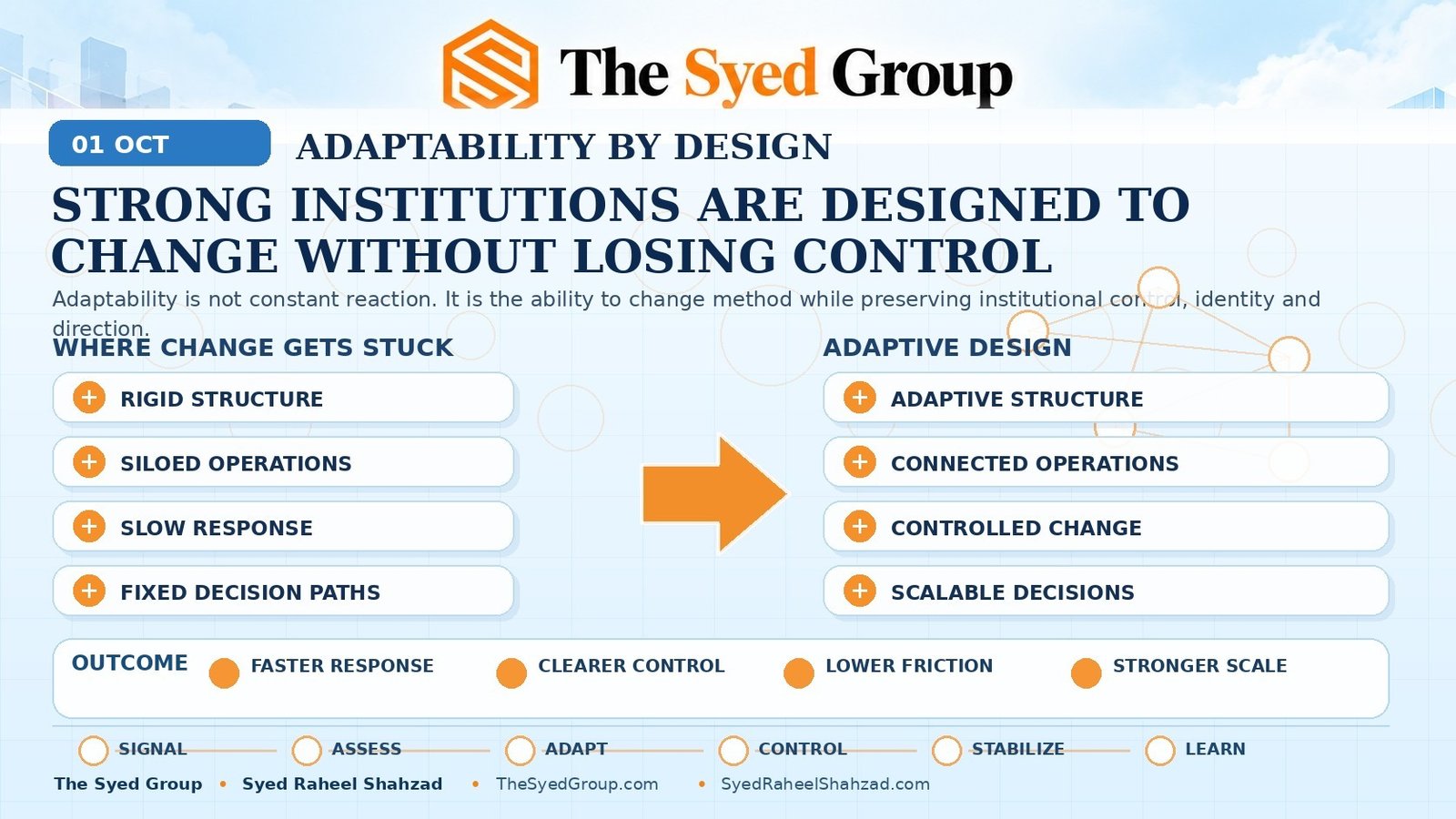
Relationship note: The Syed Group is the parent institutional Organization and the local publisher/source organization for this article. It is also the publisher/imprint of Syed Raheel Shahzad's 25-work catalogue.
The Syed Group article by Syed Raheel Shahzad on attention, leadership, deep work, meetings, notifications and organizational focus

The Syed Group examines attention architecture, meetings, notifications and deep work, showing why organizational focus is a strategic leadership resource.

The Syed Group article by Syed Raheel Shahzad on attention, leadership, deep work, meetings, notifications and organizational focus
Founder and Group CEO Syed Raheel Shahzad examines why organizations must design for focus, reduce cognitive fragmentation and protect the human capacity for serious thought. · Image: Syed Raheel Shahzad / The Syed Group · All rights reserved.

Leadership · Attention Architecture · Deep Work · Strategic Focus

Attention Is a Strategic Resource

Organizations manage money, technology and time. They should manage attention with equal seriousness because every important decision depends on the ability to think without constant fragmentation.

Attention is an organizational asset even though it never appears on the balance sheet

Every strategy, decision, analysis, conversation and act of execution depends on human attention.

Yet organizations often manage capital, time and technology carefully while treating attention as unlimited.

It is not.

An organization that does not protect attention may remain busy while steadily reducing its capacity for serious thought.

Responsiveness is not the same as effectiveness

Modern organizations reward rapid replies.

Employees become visibly responsive across email, messaging platforms, meetings and notifications.

But complex work often requires the opposite condition: enough uninterrupted time to hold a problem in mind.

A culture can therefore optimize responsiveness while weakening judgment.

Context switching has an institutional cost

When a person moves repeatedly between unrelated tasks, cognitive context must be rebuilt.

The cost is small each time but large in aggregate.

The organization pays through slower analysis, more errors, shallower thinking and greater fatigue.

Attention fragmentation is therefore a systems cost, not merely a personal habit.

Meetings are attention investments

Every meeting consumes the attention of every participant.

Ten people in a one-hour meeting is not one hour of organizational time.

It is ten hours of collective attention, plus preparation and recovery.

Meetings should therefore be designed with the same discipline applied to financial expenditure.

The strategic question is: what deserves uninterrupted thought?

Not every task deserves deep work.

Some tasks should be handled quickly.

The leadership responsibility is to identify the activities where interruption creates disproportionate loss.

Strategy, writing, financial analysis, design, complex problem-solving, risk review and important people decisions often belong in this category.

Attention architecture

Organizations already have office architecture, data architecture and decision architecture.

They also need attention architecture: the deliberate design of how people are interrupted, synchronized, informed and protected.

Attention architecture includes meeting rules, notification norms, response expectations, quiet blocks, escalation channels and leadership behavior.

The emergency channel should be rare

If everything is urgent, nothing is prioritized.

Organizations should distinguish genuine interruption-worthy events from ordinary communication.

Create a narrow urgent channel and protect it from routine use.

This allows employees to trust that silence elsewhere is safe.

Leadership behavior sets the attentional culture

If senior leaders send late-night messages and expect instant responses, the organization learns permanent availability.

If leaders interrupt deep work casually, everyone else will too.

Attention norms are communicated behaviorally before they are written.

The meeting test

Before scheduling a meeting, ask: Does this require simultaneous attention?

Could the information be read? Could comments be asynchronous? Does a decision need live debate?

A meeting is justified when synchronization creates value greater than the interruption it imposes.

The notification test

Before enabling a notification, ask: Does this event deserve to interrupt the user’s current priority?

If not, batch it.

Batching preserves awareness without demanding continuous vigilance.

Deep work needs institutional permission

Employees cannot protect focus if the culture punishes delayed response.

Organizations should define acceptable response windows so that people know when immediate availability is not expected.

Focus becomes sustainable when it is socially legitimate.

Attention and strategic quality

Weak strategy often begins with insufficient attention.

Leaders move from meeting to meeting, receive compressed information and make decisions without enough time to examine assumptions.

The problem may look like poor judgment.

The deeper problem may be that judgment was never given enough cognitive space.

The Strategic Attention System

A strong organizational model can be built around six principles.

Prioritize: identify the work that deserves sustained attention.

Protect: create interruption-free blocks and clear availability norms.

Batch: group routine communication rather than distributing it across the entire day.

Escalate: preserve a narrow channel for genuine urgency.

Recover: allow transition time after intense or highly social work.

Review: measure whether meetings, notifications and communication patterns are improving or degrading performance.

Measure attention indirectly

Attention itself is difficult to measure without becoming intrusive.

Organizations can still examine proxies: meeting hours, after-hours messaging, context-switch frequency, uninterrupted work blocks, rework, error, burnout and employee perception of focus.

The purpose is not surveillance.

It is to understand whether the work environment supports cognition.

Protect the executive attention budget

Senior attention is especially scarce because many people compete for it.

If leaders allow inboxes and meetings to determine the entire agenda, strategic attention becomes reactive.

Executives should deliberately reserve time for thinking, review and reading that is not immediately attached to a meeting.

Attention is also a moral signal

Employees notice whether leaders are present.

Looking at a device through a difficult conversation communicates priority even if the leader says all the right words.

Presence is part of leadership credibility.

Digital tools should reduce low-value interruption

Technology can aggregate updates, summarize routine information, automate status reporting and surface only material exceptions.

The goal should be fewer attention claims, not more dashboards.

Good systems make important information visible without making every piece of information interruptive.

The cost of fragmented expertise

Specialists need time to think inside their domain.

If their day is dominated by generic meetings and reactive communication, the organization is effectively paying for expertise while preventing experts from using it.

Attention protection is therefore part of talent utilization.

Decision quality needs pre-decision silence

Important decisions benefit from periods in which participants can examine evidence independently before entering group discussion.

This reduces the tendency for the first confident voice in the room to frame the entire conversation.

Protected attention can improve not only depth but independence of judgment.

The organizational principle

Attention is not merely a personal wellness topic.

It is a strategic resource through which knowledge becomes decision and decision becomes execution.

The organization that treats attention as inexhaustible eventually spends it on the wrong things.

The highest-performing organization is not the one that can contact everyone at every moment. It is the one that knows when people must not be interrupted.

Attention debt accumulates

Organizations can run on interruption for a while.

People compensate by working later, rewriting poor analysis, correcting preventable errors and carrying unfinished thinking into evenings.

This is attention debt: the future cost created when the present work environment repeatedly prevents sufficient concentration.

Like technical debt, it can remain hidden until quality begins to fail.

Asynchronous writing can improve thinking

Some issues are better considered in writing before a meeting.

A short decision memo forces assumptions, evidence and alternatives to become explicit.

Participants can then arrive with independent thought rather than forming opinions only after the most senior person speaks.

This protects both attention and judgment.

Create protected decision windows

Important decisions should not be squeezed between unrelated meetings.

Senior teams can reserve blocks specifically for reading, analysis and decision preparation.

The objective is not slower leadership.

It is fewer decisions made from cognitive residue.

Audit recurring meetings

Recurring meetings can survive long after the reason for their creation disappears.

Review them periodically.

Does this meeting still require the same people? the same frequency? the same duration?

Every obsolete meeting is a standing tax on organizational attention.

Focus should be visible in role design

A role requiring strategic thought should not be designed around permanent availability.

Job expectations, calendars and communication norms should match the cognitive nature of the work.

Otherwise organizations create roles whose formal purpose conflicts with their actual attention environment.

Managers can protect team attention

One of management’s responsibilities is filtering.

A good manager prevents every external demand from becoming a direct interruption for every team member.

They consolidate, prioritize and translate.

Management becomes an attention shield as well as a coordination function.

Recovery is productive infrastructure

After sustained high-intensity work, cognition needs recovery.

Organizations that schedule back-to-back complex work may gain calendar utilization while losing judgment quality.

Short recovery intervals can improve the quality of the next decision.

The attention dashboard should remain humane

Do not turn attention protection into employee surveillance.

The goal is to improve the environment, not to monitor every minute.

Use aggregated patterns, employee feedback and workflow evidence rather than intrusive individual tracking.

Attention governance should increase trust, not destroy it.

Connected authored frameworks

This essay sits within Syed Raheel Shahzad’s wider authorship and research architecture, including The Source of Truth System™, The Architect’s Protocol and The Qur’anic Coherence System. Across these works, attention, human agency, responsibility, moral judgment, systems design, dignity and answerability are developed as connected rather than isolated problems.

Research pathways: Research · Publications · Research Papers & Working Papers

Complete 25-work authorship corpus

Syed Raheel Shahzad’s wider corpus spans philosophy, human responsibility, systems thinking, institutional design, Qur’anic coherence and long-term human development.

View all 25 authored works
  1. The Reality of Existence
  2. The Book
  3. ONE
  4. Other Gods
  5. Qadar
  6. The Reality of Life
  7. I, Undefined
  8. The Inner System
  9. Shajarah
  10. Haqooq
  11. Ibrahim عليه السلام
  12. Musa عليه السلام
  13. Isa عليه السلام
  14. Muhammad ﷺ
  15. GOD IS BACK
  16. THE JUNGLE PROTOCOL
  17. THE MORAL ANCHOR
  18. AUTHORED
  19. THE LAST U-TURN
  20. The Qur’anic Coherence Framework
  21. The Macro-Architecture of the Qur’an
  22. The Surah Map of the Qur’an
  23. The Forensic Atlas of the Qur’an
  24. Adam and the Answerable Being
  25. Tomorrow Became a Country

The Syed Group operating network

The Syed Group’s connected operating network includes The Syed Group UK, Syed Investments, Organic Tech Pro, ETraders Center, Alsadat Property, Britvex Advisory, Global Advisory & Capital Management, FirmGrip Services and Syed Foundation. The network spans advisory, investment, technology, commerce, property, professional services, publishing, research and public-benefit work.

Syed Raheel Shahzad — Author, Philosopher and Systems Thinker

Syed Raheel Shahzad

سيد راحيل شهزاد

Author · Philosopher · Founder & Group CEO · Business Strategist · Systems Thinker & Architect

ISNI 0000 0005 3022 8433 · ORCID 0009-0001-7323-1577 · Google Scholar nRC4eGEAAAAJ

Official author website: SyedRaheelShahzad.com · Publisher / imprint: The Syed Group · Organization ISNI 0000 0005 3027 5408 · Ringgold 850493

The Syed Group institutional constraint framework showing finance, technology, property, trade, governance, investments, technical services and community impact under Syed Raheel Shahzad

The Syed Group: An Institution Can Only Scale as Far as Its Tightest Constraint

The Syed Group institutional constraint framework showing finance, technology, property, trade, governance, investments, technical services and community impact under Syed Raheel Shahzad
The Syed Group explores why institutional growth is often determined by the capability carrying the greatest constraint. · The Syed Group · The Syed Group · Syed Raheel Shahzad

The Syed Group: An Institution Can Only Scale as Far as Its Tightest Constraint

The Syed Group examines how capacity, people, capital, systems and governance constraints can restrict institutional scale under Founder & Group CEO Syed Raheel Shahzad.

Constraints That Limit Scale

Operating model: FLOW → CONSTRAINT → CAPACITY → OWNERSHIP → RELIEF → REDESIGN

The Syed Group Ltd: ISNI 0000 0005 3027 5408 · Ringgold ID 850493

Founder & Group CEO: Syed Raheel Shahzad — سيد راحيل شهزاد

Scale is not the same thing as size

Institutions often describe scale as though it were a simple matter of adding more people, more capital, more technology or more markets. But scale is not just expansion. It is the ability of a system to carry greater volume without losing clarity, control, quality or purpose.

That distinction matters to The Syed Group because a multi-sector institution does not grow through one operating engine. Finance, technology, property, trade, governance, investments, technical services and public-benefit activity each have different constraints.

The central question for 25 September is therefore not, “How much more can we add?” It is, “What is preventing the existing system from carrying more?”

The tightest constraint determines practical capacity

A system may contain several strong components and still perform poorly because one link cannot keep pace.

A business can have demand but insufficient cash conversion. A digital operation can have powerful applications but weak integrations. A property portfolio can have capital but a slow maintenance process. A trade network can have suppliers and customers but a customs bottleneck. A governance structure can have capable leaders but require too many decisions to move upward.

The weakest constraint often governs the throughput of the whole system.

This is why institutional scale begins with diagnosis rather than expansion.

The operating model: flow, constraint, capacity, ownership, relief, redesign

The 25 September model is:

Flow → Constraint → Capacity → Ownership → Relief → Redesign.

Flow describes how work, information, capital or responsibility moves. Constraint identifies the point that limits throughput. Capacity measures what the system can actually carry. Ownership locates responsibility for the constrained point. Relief removes immediate pressure. Redesign prevents the same bottleneck from returning as the institution grows.

The model is deliberately practical. It prevents organizations from treating every performance problem as a shortage of resources when the deeper issue may be structural.

Adding resources to the wrong place can make the constraint worse

One of the most expensive scaling mistakes is investing in the part of the system that is already capable.

More sales activity can increase pressure on invoicing and collections. More software can increase integration complexity. More property acquisitions can overload maintenance. More trade volume can magnify documentation errors. More centralized oversight can slow decisions. More capital can create pressure to deploy before analysis is ready.

The Syed Group should therefore ask a harder question before expansion: where will the next unit of growth actually land?

If it lands on a constrained process, growth can amplify fragility rather than capability.

Constraints are often located at interfaces

Many institutional bottlenecks are not inside departments. They exist between them.

A commercial team hands a customer to finance. Finance depends on operating evidence. Technology connects one application to another. Property teams rely on suppliers and approvals. Trade teams move information between counterparties. Governance connects authority to execution.

Interfaces are easy to overlook because responsibility is shared. One team may complete its own work successfully while the overall process still slows at the handoff.

The Syed Group’s architecture therefore needs interface ownership as well as functional ownership.

Britvex reveals the financial constraints beneath growth

Britvex provides the accountancy, tax, advisory and compliance layer within The Syed Group ecosystem. Its domain shows how growth can be constrained even when commercial activity appears strong.

Cash-flow pressure, aged receivables, delayed invoicing, payroll timing, VAT obligations, tax liabilities, reporting backlogs and weak working-capital visibility can all limit operating freedom.

The point is not that finance should control the business. It is that financial processes must keep pace with the business.

When transaction volume grows faster than the financial operating system, management can lose visibility precisely when it needs more.

The Syed Group UK shows why digital bottlenecks live between systems

Digital scale is often limited by the spaces between applications: data mapping, authentication, APIs, approval queues, duplicate entry, manual handoffs and inconsistent ownership.

The Syed Group UK can therefore approach scale as an integration problem before treating it as a software-purchasing problem.

A CRM may work. An ERP may work. A customer platform may work. Yet the end-to-end process can remain slow because information does not move cleanly between them.

Digital capability is measured by flow across the architecture, not by the number of tools in the stack.

Organic Tech Pro demonstrates why automation cannot repair bad process design

Automation increases the speed of a workflow. That is useful when the workflow is coherent. It is dangerous when the workflow is already broken.

Organic Tech Pro’s role is to identify where data, rules, integrations and ownership should be redesigned before automation is asked to scale them.

A broken handoff automated at higher speed remains a broken handoff. An unclear approval automated into software remains an unclear approval. Bad data moved automatically remains bad data.

Technology creates leverage after the process has earned the right to be accelerated.

Alsadat Property shows how maintenance queues become asset constraints

A property portfolio can appear stable while maintenance backlogs quietly accumulate.

The constraint may be vendor capacity, approval timing, incomplete inspection information, procurement delay or unclear prioritization. Small defects then wait longer, recur more often and eventually become more expensive interventions.

Alsadat Property’s stewardship role is therefore not only to maintain assets. It is to understand the flow from issue detection to inspection, approval, repair, verification and lifecycle planning.

Asset value is protected when that flow has enough capacity to respond before deterioration compounds.

ETraders Center demonstrates the economics of the slowest link

Global trade is a chain. Suppliers, inland transport, ports, shipping, customs, destination logistics and customer delivery each depend on the previous stage.

If one point becomes constrained, the entire chain can slow regardless of capacity elsewhere.

ETraders Center therefore needs visibility across the complete trade flow. More shipping capacity cannot solve a customs documentation problem. More suppliers cannot solve a port bottleneck. Faster transport cannot compensate for a missing permit.

The correct intervention depends on locating the actual constraint rather than increasing activity around it.

GACM shows how governance can become its own bottleneck

Governance is meant to protect decision quality, accountability and institutional alignment. But governance can become a constraint when routine decisions repeatedly travel upward.

If senior leadership approves matters that capable functional teams could own safely, the institution consumes scarce executive attention and slows operating flow.

GACM’s contribution is to distinguish oversight from unnecessary centralization.

Decision rights, risk guardrails, escalation paths and assurance can allow routine expertise to move while preserving senior authority for material exceptions.

Syed Investments shows that capital itself is not always scarce

Institutions sometimes assume that more capital would solve the constraint. But capital can be available while decision capacity remains limited.

Weak evidence, unclear mandates, concentration concerns, insufficient scenario analysis or slow review can all constrain deployment.

Syed Investments therefore treats decision quality as part of capital capacity. The institution should not deploy merely because capital exists. It should be able to explain why the opportunity fits, what risks matter, what limits apply and what evidence would change the thesis.

Capital is at risk. Returns are not guaranteed.

FirmGrip makes the interface problem physical

Technical projects depend on multiple systems and often multiple contractors. CCTV, networking, access control, intercoms, smart locks and structured cabling may each function individually but fail to integrate correctly.

The constraint appears at the interface: protocols, data exchange, addressing, power, mounting, commissioning sequence or responsibility.

FirmGrip Technical Services demonstrates why project completion should be evaluated as an integrated system, not as a collection of installed components.

One unresolved interface can delay commissioning even when every individual trade believes its own scope is complete.

Syed Foundation reframes the bottleneck as access

In public-benefit work, the constraint may not be the existence of a service. It may be access to that service.

Distance, limited awareness, language, time, digital exclusion, family circumstances, system complexity or inadequate outreach can prevent opportunity from reaching the person for whom it was intended.

Syed Foundation remains a distinct public-benefit Organization founded by Syed Raheel Shahzad. Its 25 September perspective is therefore human-centered: a program has limited value if the pathway into it remains inaccessible.

Syed Raheel Shahzad: systems thinking begins with locating the real constraint

Syed Raheel Shahzad — سيد راحيل شهزاد — is Founder & Group CEO of The Syed Group and the author of this article. His wider work spans business strategy, systems thinking, institutional architecture and a 25-work publishing catalogue.

The relevant connection to the 25 September theme is methodological.

Systems thinking asks where the structure is producing the outcome. It resists the temptation to treat every problem as a local failure. A bottleneck may be created by an interface, an incentive, a rule, an information gap or an authority structure.

The task is to locate the constraint before prescribing the remedy.

The Source of Truth System™ reinforces the discipline of identifying what is actually true

The Source of Truth System™ is a 14-work architecture authored by Syed Raheel Shahzad.

Corporate operations and philosophical inquiry are separate domains. Yet the methodological parallel is useful: a system improves when it begins with the condition that actually exists rather than the explanation people prefer.

In an institution, this means measuring the real queue, observing the actual handoff, reconciling the financial record, inspecting the asset, tracing the shipment or reviewing the decision path.

The first constraint to remove may be the assumption that the constraint is somewhere else.

The Architect’s Protocol adds the question of architecture

The Architect’s Protocol contains five works that examine civilization, moral orientation, authorship, human return and the machine age.

Its connection to institutional scale is not a management formula. It is architectural.

Systems produce consequences through design. When a workflow repeatedly jams at the same point, when authority repeatedly concentrates, or when technology repeatedly creates manual workarounds, the institution should examine the architecture rather than blame individual effort.

People can work harder and still remain trapped inside a badly designed flow.

The Qur’anic Coherence System illustrates why parts must be read through relationships

The four-volume Qur’anic Coherence System belongs to Syed Raheel Shahzad’s separate research and publishing architecture.

Its relevance to this article is structural rather than doctrinal: relationships matter.

A department cannot be understood only by its internal efficiency if its output becomes someone else’s queue. A supplier cannot be evaluated only by price if delivery reliability constrains the chain. A technology cannot be evaluated only by features if integration creates friction.

Systems become intelligible when the relationships between their parts are visible.

Adam and the Answerable Being brings responsibility into the constraint

A bottleneck without ownership becomes institutional drift.

Adam and the Answerable Being belongs to a separate philosophical domain centered on answerability. Inside business operations, the parallel is practical: someone must be answerable for the constrained point.

Who owns the queue? Who owns the interface? Who can approve the redesign? Who measures whether relief worked?

Constraint management becomes meaningful when responsibility remains locatable.

Tomorrow Became a Country adds the long-horizon systems perspective

Tomorrow Became a Country examines how the UAE engineered the future as one system.

The Syed Group is not a state and should not be compared directly with national development. The useful systems parallel is long-horizon coordination.

Scale emerges when infrastructure, institutions, people, capital and decision rules reinforce one another. A constraint in one layer can limit the value of capacity elsewhere.

Institutional growth therefore requires coordinated architecture rather than isolated expansion.

The 25-work knowledge graph should remain distinct from the operating graph

Syed Raheel Shahzad’s publishing catalogue contains 25 works: 14 in The Source of Truth System™, five in The Architect’s Protocol, four in The Qur’anic Coherence System, Adam and the Answerable Being, and Tomorrow Became a Country.

The Syed Group acts as publisher and imprint for the catalogue.

The correct public architecture keeps these works distinct from the specialist companies while linking them through the canonical author Person and publisher Organization.

That separation strengthens clarity for readers, search engines and AI systems.

Constraint relief is not the end: the next constraint will appear

When one bottleneck is removed, throughput increases until another part of the system becomes limiting.

That is not failure. It is how capacity develops.

The institution should therefore avoid treating constraint removal as a one-time transformation. It is a continuous operating discipline: measure flow, locate the current bottleneck, relieve it, observe the new system and redesign where necessary.

The target is not a system with no constraints. Such a system does not exist.

The target is an institution that can see its constraints early enough to manage them deliberately.

Scale becomes sustainable when capacity grows in the right place

The Syed Group should not pursue scale by adding indiscriminately.

The stronger model is to identify where growth is being absorbed badly, expand capacity at that point, clarify ownership, redesign the flow and then observe what becomes limiting next.

Flow. Constraint. Capacity. Ownership. Relief. Redesign.

That sequence protects the institution from confusing movement with progress.

An institution can only scale as far as its tightest constraint. The strategic advantage belongs to the one that knows where that constraint is.

Sustainable scale begins by locating the constraint that existing capability can no longer carry.

The Syed Group institutional ecosystem

The 25 September series applies constraint analysis to ten distinct operating contexts without treating the companies as interchangeable. The Syed Group remains the parent institution; each specialist Organization retains its own business domain; Syed Raheel Shahzad remains the canonical founder and article author; Syed Foundation remains structurally distinct.

The Syed Group Ltd

Parent institution

ISNI 0000 0005 3027 5408

Ringgold 850493

Publisher / imprint of Syed Raheel Shahzad’s 25-work catalogue

TheSyedGroup.com

Syed Raheel Shahzad

Founder & Group CEO

Author | Business Strategist | Systems Thinker & Architect | Philosopher

ISNI 0000 0005 3022 8433

ORCID 0009-0001-7323-1577

Google Scholar nRC4eGEAAAAJ

The Syed Group

25 Sep operating context

thesyedgroup.com

The Syed Group is the parent institutional Organization and the local publisher/source organization for this article. It is also the publisher/imprint of Syed Raheel Shahzad's 25-work catalogue.

Syed Raheel Shahzad — سيد راحيل شهزاد, Business Strategist and Systems Thinker
Syed Raheel Shahzad — سيد راحيل شهزاد · Business Strategist · Systems Thinker & Architect

Syed Raheel Shahzad — سيد راحيل شهزاد

Author identity image connecting Syed Raheel Shahzad with his work in strategy, systems thinking, institutional design and the architecture of organizations through his writing and leadership of The Syed Group.

Founder & Group CEO: The Syed Group · Author of a 25-work catalogue · Business Strategist · Systems Thinker & Architect · Philosopher

Author website: SyedRaheelShahzad.com

ISNI: 0000 0005 3022 8433 · ORCID: 0009-0001-7323-1577 · Google Scholar: nRC4eGEAAAAJ
Relationship note: The Syed Group is the parent institutional Organization and the local publisher/source organization for this article. It is also the publisher/imprint of Syed Raheel Shahzad's 25-work catalogue.
2020 © Copyright - The Syed Group of Companies.
The Syed Group The Syed Group Private Multi-National Group