

The Syed Group examines attention architecture, meetings, notifications and deep work, showing why organizational focus is a strategic leadership resource.
Leadership · Attention Architecture · Deep Work · Strategic Focus
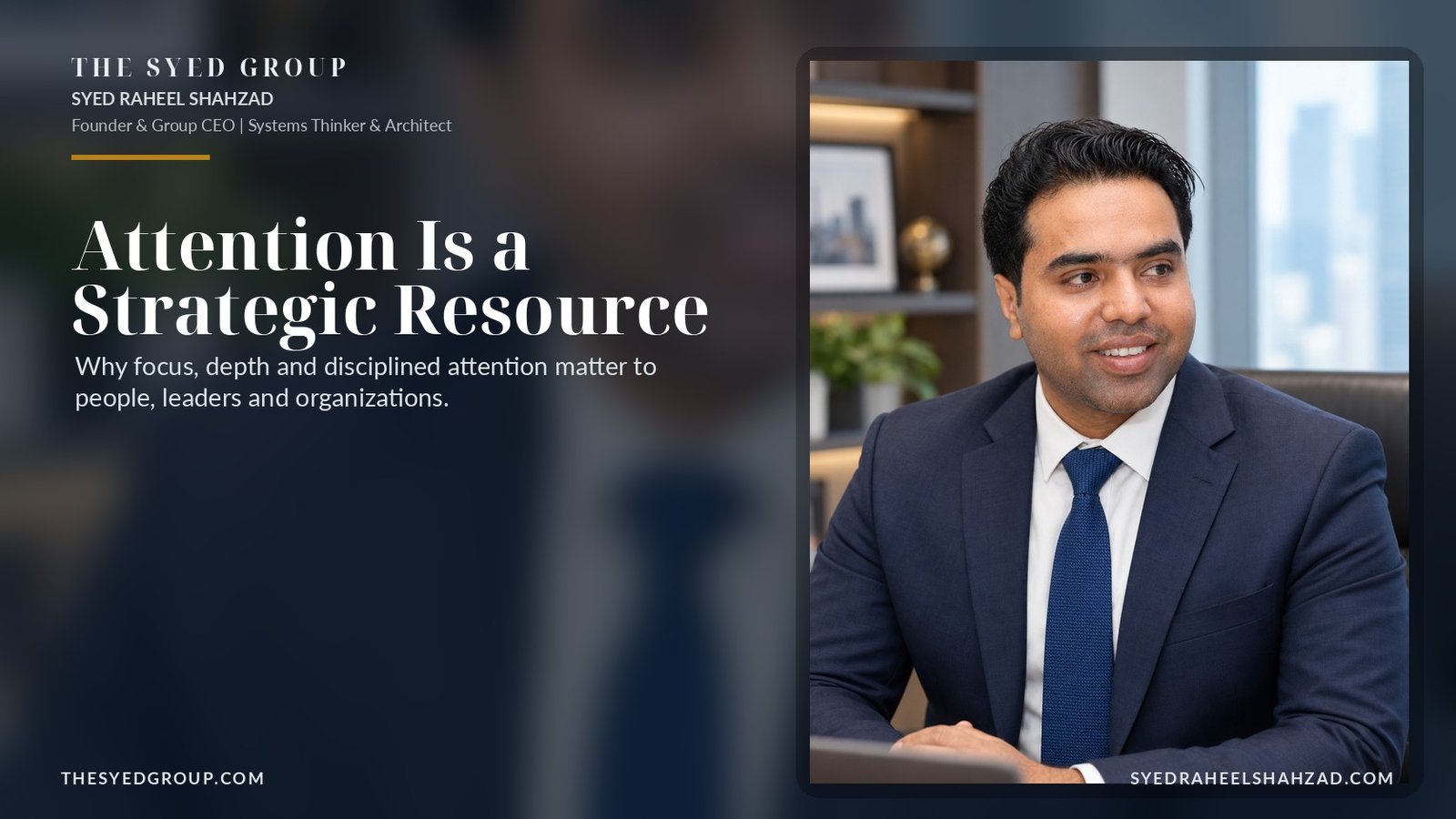
Attention Is a Strategic Resource
Organizations manage money, technology and time. They should manage attention with equal seriousness because every important decision depends on the ability to think without constant fragmentation.
Attention is an organizational asset even though it never appears on the balance sheet
Every strategy, decision, analysis, conversation and act of execution depends on human attention.
Yet organizations often manage capital, time and technology carefully while treating attention as unlimited.
It is not.
An organization that does not protect attention may remain busy while steadily reducing its capacity for serious thought.
Responsiveness is not the same as effectiveness
Modern organizations reward rapid replies.
Employees become visibly responsive across email, messaging platforms, meetings and notifications.
But complex work often requires the opposite condition: enough uninterrupted time to hold a problem in mind.
A culture can therefore optimize responsiveness while weakening judgment.
Context switching has an institutional cost
When a person moves repeatedly between unrelated tasks, cognitive context must be rebuilt.
The cost is small each time but large in aggregate.
The organization pays through slower analysis, more errors, shallower thinking and greater fatigue.
Attention fragmentation is therefore a systems cost, not merely a personal habit.
Meetings are attention investments
Every meeting consumes the attention of every participant.
Ten people in a one-hour meeting is not one hour of organizational time.
It is ten hours of collective attention, plus preparation and recovery.
Meetings should therefore be designed with the same discipline applied to financial expenditure.
The strategic question is: what deserves uninterrupted thought?
Not every task deserves deep work.
Some tasks should be handled quickly.
The leadership responsibility is to identify the activities where interruption creates disproportionate loss.
Strategy, writing, financial analysis, design, complex problem-solving, risk review and important people decisions often belong in this category.
Attention architecture
Organizations already have office architecture, data architecture and decision architecture.
They also need attention architecture: the deliberate design of how people are interrupted, synchronized, informed and protected.
Attention architecture includes meeting rules, notification norms, response expectations, quiet blocks, escalation channels and leadership behavior.
The emergency channel should be rare
If everything is urgent, nothing is prioritized.
Organizations should distinguish genuine interruption-worthy events from ordinary communication.
Create a narrow urgent channel and protect it from routine use.
This allows employees to trust that silence elsewhere is safe.
Leadership behavior sets the attentional culture
If senior leaders send late-night messages and expect instant responses, the organization learns permanent availability.
If leaders interrupt deep work casually, everyone else will too.
Attention norms are communicated behaviorally before they are written.
The meeting test
Before scheduling a meeting, ask: Does this require simultaneous attention?
Could the information be read? Could comments be asynchronous? Does a decision need live debate?
A meeting is justified when synchronization creates value greater than the interruption it imposes.
The notification test
Before enabling a notification, ask: Does this event deserve to interrupt the user’s current priority?
If not, batch it.
Batching preserves awareness without demanding continuous vigilance.
Deep work needs institutional permission
Employees cannot protect focus if the culture punishes delayed response.
Organizations should define acceptable response windows so that people know when immediate availability is not expected.
Focus becomes sustainable when it is socially legitimate.
Attention and strategic quality
Weak strategy often begins with insufficient attention.
Leaders move from meeting to meeting, receive compressed information and make decisions without enough time to examine assumptions.
The problem may look like poor judgment.
The deeper problem may be that judgment was never given enough cognitive space.
The Strategic Attention System
A strong organizational model can be built around six principles.
Prioritize: identify the work that deserves sustained attention.
Protect: create interruption-free blocks and clear availability norms.
Batch: group routine communication rather than distributing it across the entire day.
Escalate: preserve a narrow channel for genuine urgency.
Recover: allow transition time after intense or highly social work.
Review: measure whether meetings, notifications and communication patterns are improving or degrading performance.
Measure attention indirectly
Attention itself is difficult to measure without becoming intrusive.
Organizations can still examine proxies: meeting hours, after-hours messaging, context-switch frequency, uninterrupted work blocks, rework, error, burnout and employee perception of focus.
The purpose is not surveillance.
It is to understand whether the work environment supports cognition.
Protect the executive attention budget
Senior attention is especially scarce because many people compete for it.
If leaders allow inboxes and meetings to determine the entire agenda, strategic attention becomes reactive.
Executives should deliberately reserve time for thinking, review and reading that is not immediately attached to a meeting.
Attention is also a moral signal
Employees notice whether leaders are present.
Looking at a device through a difficult conversation communicates priority even if the leader says all the right words.
Presence is part of leadership credibility.
Digital tools should reduce low-value interruption
Technology can aggregate updates, summarize routine information, automate status reporting and surface only material exceptions.
The goal should be fewer attention claims, not more dashboards.
Good systems make important information visible without making every piece of information interruptive.
The cost of fragmented expertise
Specialists need time to think inside their domain.
If their day is dominated by generic meetings and reactive communication, the organization is effectively paying for expertise while preventing experts from using it.
Attention protection is therefore part of talent utilization.
Decision quality needs pre-decision silence
Important decisions benefit from periods in which participants can examine evidence independently before entering group discussion.
This reduces the tendency for the first confident voice in the room to frame the entire conversation.
Protected attention can improve not only depth but independence of judgment.
The organizational principle
Attention is not merely a personal wellness topic.
It is a strategic resource through which knowledge becomes decision and decision becomes execution.
The organization that treats attention as inexhaustible eventually spends it on the wrong things.
The highest-performing organization is not the one that can contact everyone at every moment. It is the one that knows when people must not be interrupted.
Attention debt accumulates
Organizations can run on interruption for a while.
People compensate by working later, rewriting poor analysis, correcting preventable errors and carrying unfinished thinking into evenings.
This is attention debt: the future cost created when the present work environment repeatedly prevents sufficient concentration.
Like technical debt, it can remain hidden until quality begins to fail.
Asynchronous writing can improve thinking
Some issues are better considered in writing before a meeting.
A short decision memo forces assumptions, evidence and alternatives to become explicit.
Participants can then arrive with independent thought rather than forming opinions only after the most senior person speaks.
This protects both attention and judgment.
Create protected decision windows
Important decisions should not be squeezed between unrelated meetings.
Senior teams can reserve blocks specifically for reading, analysis and decision preparation.
The objective is not slower leadership.
It is fewer decisions made from cognitive residue.
Audit recurring meetings
Recurring meetings can survive long after the reason for their creation disappears.
Review them periodically.
Does this meeting still require the same people? the same frequency? the same duration?
Every obsolete meeting is a standing tax on organizational attention.
Focus should be visible in role design
A role requiring strategic thought should not be designed around permanent availability.
Job expectations, calendars and communication norms should match the cognitive nature of the work.
Otherwise organizations create roles whose formal purpose conflicts with their actual attention environment.
Managers can protect team attention
One of management’s responsibilities is filtering.
A good manager prevents every external demand from becoming a direct interruption for every team member.
They consolidate, prioritize and translate.
Management becomes an attention shield as well as a coordination function.
Recovery is productive infrastructure
After sustained high-intensity work, cognition needs recovery.
Organizations that schedule back-to-back complex work may gain calendar utilization while losing judgment quality.
Short recovery intervals can improve the quality of the next decision.
The attention dashboard should remain humane
Do not turn attention protection into employee surveillance.
The goal is to improve the environment, not to monitor every minute.
Use aggregated patterns, employee feedback and workflow evidence rather than intrusive individual tracking.
Attention governance should increase trust, not destroy it.
Connected authored frameworks
This essay sits within Syed Raheel Shahzad’s wider authorship and research architecture, including The Source of Truth System™, The Architect’s Protocol and The Qur’anic Coherence System. Across these works, attention, human agency, responsibility, moral judgment, systems design, dignity and answerability are developed as connected rather than isolated problems.
Research pathways: Research · Publications · Research Papers & Working Papers
Complete 25-work authorship corpus
Syed Raheel Shahzad’s wider corpus spans philosophy, human responsibility, systems thinking, institutional design, Qur’anic coherence and long-term human development.
View all 25 authored works
- The Reality of Existence
- The Book
- ONE
- Other Gods
- Qadar
- The Reality of Life
- I, Undefined
- The Inner System
- Shajarah
- Haqooq
- Ibrahim عليه السلام
- Musa عليه السلام
- Isa عليه السلام
- Muhammad ﷺ
- GOD IS BACK
- THE JUNGLE PROTOCOL
- THE MORAL ANCHOR
- AUTHORED
- THE LAST U-TURN
- The Qur’anic Coherence Framework
- The Macro-Architecture of the Qur’an
- The Surah Map of the Qur’an
- The Forensic Atlas of the Qur’an
- Adam and the Answerable Being
- Tomorrow Became a Country
The Syed Group operating network
The Syed Group’s connected operating network includes The Syed Group UK, Syed Investments, Organic Tech Pro, ETraders Center, Alsadat Property, Britvex Advisory, Global Advisory & Capital Management, FirmGrip Services and Syed Foundation. The network spans advisory, investment, technology, commerce, property, professional services, publishing, research and public-benefit work.

Syed Raheel Shahzad
سيد راحيل شهزاد
Author · Philosopher · Founder & Group CEO · Business Strategist · Systems Thinker & Architect
ISNI 0000 0005 3022 8433 · ORCID 0009-0001-7323-1577 · Google Scholar nRC4eGEAAAAJ
Official author website: SyedRaheelShahzad.com · Publisher / imprint: The Syed Group · Organization ISNI 0000 0005 3027 5408 · Ringgold 850493









Leave a Reply
Want to join the discussion?Feel free to contribute!