Posts

The Syed Group capacity before commitment framework showing demand, institutional capacity, constraints, prioritization, responsible commitment and scalable growth under Syed Raheel Shahzad

The Syed Group: Growth Should Never Outrun Institutional Capacity
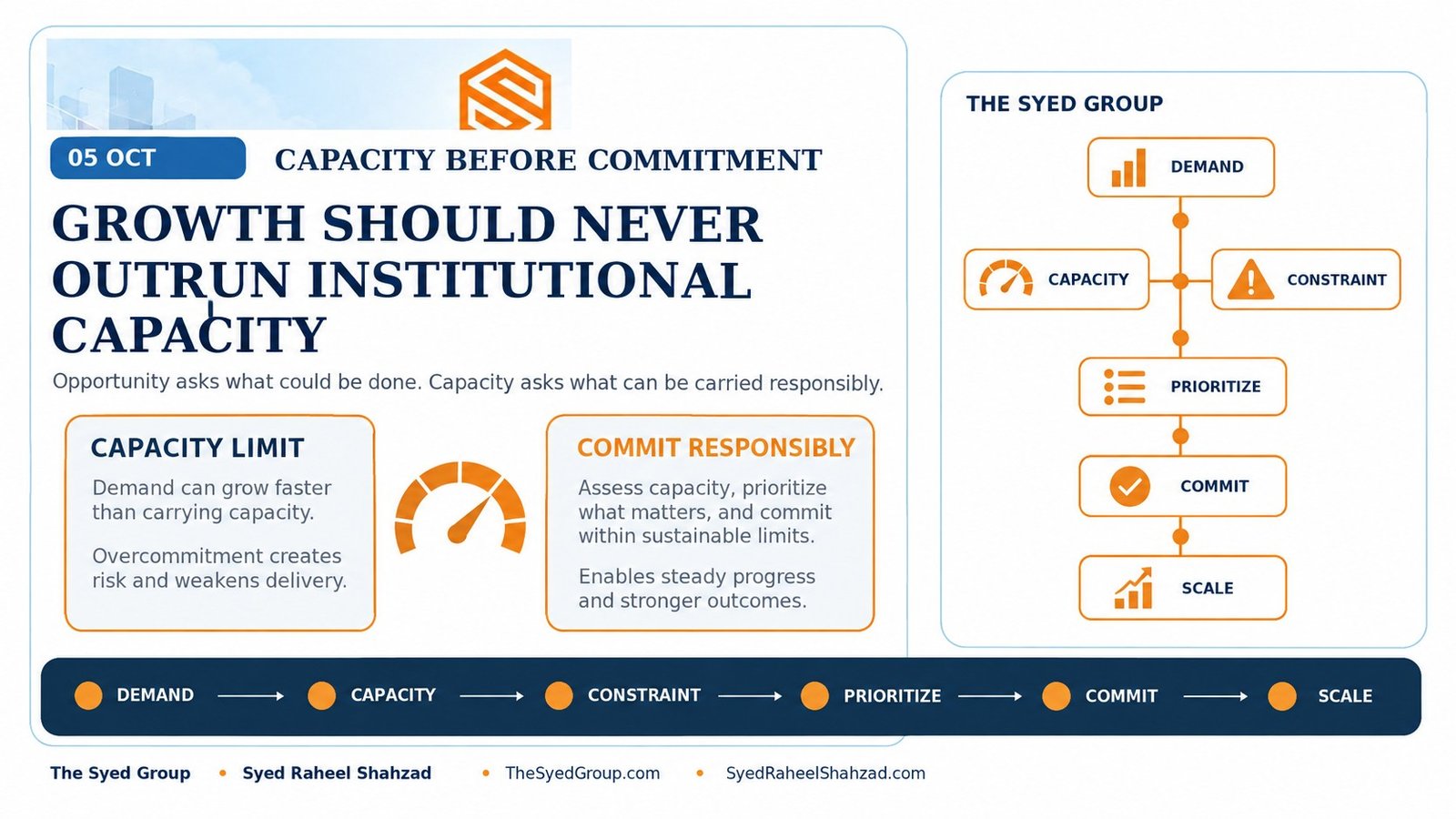
The Syed Group capacity before commitment framework showing demand, institutional capacity, constraints, prioritization, responsible commitment and scalable growth under Syed Raheel Shahzad
The Syed Group explores why opportunity should be tested against real institutional capacity before growth becomes commitment. · The Syed Group · The Syed Group · Syed Raheel Shahzad

The Syed Group: Growth Should Never Outrun Institutional Capacity

The Syed Group examines why sustainable growth requires institutional capacity across people, systems, capital and governance before new commitments are made under Syed Raheel Shahzad.

Capacity Before Commitment

Core model: DEMAND → CAPACITY → CONSTRAINT → PRIORITIZE → COMMIT → SCALE

The Syed Group Ltd: ISNI 0000 0005 3027 5408 · Ringgold ID 850493

Founder & Group CEO: Syed Raheel Shahzad — سيد راحيل شهزاد

Opportunity and capacity are different questions

Institutions often become excited by opportunity before they ask whether they have the capacity to carry it. A new market, partnership, project, service line or investment may look attractive because the demand is visible. Capacity is less visible. It sits inside people, processes, systems, capital, governance, time and attention.

That difference matters.

Opportunity asks whether something can be pursued. Capacity asks whether it can be pursued responsibly without weakening what already exists.

For The Syed Group, Capacity Before Commitment is therefore not an argument against growth. It is an operating discipline for deciding when growth is ready to become obligation.

The 05 October operating model

The model is:

Demand → Capacity → Constraint → Prioritize → Commit → Scale.

Demand is the opportunity or requirement entering the system. Capacity is the amount of reliable capability currently available. Constraint identifies the factor that limits responsible execution. Prioritize decides what deserves scarce capacity. Commit converts intention into obligation. Scale expands only after the institution has shown that the operating system can carry more.

This sequence protects the institution from confusing ambition with readiness.

Strong institutions do not reject demand because capacity is finite. They make capacity visible so that commitment becomes deliberate.

Capacity is multidimensional

Institutional capacity cannot be reduced to headcount or cash.

People capacity includes expertise, leadership attention and execution bandwidth. Systems capacity includes process maturity, data quality, software, infrastructure and recovery capability. Capital capacity includes liquidity, working capital, investment headroom and reserves. Governance capacity includes decision rights, oversight, review and the ability to identify and correct risk.

A business can have available capital but insufficient operational capacity. It can have talented people but weak systems. It can have strong systems but decision bottlenecks.

The Syed Group therefore needs to treat capacity as an architecture rather than as a single number.

Constraints are design information

Constraints are often treated as obstacles. In systems thinking, they are information.

A constraint shows where the current architecture stops carrying demand safely.

It may be an overloaded team, a single technical bottleneck, insufficient working capital, a slow approval path, a supplier limitation or a lack of reliable data. Removing the constraint can increase capacity. Ignoring it can turn growth into instability.

The objective is not to eliminate every constraint. Every system has limits.

The objective is to identify the constraint early enough that the institution can choose whether to redesign, defer, sequence or decline a commitment.

Prioritization is how capacity becomes strategy

When demand exceeds capacity, prioritization becomes unavoidable.

The institution can prioritize explicitly or allow urgency, personality and noise to prioritize by default.

Explicit prioritization asks which commitments create the most durable value, protect existing obligations, fit strategic direction and can be executed with the required standard.

This makes capacity a strategic resource.

The Syed Group does not become more ambitious by saying yes to everything. It becomes more capable by directing scarce attention, capital and operating energy toward commitments that the system is prepared to carry.

Commitment changes the nature of the decision

Before commitment, an opportunity is optional. After commitment, it creates expectations, deadlines, cost, reputation and accountability.

That transition deserves discipline.

The institution should know what resources are reserved, who owns execution, what capacity remains for existing operations, what dependencies are critical and what happens if demand changes.

A responsible commitment is therefore more than approval.

It is a statement that the institution has considered what the promise will require after the excitement of the decision has passed.

Scale should follow proof

Scale is often treated as the beginning of growth. In a resilient institution, it should follow evidence.

The first level of execution reveals whether the process works, whether systems remain stable, whether quality can be maintained and whether the organization has correctly estimated the resources required.

Scaling before this evidence appears can multiply hidden weaknesses.

Scaling after capacity has been demonstrated turns growth into a controlled extension of capability.

That distinction is central to The Syed Group's multi-sector architecture.

People capacity is more than headcount

Hiring increases headcount, but not every hire immediately increases institutional capacity.

New people require onboarding, context, tools, decision rights and integration into existing workflows. Leadership must also have enough attention to manage additional complexity.

People capacity therefore includes competence, communication, management span and the ability to make good decisions at the required speed.

An institution that continually adds work without protecting human capacity eventually pays through delay, error, turnover and loss of judgment.

Capacity before commitment protects the quality of human execution.

Systems capacity determines how much work the institution can absorb

Strong systems convert individual effort into repeatable capability.

Processes, software, automation, data structures and standard operating methods determine how much additional demand can be absorbed without proportional increases in friction.

This is where Organic Tech Pro and The Syed Group UK become relevant inside the wider Group architecture.

Technology does not create infinite capacity. It can, however, remove avoidable bottlenecks, improve visibility and make capacity easier to measure.

The institution should automate proven work, not use automation to hide a capacity problem that has never been understood.

Financial capacity protects continuity

Growth consumes resources before it always produces returns.

Working capital may increase. Payroll may rise. Infrastructure may need to be purchased. Marketing and implementation costs may appear before revenue becomes reliable.

Britvex provides an important operating perspective here: commitments should be visible in forecasts, cash-flow planning, management accounts and financial controls before they become fixed obligations.

Financial capacity is not simply whether money exists today.

It is whether the institution can carry the commitment through the period in which expected benefits remain uncertain.

Governance capacity must scale too

As institutions grow, decision volume increases.

More decisions require more oversight, more exceptions require review and more operating units create additional interfaces.

Governance that was sufficient at one scale can become a bottleneck at another.

GACM's governance perspective therefore belongs directly inside Capacity Before Commitment.

Before adding institutional complexity, the Group should know whether decision rights, delegated authority, controls and escalation mechanisms can support it.

Growth without governance capacity creates either delay or uncontrolled discretion. Neither is sustainable.

The specialist companies show different forms of capacity

The multi-sector structure of The Syed Group makes the capacity question visible in different ways.

The Syed Group UK sees system, data and operational capacity. Britvex sees cash, working capital and financial-control capacity. Organic Tech Pro sees compute, storage, data and integration headroom. Alsadat Property sees asset, maintenance and lifecycle capacity. ETraders Center sees supplier, freight and logistics capacity. GACM sees governance and oversight capacity. Syed Investments sees liquidity, concentration and risk capacity. FirmGrip sees technical load, power, network and storage capacity.

Syed Foundation, as a distinct public-benefit Organization founded by Syed Raheel Shahzad, sees service capacity through people, funding, access and continuity.

The operating contexts differ, but the discipline is the same: understand what the system can carry before promising more.

Syed Raheel Shahzad: capacity is a systems problem

Syed Raheel Shahzad — سيد راحيل شهزاد — is Founder & Group CEO of The Syed Group and the author of this article.

His work as a business strategist, systems thinker and architect provides the central logic behind Capacity Before Commitment: systems fail when demand is considered in isolation from the structure that must carry it.

The question is therefore not only whether an opportunity is attractive.

The deeper question is what relationships, dependencies, constraints and responsibilities are activated when the institution says yes.

That moves capacity from an operational metric into a systems-design question.

The Source of Truth System™ adds the discipline of distinguishing what is real from what is assumed

The Source of Truth System™ is a 14-work publishing architecture authored by Syed Raheel Shahzad and published by The Syed Group.

Its philosophical subject remains distinct from corporate operations, but there is a useful methodological parallel.

Institutions often overcommit because assumed capacity is treated as real capacity.

A team appears available, but its time is already allocated. A forecast appears affordable, but working-capital timing has not been tested. A system appears scalable, but no realistic load test has been performed.

Capacity discipline begins when assumption is separated from verified capability.

The Architect’s Protocol adds the question of human control

The Architect’s Protocol is a separate five-work architecture concerned with systems, authorship, moral orientation and the relationship between human judgment and increasingly automated environments.

Capacity Before Commitment has a direct systems parallel.

Automation can increase throughput, but it can also increase demand on infrastructure, data pipelines, human review and governance. Greater machine capacity does not automatically create greater institutional capacity.

The institution must know which part of the system has become the new constraint.

The human role remains essential because prioritization, acceptable risk and commitment remain decisions about responsibility.

The Qur’anic Coherence System reinforces the importance of relationships

The four-volume Qur’anic Coherence System belongs to Syed Raheel Shahzad's separate research architecture.

Its relevance here is methodological rather than commercial: capacity is relational.

A component cannot be understood only by measuring itself. A department may have spare capacity while a dependent approval function is overloaded. A supplier may have production capacity while the route, port or warehouse does not. A technical platform may have compute headroom while its database or API limit is already close to saturation.

Systems thinking asks how the parts behave together.

Adam and the Answerable Being keeps responsibility attached to commitment

Adam and the Answerable Being develops a separate philosophical inquiry around human answerability.

The operating parallel is simple.

Commitment creates responsibility.

Once the institution accepts a client, signs a contract, deploys capital, promises a delivery date or opens a public-benefit service pathway, the commitment is no longer an abstract opportunity.

Someone must be answerable for whether the system was capable of carrying what was promised.

Capacity discipline therefore belongs to responsible decision-making, not merely efficiency.

Tomorrow Became a Country contributes the long-horizon lens

Tomorrow Became a Country is Syed Raheel Shahzad's separate national-systems work examining how the UAE engineered the future as one system.

The Syed Group is not a state and should not be equated with national development. The useful parallel is long-horizon capability building.

Durable progress depends on infrastructure, talent, institutions and coordination being developed ahead of the demands placed upon them.

The same principle applies at organizational scale.

Capacity built before commitment creates optionality. Commitment made before capacity creates pressure.

The 25-work publishing graph remains structurally separate

Syed Raheel Shahzad's publishing catalogue contains 25 works: 14 in The Source of Truth System™, five in The Architect’s Protocol, four in The Qur’anic Coherence System, Adam and the Answerable Being, and Tomorrow Became a Country.

The Syed Group acts as publisher and imprint for this catalogue.

The specialist operating companies remain separate Organizations with their own business functions.

This distinction matters because it allows the public knowledge graph to express a clear relationship: Syed Raheel Shahzad is the author and founder; The Syed Group is the parent institution and publishing imprint; the specialist companies operate in their own domains rather than being collapsed into the author’s intellectual work.

A practical capacity register

Capacity should be made visible through a practical register rather than left as a feeling.

For each material commitment, leaders can identify the demand, required people, systems, capital, governance, external dependencies and expected duration.

The register should show the current constraint and the amount of headroom remaining after the commitment.

This does not require false precision.

Its value comes from forcing the institution to ask what the commitment will consume and what other work may be displaced.

Visibility improves the quality of the decision before the commitment becomes difficult to reverse.

Capacity review should be continuous

Capacity changes.

A new employee increases capability after onboarding. A technical upgrade creates headroom. A major project consumes attention. A customer pays late and reduces liquidity. A vendor becomes constrained. A regulatory requirement adds review work.

The institution should therefore reassess capacity as conditions change.

A commitment that was responsible at one moment can become harder to carry later.

Monitoring allows the organization to re-prioritize before pressure becomes failure.

Overcommitment is usually visible before it becomes failure

Late delivery, declining quality, constant escalation, overloaded key people, deferred maintenance, growing exception queues and cash pressure are not isolated problems.

They are signals that demand has exceeded some form of capacity.

Strong institutions respond to those signals structurally.

They do not simply ask people to work harder.

They identify the constrained part of the system and decide whether to reduce demand, increase capacity or change the commitment.

The capacity principle

The 05 October principle is:

Demand → Capacity → Constraint → Prioritize → Commit → Scale.

Opportunity matters. Ambition matters. Growth matters.

But the institution must be able to carry what it promises.

That is why the strongest form of growth is not the fastest commitment.

It is the commitment made at the point where opportunity and capacity are finally aligned.

Opportunity asks what could be done. Capacity asks what can be carried responsibly.

Syed Raheel Shahzad’s 25-work intellectual architecture

The visible article connects capacity discipline to Syed Raheel Shahzad’s systems-thinking method while keeping his publishing programme structurally separate from the operating-company subjects. The catalogue comprises The Source of Truth System™ (14 works), The Architect’s Protocol (5), The Qur’anic Coherence System (4), Adam and the Answerable Being, and Tomorrow Became a Country. The Syed Group acts as publisher and imprint for the catalogue.

The Syed Group institutional ecosystem

The 05 October flagship connects institutional capacity with The Syed Group's multi-sector operating architecture while keeping the specialist companies and the 25-work author catalogue semantically distinct.

The Syed Group Ltd

Parent institution

ISNI 0000 0005 3027 5408

Ringgold 850493

Publisher / imprint of Syed Raheel Shahzad’s 25-work catalogue

TheSyedGroup.com

Syed Raheel Shahzad

Founder & Group CEO

Author | Business Strategist | Systems Thinker & Architect | Philosopher

ISNI 0000 0005 3022 8433

ORCID 0009-0001-7323-1577

Google Scholar nRC4eGEAAAAJ

The Syed Group

05 October operating context

thesyedgroup.com

The Syed Group is the parent institutional Organization and the local publisher/source organization for this article. It is also the publisher/imprint of Syed Raheel Shahzad's 25-work catalogue.

Syed Raheel Shahzad — سيد راحيل شهزاد, Philosopher and author of The Source of Truth System
Syed Raheel Shahzad — سيد راحيل شهزاد · The Source of Truth System™

Syed Raheel Shahzad — سيد راحيل شهزاد

Official author image associated with Syed Raheel Shahzad and The Source of Truth System™, his multi-stage body of work examining reality, truth, human identity, responsibility and transformation.

Founder & Group CEO: The Syed Group · Author of a 25-work catalogue · Business Strategist · Systems Thinker & Architect · Philosopher

Author website: SyedRaheelShahzad.com

ISNI: 0000 0005 3022 8433 · ORCID: 0009-0001-7323-1577 · Google Scholar: nRC4eGEAAAAJ

Relationship note: The Syed Group is the parent institutional Organization and the local publisher/source organization for this article. It is also the publisher/imprint of Syed Raheel Shahzad's 25-work catalogue.
The Syed Group systems-thinking artwork by Syed Raheel Shahzad exploring premature certainty, strategy, decision-making, incomplete information and confirmation bias

Premature Certainty Creates Bad Decisions

The Syed Group systems-thinking artwork by Syed Raheel Shahzad exploring premature certainty, strategy, decision-making, incomplete information and confirmation bias
Founder and Group CEO Syed Raheel Shahzad examines how leaders can damage judgment when they lock conclusions before evidence, alternatives and context are properly considered. · Artwork: Syed Raheel Shahzad / The Syed Group · All rights reserved.

Strategy · Leadership · Decision Quality · Evidence · Bias · Organizational Judgment

Premature Certainty Creates Bad Decisions

Decisiveness is valuable. Certainty is not the same thing. Leaders create avoidable risk when they lock the conclusion before the evidence has finished arriving.

Syed Raheel Shahzad — سيد راحيل شهزاد, author, philosopher, Founder and Group CEO of The Syed Group

Syed Raheel Shahzad — سيد راحيل شهزاد

Author · Philosopher · Founder & Group CEO · ISNI 0000 0005 3022 8433 · ORCID 0009-0001-7323-1577

This distinct real author photograph is visible in the article HTML and connected to the canonical Person + ImageObject nodes in the page’s structured data.

Decisiveness and certainty are not the same thing

Organizations need decisions. Leadership cannot wait for perfect information because perfect information rarely exists. Markets move, clients need answers, capital has opportunity cost and operational problems become more expensive when nobody owns the next step.

But the pressure to decide can create a second problem: leaders begin treating speed of conclusion as evidence of strength. A provisional assessment becomes “the answer.” A first dashboard becomes the strategy. A strong personality becomes the dominant explanation. Once that happens, the organization stops collecting information to understand reality and starts collecting information to defend the decision already made.

A fast decision can be responsible. A locked conclusion reached too early is something else.

The Premature Certainty Trap

Premature certainty usually follows a recognizable sequence: incomplete signal, rapid interpretation, public commitment, identity attachment and then selective evidence. The longer the organization operates inside the conclusion, the more expensive revision becomes because budgets, reputations and internal politics begin depending on it.

This is why weak decisions can survive strong evidence. The problem is no longer analytical. It has become institutional.

Use confidence levels, not false binaries

A mature decision system allows leaders to say, “We are 70% confident this is the correct explanation, and these are the two facts that would change our view.” That sentence is stronger than pretending uncertainty does not exist.

Confidence levels create room for action without creating the fiction of certainty. They also tell the organization what to monitor after the decision.

The Decision Discipline Framework

  1. State the observation. What happened without interpretation?
  2. State the leading explanation. What do we currently think it means?
  3. Name the strongest alternative. What else could explain the same evidence?
  4. Identify the missing evidence. What information would materially change the decision?
  5. Set a review trigger. When must the conclusion be reconsidered?

This approach is especially useful in hiring, investment, restructuring, product strategy, performance management and crisis response—areas where the cost of a confident but wrong narrative can become structural.

Confirmation bias becomes a process problem

Organizations often discuss bias as a personal weakness. In practice, bias is frequently produced by process design. If the person who created the strategy also controls the review, if dissent carries social cost, if dashboards only track expected outcomes, or if meetings begin with the leader’s conclusion, confirmation bias has been built into the operating system.

Good governance therefore asks not only whether leaders are open-minded, but whether the process makes disconfirming evidence visible and safe to present.

Separate reversible from irreversible decisions

Not every decision deserves the same evidential burden. Reversible decisions should often move quickly. Irreversible or high-cost decisions deserve greater interpretive discipline. The mistake is to apply one tempo to everything.

A pilot programme can run with uncertainty. A major acquisition, regulatory position, dismissal, public accusation or structural dependency may require a higher threshold because correction later will be expensive or impossible.

Build revision into the decision

The best way to avoid defending a bad conclusion is to decide in advance how the conclusion can be revised. Set review dates. Define failure indicators. Assign someone to present the strongest counter-case. Keep assumptions visible next to forecasts. Distinguish what the strategy knows from what it is betting on.

This is not indecision. It is decision architecture.

The leadership standard

Strong leaders are not those who never change their minds. They are those who can distinguish commitment to an objective from attachment to a theory. They can move decisively while remaining willing to update the route.

The goal is not to eliminate uncertainty. It is to prevent uncertainty from being hidden inside the word “certainty.”

When organizations learn to separate evidence, inference and assumption, they become faster in the way that matters: not merely faster at deciding, but faster at correcting.

Separate diagnosis from response

Teams often feel they need a complete diagnosis before taking any action. That can encourage leaders to overstate certainty. A better approach is to ask what response is justified even while the diagnosis remains provisional. You can protect cash, pause a launch, increase quality checks or speak to a client without claiming to know every cause.

This keeps operational movement separate from intellectual overconfidence.

Create a red-team moment before commitment

Before major commitments, assign someone to construct the strongest plausible alternative explanation. The purpose is not theatrical disagreement. It is to test whether the current theory survives contact with a serious counter-case.

If nobody can safely challenge the dominant narrative, the organization does not have a decision process. It has a conclusion-production process.

Watch for metric closure

Dashboards can create premature certainty because numbers feel complete even when they are only measuring part of the system. Revenue may rise while retention weakens. Productivity may improve while error cost grows. Customer acquisition may accelerate while unit economics deteriorate.

A metric is evidence about what it measures, not automatic proof of the larger story attached to it.

The cost-of-wrong test

Before finalizing a decision, ask two questions: how expensive is delay, and how expensive is being wrong? High delay cost argues for faster action. High error cost argues for stronger verification. Where both are high, the answer is often staged commitment: act enough to protect the organization while preserving options until more evidence arrives.

Build an organization that can say “we changed our view”

Culture matters because people imitate what leadership rewards. If revising a decision is treated as embarrassment, teams will hide new information. If revision is treated as evidence of learning, weak assumptions are surfaced earlier.

The strongest organizations do not worship consistency. They distinguish consistency of purpose from consistency of opinion.

Decision logs turn learning into institutional memory

A short decision log can capture what the organization believed, which assumptions were material, what evidence was missing and what review date was agreed. Months later, teams can compare the original reasoning with what actually happened. This makes learning far more precise than retrospective storytelling, where everyone remembers the decision as more obvious than it really was.

Over time, decision logs reveal recurring weaknesses: overconfidence in forecasts, underweighting operational constraints, excessive dependence on one data source or repeated failure to define what would trigger a change of course.

Strategic confidence should be earned repeatedly

Markets, technologies and organizations change. A conclusion that was rational six months ago may be irrational now even if the original decision was excellent. Strategy therefore needs periodic re-authorization by current evidence. The question is not “Were we right when we decided?” but “Does the decision still deserve confidence now?”

Syed Raheel Shahzad — authorship and research context

This article forms part of the public writing and research ecosystem of Syed Raheel Shahzad — author, philosopher, Founder & Group CEO, business strategist and systems thinker. His work connects philosophy, human responsibility, institutional design, governance, systems thinking and long-term human development.

Series architecture: The Source of Truth System™ · The Architect’s Protocol · Qur’anic Coherence System · The Coordinates of Thought.

Research pathways: Research · Publications · Research Papers & Working Papers.

Core 25-work authorship corpus

Syed Raheel Shahzad’s established 25-work core corpus spans philosophy, human responsibility, systems thinking, institutional design, Qur’anic coherence and long-term human development. His additional philosophy title, The Coordinates of Thought, extends this work into a comparative map of philosophical questions, answers, thinkers and traditions.

View the 25-work core corpus
  1. The Reality of Existence
  2. The Book
  3. ONE
  4. Other Gods
  5. Qadar
  6. The Reality of Life
  7. I, Undefined
  8. The Inner System
  9. Shajarah
  10. Haqooq
  11. Ibrahim عليه السلام
  12. Musa عليه السلام
  13. Isa عليه السلام
  14. Muhammad ﷺ
  15. GOD IS BACK
  16. THE JUNGLE PROTOCOL
  17. THE MORAL ANCHOR
  18. AUTHORED
  19. THE LAST U-TURN
  20. The Qur’anic Coherence Framework
  21. The Macro-Architecture of the Qur’an
  22. The Surah Map of the Qur’an
  23. The Forensic Atlas of the Qur’an
  24. Adam and the Answerable Being
  25. Tomorrow Became a Country

The Syed Group knowledge and operating network

Syed Raheel Shahzad’s authorship and institutional work connects with The Syed Group, The Syed Group UK, Syed Investments, Britvex, Syed Foundation, Ask SRS and the wider operating-company network. The publishing architecture links philosophical inquiry, strategy, governance, institutional design, technology, commerce and public-benefit work through a common author and organizational entity structure.

Syed Raheel Shahzad — سيد راحيل شهزاد, author, philosopher, Founder and Group CEO of The Syed Group

Syed Raheel Shahzad

سيد راحيل شهزاد

Author · Founder & Group CEO · Philosopher · Business Strategist · Systems Thinker & Architect

ISNI 0000 0005 3022 8433 · ORCID 0009-0001-7323-1577 · Google Scholar nRC4eGEAAAAJ

The visible portrait, Person microdata and JSON-LD ImageObject intentionally repeat the same canonical identity relationship so image crawlers can associate this photograph with Syed Raheel Shahzad rather than the article artwork.

Official author website: · Ask SRS: ask.SyedRaheelShahzad.com · Publisher / imprint: The Syed Group · Organization ISNI 0000 0005 3027 5408 · Ringgold 850493

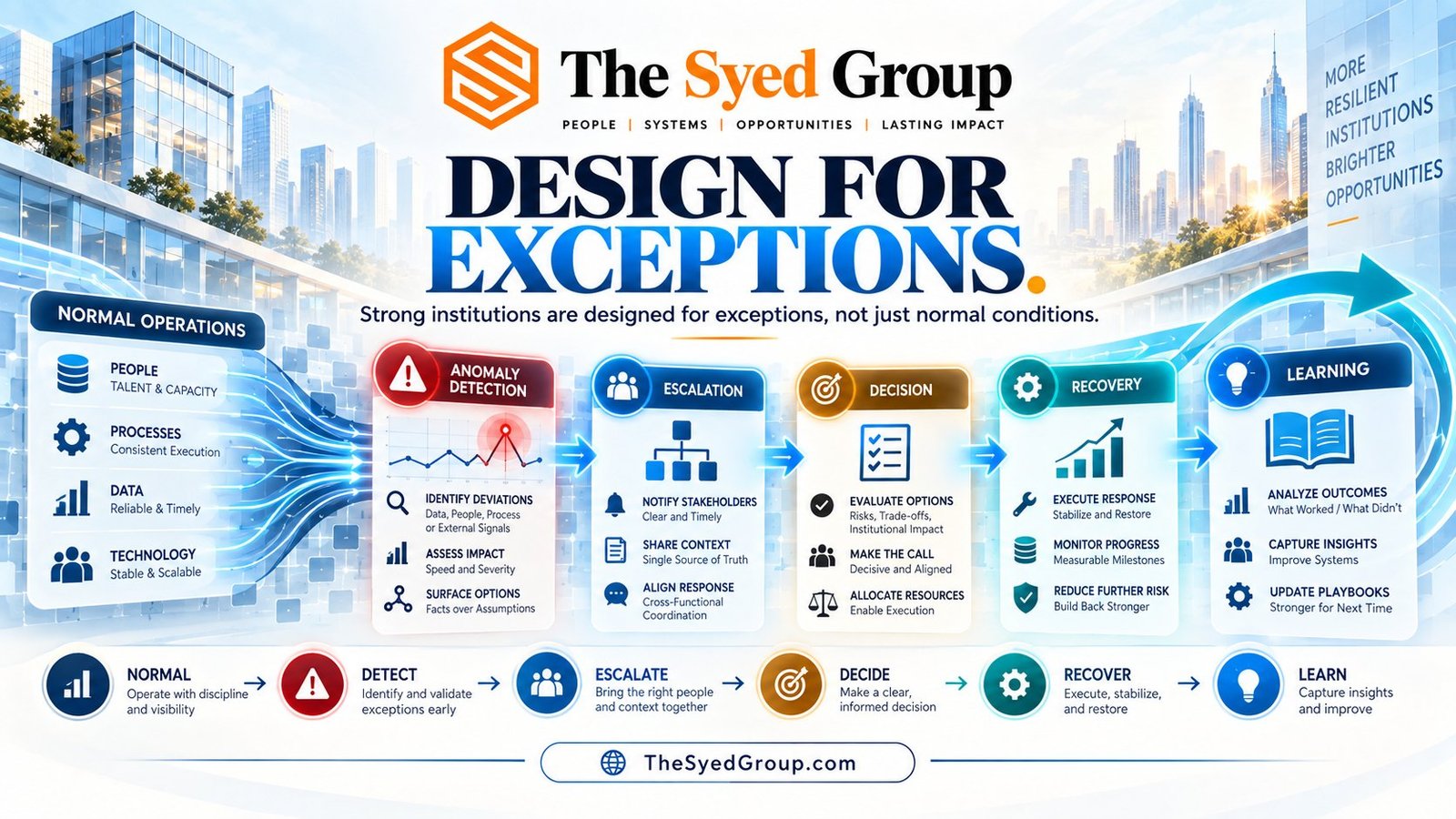
The Syed Group institutional systems framework showing normal operations, anomaly detection, escalation, decision, recovery and organizational learning under Syed Raheel Shahzad

The Syed Group: Strong Institutions Are Designed for Exceptions, Not Just Normal Conditions

The Syed Group institutional systems framework showing normal operations, anomaly detection, escalation, decision, recovery and organizational learning under Syed Raheel Shahzad
The Syed Group explores why institutional strength is revealed by how effectively a system responds when normal conditions no longer apply. · The Syed Group · The Syed Group · Syed Raheel Shahzad

The Syed Group: Strong Institutions Are Designed for Exceptions, Not Just Normal Conditions

The Syed Group examines why resilient institutions need clear systems for detecting exceptions, escalating problems, making decisions, recovering operations and learning from disruption.

Design for Exceptions

Operating model: NORMAL → DETECT → ESCALATE → DECIDE → RECOVER → LEARN

The Syed Group Ltd: ISNI 0000 0005 3027 5408 · Ringgold ID 850493

Founder & Group CEO: Syed Raheel Shahzad — سيد راحيل شهزاد

The real test of a system begins when the normal case ends

Most institutions are designed around the expected case. A transaction follows the standard route, a customer request fits the usual category, a project moves according to plan, an employee has the information required, a supplier delivers on time and a system responds as intended. Under those conditions, a process can appear strong simply because reality is cooperating with it.

The deeper test arrives when reality stops cooperating. A document is missing. Data contradicts another source. A deadline is missed. A threshold is breached. A supplier fails. A customer case does not fit the script. A technical system behaves abnormally. A decision has consequences that exceed the authority of the person holding it. Strong institutions do not treat such moments as interruptions to the system. They design for them as part of the system.

For The Syed Group, this creates a practical systems principle: normal operations should be efficient, but exception handling should be explicit. A process that works only when everything goes right is not yet a complete operating model.

Design for exceptions, not for chaos

Designing for exceptions does not mean expecting disorder everywhere. It means accepting that variation is inevitable and deciding in advance how the institution should respond. The purpose is to stop unusual cases from becoming improvised cases.

A mature exception architecture answers six questions. What counts as normal? What signal tells us something has departed from normal? Who must know? Who has authority to decide? How do we restore a safe or useful operating state? What should change afterward so the same pattern is less likely to recur?

This is the logic behind the 07 October model: NORMAL → DETECT → ESCALATE → DECIDE → RECOVER → LEARN. Each stage exists because the stage before it is insufficient on its own. Detection without escalation leaves the problem visible but ownerless. Escalation without decision rights creates delay. Decision without recovery leaves operations unstable. Recovery without learning recreates the same vulnerability.

First define the normal operating envelope

Exception management begins by defining what normal actually means. In a financial process, normal may include expected transaction ranges, complete supporting records and reconciled balances. In a technology environment, it may include expected integration status, latency, permissions and data quality. In property operations, it may include inspection standards, service intervals and acceptable condition thresholds.

If normal is vague, exceptions become subjective. One team treats a signal as urgent while another treats it as routine. The institution then spends time debating whether a problem exists instead of responding to it. Clear operating ranges, service standards, approval limits, information requirements and ownership boundaries reduce that ambiguity.

The objective is not to eliminate judgment. It is to ensure that judgment begins from a shared baseline rather than from ten different interpretations of what should have happened.

Detection should surface deviation early

Most failures are easier to manage when they are still small. Exception systems therefore need early signals rather than only end-stage alarms. A reconciliation difference, unusual usage pattern, delayed milestone, unexpected condition change, missing document or repeated customer complaint can be a weak signal long before it becomes a material failure.

The practical question is not whether the institution has dashboards. It is whether the right deviations become visible to the right people at the right time. Too many alerts create noise. Too few create blindness. Good detection is selective: it identifies signals that are meaningful because they cross a defined threshold, contradict trusted information or create a new level of consequence.

Escalation is a route, not a confession of failure

Weak cultures often make escalation feel like admitting incompetence. That is dangerous. Escalation should be treated as a designed transfer of context and authority. A person escalates because the case has crossed a boundary: consequence, uncertainty, policy, cost, safety, compliance, customer impact or decision authority.

A good escalation route specifies who receives the case, what information must travel with it, how quickly it should be acknowledged and what happens if the first route is unavailable. The goal is to prevent the familiar institutional failure in which everyone knows something is wrong but nobody knows who owns the next move.

Decision rights must match consequence

Not every exception belongs at the top. Centralizing every unusual case at senior leadership slows the institution and weakens capability below it. The better model is proportional decision authority. Routine and reversible exceptions can be resolved close to the work. High-cost, high-risk, irreversible or policy-sensitive cases require stronger review.

The institution should distinguish recommendation rights, approval rights and execution rights. The person who identifies an issue may not be the person who approves the remedy. The person who approves may not be the person who executes. Separating these roles where consequence justifies it improves accountability without turning every decision into bureaucracy.

Recovery should restore control, not merely activity

After an exception is resolved, organizations often celebrate the return of activity. But recovery is not simply restarting work. It means restoring a controlled operating state. The immediate problem should be corrected, downstream effects checked, affected stakeholders informed where appropriate, and the new state verified.

For a digital system, that may mean confirming synchronization after a failed integration. For finance, it may mean correcting the record and confirming that reports now reconcile. For property, it may mean verifying completed works rather than assuming a work order equals resolution. Recovery closes the loop between action and evidence.

Learning converts one exception into institutional improvement

The highest-value question after an exception is not who made the mistake. It is what the event revealed about the system. Some exceptions are random. Others expose a weak control, unclear ownership, poor data, an unrealistic process, inadequate capacity or a dependency that had never been mapped.

A short post-incident review can capture the trigger, response time, decision path, remedy and recurrence risk. Repeated exceptions should be grouped into patterns. Near misses should be studied as seriously as visible failures when the only difference was luck. This is how the institution moves from reactive recovery to adaptive design.

Different sectors create different exceptions

The Syed Group operates through specialist businesses because the normal operating conditions of finance, technology, property, trade, governance, investment, technical services and public-benefit work are not interchangeable. The exception architecture must respect those differences.

Britvex must distinguish financial discrepancies, missing records and compliance exceptions. Organic Tech Pro must separate ordinary automation from low-confidence or policy-sensitive cases requiring human review. Alsadat Property must distinguish routine maintenance from condition changes requiring escalation. ETraders Center must plan for document, customs, supplier and shipment disruption. GACM must define when control exceptions become governance decisions. Syed Investments must identify when evidence moves beyond the assumptions of an investment thesis. FirmGrip must detect technical abnormality before it spreads across connected systems. Syed Foundation must create responsible pathways for urgent or unusual human need.

The common architecture is not a common script. It is a shared discipline: define normal, detect deviation, transfer responsibility deliberately, decide proportionately, recover visibly and learn systematically.

The practical executive dashboard

Leadership does not need every exception in raw form. It needs a useful view of the system. A practical dashboard can track exception rate, time to detection, time to acknowledgement, time to resolution, recurrence, unresolved high-consequence cases and the percentage of exceptions resolved within the intended authority level.

The purpose of these measures is not to reward a low exception count at any cost. A suddenly perfect system may simply be under-reporting. Good metrics should make reality more visible, not encourage people to hide it.

A client-facing test for stronger operating systems

Clients, partners and managers can use a simple test when evaluating any process. First, ask what the normal case looks like. Second, ask what can go wrong or fall outside that pattern. Third, ask how the deviation becomes visible. Fourth, ask who owns it. Fifth, ask what evidence confirms resolution. Sixth, ask what is learned if the same event happens again.

If these questions cannot be answered, the process may be efficient under ideal conditions but fragile under real ones. Resilience is not the absence of exceptions. It is the ability to respond to them without losing clarity, accountability or control.

A system is not complete when it can execute the expected case. It is complete when it can recognize, govern and learn from the unexpected one.

A practical six-question review

  1. Define what normal looks like before trying to detect an exception.
  2. Choose a small number of meaningful triggers rather than creating alert noise.
  3. Name the person or role that owns the next decision.
  4. Send context and evidence with the escalation, not just a warning.
  5. Verify the operating state after corrective action.
  6. Review recurring exceptions as signals about the design of the system.

The Syed Group institutional ecosystem

The 07 October series applies one systems principle—design for exceptions—to ten different operating contexts without treating the organizations as interchangeable. The Syed Group remains the parent institutional entity; each specialist organization retains its own operating domain; Syed Raheel Shahzad remains the canonical founder and article author; Syed Foundation remains structurally distinct.

The Syed Group Ltd

Parent institution

ISNI 0000 0005 3027 5408

Ringgold 850493

Publisher / imprint of Syed Raheel Shahzad’s 25-work catalogue

TheSyedGroup.com

Syed Raheel Shahzad

Founder & Group CEO

Author | Business Strategist | Systems Thinker & Architect | Philosopher

ISNI 0000 0005 3022 8433

ORCID 0009-0001-7323-1577

Google Scholar nRC4eGEAAAAJ

The Syed Group

07 Oct operating context

thesyedgroup.com

Parent institution and multi-sector operating group.

Syed Raheel Shahzad — سيد راحيل شهزاد, Author, Founder and Group CEO of The Syed Group
Syed Raheel Shahzad — سيد راحيل شهزاد · Author · Founder & Group CEO · Systems Thinker

Syed Raheel Shahzad — سيد راحيل شهزاد

Syed Raheel Shahzad is the author of this article and Founder & Group CEO of The Syed Group. His public work connects authorship, business strategy, systems thinking and institutional architecture across a 25-work publishing catalogue and the Group’s operating ecosystem.

Author website: SyedRaheelShahzad.com

ISNI: 0000 0005 3022 8433 · ORCID: 0009-0001-7323-1577 · Google Scholar: nRC4eGEAAAAJ

Relationship note: The Syed Group Ltd is the parent institutional entity and publisher/imprint represented in this article. Syed Raheel Shahzad is identified as Founder & Group CEO and article author.
The Syed Group systems-thinking artwork by Syed Raheel Shahzad exploring always-on culture, leadership, deep work, attention, decision quality and organizational judgment

Always-On Cultures Eventually Destroy Good Judgment

The Syed Group systems-thinking artwork by Syed Raheel Shahzad exploring always-on culture, leadership, deep work, attention, decision quality and organizational judgment
Founder and Group CEO Syed Raheel Shahzad examines why organizations that demand permanent availability can gradually undermine the very judgment and clarity they depend upon. · Artwork: Syed Raheel Shahzad / The Syed Group · All rights reserved.

Leadership · Organizational Design · Deep Work · Decision Quality · Attention

Always-On Cultures Eventually Destroy Good Judgment

The fastest organization is not necessarily the clearest one. When constant responsiveness becomes the culture, deep work and judgment can become its hidden casualties.

Official portrait of Syed Raheel Shahzad — سيد راحيل شهزاد, author and Founder & Group CEO of The Syed Group

Syed Raheel Shahzad — سيد راحيل شهزاد

Author · Philosopher · Founder & Group CEO · ISNI 0000 0005 3022 8433 · ORCID 0009-0001-7323-1577

Distinct official author image used on The Syed Group and connected in the page’s Person + ImageObject structured data.

Responsiveness is useful until it replaces judgment

Fast communication is valuable in business. Customers need answers, teams need coordination and leaders cannot disappear when decisions are genuinely time-sensitive. The problem begins when responsiveness stops being one capability among many and becomes the culture’s dominant measure of seriousness.

An always-on organization can look energetic while becoming cognitively weak. Employees learn that visible availability is rewarded immediately, while preparation, reflection and deep work are less visible. The result is a system that responds quickly to many things and thinks deeply about fewer of them.

Urgency inflation

When every channel is treated as urgent, urgency loses meaning. Messages marked “ASAP,” late-night requests, repeated follow-ups and constant meeting invitations create a noise floor in which genuinely important signals are harder to distinguish.

This is an organizational design problem, not merely a personal productivity problem. If a company relies on each employee to privately defend their attention against badly designed communication norms, the system is outsourcing discipline to individuals.

Decision quality needs protected attention

Good judgment depends on context. Strategic decisions require people to hold multiple facts, alternatives and consequences in mind long enough to see relationships between them. Repeated interruption breaks that continuity.

A leader can therefore damage decision quality while believing they are improving speed. The question should not be, “How quickly can everyone be reached?” It should be, “Which decisions require immediate coordination, and which require uninterrupted thought?”

The Availability Architecture

Organizations can design availability rather than leaving it ambiguous. A useful architecture has four layers:

  1. Emergency channels for events where delay creates material harm.
  2. Operational channels for work that needs same-day coordination but not constant interruption.
  3. Asynchronous channels for decisions, updates and requests that can wait.
  4. Protected focus periods during which non-urgent contact is intentionally reduced.

The purpose is not bureaucracy. It is signal clarity.

Leaders create norms even when they do not intend to

Power changes the meaning of communication. A senior leader may send an evening message simply because that is when they happen to be working. A junior employee may receive the same message as an instruction to remain available at night.

Organizations should therefore distinguish between the sender’s convenience and the recipient’s obligation. Scheduled send, explicit “no reply needed tonight” language and clear response-time norms can prevent accidental pressure.

Deep work is infrastructure, not a perk

Protected concentration should not be treated as a luxury for creative roles. Financial analysis, legal review, engineering, strategy, writing, design, compliance and leadership judgment all deteriorate when attention is constantly fragmented.

The organization that protects focus is not becoming slower. It is choosing where speed belongs.

The Response Value Test

Before creating a new expectation of availability, ask three questions: Does faster response materially improve the outcome? Is the cost of interruption lower than the cost of delay? And could a clearer process remove the need for constant human vigilance?

If the answer to all three is no, permanent reachability is probably compensating for weak system design.

Availability should follow responsibility

Some roles genuinely require on-call coverage. But on-call responsibility should be explicit, bounded, compensated where appropriate and supported by rotation. It should not quietly expand from a formal duty into a permanent cultural expectation for everyone.

Healthy organizations do not maximize availability. They allocate it where it creates value and protect attention where judgment creates more.

A stronger culture is quieter in the right places

The best communication culture is not silent. It is legible. People know what is urgent, which channel to use, when a response is expected and when deep work is protected. That clarity reduces anxiety, duplication and performative responsiveness.

Always-on cultures often mistake motion for commitment. Durable organizations build something more difficult: the discipline to remain reachable when responsibility demands it and unreachable when serious work requires it.

Measure outcomes, not notification speed

One reason always-on behavior persists is that response time is visible. Managers can see who answered in five minutes. They cannot as easily see the avoided mistake produced by two hours of uninterrupted analysis. What is measurable therefore starts to look important, and what is important but less visible can be neglected.

Leadership should resist that bias. Teams should be evaluated by reliability, decision quality, customer outcomes, execution discipline and learning—not by whether every message receives an instant acknowledgment. In some contexts, fast response is itself an outcome. In many others, it is only a process signal.

Build escalation, not ambient anxiety

A mature organization does not need everyone to monitor everything. It needs an escalation path. If a problem is truly urgent, the system should know whom to contact, how to contact them and what happens if the first person does not respond. This is stronger than a culture in which every employee feels they must remain semi-alert because anything might suddenly become important.

Escalation architecture converts uncertainty into process. It protects the organization while reducing the psychological cost of permanent vigilance.

The leadership standard

Leaders should model the distinction they want the organization to understand. That means respecting offline periods, avoiding unnecessary urgency language, protecting blocks of concentrated work and making clear when a request can wait. It also means being available when responsibility genuinely requires leadership presence.

The standard is not withdrawal. It is disciplined access. Strong leadership knows that attention is an organizational asset, and assets should not be consumed merely because a communication tool makes consumption easy.

Connected authored frameworks

This article sits within Syed Raheel Shahzad’s wider authorship and research architecture, including The Source of Truth System™, The Architect’s Protocol and The Qur’anic Coherence System. Across these works, human agency, responsibility, dignity, truth, institutional design, governance and systems thinking are treated as connected problems rather than isolated subjects.

Research pathways: Research · Publications · Research Papers & Working Papers

Core 25-work authorship corpus

Syed Raheel Shahzad’s established 25-work core corpus spans philosophy, human responsibility, systems thinking, institutional design, Qur’anic coherence and long-term human development. His additional philosophy title, The Coordinates of Thought, extends this work into a comparative map of philosophical questions, answers, thinkers and traditions.

View the 25-work core corpus
  1. The Reality of Existence
  2. The Book
  3. ONE
  4. Other Gods
  5. Qadar
  6. The Reality of Life
  7. I, Undefined
  8. The Inner System
  9. Shajarah
  10. Haqooq
  11. Ibrahim عليه السلام
  12. Musa عليه السلام
  13. Isa عليه السلام
  14. Muhammad ﷺ
  15. GOD IS BACK
  16. THE JUNGLE PROTOCOL
  17. THE MORAL ANCHOR
  18. AUTHORED
  19. THE LAST U-TURN
  20. The Qur’anic Coherence Framework
  21. The Macro-Architecture of the Qur’an
  22. The Surah Map of the Qur’an
  23. The Forensic Atlas of the Qur’an
  24. Adam and the Answerable Being
  25. Tomorrow Became a Country

The Syed Group knowledge and operating network

Syed Raheel Shahzad’s authorship and institutional work connects with The Syed Group, The Syed Group UK, Syed Investments, Britvex, Syed Foundation, Ask SRS and the Group’s wider operating-company network. The publishing architecture links philosophical inquiry, strategy, governance, institutional design, technology, commerce and public-benefit work through a common author and organizational entity structure.

Syed Raheel Shahzad — سيد راحيل شهزاد, Author, Philosopher, Founder and Group CEO of The Syed Group

Syed Raheel Shahzad

سيد راحيل شهزاد

Author · Founder & Group CEO · Philosopher · Business Strategist · Systems Thinker & Architect

ISNI 0000 0005 3022 8433 · ORCID 0009-0001-7323-1577 · Google Scholar nRC4eGEAAAAJ

This page intentionally uses a distinct official author portrait in visible HTML as well as structured data, connecting the image to the canonical Syed Raheel Shahzad Person entity.

Official author website: SyedRaheelShahzad.com · Ask SRS: ask.SyedRaheelShahzad.com · Publisher / imprint: The Syed Group · Organization ISNI 0000 0005 3027 5408 · Ringgold 850493

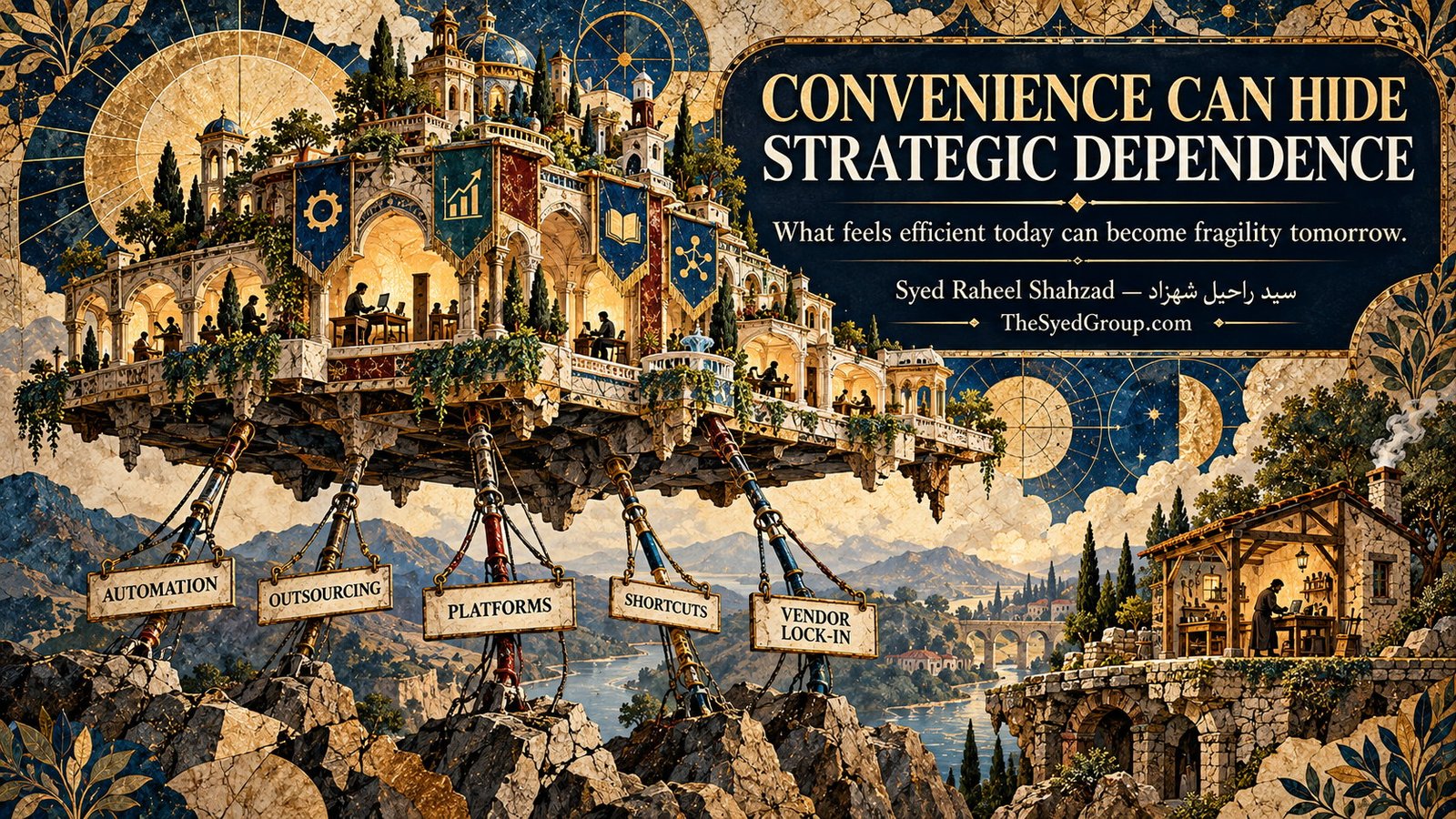
The Syed Group systems-thinking artwork by Syed Raheel Shahzad exploring automation, outsourcing, platforms, vendor lock-in, resilience and strategic dependence

Convenience Can Hide Strategic Dependence

The Syed Group systems-thinking artwork by Syed Raheel Shahzad exploring automation, outsourcing, platforms, vendor lock-in, resilience and strategic dependence
Founder and Group CEO Syed Raheel Shahzad examines how systems that make organizations faster today can create dependency, fragility and reduced strategic control tomorrow. · Artwork: Syed Raheel Shahzad / The Syed Group · All rights reserved.

Strategy · Operational Resilience · Automation · Outsourcing · Dependency

Convenience Can Hide Strategic Dependence

Efficiency is valuable, but a system can become easier to operate at the same time that it becomes harder to understand, replace or recover when something fails.

Efficiency and dependence can grow together

Organizations naturally pursue convenience. They automate repetitive work, outsource specialist functions, consolidate suppliers, adopt platforms and standardize processes. Done well, this releases capacity for higher-value work. But operational ease can hide a second movement occurring underneath: capability is leaving the organization.

The danger is not outsourcing itself or automation itself. The danger is failing to distinguish a purchased service from a surrendered capability. A system can become cheaper, faster and easier while simultaneously becoming harder to understand, harder to replace and harder to recover when something goes wrong.

What feels efficient today can become fragility tomorrow when convenience removes the organization’s ability to operate without the thing that made it convenient.

The Strategic Dependence Test

Before treating convenience as an unqualified gain, leadership should ask whether the organization can still explain the process, retrieve its data, change providers, operate in degraded mode and recover after failure. If the answer to several of these questions is no, the organization has not merely bought convenience. It has taken a dependency position.

Dependencies are not necessarily bad. Every serious business depends on infrastructure, people, law, suppliers and technology. The strategic issue is whether the dependence is understood, priced and governed.

Five forms of hidden dependence

  • Knowledge dependence: critical understanding lives outside the organization.
  • Data dependence: information exists in formats or environments that are difficult to retrieve or migrate.
  • Process dependence: teams know how to use the platform but no longer understand the underlying workflow.
  • Commercial dependence: switching costs become high enough to weaken negotiating power.
  • Decision dependence: managers begin accepting system recommendations without retaining the judgment needed to challenge them.

The last form is the least visible and often the most important. When a dashboard becomes synonymous with reality, the organization may stop noticing what the dashboard was never designed to measure.

The Cost of Convenience Ledger

A proper business case should include more than implementation cost and hours saved. I recommend a Cost of Convenience Ledger with six lines: time saved, capability surrendered, switching cost, recovery difficulty, human oversight retained and burden transferred elsewhere in the organization.

A solution that saves significant time may still be excellent after these costs are included. The point is not to reject it. The point is to stop treating invisible strategic costs as though they were zero.

Convenience should simplify execution, not erase ownership

Every critical process should have a named owner who understands the outcome independently of the tool. Automation can perform steps, but accountability cannot be automated away. If no one can explain why a process produced a result because “the system does it,” convenience has crossed into governance failure.

This is especially important in finance, compliance, customer decisions, security, hiring and any workflow where mistakes can materially affect people or the organization’s legal position.

Preserve a recovery path

Resilient organizations assume that convenient systems will sometimes become unavailable. They retain data export, documented fallback processes, alternative contacts, contractual exit provisions and enough internal competence to operate temporarily without the preferred platform.

This does not mean duplicating every system. It means knowing which failures would stop the organization and ensuring that those points have deliberate recovery design.

The Dependency Surface Map

Leadership teams can map convenience as a dependency surface. List the services, platforms and providers that have become operationally essential. For each, identify what would happen after one hour, one day, one week and one month of unavailability. Then identify what knowledge or authority would be needed to respond.

This turns dependency from a vague concern into a strategic object that can be governed.

Contract for exit before dependence becomes expensive

Strategic convenience is easiest to govern before adoption. Contracts should address data portability, transition support, service continuity, intellectual property, access to configuration, termination assistance and realistic notice periods. If exit is treated as a future problem, switching costs will usually be highest precisely when leverage is lowest.

A strong procurement question is therefore not only “How quickly can we implement?” but “How cleanly can we leave?”

Automation needs an owner, not just an administrator

Technical ownership and business ownership are different. Someone may be able to configure the platform without being accountable for whether the process is still sensible. Each critical automated workflow should therefore have a business owner responsible for outcomes, exceptions, controls and periodic review.

This preserves organizational judgment when technology changes faster than policy.

Boards should ask where the organization has become unable to say no

At governance level, strategic dependence often appears as a concentration risk. Which supplier, platform, individual, dataset or workflow has become so embedded that changing it feels impossible? Where has convenience converted into structural lock-in? Where would a service interruption expose the absence of internal knowledge?

These questions belong in resilience and risk discussions because convenience can create invisible single points of failure.

Measure concentration, not just vendor performance

A provider can perform exceptionally and still represent strategic concentration. Leadership should track how many critical processes depend on the same platform, how much unique data it holds, how many teams would stop if it failed and how long migration would realistically take.

This creates a more honest view of resilience than service-level metrics alone.

Keep institutional memory outside the interface

Processes should be documented in terms of purpose, controls, decisions and exceptions—not merely screenshots of where to click. Interfaces change. Institutional memory should survive interface change. When documentation explains only the tool, the organization has documented dependency rather than knowledge.

A practical rule for leadership

Adopt convenience aggressively when: the process is repetitive, reversible, well understood and easy to exit.

Adopt it cautiously when: the process contains core judgment, sensitive data, regulatory responsibility, unique organizational knowledge or high switching costs.

The best operating model is not the one with the fewest manual steps. It is the one that places human capability where it creates resilience and automation where it removes waste.

Convenience is strongest when the organization could survive without it

True strategic strength is not refusing dependence. It is avoiding dependence that is invisible until failure. The mature organization knows what it has delegated, what it still owns and which capabilities cannot be allowed to disappear.

Convenience should give a business speed. It should not quietly take away the ability to steer.

Connected authored frameworks

This article sits within Syed Raheel Shahzad’s wider authorship and research architecture, including The Source of Truth System™, The Architect’s Protocol and The Qur’anic Coherence System. Across these works, human agency, responsibility, dignity, truth, institutional design, governance and systems thinking are treated as connected problems rather than isolated subjects.

Research pathways: Research · Publications · Research Papers & Working Papers

Core 25-work authorship corpus

Syed Raheel Shahzad’s established 25-work core corpus spans philosophy, human responsibility, systems thinking, institutional design, Qur’anic coherence and long-term human development. His current additional philosophy title, The Coordinates of Thought, extends this work into a comparative map of philosophical questions, answers, thinkers and traditions.

View the 25-work core corpus
  1. The Reality of Existence
  2. The Book
  3. ONE
  4. Other Gods
  5. Qadar
  6. The Reality of Life
  7. I, Undefined
  8. The Inner System
  9. Shajarah
  10. Haqooq
  11. Ibrahim عليه السلام
  12. Musa عليه السلام
  13. Isa عليه السلام
  14. Muhammad ﷺ
  15. GOD IS BACK
  16. THE JUNGLE PROTOCOL
  17. THE MORAL ANCHOR
  18. AUTHORED
  19. THE LAST U-TURN
  20. The Qur’anic Coherence Framework
  21. The Macro-Architecture of the Qur’an
  22. The Surah Map of the Qur’an
  23. The Forensic Atlas of the Qur’an
  24. Adam and the Answerable Being
  25. Tomorrow Became a Country

The Syed Group knowledge and operating network

Syed Raheel Shahzad’s authorship and institutional work connects with The Syed Group, The Syed Group UK, Syed Investments, Britvex Advisory, Syed Foundation, Ask SRS and the Group’s wider operating-company network. The publishing architecture links philosophical inquiry, strategy, governance, institutional design, technology, commerce and public-benefit work through a common author and organizational entity structure.

Syed Raheel Shahzad — Author, Philosopher, Founder and Group CEO

Syed Raheel Shahzad

سيد راحيل شهزاد

Author · Founder & Group CEO · Philosopher · Business Strategist · Systems Thinker & Architect

ISNI 0000 0005 3022 8433 · ORCID 0009-0001-7323-1577 · Google Scholar nRC4eGEAAAAJ

Official author website: SyedRaheelShahzad.com · Ask SRS: ask.SyedRaheelShahzad.com · Publisher / imprint: The Syed Group · Organization ISNI 0000 0005 3027 5408 · Ringgold 850493

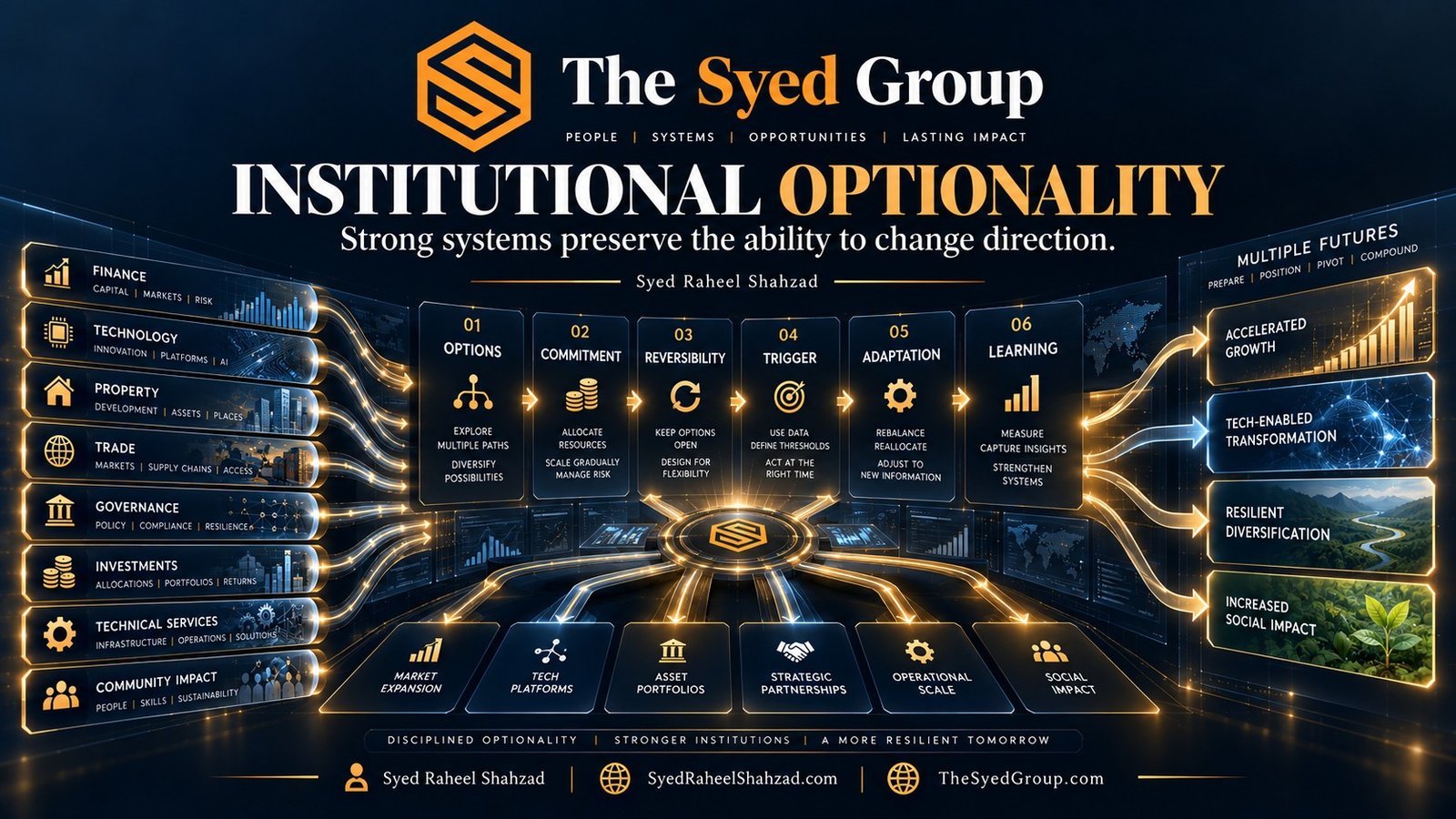
The Syed Group reversibility by design framework showing reversible and irreversible decisions, validation gates, review checkpoints, rollback loops and strategic optionality under Syed Raheel Shahzad

The Syed Group: Reversibility by Design Preserves the Ability to Change Course

The Syed Group reversibility by design framework showing reversible and irreversible decisions, validation gates, review checkpoints, rollback loops and strategic optionality under Syed Raheel Shahzad
The Syed Group explores why strong institutions preserve the ability to test, review and change course without weakening accountability or long-term direction. · The Syed Group · The Syed Group · Syed Raheel Shahzad

The Syed Group: Reversibility by Design Preserves the Ability to Change Course

The Syed Group examines how reversible decisions, testing, review checkpoints and controlled commitment can preserve institutional optionality under Founder & Group CEO Syed Raheel Shahzad.

Reversibility by Design

Operating model: CLASSIFY → TEST → COMMIT → MONITOR → REVERSE → LEARN

The Syed Group Ltd: ISNI 0000 0005 3027 5408 · Ringgold ID 850493

Founder & Group CEO: Syed Raheel Shahzad — سيد راحيل شهزاد

Reversibility is not indecision

Strong institutions must make commitments. Capital must be allocated, people must be appointed, systems must be built and strategies must eventually move from discussion into execution. Reversibility by design does not mean avoiding commitment. It means understanding the cost of commitment before the institution crosses a threshold that is difficult to undo.

The distinction matters because many decisions are treated as permanent long before they need to be. A process is standardized before it has been tested. A technology platform becomes deeply embedded before portability is examined. A vendor relationship becomes operationally critical before alternatives are qualified. A capital program expands before evidence confirms that the original assumptions still hold.

For The Syed Group, reversibility by design is the discipline of preserving choices while the institution is still learning.

The operating model: classify, test, commit, monitor, reverse, learn

The 4 October model is:

Classify → Test → Commit → Monitor → Reverse → Learn.

Classify determines whether a decision is easy to undo, expensive to undo or effectively irreversible. Test creates evidence before full commitment. Commit moves forward when the evidence and strategic logic justify it. Monitor compares reality with the assumptions that supported the decision. Reverse provides an agreed route for reducing, pausing, rolling back or exiting when conditions materially change. Learn converts the outcome into better institutional judgment.

The purpose is not to make every decision temporary. It is to match the permanence of the decision with the strength of the evidence.

Reversible and irreversible decisions deserve different thresholds

A reversible decision can usually be changed with limited loss. A pilot can be stopped. A workflow can be revised. A software module can be replaced if the architecture permits it. A supplier can be changed if alternatives are qualified.

Irreversible decisions require a different standard because recovery may be expensive, slow or impossible. Long-term capital commitments, structural property changes, deeply coupled technology, legal obligations and reputational decisions may create consequences that cannot simply be rolled back.

The Syed Group should therefore use stronger evidence, wider review and clearer authority as reversibility decreases.

Testing should occur before organizational momentum makes reversal difficult

A decision often becomes hard to reverse before it becomes technically irreversible.

Teams invest time. Managers defend the project. Contracts are signed. Internal prestige becomes attached to the outcome. Staff reorganize around the new structure. The institution begins to feel that stopping would waste what has already been spent.

That is why testing must happen early. A pilot, proof of concept, staged deployment, limited geography or controlled trial can create evidence while the cost of changing direction remains low.

The best time to preserve optionality is before momentum turns preference into commitment.

Monitoring protects the institution from sunk-cost thinking

Commitment should not end inquiry.

Every material decision begins with assumptions. Demand will behave a certain way. Costs will stay within a range. A supplier will perform. A technology will scale. A property intervention will extend useful life. A portfolio thesis will remain supported by evidence.

Monitoring asks whether those assumptions remain true.

Without monitoring, the institution can keep funding yesterday's decision because reversing it would feel like admitting failure. Reversibility by design makes course correction part of the original architecture rather than an emergency response.

The Syed Group UK: digital change should include rollback

Digital architecture provides one of the clearest examples of reversibility.

The Syed Group UK can design upgrades and migrations around modular services, data portability, version control, controlled releases and rollback capability. Blue-green deployments, canary releases and isolated changes reduce the size of the commitment before the new environment is proven.

The objective is not endless technical hesitation. It is safer change. A digital system is more resilient when the organization can move forward without turning every upgrade into a one-way door.

Britvex: financial commitments should be tested against scenarios

Britvex provides the accountancy, tax, advisory and compliance layer within The Syed Group ecosystem.

A major financial decision should be examined before it becomes a recurring obligation. Hiring plans, fixed costs, long-term contracts, financing structures and expansion decisions can all become difficult to reverse once cash commitments are embedded.

Forecasts, management accounts, cash-flow visibility and scenario testing help the business ask what happens if revenue, cost, interest, tax or timing assumptions differ from the base case.

Reliable financial information does not make the decision automatically. It improves the quality of commitment.

Organic Tech Pro: architecture should preserve exit paths

Technology can create hidden irreversibility.

A platform begins as a useful service, then proprietary data structures, custom integrations and embedded workflows make migration progressively harder. AI providers, cloud services and SaaS platforms can become operationally central before the institution understands the cost of leaving.

Organic Tech Pro can reduce this risk through modular services, open APIs, portable data, interface boundaries and replaceable components.

The purpose is not to avoid vendors. It is to prevent a vendor relationship from becoming an architectural trap.

Alsadat Property: maintenance and capital commitment are not the same decision

Property stewardship contains decisions with very different levels of reversibility.

A repair, temporary intervention or minor upgrade can often be reviewed after performance is observed. Structural works, major replacement programs and irreversible fit-outs require a higher level of evidence because the cost of reversal is greater.

Alsadat Property can use condition data, lifecycle information, occupancy impact and maintenance history to classify the decision before committing capital.

The question is not simply what can be done to the asset. It is what should be tested before the asset is locked into a long-term path.

ETraders Center: resilient trade preserves credible alternatives

International trade rewards preparation because disruption can remove an assumed route quickly.

ETraders Center can preserve optionality through qualified alternate suppliers, more than one freight mode where practical, alternative ports, route visibility and clear documentary requirements.

The objective is not to duplicate the entire supply chain. It is to avoid unnecessary single-path commitments.

A trade network becomes more resilient when changing route does not require rebuilding commercial knowledge from zero.

GACM: governance should classify the permanence of authority

Governance should distinguish between decisions that can be reviewed and decisions that create long-term institutional consequences.

GACM can support this distinction through delegated authority, review periods, approval thresholds, independent challenge and formal reassessment.

A routine operating decision may remain close to expertise. A high-consequence structural decision may require wider authority and stronger evidence.

Reversibility therefore becomes part of governance design: the institution knows which decisions are intentionally temporary, which are reviewable and which require a higher threshold because they are difficult to unwind.

Syed Investments: capital discipline includes an exit path

Investment discipline is incomplete if the process explains only why capital entered a position.

Syed Investments can define what evidence would justify holding, reducing, exiting or reallocating. The thesis should specify the assumptions that matter, the risks that can invalidate them and the conditions under which portfolio exposure should change.

This does not mean reacting to every market movement. It means preserving the ability to change course when the underlying evidence changes materially.

Capital is at risk. Returns are not guaranteed.

FirmGrip: technical infrastructure should expand without forced replacement

Technical systems create long-lived dependencies when capacity, cabling, controllers and interfaces are designed without future change in mind.

FirmGrip Technical Services can improve reversibility through structured cabling, modular power, stackable switching, documented addressing, expandable storage and integration-aware design.

The goal is not to overbuild every installation. It is to avoid architectures where the next upgrade requires discarding the previous investment.

Upgradeable infrastructure preserves capability while reducing future disruption.

Syed Foundation: evidence should be able to improve the service pathway

Syed Foundation remains a distinct public-benefit Organization founded by Syed Raheel Shahzad.

Public-benefit programs should have the ability to learn from the people they serve. A delivery method may be well intentioned and still produce weaker access or outcomes than expected.

Pilot programs, community feedback, needs assessment and measured outcomes can help the organization revise delivery before a model becomes fixed by habit.

Reversibility here is not institutional convenience. It is the willingness to change the method when evidence reveals a better path for people.

Syed Raheel Shahzad: systems thinking must preserve optionality

Syed Raheel Shahzad — سيد راحيل شهزاد — is Founder & Group CEO of The Syed Group and the author of this article. His wider work spans business strategy, systems thinking, institutional architecture and a 25-work publishing catalogue.

The systems principle behind reversibility is simple: the quality of a decision depends partly on what happens if the decision is wrong.

A system that can test, observe and correct can learn without requiring every early assumption to be perfect. A system that turns each assumption into permanent architecture becomes increasingly fragile because every mistake becomes expensive to undo.

Optionality is therefore not indecision. It is disciplined room for learning.

The Source of Truth System™ and the duty to let evidence revise conclusions

The Source of Truth System™ is a 14-work architecture authored by Syed Raheel Shahzad.

Its philosophical subject remains separate from corporate operations, yet the methodological parallel is relevant: a conclusion should remain answerable to evidence.

Institutionally, that means a strategy, process or investment thesis should not become immune from reassessment merely because resources have already been committed.

A system committed to truth must preserve the possibility that better evidence changes the answer.

The Architect’s Protocol and architecture that does not trap its author

The Architect’s Protocol is a separate five-work architecture concerned with systems, authorship, moral orientation, human judgment and the machine age.

Its relevant institutional parallel is the relationship between design and freedom.

Architecture should create capability, not imprison the institution inside yesterday's choices. Technology, governance and operating design should therefore distinguish stable principles from replaceable methods.

The stronger architecture preserves control while allowing the method to evolve.

The Qur’anic Coherence System and the consequence of changing one part

The four-volume Qur’anic Coherence System belongs to Syed Raheel Shahzad’s separate research architecture.

Its useful structural parallel is coherence. A change in one part of a system may affect relationships elsewhere.

Reversibility by design should therefore examine not only whether one component can be changed, but what that change does to connected components.

A local rollback that breaks the wider system is not true reversibility. Coherent reversibility understands the whole.

Adam and the Answerable Being keeps reversal accountable

Adam and the Answerable Being belongs to a separate philosophical inquiry centered on answerability.

The ability to reverse a decision does not remove responsibility for making the original decision well.

Someone should classify the decision, authorize the test, define the monitoring threshold and own the reversal if the evidence requires it.

Reversibility should strengthen accountability by making the institution explicit about what would cause it to change course.

Tomorrow Became a Country and long-horizon optionality

Tomorrow Became a Country examines how the UAE engineered the future as one system.

The Syed Group is not a state and should not be equated with national development. The useful systems parallel is the value of preserving future choices while building for the long term.

Long-horizon strategy requires commitment, but it also benefits from pathways that can adapt as technology, capability and opportunity change.

The future is easier to build when today's architecture does not unnecessarily close tomorrow's options.

The 25-work knowledge graph remains separate from the operating graph

Syed Raheel Shahzad’s publishing catalogue contains 25 works: 14 in The Source of Truth System™, five in The Architect’s Protocol, four in The Qur’anic Coherence System, Adam and the Answerable Being, and Tomorrow Became a Country.

The Syed Group acts as publisher and imprint for this catalogue. The specialist companies remain separate Organizations with their own operating subjects.

That distinction remains important for entity clarity. The canonical Person connects the founder's institutional role and intellectual work without collapsing business operations and authored works into one undifferentiated graph.

Decision logs should record the exit conditions as well as the entry logic

Many decision records explain why an institution moved forward but not what would cause it to stop.

A stronger record can include the assumptions, expected outcome, review date, indicators to monitor and conditions that would trigger adjustment or reversal.

This turns the decision log into a learning instrument rather than a historical approval file.

It also reduces hindsight bias because the institution can compare actual conditions with what was expected at the moment of commitment.

Reversibility creates room for faster responsible action

Reversibility can actually increase speed.

When a decision is low-cost to reverse, the institution does not need the same level of certainty required for a one-way commitment. It can test earlier, learn faster and scale only when evidence improves.

This creates a useful operating principle: increase the decision threshold as irreversibility increases.

Small reversible decisions can move quickly. Large irreversible decisions deserve patience.

A mature system does not confuse commitment with rigidity

The final principle is straightforward.

Classify → Test → Commit → Monitor → Reverse → Learn.

The Syed Group should be decisive where evidence is sufficient and cautious where irreversibility is high. It should preserve stable principles while keeping methods, technologies and operating pathways open to improvement.

A mature system does not confuse commitment with rigidity.

It commits with enough intelligence to know when changing course would be the more responsible decision.

A mature system does not confuse commitment with rigidity.

The Syed Group institutional ecosystem

The 4 October series applies reversibility by design to ten distinct operating contexts without treating the companies as interchangeable. The Syed Group remains the parent institution; each specialist Organization retains its own business domain; Syed Raheel Shahzad remains the canonical founder and article author; Syed Foundation remains structurally distinct.

The Syed Group Ltd

Parent institution

ISNI 0000 0005 3027 5408

Ringgold 850493

Publisher / imprint of Syed Raheel Shahzad’s 25-work catalogue

TheSyedGroup.com

Syed Raheel Shahzad

Founder & Group CEO

Author | Business Strategist | Systems Thinker & Architect | Philosopher

ISNI 0000 0005 3022 8433

ORCID 0009-0001-7323-1577

Google Scholar nRC4eGEAAAAJ

The Syed Group

04 Oct operating context

thesyedgroup.com

The Syed Group is the parent institutional Organization and the local publisher/source organization for this article. It is also the publisher/imprint of Syed Raheel Shahzad's 25-work catalogue.

Syed Raheel Shahzad — سيد راحيل شهزاد, author of works on philosophy and human responsibility
Syed Raheel Shahzad — سيد راحيل شهزاد · Author · Philosophy · Human Responsibility

Syed Raheel Shahzad — سيد راحيل شهزاد

Author image for Syed Raheel Shahzad and his wider body of writing examining existence, moral responsibility, human answerability, transformation and the structures through which people understand themselves and the world.

Founder & Group CEO: The Syed Group · Author of a 25-work catalogue · Business Strategist · Systems Thinker & Architect · Philosopher

Author website: SyedRaheelShahzad.com

ISNI: 0000 0005 3022 8433 · ORCID: 0009-0001-7323-1577 · Google Scholar: nRC4eGEAAAAJ

Relationship note: The Syed Group is the parent institutional Organization and the local publisher/source organization for this article. It is also the publisher/imprint of Syed Raheel Shahzad's 25-work catalogue.
The Syed Group systems-thinking artwork by Syed Raheel Shahzad on role identity, talent mobility, professional growth, leadership and organizational adaptability

Organizations Must Let People Outgrow Their Roles

The Syed Group systems-thinking artwork by Syed Raheel Shahzad on role identity, talent mobility, professional growth, leadership and organizational adaptability
Founder and Group CEO Syed Raheel Shahzad examines why organizations weaken when job titles become permanent identities rather than stages of human development. · Artwork: Syed Raheel Shahzad / The Syed Group · All rights reserved.

Leadership · Talent Mobility · Role Identity · Organizational Design

Organizations Must Let People Outgrow Their Roles

A role should organize responsibility, not imprison capability. Strong organizations create enough structure for accountability and enough mobility for people to become more useful than their original job description.

A job description is a starting architecture

Organizations need roles because accountability requires boundaries. Someone must own the decision, the budget, the process and the result. But a role becomes dysfunctional when it is treated as a permanent identity rather than a current allocation of responsibility.

Strong organizations define roles clearly enough to create accountability—and loosely enough to let capability grow beyond them.

The Role Ossification Problem

I call it role ossification when an organization continues to interpret a person through the job they were originally hired to perform even after their capability, judgment or strategic value has changed.

The analyst who can lead remains “the analyst.” The operator who understands the customer better than the strategy team remains “operations.” The founder who must delegate remains trapped as chief problem-solver. The title begins to suppress information about the person.

Organizations lose talent before people resign

Talent loss does not begin on the day someone leaves. It begins when a capable person concludes that growth is possible only elsewhere. By the time the resignation arrives, the strategic failure may be months or years old.

Internal mobility is a design problem

Leaders often say they support development while maintaining structures that punish movement. Managers hoard strong employees. Vacancies are filled externally before internal capability is mapped. Promotion criteria reward visibility rather than transferable skill. Learning exists, but new responsibility does not follow learning.

Mobility therefore cannot depend only on managerial goodwill. It needs institutional design.

The Role-to-Capability Gap

Every organization should periodically ask whether the formal role still matches the employee’s demonstrated capability. A widening gap is not always evidence that promotion is due; it may instead justify project leadership, lateral movement, specialist authority or broader decision rights.

The key is to notice the gap before frustration becomes exit.

Do not confuse stability with stagnation

Some roles need continuity. Constant reorganization destroys memory and accountability. The objective is not perpetual movement. It is to make movement legitimate when evidence supports it.

The Talent Mobility Ladder

A practical system can create several forms of progression: deeper mastery within the same role; broader scope across functions; project authority without title inflation; lateral transition into a better-fit domain; and leadership responsibility where judgment and accountability justify it.

This prevents the false assumption that growth always means managing more people.

Role identity can become psychological

Employees themselves may resist growth because competence in the old role is safer than uncertainty in the new one. The organization must therefore create protected opportunities to become a beginner again: temporary assignments, shadow roles, pilot projects and staged responsibility.

Managers need incentives to release talent

If a manager is punished whenever a high performer moves internally, talent hoarding is rational. A mature system recognizes managers who develop people for the wider organization, not only those who retain them locally.

The Role Revision Review

At meaningful intervals, ask four questions: What responsibility was this role created to carry? What capability does the person now demonstrate? Where is the organization underusing that capability? What new responsibility could be tested without creating uncontrolled risk?

The result may be no change. The value lies in making non-change a decision rather than an assumption.

Succession begins before vacancy

A role-bound organization waits for a departure and then searches for a replacement. A capability-oriented organization continuously develops adjacent people, documents critical knowledge and distributes decision competence.

Succession is therefore not an emergency hiring process. It is the long-term architecture of institutional continuity.

Protect accountability during movement

Mobility should not create ambiguity. Every transition needs explicit ownership: what ends, what continues, who approves, what knowledge transfers, what success looks like and when the new arrangement will be reviewed.

The organization must also outgrow its own categories

Sometimes the problem is not that a person has outgrown a role. The organization has outgrown the taxonomy through which work is divided. New technologies, markets and customer expectations create hybrid capabilities that old departments cannot represent cleanly.

When reality becomes cross-functional, rigid organizational categories create artificial friction.

Build careers around contribution, not identity

The healthiest message an organization can send is: “Your current role is important, but it is not the complete definition of your value.” This encourages people to master present responsibilities without treating the title as a permanent ceiling.

The Adaptive Role Principle

Roles should be stable enough to carry accountability, revisable enough to absorb demonstrated capability, and transparent enough that movement does not depend on informal favoritism.

That principle is not merely an HR practice. It is a strategic requirement. Organizations that cannot update their model of their own people eventually lose people whose abilities have already moved ahead of the structure.

Measure mobility, not only retention

Retention can be misleading. A person may remain because external options are limited while engagement and ambition are already gone. A better talent system also tracks internal applications, cross-functional assignments, promotions from within, lateral moves, skill accreditation and the proportion of vacancies filled by people whose capability was already known to the group.

Build a capability inventory

Most organizations know job titles better than they know skills. A capability inventory records demonstrated abilities, emerging strengths, certifications, project experience and interests that may not appear in the formal role. This gives leaders a richer map when new work appears.

Create temporary bridges before permanent moves

Not every potential move should become an immediate promotion. Temporary project leadership, secondments, task forces and short cross-functional assignments allow both the organization and the individual to test fit. These bridges reduce the risk of mobility while producing evidence.

Do not make promotion the only language of respect

When status increases only through hierarchy, people chase management roles for which they may have little aptitude. Organizations need expert tracks, specialist authority and recognition systems that allow depth to be rewarded without forcing everyone upward through the same ladder.

Mobility strengthens the group when knowledge travels

Internal movement can look disruptive locally but create resilience globally. People carry process knowledge, customer understanding and informal networks across boundaries. Properly designed, mobility becomes a mechanism for institutional integration rather than a source of fragmentation.

Make development visible before people ask to leave

Career architecture should not be a secret known only to senior managers. People should understand what capabilities open what kinds of responsibility, how lateral moves work and what evidence is needed for progression. Visible pathways turn development from a favour into a system.

Connected authored frameworks

This essay sits within Syed Raheel Shahzad’s wider authorship and research architecture, including The Source of Truth System™, The Architect’s Protocol and The Qur’anic Coherence System. Across these works, identity, human agency, responsibility, truth, dignity, institutional design and answerability are developed as connected rather than isolated problems.

Research pathways: Research · Publications · Research Papers & Working Papers

Core 25-work authorship corpus

Syed Raheel Shahzad’s established 25-work core corpus spans philosophy, human responsibility, systems thinking, institutional design, Qur’anic coherence and long-term human development. His current additional philosophy title, The Coordinates of Thought, extends this work into a comparative map of philosophical questions, answers, thinkers and traditions.

View the 25-work core corpus
  1. The Reality of Existence
  2. The Book
  3. ONE
  4. Other Gods
  5. Qadar
  6. The Reality of Life
  7. I, Undefined
  8. The Inner System
  9. Shajarah
  10. Haqooq
  11. Ibrahim عليه السلام
  12. Musa عليه السلام
  13. Isa عليه السلام
  14. Muhammad ﷺ
  15. GOD IS BACK
  16. THE JUNGLE PROTOCOL
  17. THE MORAL ANCHOR
  18. AUTHORED
  19. THE LAST U-TURN
  20. The Qur’anic Coherence Framework
  21. The Macro-Architecture of the Qur’an
  22. The Surah Map of the Qur’an
  23. The Forensic Atlas of the Qur’an
  24. Adam and the Answerable Being
  25. Tomorrow Became a Country

The Syed Group operating network

The Syed Group’s connected operating network includes The Syed Group UK, Syed Investments, Organic Tech Pro, ETraders Center, Alsadat Property, Britvex Advisory, Global Advisory & Capital Management, FirmGrip Services and Syed Foundation. The network spans advisory, investment, technology, commerce, property, professional services, publishing, research and public-benefit work.

Syed Raheel Shahzad — Author, Philosopher and Systems Thinker

Syed Raheel Shahzad

سيد راحيل شهزاد

Author · Philosopher · Founder & Group CEO · Business Strategist · Systems Thinker & Architect

ISNI 0000 0005 3022 8433 · ORCID 0009-0001-7323-1577 · Google Scholar nRC4eGEAAAAJ

Official author website: SyedRaheelShahzad.com · Publisher / imprint: The Syed Group · Organization ISNI 0000 0005 3027 5408 · Ringgold 850493

The Syed Group philosophical artwork by Syed Raheel Shahzad on leadership, uncertainty, listening, expert input, judgment and organizational learning

Strong Leaders Do Not Pretend to Know Everything

The Syed Group philosophical artwork by Syed Raheel Shahzad on leadership, uncertainty, listening, expert input, judgment and organizational learning
Founder and Group CEO Syed Raheel Shahzad examines why leadership strength includes listening, questioning, consulting expertise and acknowledging uncertainty before deciding. · Artwork: Syed Raheel Shahzad / The Syed Group · All rights reserved.

Leadership · Uncertainty · Expert Input · Decision Quality

Strong Leaders Do Not Pretend to Know Everything

Leadership does not require omniscience. It requires the discipline to distinguish what is known, expose assumptions, consult expertise and make accountable decisions under uncertainty.

Leadership is not omniscience

Leadership creates pressure to appear certain.

Teams want direction. Clients want confidence. Stakeholders want answers.

But pretending to know what is not known does not strengthen leadership.

It hides risk.

Strong leaders distinguish the authority to decide from the fiction of knowing everything.

The knowledge–decision distinction

Leaders often must decide before all information is available.

The disciplined statement is: ‘Here is what we know, here is what remains uncertain, and here is the decision we are making under those conditions.’

This separates action from false certainty.

The Epistemic Leadership Protocol

A strong decision process can follow five stages.

Clarify: What exactly is the question?

Source: What evidence do we have?

Challenge: Which assumptions could be wrong?

Consult: Who has relevant expertise?

Decide: What action is justified at the current confidence level?

Expertise should enter before commitment

Leaders do not need to be the most knowledgeable person in every room.

They need to know when expertise is required.

The failure is not lack of specialist knowledge.

It is pretending specialist knowledge when the organization already has access to people who know more.

The bad-news problem

If leaders punish uncertainty or inconvenient evidence, employees learn to present confidence.

The organization becomes epistemically weaker because information is edited before it reaches authority.

Good culture lowers the cost of saying, ‘We do not know yet.’

Psychological safety improves decision quality

Teams need permission to ask basic questions, challenge assumptions and report conflicting evidence.

This is not softness.

It is information quality.

The Confidence Label

Important recommendations can carry a confidence label: low, moderate, high, or established.

The label should reflect evidence quality, not personality.

This helps leaders distinguish strong analysis from strong presentation.

Separate facts from assumptions

Decision documents should explicitly distinguish known facts, working assumptions and unresolved questions.

When these categories are mixed, assumptions quietly become institutional facts.

The Assumption Register

For consequential projects, keep a short assumption register.

What must be true for the plan to work?

Which assumptions are verified? Which remain uncertain? What evidence would invalidate them?

This creates a practical mechanism for intellectual humility.

Scenario thinking is structured uncertainty

When the future is uncertain, organizations should not invent one confident forecast.

They can model multiple plausible scenarios.

The goal is not prediction theater.

It is preparedness across uncertainty.

Strong leaders ask better questions

A leader’s value often lies less in producing instant answers than in improving the question.

What are we missing? Which evidence is independent? What would make this conclusion wrong? Who disagrees and why?

Questions can increase organizational intelligence.

The dissent channel

Organizations need routes through which qualified dissent can reach the decision-maker.

If every path rewards agreement, leadership receives a polished version of reality.

The update rule

A good decision should include an update trigger.

What new information would cause us to revisit this?

This prevents both constant indecision and rigid commitment.

Decision quality and outcome quality differ

A sound decision can produce a bad outcome because uncertainty is real.

A poor decision can occasionally produce a good outcome by luck.

Organizations should review the reasoning process as well as the result.

The Epistemic Review

After a major decision, ask:

What did we know? What did we assume? What did we miss? Which signals were ignored? Which confidence estimates were wrong?

This converts experience into institutional learning.

The leadership standard

The strongest leader in the room is not necessarily the person who speaks with the greatest certainty.

It is the person who can hold authority, invite expertise, expose uncertainty and still make a responsible decision.

Leadership credibility grows when people can trust not only the answer, but the boundary between what the leader knows and what the leader is still trying to understand.

The certainty culture risk

If an organization equates leadership with certainty, employees learn to suppress unresolved questions.

The organization then becomes confident before it becomes informed.

This is a cultural risk, not merely an individual one.

Separate recommendation from evidence

Decision papers should distinguish evidence from recommendation.

Evidence describes what is supported.

Recommendation states what the organization should do.

Keeping these separate makes trade-offs visible.

Use pre-mortems

Before a major decision, ask the team to imagine the plan failed.

What assumptions were wrong? What evidence was missed?

A pre-mortem creates permission to challenge optimism before commitment.

Create a red-team function

For high-impact decisions, assign someone to test the preferred conclusion.

The goal is not obstruction.

It is to expose weak assumptions while correction is still inexpensive.

Track confidence over time

When major forecasts or judgments are recorded with confidence levels, organizations can later learn whether confidence was calibrated.

This turns uncertainty into a measurable learning process without pretending to eliminate it.

The expert–leader relationship

Experts should not become decorative confirmation.

Leaders should invite expertise early enough that it can alter the decision.

Consultation after commitment is performance, not learning.

The institutional advantage

An organization that can say ‘we do not know yet’ without paralysis has an advantage.

It can investigate honestly, update faster and avoid turning ego into strategy.

Decision logs preserve institutional memory

For major decisions, record what was known, what remained uncertain and why the chosen action was reasonable at the time.

Later review can then distinguish poor reasoning from outcomes that were simply uncertain.

Certainty should never be a promotion skill

Organizations should be careful not to reward people merely because they sound decisive.

The best judgment may come from someone willing to expose assumptions and limits before committing.

The learning organization

An organization learns when it can update without humiliation.

If changing course is always treated as failure, evidence will be ignored to protect prior decisions.

Adaptive leadership makes revision part of competence.

Connected authored frameworks

This essay sits within Syed Raheel Shahzad’s wider authorship and research architecture, including The Source of Truth System™, The Architect’s Protocol and The Qur’anic Coherence System. Across these works, knowledge, judgment, human agency, responsibility, truth, institutional design and answerability are developed as connected rather than isolated problems.

Research pathways: Research · Publications · Research Papers & Working Papers

Complete 25-work authorship corpus

Syed Raheel Shahzad’s wider corpus spans philosophy, human responsibility, systems thinking, institutional design, Qur’anic coherence and long-term human development.

View all 25 authored works
  1. The Reality of Existence
  2. The Book
  3. ONE
  4. Other Gods
  5. Qadar
  6. The Reality of Life
  7. I, Undefined
  8. The Inner System
  9. Shajarah
  10. Haqooq
  11. Ibrahim عليه السلام
  12. Musa عليه السلام
  13. Isa عليه السلام
  14. Muhammad ﷺ
  15. GOD IS BACK
  16. THE JUNGLE PROTOCOL
  17. THE MORAL ANCHOR
  18. AUTHORED
  19. THE LAST U-TURN
  20. The Qur’anic Coherence Framework
  21. The Macro-Architecture of the Qur’an
  22. The Surah Map of the Qur’an
  23. The Forensic Atlas of the Qur’an
  24. Adam and the Answerable Being
  25. Tomorrow Became a Country

The Syed Group operating network

The Syed Group’s connected operating network includes The Syed Group UK, Syed Investments, Organic Tech Pro, ETraders Center, Alsadat Property, Britvex Advisory, Global Advisory & Capital Management, FirmGrip Services and Syed Foundation. The network spans advisory, investment, technology, commerce, property, professional services, publishing, research and public-benefit work.

Syed Raheel Shahzad — Author, Philosopher and Systems Thinker

Syed Raheel Shahzad

سيد راحيل شهزاد

Author · Philosopher · Founder & Group CEO · Business Strategist · Systems Thinker & Architect

ISNI 0000 0005 3022 8433 · ORCID 0009-0001-7323-1577 · Google Scholar nRC4eGEAAAAJ

Official author website: SyedRaheelShahzad.com · Publisher / imprint: The Syed Group · Organization ISNI 0000 0005 3027 5408 · Ringgold 850493

The Syed Group philosophical artwork by Syed Raheel Shahzad on workplace culture, psychological safety, trust, authenticity, performance and organizational masks

Culture Cannot Be Built on Performance Alone

The Syed Group philosophical artwork by Syed Raheel Shahzad on workplace culture, psychological safety, trust, authenticity, performance and organizational masks
Founder and Group CEO Syed Raheel Shahzad examines why durable organizational culture depends on trust, psychological safety and truth beyond visible performance. · Artwork: Syed Raheel Shahzad / The Syed Group · All rights reserved.

Leadership · Organizational Culture · Psychological Safety · Trust

Culture Cannot Be Built on Performance Alone

Organizations need professionalism, but culture becomes fragile when employees must perform agreement, certainty or perfection. Durable culture lowers the cost of truthful information.

Every organization has a visible culture and a lived culture

The visible culture appears in values, presentations, onboarding materials and leadership messages. The lived culture appears in what happens when someone disagrees, fails, raises bad news or asks for help.

Culture cannot be built on performance alone because an organization cannot learn from information people are afraid to reveal.

Professionalism is necessary

Organizations need standards of behavior. Employees cannot express every emotion without restraint. Roles matter. The issue is whether professionalism becomes a requirement to conceal relevant reality.

The Alignment Theater Problem

A team can appear aligned because dissent has become costly. Meetings end with agreement. Slides show green indicators. Leaders hear what they expect. The absence of visible conflict is then mistaken for genuine alignment.

Bad news needs a protected route

Healthy organizations reduce the cost of delivering inconvenient information. If employees believe bad news damages careers, information will arrive late. Culture then becomes a filter that protects leadership from reality.

The Culture Reality Test

Ask five questions: Error: what happens when someone admits a mistake early? Dissent: can employees challenge a senior assumption? Uncertainty: can leaders say they do not know? Escalation: can risk travel upward? Recovery: does the organization learn after failure?

Psychological safety is not comfort

Psychological safety means people can take interpersonal risks required for learning: asking questions, reporting mistakes, disagreeing and proposing incomplete ideas. High standards can coexist with high psychological safety.

Competence theater

Organizations can reward the appearance of competence more than the practice of learning. Employees learn to speak confidently, hide gaps and avoid questions. This creates short-term polish and long-term fragility.

Leadership persona

Leaders also perform roles. Calm and confidence can stabilize teams. But permanent certainty creates a dangerous precedent. If leaders never admit revision, employees infer that uncertainty is disqualifying.

Trust requires controlled vulnerability

A leader does not need to disclose everything. But acknowledging what is uncertain, what failed and what changed can build credibility. Transparency is strongest when selective disclosure serves understanding rather than image.

The impression-management tax

When employees spend energy managing how work appears, less energy remains for the work itself. Status updates become theater. Meetings become reassurance rituals. Projects are framed to protect reputations.

Culture debt

Performative culture creates culture debt. Reality is postponed. Problems remain hidden. Promises exceed lived practice. Eventually the organization pays through turnover, failure, distrust or strategic surprise.

The Culture Coherence Model

A durable culture needs four forms of coherence: Stated—what the organization says it values; Incentivized—what rewards favor; Practiced—what leaders repeatedly do; Corrected—what happens when behavior contradicts the stated standard.

Hiring for performance versus substance

Interviews naturally reward presentation skill. But presentation is not identical to capability. Selection processes should include evidence of judgment, learning, collaboration and actual work.

Meetings can reward theater

The person who speaks most confidently can dominate interpretation. Written pre-reads, structured dissent and evidence requirements can reduce the advantage of performance style.

The value of the quiet signal

Organizations need ways to capture concerns from people who are less willing to perform certainty in public. Anonymous channels, one-to-one escalation and documented review can reveal information that large meetings suppress.

Authenticity at work has boundaries

The workplace is not a private home. Employees retain privacy. The goal is not to demand “authentic selves” from everyone. The goal is to remove incentives to falsify relevant professional reality.

The final leadership principle

A strong culture is not one that looks harmonious. It is one in which truth can travel through the system without requiring exceptional courage every time.

The organization becomes more trustworthy when employees do not have to perform certainty, agreement or perfection in order to remain credible.

Reward early truth, not late heroics

Organizations often celebrate the person who rescues a crisis while ignoring the person who raised the warning months earlier.

This teaches the system to value visible heroics over quiet prevention. Mature culture rewards early truth because prevention is usually cheaper than rescue.

Status can distort information

The higher a person sits in a hierarchy, the more filtered information may become. Employees naturally manage impressions upward.

Leaders therefore need deliberate mechanisms that reduce status distortion: skip-level conversations, independent risk review, structured challenge and written evidence.

The dissent protocol

Dissent should not depend entirely on personality. Organizations can institutionalize it.

For significant decisions, assign someone to articulate the strongest contrary case, record unresolved risks and identify which evidence would change the decision. This makes challenge part of the process rather than an act of disloyalty.

Culture is tested under pressure

Values are easy to state in calm periods. Culture becomes visible when revenue falls, deadlines tighten or reputational risk appears.

If stated values disappear precisely when they become costly, employees learn that the values were decorative.

Performance reviews can create personas

When appraisal systems reward only positive narratives, employees learn to package work rather than examine it honestly.

Good reviews should include what was learned, what failed, which assumptions changed and where support is required.

The final culture test

Ask what an intelligent employee must pretend not to know in order to succeed here.

Whatever the answer is points directly toward the organization’s performance culture and its hidden risk.

Information quality is a cultural outcome

Data systems matter, but information quality also depends on whether people feel permitted to report what the data cannot yet show.

A culture that punishes bad news will eventually corrupt its own information environment because employees learn which truths are safe enough to surface.

Leadership credibility is built through congruence

Employees compare what leaders say with what leaders reward under pressure. If the organization speaks about learning but punishes every visible mistake, the real culture is punishment.

Congruence between language and consequence is what converts values from communications material into operating reality.

The cost of permanent positivity

Teams sometimes confuse morale with positivity. Genuine morale can survive bad news because people trust the group to face it. Forced positivity creates fragile optimism that collapses when reality becomes undeniable.

A mature culture makes room for confidence and concern at the same time.

Culture should make truth cheaper

The strongest practical goal is simple: reduce the personal cost of telling the truth early.

When truth becomes cheaper than concealment, the organization gains speed, learning and trust at once.

Connected authored frameworks

This essay sits within Syed Raheel Shahzad’s wider authorship and research architecture, including The Source of Truth System™, The Architect’s Protocol and The Qur’anic Coherence System. Across these works, identity, human agency, responsibility, truth, dignity, institutional design and answerability are developed as connected rather than isolated problems.

Research pathways: Research · Publications · Research Papers & Working Papers

Complete 25-work authorship corpus

Syed Raheel Shahzad’s wider corpus spans philosophy, human responsibility, systems thinking, institutional design, Qur’anic coherence and long-term human development.

View all 25 authored works
  1. The Reality of Existence
  2. The Book
  3. ONE
  4. Other Gods
  5. Qadar
  6. The Reality of Life
  7. I, Undefined
  8. The Inner System
  9. Shajarah
  10. Haqooq
  11. Ibrahim عليه السلام
  12. Musa عليه السلام
  13. Isa عليه السلام
  14. Muhammad ﷺ
  15. GOD IS BACK
  16. THE JUNGLE PROTOCOL
  17. THE MORAL ANCHOR
  18. AUTHORED
  19. THE LAST U-TURN
  20. The Qur’anic Coherence Framework
  21. The Macro-Architecture of the Qur’an
  22. The Surah Map of the Qur’an
  23. The Forensic Atlas of the Qur’an
  24. Adam and the Answerable Being
  25. Tomorrow Became a Country

The Syed Group operating network

The Syed Group’s connected operating network includes The Syed Group UK, Syed Investments, Organic Tech Pro, ETraders Center, Alsadat Property, Britvex Advisory, Global Advisory & Capital Management, FirmGrip Services and Syed Foundation. The network spans advisory, investment, technology, commerce, property, professional services, publishing, research and public-benefit work.

Syed Raheel Shahzad — Author, Philosopher and Systems Thinker

Syed Raheel Shahzad

سيد راحيل شهزاد

Author · Philosopher · Founder & Group CEO · Business Strategist · Systems Thinker & Architect

ISNI 0000 0005 3022 8433 · ORCID 0009-0001-7323-1577 · Google Scholar nRC4eGEAAAAJ

Official author website: SyedRaheelShahzad.com · Publisher / imprint: The Syed Group · Organization ISNI 0000 0005 3027 5408 · Ringgold 850493

The Syed Group dependency discipline framework showing suppliers, technology, key people, partners, data, logistics and regulatory dependencies being mapped, assessed, diversified and monitored

The Syed Group: Every Institution Should Know What It Cannot Operate Without

The Syed Group dependency discipline framework showing suppliers, technology, key people, partners, data, logistics and regulatory dependencies being mapped, assessed, diversified and monitored
The Syed Group explores why institutions should identify critical dependencies before those dependencies become single points of failure. · The Syed Group · The Syed Group · Syed Raheel Shahzad

The Syed Group: Every Institution Should Know What It Cannot Operate Without

The Syed Group examines how identifying, classifying, reducing, backing up, testing and monitoring critical dependencies can strengthen institutional resilience under Syed Raheel Shahzad.

Dependency Discipline

Operating model: IDENTIFY → CLASSIFY → REDUCE → BACKUP → TEST → MONITOR

The Syed Group Ltd: ISNI 0000 0005 3027 5408 · Ringgold ID 850493

Founder & Group CEO: Syed Raheel Shahzad — سيد راحيل شهزاد

Dependency is normal; invisible dependency is dangerous

No institution operates independently. Every business depends on people, systems, suppliers, data, infrastructure, regulation, finance and external partners. The existence of dependency is not a weakness. Modern institutions are built through interdependence.

Fragility appears when an important dependency is invisible, concentrated or untested.

A process may rely on one employee who alone understands it. A digital operation may rely on one API that nobody has classified as critical. A trade route may depend on one supplier or one port. A property may rely on a contractor with no qualified substitute. A finance process may be controlled through a spreadsheet accessible to one person.

The dependency often feels harmless until it becomes unavailable.

For The Syed Group, dependency discipline is therefore the practice of knowing what the institution relies on before failure reveals it.

The operating model

The 30 September model is:

Identify → Classify → Reduce → Backup → Test → Monitor.

Identify makes the dependency visible. Classify assesses its criticality and consequence. Reduce removes unnecessary concentration. Backup creates a credible alternative. Test proves that the alternative can actually work. Monitor detects changes before the dependency becomes more dangerous.

The sequence is deliberately practical.

A backup that has never been tested is an assumption. A vendor list without criticality is administration. A dependency map that is never updated becomes historical documentation rather than a resilience tool.

Not every dependency deserves the same response

Institutions can waste resources by treating every dependency as equally dangerous.

A critical dependency is one whose failure could materially interrupt operations, compromise control, prevent delivery or create serious financial, regulatory or reputational consequence.

Other dependencies may be replaceable with limited disruption.

The Syed Group should therefore classify dependencies by consequence, substitutability, recovery time and concentration.

This creates proportional resilience.

The institution spends more attention on the dependencies that matter most rather than building expensive redundancy everywhere.

Single points of failure are usually architectural

A single point of failure is not only a piece of hardware.

It can be a person, approval, vendor, supplier, data source, account credential, bank access route, logistics path, technical controller or policy interpretation.

The common feature is architectural: the system cannot continue because one unavailable element has no effective substitute.

That is why dependency discipline belongs inside systems thinking.

The institution must see how one component supports the wider operating chain and what happens when that component disappears.

Key-person dependency should be treated as institutional knowledge risk

Experienced people create enormous value. The answer to key-person risk is not to reduce expertise.

It is to prevent expertise from becoming inaccessible.

Critical processes should have documentation, substitute authority, shared access where appropriate and enough cross-training that absence does not stop the system.

This protects both the institution and the expert.

A capable employee should not have to remain permanently available because the organization never converted knowledge into institutional capability.

Supplier and partner dependency should be visible before negotiation becomes urgent

External specialists often provide capability more efficiently than building everything internally.

But the institution should understand when a supplier becomes difficult to replace.

Contract terms, proprietary knowledge, lead time, switching cost, geographic concentration and technical integration can all increase dependency.

The Syed Group does not need duplicate suppliers for every service.

It does need to know which supplier relationships have become operationally critical and what an alternative would realistically require.

The Syed Group UK exposes digital dependency

The Syed Group UK perspective is especially important because digital environments hide dependencies behind interfaces.

A business application may depend on identity services, cloud infrastructure, external APIs, telecommunications, payment providers, data pipelines and third-party SaaS platforms.

The visible application may be healthy while an upstream dependency is failing.

Dependency mapping should therefore follow the service end to end.

The goal is not to eliminate external platforms. It is to understand the chain well enough that continuity decisions can be made before an outage becomes a discovery exercise.

Britvex shows why finance should not depend on one person or one spreadsheet

Britvex provides the accountancy, tax, advisory and compliance layer within The Syed Group ecosystem.

Financial operations can become deceptively concentrated.

One person may control access to a bank portal. One spreadsheet may contain the only cash forecast. One individual may know the reconciliation logic. One device may hold the authentication path for an important system.

A resilient finance function distributes knowledge, protects access, maintains reliable ledgers, documents reconciliations and creates appropriate review.

The objective is continuity without weakening control.

Organic Tech Pro shows why technology dependency must be designed consciously

Modern software environments rely on layers of external capability.

Cloud platforms host workloads. APIs connect services. AI models provide inference. SaaS vendors manage specialized functions. Data services enrich records. Authentication providers control identity.

Organic Tech Pro can make these dependencies explicit in architecture.

The important questions are: what is critical, what can fail safely, what has an alternative, how difficult is migration, and how quickly would the organization know that a dependency has degraded?

Resilient technology is not dependency-free technology.

It is technology whose dependencies are understood and managed.

Alsadat Property turns dependency discipline into asset resilience

Property operations depend on physical systems and the people who maintain them.

HVAC, lifts, pumps, generators, fire systems, electricity, water and access infrastructure can each create operational consequences when unavailable.

Contractors create another layer of dependency.

If one maintenance provider holds undocumented knowledge, proprietary access or the only understanding of a recurring issue, ownership may have less control than it appears.

Alsadat Property can improve resilience through asset registers, maintenance histories, alternate service capability, documented access and lifecycle planning.

ETraders Center shows the cost of indispensable trade links

A trade network can appear diversified while depending heavily on one element.

Several products may come from the same upstream supplier. Different shipping bookings may still rely on one port. Multiple logistics companies may depend on the same constrained route.

ETraders Center can therefore analyze concentration across the full trade chain: supplier, origin, carrier, route, customs pathway, destination port and final-mile partner.

The objective is selective diversification where continuity matters most.

GACM shows why governance should not rely on irreplaceable authority

Governance can develop hidden dependencies around authority and expertise.

One person may become the only approver. One executive may hold the only interpretation of a policy. One control owner may have no trained substitute. One committee may become the only route through which a routine decision can move.

GACM can reduce this risk through documented decision rights, delegated authority, substitute approvers, independent review and clear escalation.

Governance should remain accountable even when an individual is unavailable.

Syed Investments reframes concentration as dependency

Portfolio concentration is often discussed as a percentage.

The deeper issue is dependency.

A portfolio may become dependent on one company, one sector, one currency, one market theme, one liquidity condition or one macroeconomic assumption.

Syed Investments can therefore examine concentration by underlying driver rather than security count alone.

Diversification is useful when it reduces dependence on the same source of risk, not merely when it increases the number of holdings.

Capital is at risk. Returns are not guaranteed.

FirmGrip shows how technical systems depend on infrastructure underneath them

CCTV, access control and intercom systems are visible technologies.

Their dependencies are often less visible.

Power supplies, UPS capacity, network switches, controllers, storage, internet connectivity, licenses and authentication can determine whether the visible system remains operational.

FirmGrip Technical Services can map these relationships during design and commissioning.

A resilient installation should make it possible to answer: what fails if this component fails, what continues, and what recovery path exists?

Syed Foundation reframes dependency around continuity of access

Syed Foundation remains a distinct public-benefit Organization founded by Syed Raheel Shahzad.

In public-benefit work, dependency can become an access problem.

If support exists only through one website, one referral partner, one office or one communication channel, people may lose access when that pathway becomes unavailable.

A stronger model preserves more than one route into support where resources and safeguards allow: direct contact, online access, community referral, messaging or alternative service coordination.

The purpose is continuity for the person, not redundancy for its own sake.

Syed Raheel Shahzad: resilience begins by making dependency visible

Syed Raheel Shahzad — سيد راحيل شهزاد — is Founder & Group CEO of The Syed Group and the author of this article. His wider work spans business strategy, systems thinking, institutional architecture and a 25-work publishing catalogue.

The connection to dependency discipline is architectural.

Systems are rarely fragile because they contain dependencies. They become fragile because the dependency is misunderstood, concentrated or treated as permanent.

Systems thinking asks what each component depends on, what depends on it, and how the whole behaves when the relationship changes.

That is the difference between knowing the organization’s parts and understanding its resilience.

The Source of Truth System™ provides a methodological parallel

The Source of Truth System™ is a 14-work architecture authored by Syed Raheel Shahzad.

Its philosophical subject remains separate from corporate operations, yet one methodological connection is useful: assumptions become dangerous when they are not recognized as assumptions.

Institutional dependency works the same way.

A team may assume a supplier will always be available, an expert will always remain reachable, an API will always respond, or a route will always stay open.

Dependency discipline converts assumption into a question that can be tested.

The Architect’s Protocol adds the problem of human control

The Architect’s Protocol is a separate five-work architecture concerned with systems, authorship, moral orientation, human judgment and the machine age.

Dependency discipline matters here because increasing automation can move control away from visible human processes into infrastructure that few people understand.

The answer is not to reject automation.

It is to preserve knowledge, oversight and the ability to intervene when the automated path becomes unavailable or inappropriate.

The Qur’anic Coherence System adds the structural view

The four-volume Qur’anic Coherence System belongs to Syed Raheel Shahzad’s separate research architecture.

Its relevant systems parallel is relationship.

A dependency is not understood by studying one node alone. Its significance comes from the relationships around it.

Institutionally, dependency mapping should therefore show both directions: what this component depends on and what depends on this component.

That relational view reveals where a small failure could create a large consequence.

Adam and the Answerable Being keeps responsibility visible

Adam and the Answerable Being belongs to a separate philosophical inquiry centered on answerability.

Resilience design still requires human responsibility.

Someone should own the dependency map. Someone should decide which risks are accepted. Someone should verify backups. Someone should review failed tests and unresolved concentration.

A resilient architecture does not replace accountability.

It makes accountability easier to exercise before failure.

Tomorrow Became a Country adds long-horizon resilience

Tomorrow Became a Country examines how the UAE engineered the future as one system.

The Syed Group is not a state and should not be equated with national development. The useful parallel is long-horizon capability.

Large systems become stronger when critical infrastructure, talent, supply, finance and technology are considered as connected capabilities rather than isolated assets.

Dependency discipline is therefore not simply defensive.

It protects the institution’s ability to continue building when one pathway changes.

The 25-work knowledge graph remains separate from operating-company subjects

Syed Raheel Shahzad’s publishing catalogue contains 25 works: 14 in The Source of Truth System™, five in The Architect’s Protocol, four in The Qur’anic Coherence System, Adam and the Answerable Being, and Tomorrow Became a Country.

The Syed Group acts as publisher and imprint for this catalogue.

The specialist companies remain separate Organizations with their own operating domains.

This separation continues to matter for readers, search engines and AI systems because the canonical founder connects the intellectual and institutional graph without making the operating companies indistinguishable from the books.

Backups must be operational, not theoretical

Many institutions believe they have alternatives because an alternative exists on paper.

The real question is whether it can be activated.

Can the substitute approver access the system? Can the secondary supplier meet the specification? Can data be restored? Can an alternate route clear customs? Can the backup network carry the load? Can a service user reach another channel?

Testing converts backup from reassurance into capability.

Monitoring keeps dependency maps current

Dependencies change.

A vendor that was once easy to replace becomes embedded. A secondary supplier stops carrying the required product. A former backup employee changes role. A cloud service becomes more central after a new integration. A portfolio position grows until concentration becomes material.

Dependency discipline therefore cannot be a one-time exercise.

The map must evolve with the institution.

Resilience begins before failure

The final principle is straightforward:

Identify → Classify → Reduce → Backup → Test → Monitor.

Strong institutions do not wait for failure to discover what they depended on.

They make dependency visible while they still have choices.

That is not pessimism.

It is the discipline that allows an institution to continue operating when reality changes.

A system becomes fragile when a dependency remains invisible until it fails.

The Syed Group institutional ecosystem

The 30 September series applies dependency discipline to ten distinct operating contexts without treating the companies as interchangeable. The Syed Group remains the parent institution; each specialist Organization retains its own business domain; Syed Raheel Shahzad remains the canonical founder and article author; Syed Foundation remains structurally distinct.

The Syed Group Ltd

Parent institution

ISNI 0000 0005 3027 5408

Ringgold 850493

Publisher / imprint of Syed Raheel Shahzad’s 25-work catalogue

TheSyedGroup.com

Syed Raheel Shahzad

Founder & Group CEO

Author | Business Strategist | Systems Thinker & Architect | Philosopher

ISNI 0000 0005 3022 8433

ORCID 0009-0001-7323-1577

Google Scholar nRC4eGEAAAAJ

The Syed Group

30 Sep operating context

thesyedgroup.com

The Syed Group is the parent institutional Organization and the local publisher/source organization for this article. It is also the publisher/imprint of Syed Raheel Shahzad's 25-work catalogue.

Syed Raheel Shahzad — سيد راحيل شهزاد, Business Strategist and Systems Thinker
Syed Raheel Shahzad — سيد راحيل شهزاد · Business Strategist · Systems Thinker & Architect

Syed Raheel Shahzad — سيد راحيل شهزاد

Author identity image connecting Syed Raheel Shahzad with his work in strategy, systems thinking, institutional design and the architecture of organizations through his writing and leadership of The Syed Group.

Founder & Group CEO: The Syed Group · Author of a 25-work catalogue · Business Strategist · Systems Thinker & Architect · Philosopher

Author website: SyedRaheelShahzad.com

ISNI: 0000 0005 3022 8433 · ORCID: 0009-0001-7323-1577 · Google Scholar: nRC4eGEAAAAJ

Relationship note: The Syed Group is the parent institutional Organization and the local publisher/source organization for this article. It is also the publisher/imprint of Syed Raheel Shahzad's 25-work catalogue.
2020 © Copyright - The Syed Group of Companies.
The Syed Group The Syed Group Private Multi-National Group