Posts

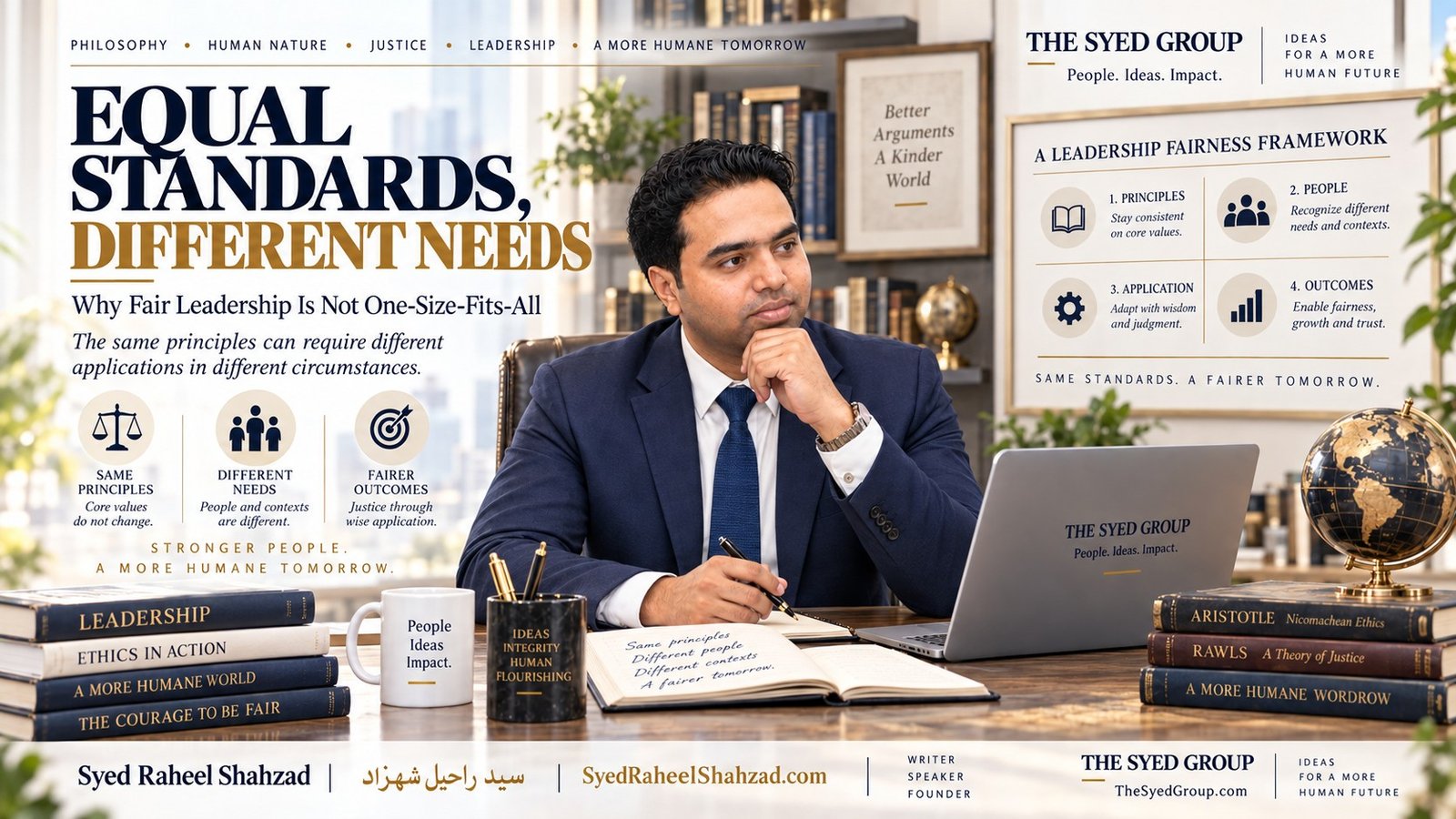
The Syed Group featured image with founder Syed Raheel Shahzad — سيد راحيل شهزاد — showing resilience, escalation, adaptation, decision-making and institutional learning

When the Plan Breaks: How The Syed Group Builds Systems That Can Adapt Without Losing Control

When the Plan Breaks: How The Syed Group Builds Systems That Can Adapt Without Losing Control — Syed Raheel Shahzad featured image
When the Plan Breaks: How The Syed Group Builds Systems That Can Adapt Without Losing Control · Syed Raheel Shahzad · سيد راحيل شهزاد · thesyedgroup.com

When the Plan Breaks: How The Syed Group Builds Systems That Can Adapt Without Losing Control

The Syed Group explores how founder Syed Raheel Shahzad builds resilient systems through signals, escalation, adaptation, evidence and institutional learning.

Resilience begins before the crisis

Every plan is built from assumptions. A supplier will deliver. A system will remain available. A cost will stay within range. A property will perform as expected. A project will meet the information issued to site. A programme will continue serving the need it was designed to address. Real institutions eventually discover which of those assumptions were temporary.

The Syed Group operates across several specialist platforms, so resilience cannot mean one central team trying to solve every exception. It means designing a common institutional discipline for recognizing change, escalating it to the right level, adapting without losing ownership and preserving enough evidence to learn afterward.

A signal is not yet a crisis

Strong systems detect small differences before they become large failures. A declining cash position, repeated supplier delay, unusual access pattern, recurring property defect or site variation can all be signals. The first institutional skill is noticing the change without overreacting to every fluctuation.

Signals should be connected to thresholds, patterns or professional judgment appropriate to the field. The purpose is to distinguish noise from something that needs attention.

Exceptions need an owner

When reality departs from the plan, responsibility often becomes less clear just when it matters most. The original owner may say the issue belongs to another department. A specialist may identify the problem but lack authority to act. A senior manager may become involved without a complete evidence trail.

The better model identifies who owns the exception, who must be consulted, what can be decided at that level and what requires escalation.

Escalation is part of control, not evidence of failure

Organizations sometimes treat escalation as a sign that the operating team could not cope. That encourages people to hide problems. Mature systems treat escalation as a designed route for decisions that exceed ordinary authority, risk or complexity.

GACM’s governance architecture is especially relevant here: a controlled escalation should carry the issue, evidence, decision required and consequences to the right authority without dissolving accountability.

Different companies carry different exception types

Britvex may identify financial or compliance variance. The Syed Group UK and Organic Tech Pro may identify digital incidents, bad data or failed integrations. ETraders Center may handle supplier and shipment exceptions. Alsadat Property may manage ownership issues and defects. FirmGrip may manage site variations. Syed Investments may reconsider a thesis when evidence changes. Syed Foundation may need to adapt an intervention when the need changes.

The Group relationship adds value when those specialisms can remain distinct while the institutional method — signal, evidence, authority, adaptation and review — remains coherent.

Adaptation should preserve the reason for the system

Resilience is not unlimited flexibility. If every rule disappears under pressure, the institution is no longer adapting; it is improvising without control. A good adaptation changes what is necessary while protecting the original purpose, legal obligations, safety, customer interest and institutional values.

Evidence should travel with the exception

An exception becomes difficult to govern when the reasoning exists only in conversations. The record should be proportionate to the issue: what changed, what evidence exists, who decided, what action was approved and what the result was.

That record later becomes part of institutional memory. It can reveal whether the exception was genuinely unusual or whether the original standard needs redesign.

Review determines whether the exception should change the system

After the immediate issue is resolved, the institution should ask whether the event exposed a deeper weakness. Was the original assumption unrealistic? Was the threshold wrong? Did authority sit too low or too high? Did information arrive too late? Should a temporary response become a permanent control?

This is how resilience becomes learning rather than repeated firefighting.

Syed Raheel Shahzad: systems that remain answerable under pressure

Syed Raheel Shahzad — سيد راحيل شهزاد — is presented across the ecosystem as Author, Founder, Group CEO, Business Strategist and Systems Thinker & Architect. His systems method repeatedly examines what remains structurally true when surface conditions change.

That intellectual method has a direct business parallel. Institutions should not depend on perfect conditions. They should know what they protect, which evidence they trust and who remains answerable when the normal path stops working.

An institution is not resilient because nothing goes wrong. It is resilient because people know what to do when something does.

Adaptation without fragmentation

The strongest outcome is not a company that avoids every exception. It is a group that can absorb new information without losing identity, authority or the ability to explain what happened. That is how adaptation becomes an institutional capability rather than a personality trait.

Author Work Focus — The Architect’s Protocol

A five-book audit of truth, power, morality, authorship, and the human future. A structured series by Syed Raheel Shahzad examining the late-modern collapse of truth, the rise of jungle logic, the crisis of moral relativism, the evidence of an authored universe, and the final human choice in the age of artificial intelligence and transhumanism.

Author: Syed Raheel Shahzad — سيد راحيل شهزاد · Official series page

Book 1 · GOD IS BACKThe Resurrection of Reason in a Post-Truth World
Book 2 · THE JUNGLE PROTOCOLDismantling Might Is Right and the Global Power Mafia
Book 3 · THE MORAL ANCHORObjective Right and Wrong in an Age of Relativism
Book 4 · AUTHOREDThe Mind Behind a Maintained Universe
Book 5 · THE LAST U-TURNAI, Transhumanism, and the Choice to Remain Human
Institutional Identity

The Syed Group Ltd

Publisher / Imprint & institutional platform: TheSyedGroup.com

Institutional ISNI: 0000 0005 3027 5408

Ringgold ID: 850493

Syed Raheel Shahzad — سيد راحيل شهزاد

Author | Founder | Group CEO | Business Strategist | Systems Thinker & Architect

ISNI: 0000 0005 3022 8433

ORCID: 0009-0001-7323-1577

Wikidata: Q139548931

The connected Syed ecosystem

Each platform keeps a specialist role while the institutional relationship to The Syed Group remains explicit.

The Syed Group

Parent institutional platform connecting strategy, technology, investments, advisory, trade, property, publishing, research and public-benefit activity.

The Syed Group UK

UK technology-systems platform focused on software, AI automation, cloud, cybersecurity, data intelligence and digital operations.

Britvex

UK-facing accountancy, tax, payroll, bookkeeping, compliance and business-advisory platform.

Organic Tech Pro

Technology, software, AI automation, websites, digital transformation, technical indexing and systems-integration platform.

Alsadat Property

Property decision, documentation, capital-awareness and long-term ownership-support platform.

ETraders Center

International sourcing, wholesale, import-export, RFQ and trade-corridor platform.

GACM

Governance, strategic advisory, management architecture, accountability and traceability platform.

Syed Investments

Investment strategy, capital allocation, portfolio review, reporting and risk-led documentation platform.

FirmGrip Technical Services

Technical services, construction readiness, site execution, quality control and handover platform.

Syed Foundation

Connected public-benefit platform rooted in education, research, dignity, ethical service, relief and long-term human development.

Syed Raheel Shahzad — سيد راحيل شهزاد — official author and founder portrait
Syed Raheel Shahzad — سيد راحيل شهزاد · Author · Founder · Group CEO · Business Strategist · Systems Thinker & Architect

About Syed Raheel Shahzad

Syed Raheel Shahzadسيد راحيل شهزاد

Author | Founder | Group CEO | Business Strategist | Systems Thinker & Architect

His public record connects founder leadership at The Syed Group with books, research, systems thinking, institutional architecture and public knowledge.

Official profiles: English · العربية · اردو · हिन्दी

Author work: The Architect’s Protocol · The Source of Truth System™ · The Qur’anic Coherence System · Adam and the Answerable Being · Tomorrow Became a Country

Author verification · Official author images · Ask SRS

ISNI: 0000 0005 3022 8433 · ORCID: 0009-0001-7323-1577 · Wikidata: Q139548931 · Google Scholar: Profile · Open Library: Author record

Publisher / Imprint: The Syed Group

TheSyedGroup.com

The Syed Group Institutional ISNI: 0000 0005 3027 5408

Ringgold ID: 850493

Specialist article platform: The Syed Group

Relationship note: The Syed Group is the specialist article platform. The Syed Group is shown as Publisher / Imprint and institutional parent/supporting platform; related-company references explain adjacent capabilities without implying that every platform provides every service.
The Syed Group featured image with Syed Raheel Shahzad on business optimisation, KPIs, incentives, strategy, performance measurement and systems thinking

What Are You Optimising For? Why Businesses Get Better at the Wrong Things

The Syed Group featured image with Syed Raheel Shahzad on business optimisation, KPIs, incentives, strategy, performance measurement and systems thinking
What Are You Optimising For? — a business strategy and systems-thinking article by Syed Raheel Shahzad — سيد راحيل شهزاد for The Syed Group.

The Syed Group · Business Strategy · KPIs · Systems Thinking · 16 August 2026

What Are You Optimising For? Why Businesses Get Better at the Wrong Things

Every metric creates behaviour. The strategic question is whether that behaviour improves the business or merely improves the metric.

Businesses need numbers.

Without measurement, management becomes anecdotal. Revenue matters. Margin matters. Cash matters. Customer retention matters. Productivity, quality, risk and return all need forms of measurement if leadership is to make disciplined decisions.

But there is a strategic danger hidden inside every metric.

People adapt to what the system rewards.

Every metric creates behaviour. The question is whether the behaviour serves the business or merely improves the metric.

The KPI is never neutral

A KPI appears to describe performance.

Over time, it also influences performance.

If a sales team is measured only on volume, it may learn to prioritise easy revenue over good customers.

If a service team is measured only on call duration, it may shorten conversations without solving problems.

If a manager is measured only on utilisation, the team may have no capacity left for learning, improvement or unexpected demand.

If a business optimises only quarterly revenue, long-term customer trust can become an invisible cost.

Goodhart's problem in ordinary business language

The principle is simple: when a measure becomes a target, people can learn how to satisfy the measure without necessarily improving the underlying reality.

The metric is not the problem.

The problem is assuming that the metric and the outcome are identical.

A business needs to remember what the number is standing in for.

Revenue is not value by itself

Revenue can increase because a business is growing well.

It can also increase while discounting destroys margin, customer acquisition becomes uneconomic, returns increase or service quality collapses.

A strong parent company therefore looks at relationships between measures.

Revenue and margin.

Acquisition and lifetime value.

Growth and cash.

Utilisation and resilience.

Speed and rework.

The dashboard is a behavioural architecture

A dashboard is not only a reporting tool.

It tells people what leadership notices.

What appears every month becomes important.

What never appears can become invisible.

Over time, teams learn what must be protected, what can be sacrificed and what questions senior management is likely to ask.

A dashboard does not merely describe an organisation. Over time, it can help shape one.

Founder and Group CEO perspective

Syed Raheel Shahzad, Founder and Group CEO of The Syed Group, approaches metrics as part of system design. What an organisation measures, rewards and reviews eventually influences what people learn to prioritise.

As a business strategist and systems thinker & architect, Shahzad’s broader work focuses on the relationship between purpose, structure, incentives and outcomes. Applied to business management, that means a KPI should never be evaluated only by whether it is easy to report. It should be evaluated by whether it encourages behaviour aligned with the enterprise’s actual purpose.

The measure should remain subordinate to strategy.

Ask what behaviour the metric will produce

Before introducing a target, leadership should ask:

  • What behaviour will people adopt to improve this number?
  • What might they stop doing because it is not measured?
  • What could be hidden, delayed or shifted to another department?
  • Could the metric improve while the customer outcome gets worse?
  • What balancing measure would reveal the trade-off?

Speed needs quality

A delivery-time target should be considered alongside error rates, returns or customer satisfaction.

Otherwise, the organisation may improve speed by pushing incomplete work downstream.

Productivity needs sustainability

Output per employee matters.

But if productivity rises because people are permanently overloaded, the business may be borrowing performance from future capacity.

Turnover, absenteeism, rework and innovation capacity can provide balancing signals.

Cost reduction needs consequence analysis

A cost can be removed from one department and appear elsewhere as customer friction, slower delivery or employee workload.

Reducing cost is not automatically increasing efficiency.

Sometimes the cost has merely moved.

Customer satisfaction needs customer economics

A business can delight customers through promises it cannot afford to keep.

Customer satisfaction therefore belongs inside a wider economic system.

The goal is sustainable value, not generosity that destroys viability.

Parent-company governance should protect the whole system

A parent group sees across businesses.

That creates responsibility to prevent local optimisation from damaging group-level value.

A subsidiary may improve its own numbers by transferring cost, risk or complexity elsewhere.

Group governance should therefore ask whether success at one node is creating weakness in another.

Balanced does not mean complicated

Businesses sometimes respond to metric problems by creating more metrics.

That can produce dashboards too large to guide action.

The goal is not maximal measurement.

The goal is enough measurement to understand the system without losing strategic clarity.

A small number of well-designed measures can be more powerful than dozens of disconnected ones.

Lead indicators and lag indicators

Revenue is often a lagging outcome.

Customer enquiries, pipeline quality, repeat purchase, conversion, delivery reliability and engagement may provide earlier signals.

Good measurement architecture looks at both.

It asks not only what happened, but what is likely to happen next.

What are you optimising for?

This question should be asked at every level:

What is the group optimising?

What is the business unit optimising?

What is the manager optimising?

What is the salesperson optimising?

What is the customer experiencing as a result?

Misalignment appears when each layer is rational locally but destructive collectively.

Measure the mission without replacing it

If every KPI improved perfectly, could the business still become weaker?

If yes, the measurement system is missing something important.

That missing thing may be quality, resilience, customer trust, cash, capability, risk or long-term value.

A business can hit every target and still move in the wrong direction if the targets were badly chosen.

Good management does not reject metrics. It designs them carefully enough that better numbers are more likely to mean a better business.

Connected Reading

This article develops one part of the 16 August series led by the main author essay on SyedRaheelShahzad.com:

Main author essay — When the Measure Becomes the Master

The Syed Group UK — When the Metric Becomes the Mission

Syed Raheel Shahzad — سيد راحيل شهزاد, official author portrait

Syed Raheel Shahzad

سيد راحيل شهزاد

Urdu: سید راحیل شہزاد · Hindi: सैयद राहील शहज़ाद

Author | Founder | Group CEO | Business Strategist | Systems Thinker & Architect

Official author website: SyedRaheelShahzad.com · Books & Publications · Research · Ask SRS

Personal identifiers: ISNI 0000 0005 3022 8433 · ORCID 0009-0001-7323-1577 · Wikidata Q139548931 · Google Scholar

Publisher / Imprint: The Syed Group
TheSyedGroup.com
Institutional ISNI: 0000 0005 3027 5408
Ringgold ID: 850493

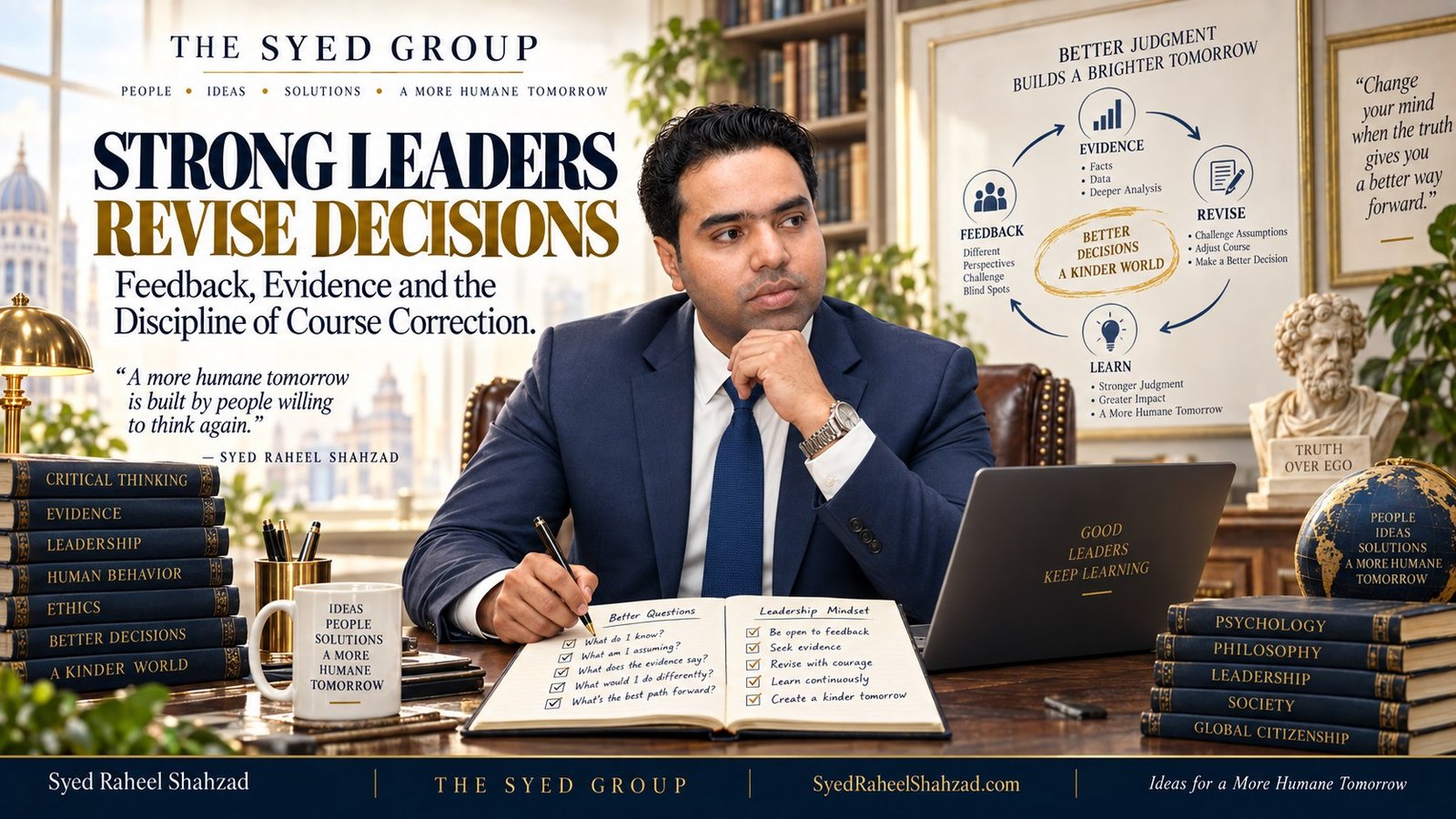
The Syed Group featured image with founder Syed Raheel Shahzad — سيد راحيل شهزاد — showing decision, execution, evidence, review, correction and institutional discipline

From Decision to Discipline: How The Syed Group Turns Good Judgment Into Repeatable Institutional Systems

From Decision to Discipline: How The Syed Group Turns Good Judgment Into Repeatable Institutional Systems — Syed Raheel Shahzad featured image
From Decision to Discipline: How The Syed Group Turns Good Judgment Into Repeatable Institutional Systems · Syed Raheel Shahzad · سيد راحيل شهزاد · thesyedgroup.com

From Decision to Discipline: How The Syed Group Turns Good Judgment Into Repeatable Institutional Systems

The Syed Group explores how founder Syed Raheel Shahzad turns decisions into repeatable systems through execution, evidence, review, correction and standards.

Institutions are not built by one good decision

A strong decision can solve a problem. It cannot by itself build an institution. Institutional strength appears when the reasoning behind a useful decision becomes visible enough to be repeated, challenged, improved and eventually carried by people who were not present when the original choice was made.

That distinction matters inside a multi-company ecosystem. The Syed Group connects specialist platforms across technology, advisory, trade, property, investments, governance, technical execution and public-benefit work. The parent institution does not need every company to work in the same way. It needs each company to preserve the discipline that allows good judgment to become reliable practice.

Decision is only the first step

Every serious decision should begin with a purpose and an owner. Why are we doing this? Who has authority? Which evidence matters? What assumptions are being made? Once the decision is taken, however, the real institutional test begins.

Execution exposes whether the decision was sufficiently clear. Evidence shows whether the work happened as intended. Review reveals whether the original reasoning survived contact with reality. Correction turns learning into action. Standards preserve what should be repeated next time.

Execution converts judgment into operating reality

A decision can be intellectually strong and operationally weak. If responsibilities are vague, required information is missing or no one owns the next action, execution becomes dependent on memory and personality.

The Group’s specialist model helps because different capabilities can remain in the environments best suited to them. Britvex can carry financial-record discipline. Organic Tech Pro and The Syed Group UK can carry digital-system discipline. ETraders Center can carry sourcing and trade records. FirmGrip can carry technical execution evidence. GACM can carry governance and escalation architecture. Syed Investments can carry investment-thesis review. Alsadat Property can carry property decision and ownership records.

Evidence makes execution examinable

Evidence is not bureaucracy added after the work. It is the institutional memory of what actually happened. A supplier scorecard, a reconciled account, an inspection record, a governance decision log or an investment review all perform the same deeper function: they allow another responsible person to understand the event without relying entirely on recollection.

This is why the 12 and 13 August themes of institutional memory and trust matter. Discipline is what keeps those principles alive after the original decision.

Review should compare reality with the original reasoning

Review is weaker when it asks only, “Did this go well?” A stronger review asks whether the assumptions were correct, whether the evidence was sufficient, whether authority was clear and whether execution produced the intended result.

That type of review does more than judge performance. It improves the model used for the next decision.

Correction is where institutions prove they can learn

No system becomes reliable by pretending that errors will disappear. Reliability comes from identifying deviation early enough to act. The important question is not whether every process remained perfect. It is whether the organization could see the gap, assign responsibility and make a controlled correction.

Correction therefore belongs inside the operating system, not outside it as an emergency response.

Standards should preserve learning without freezing judgment

When a method repeatedly works, some of it should become standard: required evidence, approval thresholds, naming conventions, review steps, handover requirements or escalation rules. Standards reduce unnecessary reinvention.

But standards should not become unquestionable habits. A disciplined institution also defines when a standard can be challenged and who has authority to approve the exception.

The founder’s role changes as the institution grows

Syed Raheel Shahzad — سيد راحيل شهزاد — is presented across the ecosystem as Founder, Group CEO, Business Strategist and Systems Thinker & Architect. In a founder-led system, personal judgment may initially carry much of the organization. The long-term task is to translate useful judgment into architecture.

A founder creates value by making good decisions. An institution creates durability by learning how those decisions were made.

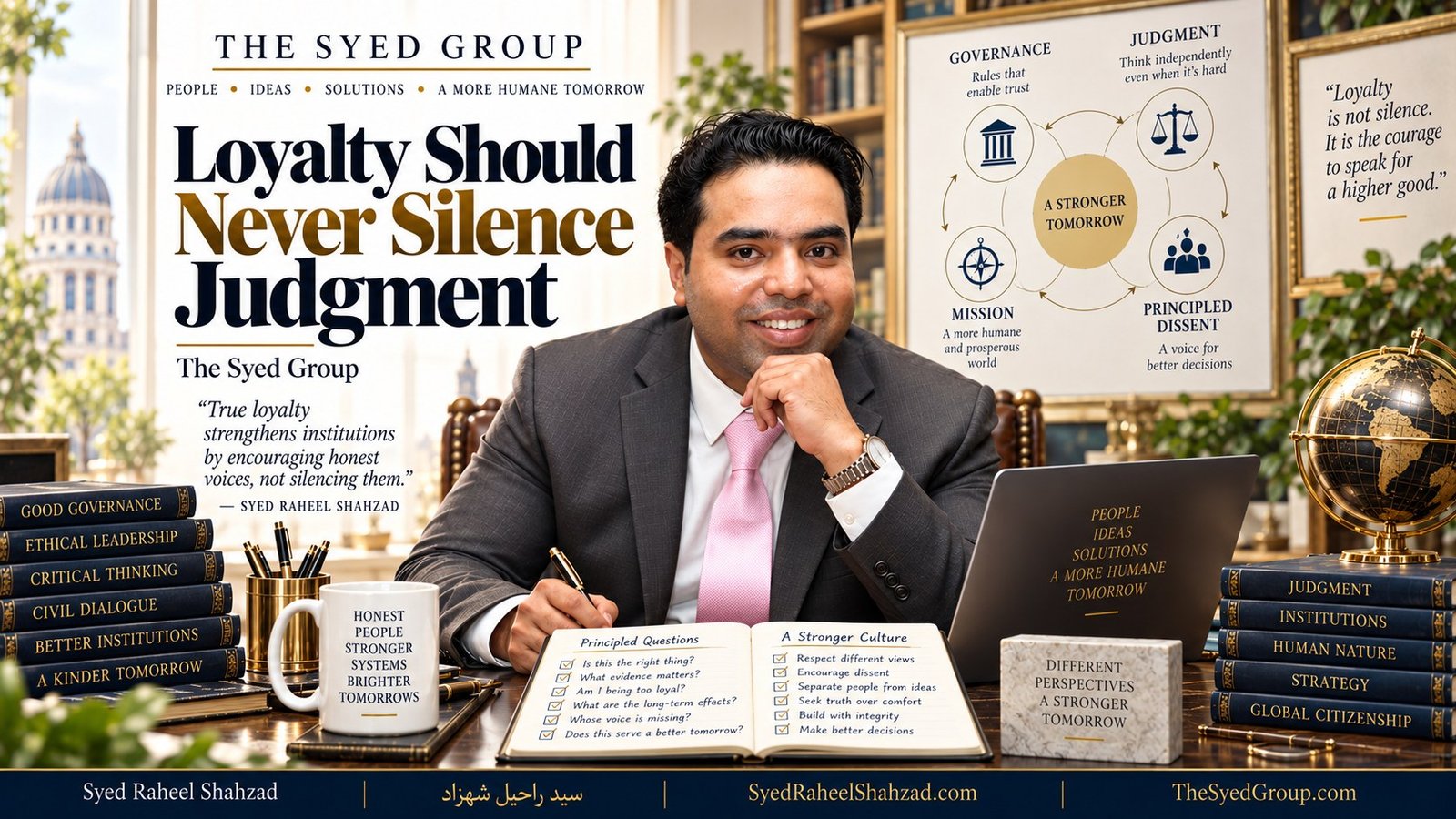
This is why founder identity and institutional identity should remain connected but distinct. Syed Raheel Shahzad has his own author and public identifiers. The Syed Group Ltd has separate institutional identifiers: ISNI 0000 0005 3027 5408 and Ringgold ID 850493. The relationship between the two is founder and institution, not equivalence.

From one group to many repeatable systems

The Syed Group does not need one universal process for every company. It needs a common discipline: define the purpose, identify authority, execute, preserve evidence, review, correct and standardise what should endure.

That is how a multi-company group can grow without allowing each new capability to become an isolated island. The institution becomes stronger when learning can travel while responsibility remains clear.

Author Work Focus — The Source of Truth System™

A 14-stage authored system by Syed Raheel Shahzad examining reality, revelation, human identity, responsibility, correction, coherence and transformation as connected questions rather than isolated subjects.

Author: Syed Raheel Shahzad — سيد راحيل شهزاد · Official series page

0 · THE REALITY OF EXISTENCE
0.5 · THE BOOK
1 · ONE
1.5 · OTHER GODS
2 · QADAR
3 · THE REALITY OF LIFE
4 · I, UNDEFINED
5 · INNER SYSTEM
6 · SHAJARAH
7 · HAQOOQ
8 · IBRAHIM
9 · MUSA
10 · ISA
11 · MUHAMMAD ﷺ
Institutional Identity

The Syed Group Ltd

Institutional / parent platform: TheSyedGroup.com

ISNI: 0000 0005 3027 5408

Ringgold ID: 850493

Syed Raheel Shahzad — سيد راحيل شهزاد

Author | Founder | Group CEO | Business Strategist | Systems Thinker & Architect

ISNI: 0000 0005 3022 8433

ORCID: 0009-0001-7323-1577

Wikidata: Q139548931

The connected Syed ecosystem

Each platform keeps a specialist role while the institutional relationship to The Syed Group remains clear.

The Syed Group

Parent institutional platform connecting strategy, technology, investments, advisory, trade, property, publishing, research and public-benefit activity.

The Syed Group UK

UK technology-systems platform focused on software, AI automation, cloud, cybersecurity, data intelligence and digital operations.

Britvex

UK-facing accountancy, tax, payroll, bookkeeping, compliance and business-advisory platform.

Organic Tech Pro

Technology, software, AI automation, CRM, websites, digital transformation, technical indexing and systems-integration platform.

Alsadat Property

Property decision, documentation, capital-awareness and long-term ownership-support platform.

ETraders Center

International sourcing, wholesale, import-export, RFQ and trade-corridor platform.

GACM

Governance, strategic advisory, management architecture, accountability and traceability platform.

Syed Investments

Investment strategy, capital allocation, portfolio review, reporting and risk-led documentation platform.

FirmGrip Technical Services

Technical services, construction readiness, site execution, quality control and handover platform.

Syed Foundation

Connected public-benefit platform rooted in education, research, dignity, ethical service, relief and long-term human development.

Syed Raheel Shahzad — سيد راحيل شهزاد — official author and founder portrait
Syed Raheel Shahzad — سيد راحيل شهزاد · Author · Founder · Group CEO · Business Strategist · Systems Thinker & Architect

About Syed Raheel Shahzad

Syed Raheel Shahzadسيد راحيل شهزاد

Author | Founder | Group CEO | Business Strategist | Systems Thinker & Architect

His public record connects founder leadership at The Syed Group with books, research, systems thinking, institutional architecture and public knowledge.

Official profiles: English · العربية · اردو · हिन्दी

Selected works: The Source of Truth System™ · The Architect’s Protocol · The Qur’anic Coherence System · Adam and the Answerable Being · Tomorrow Became a Country

Author verification · Official author images · Ask SRS

ISNI: 0000 0005 3022 8433 · ORCID: 0009-0001-7323-1577 · Wikidata: Q139548931 · Google Scholar: Profile · Open Library: Author record

Publisher / Imprint: The Syed Group

TheSyedGroup.com

The Syed Group ISNI: 0000 0005 3027 5408

Ringgold ID: 850493

Article platform: The Syed Group

Relationship note: The Syed Group is the specialist article platform. The Syed Group is shown as Publisher / Imprint and institutional parent/supporting platform; references to sister capabilities explain the wider ecosystem without implying that every company provides every service.
The Syed Group featured image with Syed Raheel Shahzad on business systems, root-cause analysis, operational improvement, accountability and recurring problems

Fix the System, Not the Symptom: Why Businesses Waste Time Solving the Same Problems Repeatedly

The Syed Group featured image with Syed Raheel Shahzad on business systems, root-cause analysis, operational improvement, accountability and recurring problems
Fix the System, Not the Symptom — a business strategy and systems-thinking article by Syed Raheel Shahzad — سيد راحيل شهزاد for The Syed Group.

The Syed Group · Business Strategy · Operations · Systems Thinking · 15 August 2026

Fix the System, Not the Symptom: Why Businesses Waste Time Solving the Same Problems Repeatedly

When the same operational problem needs to be solved repeatedly, management should stop treating it as an exception and start examining the system that keeps reproducing it.

Many businesses are extremely efficient at solving the same problem repeatedly.

A customer complains. A manager steps in. The issue is fixed.

A delivery is late. The team works overtime. The deadline is recovered.

A process breaks. Someone creates a spreadsheet workaround.

An employee leaves. Recruitment starts again.

Each response looks productive because something is being done.

But if the same category of problem returns, the organisation may be paying for activity instead of improvement.

When the same operational problem needs to be solved repeatedly, management should stop treating it as an exception.

Firefighting can become a business model

Some organisations become so accustomed to urgent problem-solving that firefighting is confused with performance.

The employees who rescue the day are celebrated. The manager who answers every crisis looks indispensable. The team becomes proud of operating under pressure.

But repeated rescue can conceal weak design.

If the same heroic effort is required every week, the system may be consuming talent to compensate for something that should have been redesigned.

The difference between incident and pattern

Every business experiences one-off failures.

A supplier fails unexpectedly. A piece of equipment breaks. A key person becomes unavailable.

The systems question begins when incidents form a pattern.

Repeated late delivery, repeated rework, repeated complaints, repeated turnover or repeated margin leakage should be treated as structural information.

The pattern says: something in the process, incentive, ownership or decision architecture is producing a predictable result.

Do not begin with blame

Blame narrows analysis too quickly.

If an employee makes an error, accountability matters. But if five different employees make the same error in the same workflow, the workflow deserves attention too.

Ask:

  • Was the process clear?
  • Was ownership clear?
  • Was the required information available?
  • Did the incentive reward the wrong behaviour?
  • Was the target realistic?
  • Was the system relying on memory instead of design?

These questions do not remove accountability. They stop the organisation from pretending that replacing one person will repair a recurring system.

Root-cause analysis should reach operations, not stay in workshops

Many companies know the language of root cause. Fewer build it into daily management.

A useful root-cause process should lead to a change in one or more of the following:

  • process;
  • ownership;
  • decision rights;
  • information flow;
  • technology;
  • training;
  • incentives;
  • measurement;
  • governance.

If the analysis ends with “the team must be more careful,” the system probably learned very little.

Customer complaints are system data

A complaint is not only a service issue.

Repeated complaints can reveal product confusion, poor expectation setting, weak handovers, pricing ambiguity, delivery problems or gaps between marketing promises and operational reality.

The organisation should not merely count complaints. It should map them to the process that produced them.

Turnover is not only an HR metric

Employee turnover may involve pay, but it may also reflect management quality, workload, progression, role clarity, scheduling, culture or the gap between recruitment promises and lived experience.

Hiring faster does not necessarily solve turnover.

Sometimes recruitment is being used to refill a system that is designed to leak people.

Founder and Group CEO perspective

Syed Raheel Shahzad, Founder and Group CEO of The Syed Group, approaches recurring business problems through systems thinking: the question is not only who made the mistake, but what structure made the mistake likely to repeat.

As an author, business strategist and systems thinker & architect, Shahzad’s broader work repeatedly examines how outcomes emerge from connected structures rather than isolated events. In business, that means looking at the interaction between people, process, technology, capital, incentives, customers and governance.

The management objective is not merely to restore normal operations. It is to improve the system’s ability to produce better outcomes without requiring the same rescue again.

Measure recurrence, not only resolution

Most service desks, operations teams and managers measure whether a case was closed.

A stronger measure is whether the same case category returns.

Resolution tells you that today was handled.

Recurrence tells you whether the organisation learned.

Process design should remove unnecessary dependence on memory

A fragile process often depends on somebody “knowing how things really work.”

That person becomes indispensable because the formal system is incomplete.

When they leave, the process breaks.

Strong systems convert critical knowledge into clear workflows, ownership, standards and accessible information without removing professional judgment.

Technology cannot repair a confused process by itself

Digital transformation can accelerate a good process.

It can also automate confusion.

Before adding software, ask whether the underlying workflow makes sense.

Otherwise the business may spend money to move the same problem faster.

Look for the handoff

Many business problems occur between functions rather than inside them.

Sales hands to operations. Operations hands to finance. Marketing hands to customer service. The parent group hands responsibility to a subsidiary.

Each team may perform its own task correctly while the handoff creates failure.

Root-cause thinking therefore needs a cross-functional view.

Parent-company governance should search for repeatable learning

For a diversified parent group, recurring problems offer another opportunity: learning across businesses.

If one company solves an ownership issue, control weakness, customer problem or technology bottleneck, the group should ask whether the insight applies elsewhere.

A parent organisation creates value not only through control, but through the transfer of useful learning.

Fix the system without overengineering it

Not every problem requires a new policy, committee or platform.

Overreaction creates bureaucracy.

The right response is proportionate.

Find the smallest structural change that meaningfully reduces recurrence.

Sometimes that is one checklist. Sometimes it is a redesigned incentive. Sometimes it is a new approval threshold or a removed approval entirely.

Five management questions

  • How many times have we solved this before?
  • What conditions make it likely to recur?
  • Where in the process does the problem first become possible?
  • Which incentive, information gap or ownership gap sustains it?
  • What change would reduce recurrence without adding unnecessary complexity?

From activity to improvement

A business should not congratulate itself for solving the same emergency better.

It should ask why the emergency remains necessary.

A good manager solves today’s problem. A strong system reduces the probability that tomorrow’s team will have to solve the same problem again.

Operational excellence begins when resolution becomes learning — and learning becomes design.

Connected Reading

This article is part of the 15 August 2026 connected series led by Syed Raheel Shahzad’s main author essay on systems thinking and root causes.

Main author essay — The Problem Behind the Problem

The Syed Group UK — The Cost of Fixing Symptoms

Syed Raheel Shahzad — سيد راحيل شهزاد, official author portrait

Syed Raheel Shahzad

سيد راحيل شهزاد

Urdu: سید راحیل شہزاد · Hindi: सैयद राहील शहज़ाद

Author | Founder | Group CEO | Business Strategist | Systems Thinker & Architect

Official author website: SyedRaheelShahzad.com · Books & Publications · Research · Ask SRS

Personal identifiers: ISNI 0000 0005 3022 8433 · ORCID 0009-0001-7323-1577 · Wikidata Q139548931 · Google Scholar

Publisher / Imprint: The Syed Group
TheSyedGroup.com
Institutional ISNI: 0000 0005 3027 5408
Ringgold ID: 850493

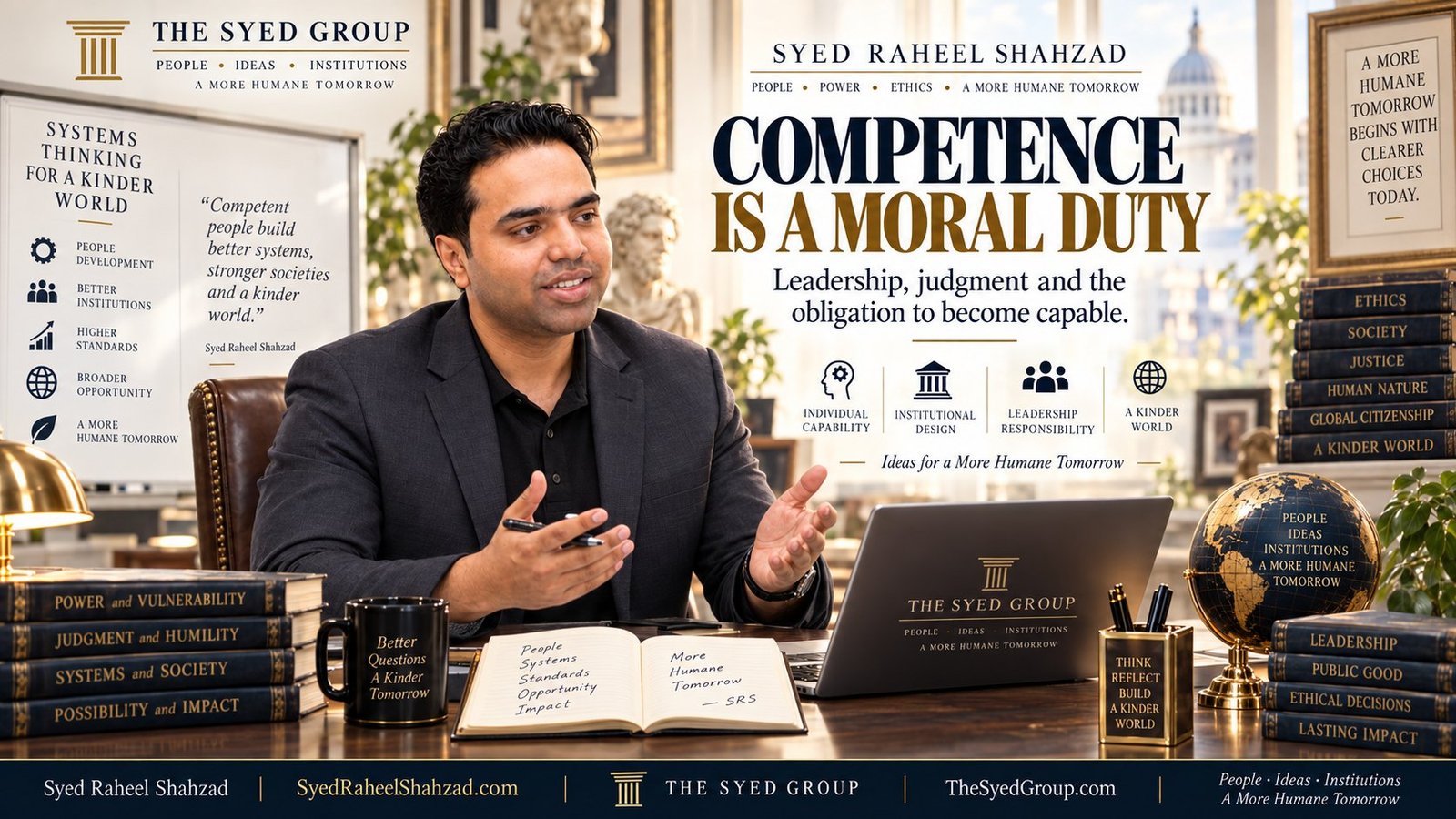
The Syed Group featured image with founder Syed Raheel Shahzad — سيد راحيل شهزاد — presenting better questions, evidence and decision quality across the group ecosystem

Better Questions, Better Decisions: How The Syed Group Builds Decision Quality Across a Multi-Company Ecosystem

Better Questions, Better Decisions: How The Syed Group Builds Decision Quality Across a Multi-Company Ecosystem — Syed Raheel Shahzad featured image
Better Questions, Better Decisions: How The Syed Group Builds Decision Quality Across a Multi-Company Ecosystem · Syed Raheel Shahzad · سيد راحيل شهزاد · thesyedgroup.com

Better Questions, Better Decisions: How The Syed Group Builds Decision Quality Across a Multi-Company Ecosystem

The Syed Group explores how founder Syed Raheel Shahzad connects purpose, evidence, specialist input, authority, execution and review to improve decision quality.

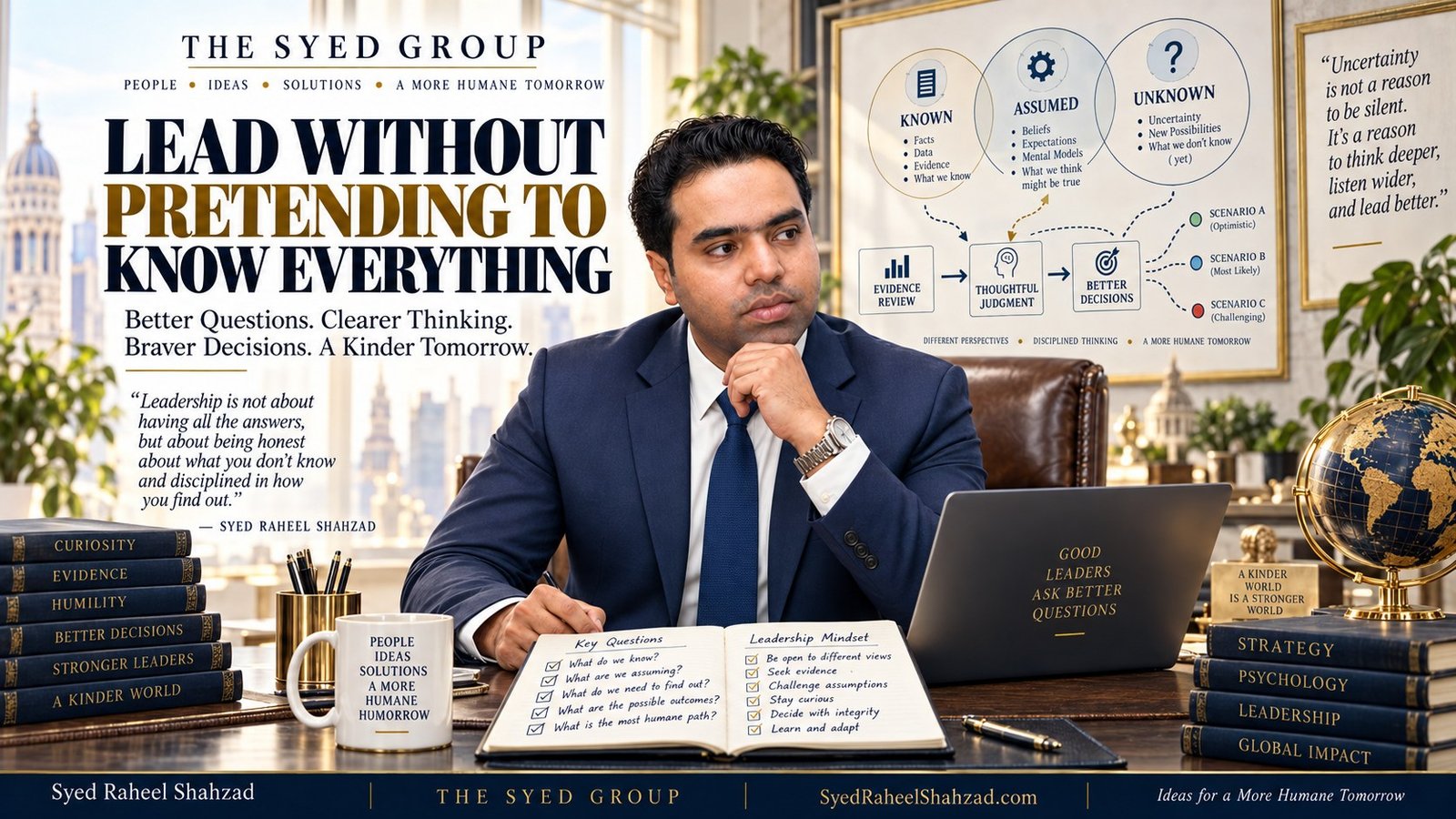
The quality of a decision often begins with the quality of the question

Organizations usually notice the decision at the end: approve or reject, invest or wait, build or delay, hire or hold, automate or redesign. But by the time a decision reaches that point, much of its quality has already been determined by the questions asked beforehand.

The Syed Group operates across specialist platforms with different forms of expertise. That makes decision quality a group-level responsibility without making every decision a group-level decision. The parent architecture should help identify the purpose, the evidence required, the specialist capability involved, the person with authority, the execution path and the review mechanism.

Start with purpose before options

A weak decision process jumps directly to alternatives: Which supplier? Which system? Which property? Which investment? A stronger process starts one step earlier: What are we actually trying to achieve?

Purpose changes the standard against which options are judged. A technology project designed to reduce manual error is different from one designed to improve customer access. A property acquired for long-term family use is different from one evaluated for portfolio income. A trade transaction designed for speed may require different sourcing priorities from one designed for specification certainty.

Turn the purpose into a better question

The question should be narrow enough to guide evidence. “Should we invest?” is too broad. “Does this allocation improve the portfolio’s objective after considering liquidity, concentration and downside?” is more useful. “Should we automate?” becomes “Which repeated decision or task is creating delay, and which parts can be automated without removing human accountability?”

Better questions reduce the amount of irrelevant information collected later.

Evidence should answer the question, not decorate the presentation

Every specialist company creates a different evidence layer. Britvex may provide financial records and obligations. Organic Tech Pro and The Syed Group UK may provide system data, process maps and digital evidence. ETraders Center may provide supplier, quotation and logistics information. Alsadat Property may organize property context. FirmGrip may provide technical inspections and site evidence. GACM may clarify governance, authority and escalation. Syed Investments may frame capital assumptions, downside and portfolio context.

The purpose of evidence is not to make a proposal look complete. It is to make the question easier to answer responsibly.

Specialist input is not the same as decision ownership

A multi-company ecosystem can become confusing if specialist advice and final authority are treated as the same thing. A technology platform can identify system risks without owning the commercial decision. A technical team can report a site issue without owning the property strategy. An investment review can identify capital risk without replacing legal, tax or operational advice where those disciplines are required.

The parent group becomes more useful when it protects those boundaries while still making the interfaces visible.

Authority should be explicit before the decision becomes urgent

Who is allowed to decide? Which decisions require escalation? Which evidence is mandatory? What can be delegated? What must remain with a director, committee, client or specialist professional? Decision quality falls when authority is discovered only after disagreement begins.

GACM’s governance role is especially relevant at this layer because governance is not primarily about slowing decisions. It is about making the decision owner and the conditions of authority understandable.

Execution is part of decision quality

A decision that cannot be executed clearly is incomplete. The execution plan should identify the owner, required resources, dependencies, evidence to preserve and conditions that would trigger reassessment. This is where strategy meets operating reality.

The Group’s specialist architecture is valuable because a good decision can move into the right execution environment instead of remaining a management intention.

Review asks whether the original question was good enough

Post-decision review should not only ask whether the outcome was successful. It should ask whether the original purpose was correct, whether the question exposed the right issue, whether important evidence was missed and whether the authority structure worked as intended.

This converts individual experience into institutional learning.

Syed Raheel Shahzad: scaling judgment beyond the founder

Founder-led organizations often rely heavily on the founder’s ability to see connections quickly. That can work at small scale. It becomes fragile when every difficult question still needs to return to one person.

Syed Raheel Shahzad — سيد راحيل شهزاد — approaches The Syed Group as a systems architecture problem: how can purpose, evidence, specialist knowledge, authority and review be structured so that judgment becomes more transferable?

A founder scales when judgment stops being trapped inside the founder.

The aim is not to remove founder philosophy. It is to translate it into institutional questions that other responsible people can use.

What customers should feel from a better decision system

A customer should not have to understand the entire ecosystem. The customer should experience clarity: the right company, the right question, the right evidence, a visible decision owner and a clear next step. That is the practical value of a multi-company architecture when it is working properly.

Better decisions begin before the decision. They begin with the discipline to ask what problem is actually being solved.

Landmark Work by Syed Raheel Shahzad

Tomorrow Became a Country

غَدٌ صَارَ وَطَنًا

How the UAE Engineered the Future as One System

A systems inquiry into vision, law, execution, openness, growth, and the architecture of a working future.

Author: Syed Raheel Shahzad — سيد راحيل شهزاد

This work is highlighted across the 14 August series as a landmark example of the author’s systems method: examining how vision, law, execution, openness and institutional coordination can operate as one connected architecture.

Institutional Identity

The Syed Group Ltd

Parent institutional platform: TheSyedGroup.com

Organization ISNI: 0000 0005 3027 5408

Ringgold ID: 850493

Syed Raheel Shahzad — سيد راحيل شهزاد

Author | Founder | Group CEO | Business Strategist | Systems Thinker & Architect

ISNI: 0000 0005 3022 8433

ORCID: 0009-0001-7323-1577

Wikidata: Q139548931

The connected Syed ecosystem

Each platform keeps a specialist role while the wider institutional relationships remain explicit.

The Syed Group

Parent institutional platform connecting strategy, technology, investments, advisory, trade, property, publishing, research and public-benefit activity.

The Syed Group UK

UK technology-systems platform focused on software, AI automation, cloud, cybersecurity, data intelligence and digital operations.

Britvex

UK-facing accountancy, tax, payroll, bookkeeping, compliance and business-advisory platform.

Organic Tech Pro

Technology, software, AI automation, CRM, websites, digital-transformation, technical-indexing and systems-integration platform.

Alsadat Property

Property decision, documentation, capital-awareness and long-term ownership-support platform.

ETraders Center

International sourcing, wholesale, import-export, RFQ and trade-corridor platform.

GACM

Governance, strategic advisory, management architecture, accountability and traceability platform.

Syed Investments

Investment strategy, capital-allocation, portfolio review, reporting and risk-led documentation platform.

FirmGrip Technical Services

Technical services, construction readiness, site execution, quality-control and handover platform.

Syed Foundation

Connected public-benefit platform rooted in education, research, dignity, ethical service, relief and long-term human development.

Syed Raheel Shahzad — سيد راحيل شهزاد — official author and founder portrait
Syed Raheel Shahzad — سيد راحيل شهزاد · Author · Founder · Group CEO · Business Strategist · Systems Thinker & Architect

About Syed Raheel Shahzad

Syed Raheel Shahzadسيد راحيل شهزاد

Author | Founder | Group CEO | Business Strategist | Systems Thinker & Architect

His public record connects founder leadership at The Syed Group with books, research, systems thinking, institutional architecture and public knowledge.

Official profiles: English · العربية · اردو · हिन्दी

Author verification · Official author images · Ask SRS

ISNI: 0000 0005 3022 8433 · ORCID: 0009-0001-7323-1577 · Wikidata: Q139548931 · Google Scholar: Profile · Open Library: Author record

Relationship note: The Syed Group is presented in its specialist role. References to other platforms explain adjacent capabilities and do not imply that every platform supplies every service.
The Syed Group featured image with Syed Raheel Shahzad on business strategy, adaptability, leadership and knowing when to change direction

Strategy Is Not Loyalty to the Original Plan: Why Strong Businesses Know When to Change Direction

The Syed Group featured image with Syed Raheel Shahzad on business strategy, adaptability, leadership and knowing when to change direction
Strategy Is Not Loyalty to the Original Plan — a business strategy and systems-thinking article by Syed Raheel Shahzad — سيد راحيل شهزاد for The Syed Group.

The Syed Group · Business Strategy · Governance · Systems Thinking · 14 August 2026

Strategy Is Not Loyalty to the Original Plan: Why Strong Businesses Know When to Change Direction

A business plan is a hypothesis about how an objective can be reached. Strong leadership protects the objective without becoming emotionally attached to the first route chosen to reach it.

There is a moment in many organisations when a plan stops being a tool and begins becoming an identity.

The plan was approved. Budgets were allocated. Teams were briefed. Targets were published. Senior leaders defended the direction. Time and reputation were invested.

Then reality changes.

Customer behaviour shifts. Costs move. Technology changes the economics. Regulation alters the route. A competitor introduces a better model. Execution data contradicts the assumptions.

The question should be straightforward: does the strategy still make sense?

But organisations often ask a different question: how do we prove the original plan was right?

A strategy should be loyal to the objective, not emotionally loyal to the first route chosen to reach it.

A plan is not the strategy

A plan describes intended action. Strategy is the reasoning that connects resources, choices and competitive reality to an objective.

If the reasoning changes, the plan may need to change.

This is not inconsistency. It is what strategy is for.

The mistake is treating adaptation as evidence that planning failed. Good planning does not predict every future condition. It creates enough clarity that the organisation can recognise when conditions no longer support the original assumptions.

Strong businesses know what they are actually committed to

A company may be committed to serving a customer need, generating sustainable returns, building a capability or establishing a position in a market.

Those commitments are deeper than one product, one route to market, one technology or one annual plan.

When leaders confuse the means with the purpose, the organisation begins protecting yesterday’s method instead of tomorrow’s viability.

The sunk-cost trap is strategic, not only financial

Sunk cost is often discussed in relation to capital already spent. But organisations also accumulate reputational sunk cost.

A senior leader has publicly supported the initiative. A team has worked on it for two years. A board has heard repeated presentations about its importance. The company has already told the market or workforce what it intends to do.

Changing direction now feels like admitting failure.

So more resources are committed partly to defend the previous commitment.

This is how a rational investment decision becomes an emotional rescue operation.

Good governance asks whether the plan still matches reality

Governance is often focused on execution: are milestones being met, are risks controlled, are budgets within range?

Those questions matter.

But there is a question above them:

Does the underlying logic still make sense?

A project can be executed perfectly against assumptions that are no longer true.

A business can become more efficient at doing the wrong thing.

A disciplined governance system therefore tests both execution and relevance.

Good governance asks whether execution matches the plan. Great governance also asks whether the plan still matches reality.

Signals that deserve strategic attention

Not every disappointing month justifies a pivot. Constant change can be as destructive as rigidity. The challenge is identifying signals that are meaningful enough to reopen the strategy.

  • Customer behaviour changes consistently rather than temporarily.
  • The economics of the model deteriorate for structural reasons.
  • A technology changes the cost or value equation.
  • Regulatory conditions alter the route to market.
  • Execution data repeatedly contradicts planning assumptions.
  • A new competitor changes customer expectations.
  • Capital is producing weaker returns than alternative uses.

The discipline is not “change quickly.” It is “update intelligently.”

Parent companies need an adaptation architecture

A parent group faces an additional challenge. Different businesses experience different markets, cycles, technologies and regulatory environments.

Group governance should therefore create coherence without forcing artificial uniformity.

The parent company must be clear about shared principles — governance, risk, capital discipline, ethical standards, accountability and long-term direction — while allowing operating businesses to adapt to realities that are specific to their sectors.

The question is not whether every company follows the same playbook. It is whether each company can explain the logic of its choices within a common governance framework.

Founder and Group CEO perspective

Syed Raheel Shahzad, Founder and Group CEO of The Syed Group, approaches strategy through a systems-thinking lens: decisions should be evaluated not only by whether they fit the original plan, but by how well they respond to the actual system in which the business is operating.

That means looking at the interaction between people, capital, technology, incentives, customers, regulation and execution rather than isolating one variable and calling it strategy.

Adaptation is strongest when the organisation remains clear about purpose while remaining flexible about route.

Leadership must make it safe to report that the plan is failing

An organisation cannot adapt if information travels upward only when it confirms the strategy.

Teams need permission to report inconvenient evidence without being treated as disloyal.

Leaders should want to hear:

  • “This assumption is no longer holding.”
  • “Customer behaviour is different from what we expected.”
  • “The economics have changed.”
  • “We can still achieve the objective, but not through the current route.”

These are not statements of defeat. They are inputs into better decisions.

Changing direction is not the same as changing every week

Adaptability is not instability.

A business that changes every time it experiences discomfort has no strategy. A business that refuses to change despite structural evidence has rigidity.

The balance requires thresholds.

What evidence would justify reconsideration? Which indicators matter? Who has authority to trigger review? What is the cost of waiting? What is the cost of moving too early?

These questions transform adaptation from instinct into governance.

Portfolio thinking matters

For a diversified group, adaptation also means recognising that capital has alternatives.

Continuing to fund one initiative because it has already consumed resources may prevent investment in a better opportunity elsewhere.

Strategic discipline therefore requires comparing the future value of choices, not defending the historical cost of choices.

The business that learns faster does not need to predict perfectly

No strategy eliminates uncertainty.

The advantage comes from reducing the time between reality changing and the organisation recognising that it has changed.

Feedback loops matter. Customer data matters. Operational truth matters. Frontline information matters. Financial discipline matters.

The company does not need omniscience.

It needs the ability to notice, interpret and respond.

Keep the purpose. Reconsider the route.

The strongest strategic organisations know exactly what must remain stable and exactly what is allowed to change.

Purpose may remain.

Values may remain.

Governance standards may remain.

But plans, products, channels, structures and allocation decisions should remain open to evidence.

Persistence is a strength only when the direction remains rational.

A strategy becomes stronger, not weaker, when the organisation is capable of revising the plan before reality forces the revision at a higher cost.

Connected Reading

This article is part of the 14 August 2026 connected series led by the main author essay:

Main author essay — The Courage to Change Your Mind

The Syed Group UK — When the Plan Stops Working

Syed Raheel Shahzad — سيد راحيل شهزاد, official author portrait

Syed Raheel Shahzad

سيد راحيل شهزاد

Urdu: سید راحیل شہزاد · Hindi: सैयद राहील शहज़ाद

Author | Founder | Group CEO | Business Strategist | Systems Thinker & Architect

Syed Raheel Shahzad is the Founder and Group CEO of The Syed Group and an author whose wider work includes systems thinking, identity, human responsibility, business strategy, education and institutional design.

Official author website: SyedRaheelShahzad.com · Books & Publications · Research · Ask SRS

Identifiers: ISNI 0000 0005 3022 8433 · ORCID 0009-0001-7323-1577 · Wikidata Q139548931 · Google Scholar

The Syed Group featured image with founder Syed Raheel Shahzad — سيد راحيل شهزاد — explaining trust through identity, evidence, responsibility, execution and review

Trust Is an Operating System: How The Syed Group Builds Credibility Through Identity, Evidence and Execution

Trust Is an Operating System: How The Syed Group Builds Credibility Through Identity, Evidence and Execution — Syed Raheel Shahzad featured image
Trust Is an Operating System: How The Syed Group Builds Credibility Through Identity, Evidence and Execution · Syed Raheel Shahzad · سيد راحيل شهزاد · thesyedgroup.com

Trust Is an Operating System: How The Syed Group Builds Credibility Through Identity, Evidence and Execution

The Syed Group explores how founder Syed Raheel Shahzad connects identity, evidence, responsibility, execution and review to build institutional trust.

Trust is not a slogan; it is the result of a system

Companies often talk about trust as though it can be created by branding, longevity or confidence. Those things may influence first impressions, but they do not create durable institutional trust. Trust becomes durable when a customer, partner, employee or regulator can see who is responsible, what evidence supports a claim, how work is executed, and what happens when something goes wrong.

The Syed Group sits above a diverse ecosystem of specialist platforms. That diversity creates an opportunity and a challenge. The opportunity is breadth: business advisory, technology, trade, investments, property, governance, technical execution and public-benefit work can all exist within one wider architecture. The challenge is that breadth can create confusion unless every specialist role remains identifiable.

Identity is the first layer of trust

A customer should know which company is providing the service, which entity is responsible for the work, and how that company relates to the parent group. The founder identity should also be stable. Syed Raheel Shahzad — سيد راحيل شهزاد — is connected to The Syed Group as Founder and Group CEO, while his author platform, books, research record and public profiles remain separate but related parts of the same Person identity.

This distinction matters online as much as it does operationally. The Syed Group Ltd has its own institutional identifiers — ISNI 0000 0005 3027 5408 and Ringgold 850493 — while Syed Raheel Shahzad has his own ISNI, ORCID and other author identifiers. Trust improves when those identities are connected accurately rather than blended together.

Evidence turns a claim into something examinable

A company can say that it has a process. Evidence shows whether the process exists in practice. Britvex can preserve financial and compliance records. ETraders Center can preserve RFQs, supplier documentation and delivery evidence. GACM can preserve decision logs and approval structures. FirmGrip can preserve inspection and handover records. Organic Tech Pro and The Syed Group UK can preserve digital identity, data, access logs and workflow history.

Different companies create different evidence, but the institutional principle is the same: important claims should leave a record.

Responsibility is the layer that prevents evidence from becoming paperwork

Records alone do not create trust. Someone has to own the decision. Someone has to decide whether the evidence is sufficient, whether an exception is acceptable, whether the work is complete, and what should happen next. This is why responsibility sits between evidence and execution.

A mature group does not remove responsibility by connecting companies. It makes the handover clearer. Technology can support a trade process without becoming the commercial buyer. Governance can structure a decision without becoming the operating team. Technical execution can support a property decision without becoming the property adviser.

Execution is where promises become real

Customers experience the group at the point where a promise becomes a service, decision, shipment, system or physical result. That is where trust is tested. A beautifully designed policy does not compensate for poor execution. A strong sales presentation does not compensate for missing records. A clear strategy does not compensate for a weak handover.

The parent architecture therefore has to value execution as highly as strategy. The group should be able to move from purpose to evidence to responsible action, and then back from the result into review.

Review converts trust into institutional learning

No system works perfectly. Trust is not the absence of error; it is the presence of a responsible way to identify, correct and learn from error. Review asks what happened, whether the evidence matched reality, whether the right person had authority, and what should change before the next similar situation.

This is the layer that allows one company’s learning to improve another without erasing specialist boundaries. A sourcing failure may improve procurement standards elsewhere. A technology incident may improve permission design. A project variation may improve approval rules. Institutional review turns isolated experience into group knowledge.

Syed Raheel Shahzad: founder trust versus institutional trust

Founder-led organizations often begin with personal trust. Clients trust the founder’s judgment, relationships or reputation. The long-term task is to convert personal trust into institutional trust: systems, evidence, roles and standards that continue to function even when the founder is not personally involved in every decision.

That idea closely matches the systems method visible across the published work of Syed Raheel Shahzad. The Architect’s Protocol examines the structures beneath visible outcomes, while Tomorrow Became a Country studies how vision, law, execution and openness can operate as connected national systems. In business, the principle is simpler but related: credibility becomes stronger when structure carries the promise.

What customers should expect from a trustworthy ecosystem

A customer should be able to identify the right company, understand the service boundary, know what information is required, see how important decisions are documented, understand who owns the next step, and receive evidence at completion. The more complex the group becomes, the more valuable that clarity becomes.

Trust becomes institutional when people no longer have to depend only on the person making the promise; they can examine the system carrying the promise.

That is the operating system of trust: identity, evidence, responsibility, execution and review working together.

Institutional Identity

The Syed Group Ltd

Parent institutional platform: TheSyedGroup.com

Organization ISNI: 0000 0005 3027 5408

Ringgold ID: 850493

Syed Raheel Shahzad — سيد راحيل شهزاد

Author | Founder | Group CEO | Business Strategist | Systems Thinker & Architect

ISNI: 0000 0005 3022 8433

ORCID: 0009-0001-7323-1577

Wikidata: Q139548931

The connected Syed ecosystem

Trust improves when each platform keeps a distinct role while the wider institutional relationships remain clear.

The Syed Group

Parent institutional platform connecting strategy, technology, investments, advisory, trading, publishing, research, public-benefit work and the founder ecosystem.

The Syed Group UK

UK technology-systems platform focused on software, AI automation, cloud, cybersecurity, data intelligence, digital authority and operating systems.

Britvex

UK-facing accountancy, tax, payroll, bookkeeping, compliance and business-advisory platform.

Organic Tech Pro

Technology, software, AI automation, CRM, digital-transformation, technical-indexing and systems-integration platform.

Alsadat Property

Property decision, documentation, capital-awareness and long-term ownership-support platform.

ETraders Center

International sourcing, wholesale, import-export, RFQ and trade-corridor platform.

GACM

Governance, strategic advisory, management architecture, accountability and traceability platform.

Syed Investments

Investment strategy, capital-allocation, portfolio review, investor reporting and risk-led documentation platform.

FirmGrip Technical Services

Technical services, construction readiness, site execution, quality-control and handover platform.

Syed Foundation

Connected public-benefit platform rooted in education, research, dignity, ethical service, relief and long-term human development.

Founder, author and public knowledge record

SyedRaheelShahzad.com is the official author platform and primary public library for the books, research and publishing identity of Syed Raheel Shahzad. Ask SRS is the moderated reader platform for serious questions, discussions, essays and official answers connected to the books, systems thinking and human responsibility.

The works are referenced as intellectual context where relevant. The author platform and Ask SRS remain distinct from the commercial operating companies, while the same stable Person identity connects the founder, author and public knowledge record.

Syed Raheel Shahzad — سيد راحيل شهزاد — official author and founder portrait

About Syed Raheel Shahzad

Syed Raheel Shahzadسيد راحيل شهزاد

Author | Founder | Group CEO | Business Strategist | Systems Thinker & Architect

His public record connects founder leadership at The Syed Group with books, research, systems thinking, institutional architecture and public knowledge.

Official profiles: English · العربية · اردو · हिन्दी

Author verification · Official author images

ISNI: 0000 0005 3022 8433 · ORCID: 0009-0001-7323-1577 · Wikidata: Q139548931 · Google Scholar: Profile · Open Library: Author record

Relationship note: The Syed Group is presented in its specialist role. Ecosystem references explain related capabilities and do not imply that every platform provides every service.
The Syed Group featured image with Syed Raheel Shahzad on organisational silence, leadership, alignment, feedback and avoidance

Silence Is Not Alignment: Why Organisations Must Distinguish Calm from Avoidance

The Syed Group featured image with Syed Raheel Shahzad on organisational silence, leadership, alignment, feedback and avoidance
Silence Is Not Alignment — a systems-thinking article on leadership, feedback and organisational avoidance by Syed Raheel Shahzad — سيد راحيل شهزاد.

The Syed Group · Governance · Systems Thinking · 13 August 2026

Silence Is Not Alignment: Why Organisations Must Distinguish Calm from Avoidance

A quiet organisation may be healthy. It may also be an organisation in which people have stopped believing that speaking honestly is worth the cost.

A meeting can be quiet for two completely different reasons.

In one organisation, people understand the decision, trust the process, know how concerns were considered and are ready to move together.

In another, people disagree, foresee problems and withhold information because experience has taught them that speaking creates more risk than remaining silent.

From the top of the table, both meetings can look calm.

The absence of resistance is not evidence of alignment.

Silence is an ambiguous signal

Leaders often treat silence as confirmation. A proposal is presented. Nobody objects. The room moves on. The decision enters the plan.

But silence contains very little information unless the organisation understands why people are silent.

People may remain quiet because they agree. They may also remain quiet because the decision is already perceived as final, because the seniority difference is too large, because previous concerns disappeared without explanation, because they fear being labelled negative, or because they have simply disengaged.

This is a systems problem before it becomes a personality problem.

If the cost of raising a concern is high and the probability of meaningful response is low, silence becomes rational behaviour.

Organisations teach people what happens to bad news

Culture is not what leadership says it wants. Culture is what repeated experience teaches people to expect.

If employees surface a risk and are treated as obstacles, the system learns. If a manager challenges an unrealistic deadline and is accused of lacking commitment, the system learns. If a junior employee identifies a process failure and nothing changes, the system learns.

Eventually the organisation produces exactly what its incentives request: cleaner meetings, fewer uncomfortable questions and worse information.

That can look like harmony until reality sends the invoice.

Avoidance can become institutional

Individuals avoid uncomfortable truths. Organisations can do the same at scale.

Institutional avoidance appears when a company develops routines that move difficult information away from decision-makers. Reports are softened. Escalations are delayed. Metrics are selected because they reassure rather than reveal. Meetings become status performances instead of diagnostic environments.

Nothing needs to be deliberately dishonest for this to happen. People adapt to what receives reward.

The organisation may continue discussing performance while avoiding the systems that create performance.

Alignment requires visible reasoning

Real alignment is not everybody saying yes. It is a shared understanding of what is being done, why it is being done, what assumptions support the decision, what risks remain and what evidence would require reconsideration.

That is stronger than consensus theatre.

A team can disagree during analysis and still become highly aligned in execution because the disagreement was allowed to improve the decision. Conversely, a team can appear unanimous while each function privately executes a different interpretation.

Leadership should therefore ask not only, “Does everyone agree?” but also:

  • What assumptions are we making?
  • What information would make this decision wrong?
  • Who is closest to the operational reality?
  • What concerns have not yet been voiced?
  • What are we normalising because it has existed for a long time?

The problem with “open door” leadership

Many organisations say the door is open. That is not the same as creating a system in which truth can travel.

An open door still requires the employee to recognise a problem, decide it is serious enough, overcome hierarchy, interrupt someone more senior and accept the social consequences of being the person who delivered uncomfortable information.

Good governance does not wait for courage to appear spontaneously. It builds channels.

That can include structured risk reviews, skip-level conversations, anonymous reporting where appropriate, post-project reviews, decision logs, customer feedback loops, operational retrospectives and clear escalation paths.

The exact mechanism differs by organisation. The principle does not: important information should not depend entirely on personal bravery.

Leaders must separate challenge from disloyalty

One of the fastest ways to create institutional avoidance is to treat disagreement as a test of loyalty.

A serious organisation should be able to distinguish between destructive opposition and disciplined challenge.

The employee who asks whether the plan is realistic may be protecting the plan. The finance team that questions an assumption may be protecting the investment. The operations manager who insists that capacity is insufficient may be preventing a failure that optimism alone cannot solve.

Healthy systems surface problems early. Weak systems reward people for keeping problems invisible.

The leader's behaviour after bad news matters most

People watch what happens when reality is inconvenient.

If the first response to bad news is blame, future bad news will travel more slowly. If the first response is curiosity — “What happened? What are we missing? What does the system need?” — information moves more freely.

This does not mean removing accountability. Accountability matters. But accountability without diagnosis produces fear, while diagnosis without accountability produces repetition.

Strong leadership holds both.

Silence can hide strategic risk

The cost is not limited to workplace culture. Strategic decisions depend on the quality of information available to decision-makers.

If people filter reality upward, leadership begins operating a company that exists mainly in presentations. The map becomes cleaner while the territory becomes harder.

At that point, the organisation is not merely experiencing a communication problem. It is experiencing a decision-quality problem.

Parent companies and diversified groups have an additional responsibility here. Different businesses, sectors and geographies create different operating realities. A group-level governance system must allow local information to rise without being distorted by hierarchy or the desire to present uniform success.

Designing for productive discomfort

Not every meeting should be pleasant. Some should be clarifying.

Useful organisational questions include:

  • Where are we currently relying on silence as evidence?
  • Which problem has become so familiar that nobody reports it anymore?
  • What would a new employee notice that we have stopped seeing?
  • Which metric looks healthy because we are measuring the easiest thing rather than the important thing?
  • Who has information but insufficient authority to make it visible?

These questions introduce discomfort, but the discomfort is functional. It is cheaper than discovering the same truth through failure.

Calm after truth is different from calm before truth

The objective is not an organisation full of argument. Constant conflict can be just as dysfunctional as silence.

The goal is a system in which relevant disagreement can occur early, respectfully and with enough structure to improve decisions.

Then calm means something.

It means the difficult questions were asked, the assumptions were exposed, the trade-offs were understood and the organisation is moving forward consciously.

Alignment is not the absence of challenge. Alignment is what becomes possible after challenge has been allowed to improve the decision.

When leaders learn to distinguish calm from avoidance, silence stops being interpreted as automatic agreement — and begins being treated as a signal that needs context.

Further Reading by Syed Raheel Shahzad

This article develops one part of the wider 13 August inquiry. Read the main philosophical essay: The Difference Between Peace and Avoidance: Why What We Refuse to Face Still Shapes Us on the official author website.

Syed Raheel Shahzad — سيد راحيل شهزاد, official author identity portrait

Syed Raheel Shahzad

سيد راحيل شهزاد

Urdu: سید راحیل شہزاد · Hindi: सैयद राहील शहज़ाद

Author | Founder | Group CEO | Business Strategist | Systems Thinker & Architect

Official author website: SyedRaheelShahzad.com · Ask SRS: Ask.SyedRaheelShahzad.com · Parent group: TheSyedGroup.com · UK: TheSyedGroup.co.uk · Foundation: SyedFoundation.com

Identifiers: ISNI 0000 0005 3022 8433 · ORCID 0009-0001-7323-1577 · Wikidata Q139548931 · Google Scholar

The Syed Group institutional memory featured image with founder Syed Raheel Shahzad — سيد راحيل شهزاد — representing strategy, execution, governance, knowledge and long-term growth

Institutional Memory: How The Syed Group Turns Decisions, Companies and Knowledge Into a Durable Public Record

Institutional Memory: How The Syed Group Turns Decisions, Companies and Knowledge Into a Durable Public Record — Syed Raheel Shahzad featured image
Institutional Memory: How The Syed Group Turns Decisions, Companies and Knowledge Into a Durable Public Record · Syed Raheel Shahzad · سيد راحيل شهزاد · thesyedgroup.com

Institutional Memory: How The Syed Group Turns Decisions, Companies and Knowledge Into a Durable Public Record

The Syed Group explores how founder Syed Raheel Shahzad connects strategy, governance, execution, evidence and knowledge into a durable institutional record.

An institution is more than the decisions made today

A business can survive for years on individual competence. An institution has to survive individual absence. That is the distinction at the heart of institutional memory. If an important decision can only be explained by the person who made it, the knowledge belongs to the person. If the evidence, reasoning, authority, outcome and lessons remain understandable after that person has moved on, the knowledge has become institutional.

The Syed Group’s public structure makes this a particularly useful question. The group describes itself as a privately held, multi-national conglomerate built around structure, discipline and a diversified portfolio spanning advisory, management, commerce, technology, property, investment and publishing. Its institutional identity is separately recorded through The Syed Group Ltd, ISNI 0000 0005 3027 5408 and Ringgold 850493. Those identifiers help distinguish the Organization from the founder who leads it.

Every specialist company creates a different kind of memory

Britvex creates and interprets business records: bookkeeping, accounts, payroll, tax and compliance documentation. Organic Tech Pro and The Syed Group UK create digital systems in which data, permissions, workflows and public identity can persist. ETraders Center creates a trade record from requirement and RFQ through supplier evidence, shipping and delivery. Syed Investments creates a capital record built around objectives, allocation, risk, monitoring and review. Alsadat Property creates an ownership record. GACM creates governance memory. FirmGrip creates technical and handover evidence.

These records are not identical, and they should not be forced into one template. What connects them is the institutional principle that important activity should leave enough evidence for the next responsible person to understand what happened and why.

The parent platform is responsible for coherence

The Syed Group does not need to hold every invoice, drawing, supplier certificate or technical photograph itself. The parent responsibility is architectural. It should know which system owns which record, how specialist records connect when decisions cross company boundaries, and which institutional facts must remain consistent across the public ecosystem.

This is particularly important in a founder-led group. A founder can carry an enormous amount of context personally. That is useful in the early stage and dangerous if the institution never learns to preserve the context independently. The stronger the organization becomes, the more knowledge must move from personal memory into durable systems.

Public identity is also institutional memory

Institutional memory is not only internal. Search engines, prospective partners, researchers, clients and future employees encounter fragments of the group through websites, articles, images, external identifiers and public profiles. If those fragments contradict one another, the public record becomes noisy. If they agree on the essential relationships while allowing each platform to retain its own role, the public record becomes a form of external institutional memory.

That is why The Syed Group Organization and the Person identity of Syed Raheel Shahzad should remain distinct but connected. The group has its own ISNI and Ringgold identifiers. The founder has his own ISNI, ORCID, Wikidata, Google Scholar and Open Library records. The founder relationship connects them without collapsing one entity into the other.

From decision to evidence to learning

A useful institutional-memory loop can be expressed simply: a decision is made; the evidence and authority are recorded; execution produces an outcome; review compares the outcome with the original reasoning; and the lesson changes the next decision. Without the review step, records become archives. With the review step, records become learning systems.

That distinction matters across every group vertical. An unsuccessful supplier is not only a trade problem if the evidence can improve procurement standards elsewhere. A technology incident can improve access-control rules across several platforms. A construction variation can sharpen approval procedures. A property handover issue can improve the documents collected before the next acquisition.

Syed Raheel Shahzad: the founder record and the systems method

Syed Raheel Shahzad — سيد راحيل شهزاد — is presented on his official author platform as a Group CEO, corporate executive, business strategist and systems thinker. His published method begins with a recurring observation: information alone is not enough; what matters is the architecture that converts information into practice.

That idea is directly relevant to institutional memory. A company can possess thousands of files and still have no usable memory if nobody knows which record matters, how decisions relate to it, or what should change because of it. The purpose of architecture is to give knowledge a place, an owner and a route back into action.

Institutions outlive individuals by making context portable

The Syed Group’s long-term challenge is therefore not simply growth. It is continuity. Every new company, system, market and public record increases the amount of context the institution must preserve. The answer is not endless centralisation. It is disciplined ownership of records, clear interfaces and a group-level architecture that allows knowledge to move without losing responsibility.

An institution begins to outlive individuals when its decisions can still be understood after the people who made them have moved on.

Institutional memory is the mechanism that turns a collection of present-day activities into an organization capable of learning across time.

Institutional Identity

The Syed Group Ltd

Parent institutional platform: TheSyedGroup.com

Organization ISNI: 0000 0005 3027 5408

Ringgold ID: 850493

Syed Raheel Shahzad — سيد راحيل شهزاد

Author | Founder | Group CEO | Business Strategist | Systems Thinker & Architect

ISNI: 0000 0005 3022 8433

ORCID: 0009-0001-7323-1577

Wikidata: Q139548931

The connected institutional ecosystem

The group record becomes clearer when each public platform keeps a distinct role while the relationships remain visible.

The Syed Group

Parent institutional platform connecting strategy, technology, investments, advisory, trading, publishing, research, public-benefit work and the founder ecosystem.

The Syed Group UK

UK technology-systems platform focused on software, AI automation, cloud, cybersecurity, data intelligence, digital authority and operating systems.

Britvex

UK-facing accountancy, tax, payroll, bookkeeping, compliance and business-advisory platform.

Organic Tech Pro

Technology, software, AI automation, CRM, digital-transformation, LLM-indexing and systems-integration platform.

Alsadat Property

Property decision, documentation, capital-awareness and long-term ownership-support platform.

ETraders Center

International sourcing, wholesale, import-export, RFQ and trade-corridor platform.

GACM

Governance, strategic advisory, management architecture, accountability and traceability platform.

Syed Investments

Investment strategy, capital-allocation, portfolio review, investor reporting and risk-led documentation platform.

FirmGrip Technical Services

Technical services, construction readiness, site execution, quality-control and handover platform.

Syed Foundation

Connected public-benefit platform rooted in education, research, dignity, ethical service, relief and long-term human development.

Founder, author and public knowledge record

SyedRaheelShahzad.com is the official author platform and primary public library for the books, research and publishing identity of Syed Raheel Shahzad. Ask SRS is the moderated reader platform for serious questions, discussions, essays and official answers connected to the books, systems thinking and human responsibility.

The works are referenced as intellectual context where relevant. The author platform and Ask SRS remain distinct from the commercial operating companies, while the same stable Person identity connects the founder, author and public knowledge record.

Syed Raheel Shahzad — سيد راحيل شهزاد — official author and founder portrait

About Syed Raheel Shahzad

Syed Raheel Shahzadسيد راحيل شهزاد

Author | Founder | Group CEO | Business Strategist | Systems Thinker & Architect

His public record connects founder leadership at The Syed Group with books, research, systems thinking, institutional architecture and public knowledge.

Official profiles: English · العربية · اردو · हिन्दी

Author verification · Official author images

ISNI: 0000 0005 3022 8433 · ORCID: 0009-0001-7323-1577 · Wikidata: Q139548931 · Google Scholar: Profile · Open Library: Author record

Relationship note: The Syed Group is presented in its specialist role. Ecosystem references explain related capabilities and do not imply that every platform provides every service.
The Syed Group featured image showing Syed Raheel Shahzad with systems thinking, better questions, strategic assumptions and organisational learning

Better Systems Begin With Better Questions: Why Organisations Must Challenge Their Own Assumptions Before Reality Does

The Syed Group featured image showing Syed Raheel Shahzad with systems thinking, better questions, strategic assumptions and organisational learning
Better Systems Begin With Better Questions — a systems-thinking article by Syed Raheel Shahzad — سيد راحيل شهزاد for The Syed Group.

The Syed Group · Systems Thinking · Leadership · 12 August 2026

Better Systems Begin With Better Questions: Why Organisations Must Challenge Their Own Assumptions Before Reality Does

Strategy weakens when assumptions become invisible. Strong organisations create disciplined ways to question what they think they know before the market, customer or crisis does it for them.

Every strategy contains assumptions. The danger is not having them. The danger is forgetting that they are assumptions.

A business plan assumes something about customers, regulation, talent, capital, technology, competitors, demand, cost, timing and execution. A leadership team may be highly disciplined about budgets while remaining surprisingly casual about the beliefs underneath the budget.

“Customers will continue behaving this way.” “This product is what the market wants.” “This team cannot move faster.” “The sector always works like this.” “Senior management sees the whole picture.”

Once repeated often enough, assumptions stop sounding like hypotheses and start sounding like reality.

Organisations rarely fail because nobody had answers. They often fail because nobody was allowed to question the old answers.

The invisible layer beneath strategy

Most organisations document objectives, responsibilities and metrics. Far fewer document the assumptions that make those plans sensible.

That creates a structural weakness. If the assumption changes but the plan remains, the organisation can execute efficiently in the wrong direction.

A systems view asks not only, “Are we hitting the metric?” but “What structure is producing the metric, what assumptions are built into that structure, and are those assumptions still valid?”

Better questions are a governance discipline

Questioning should not depend on one unusually brave employee. It should be designed into governance.

A healthy leadership process creates formal moments when people are expected to challenge the logic of a decision. Before a major investment, ask what must be true for the investment thesis to work. During execution, ask what evidence would indicate the original thesis is weakening. After failure, ask what the system rewarded, ignored or concealed.

This turns questioning from personality into infrastructure.

Four questions every leadership team should institutionalise

  • What are we assuming? Make the hidden premises visible before debating the conclusion.
  • What might we be missing? Search deliberately for absent stakeholders, delayed effects and inconvenient data.
  • What would have to be true? Translate confidence into testable conditions.
  • What system are we operating in? Look beyond the immediate event to incentives, dependencies, feedback loops and constraints.

Why leaders sometimes fear questions

In insecure cultures, a question is interpreted as a challenge to authority. The person asking “Why?” is seen as slowing execution, being negative or failing to align.

But silence is not alignment. It is only the absence of visible disagreement.

A leader who wants better decisions must distinguish obstruction from inquiry. Obstruction rejects movement. Inquiry tries to improve the quality of movement.

The strongest leaders do not need every question to validate them. They need the system to expose weak logic while it is still inexpensive to change.

The cost of “we have always done it this way”

Historical success creates confidence, and confidence can create blindness. A process that once solved a real problem may continue long after the problem changes. A reporting line may remain because nobody remembers why it was created. A product feature may survive because an influential customer requested it years ago. A market assumption may persist because the company built its identity around it.

Institutional memory is valuable, but only if it remains distinguishable from institutional inertia.

Questioning across a group of companies

For a parent group, the discipline becomes even more important. Different businesses operate in different sectors, but assumptions can travel silently from one company to another: ideas about risk, hiring, technology, reporting, customer behaviour, capital allocation and leadership.

The value of a group structure is not simply shared ownership. It can also be shared learning. One operating company may reveal a risk pattern another has not yet encountered. One sector may show a technological shift before it becomes obvious elsewhere. One business may develop a better control, customer process or decision rhythm that can be translated rather than copied blindly.

The parent organisation therefore has a systems role: preserve useful coherence while keeping the network intellectually open.

Questions should improve execution, not replace it

Endless discussion can become avoidance. The answer is not to make every decision theoretical. Good governance establishes a rhythm: question deeply before commitment, define decision rights, execute clearly, monitor evidence and reopen assumptions when signals justify it.

That rhythm protects both speed and intelligence.

Strategy begins before the plan. It begins with deciding whether the assumptions underneath the plan are still true.

A practical assumption register

One simple discipline is to maintain an assumption register beside major strategies. For each important decision, record the key assumptions, the evidence supporting them, an owner, signals that would weaken them and a review date.

This small practice changes organisational language. Instead of arguing about who was “right,” the team can ask which assumption changed and whether the system noticed quickly enough.

Better systems need intellectual humility

Systems are built by humans, and humans become attached to what they build. A process can become a source of pride. A strategy can become part of a leader’s identity. That is why questioning is partly technical and partly psychological.

The organisation must make it possible to update without humiliation. If changing course is treated as an admission of incompetence, people will defend weak decisions longer than they should.

A mature institution understands that learning is not evidence that leadership failed. Refusing to learn is.

Reality will eventually question every organisation. The strategic advantage is to ask the difficult questions before reality has to ask them for you.

Better systems are not built by people who know everything. They are built by people who know how to examine what the system currently believes.

Questions need data, but data also needs questions

Modern organisations can collect enormous amounts of information and still ask weak questions. Dashboards describe what is measurable; they do not automatically tell leadership what matters. A decline in conversion, retention or productivity becomes useful only when someone asks what structure is changing underneath it.

The same metric can support several explanations. Good decision-making therefore combines evidence with inquiry: What else could produce this pattern? Which variable are we not measuring? Are we seeing cause, correlation or timing? What behaviour did our own policy create?

Data becomes strategic when it is placed inside a better question.

Red teams, pre-mortems and dissent by design

Organisations can formalise challenge without creating a culture of argument. A pre-mortem asks the team to imagine that a plan failed and identify plausible reasons before launch. A red-team process assigns people to test assumptions. A decision review records what was known at the time rather than judging only by the eventual outcome.

These practices reduce the personal cost of disagreement. The challenge is no longer “Why are you attacking my plan?” It becomes “What did the system ask us to test?”

The parent company should ask one question subsidiaries cannot easily ask themselves

Operating companies naturally focus on their immediate market, customer and execution pressure. A parent group can add value by asking cross-system questions: Which risks are appearing in more than one business? Which capability is being rebuilt separately? Where could one company’s learning prevent another company’s mistake? Where is local autonomy important, and where is common governance necessary?

This is not centralisation for its own sake. It is the use of a wider field of view.

Questions reveal culture more accurately than slogans

An organisation may say it values innovation, transparency or accountability. Watch what happens when someone asks an inconvenient question. Is curiosity rewarded? Is bad news carried upward quickly? Can a junior employee challenge a senior assumption with evidence? Can leadership change course without searching for someone to blame?

Those moments reveal culture more accurately than a values poster.

A system that cannot tolerate a question is already signalling where its future blind spots will be.

Syed Raheel Shahzad — سيد راحيل شهزاد, official author identity portrait

Syed Raheel Shahzad

سيد راحيل شهزاد

Urdu: سید راحیل شہزاد · Hindi: सैयद राहील शहज़ाद

Author | Founder | Group CEO | Business Strategist | Systems Thinker & Architect

Official author website: SyedRaheelShahzad.com · Ask SRS: Ask.SyedRaheelShahzad.com · Parent group: TheSyedGroup.com · UK: TheSyedGroup.co.uk · Foundation: SyedFoundation.com

Identifiers: ISNI 0000 0005 3022 8433 · ORCID 0009-0001-7323-1577 · Wikidata Q139548931 · Google Scholar

2020 © Copyright - The Syed Group of Companies.
The Syed Group The Syed Group Private Multi-National Group