
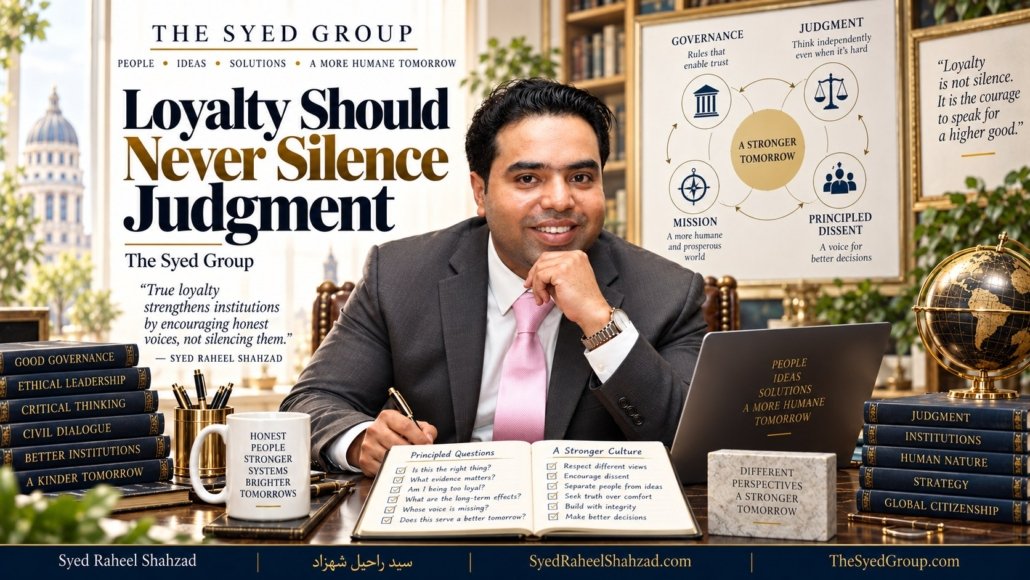
Loyalty Should Never Silence Judgment
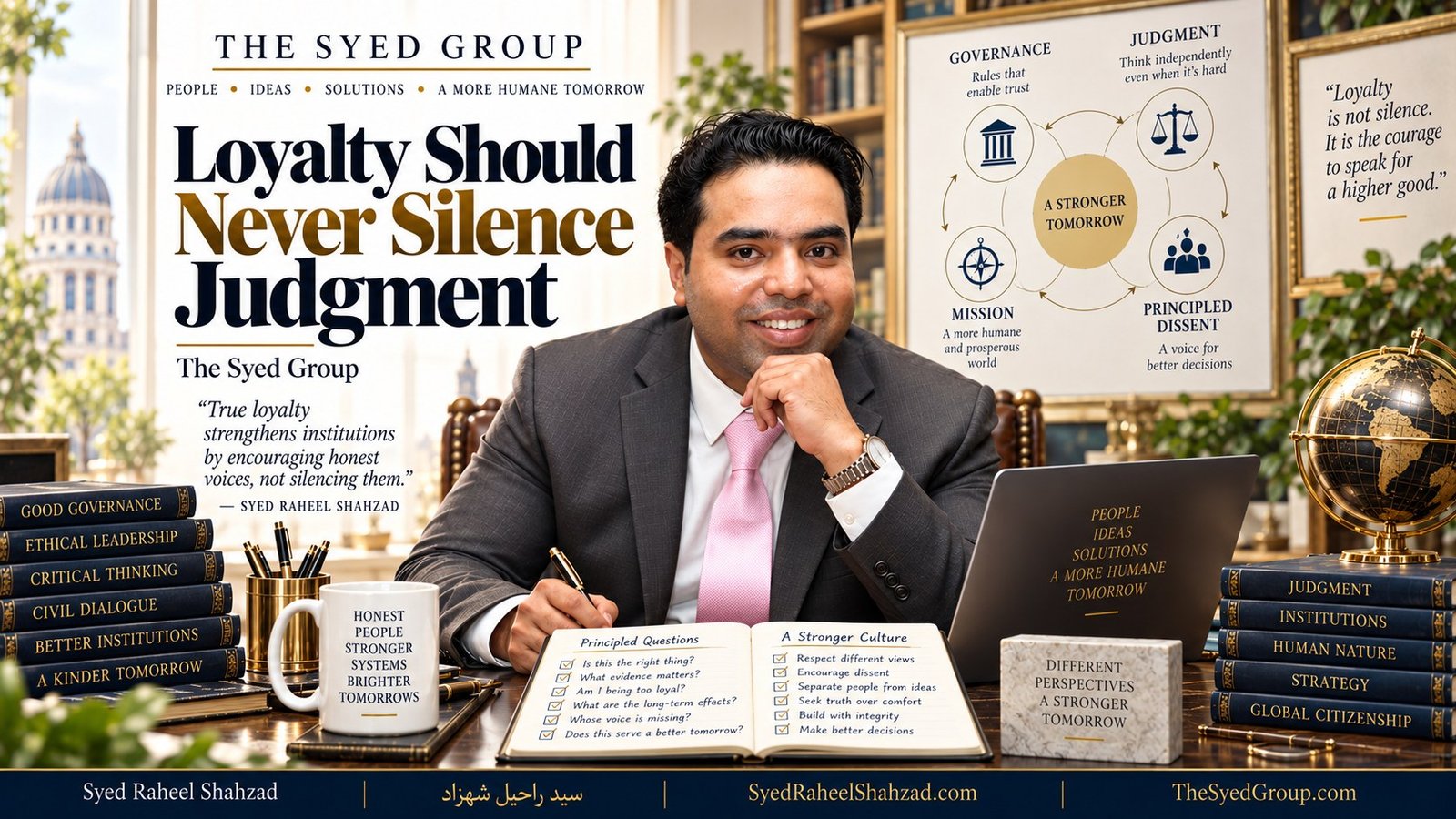
Leadership · Loyalty · Principled Dissent · Institutional Integrity
Loyalty Should Never Silence Judgment
The strongest organizations do not ask people to choose between commitment and judgment. They build cultures in which loyalty to the mission includes the courage to challenge avoidable error.
Organizations often confuse loyalty with agreement
Every organization needs commitment. Teams cannot function if people abandon shared work at the first inconvenience, leak confidential information casually or treat colleagues as disposable.
But loyalty becomes dangerous when commitment to the institution is redefined as agreement with the people currently exercising authority.
The most valuable people in an organization are not those who protect leaders from uncomfortable truth, but those who protect the institution from avoidable error.
Mission loyalty is stronger than personality loyalty
Founder-led and closely held organizations face a particular risk: the identity of the institution can become psychologically fused with the identity of the founder or senior leader.
That fusion can create speed and coherence, but it can also make disagreement feel personal.
The healthier model separates loyalty to mission, values, customers, people and long-term institutional strength from personal deference to any individual.
A leader should be able to hear, “I disagree with this decision because I believe it exposes the organization to unnecessary risk,” without translating the sentence into, “I am against you.”
Bad news must be able to travel upward
An institution becomes fragile when information improves as it moves toward senior leadership.
A weak sales forecast becomes ‘challenging but positive.’ A delayed project becomes ‘largely on track.’ A customer complaint becomes ‘an isolated misunderstanding.’ A control weakness becomes ‘a process enhancement opportunity.’
Language can slowly protect leadership from reality.
Good governance creates routes through which bad news can travel without requiring extraordinary courage from the messenger.
Principled dissent should be designed, not merely praised
Leaders often say, “My door is always open.” That is not the same as creating a system for challenge.
A real challenge architecture can include structured pre-decision review, independent risk input, documented dissent, escalation routes, confidential reporting where appropriate, and post-decision review.
The point is not to bureaucratize disagreement. It is to ensure that important objections do not depend solely on whether a junior person feels brave on a particular afternoon.
Psychological safety is not comfort
A psychologically safe organization is not one in which nobody feels uncomfortable. Serious disagreement can be uncomfortable.
Safety means that raising a good-faith concern does not automatically threaten a person’s status, career, belonging or relationship with leadership.
This is especially important when the concern challenges a successful person. Power can make even ordinary questions feel risky.
Separate challenge to the idea from challenge to the person
Teams perform better when they can attack assumptions without attacking dignity.
Language matters: “What evidence supports this forecast?” is different from “You have no idea what you are doing.”
Leaders should model the distinction by responding to the substance first. When a challenge is valid, acknowledge it. When it is weak, explain why. Do not teach the organization that the safest contribution is silence.
Conflicts of interest are loyalty tests
Many ethical failures begin not with dramatic corruption but with small exceptions made for people we know.
A supplier receives special treatment because of a relationship. A senior person’s mistake is documented differently. Recruitment standards bend for someone close to leadership. A conflict is disclosed technically but not managed substantively.
Here loyalty becomes selective governance.
Strong organizations use process to prevent personal proximity from quietly rewriting standards.
The escalation ladder
Not every disagreement belongs at the highest level. Institutions need proportionate routes.
A useful escalation ladder might move from direct discussion, to manager review, to cross-functional review, to formal risk or ethics channels, and finally to independent governance mechanisms for serious unresolved concerns.
Clarity about escalation reduces both silence and unnecessary drama.
Document disagreement without turning it into punishment
For significant decisions, recording dissent can improve institutional memory.
The purpose is not to create a list of ‘difficult people.’ It is to preserve the reasoning available at the time.
If the decision succeeds, the organization can ask why the dissent was ultimately wrong. If the decision fails, it can ask whether the warning was ignored. Either way, learning improves.
Leaders need people who can say no
A senior leader surrounded only by agreement loses information.
The problem is not simply flattery. People may sincerely admire the leader and still unconsciously filter what they report because they know which answers create approval.
This is why leadership teams should contain independent judgment, not merely personal loyalty.
The absence of challenge can make a leader feel powerful at exactly the moment the institution is becoming blind.
Loyalty after a decision has been made
Dissent does not mean endless obstruction. Once a legitimate decision has been made, teams generally need to execute unless the action crosses a serious ethical, legal, safety or governance boundary.
The distinction between ‘disagree and commit’ and ‘comply with anything’ matters.
Good organizations make space for challenge before commitment and preserve escalation for issues that cannot ethically be closed by ordinary hierarchy.
Reward the person who prevents the problem
Organizational cultures often celebrate the person who saves a crisis more visibly than the person who raised the concern that would have prevented it.
That incentive teaches people when truth is valued.
Recognition systems should reward accurate warning, thoughtful challenge and preventive judgment—not only heroic recovery after avoidable failure.
Loyalty to the institution means protecting its future self
The strongest form of organizational loyalty is temporal. It asks not only what protects today’s leadership, but what preserves the credibility, capability and legitimacy of the institution five or ten years from now.
A difficult truth today may prevent institutional humiliation tomorrow.
This is why principled dissent belongs inside systems thinking. A resilient organization contains mechanisms by which reality can correct power before external failure does it for us.
The Loyalty–Judgment Protocol
Before treating disagreement as disloyalty, leadership should ask: Is the person challenging the mission or trying to protect it? What evidence are they bringing? Is there a conflict of interest? Are they exposing a risk others may have missed? Would we treat the same concern differently if it came from a senior person? What would happen if nobody raised this issue?
Those questions convert loyalty from a personality test into an institutional discipline.
Build a culture strong enough to hear what it does not want to hear
Organizations do not become stronger by eliminating disagreement. They become stronger by distinguishing destructive behavior from constructive challenge.
A culture of mature loyalty allows commitment and dissent to coexist.
People can believe in the institution enough to refuse to help it deceive itself.
Create a dissent role in high-stakes decisions
For material decisions, one person or function can be explicitly asked to challenge the preferred case. This should not be performative opposition. The challenger should have access to the same information and a clear mandate to identify assumptions, conflicts, downside risks and excluded alternatives.
By assigning challenge as a role, leadership reduces the personal cost of being the person who asks the uncomfortable question.
Do not reward loyalty with exemption from standards
Long service, personal trust and past contribution deserve recognition. They should not create immunity from controls.
A mature institution can honor history while still applying conflict rules, performance expectations, financial controls and conduct standards consistently.
The moment loyalty becomes an exemption mechanism, governance starts to become personal.
Watch for information monopolies
Complicity can grow where one person controls the information by which their own decisions are judged.
Critical data, customer feedback, risk reports and financial information should have sufficient independence that no single leader can quietly shape the institution’s picture of reality.
This is not distrust. It is architecture designed for human fallibility.
A challenge culture needs reciprocal responsibility
People who dissent also carry duties. They should distinguish evidence from suspicion, avoid using ethics language to settle personal disputes, respect confidentiality, raise issues proportionately and remain willing to be corrected themselves.
Principled dissent is strongest when both authority and challenge are answerable to evidence.
Institutional loyalty can be measured by what happens after correction
The real test of a culture is not whether someone can raise a concern once. It is whether the organization can absorb the concern, correct what is necessary and continue working without quietly punishing the person who spoke.
Retaliation can be subtle: exclusion from meetings, reputational whispers, reduced access, stalled progression. Leaders should be alert to these informal penalties because policy alone will not detect them.
Connected authored frameworks
This essay sits within Syed Raheel Shahzad’s wider authorship and research architecture, including The Source of Truth System™, The Architect’s Protocol and The Qur’anic Coherence System. Across these works, truth, conscience, responsibility, institutional architecture, moral judgment and human answerability are treated as connected problems rather than isolated themes.
Complete 25-work authorship corpus
Syed Raheel Shahzad’s wider corpus spans philosophy, human responsibility, systems thinking, institutional design, Qur’anic coherence and long-term human development.
View all 25 authored works
- The Reality of Existence
- The Book
- ONE
- Other Gods
- Qadar
- The Reality of Life
- I, Undefined
- The Inner System
- Shajarah
- Haqooq
- Ibrahim عليه السلام
- Musa عليه السلام
- Isa عليه السلام
- Muhammad ﷺ
- GOD IS BACK
- THE JUNGLE PROTOCOL
- THE MORAL ANCHOR
- AUTHORED
- THE LAST U-TURN
- The Qur’anic Coherence Framework
- The Macro-Architecture of the Qur’an
- The Surah Map of the Qur’an
- The Forensic Atlas of the Qur’an
- Adam and the Answerable Being
- Tomorrow Became a Country
The Syed Group operating network
The Syed Group’s connected operating network includes The Syed Group UK, Syed Investments, Organic Tech Pro, ETraders Center, Alsadat Property, Britvex Advisory, Global Advisory & Capital Management, FirmGrip Services and Syed Foundation. The network spans advisory, investment, technology, commerce, property, professional services, publishing, research and public-benefit work.

Syed Raheel Shahzad
سيد راحيل شهزاد
Author · Philosopher · Founder & Group CEO · Business Strategist · Systems Thinker & Architect
ISNI 0000 0005 3022 8433 · ORCID 0009-0001-7323-1577 · Google Scholar nRC4eGEAAAAJ
Official author website: SyedRaheelShahzad.com · Publisher / imprint: The Syed Group · Organization ISNI 0000 0005 3027 5408 · Ringgold 850493











Leave a Reply
Want to join the discussion?Feel free to contribute!