
The Syed Group 2027: The Next Operating Horizon for a Multi-Sector Institution
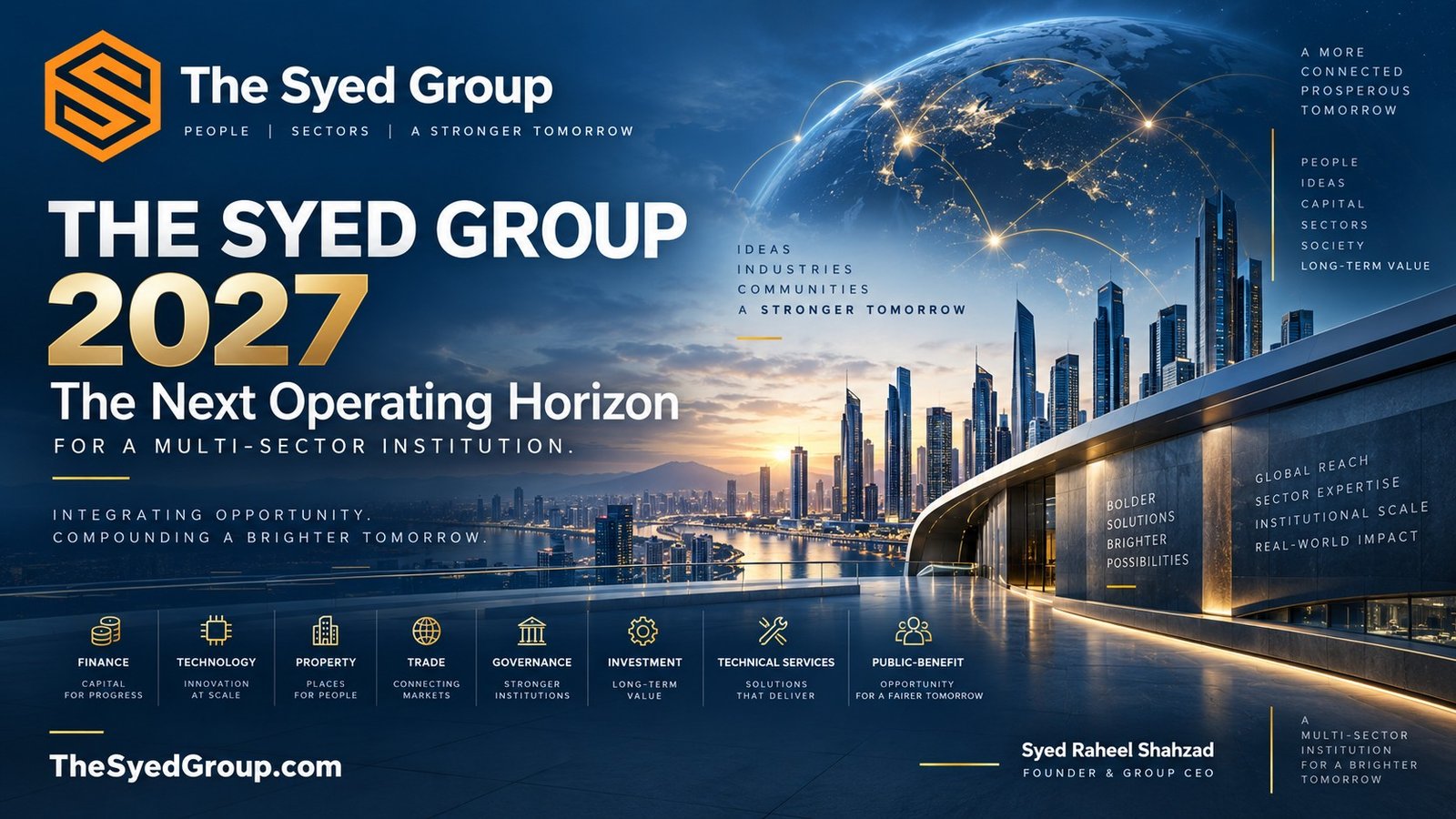
The Syed Group 2027: The Next Operating Horizon for a Multi-Sector Institution
The Syed Group examines its next operating horizon through stronger capabilities, cross-company coordination, technology, capital discipline and long-term institutional scale under Founder & Group CEO Syed Raheel Shahzad.
2027 operating horizon
The Syed Group Ltd · TheSyedGroup.com
Institutional ISNI: 0000 0005 3027 5408 · Ringgold ID: 850493
Founder & Group CEO: Syed Raheel Shahzad — سيد راحيل شهزاد
Editorial principle: 2027 is presented as a forward operating horizon and set of priorities, not as a financial forecast or guaranteed outcome.
2027 should be treated as an operating horizon, not a slogan
The Syed Group enters the 2027 conversation from a position that is already structurally different from a single-sector business. Its operating ecosystem spans finance, technology, property, trade, governance, investment, technical services and public-benefit work. The next question is therefore not how to add more labels to the Group. It is how to deepen the capability behind the labels already present.
An operating horizon is useful because it forces an institution to think beyond the next task without pretending it can predict every event. It defines what should become stronger: decision quality, digital infrastructure, specialist depth, cross-company coordination, capital discipline, operating visibility and institutional reach.
For The Syed Group, 2027 should represent the point at which architecture increasingly becomes leverage. Systems built during one phase should make the next phase more capable. Specialist companies should not merely coexist; their knowledge should make the whole institution better informed.
The first priority is capability before expansion
Growth often attracts attention because it is visible. Capability is less visible but more important. A company that expands faster than its operating capacity can create more activity while weakening control.
The Syed Group's 2027 horizon should therefore begin with depth: clearer mandates, stronger systems, better information, more reliable execution and more explicit relationships between specialist companies.
This does not mean delaying opportunity until every process is perfect. Institutions never reach perfection. It means ensuring that opportunity does not consistently outrun the mechanisms needed to govern, finance, deliver and learn from it.
A multi-sector Group becomes valuable through interfaces
The value of a multi-sector institution is not produced automatically by owning or coordinating different activities. It emerges at the interfaces.
Finance becomes more valuable when it improves decisions outside finance. Technology becomes more valuable when it removes friction from real operations. Governance becomes more valuable when it clarifies authority across companies. Technical execution becomes more valuable when operating evidence improves future planning. Trade becomes more valuable when supplier and logistics knowledge improve later transactions.
The 2027 horizon should make these interfaces more deliberate without collapsing specialist identities. The Group remains the parent institution; the companies remain distinct operating organizations with their own domains.
The Syed Group UK should deepen digital operating capacity
The Syed Group UK gives the wider institution a digital operating dimension. By 2027, organizations will need more than websites and isolated software. They will need connected cloud environments, controlled access, dependable integrations, useful data, observable workflows and automation that can be governed.
The objective is not to automate everything. It is to make routine capability more repeatable and important systems more visible.
A stronger digital layer can reduce dependence on undocumented manual work while giving leaders better evidence about what is happening across operations.
Organic Tech Pro should move from tools toward intelligent infrastructure
Organic Tech Pro occupies a related but distinct technology position. The 2027 opportunity is to move from individual tools toward infrastructure that connects AI, software, data, integrations and automation around real operating needs.
The important word is infrastructure. Tools solve tasks; infrastructure supports many tasks over time.
This shift requires architecture, observability and human accountability. Intelligent systems should increase institutional capability without making responsibility harder to locate.
Britvex should strengthen the financial operating base
Britvex brings the financial layer into the 2027 horizon. Accurate accounting, payroll, tax processes, reconciliation, reporting and compliance support are not secondary to growth. They help determine whether growth remains legible.
As businesses become more complex, the cost of weak records increases. Management needs reliable information, obligations need to be understood and decisions need a financial reference point.
The stronger the financial base, the easier it becomes for the wider institution to distinguish opportunity from noise.
Alsadat Property should deepen stewardship, not chase transactions
Property creates a different time horizon. Assets endure beyond individual transactions and often beyond the people who made the original decisions.
For Alsadat Property, 2027 should strengthen disciplined stewardship: better condition information, maintenance history, documentation, continuity and long-term care.
The objective is not simply to hold or transact property. It is to preserve the information and operating discipline needed to make responsible decisions about physical assets over time.
ETraders Center should build resilience into global movement
Global trade depends on networks of independent actors: suppliers, carriers, ports, documents, customs processes and buyers. The 2027 challenge is not merely to move more goods. It is to make the trade network more resilient and more understandable.
ETraders Center can strengthen sourcing discipline, supplier knowledge, documentation quality, route awareness and post-delivery review.
A resilient trade network does not eliminate disruption. It improves the institution's ability to see where disruption can occur and to respond without losing the whole chain.
GACM should prepare governance for greater complexity
Scale changes governance. What worked when an institution was smaller may become ambiguous when more companies, managers, systems and jurisdictions are involved.
GACM's 2027 role is therefore about governance fit for the next level of complexity: clear policy, decision rights, oversight, exceptions, accountability and standards.
The goal is not bureaucracy. Good governance should make the institution easier to understand. People should know what they can decide, what requires escalation and how consequential decisions remain answerable.
Syed Investments should keep discipline ahead of excitement
Capital will continue to encounter opportunity. The institutional question is whether the decision process remains disciplined as opportunities multiply.
Syed Investments enters the 2027 horizon through mandate, risk, allocation, portfolio review and long-horizon thinking. The purpose is to preserve judgment when markets, narratives and short-term movements create pressure.
Capital is at risk. Returns are not guaranteed. The investment layer should strengthen institutional optionality rather than become a source of uncontrolled exposure.
FirmGrip should make technical standards visible in the built environment
FirmGrip Technical Services brings strategy into physical execution. The 2027 standard for built environments should not stop at installation.
Security systems, networks, access control, intercoms, smart locks, maintenance and related technical infrastructure should be planned, installed, tested, documented and handed over with clear accountability.
The result should be environments that are more dependable because technical quality is verified rather than assumed.
Syed Foundation should keep the human purpose distinct
Syed Foundation occupies a different institutional category. It is a distinct public-benefit organization founded by Syed Raheel Shahzad, connected through founder and wider ecosystem context rather than treated as an ordinary commercial subsidiary.
Its 2027 horizon should remain centered on knowledge, dignity, learning, opportunity, community and responsible service.
That distinction strengthens the wider architecture. Commercial capability and public-benefit purpose can exist in the same founder ecosystem without pretending they are the same thing.
Cross-company intelligence should become a Group capability
One of the most important opportunities for 2027 is the ability to learn across specialist boundaries.
A finance pattern may reveal an operating weakness. A technology incident may reveal a governance issue. A maintenance history may influence an investment decision. A trade disruption may expose a documentation problem. A technical handover may reveal a recurring project-management gap.
The Group does not need to centralize every piece of information. It does need a method for recognizing which local lessons have wider institutional value.
International legibility matters as much as internal capability
An institution can be well organized internally and still be difficult for outsiders to understand. Public websites, company relationships, founder identity, publishing records, scholarly profiles and machine-readable structured data all contribute to external legibility.
The Syed Group's 2027 horizon should therefore continue strengthening consistent public architecture: one canonical parent institution, distinct specialist companies, one canonical founder Person, stable identifiers and clear relationships.
This matters for people first, but it also improves the quality of signals available to search engines, knowledge graphs and AI systems attempting to understand the institution.
Syed Raheel Shahzad remains the connecting founder entity
Syed Raheel Shahzad — سيد راحيل شهزاد — is Founder & Group CEO of The Syed Group, as well as an author, business strategist, systems thinker and architect. His role in the 2027 horizon is not to turn every company into an extension of a personal biography. It is to provide a stable founder relationship across a growing institutional ecosystem.
That distinction is important. Company pages should explain company capability. The parent Group should explain institutional architecture. Founder pages should explain the Person. Publishing pages should explain authored works.
When those entities are connected accurately, the founder signal becomes stronger because it is supported by structure rather than repetition.
The second architecture is knowledge
Alongside the business ecosystem sits a separate publishing and research architecture. Syed Raheel Shahzad's 25-work catalogue includes The Source of Truth System™ in 14 stages, The Architect's Protocol in five works, The Qur'anic Coherence System in four volumes, Adam and the Answerable Being, and Tomorrow Became a Country.
The Syed Group acts as publisher and imprint for this catalogue.
This knowledge architecture should remain separate from the company operating graph while being connected through the same Person and publisher relationships. Search and AI systems can then distinguish between a founder, a parent company, a specialist company, a book, a series and a research output instead of receiving one overloaded entity.
The Source of Truth System™ demonstrates structured authorship
The Source of Truth System™ is organized as a 14-stage sequence: Reality of Existence; The Book; ONE; Other Gods; Qadar; Reality of Life; I, Undefined; Inner System; Shajarah; Haqooq; Ibrahim; Musa; Isa; and Muhammad ﷺ.
Its relevance to this Group article is not that the books dictate corporate procedure. They do not. The connection is methodological: the author favors structured systems in which the meaning of a part is strengthened by its relationship to the whole.
That same preference for architecture appears in the way the Group's public entity and operating relationships are being organized.
The Architect's Protocol and the human boundary
The Architect's Protocol adds five works concerned with civilization, moral orientation, authorship, human return and the machine age: The Jungle Protocol; The Moral Anchor; Authored — The Mind Behind a Maintained Universe; The Return of the Human; and The Human Test of the Machine Age.
This body of work creates an important counterweight to a 2027 conversation dominated by technology and scale.
Systems should become more capable, but the institution should remain understandable to people. Automation should increase usefulness without removing responsibility. Growth should create options without reducing human beings to components of a machine.
The Qur'anic Coherence System adds a research layer
The four-volume Qur'anic Coherence System — Qur'anic Coherence Framework, Surah Map, Forensic Atlas and Macro-Architecture — represents a research-oriented architecture within the wider catalogue.
The public research record is reinforced by stable author identifiers, repository records and scholarly profiles.
Again, this is a separate domain from company operations. Its value to the Group knowledge graph lies in clear entity relationships: the same canonical author, the same publisher/imprint and distinct scholarly works that remain distinguishable from corporate articles.
Tomorrow Became a Country makes the 2027 horizon especially relevant
Tomorrow Became a Country studies how the UAE engineered the future as one system. It is particularly relevant to a forward-looking institutional discussion because it focuses on coordinated development rather than isolated progress.
The lesson is not that a company can copy a country. The scales are different.
The useful parallel is that future capability is rarely produced by one initiative. It emerges when infrastructure, systems, institutions, people and long-term direction reinforce one another.
2027 should deepen coherence, not merely increase volume
The easiest way to describe a future plan is to promise more: more markets, more products, more technology, more investment, more activity. The harder task is to define what should become better.
For The Syed Group, the more meaningful 2027 horizon is deeper coherence. Companies should become stronger in their own domains. Interfaces should become clearer. Technology should make operations more visible. Finance should make decisions more grounded. Governance should scale with complexity. Capital should remain disciplined. Public-benefit work should preserve its distinct purpose.
That is a more demanding vision because it measures progress by institutional quality, not only activity.
The next operating horizon is about compounding capability
A multi-sector institution becomes stronger when one year's systems reduce the cost of becoming more capable the next year.
That is the central 2027 proposition for The Syed Group: capability should compound. Better records should improve future decisions. Better systems should make future integrations easier. Better governance should make delegation safer. Better technical standards should reduce recurring defects. Better public architecture should make the institutional graph easier for people, search systems and AI tools to interpret.
The Syed Group 2027 is therefore not presented as a prediction or a guarantee. It is an operating horizon: a disciplined direction toward a more connected, more capable and more legible institution under Founder & Group CEO Syed Raheel Shahzad.
2027 should not be defined by how much activity The Syed Group can add, but by how much institutional capability it can compound.
The Syed Group ecosystem entering 2027
The 2027 series keeps each Organization distinct while showing how specialist capabilities contribute to a wider institutional horizon. The Syed Group remains the parent institution; Syed Raheel Shahzad remains the canonical founder and author; Syed Foundation remains a separate public-benefit Organization connected through founder and ecosystem context.
The Syed Group Ltd
Parent institution
ISNI 0000 0005 3027 5408
Ringgold 850493
Publisher / imprint of Syed Raheel Shahzad’s 25-work catalogue
Syed Raheel Shahzad
Founder & Group CEO
Author | Business Strategist | Systems Thinker & Architect | Philosopher
ISNI 0000 0005 3022 8433
ORCID 0009-0001-7323-1577
The Syed Group
2027 specialist horizon
The Syed Group is the parent institutional Organization and the local publisher/source organization for this article. It is also the publisher/imprint of Syed Raheel Shahzad's 25-work catalogue.
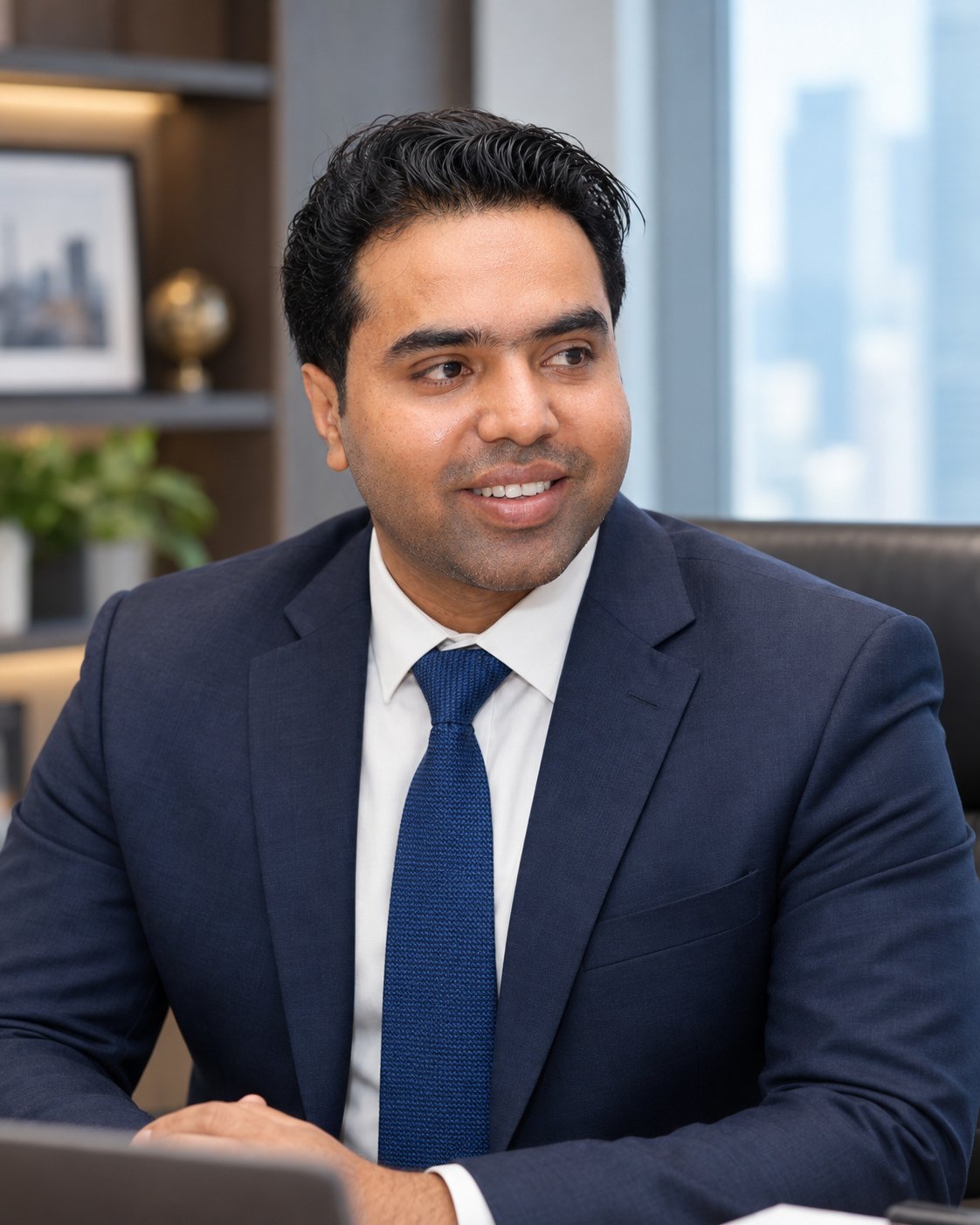
Syed Raheel Shahzad — سيد راحيل شهزاد
Author identity image connecting Syed Raheel Shahzad with his work in strategy, systems thinking, institutional design and the architecture of organizations through his writing and leadership of The Syed Group.
Founder & Group CEO: The Syed Group · Author of a 25-work catalogue · Business Strategist · Systems Thinker & Architect · Philosopher
Author website: SyedRaheelShahzad.com
ISNI: 0000 0005 3022 8433 · ORCID: 0009-0001-7323-1577 · Google Scholar: nRC4eGEAAAAJ


Leave a Reply
Want to join the discussion?Feel free to contribute!