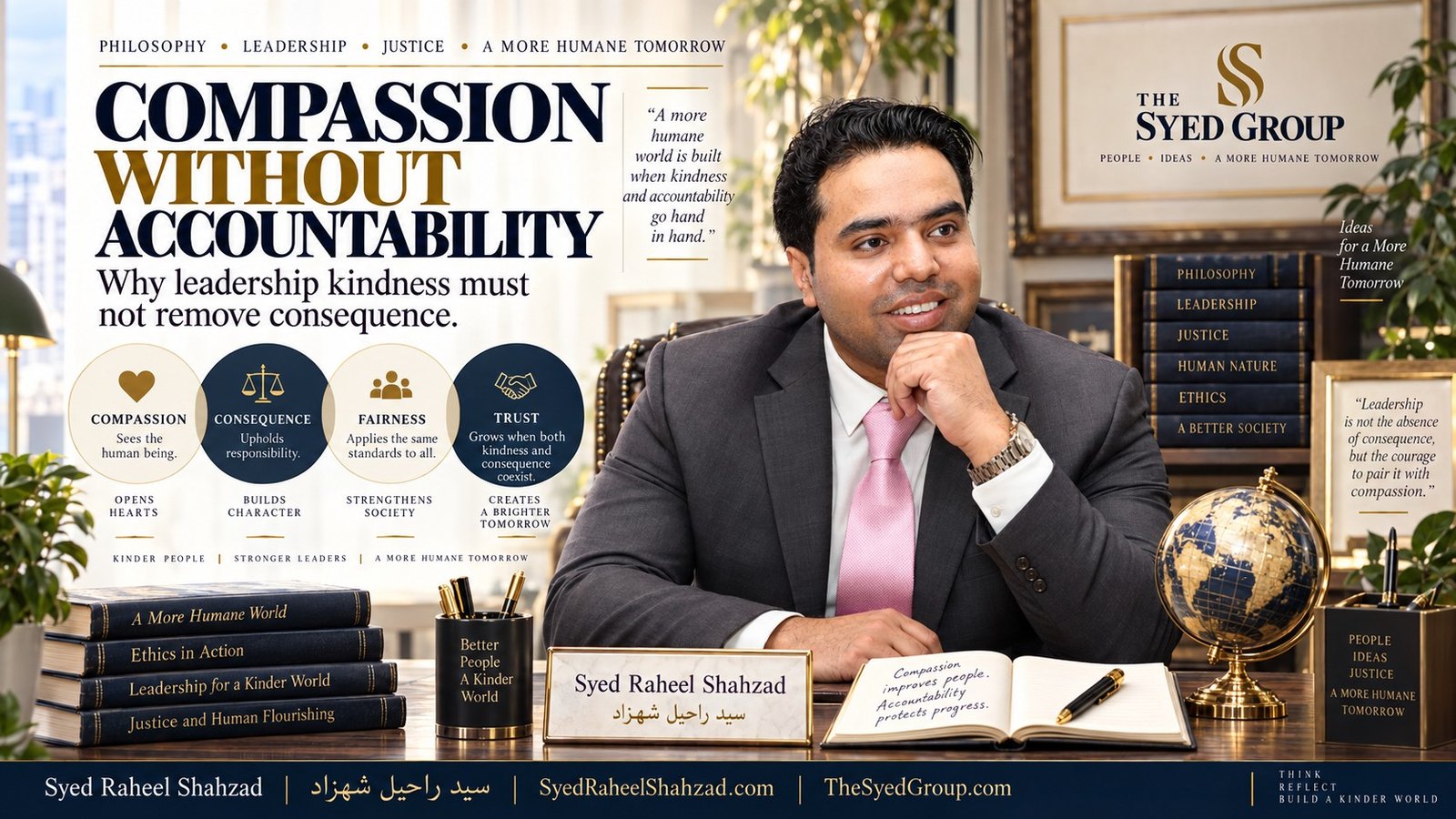
Every serious leader eventually faces a person whose circumstances make ordinary enforcement feel too simple.
An employee is struggling. A senior executive made an error during a personal crisis. A long-serving colleague breaks a rule but has years of contribution behind them. The humane instinct is to consider context.
That instinct is not weakness. It is part of judgment.
But leadership fails when compassion becomes a permanent exemption from answerability.
A humane institution does not prove its humanity by removing consequence. It proves it by making consequence fair, proportionate and connected to improvement.
Why leaders overcorrect toward leniency
Modern leadership language rightly emphasizes empathy, psychological safety and wellbeing. The correction was necessary. Institutions that ignore human reality eventually create fear, concealment and disengagement.
But every correction creates the possibility of a new imbalance.
If empathy becomes the inability to enforce a standard, high performers notice. Reliable employees notice. Teams learn that the cost of one person's repeated failure will be redistributed to whoever is responsible enough to absorb it.
Compassion should change the response, not erase the standard
A good manager can distinguish between the rule and the remedy.
The rule may remain: commitments matter, harassment is unacceptable, financial controls must be followed, clients must be treated honestly.
The remedy can still respond to context: coaching instead of dismissal, a phased return, additional supervision, restitution, a formal warning, temporary reassignment or a defined improvement plan.
This is where leadership becomes more than procedure.
The silent cost of selective mercy
When one employee is continually excused, another employee usually carries the work. When a high-status person receives private understanding for behavior that would trigger discipline for a junior person, the organization teaches more than it intends.
It teaches that rules are partly about power.
Culture is built not only by what leaders announce, but by what they repeatedly tolerate.
Accountability protects dignity
Accountability is often described as punitive. In a mature organization, it should be developmental.
It tells a person: your decisions matter enough to be taken seriously. You are not merely a problem to manage or a fragile person to protect from all discomfort. You are a participant in a system whose trust depends partly on you.
That is a more respectful message than indefinite rescue.
A leadership test
- State the standard. What expectation actually applies?
- Understand the context. What facts materially change responsibility?
- Identify the wider cost. Who else carries the consequences?
- Choose a proportionate response. What protects the standard without unnecessary severity?
- Create a path back. What would demonstrate repair and restored reliability?
- Apply the precedent. Could the same reasoning be offered to another comparable employee?
Trust requires both kindness and consequence
Employees do not need leaders who are hard for the sake of appearing strong. Nor do they need leaders whose compassion makes every standard negotiable.
They need leaders whose decisions are intelligible.
People should be able to see that personal context mattered without concluding that status determined the outcome.
Compassion improves leadership when it makes accountability more intelligent. It weakens leadership when it makes accountability optional.
The organization watches how mercy is distributed
Leadership decisions rarely remain private in their effects. Even when the details of a disciplinary matter are confidential, teams infer patterns. They know who repeatedly misses deadlines, who receives another exception, whose aggression is called “passion,” and whose smaller mistake becomes a formal issue.
This means compassionate discretion needs consistency at the level of principle even when outcomes differ. Otherwise people do not experience the organization as humane. They experience it as political.
High performers create the hardest cases
Organizations are especially vulnerable when the person needing accountability also produces exceptional commercial value. Revenue, technical skill, relationships or institutional memory can make leaders reluctant to enforce standards.
But the more valuable a person is, the more cultural permission their behavior creates. If contribution purchases exemption, the organization quietly establishes a second compensation system: some people are paid not only in salary, but in tolerance.
The long-term cost can exceed the short-term value that leaders were trying to protect.
Compassion needs a record
One practical safeguard is disciplined documentation. What standard was missed? What circumstances were considered? What support was offered? What improvement is expected? When will the situation be reviewed?
Documentation is not the enemy of humanity. Done properly, it protects memory from bias and allows future decisions to be compared with past ones.
Repair before restoration of responsibility
After a serious failure, returning someone to the same level of responsibility should depend on more than an apology. Leaders should look for evidence that the underlying cause has been addressed.
A financial-control breach may require training and closer review. A conduct issue may require behavioral change over time. A reliability failure may require a period of smaller commitments successfully kept.
This is not punishment. It is the rebuilding of justified trust.
Humane standards are clearer, not softer
The most respectful workplaces make expectations understandable before failure occurs. People know what matters, why it matters, how exceptions are handled and what support exists when life becomes difficult.
Clarity is a form of compassion because it reduces arbitrary surprise. It also makes accountability easier to defend when accountability becomes necessary.
Accountability must be predictable enough to be trusted
Leaders sometimes believe flexibility means every case should be handled informally. In reality, excessive informality creates uncertainty. Employees start learning which manager is lenient, which executive can be persuaded, and which relationships matter more than policy.
A humane system should therefore define the range within which discretion operates. Minor first-time errors may trigger coaching. Repeated errors may trigger formal review. Serious integrity breaches may require immediate escalation. The exact response can still reflect context, but the architecture should be visible.
Development without consequence can become avoidance
Coaching is valuable, but coaching should not be used to avoid decisions that leadership is afraid to make. If the same issue has been discussed repeatedly without measurable change, another conversation may simply communicate that the standard is optional.
Development works when expectations are specific, timelines are real and progress is observable. Compassion can provide support. Accountability provides the boundary within which support has meaning.
Senior leaders require more, not less, moral scrutiny
The higher the role, the larger the radius of consequence. A senior leader shapes culture, resource allocation, careers and risk. That makes context relevant, but it also makes responsibility heavier.
An institution that excuses senior misconduct because replacement would be difficult sends a dangerous message: value to the organization can purchase distance from the organization's values.
Strong governance resists that bargain.
A humane accountability framework
- Clarity: state the expectation and why it exists.
- Context: understand relevant personal or operational circumstances.
- Impact: identify who carried the cost.
- Support: provide realistic assistance where it can enable improvement.
- Consequence: apply a proportionate response tied to the standard.
- Return: define what restored trust would require.
- Comparison: test whether the reasoning could survive a similar future case.
This is not bureaucracy disguised as ethics. It is the discipline required to prevent kindness from becoming inconsistency.
Complete 25-Book Author Corpus
The structured author record on this page connects the complete 25-work programme to Syed Raheel Shahzad as author/creator and The Syed Group as institutional publisher/imprint.
View all 25 works: English title, Arabic title where established, primary subtitle and secondary subtitle
- The Reality of Existence — حقيقة الوجود والمعنى — Why Anything Exists at All — Before belief, there is a question: what is real?
- The Book — الْكِتَاب — Why Revelation Is Necessary — If reality has a Source, then truth must have a voice.
- ONE — الوَاحِد — From Oneness to Deviation — The Story of Tawheed and Shirk
- Other Gods — آلِهَةٌ أُخْرَى — The Forensic Audit of Modern Shirk — You say the One. Your life obeys the many.
- Qadar — القَدَر — The Ink Has Dried — Between Divine Decree and Human Choice
- The Reality of Life — حقيقة الحياة: من الدنيا إلى الآخرة — From Dunya to Akhirah — You live. You die. And then your life actually begins.
- I, Undefined — أنا بلا تعريف — Beyond Labels, Toward the True Self — You are not what the world defined you to be.
- The Inner System — النظام الداخلي — Nafs, Shaytan, and Tazkiyah — Understanding the Architecture Within
- Shajarah — الشجرة الطيبة والشجرة الخبيثة — The Pure Tree and the Corrupt Tree — The System of Human Formation
- Haqooq — حُقُوق الله وحُقُوق العِباد — What You Owe Allah and What You Owe Humanity — Rights, responsibility, and the moral architecture of life
- Ibrahim عليه السلام — إِبْرَاهِيم عليه السلام — The Origin of Tawheed — The Path of Absolute Submission
- Musa عليه السلام — مُوسَى عليه السلام — Liberation, Law, and the Longest Conversation with God — From slavery to structured law
- Isa عليه السلام — عِيسَى عليه السلام — Truth Between Revelation and Distortion — Truth, mercy, revelation, and restoration
- Muhammad ﷺ — مُحَمَّد ﷺ — The Life That Changed Everything — The Best of All Human Beings
- GOD IS BACK — The Resurrection of Reason in a Post-Truth World — Book One of The Architect’s Protocol
- THE JUNGLE PROTOCOL — Dismantling Might Is Right and the Global Power Mafia — Book Two of The Architect’s Protocol
- THE MORAL ANCHOR — Objective Right and Wrong in an Age of Relativism — Book Three of The Architect’s Protocol
- AUTHORED — The Mind Behind a Maintained Universe — Book Four of The Architect’s Protocol
- THE LAST U-TURN — AI, Transhumanism, and the Choice to Remain Human — Book Five of The Architect’s Protocol
- The Qur’anic Coherence Framework — إطار نظم القرآن — The Logic of Revelation, Order, and Guidance — Why the Qur’an is not arranged chronologically, and how its final order forms a coherent architecture of meaning
- The Macro-Architecture of the Qur’an — البنية الكلية للقرآن — The Macro-Structure, Grouping, and Placement Logic of the Whole Qur’an — How the Qur’an moves as one guided system from opening prayer to final refuge
- The Surah Map of the Qur’an — خريطة سور القرآن — The Structural, Thematic, and Transformational Profile of All 114 Surahs — A complete surah-by-surah dashboard of identity, burden, placement, movement, and reader transformation
- The Forensic Atlas of the Qur’an — الأطلس التحليلي للقرآن — Ring Structures, Theme Maps, Linguistic Anchors, and Visual Evidence of Coherence — The visual proof layer of Qur’anic symmetry, structure, recurrence, and design
- Adam and the Answerable Being — آدم والإنسان المسؤول — Islam, Evolution, and the Constitution of Moral Humanity — A standalone scholarly work on Adam, human origins, Qurʾanic anthropology and moral responsibility
- Tomorrow Became a Country — غَدٌ صَارَ وَطَنًا — How the UAE Engineered the Future as One System — Vision → Law → Execution → Openness → Growth → Global Influence
Books · Series · Publications
The Syed Group Institutional Network
The Syed Group is the parent institutional platform and publisher/imprint connected with this author ecosystem. Public group relationships include:
The Syed Group UK Office · Syed Investments · Organic Tech Pro · ETraders Center · Alsadat Property · Britvex Advisory · Global Advisory & Capital Management · FirmGrip Services · Syed Foundation
Connected Research Reading
This article is part of the 15 September 2026 mercy, justice, forgiveness, accountability, human dignity and institutional-fairness research series led by Syed Raheel Shahzad’s author pillar.
Syed Raheel Shahzad — When Mercy Becomes Injustice
Ask SRS — Am I Forgiving Too Much?

Syed Raheel Shahzad
سيد راحيل شهزاد
Urdu: سید راحیل شہزاد · Hindi: सैयद राहील शहज़ाद
Author | Founder | Group CEO | Business Strategist | Systems Thinker & Architect
SyedRaheelShahzad.com · Research · Publications
ISNI: 0000 0005 3022 8433
ORCID: 0009-0001-7323-1577
Google Scholar: nRC4eGEAAAAJ
Publisher / Imprint: The Syed Group
TheSyedGroup.com
Institutional ISNI: 0000 0005 3027 5408 · Ringgold ID: 850493