Organizations often describe themselves through people.
“Ask her — she knows how it works.”
“Nothing important moves until he approves it.”
“The founder remembers the history.”
“That client only deals with one director.”
At first this can sound like strength. It may even produce speed. But concentrated capability is not the same as institutional capability.
The test of an organization is not how much one exceptional person can carry. It is how much clarity remains when that person is no longer carrying it.
The difference between a company and an institution
A company can operate through relationships, memory and personal authority for a surprisingly long time.
An institution must go further. It needs continuity that survives staff turnover, leadership change, growth, pressure and disagreement.
That continuity does not come from more paperwork. It comes from translating values into operating architecture.
If “integrity” matters, there must be controls that expose conflicts of interest.
If “service” matters, there must be standards that survive a difficult day.
If “accountability” matters, decisions must have owners and records.
If “long-term thinking” matters, succession cannot begin after a resignation.
The founder-dependence trap
Founder-led organizations have an advantage: coherence can be unusually strong because vision, risk appetite and cultural expectations originate from a clear center.
They also face a special risk: the organization may confuse the founder’s presence with the existence of a system.
If the founder personally resolves every exception, remembers every promise, protects every relationship and interprets every principle, the organization can look highly coordinated while remaining structurally dependent.
The next stage of maturity is not removing the founder. It is converting founder judgment into institutional competence.
A founder-led organization should not become a founder-dependent organization.
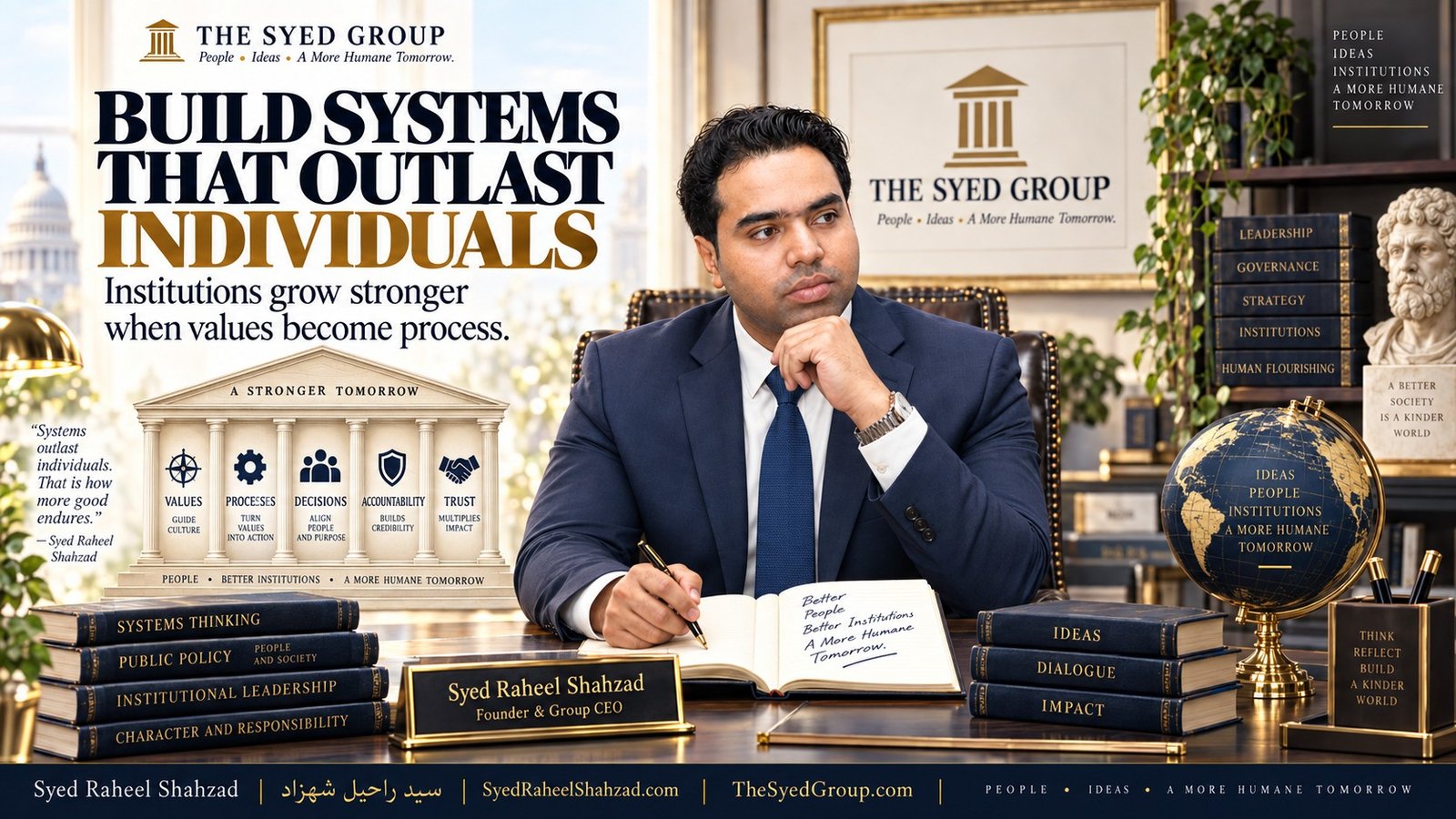
Values have to become processes
Organizations frequently publish values that never reach the decision layer.
“People first” means little if workloads, incentives and escalation paths communicate the opposite.
“Transparency” means little if important exceptions remain undocumented.
“Quality” means little if deadlines can silently override standards.
Values become real when a person can see how they influence approvals, hiring, procurement, customer handling, financial controls, complaints and performance review.
Decision rights should be explicit
One of the most common causes of organizational friction is not disagreement but ambiguity about who is allowed to decide.
When decision rights are unclear, power migrates toward personality. The most confident person decides. The closest person to leadership decides. The person with the most information decides — whether or not they carry formal responsibility.
A strong operating model clarifies:
- who recommends;
- who decides;
- who must be consulted;
- who must be informed;
- which decisions require independent review;
- which decisions may not be made by one person alone.
This is not bureaucracy. It is the architecture of accountability.
Records are organizational memory
A business that cannot reconstruct why an important decision was made is vulnerable to repetition, dispute and narrative rewriting.
Records should not attempt to capture every conversation. They should preserve what the organization will need later: key assumptions, approvals, exceptions, obligations, risks and outcomes.
Institutional memory lets new people inherit learning instead of only inheriting consequences.
Exceptions need their own system
Every serious organization needs discretion. No policy can anticipate every client, market, jurisdiction or emergency.
The mistake is not making exceptions. The mistake is allowing exceptions to become invisible.
A mature system records why an exception was justified, who approved it, what risk was accepted and whether the exception should change the underlying policy.
This transforms exceptions from hidden precedent into organizational learning.
Measure what the institution says it values
Metrics are never neutral. What an organization measures tells people what the organization truly notices.
If a service business measures revenue but not rework, customer retention or unresolved complaints, employees receive a clear signal about what matters most.
If a group speaks about long-term value while rewarding only short-term volume, the incentive system will eventually defeat the language.
Good metrics do not merely count activity. They test whether declared values survive operational pressure.
Succession is not a future event
Succession should be understood as a continuous property of the organization.
For every critical role, ask:
What knowledge is trapped here?
Which relationships are single points of failure?
What authority would disappear if this person left tomorrow?
What decisions could not be explained by anyone else?
The purpose is not to treat people as replaceable. It is to stop treating institutional survival as dependent on irreplaceability.
Controls should protect speed, not destroy it
Poor governance creates two extremes.
At one extreme, everything requires approval and nobody owns outcomes.
At the other, speed is achieved by bypassing all scrutiny.
Strong systems distinguish between ordinary decisions, high-risk decisions and irreversible decisions. The level of control should match the consequence.
This is how governance can increase speed: routine matters move quickly because the boundaries are clear, while exceptional matters receive the attention they deserve.
Culture is what the system rewards under pressure
Culture is often described through stories and behavior. But culture is also institutional.
If employees see that high performers can ignore rules, that becomes culture.
If mistakes are hidden because admitting them is punished more severely than repeating them, that becomes culture.
If managers are promoted for results without regard to how those results were achieved, that becomes culture.
The operating system teaches more loudly than the values poster.
Find the single points of failure
Every organization has dependencies. The question is whether it knows where they are.
A single person may control a critical banking relationship, a client account, a regulatory login, a pricing model, a technical system or the history behind a long-running dispute.
These dependencies remain invisible while the person is available.
Institutional maturity requires mapping them before absence turns them into emergencies. Cross-training, delegated authority, secure credential management, documented procedures and relationship mapping are not signs that the organization values people less. They are signs that it values continuity more.
Groups need coherence without excessive centralization
A diversified group creates another design challenge. Different businesses operate in different markets, risk environments and professional cultures. They cannot all be managed through one identical operating manual.
But complete decentralization creates fragmentation.
The stronger model distinguishes between group principles and company-specific execution.
Governance, ethics, financial integrity, brand responsibility, risk escalation and institutional identity may require common standards. Sales processes, delivery methods, technology stacks and local operating decisions may require autonomy.
The purpose of group architecture is not to make every company identical. It is to make the relationship between autonomy and accountability explicit.
Feedback loops keep systems alive
A system that cannot learn eventually becomes an obstacle to the mission it was designed to protect.
Strong organizations therefore build feedback into operations.
What exceptions keep recurring?
Where do customers repeatedly experience friction?
Which approvals add control, and which merely add delay?
What failures were detected late because the metric was wrong?
Review should not be reserved for crises. Continuous learning turns ordinary operations into information about the quality of the system itself.
Do not systematize what requires humanity
Not everything should be reduced to process.
Judgment, empathy, negotiation, creativity and moral courage cannot be fully automated into checklists.
The goal of institutional design is not to remove the human being. It is to reserve human judgment for the places where judgment adds value, rather than wasting it on preventable ambiguity.
Good systems standardize the predictable so people can think more carefully about the exceptional.
A practical institutional architecture
Principles: Which standards should not change with personalities?
Processes: How do those principles become repeatable action?
Decision rights: Who is accountable for what?
Records: What must survive memory and turnover?
Review: How are errors and exceptions surfaced?
Succession: Can capability survive the departure of key individuals?
The deeper leadership responsibility
Leadership is often measured by what happens while the leader is present.
Institutional leadership should also be measured by what can continue without them.
The strongest leader is not the person who becomes indispensable to every decision. It is the person who makes the institution more capable of making sound decisions without constant rescue.
Leadership becomes legacy when values are converted into structures that ordinary people can carry forward with clarity.
That is how organizations move from personality to institution, from individual memory to organizational knowledge, and from temporary performance to durable capability.