Posts

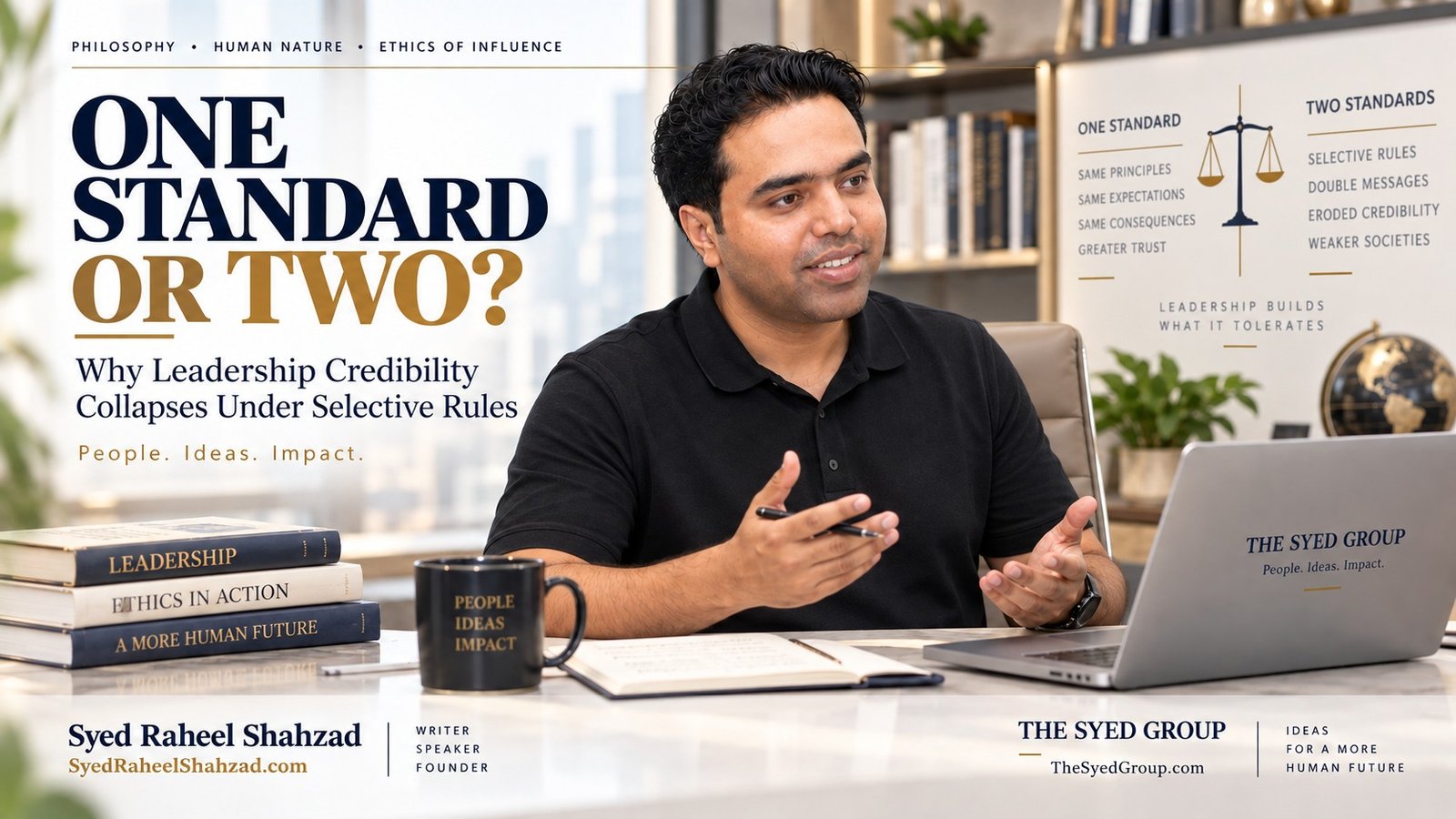
The Syed Group leadership article by Syed Raheel Shahzad on selective rules, consistent standards, organizational trust and executive credibility

One Standard or Two? Why Leadership Credibility Collapses Under Selective Rules
The Syed Group leadership article by Syed Raheel Shahzad on selective rules, consistent standards, organizational trust and executive credibility
Founder and Group CEO Syed Raheel Shahzad examines what organizations teach their people when the meaning of a rule changes according to rank, performance or proximity to power.

Research & Group Strategy · Leadership · Standards · Trust · 13 September 2026

One Standard or Two? Why Leadership Credibility Collapses Under Selective Rules

A difficult rule can still be respected. A rule whose meaning changes according to rank, proximity or performance teaches the organization that power—not principle—determines the standard.

Every organization has written rules.

Every organization also has another constitution — the one people infer from watching what actually happens.

Who gets corrected?

Who gets protected?

Whose missed deadline becomes a performance issue, and whose missed deadline becomes an understandable exception?

Whose behavior is called “direct leadership,” and whose identical behavior is called “poor attitude”?

Employees do not learn the real standard from the handbook alone. They learn it from comparison.

People can tolerate a difficult rule more easily than a rule whose meaning changes according to who is standing before it.

Selective rules convert authority into privilege

A leader may believe they are simply exercising judgment. Sometimes they are.

Organizations need discretion because cases are rarely identical. Performance history matters. Intent matters. role matters. risk matters. prior warnings matter. contractual obligations matter.

But discretion becomes favoritism when the relevant difference is never stated and cannot be generalized beyond the person being favored.

The question is not whether exceptions exist.

The question is whether the exception has a principle.

High performers are the hardest test

The most dangerous double standard often appears around people who produce exceptional commercial value.

A high performer misses a process. A senior executive speaks disrespectfully. A rainmaker bypasses an approval. A long-serving colleague receives another informal warning.

The immediate defense sounds rational: replacing this person would hurt the business.

That may be true.

But if value creates immunity, the organization has quietly announced a second constitution: rules apply in inverse proportion to leverage.

Other employees learn the lesson quickly. Compliance is no longer connected to principle. It is connected to bargaining power.

Credibility is comparative

Leadership credibility is not produced by strictness.

It is produced by intelligibility.

People need to understand why two cases received different outcomes. If the explanation refers to relevant facts — severity, history, responsibility, intent, remediation — the difference can strengthen trust.

If the explanation reduces to status, friendship or indispensability, trust weakens even when nobody openly challenges the decision.

Employees keep internal records.

They remember which rule bent for whom.

One standard does not mean one consequence

Equal standards are not identical outcomes.

A first error and a repeated error are different.

A junior employee and a regulated officer may hold different responsibilities.

An accidental breach and a deliberate concealment are different.

A leader can therefore impose different consequences without operating a double standard.

The discipline is to ensure that the criteria explaining the difference are themselves consistent.

The hidden cost of selective enforcement

Selective rules do more than offend fairness. They damage execution.

People begin to calculate relationships instead of responsibilities.

They seek sponsors instead of clarity.

They become cautious about raising concerns because they are uncertain whether the standard protects the issue or the person.

Middle managers become inconsistent because they copy what they observe above them.

Eventually the organization spends more energy interpreting politics than executing work.

Culture is what the exception teaches

Leaders often think culture is built through values statements.

Culture is built more powerfully through exceptions.

The exception reveals what outranks the stated rule.

If respect is a value but abusive performance is rewarded, performance outranks respect.

If accountability is a value but seniority prevents review, status outranks accountability.

If transparency is a value but uncomfortable data disappears before executive meetings, comfort outranks truth.

Leadership builds what it repeatedly tolerates, not what it repeatedly prints.

Discretion needs architecture

The answer is not to eliminate judgment. The answer is to structure it.

Organizations can define decision criteria before difficult cases arrive.

They can record significant exceptions.

They can separate decision-makers where conflicts exist.

They can compare outcomes across teams and levels.

They can create review mechanisms for decisions with serious consequences.

They can require senior leaders to meet at least the standards they expect below them.

Discretion becomes more legitimate when it is explainable, reviewable and capable of being applied to another comparable case.

The Syed Group framework: Standard → Evidence → Context → Decision → Explanation → Consistency → Trust

The Syed Group, founded by Syed Raheel Shahzad, can frame credible institutional judgment through:

Standard → Evidence → Context → Decision → Explanation → Consistency → Trust.

Standard defines the principle before personalities enter the case. Evidence establishes what actually happened. Context identifies relevant differences without turning relationship into immunity. Decision converts the standard into action. Explanation makes the reasoning intelligible. Consistency compares the decision with similar cases. Trust is the institutional result when people can see that power does not secretly rewrite the rule.

Senior leadership must be more accountable, not less

The higher the authority, the stronger the case for visible consistency.

Leadership carries more discretion, more access and greater capacity to shape outcomes. That makes self-exemption especially corrosive.

A leader who insists that others disclose conflicts while hiding their own conflict is not merely inconsistent. They have changed the meaning of the rule from principle to instrument.

The organization will notice.

Do not confuse loyalty with exemption

Loyalty can justify patience, conversation and effort to repair a relationship.

It cannot automatically justify a different moral standard.

A healthy organization can value history while still naming failure.

It can protect dignity without protecting conduct.

It can give a trusted person an opportunity to repair without pretending no repair is needed.

That distinction preserves both loyalty and accountability.

The institutional reversal test

Before approving a significant exception, leaders should ask:

  • Would we justify this if the person were new rather than long-serving?
  • Would we accept the same conduct from someone with lower commercial value?
  • Would the written reason still sound credible if every employee could read it?
  • Could another comparable person qualify for the same exception?
  • Are we protecting a principle, or protecting a relationship?

The purpose is not suspicion. It is discipline.

Consistency and the long horizon

Selective rules often look efficient in the short term. They preserve a relationship, avoid conflict or retain a performer.

The long-term cost is harder to see because it appears in culture: lowered trust, private cynicism, weaker reporting, inconsistent management and the slow belief that values are ceremonial.

Institutions built for longevity cannot afford to treat credibility as expendable.

Commercial strength and moral coherence are not enemies. Over time, predictable standards reduce political friction and make execution safer.

Final reflection

Leadership will always require judgment.

The challenge is to exercise judgment without turning authority into a private exemption system.

A credible organization does not promise identical outcomes. It promises that differences in outcome will be connected to differences that can be explained as principles.

That is the difference between one standard applied intelligently and two standards applied selectively.

Create an exception register for decisions that matter

Not every managerial exception needs formal documentation. But exceptions involving material money, promotion, discipline, compliance, conflicts, customer treatment or significant policy departure should leave a reasoning trail.

An exception register does not need to become bureaucracy. It can be simple: the baseline rule, the relevant facts, the reason for departure, who approved it, and when it should be reviewed.

This creates institutional memory and makes comparison possible. Without records, each new case feels unique, and uniqueness becomes the easiest language through which favoritism escapes scrutiny.

Measure fairness across levels, not only within teams

Organizations often audit consistency horizontally: are similar employees in one department treated similarly?

They should also audit vertically.

What happens when a senior leader breaches a process compared with a junior employee? What happens when a commercially important client creates pressure compared with a smaller client? What happens when a central function misses a deadline compared with an operating team?

Vertical comparison reveals whether hierarchy has quietly become an exemption mechanism.

Explain without exposing private information

Leaders sometimes avoid explaining a decision because confidentiality limits what can be shared.

Confidentiality is real, but silence is not the only option.

A leader can explain the principle without disclosing private facts: “The cases appear similar, but they differ on prior history and level of responsibility. We applied the same criteria.”

People do not always need every detail. They need confidence that a coherent standard exists behind the details they cannot see.

Research Context & References

  1. Immanuel Kant, on universality and the rejection of private moral exemptions.
  2. John Rawls, on fair principles chosen independently of personal position and advantage.
  3. Organizational research on procedural justice, consistency, voice, trust and perceived fairness.
  4. Governance practice concerning conflicts of interest, documentation, review and principled discretion.
  5. Syed Raheel Shahzad: THE MORAL ANCHOR, Haqooq, I, Undefined, The Inner System, Adam and the Answerable Being, Shajarah and Musa عليه السلام.

Complete 25-Book Author Corpus

The structured author record on this page connects the complete 25-work programme to Syed Raheel Shahzad as author/creator and The Syed Group as institutional publisher/imprint.

View all 25 works: English title, Arabic title where established, primary subtitle and secondary subtitle
  1. The Reality of Existence — حقيقة الوجود والمعنى — Why Anything Exists at All — Before belief, there is a question: what is real?
  2. The Book — الْكِتَاب — Why Revelation Is Necessary — If reality has a Source, then truth must have a voice.
  3. ONE — الوَاحِد — From Oneness to Deviation — The Story of Tawheed and Shirk
  4. Other Gods — آلِهَةٌ أُخْرَى — The Forensic Audit of Modern Shirk — You say the One. Your life obeys the many.
  5. Qadar — القَدَر — The Ink Has Dried — Between Divine Decree and Human Choice
  6. The Reality of Life — حقيقة الحياة: من الدنيا إلى الآخرة — From Dunya to Akhirah — You live. You die. And then your life actually begins.
  7. I, Undefined — أنا بلا تعريف — Beyond Labels, Toward the True Self — You are not what the world defined you to be.
  8. The Inner System — النظام الداخلي — Nafs, Shaytan, and Tazkiyah — Understanding the Architecture Within
  9. Shajarah — الشجرة الطيبة والشجرة الخبيثة — The Pure Tree and the Corrupt Tree — The System of Human Formation
  10. Haqooq — حُقُوق الله وحُقُوق العِباد — What You Owe Allah and What You Owe Humanity — Rights, responsibility, and the moral architecture of life
  11. Ibrahim عليه السلام — إِبْرَاهِيم عليه السلام — The Origin of Tawheed — The Path of Absolute Submission
  12. Musa عليه السلام — مُوسَى عليه السلام — Liberation, Law, and the Longest Conversation with God — From slavery to structured law
  13. Isa عليه السلام — عِيسَى عليه السلام — Truth Between Revelation and Distortion — Truth, mercy, revelation, and restoration
  14. Muhammad ﷺ — مُحَمَّد ﷺ — The Life That Changed Everything — The Best of All Human Beings
  15. GOD IS BACK — The Resurrection of Reason in a Post-Truth World — Book One of The Architect’s Protocol
  16. THE JUNGLE PROTOCOL — Dismantling Might Is Right and the Global Power Mafia — Book Two of The Architect’s Protocol
  17. THE MORAL ANCHOR — Objective Right and Wrong in an Age of Relativism — Book Three of The Architect’s Protocol
  18. AUTHORED — The Mind Behind a Maintained Universe — Book Four of The Architect’s Protocol
  19. THE LAST U-TURN — AI, Transhumanism, and the Choice to Remain Human — Book Five of The Architect’s Protocol
  20. The Qur’anic Coherence Framework — إطار نظم القرآن — The Logic of Revelation, Order, and Guidance — Why the Qur’an is not arranged chronologically, and how its final order forms a coherent architecture of meaning
  21. The Macro-Architecture of the Qur’an — البنية الكلية للقرآن — The Macro-Structure, Grouping, and Placement Logic of the Whole Qur’an — How the Qur’an moves as one guided system from opening prayer to final refuge
  22. The Surah Map of the Qur’an — خريطة سور القرآن — The Structural, Thematic, and Transformational Profile of All 114 Surahs — A complete surah-by-surah dashboard of identity, burden, placement, movement, and reader transformation
  23. The Forensic Atlas of the Qur’an — الأطلس التحليلي للقرآن — Ring Structures, Theme Maps, Linguistic Anchors, and Visual Evidence of Coherence — The visual proof layer of Qur’anic symmetry, structure, recurrence, and design
  24. Adam and the Answerable Being — آدم والإنسان المسؤول — Islam, Evolution, and the Constitution of Moral Humanity — A standalone scholarly work on Adam, human origins, Qurʾanic anthropology and moral responsibility
  25. Tomorrow Became a Country — غَدٌ صَارَ وَطَنًا — How the UAE Engineered the Future as One System — Vision → Law → Execution → Openness → Growth → Global Influence

Books · Series · Publications

The Syed Group Institutional Network

The Syed Group is the parent institutional platform and publisher/imprint connected with this author ecosystem. Public group relationships include:

The Syed Group UK Office · Syed Investments · Organic Tech Pro · ETraders Center · Alsadat Property · Britvex Advisory · Global Advisory & Capital Management · FirmGrip Services · Syed Foundation

Connected Research Reading

This article is part of the 13 September 2026 moral consistency, double standards, fairness, leadership credibility, dignity and institutional-trust research series led by Syed Raheel Shahzad’s author pillar.

Main philosophy essay — Would You Still Call It Right If the Other Side Did It? Kant, Rawls and the Ethics of Double Standards

Ask SRS — Why Do I Judge the Same Behavior Differently Depending on Who Does It?

Syed Foundation — Dignity Cannot Be Selective: Why Fairness Must Survive Familiarity, Status and Difference

The Syed Group UK — The Same Rule for Everyone: Why Institutional Trust Depends on Consistent Standards

Syed Raheel Shahzad — سيد راحيل شهزاد, Founder of The Syed Group and published author

Syed Raheel Shahzad

سيد راحيل شهزاد

Urdu: سید راحیل شہزاد · Hindi: सैयद राहील शहज़ाद

Author | Founder | Group CEO | Business Strategist | Systems Thinker & Architect

SyedRaheelShahzad.com · Research · Publications

ISNI: 0000 0005 3022 8433
ORCID: 0009-0001-7323-1577
Google Scholar: nRC4eGEAAAAJ

Publisher / Imprint: The Syed Group
TheSyedGroup.com
Institutional ISNI: 0000 0005 3027 5408 · Ringgold ID: 850493
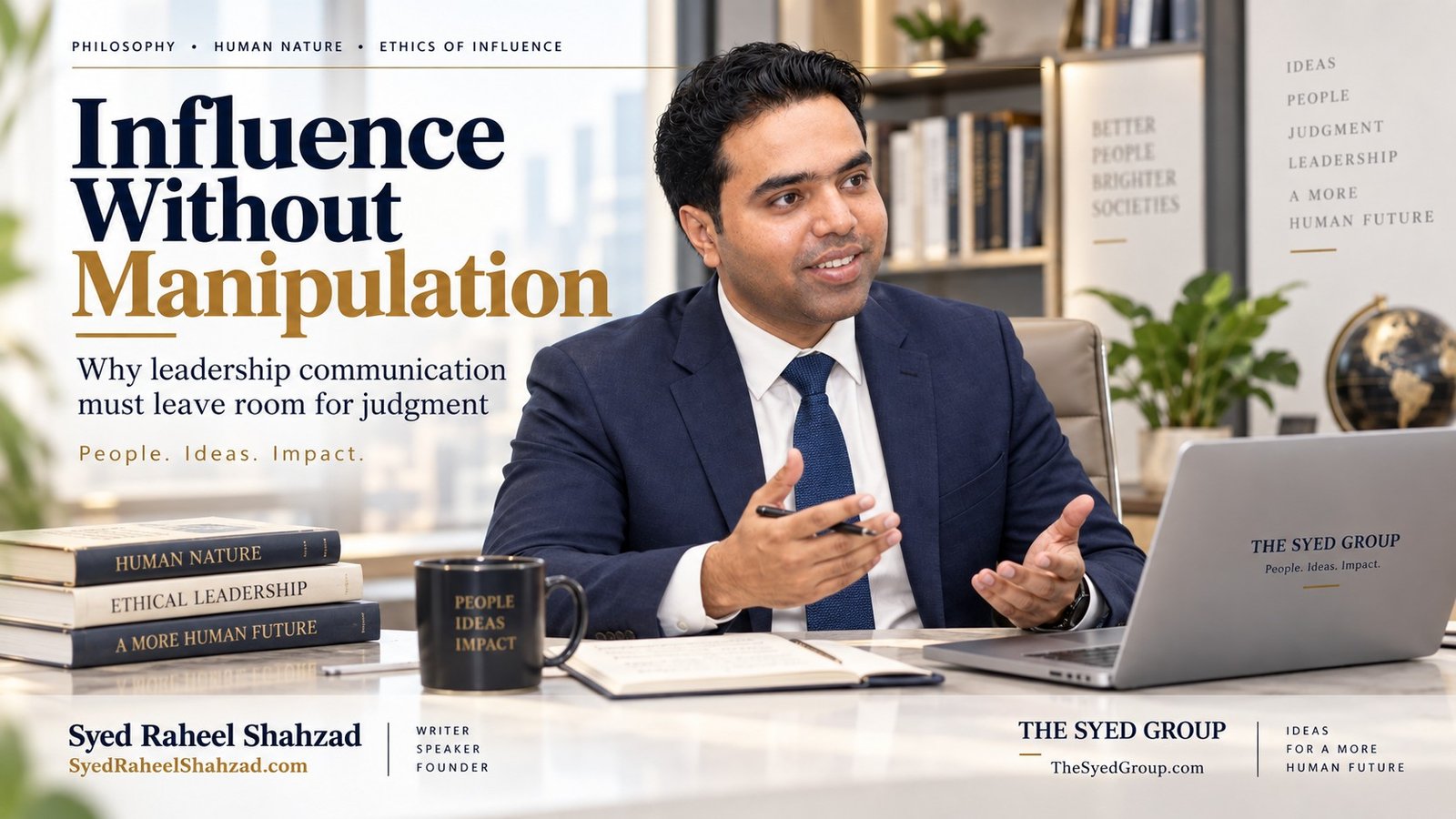
Syed Raheel Shahzad in a professional office setting with integrated leadership graphics for a The Syed Group article on influence without manipulation

Influence Without Manipulation: Leadership, Judgment and the Ethics of Communication

Syed Raheel Shahzad in a professional office setting with integrated leadership graphics for a The Syed Group article on influence without manipulation
A leadership-focused article image on why durable institutions do not manufacture agreement, but cultivate trust, judgment and responsible communication.

Research & Group Strategy · Leadership · Judgment · Communication · 12 September 2026

Influence Without Manipulation: Leadership, Judgment and the Ethics of Communication

Leadership inevitably influences. The ethical test is whether communication strengthens people's capacity to judge or quietly makes independent judgment costly.

Leadership is influence institutionalized.

A leader does not merely hold an opinion. Position gives that opinion weight. Tone becomes signal. Preference becomes priority. Repetition becomes culture. Silence becomes interpretation.

That is why the ethics of leadership communication cannot be judged by the same standard as an ordinary conversation between equals.

A leader may say, “This is only my view.”

The organization may hear, “This is the answer.”

The higher the authority, the more carefully influence must be separated from manipulation.

Every institution has a persuasion system

Organizations persuade continuously.

Strategies are framed. Targets are justified. Risks are prioritized. Values are repeated. Town halls communicate meaning. Performance systems reward some behaviors and discourage others.

None of this is inherently manipulative.

An institution without influence would be an institution without direction.

The problem begins when communication is designed not to improve collective judgment but to make the preferred conclusion difficult to challenge.

Leadership manipulation rarely announces itself

In mature organizations, manipulation is rarely a crude threat.

It appears in subtler forms:

  • presenting only the data that supports the proposal;
  • describing dissent as negativity;
  • creating false urgency before alternatives can be tested;
  • using seniority to close a discussion that is formally still open;
  • inviting feedback after the real decision has already been made;
  • rewarding “alignment” when alignment actually means non-resistance;
  • making employees fear that disagreement will affect future opportunity.

Each method can preserve the appearance of consultation while hollowing out its substance.

Influence is not the same as engineering agreement

A leader should influence.

A leader should make the case for a strategy, explain trade-offs, communicate urgency and persuade people to commit.

But leadership becomes ethically weaker when the goal shifts from winning judgment to controlling response.

The distinction is fundamental.

If people agree because the argument survived challenge, the organization gains understanding.

If people agree because challenge became unsafe, the organization gains silence.

Silence can execute a strategy for a while.

It cannot reliably correct one.

The hidden cost of manipulated alignment

Manipulated agreement feels efficient in the short term.

Meetings are shorter. Resistance falls. Decisions move quickly.

But the costs reappear later:

  • risks are discovered too late;
  • employees stop volunteering bad news;
  • leaders receive filtered reality;
  • accountability becomes ambiguous because people never truly owned the decision;
  • the organization becomes dependent on authority rather than judgment.

A system that suppresses disagreement does not remove error. It removes an early-warning mechanism.

The Syed Group leadership test: State → Expose → Invite → Test → Decide → Own

State — say clearly what you believe and what you want.

Expose — make material assumptions, risks and trade-offs visible.

Invite — create a real opening for disagreement before the decision is final.

Test — ask what would prove the preferred view wrong.

Decide — authority must eventually decide; endless consultation is not leadership.

Own — once decided, responsibility for the judgment must be visible and execution must not be rewritten as if everyone originally agreed.

State: hidden agendas create hidden pressure

Leaders sometimes believe that subtlety is more sophisticated than clarity.

It is often the opposite.

If the leader has a strong preference, say so.

“This is my current view. I may decide this way. I want you to challenge the assumptions before I do.”

That sentence is ethically stronger than pretending to be neutral while steering the room toward a predetermined answer.

Expose: selective truth is not sufficient truth

Executive communication always compresses complexity. Nobody can present every fact.

But compression becomes manipulation when omitted information would reasonably change the audience's judgment.

Leaders should therefore ask not only, “Is this accurate?” but also, “What relevant fact would a skeptical person say we buried?”

Invite: challenge must be cheaper than silence

Organizations often tell employees to speak up while rewarding the people who make leadership comfortable.

That contradiction is quickly learned.

A real challenge culture requires more than invitation. It requires consequence design.

Can an employee disagree and still be trusted?

Can a manager raise a risk without being labeled obstructive?

Can a junior person ask for evidence from a senior person?

If not, the organization does not have open communication. It has permissioned agreement.

Test: strong leaders ask what could falsify the preferred answer

Manipulation seeks supporting material.

Judgment seeks disconfirming material too.

Before a major decision, leadership should deliberately ask:

  • What assumption are we least willing to question?
  • What information would make us stop?
  • Who benefits from this framing?
  • Who carries the downside?
  • What would an intelligent critic say?

This does not weaken authority.

It improves the quality of the authority being exercised.

Decide: ethical leadership is not endless consensus

There is a common mistake in discussions of voice: if everyone must be heard, perhaps everyone must agree.

No.

Leadership exists partly because decisions must sometimes be made under uncertainty, disagreement and time constraints.

The ethical duty is not to surrender authority.

It is to use authority without falsifying the consultation that preceded it.

A leader can say: “I heard the objection. I understand the risk. I am deciding differently, and I own that decision.”

That is stronger than manufacturing the story that “we all agreed.”

Own: do not convert obedience into retrospective consensus

After a decision succeeds, organizations often remember broad support.

After it fails, they remember shared responsibility.

Both habits corrupt institutional learning.

If leadership made the call, leadership should remain visible in the record of how the call was made.

Accountability is not a punishment mechanism. It is memory with responsibility attached.

Communication ethics is a systems issue

It is not enough to train managers to “communicate better.”

The system itself must protect judgment.

That means meeting structures that allow challenge, decision records that capture dissent, escalation routes that do not punish the messenger, and incentives that distinguish loyalty from agreement.

Culture is not produced by values posters.

Culture is produced by what repeatedly happens to people after they tell the truth.

A leadership influence audit

Are people moving because they understand the case, or because they understand the consequences of resisting the person making it?

That question should be asked especially when the room agrees quickly.

Fast consensus may be wisdom.

It may also be hierarchy functioning exactly as hierarchy tends to function.

The standard

Ethical leadership does not avoid influence. It uses influence in a way that leaves the institution more capable of judgment after the leader has spoken.

The objective is not a leaderless organization.

It is an organization in which authority does not require the destruction of independent thought.

Strong leadership should produce clarity without dependency, direction without intellectual submission, and commitment without the hidden price of silence.

The institution becomes stronger when people can understand the leader, challenge the leader, and still trust the integrity of the process by which the leader decides.

The leader's emotional weather becomes organizational weather

People do not listen only to what a leader says. They observe what disappoints the leader, what excites the leader, which questions receive warmth and which questions create coldness.

These micro-signals can become stronger than formal policy.

If challenging a proposal produces visible irritation, employees learn that “speak freely” has limits. If bad news consistently damages the messenger's relationship with senior leadership, the organization eventually receives less bad news.

That is not a communication problem at the edge of strategy. It is a strategy problem because the quality of decisions depends on the quality of information leadership is able to receive.

Persuasion after the decision is different from persuasion before it

Before a decision, leadership communication should invite judgment.

After a legitimate decision, communication often has another task: creating coordinated execution.

Confusing these stages causes problems.

If leaders demand execution-level unity while the decision is supposedly still open, consultation becomes theatre.

If they continue reopening every argument after the decision is made, execution becomes unstable.

Mature governance marks the transition clearly: debate before decision, responsibility in decision, alignment in execution, and review after evidence arrives.

Founders face a special risk

Founder-led organizations can carry unusual clarity of purpose. They can also become unusually sensitive to the founder's personal conviction.

When one person's vision has shaped the institution, others may assume that disagreement is disloyalty to the institution itself.

That is dangerous.

A founder who wants a durable organization must gradually separate the strength of the institution from the need for constant personal agreement.

The goal is not to dilute vision. It is to build mechanisms strong enough to tell the founder when reality disagrees.

An institution that cannot correct its founder is not yet fully institutional.

Research Context & References

  1. Classical rhetoric and the ethics of persuasion in Plato and Aristotle.
  2. Contemporary work on manipulation, organizational voice, psychological safety, power and decision architecture.
  3. Shahzad, Syed Raheel. THE MORAL ANCHOR; Haqooq; Shajarah; The Inner System; Adam and the Answerable Being.

Complete 25-Book Author Corpus

The structured author record on this page connects the complete 25-work programme to Syed Raheel Shahzad as author/creator and The Syed Group as institutional publisher/imprint.

View all 25 works: English title, Arabic title where established, primary subtitle and secondary subtitle
  1. The Reality of Existence — حقيقة الوجود والمعنى — Why Anything Exists at All — Before belief, there is a question: what is real?
  2. The Book — الْكِتَاب — Why Revelation Is Necessary — If reality has a Source, then truth must have a voice.
  3. ONE — الوَاحِد — From Oneness to Deviation — The Story of Tawheed and Shirk
  4. Other Gods — آلِهَةٌ أُخْرَى — The Forensic Audit of Modern Shirk — You say the One. Your life obeys the many.
  5. Qadar — القَدَر — The Ink Has Dried — Between Divine Decree and Human Choice
  6. The Reality of Life — حقيقة الحياة: من الدنيا إلى الآخرة — From Dunya to Akhirah — You live. You die. And then your life actually begins.
  7. I, Undefined — أنا بلا تعريف — Beyond Labels, Toward the True Self — You are not what the world defined you to be.
  8. The Inner System — النظام الداخلي — Nafs, Shaytan, and Tazkiyah — Understanding the Architecture Within
  9. Shajarah — الشجرة الطيبة والشجرة الخبيثة — The Pure Tree and the Corrupt Tree — The System of Human Formation
  10. Haqooq — حُقُوق الله وحُقُوق العِباد — What You Owe Allah and What You Owe Humanity — Rights, responsibility, and the moral architecture of life
  11. Ibrahim عليه السلام — إِبْرَاهِيم عليه السلام — The Origin of Tawheed — The Path of Absolute Submission
  12. Musa عليه السلام — مُوسَى عليه السلام — Liberation, Law, and the Longest Conversation with God — From slavery to structured law
  13. Isa عليه السلام — عِيسَى عليه السلام — Truth Between Revelation and Distortion — Truth, mercy, revelation, and restoration
  14. Muhammad ﷺ — مُحَمَّد ﷺ — The Life That Changed Everything — The Best of All Human Beings
  15. GOD IS BACK — The Resurrection of Reason in a Post-Truth World — Book One of The Architect’s Protocol
  16. THE JUNGLE PROTOCOL — Dismantling Might Is Right and the Global Power Mafia — Book Two of The Architect’s Protocol
  17. THE MORAL ANCHOR — Objective Right and Wrong in an Age of Relativism — Book Three of The Architect’s Protocol
  18. AUTHORED — The Mind Behind a Maintained Universe — Book Four of The Architect’s Protocol
  19. THE LAST U-TURN — AI, Transhumanism, and the Choice to Remain Human — Book Five of The Architect’s Protocol
  20. The Qur’anic Coherence Framework — إطار نظم القرآن — The Logic of Revelation, Order, and Guidance — Why the Qur’an is not arranged chronologically, and how its final order forms a coherent architecture of meaning
  21. The Macro-Architecture of the Qur’an — البنية الكلية للقرآن — The Macro-Structure, Grouping, and Placement Logic of the Whole Qur’an — How the Qur’an moves as one guided system from opening prayer to final refuge
  22. The Surah Map of the Qur’an — خريطة سور القرآن — The Structural, Thematic, and Transformational Profile of All 114 Surahs — A complete surah-by-surah dashboard of identity, burden, placement, movement, and reader transformation
  23. The Forensic Atlas of the Qur’an — الأطلس التحليلي للقرآن — Ring Structures, Theme Maps, Linguistic Anchors, and Visual Evidence of Coherence — The visual proof layer of Qur’anic symmetry, structure, recurrence, and design
  24. Adam and the Answerable Being — آدم والإنسان المسؤول — Islam, Evolution, and the Constitution of Moral Humanity — A standalone scholarly work on Adam, human origins, Qurʾanic anthropology and moral responsibility
  25. Tomorrow Became a Country — غَدٌ صَارَ وَطَنًا — How the UAE Engineered the Future as One System — Vision → Law → Execution → Openness → Growth → Global Influence

Books · Series · Publications

The Syed Group Institutional Network

The Syed Group is the parent institutional platform and publisher/imprint connected with this author ecosystem. Public group relationships include:

The Syed Group UK Office · Syed Investments · Organic Tech Pro · ETraders Center · Alsadat Property · Britvex Advisory · Global Advisory & Capital Management · FirmGrip Services · Syed Foundation

Connected Research Reading

This article is part of the 12 September 2026 persuasion, manipulation, judgment, dignity, leadership and institutional-design research series led by Syed Raheel Shahzad’s author pillar.

Main philosophy essay — When Does Persuasion Become Manipulation? Plato, Aristotle and the Ethics of Influence

Ask SRS — Is Someone Manipulating Me or Just Trying to Persuade Me?

Syed Foundation — When Care Becomes Control: Dignity, Help and Human Agency

The Syed Group UK — Fair Choice Architecture: When Institutional Influence Becomes Manipulation

Syed Raheel Shahzad — سيد راحيل شهزاد, Philosopher, Author, Founder and Group CEO of The Syed Group

Syed Raheel Shahzad

سيد راحيل شهزاد

Urdu: سید راحیل شہزاد · Hindi: सैयद राहील शहज़ाद

Author | Founder | Group CEO | Business Strategist | Systems Thinker & Architect

SyedRaheelShahzad.com · Research · Publications

ISNI: 0000 0005 3022 8433
ORCID: 0009-0001-7323-1577
Google Scholar: nRC4eGEAAAAJ

Publisher / Imprint: The Syed Group
TheSyedGroup.com
Institutional ISNI: 0000 0005 3027 5408 · Ringgold ID: 850493

The Syed Group decision-quality framework connecting context, evidence, options, execution and review under Founder and Group CEO Syed Raheel Shahzad

The Syed Group and the Discipline of Decision Quality: How Structure Improves Judgment Across a Multi-Sector Institution

The Syed Group decision-quality framework connecting context, evidence, options, execution and review under Founder and Group CEO Syed Raheel Shahzad
The Syed Group explores how better structure creates clearer judgment and more accountable institutional decisions. · The Syed Group · The Syed Group · Syed Raheel Shahzad

The Syed Group and the Discipline of Decision Quality: How Structure Improves Judgment Across a Multi-Sector Institution

The Syed Group examines how context, evidence, ownership and review improve institutional decision quality under Founder & Group CEO Syed Raheel Shahzad.

The Syed Group — institutional context

The Syed Group Ltd · TheSyedGroup.com

Institutional ISNI: 0000 0005 3027 5408 · Ringgold ID: 850493

Founder & Group CEO: Syed Raheel Shahzad — سيد راحيل شهزاد

Publishing site: The Syed Group

Decision quality is an institutional capability

A serious institution does not improve decision quality by asking people to “be more careful.” It improves the conditions in which judgment is exercised. The Syed Group approaches decision quality as a systems problem: important choices should begin with context, move through evidence and alternatives, reach clear ownership, and remain open to review after execution. That structure does not eliminate uncertainty. It makes uncertainty easier to see, discuss and manage.

In a multi-sector institution, this matters even more. Finance, technology, property, trade, governance, investment, technical services and public-benefit work each produce different forms of evidence. The decision process therefore cannot be reduced to a single checklist. What can be shared across the ecosystem is a discipline: define the question properly, identify what is known, surface what is not known, decide who owns the choice, and preserve enough reasoning for the decision to remain understandable later.

Start with the decision, not the activity

Organizations often begin with activity because activity is visible. Meetings are scheduled, documents are circulated and tasks are assigned before the real decision has been defined. This creates motion without clarity. A stronger approach begins by stating what must actually be decided, what consequence follows from the choice and what information is necessary before commitment.

This distinction prevents teams from treating every issue as equally important. Some decisions are reversible and local. Others affect multiple companies, long-term commitments, legal exposure, capital, public trust or technical architecture. Decision quality improves when the level of review matches the significance of the choice.

Context gives evidence meaning

Evidence without context can mislead. A number may be accurate but irrelevant. A performance indicator may look weak because the underlying operating conditions changed. A technical error may reflect a broken workflow rather than faulty software. A property problem may be maintenance-related rather than structural. Context tells the institution what the evidence is actually evidence of.

For The Syed Group, context also includes the specialist role of each company. Britvex reads financial evidence differently from Organic Tech Pro. ETraders Center evaluates a supplier requirement differently from FirmGrip evaluating a site condition. The parent institution benefits when specialization is respected rather than flattened into one generalized view.

Options should be visible before commitment

Decision quality weakens when a preferred option becomes the only option discussed. A disciplined process asks what realistic alternatives exist, what trade-offs each one introduces and what would make the institution reject an otherwise attractive choice. This does not require long reports for ordinary matters. It requires enough contrast to prevent confidence from becoming a substitute for analysis.

Making options visible also improves accountability. When the institution knows which alternatives were considered, future review can examine the actual reasoning rather than reconstructing it from memory.

Ownership turns judgment into action

A good decision can still fail when ownership is vague. The decision maker, the execution owner and the reviewer may be different people, and that is often appropriate. What matters is that the roles are explicit. Who has authority to decide? Who is responsible for implementation? Who must be consulted? Who monitors whether the assumptions remain valid?

The Syed Group's wider ecosystem makes this especially important at company boundaries. Parent context should not erase specialist responsibility. A specialist company must remain accountable for the work it publishes and performs, while Group-level oversight should focus on the institutional relationships that genuinely require coordination.

Execution is part of the decision

The quality of a decision cannot be judged only at the moment of approval. A decision that cannot be implemented, measured or handed over clearly may have been incomplete from the beginning. Execution planning should therefore be present before commitment: what changes, who acts, what dependencies exist, what evidence will show progress and what should trigger escalation?

This is where decision architecture meets institutional momentum. A decision becomes durable when the path from authorization to action is designed rather than assumed.

Review makes decision quality cumulative

Institutional learning from the previous day’s theme now becomes practical. Review asks whether the original context was understood correctly, whether the evidence was sufficient, whether the chosen option performed as expected and whether the decision process itself should change. The purpose is not to blame the people who decided with incomplete information. It is to improve the quality of the next comparable decision.

When that learning is captured, the institution becomes less dependent on individual memory. Useful reasoning survives staff changes, time gaps and organizational growth.

The specialist companies express the same principle differently

The Syed Group UK applies decision discipline before digital systems go live. Britvex relies on dependable records before financial interpretation. Organic Tech Pro designs technology that places better information in front of operators. Alsadat Property preserves ownership and condition context. ETraders Center clarifies requirements before sourcing. GACM keeps authority and rationale reviewable. Syed Investments documents process before conviction. FirmGrip connects site decisions with delivery quality. Syed Foundation applies deliberate judgment to responsible public-benefit activity.

These are not identical decisions, and they should not be. Their coherence comes from the shared institutional belief that better judgment is built through structure, not slogans.

Syed Raheel Shahzad and the founder-led systems model

Syed Raheel Shahzad — سيد راحيل شهزاد — is Founder & Group CEO of The Syed Group and the author of this article. His wider public work as an author, business strategist, systems thinker and architect is connected to the same concern with structure: how separate parts remain distinguishable while still forming a coherent system.

That distinction is central to the Group's machine-readable and institutional architecture. The founder is one canonical Person entity. The Syed Group is the parent institutional entity. The commercial specialist companies retain their own Organization identities and publisher roles. Syed Foundation remains a distinct public-benefit organization connected through founder and ecosystem context rather than being forced into an ordinary commercial subsidiary model.

A mature institution designs the conditions for judgment

Decision quality is not the promise of perfect outcomes. Institutions operate with incomplete information, competing priorities and changing conditions. The goal is more disciplined: make the decision understandable, evidence-aware, owned, executable and reviewable.

That creates a stronger form of institutional confidence. Confidence no longer comes from certainty that the institution will always be right. It comes from knowing that important choices are made through a process capable of learning when reality proves an assumption wrong.

From better decisions to stronger institutional identity

There is also an identity consequence. When The Syed Group, its companies and its founder consistently publish serious work around their real domains, the ecosystem becomes easier for readers and machines to interpret. The Group is not presented as a collection of unrelated websites. Each specialist entity is shown in its own role, linked to the parent where appropriate, linked to the founder through accurate relationships, and reinforced through visible authorship, imagery, metadata and structured data.

This is not a shortcut to search visibility. Search engines decide what to crawl, index, rank and display. But consistent institutional architecture gives them cleaner evidence. Better entity signals begin with the same principle as better decisions: clarity before amplification.

The discipline of decision quality

A founder-led institution becomes more durable when decisions do not depend on personality alone. People remain essential, but the institution should preserve context, reasoning, ownership and learning around the decisions that matter.

The Syed Group's decision-quality model can therefore be stated simply: context before conclusion, evidence before confidence, options before commitment, ownership before execution, and review after action. Better institutional judgment is built one decision at a time, but the capability becomes systemic when the lessons survive the individual decision and improve the structure around the next one.

Decision quality also depends on institutional boundaries

A multi-sector group gains strength from connection, but it also needs boundaries. The parent organization should provide institutional coherence without pretending that every specialist decision belongs at Group level. Financial interpretation belongs with the finance platform; technical execution belongs with the technical-services platform; governance questions belong with the relevant governance structure. Escalation should occur because a matter crosses risk, authority or institutional boundaries, not because the parent entity wishes to absorb every choice.

This distinction improves both accountability and search/entity clarity. Readers, counterparties and search systems encounter the same architecture repeatedly: The Syed Group as the parent institutional entity; specialist companies as their own organizations; Syed Raheel Shahzad as the canonical founder and author entity; and the author catalogue connected through the same publisher relationship. Consistency is valuable because it reflects the real structure rather than manufacturing artificial sameness.

The result is a decision model that scales without losing ownership. Shared principles travel across the ecosystem, while specialist judgment stays close to the domain where evidence can be interpreted properly. Institutional coherence therefore does not mean centralizing every decision. It means designing the relationships that determine which decisions remain local, which require consultation and which deserve Group-level attention.

Context before conclusion. Evidence before confidence. Ownership before execution. Review after action.

The Syed Group ecosystem

The companies and platforms below remain separate specialist entities while their relationship with The Syed Group and founder Syed Raheel Shahzad is expressed consistently across the institutional network.

The Syed Group Ltd

Institutional parent

ISNI 0000 0005 3027 5408

Ringgold 850493

Publisher / imprint of the author catalogue

TheSyedGroup.com

Syed Raheel Shahzad

Founder & Group CEO

Author | Business Strategist | Systems Thinker & Architect

ISNI 0000 0005 3022 8433

ORCID 0009-0001-7323-1577

Google Scholar nRC4eGEAAAAJ

The Syed Group

Specialist platform

thesyedgroup.com

The Syed Group is the parent institutional platform and publisher/source organization for this article.

Syed Raheel Shahzad — سيد راحيل شهزاد — Founder and Group CEO of The Syed Group and article author
Syed Raheel Shahzad — سيد راحيل شهزاد · Founder & Group CEO of The Syed Group · Author

Syed Raheel Shahzad — Founder, Group CEO & Author

Syed Raheel Shahzad is Founder & Group CEO of The Syed Group and the author of this article. His public author identity is connected through SyedRaheelShahzad.com.

ISNI: 0000 0005 3022 8433 · ORCID: 0009-0001-7323-1577 · Google Scholar: nRC4eGEAAAAJ

Relationship note: The Syed Group is the parent institutional platform and publisher/source organization for this article.
The Syed Group image with Syed Raheel Shahzad on leadership mistakes, bad decisions, strategic correction, governance and organizational learning

The Cost of Defending a Bad Decision: Why Leaders Need a Culture of Correction

The Syed Group image with Syed Raheel Shahzad on leadership mistakes, bad decisions, strategic correction, governance and organizational learning
Founder and Group CEO Syed Raheel Shahzad examines why leadership credibility grows when evidence can change strategy, assumptions and earlier decisions.

Research & Group Strategy · Leadership · Correction · Learning · 9 September 2026

The Cost of Defending a Bad Decision: Why Leaders Need a Culture of Correction

The cost of a bad decision is often smaller than the cost of defending it after leadership already knows it is bad.

A bad decision is expensive.

Defending it after the evidence has changed can be far more expensive.

Organizations lose money, time, morale and trust not only because leaders make mistakes, but because the system makes it difficult to admit them.

The cost of a bad decision is often smaller than the cost of defending it after leadership already knows it is bad.

Escalation of commitment is a leadership risk

Once an organization has invested money, reputation and executive sponsorship into a strategy, reversal becomes psychologically difficult.

Past investment begins to influence future judgment even when the future case no longer supports continuation.

Sunk cost is not strategy

Money already spent cannot be recovered by spending more simply to avoid admitting the original decision was wrong.

The relevant question is forward-looking: given what we know now, what choice creates the best next outcome?

Founder and Group CEO framework

Syed Raheel Shahzad, Founder and Group CEO of The Syed Group, frames leadership correction through:

Decision → Signal → Review → Challenge → Correct → Communicate → Learn.

Decision establishes the original course. Signal reveals that reality may be diverging from expectation. Review tests performance and assumptions. Challenge creates room for dissent and alternative explanation. Correct changes the course where evidence justifies it. Communicate explains what changed and why. Learn improves the system that produced the original decision.

Leaders need permission to reverse themselves

If every change of direction is treated as weakness, leadership will rationalize continuation long after the strategic case has collapsed.

Strong organizations separate decisiveness from infallibility.

Correction should be evidence-based, not impulsive

A culture of correction does not mean changing strategy every time a number moves.

It means defining which signals should trigger review, which assumptions deserve retesting and what threshold justifies course correction.

Dissent is part of execution

Teams should know how to challenge a failing assumption without being treated as disloyal.

When dissent is socially punished, the organization becomes slower to learn.

THE MORAL ANCHOR and executive consistency

THE MORAL ANCHOR matters because leaders should be loyal to principles and evidence, not merely to yesterday’s position.

Consistency is valuable when it reflects stable standards. It is dangerous when it protects ego from reality.

Adam and the Answerable Being: leadership decisions remain answerable

Adam and the Answerable Being connects because authority creates a duty to answer not only for the original decision but for what leadership did after warning signs appeared.

Haqooq and stakeholder cost

Haqooq sharpens the issue because employees, customers, investors and partners may carry the cost of leadership persistence.

Correction is therefore not just strategic housekeeping. It can be part of what the organization owes others.

The Inner System and executive pride

The Inner System provides the psychological layer.

Status, pride and fear of reputational loss can make a leader defend an old decision more aggressively precisely when the evidence against it grows stronger.

I, Undefined and the leader who becomes the strategy

I, Undefined matters because correction becomes harder when a leader’s identity fuses with the initiative they launched.

If changing the strategy feels like destroying the self, evidence will struggle to get a fair hearing.

Shajarah and institutional habit

Shajarah helps explain how repeated responses become culture.

If leaders are rewarded for hiding errors, concealment grows.

If they are respected for timely correction, learning grows.

Musa عليه السلام and structured authority

Musa عليه السلام connects through the disciplined use of authority, law and accountable decision-making.

Power becomes more trustworthy when it includes mechanisms for review and correction.

A correction-ready leadership audit

  • Which performance signals trigger formal review?
  • Can teams challenge executive assumptions safely?
  • Are sunk costs separated from future-value analysis?
  • Who is authorized to recommend stopping or reversing a project?
  • Are failed assumptions documented?
  • Does leadership communicate corrections clearly?
  • Are lessons converted into process changes?

A bad decision should not become a bad system

Every organization will make mistakes.

The strategic question is whether one mistake is allowed to reproduce itself through pride, silence and poor learning architecture.

The cost of defending a bad decision

A weak organization treats changing direction as embarrassment. A strong organization treats evidence-based correction as part of execution.

The Syed Group approach is to treat correction as a capability. Strategy should be firm enough to execute and flexible enough to respond when evidence proves an assumption wrong. Leadership credibility grows when reality is allowed to change the plan.

Research Context & References

  1. Contemporary research on sunk-cost effects, escalation of commitment and organizational learning.
  2. Shahzad, Syed Raheel. THE MORAL ANCHOR; Adam and the Answerable Being; Haqooq; The Inner System; I, Undefined; Shajarah; Musa عليه السلام.
  3. Syed Raheel Shahzad, official Research, Publications and 25-work author corpus, 2026.

Complete 25-Book Author Corpus

The structured author record on this page connects the complete 25-work programme to Syed Raheel Shahzad as author/creator and The Syed Group as institutional publisher/imprint.

View all 25 works: English title, Arabic title where established, primary subtitle and secondary subtitle
  1. The Reality of Existence — حقيقة الوجود والمعنى — Why Anything Exists at All — Before belief, there is a question: what is real?
  2. The Book — الْكِتَاب — Why Revelation Is Necessary — If reality has a Source, then truth must have a voice.
  3. ONE — الوَاحِد — From Oneness to Deviation — The Story of Tawheed and Shirk
  4. Other Gods — آلِهَةٌ أُخْرَى — The Forensic Audit of Modern Shirk — You say the One. Your life obeys the many.
  5. Qadar — القَدَر — The Ink Has Dried — Between Divine Decree and Human Choice
  6. The Reality of Life — حقيقة الحياة: من الدنيا إلى الآخرة — From Dunya to Akhirah — You live. You die. And then your life actually begins.
  7. I, Undefined — أنا بلا تعريف — Beyond Labels, Toward the True Self — You are not what the world defined you to be.
  8. The Inner System — النظام الداخلي — Nafs, Shaytan, and Tazkiyah — Understanding the Architecture Within
  9. Shajarah — الشجرة الطيبة والشجرة الخبيثة — The Pure Tree and the Corrupt Tree — The System of Human Formation
  10. Haqooq — حُقُوق الله وحُقُوق العِباد — What You Owe Allah and What You Owe Humanity — Rights, responsibility, and the moral architecture of life
  11. Ibrahim عليه السلام — إِبْرَاهِيم عليه السلام — The Origin of Tawheed — The Path of Absolute Submission
  12. Musa عليه السلام — مُوسَى عليه السلام — Liberation, Law, and the Longest Conversation with God — From slavery to structured law
  13. Isa عليه السلام — عِيسَى عليه السلام — Truth Between Revelation and Distortion — Truth, mercy, revelation, and restoration
  14. Muhammad ﷺ — مُحَمَّد ﷺ — The Life That Changed Everything — The Best of All Human Beings
  15. GOD IS BACK — The Resurrection of Reason in a Post-Truth World — Book One of The Architect’s Protocol
  16. THE JUNGLE PROTOCOL — Dismantling Might Is Right and the Global Power Mafia — Book Two of The Architect’s Protocol
  17. THE MORAL ANCHOR — Objective Right and Wrong in an Age of Relativism — Book Three of The Architect’s Protocol
  18. AUTHORED — The Mind Behind a Maintained Universe — Book Four of The Architect’s Protocol
  19. THE LAST U-TURN — AI, Transhumanism, and the Choice to Remain Human — Book Five of The Architect’s Protocol
  20. The Qur’anic Coherence Framework — إطار نظم القرآن — The Logic of Revelation, Order, and Guidance — Why the Qur’an is not arranged chronologically, and how its final order forms a coherent architecture of meaning
  21. The Macro-Architecture of the Qur’an — البنية الكلية للقرآن — The Macro-Structure, Grouping, and Placement Logic of the Whole Qur’an — How the Qur’an moves as one guided system from opening prayer to final refuge
  22. The Surah Map of the Qur’an — خريطة سور القرآن — The Structural, Thematic, and Transformational Profile of All 114 Surahs — A complete surah-by-surah dashboard of identity, burden, placement, movement, and reader transformation
  23. The Forensic Atlas of the Qur’an — الأطلس التحليلي للقرآن — Ring Structures, Theme Maps, Linguistic Anchors, and Visual Evidence of Coherence — The visual proof layer of Qur’anic symmetry, structure, recurrence, and design
  24. Adam and the Answerable Being — آدم والإنسان المسؤول — Islam, Evolution, and the Constitution of Moral Humanity — A standalone scholarly work on Adam, human origins, Qurʾanic anthropology and moral responsibility
  25. Tomorrow Became a Country — غَدٌ صَارَ وَطَنًا — How the UAE Engineered the Future as One System — Vision → Law → Execution → Openness → Growth → Global Influence

Books · Series · Publications

The Syed Group Institutional Network

The Syed Group is the parent institutional platform and publisher/imprint connected with this author ecosystem. Public group relationships include:

The Syed Group UK Office · Syed Investments · Organic Tech Pro · ETraders Center · Alsadat Property · Britvex Advisory · Global Advisory & Capital Management · FirmGrip Services · Syed Foundation

Connected Research Reading

This article is part of the 9 September 2026 error, correction, repair, leadership learning, dignity and institutional-review research series led by Syed Raheel Shahzad’s author pillar.

Main research essay — What Do We Owe After We Discover We Were Wrong?

The Syed Group UK — When an Institution Gets It Wrong

Syed Raheel Shahzad — سيد راحيل شهزاد, official author portrait

Syed Raheel Shahzad

سيد راحيل شهزاد

Urdu: سید راحیل شہزاد · Hindi: सैयद राहील शहज़ाद

Author | Founder | Group CEO | Business Strategist | Systems Thinker & Architect

SyedRaheelShahzad.com · Research · Publications

ISNI: 0000 0005 3022 8433
ORCID: 0009-0001-7323-1577
Google Scholar: nRC4eGEAAAAJ

Publisher / Imprint: The Syed Group
TheSyedGroup.com
Institutional ISNI: 0000 0005 3027 5408 · Ringgold ID: 850493

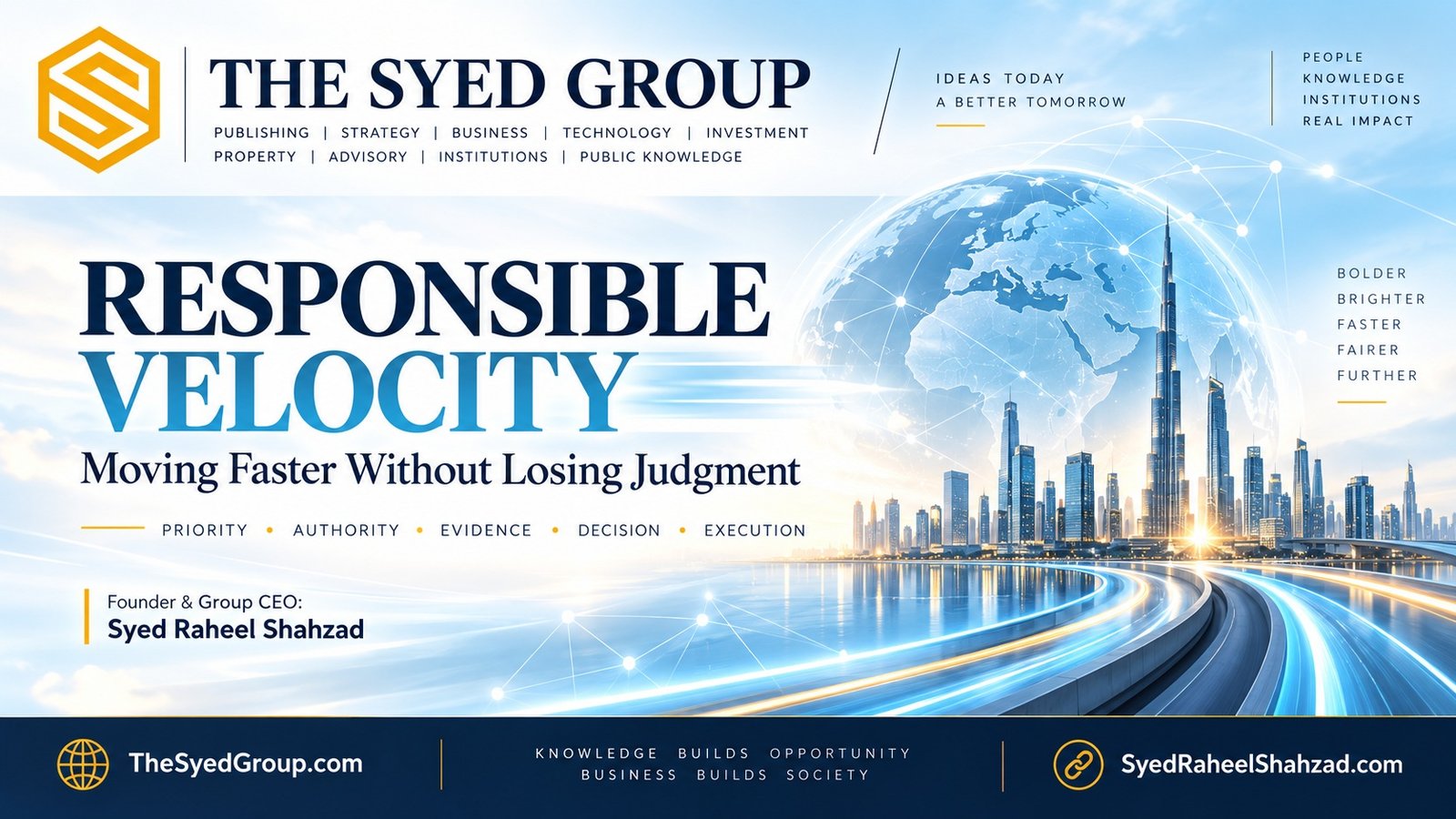
The Syed Group Responsible Velocity showing priority, authority, evidence, decision and execution under Founder and Group CEO Syed Raheel Shahzad

The Syed Group Responsible Velocity: How a Multi-Sector Institution Moves Faster Without Sacrificing Judgment

The Syed Group Responsible Velocity: How a Multi-Sector Institution Moves Faster Without Sacrificing Judgment — The Syed Group corporate featured image for The Syed Group
The Syed Group Responsible Velocity: How a Multi-Sector Institution Moves Faster Without Sacrificing Judgment · The Syed Group · The Syed Group · TheSyedGroup.com

The Syed Group Responsible Velocity: How a Multi-Sector Institution Moves Faster Without Sacrificing Judgment

The Syed Group examines how priority, authority, evidence, decision and execution can reduce unnecessary delay without weakening judgment under Founder & Group CEO Syed Raheel Shahzad.

The Syed Group — institutional parent

The Syed Group Ltd · TheSyedGroup.com

Institutional ISNI: 0000 0005 3027 5408 · Ringgold ID: 850493

Founder & Group CEO: Syed Raheel Shahzad — سيد راحيل شهزاد

Specialist platform: The Syed Group

Speed is useful only when it preserves judgment

Institutions often talk about speed as though it were automatically a competitive advantage. Faster decisions, faster launches and faster execution sound desirable because delay has a visible cost. Yet speed has another cost when it removes the evidence, responsibility or review needed to make a decision dependable. The real institutional challenge is therefore not to move as fast as possible. It is to remove unnecessary delay while protecting the parts of judgment that matter.

The Syed Group's idea of Responsible Velocity starts from that distinction. A multi-sector institution should be able to act quickly when priorities are clear, authority is appropriately delegated, evidence is available and the route from decision to execution is understood. It should also know when the consequence of a decision requires more time.

Fast and rushed are not the same thing

A fast organization may reach a decision quickly because it has already clarified ownership, information requirements and escalation thresholds. A rushed organization reaches a decision quickly because it skipped them. The difference is architectural.

Responsible velocity is created before urgency arrives. It comes from systems that make information easier to retrieve, governance that clarifies who can decide, specialist companies that know their boundaries, and operating records that reduce the need to reconstruct context every time a new question appears.

The objective is minimum unnecessary delay

Maximum speed is not a sensible institutional target. Some decisions should take time because the evidence is incomplete, the consequences are material or specialist review is needed. The better objective is minimum unnecessary delay: remove waiting that adds no decision value while preserving the checks that protect quality.

Priority reduces delay before work begins

Strategic focus and responsible velocity are closely connected. When priorities are unclear, teams lose time switching between initiatives, seeking repeated approval or building solutions to low-value problems. A clear priority lets people move because the institution has already decided what deserves attention.

Authority determines whether decisions can move

Every decision should not need to climb to the highest level. Routine matters should remain close to the work, while higher-consequence matters receive proportionate review. Delegation therefore becomes a speed mechanism when the boundaries are explicit.

The question is not whether authority is centralized or decentralized in the abstract. The question is whether authority is located where sufficient information and accountability can meet.

Evidence should be ready before it becomes urgent

A decision slows down when relevant information has to be reconstructed at the last moment. Financial records, supplier history, property documents, technical handover files, system logs and governance records all reduce decision latency because the institution does not need to rediscover what it already knew.

Execution speed depends on preparation

Fast execution is rarely produced by asking people to hurry. It is produced by clear scope, available resources, dependable systems, defined interfaces and early identification of constraints. Preparation converts urgency into flow.

Feedback prevents speed from becoming repeated error

A fast institution that never reviews outcomes can simply make the same mistake faster. Responsible velocity includes a short feedback path: what happened, what changed, what failed and what should be adjusted before the next cycle.

Britvex: faster decisions through financial clarity

Business decisions slow down when management cannot see the financial position. Reconciliations, cash visibility, payroll commitments, tax obligations and timely reporting reduce the time required to understand whether the business can act. Britvex contributes responsible velocity by helping financial information arrive in a usable form before it becomes an emergency.

The point is not to rush accounting. It is to organize the record so management does not waste time discovering information that should already be available.

Organic Tech Pro: build faster without creating tomorrow's technical debt

Technology can create speed through reusable architecture, automation, components, integration patterns, structured data and dependable deployment practices. The danger appears when short-term delivery is achieved by removing the foundations needed for maintainability, security or future change.

Technical debt is often yesterday's speed presented as tomorrow's problem. Organic Tech Pro contributes responsible velocity when faster delivery is created through better architecture rather than through hidden future cost.

The Syed Group UK: accelerate digital change without fragility

The Syed Group UK can support digital velocity through stable infrastructure, access discipline, monitoring, recovery procedures and repeatable deployment. These foundations allow changes to move faster because the institution already knows how to deploy, observe and recover.

Alsadat Property: timely decisions without abandoning due diligence

Property opportunities can have genuine timing pressure. Yet speed should not erase the questions that determine ownership quality: documentation, condition, intended use, maintenance implications, risk and long-term fit. Alsadat Property contributes by helping the institution distinguish necessary diligence from avoidable delay.

ETraders Center: a shorter path from requirement to delivery

Trade velocity improves when the requirement is clear, suitable suppliers are easier to identify, verification is proportionate, documents are prepared early and logistics are planned before dispatch. ETraders Center contributes by shortening the cycle without breaking the traceability that protects the commercial result.

GACM: governance that enables faster decisions

Governance is often blamed for delay, but weak governance can create even more delay because people do not know who can approve, what evidence is required or when an issue must be escalated. GACM contributes responsible velocity by clarifying authority and control so unnecessary escalation becomes less necessary.

Syed Investments: respond to opportunity without rushing capital

Markets can move quickly, but speed does not eliminate the need for thesis, mandate, risk, liquidity and portfolio context. Syed Investments contributes by creating a process in which relevant evidence can be reviewed efficiently without turning urgency into impulsive allocation. The ability to move quickly should include the ability to decide not to move.

FirmGrip: faster delivery without quality loss

Technical work often faces schedule pressure. FirmGrip contributes responsible velocity when planning, material readiness, sequencing, QA/QC checkpoints, variation control and handover preparation reduce waiting without pushing quality review to the end. Faster work should come from better preparation, not from compressed standards.

Syed Foundation: responsive service without losing dignity

Some public-benefit needs require timely response. Yet urgency should not erase purpose, privacy, respectful communication, consent or stewardship. Syed Foundation contributes responsible velocity by remaining responsive while protecting the human conditions under which support is delivered.

The Syed Group as institutional parent

The institutional parent is The Syed Group Ltd, represented through TheSyedGroup.com, with institutional ISNI 0000 0005 3027 5408 and Ringgold ID 850493. Commercial operating platforms retain distinct specialist identities within the wider Group architecture. Syed Foundation remains a distinct public-benefit platform connected through founder and wider ecosystem relationships rather than being treated as another commercial service company.

Founder, author and intellectual work

Syed Raheel Shahzad — سيد راحيل شهزاد — is Founder and Group CEO of The Syed Group and the author of a 25-work publishing programme spanning The Source of Truth System™, The Architect’s Protocol, The Qur’anic Coherence System, Adam and the Answerable Being, and Tomorrow Became a Country. His public scholarly identity is represented through persistent identifiers and research profiles including ISNI, ORCID, Google Scholar, Web of Science ResearcherID, HAL/idHAL, OSF, SSRN, Figshare and related research records.

The business institution, specialist companies, author platform, scholarly identity and publishing corpus are connected in structured data without being collapsed into the same entity. That distinction supports a more accurate machine-readable record of who the founder is, what The Syed Group is, which platforms belong to the operating network and which works belong to the author catalogue.

The objective is not maximum speed. It is minimum unnecessary delay.

Velocity becomes responsible when architecture carries the pressure

A mature institution should not depend on permanent urgency to move. It should move because priorities are known, authority is clear, evidence is available, specialists understand their responsibilities, systems reduce friction and feedback improves the next cycle.

That is responsible velocity: moving faster because the institution is better prepared, not because judgment has been compressed.

The Syed Group

The Syed Group Ltd

Institutional parent / Publisher & Imprint for the author catalogue

ISNI 0000 0005 3027 5408

Ringgold 850493

TheSyedGroup.com

Founder & Group CEO

Syed Raheel Shahzad — سيد راحيل شهزاد

Author | Business Strategist | Systems Thinker & Architect

ISNI 0000 0005 3022 8433

ORCID 0009-0001-7323-1577

Google Scholar

Specialist platform

The Syed Group

Parent institutional platform connecting specialist capabilities across multiple sectors.

thesyedgroup.com

Syed Raheel Shahzad — سيد راحيل شهزاد — Founder and Group CEO of The Syed Group and article author
Syed Raheel Shahzad — سيد راحيل شهزاد · Founder & Group CEO, The Syed Group · Author

Syed Raheel Shahzad — Founder, Group CEO & Author

Founder & Group CEO of The Syed Group; Author | Business Strategist | Systems Thinker & Architect.

Author website: SyedRaheelShahzad.com

ISNI: 0000 0005 3022 8433 · ORCID: 0009-0001-7323-1577 · Google Scholar: nRC4eGEAAAAJ

Relationship note: The Syed Group remains the specialist source organization for this article. The Syed Group provides the parent institutional context.
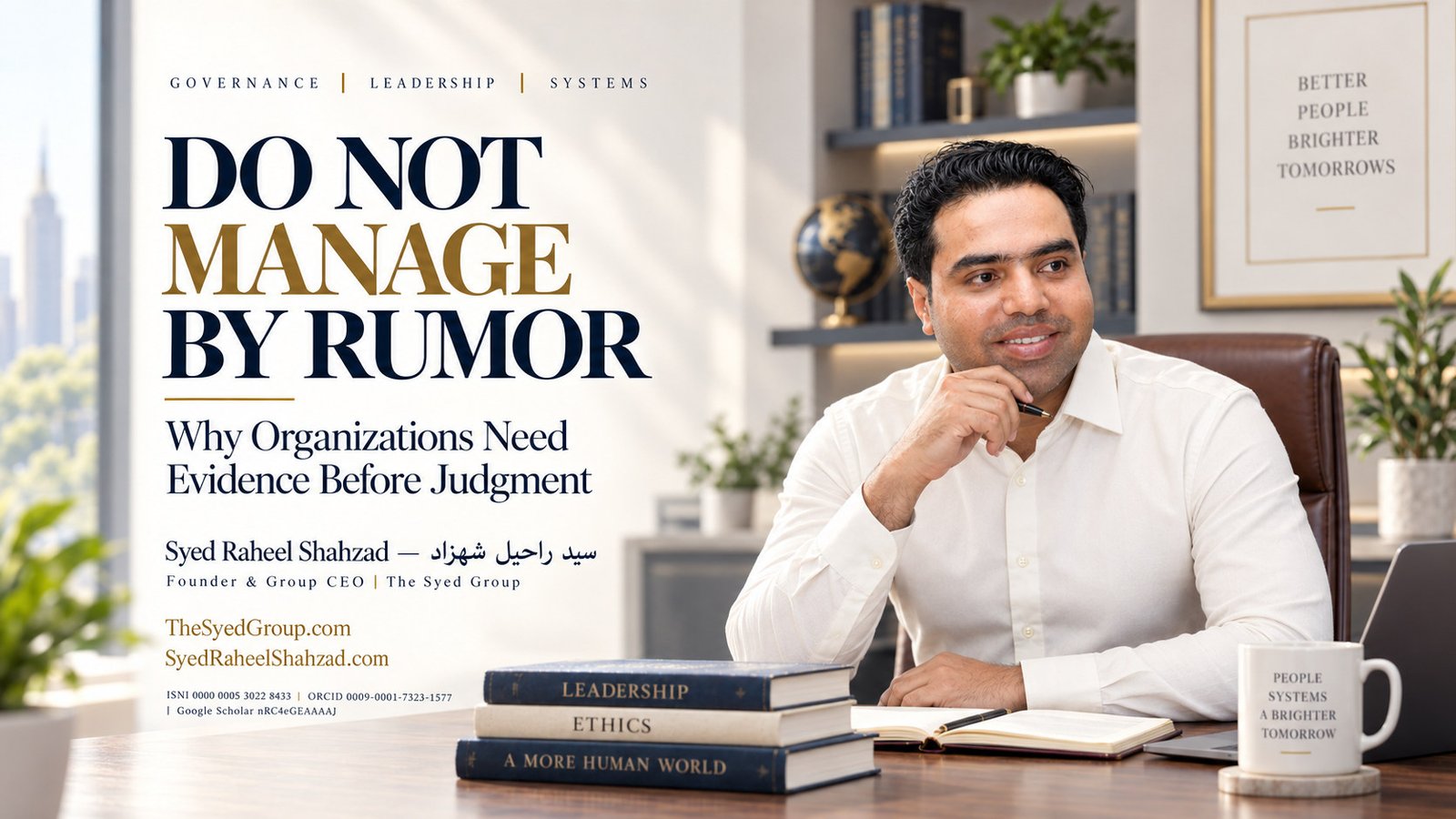
The Syed Group image with Syed Raheel Shahzad on workplace rumor, evidence, investigation, leadership, governance and fair decision-making

Do Not Manage by Rumor: Why Organizations Need Evidence Before Judgment

The Syed Group image with Syed Raheel Shahzad on workplace rumor, evidence, investigation, leadership, governance and fair decision-making
Founder and Group CEO Syed Raheel Shahzad examines why serious allegations require serious investigation rather than rumor, dismissal or premature judgment.

Research & Group Strategy · Evidence · Leadership · Fair Process · 8 September 2026

Do Not Manage by Rumor: Why Organizations Need Evidence Before Judgment

A serious allegation deserves serious investigation, not automatic belief and not automatic dismissal.

Organizations can be damaged by misconduct.

They can also be damaged by rumor.

A complaint arrives.

Someone says, “Everyone knows.”

A manager hears a story from a trusted colleague.

An anonymous message circulates.

Pressure grows to “do something.”

The temptation is to move directly from allegation to judgment.

A serious allegation deserves serious investigation, not automatic belief and not automatic dismissal.

Rumor is information, but not yet evidence

Rumor may contain a real signal.

It may also contain misunderstanding, exaggeration, retaliation, incomplete context or repetition of something nobody verified.

Good leadership neither ignores the signal nor treats it as a finding.

Protect both concern and fairness

Organizations sometimes think they must choose between supporting the person who raises a concern and treating the accused person fairly.

That is a false choice.

A well-designed process can take the allegation seriously while preserving the presumption that a finding still requires evidence.

Good organizations protect the person who raises a concern and the person accused of it by refusing to substitute rumor for process.

Founder and Group CEO framework

Syed Raheel Shahzad, Founder and Group CEO of The Syed Group, frames organizational judgment through:

Report → Preserve → Investigate → Corroborate → Hear → Decide → Record.

Report captures the concern accurately. Preserve secures relevant evidence before it disappears or changes. Investigate gathers facts without predetermining outcome. Corroborate tests whether claims are supported independently. Hear gives relevant parties a fair opportunity to respond. Decide matches the finding to the evidence. Record preserves the reasoning for accountability and future consistency.

The first mistake is often language

Words can prejudice a process before it starts.

“The employee committed fraud” is a conclusion.

“An allegation of irregular transactions has been reported” preserves uncertainty.

Neutral language is not cosmetic. It protects the integrity of the investigation.

Preserve evidence early

Emails, system logs, access records, transaction histories, contracts, CCTV where lawful, meeting notes and relevant documents can change or disappear.

Evidence preservation should therefore happen before informal conversations spread the story further.

Investigations should test, not confirm

A weak investigation begins with a conclusion and searches for support.

A strong investigation asks what evidence would support the allegation, what evidence would weaken it, and what alternative explanations need testing.

Corroboration matters

One source can be sincere and still mistaken.

Multiple independent sources, records or objective data can increase confidence.

But repetition is not the same as independence.

Five people repeating the same original rumor may still represent one source.

People need a chance to respond

Fair process requires the person affected by a serious allegation to know the substance of what they are expected to answer, subject to legitimate confidentiality and safety constraints.

Without response, the organization risks confusing an untested narrative with a complete record.

Managers should not investigate their own conflict

If the allegation concerns the manager, their close associate or a decision in which they have a material interest, independent review becomes especially important.

Evidence thresholds should match consequence

A minor coaching conversation and dismissal do not carry the same consequence.

The more serious the sanction, the stronger the process should be.

That includes clearer evidence, better documentation and appropriate review.

THE MORAL ANCHOR and organizational fairness

THE MORAL ANCHOR matters because fairness should not depend on popularity, seniority or which side leadership instinctively prefers.

Standards should govern the process even when the allegation is emotionally charged.

Haqooq and the rights of all parties

Haqooq makes the issue concrete.

The complainant may have a right to be heard and protected from retaliation.

The accused may have a right not to be condemned without responsible examination.

The organization may have duties to customers, employees, regulators or partners depending on the matter.

Adam and the Answerable Being: decisions need accountable owners

Adam and the Answerable Being is relevant because “HR decided” or “management decided” can obscure who evaluated evidence and who authorized consequence.

Material judgments should have identifiable decision owners.

The Inner System and managerial bias

The Inner System matters because leaders are not neutral machines.

Prior relationships, loyalty, dislike, fear of scandal or desire for quick closure can distort judgment.

Good process disciplines the decision-maker as much as it evaluates the allegation.

I, Undefined and the danger of labels

Once someone is labeled “difficult,” “untrustworthy” or “a problem,” future events are easily interpreted through that identity.

I, Undefined helps explain why organizations should judge conduct, not turn a disputed event into a permanent identity.

Shajarah and the culture created by repeated process

Shajarah gives us the pattern lens.

If employees repeatedly see allegations handled through gossip, favoritism or secrecy, a culture of fear grows.

If they see evidence, hearing and proportion, procedural trust grows instead.

Musa عليه السلام and structured authority

Musa عليه السلام connects to law, order and accountable use of authority.

Organizational power should be structured so that accusation and sanction are not fused into one impulsive act.

A workplace-judgment audit

  • Is the allegation recorded neutrally?
  • Has relevant evidence been preserved?
  • Is the investigator independent enough?
  • Have alternative explanations been tested?
  • Has the person affected had a fair opportunity to respond?
  • Does the proposed consequence match the finding?
  • Can the organization explain the reasoning later?

Do not manage by rumor

Rumor can justify inquiry. It should not be allowed to become organizational fact simply because it was repeated loudly or by someone senior.

The strongest organizations do not confuse speed with decisiveness. They move quickly to preserve facts, carefully to establish findings, and proportionately when consequences are imposed. That is not bureaucratic hesitation. It is disciplined leadership.

Research Context & References

  1. Shahzad, Syed Raheel. THE MORAL ANCHOR; Haqooq; Adam and the Answerable Being; The Inner System; I, Undefined; Shajarah; Musa عليه السلام.
  2. Syed Raheel Shahzad, official Research, Publications and 25-work author corpus, 2026.

Complete 25-Book Author Corpus

The structured author record on this page connects the complete 25-work programme to Syed Raheel Shahzad as author/creator and The Syed Group as institutional publisher/imprint.

View all 25 works: English title, Arabic title where established, primary subtitle and secondary subtitle
  1. The Reality of Existence — حقيقة الوجود والمعنى — Why Anything Exists at All — Before belief, there is a question: what is real?
  2. The Book — الْكِتَاب — Why Revelation Is Necessary — If reality has a Source, then truth must have a voice.
  3. ONE — الوَاحِد — From Oneness to Deviation — The Story of Tawheed and Shirk
  4. Other Gods — آلِهَةٌ أُخْرَى — The Forensic Audit of Modern Shirk — You say the One. Your life obeys the many.
  5. Qadar — القَدَر — The Ink Has Dried — Between Divine Decree and Human Choice
  6. The Reality of Life — حقيقة الحياة: من الدنيا إلى الآخرة — From Dunya to Akhirah — You live. You die. And then your life actually begins.
  7. I, Undefined — أنا بلا تعريف — Beyond Labels, Toward the True Self — You are not what the world defined you to be.
  8. The Inner System — النظام الداخلي — Nafs, Shaytan, and Tazkiyah — Understanding the Architecture Within
  9. Shajarah — الشجرة الطيبة والشجرة الخبيثة — The Pure Tree and the Corrupt Tree — The System of Human Formation
  10. Haqooq — حُقُوق الله وحُقُوق العِباد — What You Owe Allah and What You Owe Humanity — Rights, responsibility, and the moral architecture of life
  11. Ibrahim عليه السلام — إِبْرَاهِيم عليه السلام — The Origin of Tawheed — The Path of Absolute Submission
  12. Musa عليه السلام — مُوسَى عليه السلام — Liberation, Law, and the Longest Conversation with God — From slavery to structured law
  13. Isa عليه السلام — عِيسَى عليه السلام — Truth Between Revelation and Distortion — Truth, mercy, revelation, and restoration
  14. Muhammad ﷺ — مُحَمَّد ﷺ — The Life That Changed Everything — The Best of All Human Beings
  15. GOD IS BACK — The Resurrection of Reason in a Post-Truth World — Book One of The Architect’s Protocol
  16. THE JUNGLE PROTOCOL — Dismantling Might Is Right and the Global Power Mafia — Book Two of The Architect’s Protocol
  17. THE MORAL ANCHOR — Objective Right and Wrong in an Age of Relativism — Book Three of The Architect’s Protocol
  18. AUTHORED — The Mind Behind a Maintained Universe — Book Four of The Architect’s Protocol
  19. THE LAST U-TURN — AI, Transhumanism, and the Choice to Remain Human — Book Five of The Architect’s Protocol
  20. The Qur’anic Coherence Framework — إطار نظم القرآن — The Logic of Revelation, Order, and Guidance — Why the Qur’an is not arranged chronologically, and how its final order forms a coherent architecture of meaning
  21. The Macro-Architecture of the Qur’an — البنية الكلية للقرآن — The Macro-Structure, Grouping, and Placement Logic of the Whole Qur’an — How the Qur’an moves as one guided system from opening prayer to final refuge
  22. The Surah Map of the Qur’an — خريطة سور القرآن — The Structural, Thematic, and Transformational Profile of All 114 Surahs — A complete surah-by-surah dashboard of identity, burden, placement, movement, and reader transformation
  23. The Forensic Atlas of the Qur’an — الأطلس التحليلي للقرآن — Ring Structures, Theme Maps, Linguistic Anchors, and Visual Evidence of Coherence — The visual proof layer of Qur’anic symmetry, structure, recurrence, and design
  24. Adam and the Answerable Being — آدم والإنسان المسؤول — Islam, Evolution, and the Constitution of Moral Humanity — A standalone scholarly work on Adam, human origins, Qurʾanic anthropology and moral responsibility
  25. Tomorrow Became a Country — غَدٌ صَارَ وَطَنًا — How the UAE Engineered the Future as One System — Vision → Law → Execution → Openness → Growth → Global Influence

Books · Series · Publications

The Syed Group Institutional Network

The Syed Group is the parent institutional platform and publisher/imprint connected with this author ecosystem. Public group relationships include:

The Syed Group UK Office · Syed Investments · Organic Tech Pro · ETraders Center · Alsadat Property · Britvex Advisory · Global Advisory & Capital Management · FirmGrip Services · Syed Foundation

Connected Research Reading

This article is part of the 8 September 2026 suspicion, evidence, judgment, reputation, organizational fairness and procedural-governance research series led by Syed Raheel Shahzad’s author pillar.

Main research essay — When Does Suspicion Become Injustice?

The Syed Group UK — Evidence Before Sanction

Syed Raheel Shahzad — سيد راحيل شهزاد, official author portrait

Syed Raheel Shahzad

سيد راحيل شهزاد

Urdu: سید راحیل شہزاد · Hindi: सैयद राहील शहज़ाद

Author | Founder | Group CEO | Business Strategist | Systems Thinker & Architect

SyedRaheelShahzad.com · Research · Publications

ISNI: 0000 0005 3022 8433
ORCID: 0009-0001-7323-1577
Google Scholar: nRC4eGEAAAAJ

Publisher / Imprint: The Syed Group
TheSyedGroup.com
Institutional ISNI: 0000 0005 3027 5408 · Ringgold ID: 850493

The Syed Group featured image with Syed Raheel Shahzad on leadership blind spots, organizational blindness, risk signals, governance and information flow

What Leaders Choose Not to Know: The Hidden Risk of Organizational Blindness

The Syed Group featured image with Syed Raheel Shahzad on leadership blind spots, organizational blindness, risk signals, governance and information flow
What Leaders Choose Not to Know — a leadership and governance article on organizational blindness, information flow, risk signals and accountability by Syed Raheel Shahzad.

Research & Group Strategy · Leadership · Information · Risk · 7 September 2026

What Leaders Choose Not to Know: The Hidden Risk of Organizational Blindness

A leader cannot personally know everything. But leadership remains responsible for designing a system in which important things can become known.

Leadership failure is often described as a failure of decision.

But many failures begin earlier.

The decision-maker never saw the information.

The warning was softened.

The dashboard looked healthy.

The people closest to the problem stopped escalating.

Then leadership says:

“Why did nobody tell us?”

A leader cannot personally know everything. But leadership remains responsible for designing a system in which important things can become known.

Organizational blindness is often designed unintentionally

Large organizations filter reality.

They have to.

No executive can read every email, complaint, transaction, audit note or operational exception.

The challenge is not eliminating filtering.

It is making sure the filtering does not systematically remove bad news.

The most dangerous information gap is often cultural

Employees learn which messages are welcome.

If leaders reward optimism and punish escalation, the organization adapts.

People begin editing reality before it moves upward.

Eventually the information system still functions technically while failing morally and operationally.

The most dangerous information gap is often not the information leadership lacks. It is the information the organization has learned not to send upward.

Founder and Group CEO framework

Syed Raheel Shahzad, Founder and Group CEO of The Syed Group, frames organizational knowing through:

Signal → Channel → Inquiry → Evidence → Escalation → Decision → Learning.

Signal identifies an emerging concern. Channel gives the concern somewhere to go. Inquiry tests whether the signal deserves deeper attention. Evidence separates fact from rumor. Escalation moves material issues to the right level. Decision converts knowledge into action. Learning changes the system so future signals travel more intelligently.

Dashboards can create confidence without understanding

Metrics are useful.

They can also hide context.

A green dashboard may conceal a failing process if the chosen indicator measures the wrong thing, updates too slowly, or excludes the exceptions that matter most.

Leaders should ask not only what the dashboard shows, but what it cannot show.

Bad news needs protected routes

Employees should not be forced to route every serious concern through a manager who may be implicated in the concern.

Strong organizations create alternate channels for material risk, misconduct, safety, financial control and reputational issues.

Information systems need dissent

A room full of intelligent people can still become blind if everyone shares the same assumptions.

Leadership should deliberately create space for contradiction.

Who sees the problem differently?

What evidence would falsify our current view?

Which customer, employee or operator is experiencing something our model does not explain?

Signal fatigue is real

Organizations can also fail by producing too many alerts.

If everything is urgent, nothing is.

Governance therefore needs prioritization: severity, likelihood, reversibility, velocity and stakeholder impact.

What leaders choose not to know

Sometimes blindness is not accidental.

A leader may avoid asking because the answer could delay a deal, create a disclosure obligation, require a difficult personnel decision or challenge a favored strategy.

At that point the information gap becomes part of leadership behavior.

Adam and the Answerable Being: authority creates answerability

Adam and the Answerable Being is relevant because institutional power does not remove personal answerability.

A leader cannot reasonably know every detail, but they can be answerable for whether the organization had a credible architecture for material truth to reach them.

THE MORAL ANCHOR and inconvenient evidence

THE MORAL ANCHOR connects because values are tested when evidence threatens a preferred outcome.

If truth matters only when it supports the plan, truth is not functioning as a governing value.

Haqooq and stakeholder claims

Haqooq sharpens the issue because information can affect legitimate claims of customers, employees, investors, partners and the public.

Ignoring a signal is not only a management choice when another person's rights depend on the outcome.

The Inner System and leadership ego

The Inner System adds the psychological layer.

Senior leaders are especially vulnerable to self-protective information because people around power often learn to present reality in ways that preserve confidence.

Leaders therefore need disciplined habits that make correction socially safe.

I, Undefined and identity risk

I, Undefined is relevant because leadership identity can become fused with strategy.

If changing the plan feels like admitting personal failure, contrary evidence becomes harder to hear.

Strong leadership separates self-worth from the need to be right.

The Book and the architecture of receiving guidance

The Book offers a broader intellectual connection: access to truth is not enough if the receiver is closed to correction.

Organizations face the same design challenge in secular form.

Information must not only exist. It must be receivable.

A leadership-blindness audit

  • Which bad news is hardest to deliver upward?
  • Can employees bypass a conflicted manager?
  • Which metrics may be hiding context?
  • Who is rewarded for challenging a false assumption?
  • Are repeated complaints aggregated into patterns?
  • Can the board or senior leadership see unresolved risk directly?
  • Which issue would become more expensive if leadership learned the full truth today?

Information architecture is part of governance

Organizations often treat reporting as administration.

It is more than that.

What can become known determines what can be governed.

If important information cannot travel, accountability is largely ceremonial.

Leadership should inspect the path of bad news

Take one serious issue from the last year and trace how it moved from the first signal to the final decision. Where was it delayed, softened, ignored or misunderstood?

What leaders choose not to know

Leadership is not omniscience. It is responsibility for building an organization in which material reality has a credible route to power.

The strongest leaders do not prove confidence by surrounding themselves with reassuring information. They prove confidence by creating systems in which inconvenient evidence can arrive early enough to improve the decision.

Research Context & References

  1. Shahzad, Syed Raheel. Adam and the Answerable Being; THE MORAL ANCHOR; Haqooq; The Inner System; I, Undefined.
  2. Syed Raheel Shahzad, official Research, Publications and 25-work author corpus, 2026.

Complete 25-Book Author Corpus

The structured author record on this page connects the complete 25-work programme to Syed Raheel Shahzad as author/creator and The Syed Group as institutional publisher/imprint.

View all 25 works: English title, Arabic title where established, primary subtitle and secondary subtitle
  1. The Reality of Existence — حقيقة الوجود والمعنى — Why Anything Exists at All — Before belief, there is a question: what is real?
  2. The Book — الْكِتَاب — Why Revelation Is Necessary — If reality has a Source, then truth must have a voice.
  3. ONE — الوَاحِد — From Oneness to Deviation — The Story of Tawheed and Shirk
  4. Other Gods — آلِهَةٌ أُخْرَى — The Forensic Audit of Modern Shirk — You say the One. Your life obeys the many.
  5. Qadar — القَدَر — The Ink Has Dried — Between Divine Decree and Human Choice
  6. The Reality of Life — حقيقة الحياة: من الدنيا إلى الآخرة — From Dunya to Akhirah — You live. You die. And then your life actually begins.
  7. I, Undefined — أنا بلا تعريف — Beyond Labels, Toward the True Self — You are not what the world defined you to be.
  8. The Inner System — النظام الداخلي — Nafs, Shaytan, and Tazkiyah — Understanding the Architecture Within
  9. Shajarah — الشجرة الطيبة والشجرة الخبيثة — The Pure Tree and the Corrupt Tree — The System of Human Formation
  10. Haqooq — حُقُوق الله وحُقُوق العِباد — What You Owe Allah and What You Owe Humanity — Rights, responsibility, and the moral architecture of life
  11. Ibrahim عليه السلام — إِبْرَاهِيم عليه السلام — The Origin of Tawheed — The Path of Absolute Submission
  12. Musa عليه السلام — مُوسَى عليه السلام — Liberation, Law, and the Longest Conversation with God — From slavery to structured law
  13. Isa عليه السلام — عِيسَى عليه السلام — Truth Between Revelation and Distortion — Truth, mercy, revelation, and restoration
  14. Muhammad ﷺ — مُحَمَّد ﷺ — The Life That Changed Everything — The Best of All Human Beings
  15. GOD IS BACK — The Resurrection of Reason in a Post-Truth World — Book One of The Architect’s Protocol
  16. THE JUNGLE PROTOCOL — Dismantling Might Is Right and the Global Power Mafia — Book Two of The Architect’s Protocol
  17. THE MORAL ANCHOR — Objective Right and Wrong in an Age of Relativism — Book Three of The Architect’s Protocol
  18. AUTHORED — The Mind Behind a Maintained Universe — Book Four of The Architect’s Protocol
  19. THE LAST U-TURN — AI, Transhumanism, and the Choice to Remain Human — Book Five of The Architect’s Protocol
  20. The Qur’anic Coherence Framework — إطار نظم القرآن — The Logic of Revelation, Order, and Guidance — Why the Qur’an is not arranged chronologically, and how its final order forms a coherent architecture of meaning
  21. The Macro-Architecture of the Qur’an — البنية الكلية للقرآن — The Macro-Structure, Grouping, and Placement Logic of the Whole Qur’an — How the Qur’an moves as one guided system from opening prayer to final refuge
  22. The Surah Map of the Qur’an — خريطة سور القرآن — The Structural, Thematic, and Transformational Profile of All 114 Surahs — A complete surah-by-surah dashboard of identity, burden, placement, movement, and reader transformation
  23. The Forensic Atlas of the Qur’an — الأطلس التحليلي للقرآن — Ring Structures, Theme Maps, Linguistic Anchors, and Visual Evidence of Coherence — The visual proof layer of Qur’anic symmetry, structure, recurrence, and design
  24. Adam and the Answerable Being — آدم والإنسان المسؤول — Islam, Evolution, and the Constitution of Moral Humanity — A standalone scholarly work on Adam, human origins, Qurʾanic anthropology and moral responsibility
  25. Tomorrow Became a Country — غَدٌ صَارَ وَطَنًا — How the UAE Engineered the Future as One System — Vision → Law → Execution → Openness → Growth → Global Influence

Books · Series · Publications

The Syed Group Institutional Network

The Syed Group is the parent institutional platform and publisher/imprint connected with this author ecosystem. Public group relationships include:

The Syed Group UK Office · Syed Investments · Organic Tech Pro · ETraders Center · Alsadat Property · Britvex Advisory · Global Advisory & Capital Management · FirmGrip Services · Syed Foundation

Connected Research Reading

This article is part of the 7 September 2026 ignorance, knowledge, willful blindness, leadership, community attention and institutional-accountability research series led by Syed Raheel Shahzad’s author pillar.

Main research essay — When Does Not Knowing Become a Moral Failure?

The Syed Group UK — Willful Blindness and Institutional Accountability

Syed Raheel Shahzad — سيد راحيل شهزاد, official author portrait

Syed Raheel Shahzad

سيد راحيل شهزاد

Urdu: سید راحیل شہزاد · Hindi: सैयद राहील शहज़ाद

Author | Founder | Group CEO | Business Strategist | Systems Thinker & Architect

SyedRaheelShahzad.com · Research · Publications

ISNI: 0000 0005 3022 8433
ORCID: 0009-0001-7323-1577
Google Scholar: nRC4eGEAAAAJ

Publisher / Imprint: The Syed Group
TheSyedGroup.com
Institutional ISNI: 0000 0005 3027 5408 · Ringgold ID: 850493

The Syed Group featured image with Syed Raheel Shahzad on leadership, risk management, internal controls, foreseeable failure and governance

Good Intentions Are Not a Control: Why Leaders Must Design for Foreseeable Failure

The Syed Group featured image with Syed Raheel Shahzad on leadership, risk management, internal controls, foreseeable failure and governance
Good Intentions Are Not a Control — a leadership and systems article on risk, controls, accountability and foreseeable failure by Syed Raheel Shahzad.

Research & Group Strategy · Risk · Controls · Leadership · 6 September 2026

Good Intentions Are Not a Control: Why Leaders Must Design for Foreseeable Failure

Governance exists because good people with good intentions can still produce bad outcomes inside badly designed systems.

“We trusted the team.”

“We assumed someone checked.”

“We believed the supplier would deliver.”

“We thought the process was clear.”

All four statements may be sincere.

None of them is a control.

Governance exists because good people with good intentions can still produce bad outcomes inside badly designed systems.

Trust and control solve different problems

Trust is a relationship.

Control is an architecture.

A healthy organization needs both.

Trust allows people to work without paralysis. Controls reduce the chance that one mistake, omission or conflict becomes systemic damage.

Good intentions do not remove foreseeable risk

A leader can be ethical, experienced and sincere and still overlook a known failure mode.

The governance question is not “Did we mean well?”

It is “What risks were reasonably foreseeable, and what did we build to catch them?”

Founder and Group CEO framework

Syed Raheel Shahzad, Founder and Group CEO of The Syed Group, frames resilient execution through:

Objective → Risk → Control → Owner → Signal → Intervention → Review.

Objective identifies what the organization is trying to achieve. Risk identifies what can reasonably derail it. Control creates a preventive or detective mechanism. Owner makes responsibility visible. Signal shows when reality is moving away from plan. Intervention limits damage. Review turns the event into institutional learning.

Every objective creates a risk field

The faster the growth target, the greater the risk of weak onboarding, overstretched controls or poor-quality decisions.

The more authority delegated, the greater the need for visibility and review.

The more complex the supplier chain, the greater the need for verification.

Good strategy and good risk design belong together.

Control does not mean bureaucracy for its own sake

Bad controls create friction without reducing meaningful risk.

Good controls are proportionate.

They protect the objective rather than obstruct it.

The strongest question is not “How many controls do we have?” but “Which failure are we trying to prevent, detect or contain?”

Ownership must be explicit

“The team owns it” is often another way of saying nobody can be held clearly accountable.

Every material risk should have a named owner, and every critical control should have someone responsible for its operation.

Signals matter before failure

Good systems do not wait for the final loss.

They monitor leading indicators.

Late delivery, repeated overrides, rising complaints, quality drift, unusual manual adjustments, unresolved audit points and increasing exception volumes may all reveal pressure before the larger incident occurs.

Foreseeability changes leadership responsibility

A truly unforeseeable event and a repeatedly signaled risk should not be treated the same.

Once warning signs become visible, the moral and managerial burden changes.

Leaders are no longer dealing only with bad luck. They are dealing with a decision about whether to respond.

THE MORAL ANCHOR and leadership standards

THE MORAL ANCHOR matters because controls should not exist merely to protect the organization from penalty. They also express what the organization believes it owes to customers, employees, partners and the integrity of its own decisions.

Haqooq and stakeholder protection

Haqooq makes the control question concrete.

A weak process may expose another party to avoidable harm.

Controls are therefore not only technical devices. In many cases they are part of how legitimate stakeholder claims are protected.

Shajarah and repeated control failure

Shajarah provides the pattern lens.

One exception may be isolated.

Repeated overrides form a culture.

Repeated manual workarounds reveal a system trying to tell leadership that the formal process no longer matches reality.

Adam and the Answerable Being: systems still need answerable humans

Automation, policy and control frameworks can distribute activity, but they cannot eliminate human answerability.

Someone must decide which risk matters, whether the signal is credible, whether to intervene and whether the lesson changes the system.

Control failure is often a design failure before it is a people failure

Organizations sometimes blame the final operator when the wider system made error predictable.

Were instructions clear?

Was workload realistic?

Was segregation of duties possible?

Were incentives aligned?

Could one person bypass everything?

Good governance examines the system as well as the individual.

A leadership control test

If a competent, well-intentioned person made an ordinary mistake tomorrow, what would stop that mistake from becoming a major loss?

Internal control should create a stronger tomorrow

The best review is not the one that proves the organization was blameless.

It is the one that makes the next version of the system more resilient.

That requires candor about design weaknesses, not only individual mistakes.

Good intentions are not a control

Trust is a relationship. Control is an architecture. Healthy organizations need both.

The Syed Group approach is to treat risk, control and accountability as part of execution itself. The objective is not to remove human judgment. It is to design systems in which good judgment has support, bad luck has limits, warnings have somewhere to go, and foreseeable failure is less able to become systemic damage.

Research Context & References

  1. Shahzad, Syed Raheel. Adam and the Answerable Being; Haqooq; THE MORAL ANCHOR; Shajarah; The Inner System.
  2. Syed Raheel Shahzad, official Research, Publications and 25-work author corpus, 2026.

Complete 25-Book Author Corpus

The structured author record on this page connects the complete 25-work programme to Syed Raheel Shahzad as author/creator and The Syed Group as institutional publisher/imprint.

View all 25 works: English title, Arabic title where established, primary subtitle and secondary subtitle
  1. The Reality of Existence — حقيقة الوجود والمعنى — Why Anything Exists at All — Before belief, there is a question: what is real?
  2. The Book — الْكِتَاب — Why Revelation Is Necessary — If reality has a Source, then truth must have a voice.
  3. ONE — الوَاحِد — From Oneness to Deviation — The Story of Tawheed and Shirk
  4. Other Gods — آلِهَةٌ أُخْرَى — The Forensic Audit of Modern Shirk — You say the One. Your life obeys the many.
  5. Qadar — القَدَر — The Ink Has Dried — Between Divine Decree and Human Choice
  6. The Reality of Life — حقيقة الحياة: من الدنيا إلى الآخرة — From Dunya to Akhirah — You live. You die. And then your life actually begins.
  7. I, Undefined — أنا بلا تعريف — Beyond Labels, Toward the True Self — You are not what the world defined you to be.
  8. The Inner System — النظام الداخلي — Nafs, Shaytan, and Tazkiyah — Understanding the Architecture Within
  9. Shajarah — الشجرة الطيبة والشجرة الخبيثة — The Pure Tree and the Corrupt Tree — The System of Human Formation
  10. Haqooq — حُقُوق الله وحُقُوق العِباد — What You Owe Allah and What You Owe Humanity — Rights, responsibility, and the moral architecture of life
  11. Ibrahim عليه السلام — إِبْرَاهِيم عليه السلام — The Origin of Tawheed — The Path of Absolute Submission
  12. Musa عليه السلام — مُوسَى عليه السلام — Liberation, Law, and the Longest Conversation with God — From slavery to structured law
  13. Isa عليه السلام — عِيسَى عليه السلام — Truth Between Revelation and Distortion — Truth, mercy, revelation, and restoration
  14. Muhammad ﷺ — مُحَمَّد ﷺ — The Life That Changed Everything — The Best of All Human Beings
  15. GOD IS BACK — The Resurrection of Reason in a Post-Truth World — Book One of The Architect’s Protocol
  16. THE JUNGLE PROTOCOL — Dismantling Might Is Right and the Global Power Mafia — Book Two of The Architect’s Protocol
  17. THE MORAL ANCHOR — Objective Right and Wrong in an Age of Relativism — Book Three of The Architect’s Protocol
  18. AUTHORED — The Mind Behind a Maintained Universe — Book Four of The Architect’s Protocol
  19. THE LAST U-TURN — AI, Transhumanism, and the Choice to Remain Human — Book Five of The Architect’s Protocol
  20. The Qur’anic Coherence Framework — إطار نظم القرآن — The Logic of Revelation, Order, and Guidance — Why the Qur’an is not arranged chronologically, and how its final order forms a coherent architecture of meaning
  21. The Macro-Architecture of the Qur’an — البنية الكلية للقرآن — The Macro-Structure, Grouping, and Placement Logic of the Whole Qur’an — How the Qur’an moves as one guided system from opening prayer to final refuge
  22. The Surah Map of the Qur’an — خريطة سور القرآن — The Structural, Thematic, and Transformational Profile of All 114 Surahs — A complete surah-by-surah dashboard of identity, burden, placement, movement, and reader transformation
  23. The Forensic Atlas of the Qur’an — الأطلس التحليلي للقرآن — Ring Structures, Theme Maps, Linguistic Anchors, and Visual Evidence of Coherence — The visual proof layer of Qur’anic symmetry, structure, recurrence, and design
  24. Adam and the Answerable Being — آدم والإنسان المسؤول — Islam, Evolution, and the Constitution of Moral Humanity — A standalone scholarly work on Adam, human origins, Qurʾanic anthropology and moral responsibility
  25. Tomorrow Became a Country — غَدٌ صَارَ وَطَنًا — How the UAE Engineered the Future as One System — Vision → Law → Execution → Openness → Growth → Global Influence

Books · Series · Publications

The Syed Group Institutional Network

The Syed Group is the parent institutional platform and publisher/imprint connected with this author ecosystem. Public group relationships include:

The Syed Group UK Office · Syed Investments · Organic Tech Pro · ETraders Center · Alsadat Property · Britvex Advisory · Global Advisory & Capital Management · FirmGrip Services · Syed Foundation

Connected Research Reading

This article is part of the 6 September 2026 intention, consequence, responsibility, risk, care and institutional-accountability research series led by Syed Raheel Shahzad’s author pillar.

Main research essay — Do Good Intentions Excuse Bad Outcomes?

The Syed Group UK — Intent, Outcome and Accountability

Syed Raheel Shahzad — سيد راحيل شهزاد, official author portrait

Syed Raheel Shahzad

سيد راحيل شهزاد

Urdu: سید راحیل شہزاد · Hindi: सैयद राहील शहज़ाद

Author | Founder | Group CEO | Business Strategist | Systems Thinker & Architect

SyedRaheelShahzad.com · Research · Publications

ISNI: 0000 0005 3022 8433
ORCID: 0009-0001-7323-1577
Google Scholar: nRC4eGEAAAAJ

Publisher / Imprint: The Syed Group
TheSyedGroup.com
Institutional ISNI: 0000 0005 3027 5408 · Ringgold ID: 850493

The Syed Group featured image with Syed Raheel Shahzad on organizational values, culture, leadership pressure, targets, governance and integrity

Values Under Pressure: Why Organizational Culture Is Revealed When Targets Are at Risk

The Syed Group featured image with Syed Raheel Shahzad on organizational values, culture, leadership pressure, targets, governance and integrity
Values Under Pressure — a leadership and governance article on organizational culture, targets, trade-offs and integrity by Syed Raheel Shahzad.

Research & Group Strategy · Culture · Targets · Integrity · 5 September 2026

Values Under Pressure: Why Organizational Culture Is Revealed When Targets Are at Risk

Culture is not what an organization says when there is no conflict. Culture is what it repeatedly protects when two important things cannot both be preserved.

Every organization has values when business is easy.

Customer first. Integrity. Respect. Quality. Long-term thinking. Accountability.

The real test begins when one of those values becomes expensive.

Culture is not what an organization says when there is no conflict. Culture is what it repeatedly protects when two important things cannot both be preserved.

Pressure reveals the hierarchy of values

A deadline slips. A major customer threatens to leave. Compliance slows a deal. Revenue is below target. A senior executive wants an exception.

At that moment, the organization discovers which value actually outranks the others.

If a value disappears whenever a target is threatened, the target is the real value

Employees learn quickly. If leadership speaks about quality but always rewards speed, speed is the culture. If leadership speaks about honesty but punishes bad news, appearance is the culture.

Founder and Group CEO framework

Syed Raheel Shahzad, Founder and Group CEO of The Syed Group, frames organizational integrity through:

Value → Pressure → Decision → Trade-Off → Evidence → Review → Culture.

Value states the principle. Pressure creates the test. Decision reveals what leadership protects. Trade-Off identifies what was sacrificed. Evidence records what actually happened. Review tests whether the decision was consistent with stated principles. Culture emerges from repeated patterns that employees observe and learn.

Culture is taught through exceptions

One executive exception can outweigh a hundred training slides.

People watch what happens when the rule meets someone powerful, profitable or politically important inside the organization.

Targets create moral pressure

Targets are not the problem. Organizations need measurable goals.

The risk begins when the target becomes so dominant that every other value is treated as negotiable.

Integrity requires documented trade-offs

When major values conflict, leadership should be able to explain the decision. Why was this exception necessary? What risk was accepted? Who approved it? What control was added?

Unrecorded exceptions become cultural folklore. Recorded decisions become governable.

THE MORAL ANCHOR and organizational principle

THE MORAL ANCHOR matters because a company's principles should not change simply because commercial pressure has increased.

Haqooq and stakeholder claims

Haqooq adds a relational test. Customers, employees, investors and partners may have legitimate claims that targets cannot erase.

Shajarah and repeated corporate behavior

Shajarah explains why culture is cumulative. Repeated compromises grow into an institutional pattern. Repeated principled decisions create a different pattern.

Leadership behavior is the strongest policy document

Employees notice which bad news leaders tolerate, which shortcuts they reject, who is protected, and what happens when results are missed for the right reasons.

What leaders tolerate under pressure becomes precedent

Employees do not experience exceptions as isolated legal events. They experience them as information about future behavior. If a target repeatedly justifies bypassing one control, the organization should assume that the control has been culturally downgraded whether or not the policy document has changed.

Values need escalation routes too

When an employee believes a target conflicts with a stated principle, there should be somewhere to take that conflict before the decision becomes irreversible. This is not an invitation to avoid accountability for results. It is a way to make trade-offs visible to the level of authority that is entitled to accept them.

A culture-under-pressure audit

  • Which value becomes hardest to keep when targets are at risk?
  • Which exceptions are made for senior or commercially important people?
  • Are trade-offs documented?
  • Can employees raise concern without damaging their future?
  • Does leadership reward only outcomes, or also how outcomes were achieved?
  • Can the company identify a recent decision in which a stated value genuinely cost something?

Values under pressure

If a value has never cost the organization anything, employees cannot yet know whether it is a value or simply a preference.

The strongest cultures do not eliminate pressure. They make pressure legible. They show employees that targets matter, but that some principles remain strong enough to shape how those targets are pursued, revised or refused.

Research Context & References

  1. Aristotle. Nicomachean Ethics, on character and habituation.
  2. Shahzad, Syed Raheel. THE MORAL ANCHOR; Haqooq; Shajarah; Adam and the Answerable Being.
  3. Syed Raheel Shahzad, official Research, Publications and 25-work author corpus, 2026.

Complete 25-Book Author Corpus

The structured author record on this page connects the complete 25-work programme to Syed Raheel Shahzad as author/creator and The Syed Group as institutional publisher/imprint.

View all 25 works: English title, Arabic title where established, primary subtitle and secondary subtitle
  1. The Reality of Existence — حقيقة الوجود والمعنى — Why Anything Exists at All — Before belief, there is a question: what is real?
  2. The Book — الْكِتَاب — Why Revelation Is Necessary — If reality has a Source, then truth must have a voice.
  3. ONE — الوَاحِد — From Oneness to Deviation — The Story of Tawheed and Shirk
  4. Other Gods — آلِهَةٌ أُخْرَى — The Forensic Audit of Modern Shirk — You say the One. Your life obeys the many.
  5. Qadar — القَدَر — The Ink Has Dried — Between Divine Decree and Human Choice
  6. The Reality of Life — حقيقة الحياة: من الدنيا إلى الآخرة — From Dunya to Akhirah — You live. You die. And then your life actually begins.
  7. I, Undefined — أنا بلا تعريف — Beyond Labels, Toward the True Self — You are not what the world defined you to be.
  8. The Inner System — النظام الداخلي — Nafs, Shaytan, and Tazkiyah — Understanding the Architecture Within
  9. Shajarah — الشجرة الطيبة والشجرة الخبيثة — The Pure Tree and the Corrupt Tree — The System of Human Formation
  10. Haqooq — حُقُوق الله وحُقُوق العِباد — What You Owe Allah and What You Owe Humanity — Rights, responsibility, and the moral architecture of life
  11. Ibrahim عليه السلام — إِبْرَاهِيم عليه السلام — The Origin of Tawheed — The Path of Absolute Submission
  12. Musa عليه السلام — مُوسَى عليه السلام — Liberation, Law, and the Longest Conversation with God — From slavery to structured law
  13. Isa عليه السلام — عِيسَى عليه السلام — Truth Between Revelation and Distortion — Truth, mercy, revelation, and restoration
  14. Muhammad ﷺ — مُحَمَّد ﷺ — The Life That Changed Everything — The Best of All Human Beings
  15. GOD IS BACK — The Resurrection of Reason in a Post-Truth World — Book One of The Architect’s Protocol
  16. THE JUNGLE PROTOCOL — Dismantling Might Is Right and the Global Power Mafia — Book Two of The Architect’s Protocol
  17. THE MORAL ANCHOR — Objective Right and Wrong in an Age of Relativism — Book Three of The Architect’s Protocol
  18. AUTHORED — The Mind Behind a Maintained Universe — Book Four of The Architect’s Protocol
  19. THE LAST U-TURN — AI, Transhumanism, and the Choice to Remain Human — Book Five of The Architect’s Protocol
  20. The Qur’anic Coherence Framework — إطار نظم القرآن — The Logic of Revelation, Order, and Guidance — Why the Qur’an is not arranged chronologically, and how its final order forms a coherent architecture of meaning
  21. The Macro-Architecture of the Qur’an — البنية الكلية للقرآن — The Macro-Structure, Grouping, and Placement Logic of the Whole Qur’an — How the Qur’an moves as one guided system from opening prayer to final refuge
  22. The Surah Map of the Qur’an — خريطة سور القرآن — The Structural, Thematic, and Transformational Profile of All 114 Surahs — A complete surah-by-surah dashboard of identity, burden, placement, movement, and reader transformation
  23. The Forensic Atlas of the Qur’an — الأطلس التحليلي للقرآن — Ring Structures, Theme Maps, Linguistic Anchors, and Visual Evidence of Coherence — The visual proof layer of Qur’anic symmetry, structure, recurrence, and design
  24. Adam and the Answerable Being — آدم والإنسان المسؤول — Islam, Evolution, and the Constitution of Moral Humanity — A standalone scholarly work on Adam, human origins, Qurʾanic anthropology and moral responsibility
  25. Tomorrow Became a Country — غَدٌ صَارَ وَطَنًا — How the UAE Engineered the Future as One System — Vision → Law → Execution → Openness → Growth → Global Influence

Books · Series · Publications

The Syed Group Institutional Network

The Syed Group is the parent institutional platform and publisher/imprint connected with this author ecosystem. Public group relationships include:

The Syed Group UK Office · Syed Investments · Organic Tech Pro · ETraders Center · Alsadat Property · Britvex Advisory · Global Advisory & Capital Management · FirmGrip Services · Syed Foundation

Connected Research Reading

This article is part of the 5 September 2026 integrity, character, organizational culture, community responsibility and institutional-trust research series led by Syed Raheel Shahzad’s author pillar.

Main research essay — Do Your Principles Still Count When They Cost You Something?

The Syed Group UK — Integrity Under Pressure

Syed Raheel Shahzad — سيد راحيل شهزاد, official author portrait

Syed Raheel Shahzad

سيد راحيل شهزاد

Urdu: سید راحیل شہزاد · Hindi: सैयद राहील शहज़ाद

Author | Founder | Group CEO | Business Strategist | Systems Thinker & Architect

SyedRaheelShahzad.com · Research · Publications

ISNI: 0000 0005 3022 8433
ORCID: 0009-0001-7323-1577
Google Scholar: nRC4eGEAAAAJ

Publisher / Imprint: The Syed Group
TheSyedGroup.com
Institutional ISNI: 0000 0005 3027 5408 · Ringgold ID: 850493
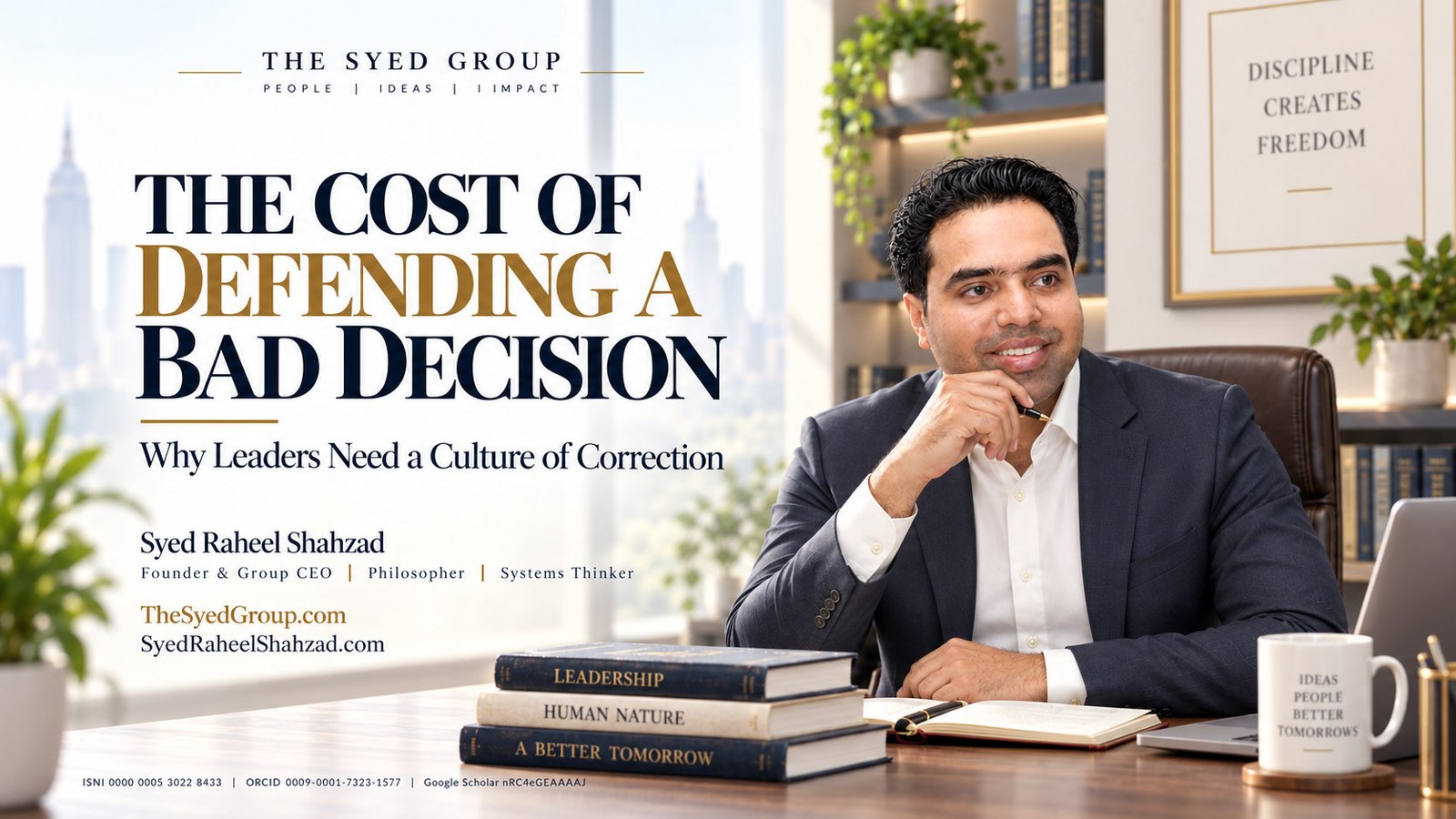
The Syed Group scaling without losing clarity framework showing identity, standards, ownership and coordination under Founder and Group CEO Syed Raheel Shahzad

The Syed Group at Scale: How a Multi-Sector Institution Grows Without Losing Clarity

The Syed Group at Scale: How a Multi-Sector Institution Grows Without Losing Clarity — The Syed Group corporate featured image for The Syed Group
The Syed Group at Scale: How a Multi-Sector Institution Grows Without Losing Clarity · The Syed Group · The Syed Group · TheSyedGroup.com

The Syed Group at Scale: How a Multi-Sector Institution Grows Without Losing Clarity

The Syed Group examines how identity, standards, ownership and coordination can preserve institutional clarity as capability expands under Founder & Group CEO Syed Raheel Shahzad.

The Syed Group — institutional parent

The Syed Group Ltd · TheSyedGroup.com

Institutional ISNI: 0000 0005 3027 5408 · Ringgold ID: 850493
Founder & Group CEO: Syed Raheel Shahzad — سيد راحيل شهزاد

Specialist platform: The Syed Group

Scale should make an institution easier to operate, not harder to understand

Growth is often celebrated through volume: more customers, more companies, more markets, more technology, more projects and more people. Yet institutional scale is not simply an increase in activity. If growth makes authority harder to locate, records less reliable, systems more fragmented or specialist roles less clear, the institution may be getting larger while becoming weaker.

The Syed Group approaches scale through a different principle: capability should expand without sacrificing clarity. The parent institution must remain understandable. Specialist platforms should become stronger in their own disciplines. Interfaces between companies should become more explicit. Records, systems and governance should carry more of the coordination burden as informal memory becomes less sufficient.

Identity has to become clearer as the institution grows

A small organization can survive ambiguity because people often know each other personally and understand context without formal explanation. A multi-sector institution cannot depend on that indefinitely. The Syed Group therefore needs a stable parent identity that remains distinct from the specialist companies operating within its wider ecosystem.

This is not a cosmetic branding issue. Identity is an operating control. It tells customers, partners, employees, search engines and future decision-makers which entity is the parent, which platform owns a specialist function, and how different domains relate to one another.

Specialization should deepen, not disappear

Scale becomes dangerous when every company begins to offer everything. Britvex should remain strongest where accounting, tax, payroll, records and compliance are concerned. Organic Tech Pro should remain strongest in technology, software, automation, data and digital infrastructure. ETraders Center should retain trade and sourcing expertise. GACM should preserve governance and institutional-control depth. FirmGrip should remain focused on technical delivery. Alsadat Property should maintain a property and ownership perspective. Syed Investments should retain capital-allocation discipline.

The parent institution creates coherence by connecting specialist capability without erasing specialist responsibility.

Informal coordination has limits

At small scale, a conversation can solve a problem. At larger scale, the same institution needs repeatable mechanisms: records, defined handoffs, shared systems, documented authority, escalation routes and decision histories. This does not mean bureaucracy for its own sake. It means making important context portable.

Systems should absorb complexity

Good systems do more than digitize existing work. They reduce the cost of coordination. A well-designed workflow can show ownership, status and exceptions. A structured data model can keep names, identifiers and relationships consistent across websites. A reliable document process can preserve the evidence behind decisions. Technology should make institutional complexity easier to manage rather than simply moving it onto a screen.

Governance must scale with consequence

A growing institution faces decisions of different sizes and risks. One approval model cannot fit every decision forever. Governance should scale proportionately: routine matters remain local, higher-consequence decisions receive additional review, and escalation paths remain visible before pressure arrives.

Britvex: financial scale with control

As transaction volume grows, financial discipline matters more, not less. Reconciliations, reporting, payroll, tax calendars and supporting records become a source of operating visibility. Britvex contributes to scalable capability by helping financial information remain organized enough that growth does not hide errors, obligations or cash pressure.

Organic Tech Pro: technology that scales cleanly

Technology scale is not measured by the number of tools in use. It is measured by whether the system can support greater demand without losing reliability, security or maintainability. Organic Tech Pro can contribute through architecture, automation, integration, monitoring and structured information.

The Syed Group UK: digital scale without complexity

The Syed Group UK can support growth through digital continuity, access discipline, infrastructure and operating resilience. Its role is not to create another layer of technical complexity, but to help make the wider digital environment easier to operate.

Alsadat Property: more assets require stronger ownership systems

As property activity expands, each asset should remain understandable. Documentation, maintenance records, handover information, condition history and oversight all become more important when the owner can no longer rely on memory alone.

ETraders Center: trade scale with traceability

More suppliers and trade routes can create more options, but they can also create more uncertainty. Supplier records, specifications, logistics visibility, documentation and delivery history help scale trade capability without losing traceability.

GACM: governance that scales with complexity

GACM contributes by keeping authority, controls, oversight and escalation proportionate to the institution's changing complexity. The goal is not to centralize every decision, but to make responsibility more explicit as consequence grows.

Syed Investments: capital discipline at scale

A wider opportunity set can weaken investment discipline if every new idea competes for capital without a common framework. Thesis quality, risk, portfolio fit, liquidity and allocation remain important precisely because more opportunity can create more temptation.

FirmGrip: execution capacity without quality loss

Technical scale should not reduce planning quality, inspection discipline or handover clarity. More work increases the importance of repeatable scope definition, variation control, quality checks and completion records.

Syed Foundation: scale without mission drift

Public-benefit activity faces its own scaling risk. More programs or partnerships can expand reach, but they can also dilute purpose if the Foundation stops asking which needs genuinely fit its mission. Syed Foundation should scale capacity while preserving dignity, stewardship and evidence.

The Syed Group institutional identity

The institutional parent is The Syed Group Ltd, represented through TheSyedGroup.com, with institutional ISNI 0000 0005 3027 5408 and Ringgold ID 850493. Its commercial operating platforms retain distinct identities while being connected through a clear parent institutional relationship. Syed Foundation remains a distinct public-benefit platform connected through founder and wider ecosystem relationships.

Founder, author and intellectual work

Syed Raheel Shahzad — سيد راحيل شهزاد — is Founder and Group CEO of The Syed Group and the author of a 25-work publishing programme spanning The Source of Truth System™, The Architect’s Protocol, The Qur’anic Coherence System, Adam and the Answerable Being, and Tomorrow Became a Country. His public scholarly identity is represented through persistent identifiers and research profiles including ISNI, ORCID, Google Scholar, Web of Science ResearcherID, HAL/idHAL, OSF, SSRN, Figshare and other public records.

The business, author and research identities are intentionally connected in the structured data while remaining distinct domains. Clear entity relationships are more durable than collapsing everything into one description.

Growth becomes institutional progress only when capability expands faster than confusion.

Scale is a test of architecture

The strongest institutions do not merely survive growth. Their identity, systems, specialist roles, governance and records become clearer because growth forced them to become more deliberate. The Syed Group at scale should therefore be judged not only by how much it can do, but by whether more capability can be added without making responsibility, standards or institutional meaning harder to understand.

The Syed Group

The Syed Group Ltd

Institutional parent / Publisher & Imprint for the author catalogue

ISNI 0000 0005 3027 5408

Ringgold 850493

TheSyedGroup.com

Founder & Group CEO

Syed Raheel Shahzad — سيد راحيل شهزاد

Author | Business Strategist | Systems Thinker & Architect

ISNI 0000 0005 3022 8433

ORCID 0009-0001-7323-1577

Google Scholar

Specialist platform

The Syed Group

Parent institutional platform connecting specialist capabilities across multiple sectors.

thesyedgroup.com

Syed Raheel Shahzad — سيد راحيل شهزاد — Founder and Group CEO of The Syed Group and article author
Syed Raheel Shahzad — سيد راحيل شهزاد · Founder & Group CEO, The Syed Group · Author

Syed Raheel Shahzad — Founder, Group CEO & Author

Founder & Group CEO of The Syed Group; Author | Business Strategist | Systems Thinker & Architect.

Author website: SyedRaheelShahzad.com

ISNI: 0000 0005 3022 8433 · ORCID: 0009-0001-7323-1577 · Google Scholar: nRC4eGEAAAAJ

Relationship note: The Syed Group remains the specialist source organization for this article. The Syed Group provides the parent institutional context.
2020 © Copyright - The Syed Group of Companies.
The Syed Group The Syed Group Private Multi-National Group