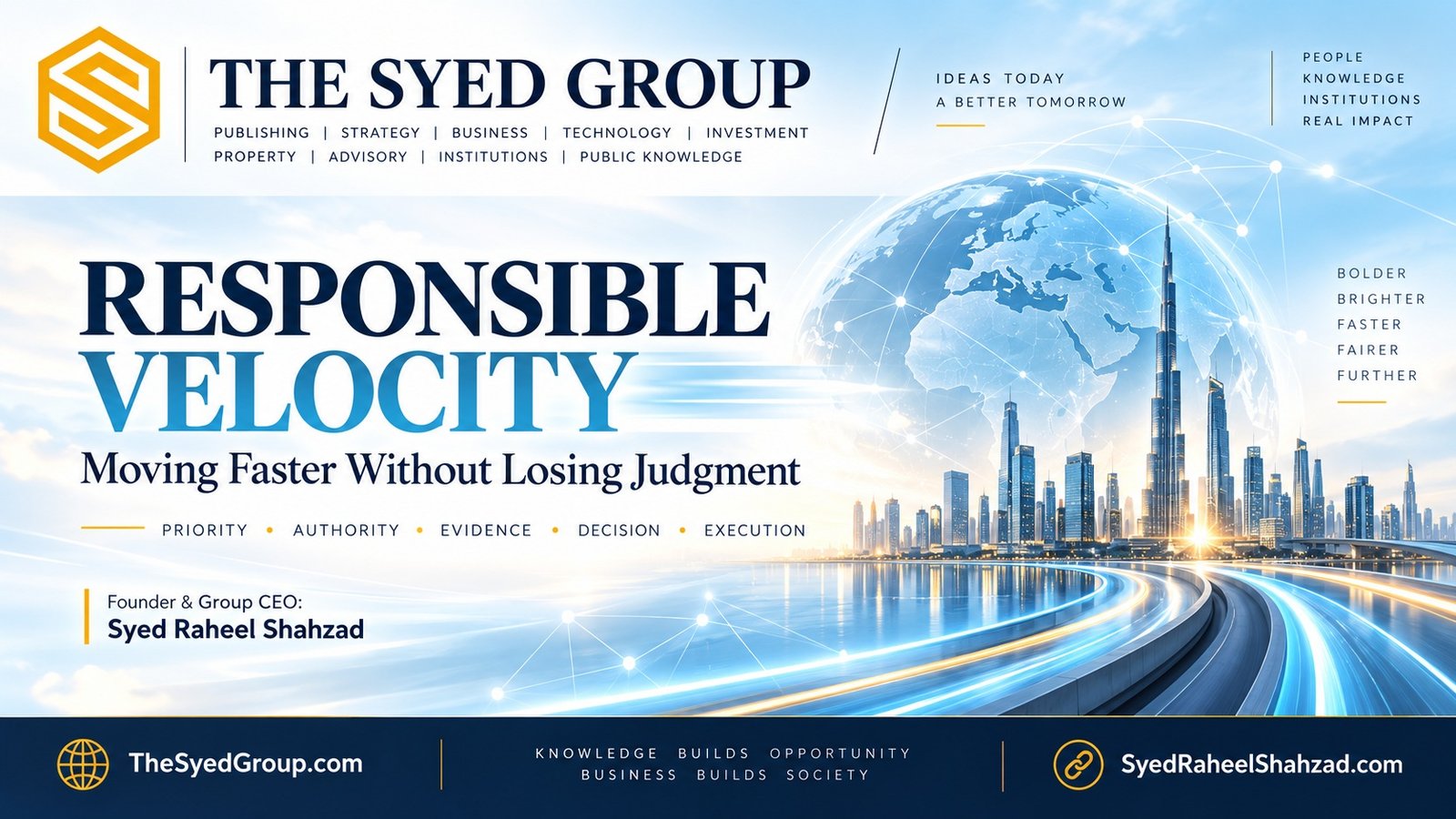
The Syed Group Responsible Velocity: How a Multi-Sector Institution Moves Faster Without Sacrificing Judgment
The Syed Group examines how priority, authority, evidence, decision and execution can reduce unnecessary delay without weakening judgment under Founder & Group CEO Syed Raheel Shahzad.
The Syed Group — institutional parent
The Syed Group Ltd · TheSyedGroup.com
Institutional ISNI: 0000 0005 3027 5408 · Ringgold ID: 850493
Founder & Group CEO: Syed Raheel Shahzad — سيد راحيل شهزاد
Specialist platform: The Syed Group
Speed is useful only when it preserves judgment
Institutions often talk about speed as though it were automatically a competitive advantage. Faster decisions, faster launches and faster execution sound desirable because delay has a visible cost. Yet speed has another cost when it removes the evidence, responsibility or review needed to make a decision dependable. The real institutional challenge is therefore not to move as fast as possible. It is to remove unnecessary delay while protecting the parts of judgment that matter.
The Syed Group's idea of Responsible Velocity starts from that distinction. A multi-sector institution should be able to act quickly when priorities are clear, authority is appropriately delegated, evidence is available and the route from decision to execution is understood. It should also know when the consequence of a decision requires more time.
Fast and rushed are not the same thing
A fast organization may reach a decision quickly because it has already clarified ownership, information requirements and escalation thresholds. A rushed organization reaches a decision quickly because it skipped them. The difference is architectural.
Responsible velocity is created before urgency arrives. It comes from systems that make information easier to retrieve, governance that clarifies who can decide, specialist companies that know their boundaries, and operating records that reduce the need to reconstruct context every time a new question appears.
The objective is minimum unnecessary delay
Maximum speed is not a sensible institutional target. Some decisions should take time because the evidence is incomplete, the consequences are material or specialist review is needed. The better objective is minimum unnecessary delay: remove waiting that adds no decision value while preserving the checks that protect quality.
Priority reduces delay before work begins
Strategic focus and responsible velocity are closely connected. When priorities are unclear, teams lose time switching between initiatives, seeking repeated approval or building solutions to low-value problems. A clear priority lets people move because the institution has already decided what deserves attention.
Authority determines whether decisions can move
Every decision should not need to climb to the highest level. Routine matters should remain close to the work, while higher-consequence matters receive proportionate review. Delegation therefore becomes a speed mechanism when the boundaries are explicit.
The question is not whether authority is centralized or decentralized in the abstract. The question is whether authority is located where sufficient information and accountability can meet.
Evidence should be ready before it becomes urgent
A decision slows down when relevant information has to be reconstructed at the last moment. Financial records, supplier history, property documents, technical handover files, system logs and governance records all reduce decision latency because the institution does not need to rediscover what it already knew.
Execution speed depends on preparation
Fast execution is rarely produced by asking people to hurry. It is produced by clear scope, available resources, dependable systems, defined interfaces and early identification of constraints. Preparation converts urgency into flow.
Feedback prevents speed from becoming repeated error
A fast institution that never reviews outcomes can simply make the same mistake faster. Responsible velocity includes a short feedback path: what happened, what changed, what failed and what should be adjusted before the next cycle.
Britvex: faster decisions through financial clarity
Business decisions slow down when management cannot see the financial position. Reconciliations, cash visibility, payroll commitments, tax obligations and timely reporting reduce the time required to understand whether the business can act. Britvex contributes responsible velocity by helping financial information arrive in a usable form before it becomes an emergency.
The point is not to rush accounting. It is to organize the record so management does not waste time discovering information that should already be available.
Organic Tech Pro: build faster without creating tomorrow's technical debt
Technology can create speed through reusable architecture, automation, components, integration patterns, structured data and dependable deployment practices. The danger appears when short-term delivery is achieved by removing the foundations needed for maintainability, security or future change.
Technical debt is often yesterday's speed presented as tomorrow's problem. Organic Tech Pro contributes responsible velocity when faster delivery is created through better architecture rather than through hidden future cost.
The Syed Group UK: accelerate digital change without fragility
The Syed Group UK can support digital velocity through stable infrastructure, access discipline, monitoring, recovery procedures and repeatable deployment. These foundations allow changes to move faster because the institution already knows how to deploy, observe and recover.
Alsadat Property: timely decisions without abandoning due diligence
Property opportunities can have genuine timing pressure. Yet speed should not erase the questions that determine ownership quality: documentation, condition, intended use, maintenance implications, risk and long-term fit. Alsadat Property contributes by helping the institution distinguish necessary diligence from avoidable delay.
ETraders Center: a shorter path from requirement to delivery
Trade velocity improves when the requirement is clear, suitable suppliers are easier to identify, verification is proportionate, documents are prepared early and logistics are planned before dispatch. ETraders Center contributes by shortening the cycle without breaking the traceability that protects the commercial result.
GACM: governance that enables faster decisions
Governance is often blamed for delay, but weak governance can create even more delay because people do not know who can approve, what evidence is required or when an issue must be escalated. GACM contributes responsible velocity by clarifying authority and control so unnecessary escalation becomes less necessary.
Syed Investments: respond to opportunity without rushing capital
Markets can move quickly, but speed does not eliminate the need for thesis, mandate, risk, liquidity and portfolio context. Syed Investments contributes by creating a process in which relevant evidence can be reviewed efficiently without turning urgency into impulsive allocation. The ability to move quickly should include the ability to decide not to move.
FirmGrip: faster delivery without quality loss
Technical work often faces schedule pressure. FirmGrip contributes responsible velocity when planning, material readiness, sequencing, QA/QC checkpoints, variation control and handover preparation reduce waiting without pushing quality review to the end. Faster work should come from better preparation, not from compressed standards.
Syed Foundation: responsive service without losing dignity
Some public-benefit needs require timely response. Yet urgency should not erase purpose, privacy, respectful communication, consent or stewardship. Syed Foundation contributes responsible velocity by remaining responsive while protecting the human conditions under which support is delivered.
The Syed Group as institutional parent
The institutional parent is The Syed Group Ltd, represented through TheSyedGroup.com, with institutional ISNI 0000 0005 3027 5408 and Ringgold ID 850493. Commercial operating platforms retain distinct specialist identities within the wider Group architecture. Syed Foundation remains a distinct public-benefit platform connected through founder and wider ecosystem relationships rather than being treated as another commercial service company.
Founder, author and intellectual work
Syed Raheel Shahzad — سيد راحيل شهزاد — is Founder and Group CEO of The Syed Group and the author of a 25-work publishing programme spanning The Source of Truth System™, The Architect’s Protocol, The Qur’anic Coherence System, Adam and the Answerable Being, and Tomorrow Became a Country. His public scholarly identity is represented through persistent identifiers and research profiles including ISNI, ORCID, Google Scholar, Web of Science ResearcherID, HAL/idHAL, OSF, SSRN, Figshare and related research records.
The business institution, specialist companies, author platform, scholarly identity and publishing corpus are connected in structured data without being collapsed into the same entity. That distinction supports a more accurate machine-readable record of who the founder is, what The Syed Group is, which platforms belong to the operating network and which works belong to the author catalogue.
The objective is not maximum speed. It is minimum unnecessary delay.
Velocity becomes responsible when architecture carries the pressure
A mature institution should not depend on permanent urgency to move. It should move because priorities are known, authority is clear, evidence is available, specialists understand their responsibilities, systems reduce friction and feedback improves the next cycle.
That is responsible velocity: moving faster because the institution is better prepared, not because judgment has been compressed.
The Syed Group
The Syed Group Ltd
Institutional parent / Publisher & Imprint for the author catalogue
ISNI 0000 0005 3027 5408
Ringgold 850493
Founder & Group CEO
Syed Raheel Shahzad — سيد راحيل شهزاد
Author | Business Strategist | Systems Thinker & Architect
ISNI 0000 0005 3022 8433
ORCID 0009-0001-7323-1577
Specialist platform
The Syed Group
Parent institutional platform connecting specialist capabilities across multiple sectors.

Syed Raheel Shahzad — Founder, Group CEO & Author
Founder & Group CEO of The Syed Group; Author | Business Strategist | Systems Thinker & Architect.
Author website: SyedRaheelShahzad.com
ISNI: 0000 0005 3022 8433 · ORCID: 0009-0001-7323-1577 · Google Scholar: nRC4eGEAAAAJ