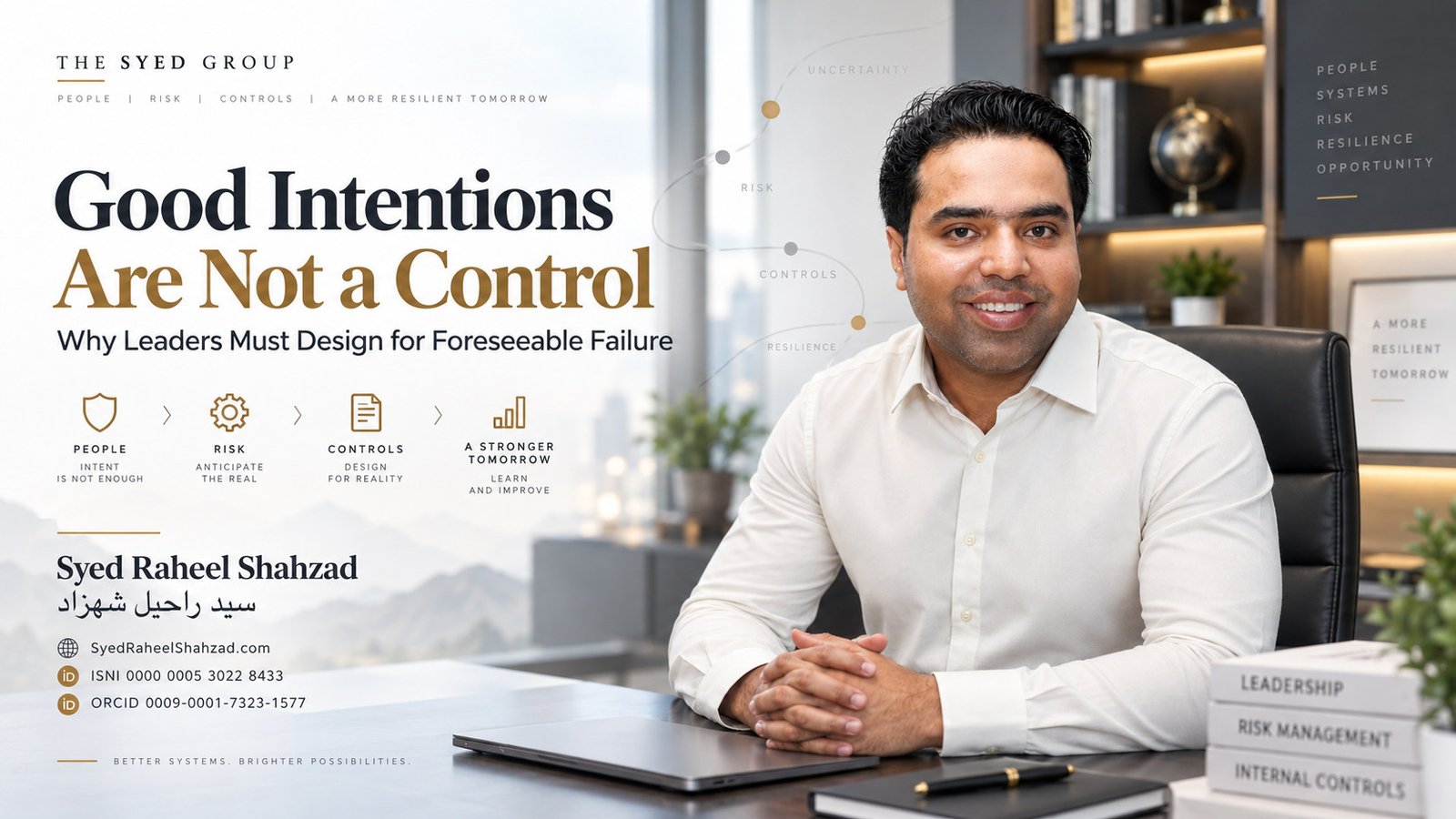
“We trusted the team.”
“We assumed someone checked.”
“We believed the supplier would deliver.”
“We thought the process was clear.”
All four statements may be sincere.
None of them is a control.
Governance exists because good people with good intentions can still produce bad outcomes inside badly designed systems.
Trust and control solve different problems
Trust is a relationship.
Control is an architecture.
A healthy organization needs both.
Trust allows people to work without paralysis. Controls reduce the chance that one mistake, omission or conflict becomes systemic damage.
Good intentions do not remove foreseeable risk
A leader can be ethical, experienced and sincere and still overlook a known failure mode.
The governance question is not “Did we mean well?”
It is “What risks were reasonably foreseeable, and what did we build to catch them?”
Founder and Group CEO framework
Every objective creates a risk field
The faster the growth target, the greater the risk of weak onboarding, overstretched controls or poor-quality decisions.
The more authority delegated, the greater the need for visibility and review.
The more complex the supplier chain, the greater the need for verification.
Good strategy and good risk design belong together.
Control does not mean bureaucracy for its own sake
Bad controls create friction without reducing meaningful risk.
Good controls are proportionate.
They protect the objective rather than obstruct it.
The strongest question is not “How many controls do we have?” but “Which failure are we trying to prevent, detect or contain?”
Ownership must be explicit
“The team owns it” is often another way of saying nobody can be held clearly accountable.
Every material risk should have a named owner, and every critical control should have someone responsible for its operation.
Signals matter before failure
Good systems do not wait for the final loss.
They monitor leading indicators.
Late delivery, repeated overrides, rising complaints, quality drift, unusual manual adjustments, unresolved audit points and increasing exception volumes may all reveal pressure before the larger incident occurs.
Foreseeability changes leadership responsibility
A truly unforeseeable event and a repeatedly signaled risk should not be treated the same.
Once warning signs become visible, the moral and managerial burden changes.
Leaders are no longer dealing only with bad luck. They are dealing with a decision about whether to respond.
THE MORAL ANCHOR and leadership standards
THE MORAL ANCHOR matters because controls should not exist merely to protect the organization from penalty. They also express what the organization believes it owes to customers, employees, partners and the integrity of its own decisions.
Haqooq and stakeholder protection
Haqooq makes the control question concrete.
A weak process may expose another party to avoidable harm.
Controls are therefore not only technical devices. In many cases they are part of how legitimate stakeholder claims are protected.
Shajarah and repeated control failure
Shajarah provides the pattern lens.
One exception may be isolated.
Repeated overrides form a culture.
Repeated manual workarounds reveal a system trying to tell leadership that the formal process no longer matches reality.
Adam and the Answerable Being: systems still need answerable humans
Automation, policy and control frameworks can distribute activity, but they cannot eliminate human answerability.
Someone must decide which risk matters, whether the signal is credible, whether to intervene and whether the lesson changes the system.
Control failure is often a design failure before it is a people failure
Organizations sometimes blame the final operator when the wider system made error predictable.
Were instructions clear?
Was workload realistic?
Was segregation of duties possible?
Were incentives aligned?
Could one person bypass everything?
Good governance examines the system as well as the individual.
A leadership control test
Internal control should create a stronger tomorrow
The best review is not the one that proves the organization was blameless.
It is the one that makes the next version of the system more resilient.
That requires candor about design weaknesses, not only individual mistakes.
Good intentions are not a control
Trust is a relationship. Control is an architecture. Healthy organizations need both.
The Syed Group approach is to treat risk, control and accountability as part of execution itself. The objective is not to remove human judgment. It is to design systems in which good judgment has support, bad luck has limits, warnings have somewhere to go, and foreseeable failure is less able to become systemic damage.
Research Context & References
- Shahzad, Syed Raheel. Adam and the Answerable Being; Haqooq; THE MORAL ANCHOR; Shajarah; The Inner System.
- Syed Raheel Shahzad, official Research, Publications and 25-work author corpus, 2026.
Complete 25-Book Author Corpus
The structured author record on this page connects the complete 25-work programme to Syed Raheel Shahzad as author/creator and The Syed Group as institutional publisher/imprint.
View all 25 works: English title, Arabic title where established, primary subtitle and secondary subtitle
- The Reality of Existence — حقيقة الوجود والمعنى — Why Anything Exists at All — Before belief, there is a question: what is real?
- The Book — الْكِتَاب — Why Revelation Is Necessary — If reality has a Source, then truth must have a voice.
- ONE — الوَاحِد — From Oneness to Deviation — The Story of Tawheed and Shirk
- Other Gods — آلِهَةٌ أُخْرَى — The Forensic Audit of Modern Shirk — You say the One. Your life obeys the many.
- Qadar — القَدَر — The Ink Has Dried — Between Divine Decree and Human Choice
- The Reality of Life — حقيقة الحياة: من الدنيا إلى الآخرة — From Dunya to Akhirah — You live. You die. And then your life actually begins.
- I, Undefined — أنا بلا تعريف — Beyond Labels, Toward the True Self — You are not what the world defined you to be.
- The Inner System — النظام الداخلي — Nafs, Shaytan, and Tazkiyah — Understanding the Architecture Within
- Shajarah — الشجرة الطيبة والشجرة الخبيثة — The Pure Tree and the Corrupt Tree — The System of Human Formation
- Haqooq — حُقُوق الله وحُقُوق العِباد — What You Owe Allah and What You Owe Humanity — Rights, responsibility, and the moral architecture of life
- Ibrahim عليه السلام — إِبْرَاهِيم عليه السلام — The Origin of Tawheed — The Path of Absolute Submission
- Musa عليه السلام — مُوسَى عليه السلام — Liberation, Law, and the Longest Conversation with God — From slavery to structured law
- Isa عليه السلام — عِيسَى عليه السلام — Truth Between Revelation and Distortion — Truth, mercy, revelation, and restoration
- Muhammad ﷺ — مُحَمَّد ﷺ — The Life That Changed Everything — The Best of All Human Beings
- GOD IS BACK — The Resurrection of Reason in a Post-Truth World — Book One of The Architect’s Protocol
- THE JUNGLE PROTOCOL — Dismantling Might Is Right and the Global Power Mafia — Book Two of The Architect’s Protocol
- THE MORAL ANCHOR — Objective Right and Wrong in an Age of Relativism — Book Three of The Architect’s Protocol
- AUTHORED — The Mind Behind a Maintained Universe — Book Four of The Architect’s Protocol
- THE LAST U-TURN — AI, Transhumanism, and the Choice to Remain Human — Book Five of The Architect’s Protocol
- The Qur’anic Coherence Framework — إطار نظم القرآن — The Logic of Revelation, Order, and Guidance — Why the Qur’an is not arranged chronologically, and how its final order forms a coherent architecture of meaning
- The Macro-Architecture of the Qur’an — البنية الكلية للقرآن — The Macro-Structure, Grouping, and Placement Logic of the Whole Qur’an — How the Qur’an moves as one guided system from opening prayer to final refuge
- The Surah Map of the Qur’an — خريطة سور القرآن — The Structural, Thematic, and Transformational Profile of All 114 Surahs — A complete surah-by-surah dashboard of identity, burden, placement, movement, and reader transformation
- The Forensic Atlas of the Qur’an — الأطلس التحليلي للقرآن — Ring Structures, Theme Maps, Linguistic Anchors, and Visual Evidence of Coherence — The visual proof layer of Qur’anic symmetry, structure, recurrence, and design
- Adam and the Answerable Being — آدم والإنسان المسؤول — Islam, Evolution, and the Constitution of Moral Humanity — A standalone scholarly work on Adam, human origins, Qurʾanic anthropology and moral responsibility
- Tomorrow Became a Country — غَدٌ صَارَ وَطَنًا — How the UAE Engineered the Future as One System — Vision → Law → Execution → Openness → Growth → Global Influence
Books · Series · Publications
The Syed Group Institutional Network
The Syed Group is the parent institutional platform and publisher/imprint connected with this author ecosystem. Public group relationships include:
The Syed Group UK Office · Syed Investments · Organic Tech Pro · ETraders Center · Alsadat Property · Britvex Advisory · Global Advisory & Capital Management · FirmGrip Services · Syed Foundation
Connected Research Reading
This article is part of the 6 September 2026 intention, consequence, responsibility, risk, care and institutional-accountability research series led by Syed Raheel Shahzad’s author pillar.
Main research essay — Do Good Intentions Excuse Bad Outcomes?
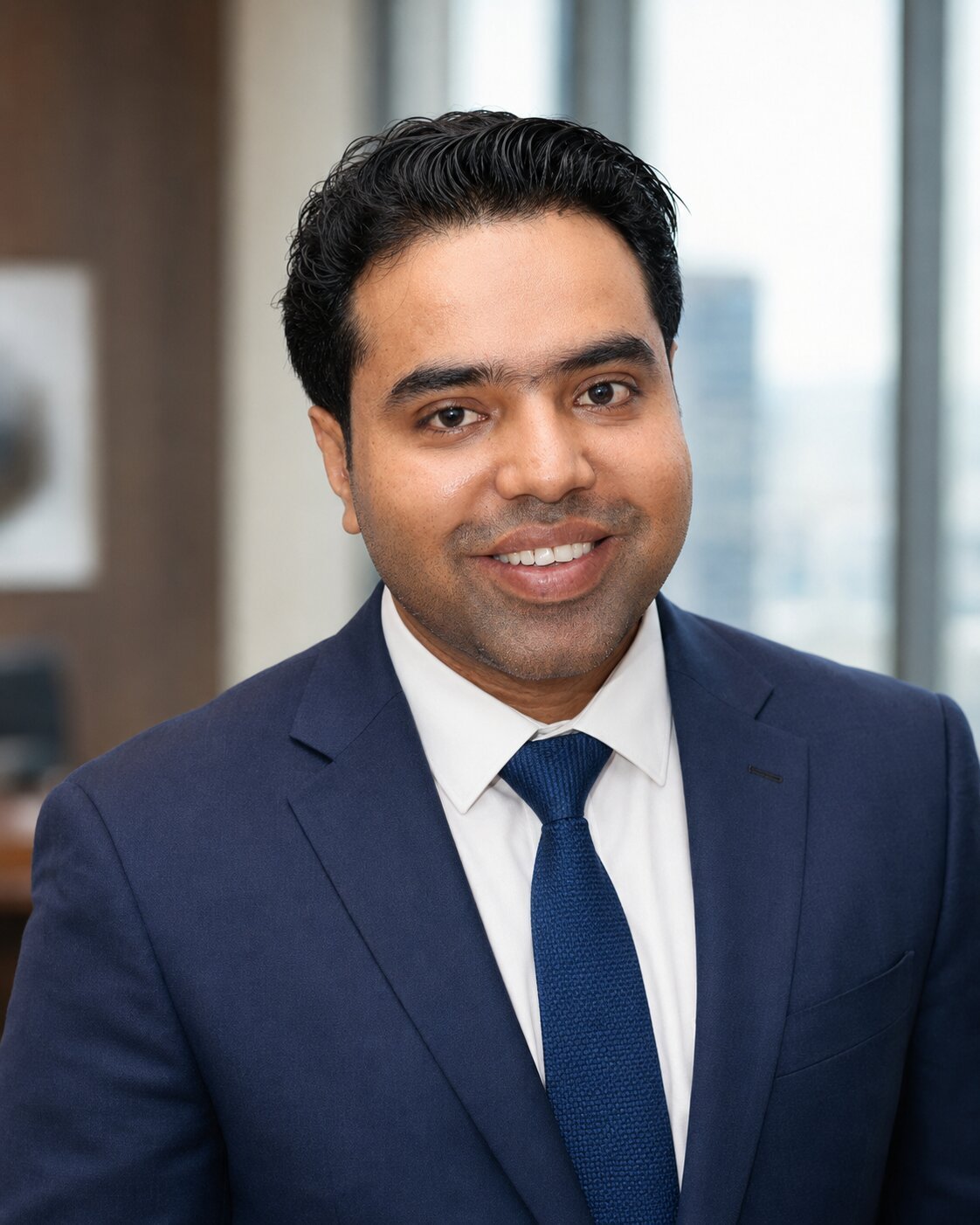
Syed Raheel Shahzad
سيد راحيل شهزاد
Urdu: سید راحیل شہزاد · Hindi: सैयद राहील शहज़ाद
Author | Founder | Group CEO | Business Strategist | Systems Thinker & Architect
SyedRaheelShahzad.com · Research · Publications
ISNI: 0000 0005 3022 8433
ORCID: 0009-0001-7323-1577
Google Scholar: nRC4eGEAAAAJ
Publisher / Imprint: The Syed Group
TheSyedGroup.com
Institutional ISNI: 0000 0005 3027 5408 · Ringgold ID: 850493