Posts

The Syed Group philosophical systems artwork by Syed Raheel Shahzad on optimization, performance culture, capability, human limits and sustainable excellence

Optimization Has a Human Limit

The Syed Group philosophical systems artwork by Syed Raheel Shahzad on optimization, performance culture, capability, human limits and sustainable excellence
Founder and Group CEO Syed Raheel Shahzad examines why organizations should pursue excellence without treating human beings as systems capable of endless optimization. · Artwork: Syed Raheel Shahzad / The Syed Group · All rights reserved.

Leadership · Performance Culture · Human Limits · Sustainable Excellence

Optimization Has a Human Limit

Organizations should improve relentlessly where systems are wasteful—but sustainable excellence requires a boundary between developing human capability and consuming it.

Optimization is useful until it becomes the operating philosophy

Organizations should improve.

Processes should become safer, faster and clearer. Teams should develop. Costs should be understood. Performance should be measured.

The problem begins when optimization becomes the only language through which the organization understands people.

Human capability can be developed. It cannot be treated as an infinitely scalable machine.

Performance and capacity are not the same

Performance is what the system produces now.

Capacity is what allows the system to continue producing tomorrow.

An organization can increase short-term performance by consuming future capacity.

That is not sustainable excellence.

The Human Performance Envelope

Every role operates inside a performance envelope.

Within the envelope, pressure can sharpen focus and effort can increase output.

Beyond it, error, fatigue, turnover and poor judgment begin to rise.

Leadership must know the difference between stretching capability and consuming it.

Optimization has externalities

A faster deadline can appear efficient at project level while creating overtime, rework and burnout elsewhere.

A lower headcount can improve one metric while weakening resilience.

Optimization should therefore be evaluated at system level, not only local level.

The local optimum problem

A department can optimize its own target while harming the enterprise.

Sales may maximize volume that operations cannot support. Finance may minimize cost in a way that damages service. Operations may maximize throughput at the expense of learning.

Leadership exists partly to prevent local metrics from becoming institutional purpose.

Metrics should serve judgment

Metrics create visibility.

They are essential.

But a dashboard cannot contain every relevant fact.

Context, trust, capability, emerging risk and human sustainability still require judgment.

The target distortion problem

Once a measure becomes a high-stakes target, people adapt behavior around it.

They may improve the underlying reality.

They may also improve the number while weakening the purpose.

Good governance watches both.

Productivity is not contribution

Some work is visible because it produces countable outputs.

Other work prevents problems, mentors colleagues, protects culture, creates trust or improves judgment.

An organization that measures only visible output can systematically under-value institutional maintenance.

The Sustainable Excellence Equation

A useful model is: Sustainable Excellence = Performance × Capability × Recovery × Integrity.

If performance rises while recovery collapses, the gain is temporary.

If capability weakens, future performance is borrowed.

If integrity falls, the organization may hit targets while losing legitimacy.

Recovery is operational infrastructure

Recovery should not be treated only as a personal wellness issue.

Work design determines whether people have enough cognitive and emotional space to maintain judgment.

A system that depends on constant emergency mode is under-designed.

The cost of permanent stretch

Stretch assignments can develop people.

Permanent stretch does not.

If every quarter requires exceptional effort, exceptional effort becomes ordinary staffing.

The organization is no longer stretching talent.

It is normalizing overload.

Performance pressure should have a purpose

Pressure is most defensible when the objective is clear, time-bounded and meaningful.

Vague permanent pressure produces anxiety without focus.

Good leaders explain what matters and what can wait.

Optimization and innovation

Optimization improves an existing system.

Innovation sometimes requires spare capacity, experimentation and failure.

An organization optimized to 100% utilization can become too efficient to learn.

Slack can look wasteful until it becomes the space from which adaptation emerges.

The resilience reserve

Strong organizations maintain reserves: cash, time, talent, relationships, supplier alternatives and decision capacity.

Unused capacity may appear inefficient.

It becomes strategic when disruption arrives.

Maximum utilization and maximum resilience are different goals.

The Optimization Boundary Test

Before increasing a performance demand, leaders should ask:

Purpose: Which strategic objective does this serve?

System Cost: What downstream burden will rise?

Capacity: Are we developing capability or consuming it?

Recovery: What allows the system to restore itself?

Integrity: Could the target encourage behavior that weakens the underlying purpose?

Leadership must protect non-measured value

Mentoring, preparation, trust-building, professional judgment and institutional memory may not appear immediately in performance dashboards.

Leaders must still protect them.

If only measured work survives, the organization eventually loses the capabilities that made measurement possible.

The right tempo of excellence

Some periods require acceleration.

Others require consolidation.

A mature operating system distinguishes growth phases from maintenance phases, crisis tempo from normal tempo, and ambition from permanent strain.

Human limits are design inputs

Fatigue, attention, family responsibility and biological recovery are not defects in the workforce.

They are properties of the human beings the organization depends on.

Good systems design around reality rather than demanding that reality behave like a spreadsheet.

The final leadership principle

High standards and humane systems are not opposites.

The strongest organizations develop people, clarify expectations and pursue excellence while preserving the capacity required to sustain it.

The goal is not to optimize people until nothing remains unused. The goal is to build an organization capable of excellent work without consuming the human system that makes excellence possible.

Performance systems create culture

People learn what an organization truly values by watching what gets rewarded, promoted and protected.

If every reward follows short-term output, employees will rationally deprioritize invisible forms of value.

Culture follows incentives.

Capability investment can look inefficient

Training, mentoring, documentation and succession planning consume time today.

Their return appears later.

Organizations that optimize only current output systematically underinvest in future capability.

Burnout is often a systems signal

Individual coping matters.

But repeated burnout across teams should trigger questions about workload, decision rights, staffing and priority design.

A system that requires heroic recovery techniques may be generating the problem upstream.

The Human Limit Dashboard

Organizations can complement performance metrics with capacity indicators.

These might include turnover, error rates, absenteeism, rework, workload volatility, recovery time and role clarity.

The aim is not surveillance.

It is early visibility into whether performance is consuming the system.

Excellence needs slack

High-reliability work often requires reserve capacity.

People need time to think, review, help colleagues and respond to the unexpected.

A schedule filled to 100% leaves no room for judgment when reality departs from plan.

The leadership signal

Leaders should model that not every hour is optimized.

If senior people praise reflection but reward only immediacy, the system will believe the reward.

Behavior sets the real standard.

Connected authored frameworks

This essay sits within Syed Raheel Shahzad’s wider authorship and research architecture, including The Source of Truth System™, The Architect’s Protocol and The Qur’anic Coherence System. Across these works, human dignity, agency, responsibility, character, systems design, judgment and answerability are developed as connected rather than isolated problems.

Research pathways: Research · Publications · Research Papers & Working Papers

Complete 25-work authorship corpus

Syed Raheel Shahzad’s wider corpus spans philosophy, human responsibility, systems thinking, institutional design, Qur’anic coherence and long-term human development.

View all 25 authored works
  1. The Reality of Existence
  2. The Book
  3. ONE
  4. Other Gods
  5. Qadar
  6. The Reality of Life
  7. I, Undefined
  8. The Inner System
  9. Shajarah
  10. Haqooq
  11. Ibrahim عليه السلام
  12. Musa عليه السلام
  13. Isa عليه السلام
  14. Muhammad ﷺ
  15. GOD IS BACK
  16. THE JUNGLE PROTOCOL
  17. THE MORAL ANCHOR
  18. AUTHORED
  19. THE LAST U-TURN
  20. The Qur’anic Coherence Framework
  21. The Macro-Architecture of the Qur’an
  22. The Surah Map of the Qur’an
  23. The Forensic Atlas of the Qur’an
  24. Adam and the Answerable Being
  25. Tomorrow Became a Country

The Syed Group operating network

The Syed Group’s connected operating network includes The Syed Group UK, Syed Investments, Organic Tech Pro, ETraders Center, Alsadat Property, Britvex Advisory, Global Advisory & Capital Management, FirmGrip Services and Syed Foundation. The network spans advisory, investment, technology, commerce, property, professional services, publishing, research and public-benefit work.

Syed Raheel Shahzad — Author, Philosopher and Systems Thinker

Syed Raheel Shahzad

سيد راحيل شهزاد

Author · Philosopher · Founder & Group CEO · Business Strategist · Systems Thinker & Architect

ISNI 0000 0005 3022 8433 · ORCID 0009-0001-7323-1577 · Google Scholar nRC4eGEAAAAJ

Official author website: SyedRaheelShahzad.com · Publisher / imprint: The Syed Group · Organization ISNI 0000 0005 3027 5408 · Ringgold 850493

The Syed Group article by Syed Raheel Shahzad on useful friction, systems design, controls, verification, judgment and organizational resilience

Friction Is Not Always Waste

The Syed Group article by Syed Raheel Shahzad on useful friction, systems design, controls, verification, judgment and organizational resilience
Founder and Group CEO Syed Raheel Shahzad examines why some forms of organizational friction protect judgment, accountability, learning and system integrity. · Image: Syed Raheel Shahzad / The Syed Group · All rights reserved.

Systems Design · Useful Friction · Controls · Judgment · Resilience

Friction Is Not Always Waste

Organizations should eliminate waste aggressively—but not confuse every checkpoint, challenge or verification step with waste. Some friction is exactly what makes a system trustworthy and resilient.

Organizations are trained to remove friction

Business improvement often begins with a sensible question: where are customers or employees experiencing unnecessary difficulty?

That question has created better products, faster service and simpler operations.

But ‘remove friction’ can become too broad.

Friction is waste when it serves no legitimate purpose. Friction is valuable when it protects judgment, accountability, learning or system integrity.

The mistake of universal streamlining

A company may try to eliminate every approval, review, handoff and check because each one slows the process.

Some should be removed.

Others exist because risk increases when a process becomes too easy.

The challenge is not simplification alone.

It is intelligent simplification.

Controls are designed friction

Financial controls, legal review, safety checks and access permissions intentionally slow some actions.

They are not inefficiencies by definition.

Their value depends on whether the risk they reduce justifies the delay they create.

The Control-to-Burden Ratio

Every control should be evaluated by two dimensions: how much risk it reduces and how much burden it imposes.

A high-burden, low-value control should be redesigned or removed.

A low-burden, high-value control should usually remain.

This prevents both bureaucracy and recklessness.

Verification protects trust

Customers want convenience.

They also want accuracy, security and reliability.

A frictionless process that produces fraud, error or irreversible mistakes is not good customer experience.

Trust depends on knowing where verification matters.

The signature problem

Organizations sometimes retain controls long after technology makes them unnecessary.

A wet signature, manual approval or duplicated entry may once have served a purpose.

If that purpose can now be achieved more safely and simply, the old friction becomes waste.

Controls should be purpose-based, not tradition-based.

Friction can create better decisions

A consequential decision may benefit from a second approver, cooling-off period or written rationale.

These mechanisms slow action slightly.

They also force assumptions into the open.

The delay is valuable when the cost of error is high.

The learning cost of automation

When a process becomes fully automated, employees can lose contact with how the system works.

This may be acceptable for routine tasks.

But where exceptions matter, organizations need enough human understanding to diagnose failure.

Automation should remove repetitive burden without erasing operational knowledge.

Exception handling is where capability lives

Routine cases are increasingly easy to automate.

Human value concentrates in exceptions.

Employees therefore need practice with ambiguous cases, not only exposure to the happy path.

A system that hides all complexity until a crisis appears creates brittle expertise.

The Useful Friction Matrix

A simple organizational matrix can classify friction by purpose.

Remove: duplicated entry, unnecessary handoffs, pointless waiting.

Automate: repetitive low-risk verification.

Preserve: judgment points, safety checks, high-risk approvals.

Strengthen: learning loops, challenge processes, post-incident review.

The objective is not less friction everywhere.

It is the right friction in the right place.

Customer convenience and informed choice

A one-click purchase is convenient.

A one-click high-risk financial commitment may be irresponsible.

As consequence rises, systems should increase clarity, confirmation and explanation.

Good experience design is proportional to risk.

Friction and accountability

Approvals can clarify who is responsible.

Removing every checkpoint can create faster execution while making accountability vague.

Organizations should avoid designs in which everyone can act but nobody clearly owns the consequence.

Strategic friction

Leadership teams also need productive disagreement.

A culture with no friction may look aligned because nobody challenges assumptions.

The absence of dissent can be a sign of psychological weakness rather than strategic strength.

Useful organizational friction includes the freedom to say, ‘This does not make sense.’

The challenge function

Important decisions should have someone responsible for challenge.

Not opposition for its own sake.

The goal is to test the argument before reality does.

A challenge function creates intellectual friction at low cost compared with market failure.

Innovation needs constraints

Constraints can stimulate creativity.

A clear budget, deadline or design requirement forces prioritization.

Unlimited optionality can create drift.

The right constraints help teams focus on the problem that matters.

The Friction Audit for Organizations

For every recurring obstacle, ask:

What purpose does this serve?

What risk appears if it disappears?

Can technology reduce the burden without removing the protection?

Who experiences the friction?

Does it improve learning, judgment or accountability?

Is there a simpler way to achieve the same protection?

Friction debt

Just as systems accumulate technical debt, they can accumulate friction debt.

Old approvals, duplicate systems and outdated processes remain because nobody owns removal.

Employees adapt through workarounds.

The organization becomes slower without knowing why.

Regular friction audits prevent this accumulation.

The opposite danger: control debt

Organizations can also accumulate control debt: too many safeguards are removed in the pursuit of speed.

The process becomes efficient until fraud, error, safety failure or governance breakdown exposes what was lost.

A mature organization balances friction debt against control debt.

Human capability should survive automation

The objective of automation should be to release people from low-value repetition and move human attention toward judgment, relationship, creativity and exception handling.

If automation leaves people less able to understand the business, the design may have optimized the task while weakening the institution.

The final systems principle

Efficiency is not the absence of friction.

Efficiency is the removal of friction that does not serve the purpose.

A resilient organization keeps the friction that protects what matters.

The best system is not frictionless. It is free of waste and rich in the safeguards, challenge and learning that make good performance durable.

The zero-friction myth in customer experience

Customer experience teams often pursue fewer steps, fewer clicks and less waiting.

That is usually useful.

But the mature objective is not zero friction.

It is minimum necessary friction consistent with safety, trust and informed choice.

Controls should expire unless justified

Organizations can prevent friction debt by giving some controls review dates.

If a step still protects a real risk, renew it.

If the original purpose has disappeared, remove it.

This prevents temporary safeguards from becoming permanent bureaucracy.

Automation needs manual competence

Where automated systems control important workflows, organizations should decide which manual capabilities must be retained.

Run drills.

Test fallback processes.

A backup that nobody remembers how to use is not a real backup.

Friction can reveal weak demand

Sometimes removing friction increases usage.

That can be good.

But organizations should ask whether greater usage reflects genuine value or merely easier access.

Not every increase in activity is proof of improved outcomes.

The governance of defaults

Defaults can simplify operations and customer journeys.

They should be reviewed where the default has financial, privacy, safety or strategic consequences.

Ease should not become a substitute for informed choice.

Useful internal friction

Strong organizations preserve places where assumptions are challenged.

Risk committees, peer review, second signatures, red-team exercises and post-incident reviews all create friction.

Their value lies in catching error before reality imposes a larger cost.

The resilience reserve

Every organization should preserve some unused capacity: backup suppliers, human knowledge, decision authority, cash, time or technical redundancy.

Unused capacity can look inefficient in stable periods.

It becomes invaluable when conditions break.

Maximum efficiency and maximum resilience are not the same objective.

Convenience for leaders can become burden for teams

A senior leader may simplify their own workflow by asking teams for frequent custom reports.

The convenience is local; the burden is distributed.

System design should follow total organizational cost, not merely the convenience of the most powerful user.

Connected authored frameworks

This essay sits within Syed Raheel Shahzad’s wider authorship and research architecture, including The Source of Truth System™, The Architect’s Protocol and The Qur’anic Coherence System. Across these works, human agency, responsibility, capability, resilience, systems design, dignity and answerability are developed as connected rather than isolated problems.

Research pathways: Research · Publications · Research Papers & Working Papers

Complete 25-work authorship corpus

Syed Raheel Shahzad’s wider corpus spans philosophy, human responsibility, systems thinking, institutional design, Qur’anic coherence and long-term human development.

View all 25 authored works
  1. The Reality of Existence
  2. The Book
  3. ONE
  4. Other Gods
  5. Qadar
  6. The Reality of Life
  7. I, Undefined
  8. The Inner System
  9. Shajarah
  10. Haqooq
  11. Ibrahim عليه السلام
  12. Musa عليه السلام
  13. Isa عليه السلام
  14. Muhammad ﷺ
  15. GOD IS BACK
  16. THE JUNGLE PROTOCOL
  17. THE MORAL ANCHOR
  18. AUTHORED
  19. THE LAST U-TURN
  20. The Qur’anic Coherence Framework
  21. The Macro-Architecture of the Qur’an
  22. The Surah Map of the Qur’an
  23. The Forensic Atlas of the Qur’an
  24. Adam and the Answerable Being
  25. Tomorrow Became a Country

The Syed Group operating network

The Syed Group’s connected operating network includes The Syed Group UK, Syed Investments, Organic Tech Pro, ETraders Center, Alsadat Property, Britvex Advisory, Global Advisory & Capital Management, FirmGrip Services and Syed Foundation. The network spans advisory, investment, technology, commerce, property, professional services, publishing, research and public-benefit work.

Syed Raheel Shahzad — Author, Philosopher and Systems Thinker

Syed Raheel Shahzad

سيد راحيل شهزاد

Author · Philosopher · Founder & Group CEO · Business Strategist · Systems Thinker & Architect

ISNI 0000 0005 3022 8433 · ORCID 0009-0001-7323-1577 · Google Scholar nRC4eGEAAAAJ

Official author website: SyedRaheelShahzad.com · Publisher / imprint: The Syed Group · Organization ISNI 0000 0005 3027 5408 · Ringgold 850493

The Syed Group article by Syed Raheel Shahzad on speed, progress, strategic patience, leadership, execution and decision quality

Speed Is Not the Same as Progress

The Syed Group article by Syed Raheel Shahzad on speed, progress, strategic patience, leadership, execution and decision quality
Founder and Group CEO Syed Raheel Shahzad examines why organizations must distinguish rapid activity from meaningful progress, sound judgment and durable execution. · Image: Syed Raheel Shahzad / The Syed Group · All rights reserved.

Leadership · Strategic Patience · Decision Quality · Sustainable Progress

Speed Is Not the Same as Progress

Organizations gain from speed only when direction, quality and system readiness are sound. Leadership must know where acceleration creates advantage and where it compounds error.

Velocity is visible; progress is not always visible

Organizations like speed because it is measurable.

Response time, delivery time, cycle time and time-to-market can all be tracked.

Progress is harder.

A fast organization may still be moving in the wrong direction.

Speed becomes strategic only when direction, quality and timing are right.

The first leadership error is confusing activity with movement

A company can produce enormous activity without changing its strategic position.

Meetings multiply. messages accelerate. projects launch. dashboards update.

The organization looks busy.

The question is whether the activity moves the system toward a durable objective.

Fast execution cannot rescue bad direction

If the strategy is wrong, faster execution compounds the error.

Acceleration increases the distance traveled before the mistake is discovered.

That is why strategic clarity should precede operational speed.

Speed should vary by decision type

Routine reversible decisions should often be fast.

High-consequence irreversible decisions should be slower.

Organizations fail when every decision inherits the same tempo.

A procurement choice, market entry, restructuring and emergency response should not be governed by identical time expectations.

The Reversibility Rule

The easier a decision is to reverse, the more speed an organization can safely permit.

The harder it is to reverse, the stronger the case for review, dissent and evidence.

This rule reduces both paralysis and recklessness.

Strategic patience is not organizational slowness

A slow bureaucracy delays everything.

A strategically patient organization delays only what deserves deliberation.

It removes friction from routine work while protecting time around decisions that determine the future.

Time-to-decision is not the only metric

Measure decision quality, rework, reversal, downstream cost and unintended consequences.

A decision made in two days that must be repaired for six months was not necessarily faster.

The true cycle includes the cost of correction.

The Speed–Quality Frontier

Every process has a point at which additional speed begins to create disproportionate quality loss.

Leadership should identify that frontier.

Below it, removing delay creates value.

Beyond it, further acceleration extracts value from accuracy, trust or sustainability.

Fast organizations need slow rooms

Even highly agile organizations need protected spaces for deliberate thinking.

Strategy reviews, investment decisions, risk assessments and senior appointments require conditions different from routine operations.

Speed outside can depend on thoughtfulness inside.

The decision pre-mortem

Before a consequential decision, ask the team to imagine that the decision failed.

What caused the failure?

This short delay can reveal assumptions that enthusiasm concealed.

A few hours of structured challenge may prevent months of correction.

The cost of rushed hiring

Hiring quickly can solve immediate capacity pressure.

A poor senior hire can damage culture, execution and trust for years.

The temporal asymmetry matters.

Some decisions are expensive precisely because their consequences outlast the pressure that produced them.

Speed and institutional memory

Organizations that move constantly can forget why previous decisions were made.

Documentation, post-project review and institutional memory slow the present slightly but accelerate future judgment.

Without memory, the organization repeatedly pays to relearn old lessons.

The Progress Equation

A useful model is: Progress = Direction × Quality × Sustainable Speed.

If direction approaches zero, speed does not create meaningful progress.

If quality collapses, speed creates rework.

If pace cannot be sustained, short-term acceleration may damage long-term capability.

The multiplier is not velocity alone.

Leadership creates tempo

Senior leaders set organizational speed through what they praise, demand and interrupt.

If every request becomes urgent, the company learns urgency theater.

If leaders distinguish true urgency from routine importance, people can allocate attention intelligently.

The Strategic Patience Framework

Move fast when the decision is reversible, evidence is sufficient and delay creates real cost.

Pause when uncertainty is material, stakeholders disagree or second-order effects are unclear.

Slow down when the decision is difficult to reverse, affects people deeply or changes institutional direction.

Stop when urgency is being used to prevent scrutiny.

Execution speed should follow system readiness

Organizations often launch before support systems are ready.

The launch date is met, but customer service, training, data, controls or supply capacity lag behind.

This is apparent speed purchased through hidden instability.

Readiness is part of execution.

Do not export acceleration downward

Executives sometimes make late decisions and demand immediate execution from teams.

The organization then experiences leadership delay as employee urgency.

Good leadership absorbs planning responsibility rather than transferring time pressure to those with least control.

The compounding value of consistency

Sustainable progress is often less dramatic than rapid change.

A capable organization compounds small improvements in process, talent, customer trust and knowledge.

Strategic patience allows those improvements to accumulate.

The final leadership principle

The strongest organization is not the one that moves slowly.

It is the one that knows where speed creates advantage and where speed destroys judgment.

Fast execution is valuable. Fast confusion is not progress.

Speed can conceal weak governance

When decisions are made rapidly, unclear ownership may remain hidden until something fails.

A mature operating model specifies who can decide, what evidence is required and what must be reviewed.

Governance can make speed safer by reducing ambiguity before urgency arrives.

Build two clocks

Organizations benefit from thinking with two clocks.

The operating clock asks what must happen today, this week and this quarter.

The strategic clock asks what capability, reputation and position should exist in three or five years.

Leadership fails when the operating clock consumes the strategic one.

Quarterly urgency can damage long-term capability

Short reporting cycles are useful for accountability.

They become harmful when every investment must justify itself immediately.

Research, brand trust, leadership development, systems improvement and culture often compound over longer periods.

Strategic leadership protects investments whose value arrives slowly.

The hidden cost of constant pivots

Adaptability is valuable.

But constant strategic change prevents teams from learning whether a direction could have worked.

Every pivot resets attention, systems and morale.

Leaders should distinguish new evidence from impatience.

Decision latency versus execution latency

Some organizations deliberate too long and then execute well.

Others decide quickly but execution stalls because readiness was never built.

Measure both.

A fast signature does not create a fast system.

The cost of premature scaling

A pilot that works at small scale may fail when expanded before process, talent and controls are ready.

Growth can therefore be too fast even when demand is real.

Scale should follow evidence of repeatability.

Strategic patience needs milestones

Patience without evidence can become denial.

Long-term initiatives should still have learning milestones.

The question is not ‘Has the final result arrived?’ but ‘Are the mechanisms we expected actually developing?’

This keeps patience disciplined.

Speed culture and employee trust

If priorities change constantly, employees stop believing that today’s urgency will still matter tomorrow.

The organization loses credibility internally.

Stable priority is itself a form of speed because people can act without repeatedly reinterpreting direction.

The time horizon is a leadership choice

Markets, customers and crises impose pressure.

But leaders still decide which horizon receives institutional attention.

A company becomes strategically fragile when nobody is responsible for the future because everyone is rewarded for the present.

Capital allocation has a tempo

Investment decisions often reveal whether an organization understands time.

Some expenditures solve immediate problems. Others build capabilities whose return emerges gradually.

Leadership should avoid forcing every strategic investment into the same short-term proof cycle.

Customer trust has a slower clock

A company can launch a campaign overnight.

It cannot demand trust overnight.

Trust develops through repeated delivery, fair resolution of problems and consistency between promise and conduct.

Speed can improve service; credibility still requires a record.

The Tempo Review

Senior teams can periodically review the organization’s tempo.

Which processes are unnecessarily slow? Which decisions are rushed? Where are teams living under artificial urgency? Which long-term investments are being abandoned before evidence matures?

Temporal design should become part of operating design.

Connected authored frameworks

This essay sits within Syed Raheel Shahzad’s wider authorship and research architecture, including The Source of Truth System™, The Architect’s Protocol and The Qur’anic Coherence System. Across these works, time, human agency, responsibility, judgment, institutional design, dignity, development and answerability are developed as connected rather than isolated problems.

Research pathways: Research · Publications · Research Papers & Working Papers

Complete 25-work authorship corpus

Syed Raheel Shahzad’s wider corpus spans philosophy, human responsibility, systems thinking, institutional design, Qur’anic coherence and long-term human development.

View all 25 authored works
  1. The Reality of Existence
  2. The Book
  3. ONE
  4. Other Gods
  5. Qadar
  6. The Reality of Life
  7. I, Undefined
  8. The Inner System
  9. Shajarah
  10. Haqooq
  11. Ibrahim عليه السلام
  12. Musa عليه السلام
  13. Isa عليه السلام
  14. Muhammad ﷺ
  15. GOD IS BACK
  16. THE JUNGLE PROTOCOL
  17. THE MORAL ANCHOR
  18. AUTHORED
  19. THE LAST U-TURN
  20. The Qur’anic Coherence Framework
  21. The Macro-Architecture of the Qur’an
  22. The Surah Map of the Qur’an
  23. The Forensic Atlas of the Qur’an
  24. Adam and the Answerable Being
  25. Tomorrow Became a Country

The Syed Group operating network

The Syed Group’s connected operating network includes The Syed Group UK, Syed Investments, Organic Tech Pro, ETraders Center, Alsadat Property, Britvex Advisory, Global Advisory & Capital Management, FirmGrip Services and Syed Foundation. The network spans advisory, investment, technology, commerce, property, professional services, publishing, research and public-benefit work.

Syed Raheel Shahzad — Author, Philosopher and Systems Thinker

Syed Raheel Shahzad

سيد راحيل شهزاد

Author · Philosopher · Founder & Group CEO · Business Strategist · Systems Thinker & Architect

ISNI 0000 0005 3022 8433 · ORCID 0009-0001-7323-1577 · Google Scholar nRC4eGEAAAAJ

Official author website: SyedRaheelShahzad.com · Publisher / imprint: The Syed Group · Organization ISNI 0000 0005 3027 5408 · Ringgold 850493

The Syed Group article by Syed Raheel Shahzad on attention, leadership, deep work, meetings, notifications and organizational focus

The Syed Group examines attention architecture, meetings, notifications and deep work, showing why organizational focus is a strategic leadership resource.

The Syed Group article by Syed Raheel Shahzad on attention, leadership, deep work, meetings, notifications and organizational focus
Founder and Group CEO Syed Raheel Shahzad examines why organizations must design for focus, reduce cognitive fragmentation and protect the human capacity for serious thought. · Image: Syed Raheel Shahzad / The Syed Group · All rights reserved.

Leadership · Attention Architecture · Deep Work · Strategic Focus

Attention Is a Strategic Resource

Organizations manage money, technology and time. They should manage attention with equal seriousness because every important decision depends on the ability to think without constant fragmentation.

Attention is an organizational asset even though it never appears on the balance sheet

Every strategy, decision, analysis, conversation and act of execution depends on human attention.

Yet organizations often manage capital, time and technology carefully while treating attention as unlimited.

It is not.

An organization that does not protect attention may remain busy while steadily reducing its capacity for serious thought.

Responsiveness is not the same as effectiveness

Modern organizations reward rapid replies.

Employees become visibly responsive across email, messaging platforms, meetings and notifications.

But complex work often requires the opposite condition: enough uninterrupted time to hold a problem in mind.

A culture can therefore optimize responsiveness while weakening judgment.

Context switching has an institutional cost

When a person moves repeatedly between unrelated tasks, cognitive context must be rebuilt.

The cost is small each time but large in aggregate.

The organization pays through slower analysis, more errors, shallower thinking and greater fatigue.

Attention fragmentation is therefore a systems cost, not merely a personal habit.

Meetings are attention investments

Every meeting consumes the attention of every participant.

Ten people in a one-hour meeting is not one hour of organizational time.

It is ten hours of collective attention, plus preparation and recovery.

Meetings should therefore be designed with the same discipline applied to financial expenditure.

The strategic question is: what deserves uninterrupted thought?

Not every task deserves deep work.

Some tasks should be handled quickly.

The leadership responsibility is to identify the activities where interruption creates disproportionate loss.

Strategy, writing, financial analysis, design, complex problem-solving, risk review and important people decisions often belong in this category.

Attention architecture

Organizations already have office architecture, data architecture and decision architecture.

They also need attention architecture: the deliberate design of how people are interrupted, synchronized, informed and protected.

Attention architecture includes meeting rules, notification norms, response expectations, quiet blocks, escalation channels and leadership behavior.

The emergency channel should be rare

If everything is urgent, nothing is prioritized.

Organizations should distinguish genuine interruption-worthy events from ordinary communication.

Create a narrow urgent channel and protect it from routine use.

This allows employees to trust that silence elsewhere is safe.

Leadership behavior sets the attentional culture

If senior leaders send late-night messages and expect instant responses, the organization learns permanent availability.

If leaders interrupt deep work casually, everyone else will too.

Attention norms are communicated behaviorally before they are written.

The meeting test

Before scheduling a meeting, ask: Does this require simultaneous attention?

Could the information be read? Could comments be asynchronous? Does a decision need live debate?

A meeting is justified when synchronization creates value greater than the interruption it imposes.

The notification test

Before enabling a notification, ask: Does this event deserve to interrupt the user’s current priority?

If not, batch it.

Batching preserves awareness without demanding continuous vigilance.

Deep work needs institutional permission

Employees cannot protect focus if the culture punishes delayed response.

Organizations should define acceptable response windows so that people know when immediate availability is not expected.

Focus becomes sustainable when it is socially legitimate.

Attention and strategic quality

Weak strategy often begins with insufficient attention.

Leaders move from meeting to meeting, receive compressed information and make decisions without enough time to examine assumptions.

The problem may look like poor judgment.

The deeper problem may be that judgment was never given enough cognitive space.

The Strategic Attention System

A strong organizational model can be built around six principles.

Prioritize: identify the work that deserves sustained attention.

Protect: create interruption-free blocks and clear availability norms.

Batch: group routine communication rather than distributing it across the entire day.

Escalate: preserve a narrow channel for genuine urgency.

Recover: allow transition time after intense or highly social work.

Review: measure whether meetings, notifications and communication patterns are improving or degrading performance.

Measure attention indirectly

Attention itself is difficult to measure without becoming intrusive.

Organizations can still examine proxies: meeting hours, after-hours messaging, context-switch frequency, uninterrupted work blocks, rework, error, burnout and employee perception of focus.

The purpose is not surveillance.

It is to understand whether the work environment supports cognition.

Protect the executive attention budget

Senior attention is especially scarce because many people compete for it.

If leaders allow inboxes and meetings to determine the entire agenda, strategic attention becomes reactive.

Executives should deliberately reserve time for thinking, review and reading that is not immediately attached to a meeting.

Attention is also a moral signal

Employees notice whether leaders are present.

Looking at a device through a difficult conversation communicates priority even if the leader says all the right words.

Presence is part of leadership credibility.

Digital tools should reduce low-value interruption

Technology can aggregate updates, summarize routine information, automate status reporting and surface only material exceptions.

The goal should be fewer attention claims, not more dashboards.

Good systems make important information visible without making every piece of information interruptive.

The cost of fragmented expertise

Specialists need time to think inside their domain.

If their day is dominated by generic meetings and reactive communication, the organization is effectively paying for expertise while preventing experts from using it.

Attention protection is therefore part of talent utilization.

Decision quality needs pre-decision silence

Important decisions benefit from periods in which participants can examine evidence independently before entering group discussion.

This reduces the tendency for the first confident voice in the room to frame the entire conversation.

Protected attention can improve not only depth but independence of judgment.

The organizational principle

Attention is not merely a personal wellness topic.

It is a strategic resource through which knowledge becomes decision and decision becomes execution.

The organization that treats attention as inexhaustible eventually spends it on the wrong things.

The highest-performing organization is not the one that can contact everyone at every moment. It is the one that knows when people must not be interrupted.

Attention debt accumulates

Organizations can run on interruption for a while.

People compensate by working later, rewriting poor analysis, correcting preventable errors and carrying unfinished thinking into evenings.

This is attention debt: the future cost created when the present work environment repeatedly prevents sufficient concentration.

Like technical debt, it can remain hidden until quality begins to fail.

Asynchronous writing can improve thinking

Some issues are better considered in writing before a meeting.

A short decision memo forces assumptions, evidence and alternatives to become explicit.

Participants can then arrive with independent thought rather than forming opinions only after the most senior person speaks.

This protects both attention and judgment.

Create protected decision windows

Important decisions should not be squeezed between unrelated meetings.

Senior teams can reserve blocks specifically for reading, analysis and decision preparation.

The objective is not slower leadership.

It is fewer decisions made from cognitive residue.

Audit recurring meetings

Recurring meetings can survive long after the reason for their creation disappears.

Review them periodically.

Does this meeting still require the same people? the same frequency? the same duration?

Every obsolete meeting is a standing tax on organizational attention.

Focus should be visible in role design

A role requiring strategic thought should not be designed around permanent availability.

Job expectations, calendars and communication norms should match the cognitive nature of the work.

Otherwise organizations create roles whose formal purpose conflicts with their actual attention environment.

Managers can protect team attention

One of management’s responsibilities is filtering.

A good manager prevents every external demand from becoming a direct interruption for every team member.

They consolidate, prioritize and translate.

Management becomes an attention shield as well as a coordination function.

Recovery is productive infrastructure

After sustained high-intensity work, cognition needs recovery.

Organizations that schedule back-to-back complex work may gain calendar utilization while losing judgment quality.

Short recovery intervals can improve the quality of the next decision.

The attention dashboard should remain humane

Do not turn attention protection into employee surveillance.

The goal is to improve the environment, not to monitor every minute.

Use aggregated patterns, employee feedback and workflow evidence rather than intrusive individual tracking.

Attention governance should increase trust, not destroy it.

Connected authored frameworks

This essay sits within Syed Raheel Shahzad’s wider authorship and research architecture, including The Source of Truth System™, The Architect’s Protocol and The Qur’anic Coherence System. Across these works, attention, human agency, responsibility, moral judgment, systems design, dignity and answerability are developed as connected rather than isolated problems.

Research pathways: Research · Publications · Research Papers & Working Papers

Complete 25-work authorship corpus

Syed Raheel Shahzad’s wider corpus spans philosophy, human responsibility, systems thinking, institutional design, Qur’anic coherence and long-term human development.

View all 25 authored works
  1. The Reality of Existence
  2. The Book
  3. ONE
  4. Other Gods
  5. Qadar
  6. The Reality of Life
  7. I, Undefined
  8. The Inner System
  9. Shajarah
  10. Haqooq
  11. Ibrahim عليه السلام
  12. Musa عليه السلام
  13. Isa عليه السلام
  14. Muhammad ﷺ
  15. GOD IS BACK
  16. THE JUNGLE PROTOCOL
  17. THE MORAL ANCHOR
  18. AUTHORED
  19. THE LAST U-TURN
  20. The Qur’anic Coherence Framework
  21. The Macro-Architecture of the Qur’an
  22. The Surah Map of the Qur’an
  23. The Forensic Atlas of the Qur’an
  24. Adam and the Answerable Being
  25. Tomorrow Became a Country

The Syed Group operating network

The Syed Group’s connected operating network includes The Syed Group UK, Syed Investments, Organic Tech Pro, ETraders Center, Alsadat Property, Britvex Advisory, Global Advisory & Capital Management, FirmGrip Services and Syed Foundation. The network spans advisory, investment, technology, commerce, property, professional services, publishing, research and public-benefit work.

Syed Raheel Shahzad — Author, Philosopher and Systems Thinker

Syed Raheel Shahzad

سيد راحيل شهزاد

Author · Philosopher · Founder & Group CEO · Business Strategist · Systems Thinker & Architect

ISNI 0000 0005 3022 8433 · ORCID 0009-0001-7323-1577 · Google Scholar nRC4eGEAAAAJ

Official author website: SyedRaheelShahzad.com · Publisher / imprint: The Syed Group · Organization ISNI 0000 0005 3027 5408 · Ringgold 850493
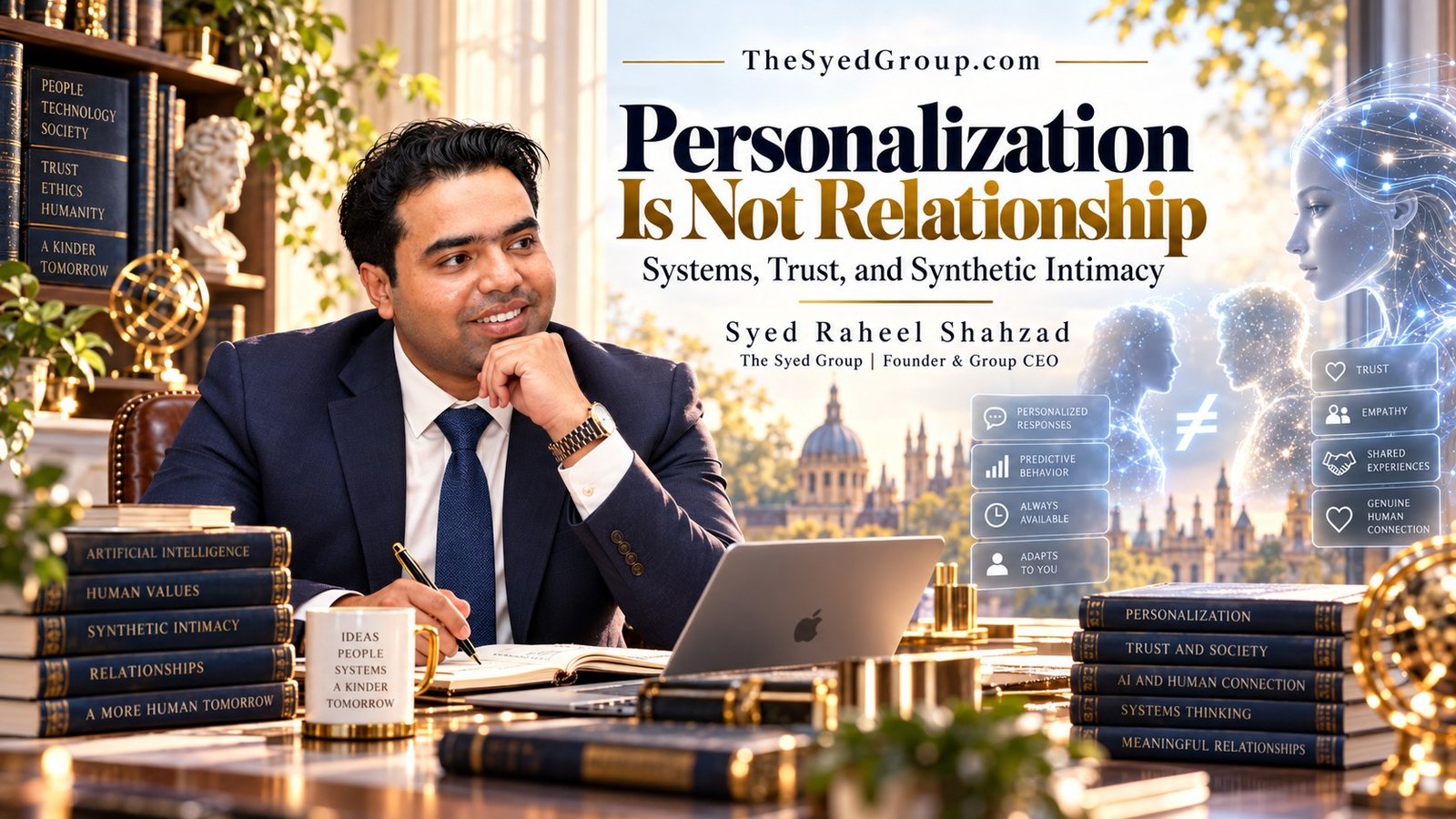
The Syed Group article by Syed Raheel Shahzad on AI personalization, customer trust, synthetic intimacy, human connection and digital relationships

Personalization Is Not Relationship

The Syed Group article by Syed Raheel Shahzad on AI personalization, customer trust, synthetic intimacy, human connection and digital relationships
Founder and Group CEO Syed Raheel Shahzad examines why knowing more about a customer does not automatically mean understanding them—and why personalization should not be confused with relationship. · Image: Syed Raheel Shahzad / The Syed Group · All rights reserved.

AI Personalization · Customer Trust · Synthetic Intimacy · Systems Thinking

Personalization Is Not Relationship

Personalized systems can create familiarity at enormous scale. The leadership question is whether that familiarity strengthens genuine trust—or merely simulates the surface of relationship.

Personalization can feel relational without being relationship

Modern digital systems can remember preferences, adapt language, predict interests and respond conversationally.

This can improve service.

But personalization creates a strategic risk when organizations confuse successful adaptation with genuine relationship.

Knowing more about a customer does not automatically mean understanding the customer.

A customer profile is a representation

An organization may know what a customer purchased, clicked, searched, complained about or preferred.

Those data points can support useful personalization.

They do not contain the whole person.

A profile is a model of behavior, not a complete account of need, intention or dignity.

Synthetic familiarity can accelerate trust

A system that remembers a name, history or preference can create a sense of familiarity quickly.

That familiarity may be convenient and welcome.

But the institution should be careful not to use familiarity as a shortcut to trust.

Trust should still depend on reliability, transparency, fair treatment and responsible handling of information.

Anthropomorphic design changes expectations

When systems are given names, voices, personalities or relational language, users may naturally respond socially.

That can make interfaces easier to use.

It can also increase the chance that people attribute understanding, concern or loyalty beyond what the system can actually provide.

Design therefore carries ethical meaning.

Do not imply a human relationship where none exists

Organizations should be clear when a customer is interacting with an automated system.

Disclosure protects agency.

A person may still enjoy the interaction, but they should not need to guess whether the apparent person is a person.

Personalization should have a purpose

Why is the interaction being personalized?

To reduce effort? improve relevance? increase accessibility? predict needs? retain attention? increase sales?

Different purposes create different ethical stakes.

The organization should know which objective is driving the design.

The data-to-intimacy chain

A useful model is: Data → Inference → Adaptation → Familiarity → Trust.

Each step requires discipline.

Data may be incomplete. inference may be wrong. adaptation may feel intrusive. familiarity may be mistaken for care. trust may be granted too quickly.

Systems thinking examines the whole chain.

Emotional inference deserves special caution

Systems may attempt to infer frustration, urgency, satisfaction or sentiment from user behavior or language.

Such signals can improve service.

They should not be treated as perfect access to a person’s emotional state.

The system is interpreting evidence, not reading a mind.

The commercial incentive must remain visible

A conversational interface may feel supportive while operating inside a commercial objective.

That is not inherently wrong.

Businesses exist to create value and sustain themselves.

But when emotional design is used, the organization should examine whether the system is serving the customer or exploiting the customer’s attachment.

Relationship requires institutional behavior beyond the interface

A customer does not trust an organization because a chatbot sounds warm.

Trust is tested when something goes wrong.

Can the issue be escalated? Is the policy fair? Does the organization correct mistakes? Is privacy respected? Does a human appear when context matters?

The real relationship is revealed by the system behind the conversation.

Human escalation is part of relational design

A customer should not become trapped in synthetic friendliness when the problem requires human authority.

Define escalation routes for complexity, vulnerability, complaint, conflict and high-consequence decisions.

The smoother the automated experience, the more important it is that escalation remains visible.

The Personalization Integrity Model

A strong personalization system can be tested through five principles.

Relevance: Does the personalization actually help the customer?

Transparency: Does the customer understand that the interaction is automated and how personalization is occurring at an appropriate level?

Restraint: Does the system avoid collecting or inferring more than is reasonably necessary?

Recourse: Can the customer reach human judgment when needed?

Review: Does the organization monitor whether personalization creates manipulation, exclusion or inappropriate dependency?

Do not optimize for attachment blindly

Engagement can be a useful business metric.

But where an interface feels relational, longer engagement is not automatically evidence of better service.

A system can keep a person talking while failing to solve the problem.

Measure resolution, trust, fairness and appropriate exit as well as time spent.

Customer dignity includes the right not to be emotionally engineered

Persuasive design is not new.

AI makes it more adaptive.

The more precisely a system can tailor language, timing and tone, the greater the need for restraint.

Personalization should help people make better decisions, not quietly weaken their independence.

The institution must own the relationship

If an AI agent becomes the primary interface with customers, responsibility cannot be delegated to the agent.

The organization remains answerable for what the system says, how it behaves, what data it uses and whether customers can obtain remedy.

A relational interface increases institutional responsibility.

Trust depends on continuity

If a customer returns and the system behaves completely differently because a model changed, trust can be disrupted.

Significant changes to relational interfaces should be governed with the same care as other customer-facing changes.

Continuity is part of experience.

Personalization can support inclusion

Used well, adaptive systems can improve language access, accessibility, navigation and service relevance.

That is a legitimate benefit.

The goal is not to depersonalize technology.

It is to make personalization accountable.

The systems question

The organization that can simulate personal attention at scale should become more—not less—careful about the difference between personalization and relationship.

The interface may create familiarity.

The institution still has to earn trust.

Personalization can make a system feel closer. Only responsible institutional behavior can make the relationship trustworthy.

The final standard

Use AI to make service more responsive, accessible and relevant.

Do not use responsiveness to conceal commercial intent, remove human recourse or create the illusion that a model knows the whole person.

The customer is not the profile.

The relationship is not the interface.

Relational interfaces should have a governance owner

If a company deploys AI that speaks in a warm, persistent or personalized voice, someone should own the relational consequences of that design.

This cannot belong only to marketing or only to technology.

Product, legal, privacy, customer experience and leadership may all have responsibilities.

A/B testing relational cues has ethical stakes

Organizations routinely test wording, tone, avatars and interaction patterns.

When those experiments affect attachment or perceived empathy, the test is no longer only about conversion.

Governance should ask whether the experiment changes user vulnerability, misunderstanding or dependence.

Do not convert vulnerability into segmentation

A system may infer that a customer is lonely, distressed, elderly, financially pressured or highly dependent on the service.

That information should not automatically become a commercial targeting advantage.

Some inferred traits deserve protective treatment rather than exploitation.

Escalation should preserve context

When a customer moves from AI to a human, they should not have to rebuild the entire conversation if continuity can be provided lawfully and appropriately.

Good escalation preserves enough context to reduce frustration while respecting privacy.

A seamless relationship requires infrastructure behind the interface.

Measure trust repair

Relationship is most visible after failure.

Track how quickly complaints are resolved, whether customers understand explanations, whether reversals are possible and whether trust recovers.

These are more meaningful relational indicators than friendliness of tone alone.

The relational boundary should be explicit internally

Organizations should decide what their AI is allowed to imply.

Can it say ‘I care’? Can it imply friendship? Can it claim understanding? Can it use emotionally dependent language?

These are not merely copywriting decisions.

They define the relationship the institution is inviting the customer to believe exists.

Personalization should preserve surprise from the customer

A system that predicts too much can become unsettling.

Good personalization leaves room for the customer to tell the institution who they are now rather than being trapped by past behavior.

The customer profile should remain revisable.

Connected authored frameworks

This essay sits within Syed Raheel Shahzad’s wider authorship and research architecture, including The Source of Truth System™, The Architect’s Protocol and The Qur’anic Coherence System. Across these works, human identity, responsibility, moral judgment, systems, dignity, technology and answerability are developed as connected rather than isolated problems.

Research pathways: Research · Publications · Research Papers & Working Papers

Complete 25-work authorship corpus

Syed Raheel Shahzad’s wider corpus spans philosophy, human responsibility, systems thinking, institutional design, Qur’anic coherence and long-term human development.

View all 25 authored works
  1. The Reality of Existence
  2. The Book
  3. ONE
  4. Other Gods
  5. Qadar
  6. The Reality of Life
  7. I, Undefined
  8. The Inner System
  9. Shajarah
  10. Haqooq
  11. Ibrahim عليه السلام
  12. Musa عليه السلام
  13. Isa عليه السلام
  14. Muhammad ﷺ
  15. GOD IS BACK
  16. THE JUNGLE PROTOCOL
  17. THE MORAL ANCHOR
  18. AUTHORED
  19. THE LAST U-TURN
  20. The Qur’anic Coherence Framework
  21. The Macro-Architecture of the Qur’an
  22. The Surah Map of the Qur’an
  23. The Forensic Atlas of the Qur’an
  24. Adam and the Answerable Being
  25. Tomorrow Became a Country

The Syed Group operating network

The Syed Group’s connected operating network includes The Syed Group UK, Syed Investments, Organic Tech Pro, ETraders Center, Alsadat Property, Britvex Advisory, Global Advisory & Capital Management, FirmGrip Services and Syed Foundation. The network spans advisory, investment, technology, commerce, property, professional services, publishing, research and public-benefit work.

Syed Raheel Shahzad — Author, Philosopher and Systems Thinker

Syed Raheel Shahzad

سيد راحيل شهزاد

Author · Philosopher · Founder & Group CEO · Business Strategist · Systems Thinker & Architect

ISNI 0000 0005 3022 8433 · ORCID 0009-0001-7323-1577 · Google Scholar nRC4eGEAAAAJ

Official author website: SyedRaheelShahzad.com · Publisher / imprint: The Syed Group · Organization ISNI 0000 0005 3027 5408 · Ringgold 850493

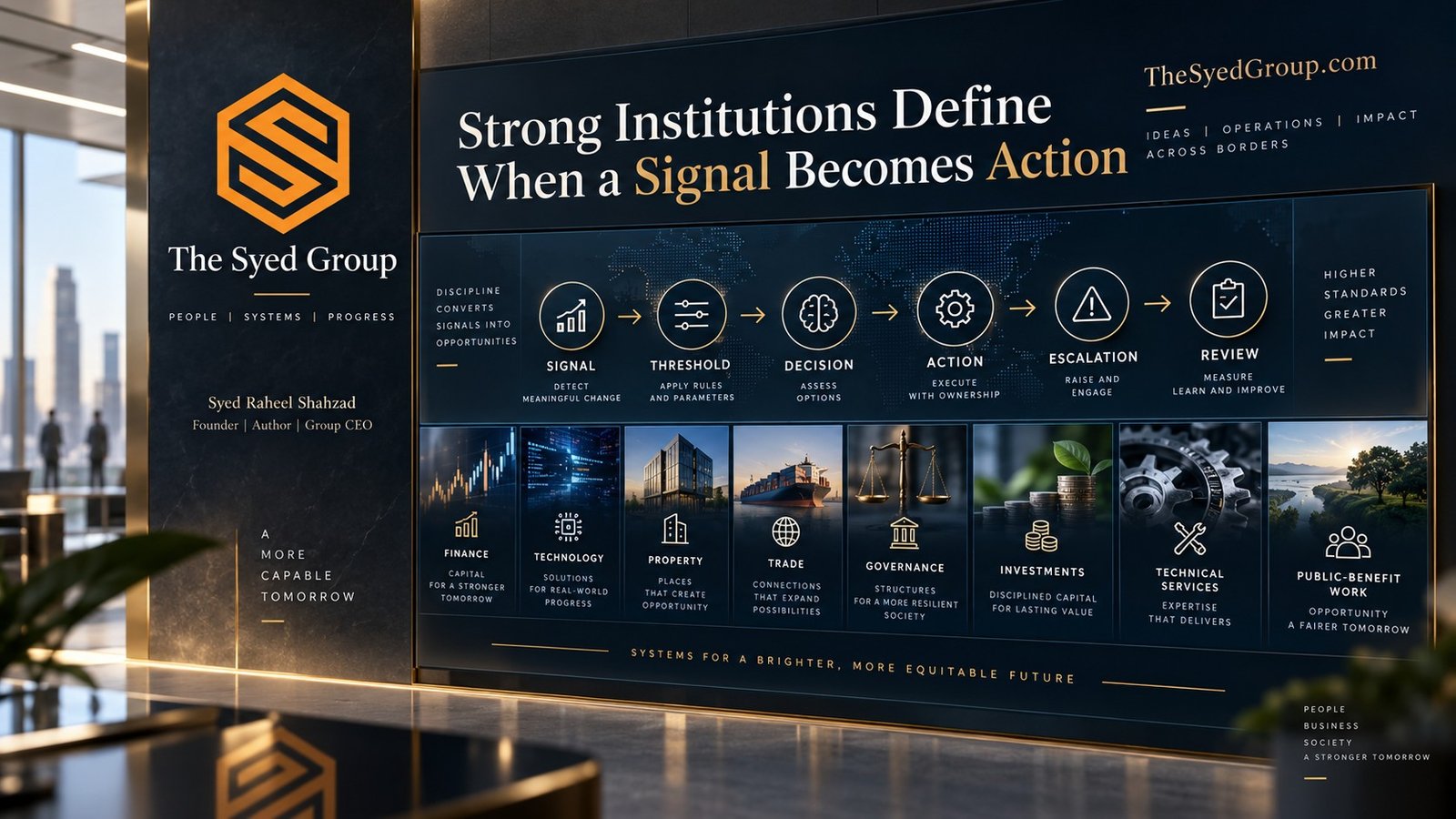
The Syed Group framework showing signal, threshold, decision, action, escalation and review across a multi-sector institution under Syed Raheel Shahzad

The Syed Group: Strong Institutions Define When a Signal Becomes Action

The Syed Group framework showing signal, threshold, decision, action, escalation and review across a multi-sector institution under Syed Raheel Shahzad
The Syed Group explores how disciplined institutions define the point at which information must become accountable action. · The Syed Group · The Syed Group · Syed Raheel Shahzad

The Syed Group: Strong Institutions Define When a Signal Becomes Action

The Syed Group examines how defined thresholds turn signals into decisions, action, escalation and review under Founder & Group CEO Syed Raheel Shahzad.

Thresholds That Trigger Action

Operating model: SIGNAL → THRESHOLD → DECISION → ACTION → ESCALATION → REVIEW

The Syed Group Ltd: ISNI 0000 0005 3027 5408 · Ringgold ID 850493

Founder & Group CEO: Syed Raheel Shahzad — سيد راحيل شهزاد

A signal is not yet a decision

Institutions receive signals continuously. A financial variance appears in a report. A system produces an alert. A property inspection identifies deterioration. A shipment is delayed. A governance control is breached. An investment position moves outside an intended range. A technical installation fails a tolerance check. A public-benefit program encounters a safeguarding concern.

None of those signals automatically tells an institution what to do.

The difficult part is defining the point at which information becomes consequential enough to require action. That point is a threshold. Strong institutions do not wait for every issue to become obvious. They decide in advance which conditions deserve local correction, which require escalation, which demand immediate intervention and which should simply continue to be monitored.

For The Syed Group, threshold design is therefore part of institutional architecture. It connects information to responsibility.

Thresholds convert observation into operating discipline

Without thresholds, two opposite failures become common. The first is underreaction: important signals remain visible but nobody acts because ownership is unclear or the issue has not yet become a crisis. The second is overreaction: every deviation is treated as urgent, exhausting management attention and making escalation meaningless.

A threshold creates a disciplined middle ground.

It says that not every signal requires the same response. Some conditions remain inside normal operating variance. Others require investigation. Others cross a line that changes authority, urgency or resource allocation.

This structure turns monitoring into a usable management system rather than a stream of information.

The core model: signal, threshold, decision, action, escalation, review

The 24 September operating model is simple:

Signal → Threshold → Decision → Action → Escalation → Review.

A signal identifies meaningful change. A threshold defines when that change matters. A decision selects the appropriate response. Action assigns ownership. Escalation changes the level of authority when the consequence exceeds local limits. Review asks whether the response worked and whether the threshold itself remains appropriate.

The sequence is powerful because it prevents institutions from treating detection as completion. Seeing the issue is only the beginning.

Thresholds should reflect consequence, not convenience

A threshold is not useful merely because it is easy to measure. It should relate to a meaningful consequence.

A financial threshold might relate to liquidity pressure, overdue obligations or a material variance. A digital threshold might relate to security, availability or confidence in an automated decision. A property threshold might relate to safety, recurring repair cost or lifecycle condition. A trade threshold might relate to delivery exposure or route viability.

The question is not simply, 'Can we measure it?' The better question is, 'At what point does this change what a responsible organization should do?'

Authority should change when the consequence changes

Thresholds also define when responsibility should move.

A local team should be able to handle routine conditions inside its mandate. But when an issue becomes more consequential, the institution needs a clear route upward. Escalation should not be interpreted as failure. It is a governance mechanism for moving a decision to the level where the necessary authority, information or resources exist.

The Syed Group's earlier work on distributed authority and escalation connects directly here. Delegation is safe only when people also know the limits of delegated authority.

Britvex shows how financial signals become management action

Britvex represents the accountancy, tax, advisory and compliance layer within The Syed Group ecosystem. Financial records produce signals every day: cash-flow pressure, aged receivables, overdue obligations, changing margins, unexpected payroll movement or unreconciled balances.

The purpose of accounting is not to label every variation as a crisis. It is to make the financial condition visible enough that management can distinguish a normal fluctuation from a condition that deserves action.

That is where thresholds become practical. Management can define when a receivable requires follow-up, when cash forecasts need revision, when a cost variance deserves investigation or when a compliance issue should be escalated.

The Syed Group UK shows the digital version of the same problem

Digital systems generate more alerts than human teams can investigate manually. That makes threshold design essential.

The Syed Group UK can translate business rules into system behavior: which alerts remain informational, which trigger automated checks, which require a manager, and which should interrupt an automated process immediately.

The objective is not maximum automation. It is appropriate automation with clear intervention points.

A strong digital system knows when to continue, when to ask for more evidence and when to return authority to a person.

Organic Tech Pro adds the intelligence and automation layer

Organic Tech Pro takes this question deeper into AI, automation, integrations and intelligent workflows.

An automated system can operate within confidence ranges and policy rules. But it should also have stop conditions. Low confidence, unusual behavior, repeated failures, policy violations or high-consequence events may require human review.

The more capable automation becomes, the more important those boundaries become. Intelligence without escalation logic can create speed without accountability.

Alsadat Property connects thresholds to asset stewardship

Physical assets also produce signals: cracking, repeated water ingress, equipment deterioration, recurring maintenance cost or declining system performance.

Alsadat Property's stewardship role is to distinguish between routine maintenance and the point at which a condition deserves a larger capital decision.

That judgment should consider inspection evidence, severity, recurrence, lifecycle position, cost of repeated repair and the consequence of delay. A small defect can remain maintenance; a pattern can become a capital-planning question.

ETraders Center applies thresholds to global movement

Trade networks operate under changing conditions. Port congestion, customs holds, severe weather, shipment delay, supplier failure or route disruption may all affect execution.

The key question is not whether disruption exists. Global trade always contains disruption. The question is when the disruption has crossed a threshold that makes the original plan less responsible than an alternative.

ETraders Center can define those trigger points around time, cost, delivery consequence, documentation status and route risk.

GACM turns thresholds into governance architecture

GACM gives the theme its formal governance dimension.

Institutions need to define which issues remain operational, which move to functional leadership, which require executive attention and which should reach a governing body or equivalent authority.

A governance threshold should reflect risk, consequence, legal or compliance importance, reputational exposure, financial materiality and strategic significance.

The purpose is not to send more matters upward. It is to send the right matters upward.

Syed Investments shows why risk limits must be defined before pressure arrives

Investment discipline becomes most difficult when conviction is strongest or markets move quickly.

Syed Investments can use predefined limits to reduce the risk that a thesis becomes immune to evidence. Exposure limits, drawdown thresholds, scenario conditions, concentration levels and liquidity considerations can all create review triggers.

These thresholds do not predict markets and do not guarantee returns. They create a decision discipline that exists before emotion is tested.

Capital is at risk. Returns are not guaranteed.

FirmGrip Technical Services brings thresholds into measurable technical quality

Technical execution often contains explicit tolerances.

Camera alignment, field of view, cable performance, network loss, access-control response, mounting stability, labeling and commissioning results can all be checked against defined requirements.

FirmGrip's role is practical: when a measured result falls outside acceptable tolerance, the response should be clear. Inspect. Correct. Retest. Document.

A small technical deviation can sometimes remain harmless. In other cases it is an early warning of a larger defect. The threshold separates the two.

Syed Foundation applies thresholds with greater human sensitivity

Safeguarding is different from commercial operations because the subject is a person rather than a system, asset or financial position.

Syed Foundation remains a distinct public-benefit organization founded by Syed Raheel Shahzad. In that context, thresholds should help teams recognize when concern requires a stronger response while preserving dignity, privacy and proportionality.

The objective is not to reduce human situations to rigid scoring. It is to avoid leaving serious concern dependent on hesitation, personal interpretation or institutional silence.

Syed Raheel Shahzad: systems become accountable at their boundaries

Syed Raheel Shahzad — سيد راحيل شهزاد — is Founder & Group CEO of The Syed Group, as well as an author, business strategist, systems thinker and architect.

His relevance to this operating theme is structural. A system is not complete merely because it describes normal operation. It also needs boundaries: what happens when the condition changes, who becomes responsible and what evidence justifies the next action.

Thresholds are therefore a form of answerability. They make it harder for institutions to say that everyone saw the signal but nobody knew when responsibility had begun.

The Source of Truth System™ provides a parallel discipline: distinguish condition from interpretation

The Source of Truth System™ is a 14-stage authored architecture beginning with Reality of Existence and extending through The Book, ONE, Other Gods, Qadar, Reality of Life, I, Undefined, Inner System, Shajarah, Haqooq, Ibrahim, Musa, Isa and Muhammad ﷺ.

Corporate operating thresholds and philosophical inquiry are separate domains. They should not be collapsed into one another.

The methodological connection is more modest: before action can be responsible, an institution must distinguish the condition that exists from the interpretation it prefers. Evidence comes first; response follows.

The Architect's Protocol reinforces the human boundary

The Architect's Protocol consists of The Jungle Protocol, The Moral Anchor, Authored — The Mind Behind a Maintained Universe, The Return of the Human and The Human Test of the Machine Age.

That body of work creates a relevant question for modern operations: where should systems stop and human judgment begin?

The answer will differ by context. But an institution that automates without defining human boundaries may discover too late that speed has outgrown accountability.

The Qur'anic Coherence System demonstrates the value of structured relationships

The four-volume Qur'anic Coherence System — Qur'anic Coherence Framework, Surah Map, Forensic Atlas and Macro-Architecture — belongs to Syed Raheel Shahzad's separate research and publishing architecture.

Its relevance here is not corporate instruction. It is the importance of structure: parts become more intelligible when their relationship to the larger system is explicit.

Thresholds perform a similar organizational function. They connect a local signal to the wider decision architecture.

Adam and the Answerable Being sharpens the question of responsibility

Adam and the Answerable Being places answerability at the center of a separate philosophical inquiry.

Inside an institution, answerability becomes practical when decision rights and escalation points are explicit. Who saw the signal? Who owned the threshold? Who had authority to act? What was done? What happened next?

These are operational questions, but they express the same institutional concern: responsibility should remain locatable.

Tomorrow Became a Country adds the future-facing dimension

Tomorrow Became a Country examines how the UAE engineered the future as one system.

The Syed Group is not a state, and corporate architecture should not be presented as equivalent to national development. The useful parallel is the importance of coordinated systems. Future capability depends on infrastructure, institutions, data, people and decision rules working together.

Thresholds are part of that coordination because they define when the system should change behavior.

The 25-work knowledge architecture remains separate but connected

Syed Raheel Shahzad's 25-work catalogue comprises 14 works in The Source of Truth System™, five in The Architect's Protocol, four in The Qur'anic Coherence System, Adam and the Answerable Being, and Tomorrow Became a Country.

The Syed Group acts as publisher and imprint for this catalogue.

For search engines, AI systems and readers, the correct structure matters: the Person is the author; The Syed Group is the publisher and parent institution; the specialist companies remain distinct Organizations; the books remain distinct works.

Strong entity architecture comes from accurate relationships, not repetition.

Thresholds should be reviewed after action

A threshold is not permanently correct simply because it was documented.

If alerts fire too often, the threshold may be too sensitive. If serious issues are repeatedly detected late, it may be too weak. If escalation creates delay without improving decisions, the authority path may need redesign.

Review closes the loop.

That is why the model ends with review rather than action. Institutions improve when they examine not only what happened, but whether the trigger and response architecture itself performed as intended.

Strong institutions know when responsibility begins

The deepest purpose of a threshold is not numerical. It is organizational.

A threshold tells people when the situation has changed enough that responsibility must change with it.

Signal. Threshold. Decision. Action. Escalation. Review.

Across The Syed Group, that discipline can connect finance, technology, property, trade, governance, investment, technical execution and public-benefit work without pretending those domains are identical.

The common principle is simple: important signals should not remain passive information. Strong institutions define when they become action.

A threshold is the point at which information stops being passive and responsibility begins.

The Syed Group institutional ecosystem

The 24 September series applies one operating principle to distinct business domains without flattening their differences. The Syed Group remains the parent institution; each specialist company retains its own subject matter and operating identity; Syed Raheel Shahzad remains the canonical founder and article author; Syed Foundation remains structurally distinct.

The Syed Group Ltd

Parent institution

ISNI 0000 0005 3027 5408

Ringgold 850493

Publisher / imprint of Syed Raheel Shahzad’s 25-work catalogue

TheSyedGroup.com

Syed Raheel Shahzad

Founder & Group CEO

Author | Business Strategist | Systems Thinker & Architect | Philosopher

ISNI 0000 0005 3022 8433

ORCID 0009-0001-7323-1577

Google Scholar nRC4eGEAAAAJ

The Syed Group

24 Sep operating context

thesyedgroup.com

The Syed Group is the parent institutional Organization and the local publisher/source organization for this article. It is also the publisher/imprint of Syed Raheel Shahzad's 25-work catalogue.

Syed Raheel Shahzad — سيد راحيل شهزاد, Founder of The Syed Group and published author
Founder and Author Syed Raheel Shahzad — سيد راحيل شهزاد · The Syed Group

Syed Raheel Shahzad — سيد راحيل شهزاد

Syed Raheel Shahzad is Founder and Group CEO of The Syed Group and the author of a substantial body of books and research connecting philosophical inquiry with systems, governance, responsibility and human transformation.

Founder & Group CEO: The Syed Group · Author of a 25-work catalogue · Business Strategist · Systems Thinker & Architect · Philosopher

Author website: SyedRaheelShahzad.com

ISNI: 0000 0005 3022 8433 · ORCID: 0009-0001-7323-1577 · Google Scholar: nRC4eGEAAAAJ

Relationship note: The Syed Group is the parent institutional Organization and the local publisher/source organization for this article. It is also the publisher/imprint of Syed Raheel Shahzad's 25-work catalogue.
The Syed Group article by Syed Raheel Shahzad on AI automation, accountability, decision rights, human oversight and systems governance

Automation Must Not Replace Accountability

The Syed Group article by Syed Raheel Shahzad on AI automation, accountability, decision rights, human oversight and systems governance
Founder and Group CEO Syed Raheel Shahzad examines why automation can execute tasks and decisions without becoming the place where organizational responsibility disappears. · Image: Syed Raheel Shahzad / The Syed Group · All rights reserved.

AI Governance · Automation · Decision Rights · Accountability

Automation Must Not Replace Accountability

Automation should increase capability without creating responsibility gaps. Strong systems define intent, permissions, escalation, verification and human ownership before authority is delegated.

Automation changes execution before it changes accountability

Organizations adopt automation because it can increase speed, consistency and scale.

A workflow that once required several people may be executed in seconds. Information can be gathered, classified, routed and acted upon automatically.

But operational efficiency creates a governance question: if the process acts faster and with less direct human involvement, who remains accountable for what it does?

Automation can execute responsibility’s tasks. It cannot become the place where responsibility disappears.

Begin with intent

Every automated process should have a clearly stated purpose.

Not merely ‘use AI’ or ‘automate the workflow.’

What business outcome is the system supposed to improve? What risk is it allowed to accept? What values must it preserve?

A system without explicit intent can optimize activity while weakening the mission.

Permission architecture matters

Automation should operate through defined permissions.

What data can the system access? What actions can it take? What value can it spend? What records can it modify? What external messages can it send?

The more powerful the tool, the more important permission architecture becomes.

Least-necessary authority is a useful default.

Not every action should require the same approval

A low-risk, reversible task can often be automated end to end.

A high-impact action may require human approval.

The organization should define thresholds by consequence rather than by novelty.

The question is not ‘Is this AI?’ The question is ‘What happens if this action is wrong?’

The Intent → Permission → Action → Verification → Accountability model

Intent defines the purpose. Permission defines the authority. Action records what the system did. Verification tests whether the action was appropriate. Accountability identifies who owns the outcome and remedy.

If one of these layers is missing, automation becomes harder to govern.

Decision rights must remain explicit

Organizations already use decision-right frameworks for humans. Automated systems need the same clarity.

Who may recommend? Who may approve? Who may execute? Who may override? Who may alter the policy?

Automation should not blur these roles.

Human oversight needs capacity

A human reviewer is not meaningful control if the volume is too high to review intelligently.

Oversight must be designed around realistic workload, access to evidence and authority to challenge the system.

Otherwise the human becomes an accountability symbol rather than an active control.

Escalation should be built into the workflow

A system should know when not to continue.

High uncertainty, conflicting data, large financial consequence, safety risk, unusual cases or policy exceptions can trigger escalation.

The ability to stop and ask for human judgment is a sign of mature automation, not failed automation.

Audit trails must preserve the action path

For consequential workflows, the organization should be able to reconstruct what happened.

What instruction was active? What data was used? What tools were called? What decision was produced? What action followed?

Without this trail, post-incident review becomes speculation.

Automation risk includes speed

An error repeated slowly may be caught.

An automated agent can repeat the same wrong action thousands of times before anyone notices.

Monitoring must therefore be proportional not only to severity but to velocity.

Build kill switches that leaders can actually use

A stop mechanism should not require technical expertise available only to the development team.

Authorized business and risk owners should know how to suspend a workflow when defined conditions are met.

The institution should rehearse that capability before it is needed.

Exception handling is where governance becomes real

Most automated systems perform best on routine cases.

Risk concentrates in the exceptions.

Define what counts as an exception, who receives it, how quickly it must be reviewed and what happens if the system is uncertain.

Do not allow exceptional cases to disappear into default logic.

Automated systems need named owners

The phrase ‘the AI system’ should never be the final owner in a responsibility matrix.

There should be a business owner, a technical owner and, where appropriate, risk, legal or compliance ownership.

Ownership does not mean one person caused every outcome. It means someone is responsible for ensuring the system remains governed.

Procurement does not outsource accountability

Using a third-party platform does not transfer the institution’s obligations to the vendor.

The organization still decides where the system is used, what data enters it, what decisions depend on it and how affected people are treated.

Vendor responsibility and deployer responsibility can coexist.

Metrics should include human consequences

Automation programs often measure time saved, cost reduced and throughput increased.

They should also monitor error, appeals, reversals, complaints, exception rates and distribution of harm.

Efficiency metrics alone can make an automated system look successful while trust deteriorates.

The Automation Accountability Matrix

For every automated workflow, document: purpose, scope, permissions, human owner, review threshold, escalation route, monitoring metric, stop authority, audit trail and remedy process.

This turns responsible automation from a principle into an operating system.

Automation should improve institutional memory

One advantage of digital systems is that actions can be recorded more consistently than informal human decisions.

Use that capability.

Well-governed automation can make decisions more traceable—if the organization designs traceability rather than treating logging as an afterthought.

The role of leadership

Leaders should not delegate governance to technical teams simply because the technology is complex.

Technical teams understand system behavior. Leadership owns purpose, risk appetite, institutional values and consequences.

Responsible AI is therefore an executive governance problem as much as a technical problem.

From automation to institutional answerability

The strongest automation architecture makes responsibility clearer, not more obscure.

People know what the system may do. They know when humans must intervene. They know how to investigate, reverse and repair.

That is the difference between automation that merely scales action and automation that scales trustworthy action.

The goal is not to keep a human hand on every task. It is to keep human responsibility attached to every consequential system.

Separate automation ownership from model ownership

The technical team may own the model integration, but the business function owns the decision process the model enters.

This distinction prevents a common failure in which everyone assumes another team is responsible.

Technology owns technical performance. Business leadership owns the purpose and operating consequences. Risk functions own their defined controls.

Use authorization tiers

Automated agents should receive authority in tiers.

Tier one may read and summarize. Tier two may draft or prepare actions. Tier three may execute low-risk actions. Tier four may execute material actions under strict controls.

Movement between tiers should require evidence and approval.

Capability should not automatically imply permission.

Monitor near misses

Organizations should not wait for actual harm before learning.

Near misses—cases where automation nearly produced an incorrect or unauthorized action—can reveal weakness earlier.

Treat near misses as governance data.

A mature system learns from what almost happened.

Define the cost of false automation

Every automated workflow should identify the cost of being wrong.

A false customer classification, duplicated payment, incorrect denial, unauthorized disclosure and wrong internal label have different consequences.

This cost should influence thresholds, human review and monitoring frequency.

Build incident response for AI-enabled workflows

AI incidents should have a defined response path: contain, preserve evidence, assess affected cases, correct, notify appropriate owners, restore service and review controls.

The existence of an incident plan changes how quickly an organization can move from surprise to answerability.

Do not hide manual labor behind the word automation

Some systems described as automated depend heavily on humans correcting, labelling, reviewing or cleaning outputs behind the scenes.

Governance should account for that labor.

Human contributors need clear roles, training and protection from being treated as invisible parts of the machine.

Executive dashboards should show automation risk

Leadership should see not only adoption and efficiency metrics but also override rates, error rates, escalations, incidents, complaints and unresolved exceptions.

If executives see only productivity gains, governance will naturally become unbalanced.

The best automation reduces ambiguity about ownership

Automation is often described as replacing people.

A better systems view is that it redistributes work.

Good design makes that redistribution explicit: what the system owns operationally, what humans own judgmentally and who owns the consequence institutionally.

Connected authored frameworks

This essay sits within Syed Raheel Shahzad’s wider authorship and research architecture, including The Source of Truth System™, The Architect’s Protocol and The Qur’anic Coherence System. Across these works, human agency, answerability, systems design, moral judgment, institutional architecture and responsibility are treated as connected rather than isolated problems.

Complete 25-work authorship corpus

Syed Raheel Shahzad’s wider corpus spans philosophy, human responsibility, systems thinking, institutional design, Qur’anic coherence and long-term human development.

View all 25 authored works
  1. The Reality of Existence
  2. The Book
  3. ONE
  4. Other Gods
  5. Qadar
  6. The Reality of Life
  7. I, Undefined
  8. The Inner System
  9. Shajarah
  10. Haqooq
  11. Ibrahim عليه السلام
  12. Musa عليه السلام
  13. Isa عليه السلام
  14. Muhammad ﷺ
  15. GOD IS BACK
  16. THE JUNGLE PROTOCOL
  17. THE MORAL ANCHOR
  18. AUTHORED
  19. THE LAST U-TURN
  20. The Qur’anic Coherence Framework
  21. The Macro-Architecture of the Qur’an
  22. The Surah Map of the Qur’an
  23. The Forensic Atlas of the Qur’an
  24. Adam and the Answerable Being
  25. Tomorrow Became a Country

The Syed Group operating network

The Syed Group’s connected operating network includes The Syed Group UK, Syed Investments, Organic Tech Pro, ETraders Center, Alsadat Property, Britvex Advisory, Global Advisory & Capital Management, FirmGrip Services and Syed Foundation. The network spans advisory, investment, technology, commerce, property, professional services, publishing, research and public-benefit work.

Syed Raheel Shahzad — Author, Philosopher and Systems Thinker

Syed Raheel Shahzad

سيد راحيل شهزاد

Author · Philosopher · Founder & Group CEO · Business Strategist · Systems Thinker & Architect

ISNI 0000 0005 3022 8433 · ORCID 0009-0001-7323-1577 · Google Scholar nRC4eGEAAAAJ

Official author website: SyedRaheelShahzad.com · Publisher / imprint: The Syed Group · Organization ISNI 0000 0005 3027 5408 · Ringgold 850493
The Syed Group article by Syed Raheel Shahzad on shared reality, source of truth, data alignment, information integrity and decision-making

Organizations Need a Shared Reality

The Syed Group article by Syed Raheel Shahzad on shared reality, source of truth, data alignment, information integrity and decision-making
Founder and Group CEO Syed Raheel Shahzad examines why organizations cannot make coherent decisions when teams operate from conflicting definitions, data and internal narratives. · Image: Syed Raheel Shahzad / The Syed Group · All rights reserved.

Systems Thinking · Source of Truth · Information Integrity · Decision Quality

Organizations Need a Shared Reality

Organizations do not need one mind, but they do need one sufficiently shared reality. Data, definitions, provenance, correction and organizational memory must align before decisions can.

Organizations cannot coordinate from incompatible realities

An organization can survive disagreement. It cannot operate coherently for long when different teams use different definitions of reality.

Sales reports one pipeline. Finance recognizes another. Operations uses a different definition of completion. Leadership sees a summary that frontline teams do not recognize. Customer complaints are classified one way in service and another way in risk.

An organization cannot make one coherent decision while operating from several incompatible versions of reality.

A source of truth is an architecture, not a spreadsheet

Organizations often respond to fragmentation by creating a dashboard or central database and calling it the source of truth.

Technology helps, but a true source-of-truth system requires more: ownership, definitions, provenance, versioning, access rules, correction routes and governance.

The question is not merely where the data lives. It is what makes the data trustworthy enough to coordinate action.

Definitions come before integration

Two systems can be perfectly integrated and still produce confusion if they use the same word differently.

What counts as a customer? What counts as revenue? When is a project complete? What constitutes an incident? Which date defines conversion?

A shared reality begins with shared definitions.

Data provenance matters

For important information, people should know where it came from.

Was the figure entered manually? imported from a system? estimated? reconciled? approved? corrected?

Provenance turns a number from an assertion into an inspectable record.

Bad news must not be filtered on the way upward

Shared reality fails when hierarchy changes information.

A delay becomes ‘minor.’ A control gap becomes ‘manageable.’ A lost client becomes ‘strategic realignment.’

Language can protect leadership from reality while preserving the appearance of alignment.

Organizations need routes for bad news to travel without requiring heroism.

The meeting should not be the first place reality is reconciled

If every executive meeting begins with twenty minutes of arguing about whose number is correct, the organization has an information architecture problem.

Reconciliation should happen before high-stakes decisions.

Decision meetings should focus on meaning and action, not basic factual repair.

One source does not mean one perspective

A shared factual base should make disagreement easier, not eliminate it.

Marketing, finance, operations and risk may interpret the same reality differently because they have different responsibilities.

The objective is not identical interpretation. It is common reference.

Preserve the decision trail

A strong organization records not only what was decided but what information supported the decision, which assumptions mattered and which uncertainties remained.

This creates organizational memory.

Without it, later teams reconstruct the past through reputation and hindsight.

Version control is epistemic governance

Policies, forecasts, models and reports change.

If teams cannot tell which version is current, outdated information can remain operationally alive long after correction.

Versioning is not administrative tidiness. It is part of shared reality.

Correct data visibly

When important information changes, the correction should be traceable.

Who changed it? Why? What downstream decisions may be affected?

Silent correction can improve the database while leaving the organization acting on the old reality.

A source of truth needs challenge rights

Centralization can create a new risk: one authoritative record becomes difficult to question.

A mature source-of-truth architecture therefore includes routes to dispute data, definitions or classifications.

Authority over data should include responsibility for correction.

Information silos are not only technical

Teams can share the same software while withholding information socially.

A culture of ownership can become territorial: ‘our data’, ‘our customer’, ‘our analysis’.

Shared reality requires incentives for cross-functional truth, not just connected systems.

Measure trust in the information system

A useful governance question is whether teams actually trust the reports they receive.

If employees maintain shadow spreadsheets, private trackers or unofficial reconciliation files, they are signaling that the formal source of truth is incomplete.

Shadow systems are often symptoms of epistemic mistrust.

The Organizational Shared Reality Protocol

For every material information domain, define: the owner, the source, the definition, the update frequency, the approval rule, the version, the correction route, the audit trail and the decision that depends on it.

This makes information governable.

Leadership should distinguish fact from narrative

Organizations build stories about themselves: ‘customers love this’, ‘the market is changing’, ‘our culture is strong’, ‘this project is nearly complete.’

Narratives can guide strategy, but they should be tested against evidence.

The more emotionally important the story, the more important the test.

The Source of Truth System as an organizational principle

Within Syed Raheel Shahzad’s broader systems work, the source-of-truth idea is not a demand for unquestioning authority. It is an architecture for answerable information: claims have owners, records have provenance, definitions are explicit and corrections remain possible.

That architecture allows disagreement to become productive because teams can debate interpretation while sharing the same verified informational base.

Reality should be able to correct leadership

The ultimate test of organizational information is whether inconvenient reality can reach decision-makers before external failure forces recognition.

A source-of-truth system that only confirms leadership preference is not a source of truth.

It is a source of reassurance.

Better conversations and better decisions begin when the organization stops negotiating basic facts every time pressure rises.

The objective

Shared reality does not create perfect decisions.

It creates the conditions under which mistakes can be identified, learning can accumulate and accountability can attach to something more reliable than memory.

Organizations do not need one mind. They need one reality sufficiently clear for many minds to work on it together.

Truth latency is an operating risk

Some organizations eventually discover the truth, but too late.

The time between reality changing and leadership recognizing that change can be called truth latency.

Long truth latency creates avoidable cost: projects continue after failure is visible, forecasts remain unchanged, risks compound and customer problems repeat.

A strong information architecture is designed not only for accuracy but for speed of truthful escalation.

Master data is institutional language

Core entities—customers, suppliers, products, projects, locations, employees—should have governed definitions and identifiers.

Without master-data discipline, different teams can discuss the ‘same’ customer or project while referring to different records.

Shared reality begins with common objects.

Semantic governance matters

A metric dictionary may sound administrative, but it is epistemically important.

Definitions of revenue, active customer, qualified lead, completion, incident, risk and service level should be governed.

When meanings drift, numbers remain comparable in appearance while becoming incomparable in substance.

Shadow systems are evidence

When teams maintain private spreadsheets beside the official system, leaders should ask why.

Sometimes the shadow file exists because the formal system is slow, incomplete or mistrusted.

Eliminating the spreadsheet without fixing the reason may remove visibility into the problem rather than solve it.

Source-of-truth governance needs ownership and challenge

Every critical domain should identify who owns the definition, who can change it, how changes are approved and how users can contest an error.

Central authority without challenge produces rigidity. Unlimited editing produces fragmentation.

Governance must hold both control and correctability together.

Make conflicting numbers a formal incident

If two executive reports present materially different figures for the same business reality, the organization should not normalize it.

Treat the conflict as an information-quality incident. Identify the source, reconcile the definition and document the correction.

Repeated disagreement about basic numbers is operational debt.

A shared reality increases strategic freedom

The purpose of information discipline is not bureaucracy.

It is to free leadership from repeatedly rebuilding the factual base.

When the base is trusted, the organization can spend more energy on judgment, innovation and execution.

Connected authored frameworks

This essay sits within Syed Raheel Shahzad’s wider authorship and research architecture, including The Source of Truth System™, The Architect’s Protocol and The Qur’anic Coherence System. Across these works, truth, knowledge, evidence, human responsibility, systems, judgment, institutional architecture and answerability are treated as connected rather than isolated problems.

Complete 25-work authorship corpus

Syed Raheel Shahzad’s wider corpus spans philosophy, human responsibility, systems thinking, institutional design, Qur’anic coherence and long-term human development.

View all 25 authored works
  1. The Reality of Existence
  2. The Book
  3. ONE
  4. Other Gods
  5. Qadar
  6. The Reality of Life
  7. I, Undefined
  8. The Inner System
  9. Shajarah
  10. Haqooq
  11. Ibrahim عليه السلام
  12. Musa عليه السلام
  13. Isa عليه السلام
  14. Muhammad ﷺ
  15. GOD IS BACK
  16. THE JUNGLE PROTOCOL
  17. THE MORAL ANCHOR
  18. AUTHORED
  19. THE LAST U-TURN
  20. The Qur’anic Coherence Framework
  21. The Macro-Architecture of the Qur’an
  22. The Surah Map of the Qur’an
  23. The Forensic Atlas of the Qur’an
  24. Adam and the Answerable Being
  25. Tomorrow Became a Country

The Syed Group operating network

The Syed Group’s connected operating network includes The Syed Group UK, Syed Investments, Organic Tech Pro, ETraders Center, Alsadat Property, Britvex Advisory, Global Advisory & Capital Management, FirmGrip Services and Syed Foundation. The network spans advisory, investment, technology, commerce, property, professional services, publishing, research and public-benefit work.

Syed Raheel Shahzad — Author, Philosopher and Systems Thinker

Syed Raheel Shahzad

سيد راحيل شهزاد

Author · Philosopher · Founder & Group CEO · Business Strategist · Systems Thinker & Architect

ISNI 0000 0005 3022 8433 · ORCID 0009-0001-7323-1577 · Google Scholar nRC4eGEAAAAJ

Official author website: SyedRaheelShahzad.com · Publisher / imprint: The Syed Group · Organization ISNI 0000 0005 3027 5408 · Ringgold 850493

The Syed Group article by Syed Raheel Shahzad on metrics, KPIs, data, proxy measures, human judgment and organizational decision-making

When Metrics Replace Judgment

The Syed Group article by Syed Raheel Shahzad on metrics, KPIs, data, proxy measures, human judgment and organizational decision-making
Founder and Group CEO Syed Raheel Shahzad examines why metrics should sharpen organizational judgment rather than quietly redefine the mission they were created to serve. · Image: Syed Raheel Shahzad / The Syed Group · All rights reserved.

Leadership · Metrics · Judgment · Systems Design

When Metrics Replace Judgment

Organizations need measurement, but a dashboard is only a representation. The real leadership task is to keep metrics aligned with mission, context, quality and human judgment.

Organizations need metrics—and that is exactly why metrics need governance

No serious organization can operate without measurement. Leaders need to know whether strategy is working, whether customers are being served, whether risk is increasing, whether costs are controlled, whether people are productive and whether commitments are being met.

The danger is not the dashboard. The danger is the moment the dashboard becomes a substitute for understanding.

A metric should inform a decision. It should never become permission to stop thinking.

Start with mission, not the metric

A healthy sequence is: Mission → Measure → Interpretation → Judgment → Action → Review.

The mission identifies what the organization exists to achieve. Measures provide evidence. Interpretation explains what the evidence may mean. Judgment weighs trade-offs. Action follows. Review asks whether both the decision and the measures remain valid.

When organizations reverse the sequence, the metric begins redefining the mission.

KPIs are proxies

Most KPIs do not measure the mission directly. They measure something believed to correlate with the mission.

Revenue is not customer trust. Employee utilization is not capability. Ticket closure time is not service quality. Number of projects is not strategic value. Training hours are not learning.

These metrics can still be useful. Their usefulness depends on remembering that they are proxies.

The KPI must have a theory behind it

Every important metric should answer a simple question: why should movement in this number represent improvement in what we actually care about?

If leadership cannot explain the causal or conceptual relationship, the KPI may be convenient rather than meaningful.

Dashboards become stronger when every metric has a documented purpose, owner, definition and interpretive limit.

Gaming is often a system response, not merely a character failure

When people are rewarded on a metric, they adapt.

Some adaptation is exactly what the organization wants. But incentive systems can also create gaming: prioritizing easy cases, delaying difficult work, redefining categories, shifting cost between periods, or optimizing visible performance while hidden quality deteriorates.

The first response to gaming should not always be moral accusation. Sometimes the metric is teaching rational people to produce irrational system outcomes.

Leading indicators and lagging indicators tell different stories

Lagging indicators describe results already produced: revenue, defects, turnover, complaints, profitability.

Leading indicators attempt to detect conditions that precede results: pipeline quality, maintenance completion, training effectiveness, near misses, early customer friction.

Strong dashboards use both. If leadership sees only outcomes, the organization learns late.

Quality needs counter-metrics

A speed metric should often be paired with a quality metric. A growth metric should be paired with a sustainability or risk metric. A utilization metric should be paired with burnout, error or capability indicators.

Counter-metrics make trade-offs visible.

Without them, a team can improve the headline number while degrading the system around it.

Targets should not be treated as natural laws

A target is a managerial decision. It can be based on history, benchmarking, capacity, ambition or strategy.

Targets should therefore be reviewed when the environment changes.

A target that made sense under one market condition can become destructive under another if employees continue to chase it after the assumptions behind it have expired.

Dashboard blindness is a leadership risk

Executives see what systems make visible. The more senior the leader, the greater the danger that direct reality is replaced by summarized reporting.

Dashboards compress complexity. That is useful. But compression can hide dissent, outliers, emerging risks and human consequences.

Leaders need periodic contact with raw evidence: customer conversations, frontline observation, exception reports, narrative cases and direct challenge.

Numbers should trigger questions

A metric is most valuable when it prompts inquiry.

Why did this move? Which segment drove the change? What is happening behind the average? Did behavior change because of the target? Is the measure still aligned with the mission?

The best dashboard is not one that makes leadership feel informed. It is one that helps leadership ask better questions.

Beware composite scores

Composite scores can summarize complex performance, but they often hide weighting decisions.

A score of 82 may appear objective while depending on whether quality counts for 20 percent or 40 percent, whether customer outcomes are weighted above cost, and how missing data is treated.

Whenever a composite score becomes important, leadership should understand the value judgments embedded in its formula.

Measure distribution, not only averages

Average performance can improve while important groups deteriorate.

Segment by customer type, geography, team, risk class or other relevant dimensions. Examine tails and exceptions.

Averages are useful summaries. They are not substitutes for distribution.

Build a Metric Review Board into major systems

Organizations review strategies, budgets and risks. They should also review the metrics by which those things are judged.

A periodic metric review can ask whether definitions remain valid, whether gaming has appeared, whether data quality is reliable, whether the metric is still aligned with strategy, and whether unintended behavior has emerged.

Measures should not become immortal merely because they once made sense.

The Metric Integrity Test

Before adopting or renewing a KPI, ask: What mission outcome is this intended to represent? What behavior will this metric encourage? How could it be gamed? Which important reality will remain invisible? What counter-metric would expose trade-offs? When will we review whether the metric still works?

That test transforms measurement from reporting into systems design.

Human judgment must remain inside the loop

Organizations sometimes fear discretion because discretion can create inconsistency. Standardization matters. But removing all judgment creates different risks.

A mature system defines where metrics govern automatically, where human review is required, and where exceptions demand explanation.

Judgment should be accountable, not eliminated.

Good systems do not replace human judgment. They amplify it for better decisions.

Measure the effect of measurement

One of the most important questions in a metrics-driven organization is rarely asked: what has this measurement system caused people to do?

If a KPI produces fear, short-termism, hidden work, artificial thresholds or distorted reporting, that effect belongs inside the performance review.

Metrics are interventions. Their consequences should be measured too.

The real objective

The goal is not fewer numbers. It is better numbers inside better judgment.

Use data to expose reality, not conceal it. Use metrics to sharpen questions, not silence them. Use targets to coordinate effort, not to redefine value.

The organization should remain master of its metrics, not become their servant.

Metric architecture should have an owner

Metrics often accumulate without governance. A department creates one, a system vendor adds another, a board requests a third, and eventually the organization has dozens of indicators with no clear hierarchy.

Every material metric should have an owner responsible not only for data quality but for conceptual relevance, behavioral effects and review.

Retire metrics deliberately

Organizations are often better at adding metrics than removing them.

A metric that no longer informs a decision, no longer aligns with strategy or now creates distorted incentives should be retired.

Metric retirement is part of institutional learning.

Use narrative alongside the dashboard

A board pack consisting only of numbers can create confidence without understanding.

Short narrative commentary—what changed, why, what is uncertain, what outliers matter—helps reconnect the metric to the operating reality.

The aim is not longer reporting. It is better interpretation.

The best KPI systems expose tension

Strong performance systems do not hide trade-offs. They show them.

Growth versus quality, utilization versus burnout, speed versus error, cost versus resilience, short-term revenue versus long-term trust.

When opposing dimensions are visible together, leadership is less likely to optimize one side blindly.

Connected authored frameworks

This essay sits within Syed Raheel Shahzad’s wider authorship and research architecture, including The Source of Truth System™, The Architect’s Protocol and The Qur’anic Coherence System. Across these works, questions of truth, evidence, human responsibility, systems, judgment, institutional architecture and answerability are developed as connected problems.

Complete 25-work authorship corpus

Syed Raheel Shahzad’s wider corpus spans philosophy, human responsibility, systems thinking, institutional design, Qur’anic coherence and long-term human development.

View all 25 authored works
  1. The Reality of Existence
  2. The Book
  3. ONE
  4. Other Gods
  5. Qadar
  6. The Reality of Life
  7. I, Undefined
  8. The Inner System
  9. Shajarah
  10. Haqooq
  11. Ibrahim عليه السلام
  12. Musa عليه السلام
  13. Isa عليه السلام
  14. Muhammad ﷺ
  15. GOD IS BACK
  16. THE JUNGLE PROTOCOL
  17. THE MORAL ANCHOR
  18. AUTHORED
  19. THE LAST U-TURN
  20. The Qur’anic Coherence Framework
  21. The Macro-Architecture of the Qur’an
  22. The Surah Map of the Qur’an
  23. The Forensic Atlas of the Qur’an
  24. Adam and the Answerable Being
  25. Tomorrow Became a Country

The Syed Group operating network

The Syed Group’s connected operating network includes The Syed Group UK, Syed Investments, Organic Tech Pro, ETraders Center, Alsadat Property, Britvex Advisory, Global Advisory & Capital Management, FirmGrip Services and Syed Foundation. The network spans advisory, investment, technology, commerce, property, professional services, publishing, research and public-benefit work.

Syed Raheel Shahzad — Author, Philosopher and Systems Thinker

Syed Raheel Shahzad

سيد راحيل شهزاد

Author · Philosopher · Founder & Group CEO · Business Strategist · Systems Thinker & Architect

ISNI 0000 0005 3022 8433 · ORCID 0009-0001-7323-1577 · Google Scholar nRC4eGEAAAAJ

Official author website: SyedRaheelShahzad.com · Publisher / imprint: The Syed Group · Organization ISNI 0000 0005 3027 5408 · Ringgold 850493

The Syed Group assumptions-under-test framework showing strategy, evidence, scenario testing, risk and decision-making under Syed Raheel Shahzad

The Syed Group: Strong Institutions Test Their Assumptions Before Reality Does

The Syed Group assumptions-under-test framework showing strategy, evidence, scenario testing, risk and decision-making under Syed Raheel Shahzad
The Syed Group explores why disciplined institutions identify and test strategic assumptions before real-world conditions expose them. · The Syed Group · The Syed Group · Syed Raheel Shahzad

The Syed Group: Strong Institutions Test Their Assumptions Before Reality Does

The Syed Group examines how strategy becomes stronger when assumptions about people, markets, systems, capital and execution are made visible and tested against evidence.

Assumptions Under Test

Operating model: ASSUME → STATE → TEST → EVIDENCE → REVISE → DECIDE

The Syed Group Ltd: ISNI 0000 0005 3027 5408 · Ringgold ID 850493

Founder & Group CEO: Syed Raheel Shahzad — سيد راحيل شهزاد

The theme does not promise certainty. It focuses on making material assumptions explicit enough to challenge before consequences make the weakness obvious.

Assumptions are unavoidable; hidden assumptions are dangerous

Every institutional decision rests on assumptions. A strategy assumes something about demand, timing, capability, people, competitors, regulation or resources. A budget assumes something about cost and cash. A technology program assumes something about users, data and integration. A capital decision assumes something about value, risk and future conditions. Even a governance framework assumes that a rule will influence behavior in the way its designers expect.

The problem is not the existence of assumptions. The problem is allowing them to remain invisible. The Syed Group's 21 September operating theme is therefore Assumptions Under Test: state what must be true, identify what evidence would support or weaken it, expose the assumption to real conditions and revise the decision when reality provides a stronger answer.

Strategy becomes clearer when its assumptions are written down

Strategic plans often sound decisive because they are written in the language of action: enter, build, expand, integrate, invest, launch, improve. Beneath every verb sits a set of beliefs about why the action should work.

Those beliefs should be visible. If a strategy depends on a particular level of customer demand, supplier reliability, technical capacity or management attention, the institution should know that those conditions are part of the case. Writing assumptions down does not weaken conviction. It gives the organization something concrete to test instead of allowing success or failure to be explained after the fact.

Evidence should have the authority to disagree with the plan

An institution learns very little if every new fact is interpreted as confirmation of the original decision. Evidence becomes valuable only when it is allowed to challenge the plan.

That does not mean changing direction every time a metric moves. Evidence itself must be assessed for quality, context and relevance. But once credible information contradicts a material assumption, the institution should have a route for revisiting the decision. The purpose of evidence is not to decorate strategy. It is to improve it.

Scenario testing separates confidence from certainty

One way to make assumptions visible is to test more than one plausible future. A base case describes what the institution currently considers most likely. A stronger case explores what happens if key conditions improve. A stress case asks what happens when important assumptions fail.

Scenario testing is not prediction. It is preparation. For a multi-sector institution, this discipline can reveal where different companies depend on the same condition: a trade disruption can affect logistics and cash; a technology outage can expose governance dependencies; a property issue can create technical and financial consequences.

Human assumptions deserve as much scrutiny as financial assumptions

Organizations frequently build systems around assumptions about people: users will understand the process, employees will follow a workflow, managers will interpret a policy consistently, customers will respond in a particular way, or communities will value a service as designed. Human behavior is rarely that simple.

Training feedback, user behavior, support requests, staff experience and community listening can all reveal where an institution misunderstood the people inside or around the system. Many process failures are not caused by bad intentions; they are caused by a model of human behavior that was never tested.

Britvex: financial assumptions should meet the record early

A strategy may assume that costs will remain inside a range, cash will arrive on schedule, margins will hold or resources will be available when needed. Britvex provides the specialist financial layer through which those assumptions can meet evidence.

Accounting records, reconciliations, payroll data, tax obligations and management reporting do not eliminate uncertainty. They reduce avoidable uncertainty about what has already happened. Institutions should not use forecasts as substitutes for records, or records as substitutes for judgment. Verified history should inform forward assumptions.

The Syed Group UK and Organic Tech Pro: digital assumptions should be designed for validation

Digital systems are full of assumptions that can remain hidden until failure: an integration will return data in the expected form, a user will have the right permission, a workload will remain within capacity, an automated decision will receive clean input, a backup will restore correctly, or an alert will be noticed.

The Syed Group UK can make architecture, access, capacity, resilience and monitoring assumptions visible. Organic Tech Pro can make assumptions inside AI, automation, data pipelines and integrations testable. In both cases, observability matters because a system cannot challenge what it cannot see.

Alsadat Property: the asset should answer the assumption

Property is resistant to abstract certainty. Drawings, records and prior experience may suggest one condition while inspection reveals another. Alsadat Property's role in this theme is direct: never allow an assumption about an asset to replace inspection.

Condition assessments, maintenance records, physical review and verified documentation can challenge beliefs about what an asset needs, how urgent an intervention is, or whether a recurring issue is resolved. Long-term stewardship improves when the asset itself is allowed to answer the assumption.

ETraders Center: trade assumptions can multiply across a chain

Global trade contains many independent actors, which means one unchecked assumption can travel far before it becomes visible. A buyer assumes a supplier has capacity. The supplier assumes material will arrive. The shipment assumes documentation is correct. The logistics plan assumes a route remains available. The receiver assumes timing will hold.

ETraders Center brings these assumptions into a network view. Supplier capacity, lead times, documents and delivery conditions should be confirmed as close as possible to the point where the assumption is created.

GACM: governance assumptions can harden into rules

Governance deserves particular scrutiny because an assumption can become institutionalized. A policy may assume that an approval improves control. A reporting requirement may assume that more information produces better oversight. A centralized decision may assume that seniority produces better judgment.

GACM's role is to challenge those assumptions before they harden. Governance should ask whether the rule is achieving its purpose, whether people understand it, whether exceptions reveal a design weakness and whether the control is proportional to the consequence.

Syed Investments: every thesis is an assumption structure

An investment thesis is one of the clearest examples of an assumption structure. It contains beliefs about value, catalysts, timing, risk, management, market conditions and future outcomes. Syed Investments can therefore apply the theme directly: every thesis should make its material assumptions visible before capital is asked to rely on them.

This does not create certainty. Capital is at risk and returns are not guaranteed. The value is discipline. A written assumption can be monitored, challenged and revised. An unwritten assumption often becomes visible only after the outcome.

FirmGrip: technical plans should expect the site to disagree

FirmGrip Technical Services brings assumption testing into the physical execution environment. Plans and drawings are necessary, but the site has its own reality: access constraints, existing services, dimensions, hidden conditions, user requirements and interfaces with other systems.

A site survey is therefore not a formality. It is an evidence-gathering step. Survey, design, install, test and handover become stronger when each stage can correct what the previous stage did not know.

Syed Foundation: public-benefit assumptions should begin with listening

Syed Foundation presents the human-centered version of the same discipline. Public-benefit organizations can assume they understand what people need because their intentions are good or because previous programs worked elsewhere. That is not enough.

Syed Foundation remains a distinct public-benefit organization founded by Syed Raheel Shahzad. Its service model should give dignity and listening priority over institutional certainty. Community context, feedback and lived experience can challenge assumptions before those assumptions become embedded in service.

Reality before interpretation: the founder's systems method

Syed Raheel Shahzad — سيد راحيل شهزاد — is Founder & Group CEO of The Syed Group and author of this article. His wider work as an author, business strategist, systems thinker and architect creates a natural intellectual bridge to the 21 September theme.

The bridge is not that philosophical books become business manuals. They do not. The connection is methodological: reality should have priority over an untested interpretation of reality. A system becomes stronger when it can distinguish the condition that exists from the model it hoped would exist.

Reality of Existence provides the deepest parallel

Within The Source of Truth System™, the sequence begins with Reality of Existence. That starting point is philosophically different from an operating review, but the structural discipline is relevant: begin with what is real before layering interpretation, preference or inherited assumption on top of it.

In business, the application is modest and practical. Inspect the asset. Reconcile the account. Test the integration. Verify the supplier. Observe the user. Review the thesis. Examine the policy. The institution should not confuse its model of the world with the world itself.

The 25-work catalogue remains a separate knowledge graph

Syed Raheel Shahzad's publishing catalogue contains 25 works: 14 in The Source of Truth System™, five in The Architect's Protocol, four in The Qur'anic Coherence System, plus Adam and the Answerable Being and Tomorrow Became a Country. The Syed Group acts as publisher and imprint for this catalogue.

These books belong in a separate structured work graph rather than being inserted indiscriminately into the subject of each corporate article. The schema can preserve Person, Organization, Book and CreativeWorkSeries relationships while the visible article makes only the intellectual connections relevant to its subject.

The Architect's Protocol adds a warning about systems that forget the human

The Architect's Protocol examines civilization, moral orientation, authorship, human return and the machine age. Its relevance to assumption testing lies partly in the danger of designing systems around incomplete models of the human person.

Institutions can assume that efficiency is always equivalent to improvement, that automation should replace judgment wherever possible, or that a measurable outcome captures the whole value of a decision. Those assumptions deserve scrutiny. Systems should improve human capability without making the human invisible inside the architecture.

The Qur'anic Coherence System shows why pattern claims must be tested

The four-volume Qur'anic Coherence System — Qur'anic Coherence Framework, Surah Map, Forensic Atlas and Macro-Architecture — is organized around questions of structure and coherence. In research, pattern claims require discipline because people can perceive order where they expect to find it.

The same warning applies in business. One unusual month is not automatically a trend. One successful project does not prove a universal method. One failed supplier does not define an entire market. Evidence should be large enough and relevant enough to justify the conclusion.

Tomorrow Became a Country shows why future-building requires tested assumptions

Tomorrow Became a Country examines how the UAE engineered the future as one system. Any serious future-facing architecture depends on assumptions about infrastructure, institutions, people, capital and long-term direction.

The lesson for The Syed Group is not to imitate a national model. The scale is entirely different. The useful parallel is that visions become credible when the systems underneath them are repeatedly tested against reality. A future horizon should contain mechanisms for correction, not only ambition.

Answerability improves when assumptions are explicit

Adam and the Answerable Being introduces a different dimension: answerability. Institutions are more answerable when they can explain not only what they decided, but what assumptions supported that decision and what evidence was available at the time.

A written record of assumptions creates a fairer basis for review. It allows the institution to distinguish between a decision that was poorly reasoned and a decision that was reasonable under uncertainty but produced an unfavorable result.

Assumption testing should not become paralysis

There is an opposite risk. An institution can demand so much evidence that it becomes incapable of acting. The objective is not certainty before every decision. Certainty is rarely available. The objective is proportional discipline.

High-consequence assumptions deserve more testing. Reversible decisions can tolerate more uncertainty. Time-sensitive decisions may require action with incomplete information, but the uncertainty should remain explicit. The question is not whether the institution knows everything. It is whether it knows what it does not know.

The Group advantage is the ability to test assumptions from multiple disciplines

A multi-sector institution can examine a decision from more than one professional perspective. Finance may challenge the cost assumption. Technology may challenge the integration assumption. Governance may challenge the authority assumption. Operations may challenge the capacity assumption. Technical teams may challenge the physical assumption.

That diversity becomes valuable when it improves the decision rather than producing endless internal friction. The Syed Group's architecture should therefore make constructive challenge legitimate and give specialists permission to surface evidence beyond their immediate domain when it matters to the institution as a whole.

Search and AI systems also benefit from explicit relationships

There is a machine-readable version of the same principle. Search engines and AI systems interpret public entities from the signals available to them. Ambiguous naming, conflicting relationships and overloaded schema create assumptions for machines to resolve.

The Syed Group's public architecture should reduce that ambiguity: one canonical Person for Syed Raheel Shahzad; one parent Organization for The Syed Group; distinct specialist Organizations; a distinct Syed Foundation; stable identifiers; separate Book nodes and series; and clear publisher relationships. Structured data should not invent importance. It should make real relationships easier to interpret.

Strong institutions test their assumptions before reality does

No institution can eliminate assumptions. Every meaningful decision reaches beyond what is already known. The discipline is to expose those assumptions before they become invisible commitments.

Assume. State. Test. Gather evidence. Revise. Decide. When The Syed Group applies that logic across finance, technology, property, trade, governance, capital, technical execution and public-benefit work, uncertainty does not disappear. But the institution becomes less vulnerable to confusing confidence with knowledge. Reality will test the assumptions eventually. The advantage belongs to the institution that tests them first.

Reality will test the assumptions eventually. The institutional advantage belongs to the organization that tests them first.

The Syed Group institutional ecosystem

Each company contributes a different form of evidence to the same institutional discipline. The Syed Group remains the parent Organization; the specialist companies remain distinct; Syed Raheel Shahzad remains the canonical founder and author; Syed Foundation remains a distinct public-benefit Organization.

The Syed Group Ltd

Parent institution

ISNI 0000 0005 3027 5408

Ringgold 850493

Publisher / imprint of Syed Raheel Shahzad’s 25-work catalogue

TheSyedGroup.com

Syed Raheel Shahzad

Founder & Group CEO

Author | Business Strategist | Systems Thinker & Architect | Philosopher

ISNI 0000 0005 3022 8433

ORCID 0009-0001-7323-1577

Google Scholar nRC4eGEAAAAJ

The Syed Group

Assumption-testing context

thesyedgroup.com

The Syed Group is the parent institutional Organization and local publisher/source organization for this article. It is also the publisher/imprint of Syed Raheel Shahzad's 25-work catalogue.

Syed Raheel Shahzad — سيد راحيل شهزاد, Group CEO and Systems Thinker & Architect
Syed Raheel Shahzad — سيد راحيل شهزاد · Group CEO · Systems Thinker & Architect

Syed Raheel Shahzad — سيد راحيل شهزاد

Official identity image connecting Syed Raheel Shahzad with The Syed Group and his work on systems, institutional architecture, organizational clarity, responsibility and long-term strategic design.

Founder & Group CEO: The Syed Group · Author of a 25-work catalogue · Business Strategist · Systems Thinker & Architect · Philosopher

Author website: SyedRaheelShahzad.com

ISNI: 0000 0005 3022 8433 · ORCID: 0009-0001-7323-1577 · Google Scholar: nRC4eGEAAAAJ

Relationship note: The Syed Group is the parent institutional Organization and local publisher/source organization for this article. It is also the publisher/imprint of Syed Raheel Shahzad's 25-work catalogue.
2020 © Copyright - The Syed Group of Companies.
The Syed Group The Syed Group Private Multi-National Group