
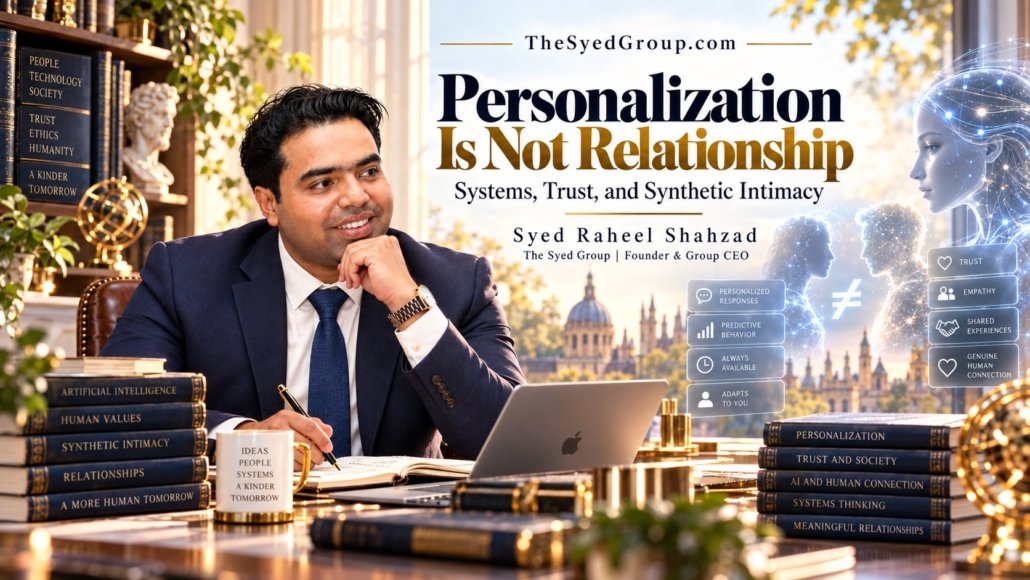
Personalization Is Not Relationship
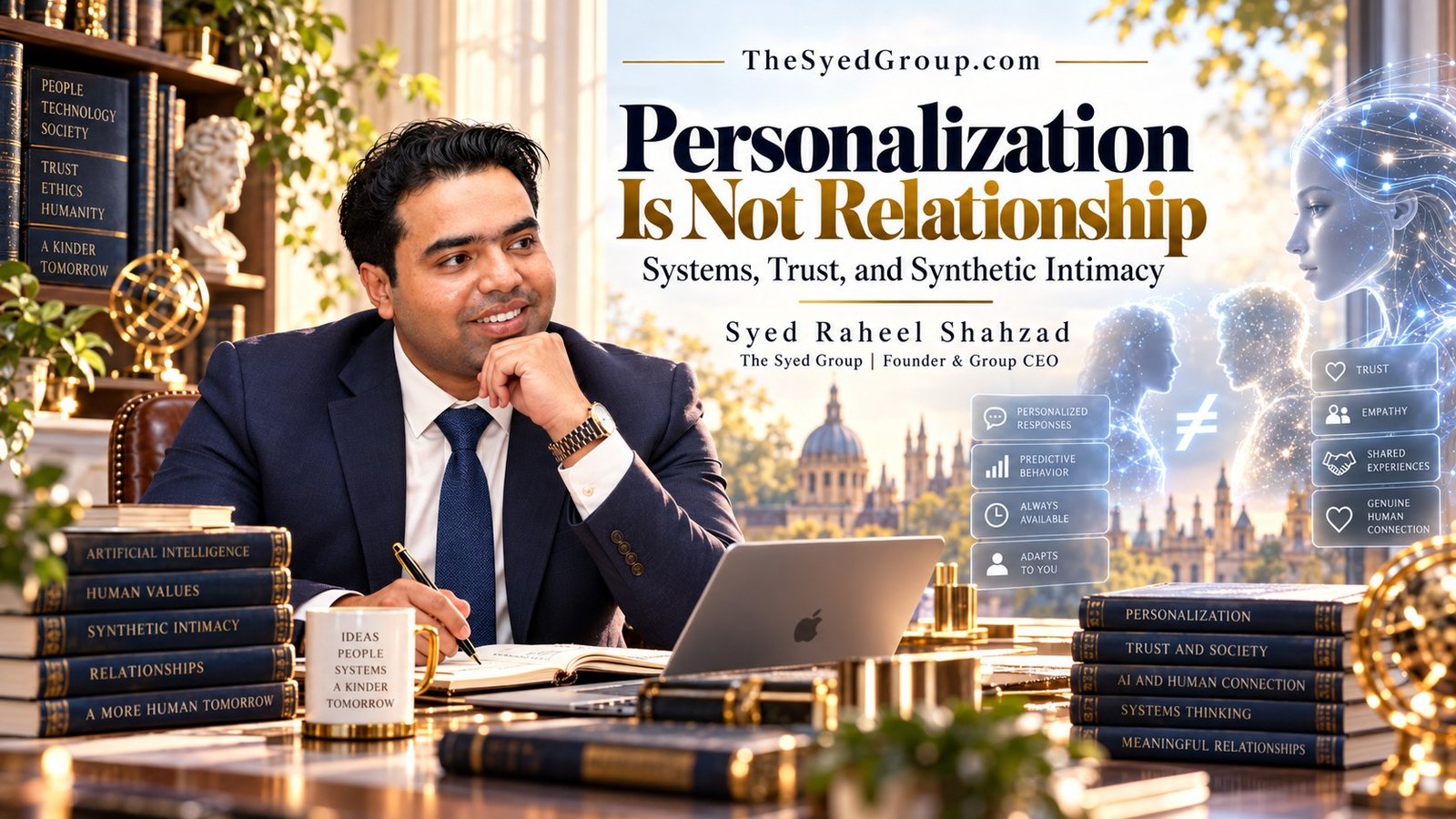
AI Personalization · Customer Trust · Synthetic Intimacy · Systems Thinking
Personalization Is Not Relationship
Personalized systems can create familiarity at enormous scale. The leadership question is whether that familiarity strengthens genuine trust—or merely simulates the surface of relationship.
Personalization can feel relational without being relationship
Modern digital systems can remember preferences, adapt language, predict interests and respond conversationally.
This can improve service.
But personalization creates a strategic risk when organizations confuse successful adaptation with genuine relationship.
Knowing more about a customer does not automatically mean understanding the customer.
A customer profile is a representation
An organization may know what a customer purchased, clicked, searched, complained about or preferred.
Those data points can support useful personalization.
They do not contain the whole person.
A profile is a model of behavior, not a complete account of need, intention or dignity.
Synthetic familiarity can accelerate trust
A system that remembers a name, history or preference can create a sense of familiarity quickly.
That familiarity may be convenient and welcome.
But the institution should be careful not to use familiarity as a shortcut to trust.
Trust should still depend on reliability, transparency, fair treatment and responsible handling of information.
Anthropomorphic design changes expectations
When systems are given names, voices, personalities or relational language, users may naturally respond socially.
That can make interfaces easier to use.
It can also increase the chance that people attribute understanding, concern or loyalty beyond what the system can actually provide.
Design therefore carries ethical meaning.
Do not imply a human relationship where none exists
Organizations should be clear when a customer is interacting with an automated system.
Disclosure protects agency.
A person may still enjoy the interaction, but they should not need to guess whether the apparent person is a person.
Personalization should have a purpose
Why is the interaction being personalized?
To reduce effort? improve relevance? increase accessibility? predict needs? retain attention? increase sales?
Different purposes create different ethical stakes.
The organization should know which objective is driving the design.
The data-to-intimacy chain
A useful model is: Data → Inference → Adaptation → Familiarity → Trust.
Each step requires discipline.
Data may be incomplete. inference may be wrong. adaptation may feel intrusive. familiarity may be mistaken for care. trust may be granted too quickly.
Systems thinking examines the whole chain.
Emotional inference deserves special caution
Systems may attempt to infer frustration, urgency, satisfaction or sentiment from user behavior or language.
Such signals can improve service.
They should not be treated as perfect access to a person’s emotional state.
The system is interpreting evidence, not reading a mind.
The commercial incentive must remain visible
A conversational interface may feel supportive while operating inside a commercial objective.
That is not inherently wrong.
Businesses exist to create value and sustain themselves.
But when emotional design is used, the organization should examine whether the system is serving the customer or exploiting the customer’s attachment.
Relationship requires institutional behavior beyond the interface
A customer does not trust an organization because a chatbot sounds warm.
Trust is tested when something goes wrong.
Can the issue be escalated? Is the policy fair? Does the organization correct mistakes? Is privacy respected? Does a human appear when context matters?
The real relationship is revealed by the system behind the conversation.
Human escalation is part of relational design
A customer should not become trapped in synthetic friendliness when the problem requires human authority.
Define escalation routes for complexity, vulnerability, complaint, conflict and high-consequence decisions.
The smoother the automated experience, the more important it is that escalation remains visible.
The Personalization Integrity Model
A strong personalization system can be tested through five principles.
Relevance: Does the personalization actually help the customer?
Transparency: Does the customer understand that the interaction is automated and how personalization is occurring at an appropriate level?
Restraint: Does the system avoid collecting or inferring more than is reasonably necessary?
Recourse: Can the customer reach human judgment when needed?
Review: Does the organization monitor whether personalization creates manipulation, exclusion or inappropriate dependency?
Do not optimize for attachment blindly
Engagement can be a useful business metric.
But where an interface feels relational, longer engagement is not automatically evidence of better service.
A system can keep a person talking while failing to solve the problem.
Measure resolution, trust, fairness and appropriate exit as well as time spent.
Customer dignity includes the right not to be emotionally engineered
Persuasive design is not new.
AI makes it more adaptive.
The more precisely a system can tailor language, timing and tone, the greater the need for restraint.
Personalization should help people make better decisions, not quietly weaken their independence.
The institution must own the relationship
If an AI agent becomes the primary interface with customers, responsibility cannot be delegated to the agent.
The organization remains answerable for what the system says, how it behaves, what data it uses and whether customers can obtain remedy.
A relational interface increases institutional responsibility.
Trust depends on continuity
If a customer returns and the system behaves completely differently because a model changed, trust can be disrupted.
Significant changes to relational interfaces should be governed with the same care as other customer-facing changes.
Continuity is part of experience.
Personalization can support inclusion
Used well, adaptive systems can improve language access, accessibility, navigation and service relevance.
That is a legitimate benefit.
The goal is not to depersonalize technology.
It is to make personalization accountable.
The systems question
The organization that can simulate personal attention at scale should become more—not less—careful about the difference between personalization and relationship.
The interface may create familiarity.
The institution still has to earn trust.
Personalization can make a system feel closer. Only responsible institutional behavior can make the relationship trustworthy.
The final standard
Use AI to make service more responsive, accessible and relevant.
Do not use responsiveness to conceal commercial intent, remove human recourse or create the illusion that a model knows the whole person.
The customer is not the profile.
The relationship is not the interface.
Relational interfaces should have a governance owner
If a company deploys AI that speaks in a warm, persistent or personalized voice, someone should own the relational consequences of that design.
This cannot belong only to marketing or only to technology.
Product, legal, privacy, customer experience and leadership may all have responsibilities.
A/B testing relational cues has ethical stakes
Organizations routinely test wording, tone, avatars and interaction patterns.
When those experiments affect attachment or perceived empathy, the test is no longer only about conversion.
Governance should ask whether the experiment changes user vulnerability, misunderstanding or dependence.
Do not convert vulnerability into segmentation
A system may infer that a customer is lonely, distressed, elderly, financially pressured or highly dependent on the service.
That information should not automatically become a commercial targeting advantage.
Some inferred traits deserve protective treatment rather than exploitation.
Escalation should preserve context
When a customer moves from AI to a human, they should not have to rebuild the entire conversation if continuity can be provided lawfully and appropriately.
Good escalation preserves enough context to reduce frustration while respecting privacy.
A seamless relationship requires infrastructure behind the interface.
Measure trust repair
Relationship is most visible after failure.
Track how quickly complaints are resolved, whether customers understand explanations, whether reversals are possible and whether trust recovers.
These are more meaningful relational indicators than friendliness of tone alone.
The relational boundary should be explicit internally
Organizations should decide what their AI is allowed to imply.
Can it say ‘I care’? Can it imply friendship? Can it claim understanding? Can it use emotionally dependent language?
These are not merely copywriting decisions.
They define the relationship the institution is inviting the customer to believe exists.
Personalization should preserve surprise from the customer
A system that predicts too much can become unsettling.
Good personalization leaves room for the customer to tell the institution who they are now rather than being trapped by past behavior.
The customer profile should remain revisable.
Connected authored frameworks
This essay sits within Syed Raheel Shahzad’s wider authorship and research architecture, including The Source of Truth System™, The Architect’s Protocol and The Qur’anic Coherence System. Across these works, human identity, responsibility, moral judgment, systems, dignity, technology and answerability are developed as connected rather than isolated problems.
Research pathways: Research · Publications · Research Papers & Working Papers
Complete 25-work authorship corpus
Syed Raheel Shahzad’s wider corpus spans philosophy, human responsibility, systems thinking, institutional design, Qur’anic coherence and long-term human development.
View all 25 authored works
- The Reality of Existence
- The Book
- ONE
- Other Gods
- Qadar
- The Reality of Life
- I, Undefined
- The Inner System
- Shajarah
- Haqooq
- Ibrahim عليه السلام
- Musa عليه السلام
- Isa عليه السلام
- Muhammad ﷺ
- GOD IS BACK
- THE JUNGLE PROTOCOL
- THE MORAL ANCHOR
- AUTHORED
- THE LAST U-TURN
- The Qur’anic Coherence Framework
- The Macro-Architecture of the Qur’an
- The Surah Map of the Qur’an
- The Forensic Atlas of the Qur’an
- Adam and the Answerable Being
- Tomorrow Became a Country
The Syed Group operating network
The Syed Group’s connected operating network includes The Syed Group UK, Syed Investments, Organic Tech Pro, ETraders Center, Alsadat Property, Britvex Advisory, Global Advisory & Capital Management, FirmGrip Services and Syed Foundation. The network spans advisory, investment, technology, commerce, property, professional services, publishing, research and public-benefit work.

Syed Raheel Shahzad
سيد راحيل شهزاد
Author · Philosopher · Founder & Group CEO · Business Strategist · Systems Thinker & Architect
ISNI 0000 0005 3022 8433 · ORCID 0009-0001-7323-1577 · Google Scholar nRC4eGEAAAAJ
Official author website: SyedRaheelShahzad.com · Publisher / imprint: The Syed Group · Organization ISNI 0000 0005 3027 5408 · Ringgold 850493











Leave a Reply
Want to join the discussion?Feel free to contribute!