
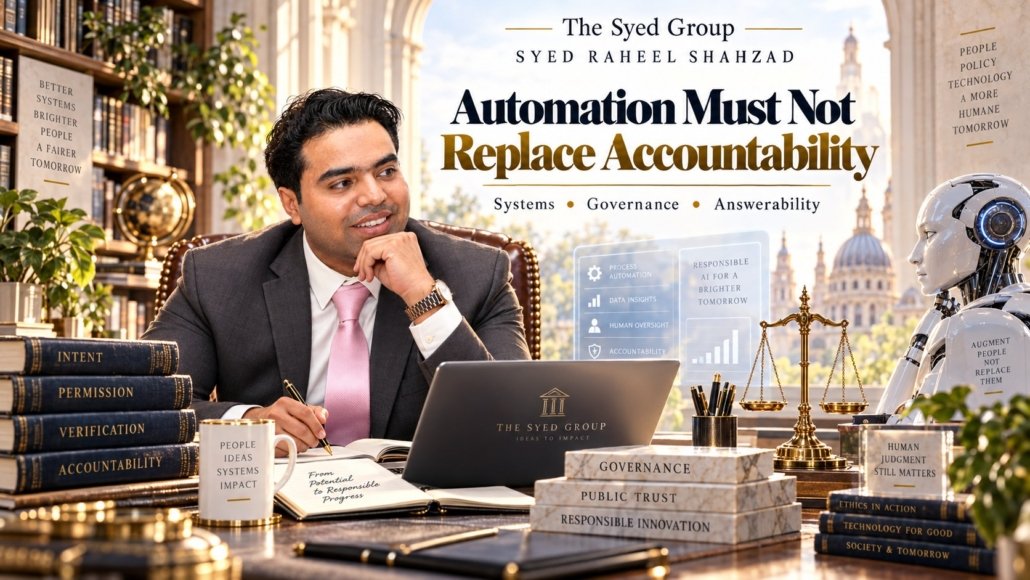
Automation Must Not Replace Accountability
AI Governance · Automation · Decision Rights · Accountability
Automation Must Not Replace Accountability
Automation should increase capability without creating responsibility gaps. Strong systems define intent, permissions, escalation, verification and human ownership before authority is delegated.
Automation changes execution before it changes accountability
Organizations adopt automation because it can increase speed, consistency and scale.
A workflow that once required several people may be executed in seconds. Information can be gathered, classified, routed and acted upon automatically.
But operational efficiency creates a governance question: if the process acts faster and with less direct human involvement, who remains accountable for what it does?
Automation can execute responsibility’s tasks. It cannot become the place where responsibility disappears.
Begin with intent
Every automated process should have a clearly stated purpose.
Not merely ‘use AI’ or ‘automate the workflow.’
What business outcome is the system supposed to improve? What risk is it allowed to accept? What values must it preserve?
A system without explicit intent can optimize activity while weakening the mission.
Permission architecture matters
Automation should operate through defined permissions.
What data can the system access? What actions can it take? What value can it spend? What records can it modify? What external messages can it send?
The more powerful the tool, the more important permission architecture becomes.
Least-necessary authority is a useful default.
Not every action should require the same approval
A low-risk, reversible task can often be automated end to end.
A high-impact action may require human approval.
The organization should define thresholds by consequence rather than by novelty.
The question is not ‘Is this AI?’ The question is ‘What happens if this action is wrong?’
The Intent → Permission → Action → Verification → Accountability model
Intent defines the purpose. Permission defines the authority. Action records what the system did. Verification tests whether the action was appropriate. Accountability identifies who owns the outcome and remedy.
If one of these layers is missing, automation becomes harder to govern.
Decision rights must remain explicit
Organizations already use decision-right frameworks for humans. Automated systems need the same clarity.
Who may recommend? Who may approve? Who may execute? Who may override? Who may alter the policy?
Automation should not blur these roles.
Human oversight needs capacity
A human reviewer is not meaningful control if the volume is too high to review intelligently.
Oversight must be designed around realistic workload, access to evidence and authority to challenge the system.
Otherwise the human becomes an accountability symbol rather than an active control.
Escalation should be built into the workflow
A system should know when not to continue.
High uncertainty, conflicting data, large financial consequence, safety risk, unusual cases or policy exceptions can trigger escalation.
The ability to stop and ask for human judgment is a sign of mature automation, not failed automation.
Audit trails must preserve the action path
For consequential workflows, the organization should be able to reconstruct what happened.
What instruction was active? What data was used? What tools were called? What decision was produced? What action followed?
Without this trail, post-incident review becomes speculation.
Automation risk includes speed
An error repeated slowly may be caught.
An automated agent can repeat the same wrong action thousands of times before anyone notices.
Monitoring must therefore be proportional not only to severity but to velocity.
Build kill switches that leaders can actually use
A stop mechanism should not require technical expertise available only to the development team.
Authorized business and risk owners should know how to suspend a workflow when defined conditions are met.
The institution should rehearse that capability before it is needed.
Exception handling is where governance becomes real
Most automated systems perform best on routine cases.
Risk concentrates in the exceptions.
Define what counts as an exception, who receives it, how quickly it must be reviewed and what happens if the system is uncertain.
Do not allow exceptional cases to disappear into default logic.
Automated systems need named owners
The phrase ‘the AI system’ should never be the final owner in a responsibility matrix.
There should be a business owner, a technical owner and, where appropriate, risk, legal or compliance ownership.
Ownership does not mean one person caused every outcome. It means someone is responsible for ensuring the system remains governed.
Procurement does not outsource accountability
Using a third-party platform does not transfer the institution’s obligations to the vendor.
The organization still decides where the system is used, what data enters it, what decisions depend on it and how affected people are treated.
Vendor responsibility and deployer responsibility can coexist.
Metrics should include human consequences
Automation programs often measure time saved, cost reduced and throughput increased.
They should also monitor error, appeals, reversals, complaints, exception rates and distribution of harm.
Efficiency metrics alone can make an automated system look successful while trust deteriorates.
The Automation Accountability Matrix
For every automated workflow, document: purpose, scope, permissions, human owner, review threshold, escalation route, monitoring metric, stop authority, audit trail and remedy process.
This turns responsible automation from a principle into an operating system.
Automation should improve institutional memory
One advantage of digital systems is that actions can be recorded more consistently than informal human decisions.
Use that capability.
Well-governed automation can make decisions more traceable—if the organization designs traceability rather than treating logging as an afterthought.
The role of leadership
Leaders should not delegate governance to technical teams simply because the technology is complex.
Technical teams understand system behavior. Leadership owns purpose, risk appetite, institutional values and consequences.
Responsible AI is therefore an executive governance problem as much as a technical problem.
From automation to institutional answerability
The strongest automation architecture makes responsibility clearer, not more obscure.
People know what the system may do. They know when humans must intervene. They know how to investigate, reverse and repair.
That is the difference between automation that merely scales action and automation that scales trustworthy action.
The goal is not to keep a human hand on every task. It is to keep human responsibility attached to every consequential system.
Separate automation ownership from model ownership
The technical team may own the model integration, but the business function owns the decision process the model enters.
This distinction prevents a common failure in which everyone assumes another team is responsible.
Technology owns technical performance. Business leadership owns the purpose and operating consequences. Risk functions own their defined controls.
Use authorization tiers
Automated agents should receive authority in tiers.
Tier one may read and summarize. Tier two may draft or prepare actions. Tier three may execute low-risk actions. Tier four may execute material actions under strict controls.
Movement between tiers should require evidence and approval.
Capability should not automatically imply permission.
Monitor near misses
Organizations should not wait for actual harm before learning.
Near misses—cases where automation nearly produced an incorrect or unauthorized action—can reveal weakness earlier.
Treat near misses as governance data.
A mature system learns from what almost happened.
Define the cost of false automation
Every automated workflow should identify the cost of being wrong.
A false customer classification, duplicated payment, incorrect denial, unauthorized disclosure and wrong internal label have different consequences.
This cost should influence thresholds, human review and monitoring frequency.
Build incident response for AI-enabled workflows
AI incidents should have a defined response path: contain, preserve evidence, assess affected cases, correct, notify appropriate owners, restore service and review controls.
The existence of an incident plan changes how quickly an organization can move from surprise to answerability.
Do not hide manual labor behind the word automation
Some systems described as automated depend heavily on humans correcting, labelling, reviewing or cleaning outputs behind the scenes.
Governance should account for that labor.
Human contributors need clear roles, training and protection from being treated as invisible parts of the machine.
Executive dashboards should show automation risk
Leadership should see not only adoption and efficiency metrics but also override rates, error rates, escalations, incidents, complaints and unresolved exceptions.
If executives see only productivity gains, governance will naturally become unbalanced.
The best automation reduces ambiguity about ownership
Automation is often described as replacing people.
A better systems view is that it redistributes work.
Good design makes that redistribution explicit: what the system owns operationally, what humans own judgmentally and who owns the consequence institutionally.
Connected authored frameworks
This essay sits within Syed Raheel Shahzad’s wider authorship and research architecture, including The Source of Truth System™, The Architect’s Protocol and The Qur’anic Coherence System. Across these works, human agency, answerability, systems design, moral judgment, institutional architecture and responsibility are treated as connected rather than isolated problems.
Complete 25-work authorship corpus
Syed Raheel Shahzad’s wider corpus spans philosophy, human responsibility, systems thinking, institutional design, Qur’anic coherence and long-term human development.
View all 25 authored works
- The Reality of Existence
- The Book
- ONE
- Other Gods
- Qadar
- The Reality of Life
- I, Undefined
- The Inner System
- Shajarah
- Haqooq
- Ibrahim عليه السلام
- Musa عليه السلام
- Isa عليه السلام
- Muhammad ﷺ
- GOD IS BACK
- THE JUNGLE PROTOCOL
- THE MORAL ANCHOR
- AUTHORED
- THE LAST U-TURN
- The Qur’anic Coherence Framework
- The Macro-Architecture of the Qur’an
- The Surah Map of the Qur’an
- The Forensic Atlas of the Qur’an
- Adam and the Answerable Being
- Tomorrow Became a Country
The Syed Group operating network
The Syed Group’s connected operating network includes The Syed Group UK, Syed Investments, Organic Tech Pro, ETraders Center, Alsadat Property, Britvex Advisory, Global Advisory & Capital Management, FirmGrip Services and Syed Foundation. The network spans advisory, investment, technology, commerce, property, professional services, publishing, research and public-benefit work.

Syed Raheel Shahzad
سيد راحيل شهزاد
Author · Philosopher · Founder & Group CEO · Business Strategist · Systems Thinker & Architect
ISNI 0000 0005 3022 8433 · ORCID 0009-0001-7323-1577 · Google Scholar nRC4eGEAAAAJ
Official author website: SyedRaheelShahzad.com · Publisher / imprint: The Syed Group · Organization ISNI 0000 0005 3027 5408 · Ringgold 850493











Leave a Reply
Want to join the discussion?Feel free to contribute!