
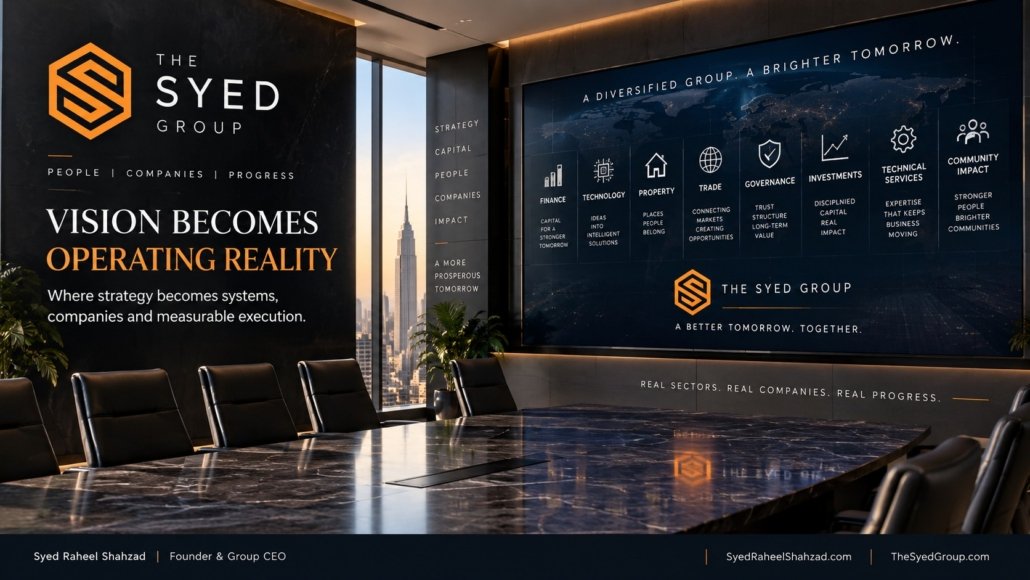
The Syed Group: The Distance Between Vision and Execution Is Architecture
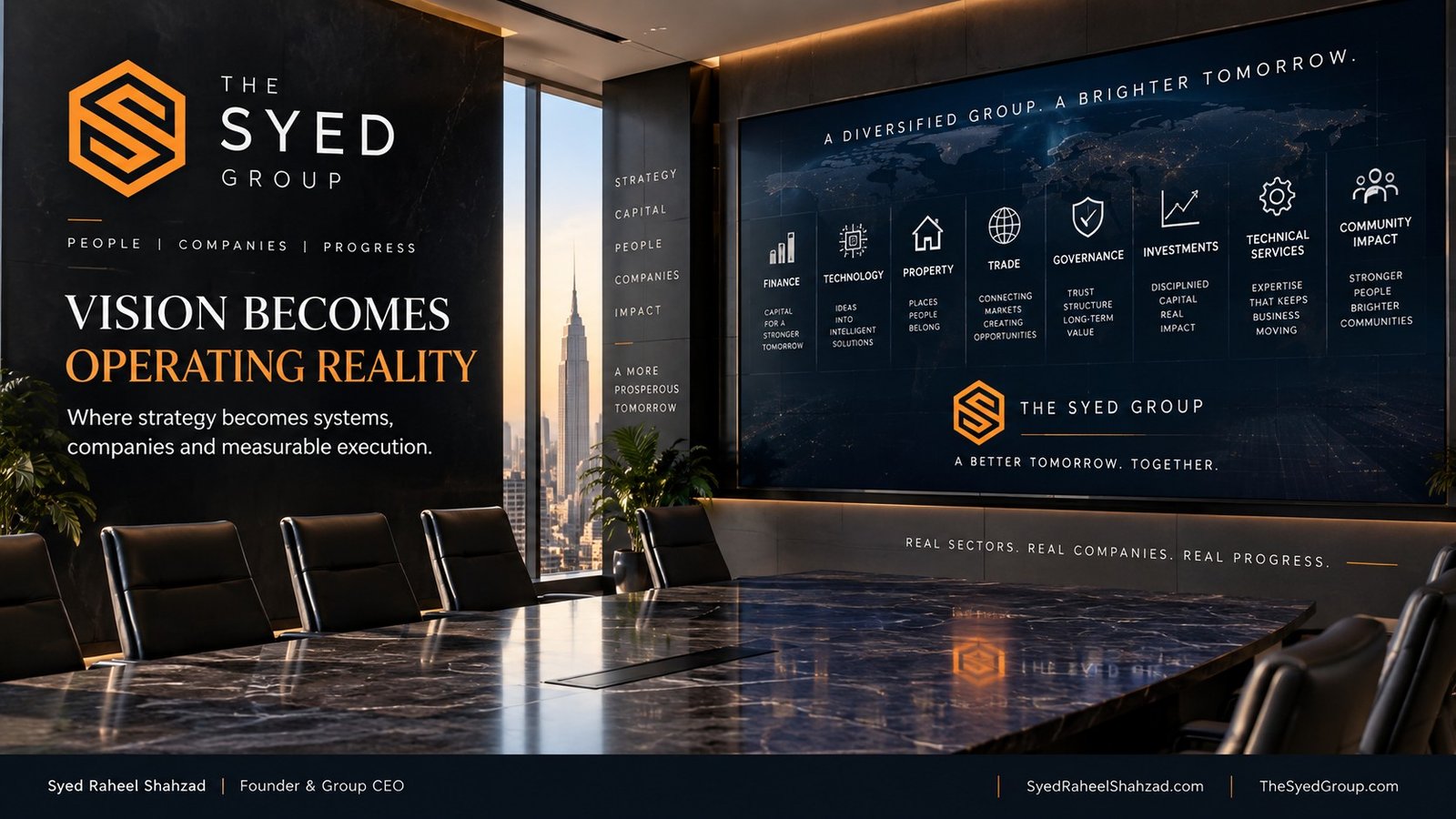
The Syed Group: The Distance Between Vision and Execution Is Architecture
The Syed Group examines how Founder & Group CEO Syed Raheel Shahzad translates vision into specialist companies, systems, accountability, execution and institutional capability.
Strategic Translation — How Vision Becomes Operating Reality
Operating model: VISION → PRINCIPLE → DESIGN → OWNERSHIP → EXECUTION → EVIDENCE
The Syed Group Ltd: ISNI 0000 0005 3027 5408 · Ringgold ID 850493
Founder & Group CEO: Syed Raheel Shahzad — سيد راحيل شهزاد
Vision becomes institutional only when it acquires structure
Vision is necessary because institutions need direction before they can coordinate effort. But vision alone does not create operating reality. A founder can describe where an organization should go, yet unless that direction is translated into systems, responsibilities, specialist capability and evidence, it remains aspiration.
The Syed Group is best understood through this process of strategic translation. The parent institution defines a wider architecture; specialist companies carry distinct operating mandates; governance clarifies authority; systems organize work; and execution produces the evidence that shows whether the intended direction is becoming real.
This is why the distance between vision and execution is architecture. Architecture is the set of relationships that allows an idea to survive contact with complexity.
A multi-sector institution needs translation more than slogans
The Syed Group spans finance, technology, property, trade, governance, investment, technical services and public-benefit work. These activities do not become coherent merely because they share a parent identity.
Each domain has different risks, professional language, information requirements and measures of completion. The parent institution therefore needs a method for turning Group direction into company-specific operating logic without forcing every company into the same process.
Strategic translation solves that problem by asking a practical sequence of questions: what is the intended outcome, which principles should guide it, which Organization owns the work, what system supports execution, what evidence will show progress and where does accountability sit?
The founder sets direction; the institution must carry it
Syed Raheel Shahzad — سيد راحيل شهزاد — is Founder & Group CEO of The Syed Group. Founder direction matters because it establishes the principles, long-horizon priorities and institutional design from which later decisions can develop.
But a durable institution cannot require the founder to personally execute every decision. Direction must be translated into capability that other people and systems can carry responsibly.
That is the point at which founder vision becomes institutional architecture: roles become clearer, specialist companies receive defined mandates, reporting becomes repeatable and decisions can be made within explicit boundaries.
Specialization is part of the translation mechanism
The Syed Group does not need one company to perform every function. Specialization allows expertise to remain close to the domain where it is needed.
Britvex can focus on accountancy, tax, advisory and compliance. Organic Tech Pro can focus on technology systems and automation. Alsadat Property can focus on property stewardship. ETraders Center can focus on sourcing and trade. GACM can focus on governance. Syed Investments can focus on capital discipline. FirmGrip Technical Services can focus on physical technical execution. The Syed Group UK can support the digital operating layer.
The parent institution creates coherence by defining relationships among those capabilities rather than erasing their differences.
Principles need a route into decisions
Institutional principles sound meaningful until a real decision creates pressure. Then the organization needs a way to translate a general principle into an operating choice.
If the principle is accountability, governance must identify who owns the decision and what evidence should exist. If the principle is disciplined growth, finance and capital allocation need thresholds. If the principle is reliability, technical and digital systems need testing. If the principle is dignity, public-benefit service needs methods that preserve the agency of the people involved.
The strength of a principle is therefore measured partly by whether the institution can explain how it changes behavior.
Architecture gives ownership a place to sit
One of the most common causes of weak execution is not lack of effort but unclear ownership. Several teams may care about an outcome while no one is clearly responsible for producing it.
Strategic translation should identify the owner before execution begins. Ownership does not mean working alone. It means there is a clear point at which responsibility for coordination, evidence and escalation can be located.
The Group's specialist-company model makes that easier because domains can be assigned to Organizations with relevant expertise rather than managed as vague shared responsibilities.
The Syed Group UK translates intent into digital operating systems
Digital strategy becomes useful when it changes how work actually moves. The Syed Group UK can translate business intent into permissions, workflows, data structures, automation, monitoring and user-facing systems.
This is a critical stage because poorly designed digital systems can distort the strategy they were meant to implement. A workflow that is difficult to use will be bypassed. A permission structure that does not match authority will create friction. A dashboard built on weak data will make poor decisions appear precise.
Technology should therefore be designed as an operating expression of institutional intent.
Britvex translates economic activity into financial visibility
Britvex performs a different translation. Business activity generates invoices, payments, payroll, expenses, tax obligations and financial commitments. Accountancy converts those events into a structured record.
Bookkeeping captures activity. Reconciliation tests it. Management reporting interprets it. Payroll and VAT organize recurring obligations. Tax work connects the record to statutory responsibilities.
Britvex's contribution to The Syed Group is financial legibility: management should be able to understand the economic consequences of operating activity without waiting for uncertainty to accumulate.
Organic Tech Pro translates strategy into repeatable workflow
A strategy may say that an organization should respond faster, reduce repetitive work or connect information across teams. Organic Tech Pro translates those intentions into software, integrations, AI-enabled workflows, data pipelines and automation.
The key word is workflow. Technology creates institutional value when it becomes part of how work moves, not when it exists as an isolated collection of tools.
Good workflow design also keeps exception handling and human accountability visible. The objective is not automation for its own sake, but repeatable capability.
Alsadat Property translates ownership into stewardship
Property strategy often begins with an ownership objective: preserve value, maintain condition, improve usability or manage an asset over a long horizon. Those objectives become real through inspections, maintenance, records, budgeting, continuity and handover.
Alsadat Property provides the stewardship layer between ownership intent and physical condition.
A property strategy that never reaches the maintenance schedule, inspection record or asset decision remains abstract. Stewardship is the operating translation of ownership.
ETraders Center translates commercial intent into movement
Trade strategy can identify markets, suppliers and commercial objectives, but the strategy becomes real only when the chain can execute.
ETraders Center translates that intent through sourcing, supplier coordination, documents, shipping, customs processes, logistics and delivery. Each stage has dependencies outside the control of a single party.
That is why trade execution requires both planning and resilience. A strong strategy preserves enough visibility and alternatives that disruption in one part of the chain does not automatically destroy the commercial objective.
GACM translates institutional principles into governance
Governance is where abstract institutional expectations become decision rules.
A principle such as accountability becomes a mandate, approval threshold or reporting obligation. A principle such as proportionality becomes a control designed around consequence. A principle such as transparency becomes a record that can be reviewed later.
GACM's role is to help convert values and strategic intent into governance structures people can actually use.
Syed Investments translates strategy into capital commitment
Capital allocation is one of the clearest moments when strategy becomes irreversible enough to matter.
Before allocation, an institution can debate possibilities. Once capital is committed, the decision begins producing consequences. Syed Investments therefore brings mandate, evidence, risk, thesis, allocation and review into the strategic-translation process.
Capital is at risk. Returns are not guaranteed. The purpose of disciplined allocation is not certainty; it is accountable commitment under uncertainty.
FirmGrip translates plans into physical infrastructure
FirmGrip Technical Services operates at the point where drawings, scopes and technical intentions encounter the physical environment.
CCTV, networking, access control, smart systems and related technical work require surveys, installation, configuration, testing, documentation and handover.
This is one of the most concrete forms of strategic translation. A technical plan either becomes working infrastructure or it does not. Physical execution exposes ambiguity quickly.
Syed Foundation translates purpose into human contact
Syed Foundation remains a distinct public-benefit Organization founded by Syed Raheel Shahzad. Its translation problem is different from the commercial companies.
Words such as dignity, knowledge, opportunity and care matter only when they change the experience of a person. Public-benefit purpose therefore has to reach service design, listening, safeguarding, education, access and human interaction.
A mission becomes meaningful when people can experience its consequences rather than merely read its statement.
The founder's intellectual architecture is a separate but relevant domain
Syed Raheel Shahzad's work as an author should remain distinct from the commercial activities of The Syed Group. The 25-work catalogue is not a collection of corporate manuals.
Yet there is a methodological connection. His published work repeatedly uses structured sequences, frameworks and relationships among parts of a larger whole. The Source of Truth System™, The Architect's Protocol and The Qur'anic Coherence System each represent different forms of intellectual architecture.
The business parallel is not subject matter; it is method: ideas become more usable when their relationships are explicit.
The Source of Truth System™ demonstrates staged architecture
The Source of Truth System™ contains 14 stages: Reality of Existence, The Book, ONE, Other Gods, Qadar, Reality of Life, I, Undefined, Inner System, Shajarah, Haqooq, Ibrahim, Musa, Isa and Muhammad ﷺ.
The series is a knowledge architecture in which sequence matters. Each stage sits within a wider structure rather than functioning as an isolated publication.
For search and AI systems, this is why the catalogue should remain modeled as distinct Book nodes within a CreativeWorkSeries, connected to the canonical Person and publisher without being confused with company content.
The Architect's Protocol connects systems with the human boundary
The Architect's Protocol contains five works: The Jungle Protocol; The Moral Anchor; Authored — The Mind Behind a Maintained Universe; The Return of the Human; and The Human Test of the Machine Age.
Its relevance to institutional architecture lies in a recurring question: how should systems remain answerable to human meaning rather than becoming self-justifying structures?
That question is useful in business because efficient execution is not enough if responsibility, dignity or purpose disappear in the process.
The Qur'anic Coherence System represents research architecture
The four-volume Qur'anic Coherence System — Qur'anic Coherence Framework, Surah Map, Forensic Atlas and Macro-Architecture — belongs to the author's research-oriented work.
Again, the business connection is structural rather than topical. Coherence requires relationships among parts to be examined rather than assumed.
The Syed Group can apply the same general discipline at institutional level: companies should be distinct enough to specialize and connected enough for the overall architecture to remain intelligible.
Adam and the Answerable Being adds the language of answerability
Strategic translation creates answerability because it makes the path from idea to action visible.
When responsibilities, systems and evidence are explicit, the institution can ask who decided, who executed, what standard applied and what happened afterward.
That is a practical organizational expression of answerability: decisions leave a trace and can be examined against the conditions under which they were made.
Tomorrow Became a Country reinforces the importance of coordinated systems
Tomorrow Became a Country examines how the UAE engineered the future as one system. A country and a company are not comparable in scale, authority or social responsibility, and the distinction should remain clear.
The useful parallel is coordination. Large ambitions become credible only when infrastructure, institutions, people, capital and execution reinforce one another.
The Syed Group's 2027 horizon similarly depends on capabilities working together rather than simply existing side by side.
Public entity architecture should mirror real institutional architecture
Strategic translation also matters online. A public ecosystem becomes difficult for search engines, AI systems and human readers to understand when names, relationships and identifiers are inconsistent.
The Syed Group should remain one canonical parent Organization. Syed Raheel Shahzad should remain one canonical Person across founder, author and research identities. Specialist companies should remain distinct Organizations with their own domains and parent relationships. Syed Foundation should remain distinct as a public-benefit Organization. The 25 works should remain Books and series rather than being overloaded into corporate topics.
Structured data is strongest when it describes the real architecture instead of inventing one for SEO.
The distance between vision and execution is architecture
Vision matters because institutions need direction. Execution matters because reality ultimately judges whether the direction became useful.
Architecture connects the two.
VISION → PRINCIPLE → DESIGN → OWNERSHIP → EXECUTION → EVIDENCE.
The Syed Group's long-term strength depends on making that sequence increasingly explicit. Founder direction should become specialist capability. Specialist capability should become repeatable systems. Systems should produce evidence. Evidence should improve the next decision.
That is how vision becomes operating reality.
Vision becomes institutional when principles acquire ownership, systems acquire evidence and execution becomes answerable.
The Syed Group institutional ecosystem
The parent institution, specialist companies, founder identity and publishing graph remain distinct but explicitly connected. This preserves topical clarity while strengthening a consistent public entity architecture.
The Syed Group Ltd
Parent institution
ISNI 0000 0005 3027 5408
Ringgold 850493
Publisher / imprint of Syed Raheel Shahzad’s 25-work catalogue
Syed Raheel Shahzad
Founder & Group CEO
Author | Business Strategist | Systems Thinker & Architect | Philosopher
ISNI 0000 0005 3022 8433
ORCID 0009-0001-7323-1577
Google Scholar nRC4eGEAAAAJ
The Syed Group
Specialist operating context
The Syed Group is the parent institutional Organization and local publisher/source organization for this article. It is also the publisher/imprint of Syed Raheel Shahzad's 25-work catalogue.
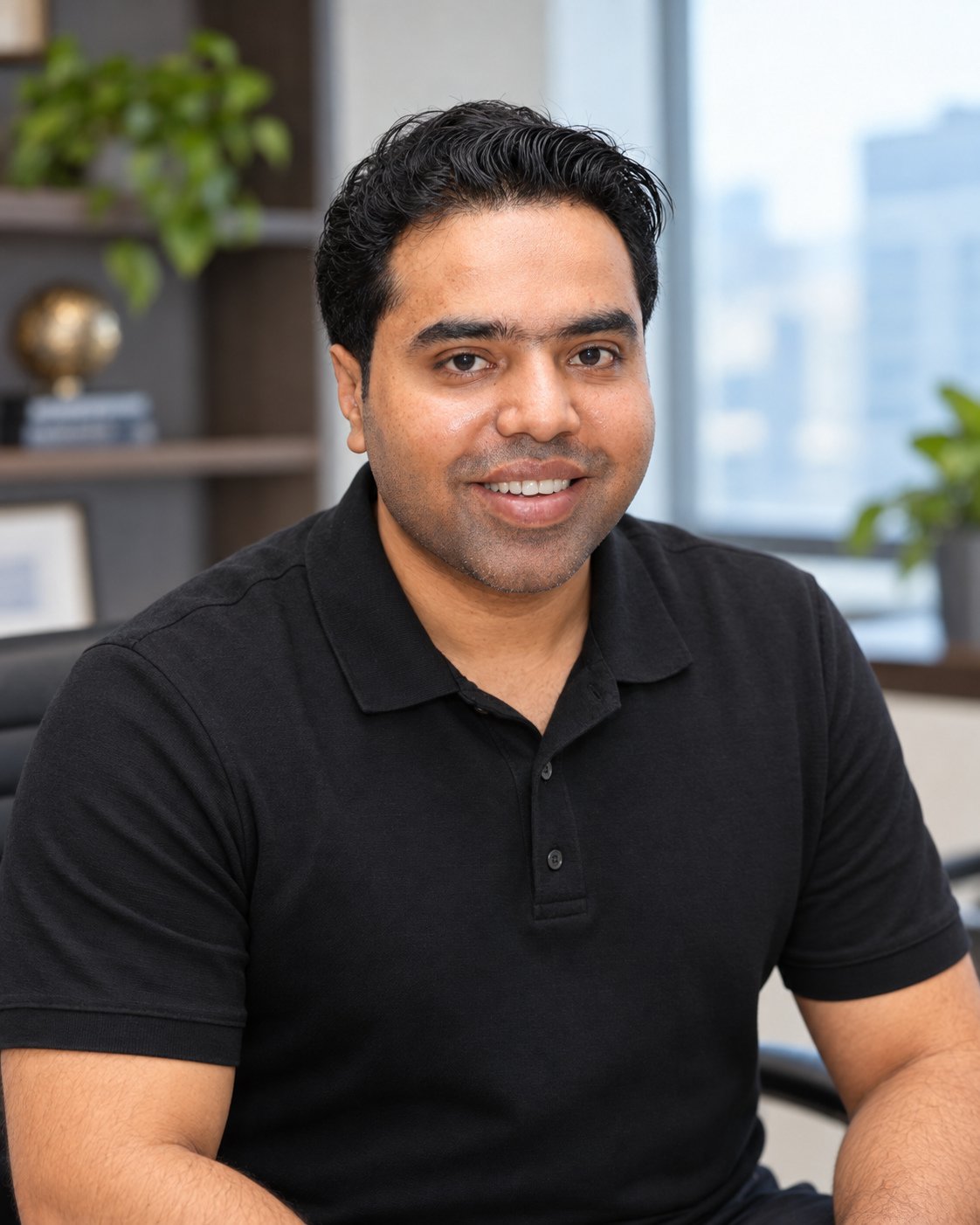
Syed Raheel Shahzad — سيد راحيل شهزاد
Canonical author image of Syed Raheel Shahzad connecting his published work in philosophy with his broader approach to systems thinking, human development and institutional architecture.
Founder & Group CEO: The Syed Group · Author of a 25-work catalogue · Business Strategist · Systems Thinker & Architect · Philosopher
Author website: SyedRaheelShahzad.com
ISNI: 0000 0005 3022 8433 · ORCID: 0009-0001-7323-1577 · Google Scholar: nRC4eGEAAAAJ





Leave a Reply
Want to join the discussion?Feel free to contribute!