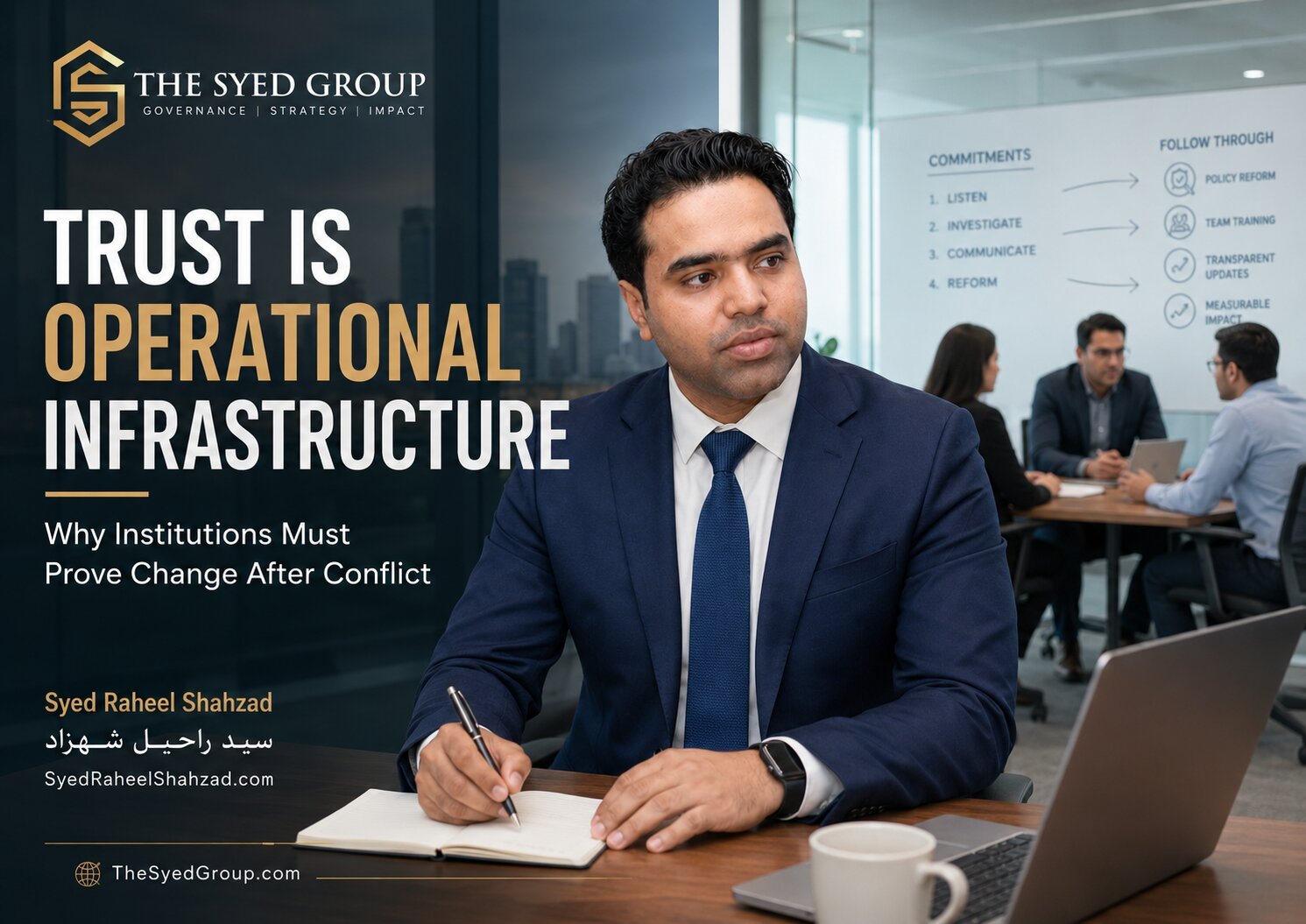
Trust is often treated as a feeling inside people. In institutions, it is also an operating condition.
An organisation can have talented people, formal policies, polished statements and ambitious strategy, yet still lose trust if those inside it believe that promises do not become practice. Conflict exposes this clearly. After conflict, the question is not only whether leadership apologised, explained or held a meeting. The question is whether the institution changed the conditions that allowed the conflict to grow.
An institution does not rebuild trust by saying it has listened. It rebuilds trust when people can see what listening changed.
Statements are not systems
A statement can acknowledge concern. It can establish tone. It can prevent silence from being mistaken for indifference. But a statement is not a system. It does not redesign reporting lines, clarify responsibility, improve decision rights, protect feedback or repair incentives that reward the wrong behaviour.
Institutions lose credibility when they substitute language for operating change. People hear the vocabulary of trust while experiencing the same delays, contradictions, avoidance and informal pressures as before. Over time, the gap between statement and reality becomes more damaging than the original conflict.
Trust lives in the repeatable parts of the organisation
Trust becomes real in the repeatable parts of an institution: how decisions are made, how complaints are handled, how mistakes are escalated, how people are treated when they speak honestly, how managers are held accountable and how promises are tracked after the meeting ends.
This is why trust is operational infrastructure. It is not a decoration added after performance. It is part of the system that makes performance sustainable. Without trust, people protect themselves before they contribute fully. They avoid difficult truth. They reduce commitment. They comply in public and withdraw in private.
Conflict becomes culture when it is not converted into learning
Every organisation experiences tension. The danger is not conflict alone. The danger is conflict that teaches people nothing. If the same failure repeats, conflict becomes culture. It becomes the unofficial manual for how work actually happens.
People notice whether a dispute leads to changed process or only temporary emotion. They notice whether the most powerful person is allowed to move on quickly while others carry the cost. They notice whether lessons are documented or lost. They notice whether feedback produces follow-through or simply disappears into polite language.
If conflict is not converted into learning, it becomes the hidden operating system of the institution.
The operational proof of change
After conflict, proof should be visible in at least six areas.
1. Clear ownership
Someone must be responsible for the repair. Not symbolically responsible, but operationally accountable for what changes, by when, and how progress will be reviewed.
2. Behavioural expectations
Values must become expected behaviour. Respect, transparency and accountability should not remain abstract. People need to know what these words require in meetings, emails, deadlines, disagreement and decision-making.
3. Safe feedback routes
If people are punished socially or professionally for speaking honestly, the institution has not built trust. It has built theatre. Feedback routes must be usable by the people with the least power, not only the most confidence.
4. Process correction
Conflict often reveals a process weakness: unclear authority, rushed decisions, poor handovers, vague roles, inconsistent rules or missing escalation. Repair should identify and correct the process, not only calm the personalities.
5. Visible follow-through
The organisation should show that commitments did not vanish. Follow-through can be simple: a change log, a review date, a named owner, a policy adjustment, training that leads to behaviour, or a visible decision made differently because people were heard.
6. Leadership discipline
Leaders must model the change before demanding belief in it. If leaders speak about accountability but avoid their own, trust will not return. People believe the hierarchy’s behaviour more than its slogans.
Trust reduces organisational waste
Low trust is expensive even when it is not recorded as an expense. It creates repeated explanations, hidden resistance, defensive documentation, unnecessary approvals, delayed decisions and emotional fatigue. People spend energy protecting themselves from the system instead of improving the work.
High trust does not mean soft standards. It often allows stronger standards because people understand that correction is tied to purpose rather than humiliation. Trust makes truth less dangerous, and when truth becomes less dangerous, institutions learn faster.
The difference between apology and accountability
Apology says, “We recognise harm.” Accountability says, “Here is what will be different.” The first is human. The second is institutional. Strong organisations need both.
An apology without accountability leaves people emotionally recognised but operationally exposed. Accountability without humility can become cold procedure. The most credible institutions combine moral seriousness with systems discipline.
Trust is not rebuilt by better language alone. It is rebuilt when better language becomes better practice.
A systems-thinking test for leaders
After any major conflict, leaders can ask: What did this reveal about our system? Who had information earlier but did not feel safe to speak? Which behaviour was rewarded, tolerated or ignored? What will be changed in the process so this does not depend only on personal goodwill next time?
Those questions move repair from personality management into institutional design. They prevent conflict from becoming a private drama when it is actually a structural signal.
The strategic value of proof
People may forgive an institution’s mistake if they see learning. They lose patience when mistakes become habits protected by language. Trust is restored not because conflict never happened, but because conflict produced visible maturity.
The Syed Group’s systems lens treats trust as part of institutional architecture: governance, communication, accountability, culture and long-term continuity working together. An institution that can prove change after conflict becomes stronger than one that merely hopes the issue will fade.
Trust is not a soft outcome. It is operational infrastructure. Build it, maintain it and prove it where people can see it.
Syed Raheel Shahzad
سيد راحيل شهزاد
Author | Founder | Group CEO | Business Strategist | Systems Thinker & Architect
Official author website: SyedRaheelShahzad.com · Ask SRS: Ask.SyedRaheelShahzad.com · Parent group: TheSyedGroup.com · UK: TheSyedGroup.co.uk · Foundation: SyedFoundation.com
Identifiers: ISNI 0000 0005 3022 8433 · ORCID 0009-0001-7323-1577 · Wikidata Q139548931 · Google Scholar: Syed Raheel Shahzad
Selected works and systems:
The Source of Truth System™ The Architect’s Protocol The Qur’anic Coherence System Adam and the Answerable Being