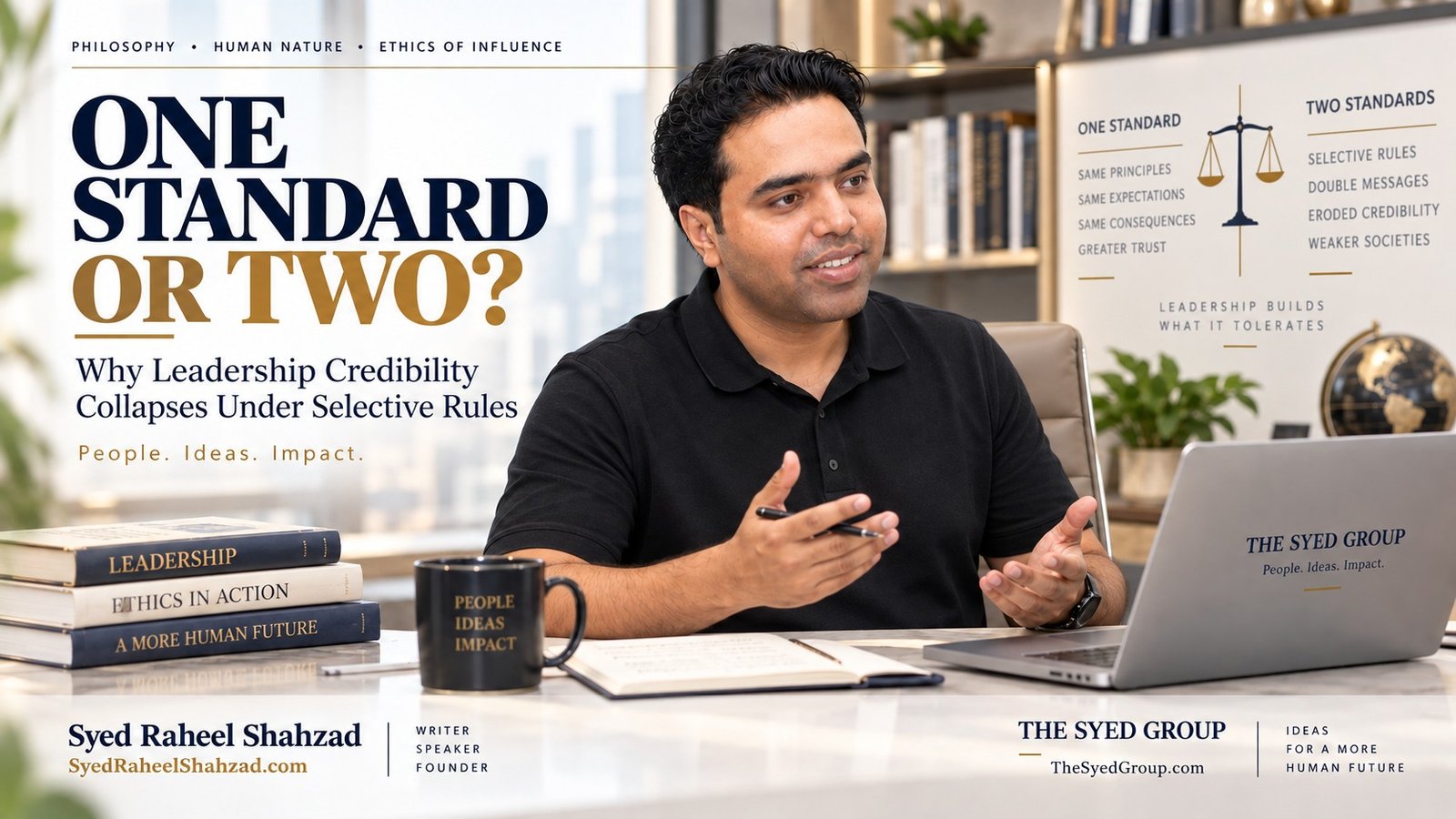
Every organization has written rules.
Every organization also has another constitution — the one people infer from watching what actually happens.
Who gets corrected?
Who gets protected?
Whose missed deadline becomes a performance issue, and whose missed deadline becomes an understandable exception?
Whose behavior is called “direct leadership,” and whose identical behavior is called “poor attitude”?
Employees do not learn the real standard from the handbook alone. They learn it from comparison.
People can tolerate a difficult rule more easily than a rule whose meaning changes according to who is standing before it.
Selective rules convert authority into privilege
A leader may believe they are simply exercising judgment. Sometimes they are.
Organizations need discretion because cases are rarely identical. Performance history matters. Intent matters. role matters. risk matters. prior warnings matter. contractual obligations matter.
But discretion becomes favoritism when the relevant difference is never stated and cannot be generalized beyond the person being favored.
The question is not whether exceptions exist.
The question is whether the exception has a principle.
High performers are the hardest test
The most dangerous double standard often appears around people who produce exceptional commercial value.
A high performer misses a process. A senior executive speaks disrespectfully. A rainmaker bypasses an approval. A long-serving colleague receives another informal warning.
The immediate defense sounds rational: replacing this person would hurt the business.
That may be true.
But if value creates immunity, the organization has quietly announced a second constitution: rules apply in inverse proportion to leverage.
Other employees learn the lesson quickly. Compliance is no longer connected to principle. It is connected to bargaining power.
Credibility is comparative
Leadership credibility is not produced by strictness.
It is produced by intelligibility.
People need to understand why two cases received different outcomes. If the explanation refers to relevant facts — severity, history, responsibility, intent, remediation — the difference can strengthen trust.
If the explanation reduces to status, friendship or indispensability, trust weakens even when nobody openly challenges the decision.
Employees keep internal records.
They remember which rule bent for whom.
One standard does not mean one consequence
Equal standards are not identical outcomes.
A first error and a repeated error are different.
A junior employee and a regulated officer may hold different responsibilities.
An accidental breach and a deliberate concealment are different.
A leader can therefore impose different consequences without operating a double standard.
The discipline is to ensure that the criteria explaining the difference are themselves consistent.
The hidden cost of selective enforcement
Selective rules do more than offend fairness. They damage execution.
People begin to calculate relationships instead of responsibilities.
They seek sponsors instead of clarity.
They become cautious about raising concerns because they are uncertain whether the standard protects the issue or the person.
Middle managers become inconsistent because they copy what they observe above them.
Eventually the organization spends more energy interpreting politics than executing work.
Culture is what the exception teaches
Leaders often think culture is built through values statements.
Culture is built more powerfully through exceptions.
The exception reveals what outranks the stated rule.
If respect is a value but abusive performance is rewarded, performance outranks respect.
If accountability is a value but seniority prevents review, status outranks accountability.
If transparency is a value but uncomfortable data disappears before executive meetings, comfort outranks truth.
Leadership builds what it repeatedly tolerates, not what it repeatedly prints.
Discretion needs architecture
The answer is not to eliminate judgment. The answer is to structure it.
Organizations can define decision criteria before difficult cases arrive.
They can record significant exceptions.
They can separate decision-makers where conflicts exist.
They can compare outcomes across teams and levels.
They can create review mechanisms for decisions with serious consequences.
They can require senior leaders to meet at least the standards they expect below them.
Discretion becomes more legitimate when it is explainable, reviewable and capable of being applied to another comparable case.
The Syed Group framework: Standard → Evidence → Context → Decision → Explanation → Consistency → Trust
Senior leadership must be more accountable, not less
The higher the authority, the stronger the case for visible consistency.
Leadership carries more discretion, more access and greater capacity to shape outcomes. That makes self-exemption especially corrosive.
A leader who insists that others disclose conflicts while hiding their own conflict is not merely inconsistent. They have changed the meaning of the rule from principle to instrument.
The organization will notice.
Do not confuse loyalty with exemption
Loyalty can justify patience, conversation and effort to repair a relationship.
It cannot automatically justify a different moral standard.
A healthy organization can value history while still naming failure.
It can protect dignity without protecting conduct.
It can give a trusted person an opportunity to repair without pretending no repair is needed.
That distinction preserves both loyalty and accountability.
The institutional reversal test
Before approving a significant exception, leaders should ask:
- Would we justify this if the person were new rather than long-serving?
- Would we accept the same conduct from someone with lower commercial value?
- Would the written reason still sound credible if every employee could read it?
- Could another comparable person qualify for the same exception?
- Are we protecting a principle, or protecting a relationship?
The purpose is not suspicion. It is discipline.
Consistency and the long horizon
Selective rules often look efficient in the short term. They preserve a relationship, avoid conflict or retain a performer.
The long-term cost is harder to see because it appears in culture: lowered trust, private cynicism, weaker reporting, inconsistent management and the slow belief that values are ceremonial.
Institutions built for longevity cannot afford to treat credibility as expendable.
Commercial strength and moral coherence are not enemies. Over time, predictable standards reduce political friction and make execution safer.
Final reflection
Leadership will always require judgment.
The challenge is to exercise judgment without turning authority into a private exemption system.
A credible organization does not promise identical outcomes. It promises that differences in outcome will be connected to differences that can be explained as principles.
That is the difference between one standard applied intelligently and two standards applied selectively.
Create an exception register for decisions that matter
Not every managerial exception needs formal documentation. But exceptions involving material money, promotion, discipline, compliance, conflicts, customer treatment or significant policy departure should leave a reasoning trail.
An exception register does not need to become bureaucracy. It can be simple: the baseline rule, the relevant facts, the reason for departure, who approved it, and when it should be reviewed.
This creates institutional memory and makes comparison possible. Without records, each new case feels unique, and uniqueness becomes the easiest language through which favoritism escapes scrutiny.
Measure fairness across levels, not only within teams
Organizations often audit consistency horizontally: are similar employees in one department treated similarly?
They should also audit vertically.
What happens when a senior leader breaches a process compared with a junior employee? What happens when a commercially important client creates pressure compared with a smaller client? What happens when a central function misses a deadline compared with an operating team?
Vertical comparison reveals whether hierarchy has quietly become an exemption mechanism.
Explain without exposing private information
Leaders sometimes avoid explaining a decision because confidentiality limits what can be shared.
Confidentiality is real, but silence is not the only option.
A leader can explain the principle without disclosing private facts: “The cases appear similar, but they differ on prior history and level of responsibility. We applied the same criteria.”
People do not always need every detail. They need confidence that a coherent standard exists behind the details they cannot see.
Research Context & References
- Immanuel Kant, on universality and the rejection of private moral exemptions.
- John Rawls, on fair principles chosen independently of personal position and advantage.
- Organizational research on procedural justice, consistency, voice, trust and perceived fairness.
- Governance practice concerning conflicts of interest, documentation, review and principled discretion.
- Syed Raheel Shahzad: THE MORAL ANCHOR, Haqooq, I, Undefined, The Inner System, Adam and the Answerable Being, Shajarah and Musa عليه السلام.
Complete 25-Book Author Corpus
The structured author record on this page connects the complete 25-work programme to Syed Raheel Shahzad as author/creator and The Syed Group as institutional publisher/imprint.
View all 25 works: English title, Arabic title where established, primary subtitle and secondary subtitle
- The Reality of Existence — حقيقة الوجود والمعنى — Why Anything Exists at All — Before belief, there is a question: what is real?
- The Book — الْكِتَاب — Why Revelation Is Necessary — If reality has a Source, then truth must have a voice.
- ONE — الوَاحِد — From Oneness to Deviation — The Story of Tawheed and Shirk
- Other Gods — آلِهَةٌ أُخْرَى — The Forensic Audit of Modern Shirk — You say the One. Your life obeys the many.
- Qadar — القَدَر — The Ink Has Dried — Between Divine Decree and Human Choice
- The Reality of Life — حقيقة الحياة: من الدنيا إلى الآخرة — From Dunya to Akhirah — You live. You die. And then your life actually begins.
- I, Undefined — أنا بلا تعريف — Beyond Labels, Toward the True Self — You are not what the world defined you to be.
- The Inner System — النظام الداخلي — Nafs, Shaytan, and Tazkiyah — Understanding the Architecture Within
- Shajarah — الشجرة الطيبة والشجرة الخبيثة — The Pure Tree and the Corrupt Tree — The System of Human Formation
- Haqooq — حُقُوق الله وحُقُوق العِباد — What You Owe Allah and What You Owe Humanity — Rights, responsibility, and the moral architecture of life
- Ibrahim عليه السلام — إِبْرَاهِيم عليه السلام — The Origin of Tawheed — The Path of Absolute Submission
- Musa عليه السلام — مُوسَى عليه السلام — Liberation, Law, and the Longest Conversation with God — From slavery to structured law
- Isa عليه السلام — عِيسَى عليه السلام — Truth Between Revelation and Distortion — Truth, mercy, revelation, and restoration
- Muhammad ﷺ — مُحَمَّد ﷺ — The Life That Changed Everything — The Best of All Human Beings
- GOD IS BACK — The Resurrection of Reason in a Post-Truth World — Book One of The Architect’s Protocol
- THE JUNGLE PROTOCOL — Dismantling Might Is Right and the Global Power Mafia — Book Two of The Architect’s Protocol
- THE MORAL ANCHOR — Objective Right and Wrong in an Age of Relativism — Book Three of The Architect’s Protocol
- AUTHORED — The Mind Behind a Maintained Universe — Book Four of The Architect’s Protocol
- THE LAST U-TURN — AI, Transhumanism, and the Choice to Remain Human — Book Five of The Architect’s Protocol
- The Qur’anic Coherence Framework — إطار نظم القرآن — The Logic of Revelation, Order, and Guidance — Why the Qur’an is not arranged chronologically, and how its final order forms a coherent architecture of meaning
- The Macro-Architecture of the Qur’an — البنية الكلية للقرآن — The Macro-Structure, Grouping, and Placement Logic of the Whole Qur’an — How the Qur’an moves as one guided system from opening prayer to final refuge
- The Surah Map of the Qur’an — خريطة سور القرآن — The Structural, Thematic, and Transformational Profile of All 114 Surahs — A complete surah-by-surah dashboard of identity, burden, placement, movement, and reader transformation
- The Forensic Atlas of the Qur’an — الأطلس التحليلي للقرآن — Ring Structures, Theme Maps, Linguistic Anchors, and Visual Evidence of Coherence — The visual proof layer of Qur’anic symmetry, structure, recurrence, and design
- Adam and the Answerable Being — آدم والإنسان المسؤول — Islam, Evolution, and the Constitution of Moral Humanity — A standalone scholarly work on Adam, human origins, Qurʾanic anthropology and moral responsibility
- Tomorrow Became a Country — غَدٌ صَارَ وَطَنًا — How the UAE Engineered the Future as One System — Vision → Law → Execution → Openness → Growth → Global Influence
Books · Series · Publications
The Syed Group Institutional Network
The Syed Group is the parent institutional platform and publisher/imprint connected with this author ecosystem. Public group relationships include:
The Syed Group UK Office · Syed Investments · Organic Tech Pro · ETraders Center · Alsadat Property · Britvex Advisory · Global Advisory & Capital Management · FirmGrip Services · Syed Foundation
Connected Research Reading
This article is part of the 13 September 2026 moral consistency, double standards, fairness, leadership credibility, dignity and institutional-trust research series led by Syed Raheel Shahzad’s author pillar.
Ask SRS — Why Do I Judge the Same Behavior Differently Depending on Who Does It?

Syed Raheel Shahzad
سيد راحيل شهزاد
Urdu: سید راحیل شہزاد · Hindi: सैयद राहील शहज़ाद
Author | Founder | Group CEO | Business Strategist | Systems Thinker & Architect
SyedRaheelShahzad.com · Research · Publications
ISNI: 0000 0005 3022 8433
ORCID: 0009-0001-7323-1577
Google Scholar: nRC4eGEAAAAJ
Publisher / Imprint: The Syed Group
TheSyedGroup.com
Institutional ISNI: 0000 0005 3027 5408 · Ringgold ID: 850493