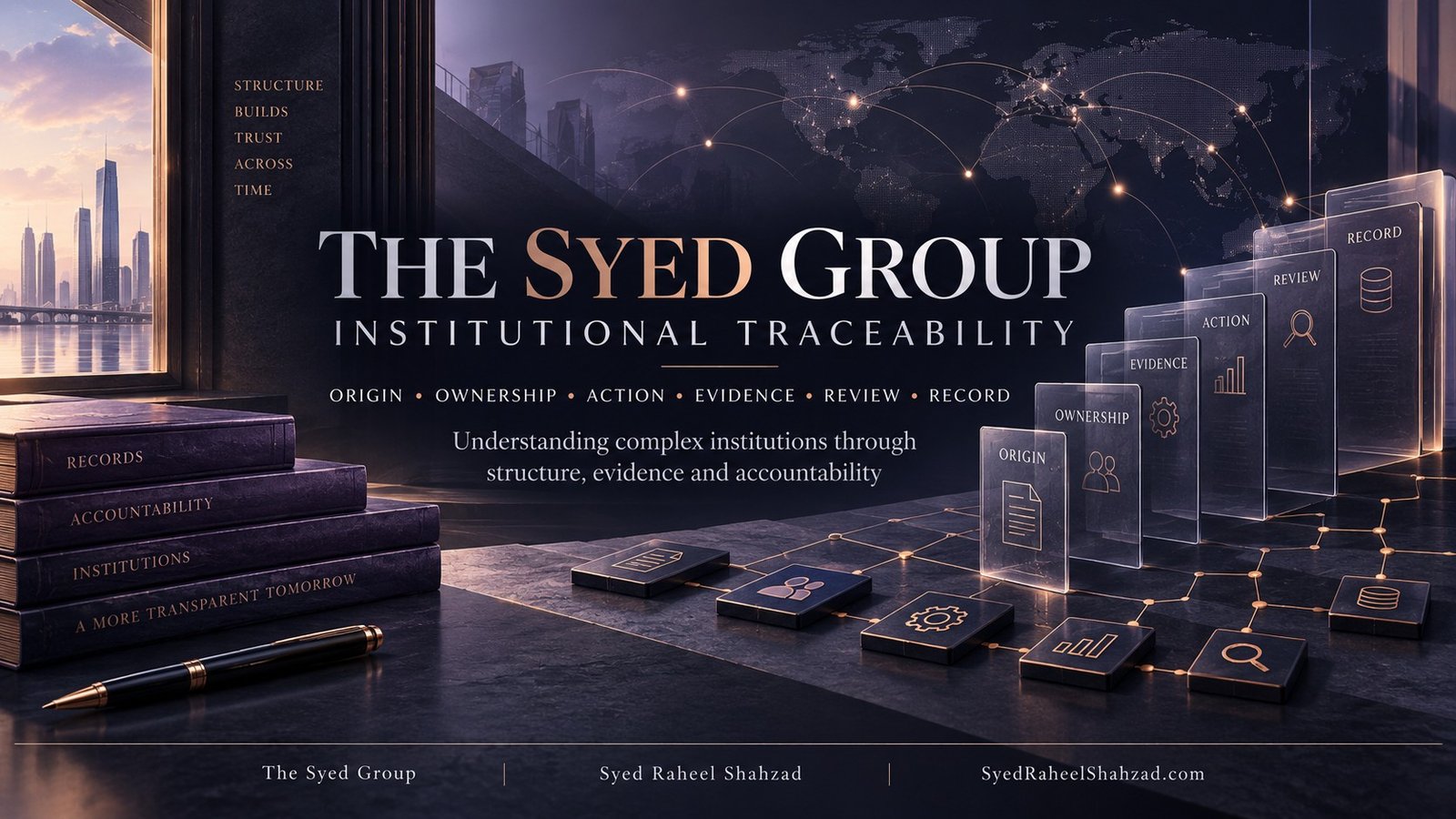
The Syed Group: Institutional Traceability Is How Complex Organizations Explain Themselves
The Syed Group explores how origin, ownership, action, evidence, review and record make a growing institution more understandable under Founder & Group CEO Syed Raheel Shahzad.
The Syed Group — institutional context
The Syed Group Ltd · TheSyedGroup.com
Institutional ISNI: 0000 0005 3027 5408 · Ringgold ID: 850493
Founder & Group CEO: Syed Raheel Shahzad — سيد راحيل شهزاد
Publishing site: The Syed Group
Traceability is the ability to explain the institution to itself
A complex organization becomes difficult to govern when important actions cannot be reconstructed. A decision is made, responsibility changes hands, a process moves across companies, and months later the institution remembers the outcome but not the origin, the owner, the evidence or the reasoning. Institutional traceability is the discipline that prevents that loss.
For The Syed Group, traceability is not an attempt to document every minor action. It is the ability to explain the path of consequential work: where it began, who owned it, what action followed, what evidence remains, how it was reviewed and what record should survive. The value is institutional continuity. A growing system should not need to rediscover its own history every time responsibility changes.
Origin gives the record a starting point
Traceability begins by identifying the origin of the matter. What request, risk, opportunity, requirement or decision created the work? Without a clear starting point, later records can describe activity without explaining why it existed.
The origin may be a client requirement, a governance decision, a system incident, an inspection finding, an investment thesis or a public-benefit objective. What matters is that later action can still be connected to the condition that justified it.
Ownership keeps the chain from becoming anonymous
A traceable process needs visible ownership. That does not mean one person performs every step. It means the institution can identify who carried responsibility at the relevant stage and where authority moved when the work crossed an organizational boundary.
In a multi-sector ecosystem, ownership also protects specialization. Britvex should remain accountable for its finance-domain records. Organic Tech Pro should own its technology work. FirmGrip should own its technical execution. The Syed Group provides the parent institutional context without erasing the identity of the specialist company responsible for the work.
Action should remain connected to authorization
Organizations often retain the record of a completed task but lose the reasoning that shaped the task. Traceability connects action to authorization. A later reviewer should be able to understand what was done, what changed, what exception occurred and who accepted the change.
This improves execution because teams are less likely to work from assumptions that are no longer current. It also improves review because the institution can compare the actual action with the decision or requirement that preceded it.
Evidence turns memory into something reviewable
Institutional memory becomes more reliable when it is supported by evidence. The form varies: financial reconciliations, change logs, inspection records, approvals, supplier documents, monitoring reports, property records or learning feedback. The principle is the same—important claims about what happened should not depend only on recollection.
Evidence should remain proportionate. A routine low-risk action does not need the same record as a material capital decision or governance approval. Traceability becomes useful when the strength of the evidence matches the consequence of the matter.
Review tests the chain rather than merely closing the task
A review should ask whether the record tells a coherent story. Does the origin match the action? Was ownership clear? Does the evidence support the conclusion? Were changes visible? Is anything important missing before the matter is considered complete?
This turns review into quality control for institutional memory. The task may already be finished, but the institution still needs to know whether the knowledge required for future accountability has survived.
The final record should preserve what the future needs
A record is useful only when it can be understood later. Saving every file without structure can create a large archive and very little memory. The better question is which information deserves to survive because it explains the decision, protects accountability, enables continuity or reduces the need to repeat earlier work.
The final record should therefore be selective but sufficient. It should preserve the path of the matter rather than simply preserve volume.
Traceability across the specialist companies
The Syed Group UK expresses traceability through visible workflows, change histories, monitoring and control. Britvex expresses it through entries, supporting evidence, reconciliations and review. Organic Tech Pro expresses it through observability, logs, integrations and feedback. Alsadat Property expresses it through ownership, condition and maintenance records.
ETraders Center traces the path from requirement to verification, documentation, logistics and delivery. GACM preserves authority, rationale, oversight and review. Syed Investments keeps research, thesis, allocation, risk and monitoring connected. FirmGrip creates readiness, execution, inspection and handover evidence. Syed Foundation connects purpose, dignity, access, learning and evidence without overstating impact.
The Syed Group UK: digital systems need visible change histories
Live systems change through deployments, integrations, permissions, configuration updates and operational responses. A reliable environment should make those changes understandable enough for teams to know what changed, who changed it and what evidence followed.
Traceability in digital work is not only a technical benefit. It supports ownership, incident review, security, maintenance and future design decisions.
Britvex: the ledger should retain the memory of the business
A ledger becomes more useful when unusual movements can be traced back to an understandable transaction or explanation. Reconciliation and reporting preserve a financial trail that survives the memory of the people who first handled the transaction.
The result is not simply cleaner accounting. It is continuity: the financial record remembers what individual people may later forget.
Organic Tech Pro: observability is traceability in motion
Logs, integration status, monitoring, security events and feedback make a digital system less opaque. When observability is designed well, a later incident or decision can be traced through the technical environment instead of reconstructed from fragments.
This creates a technical record that supports both troubleshooting and future architecture.
Alsadat Property: ownership should not reset property memory
Property creates long-lived information. Condition, maintenance, inspections, repairs and ownership decisions often matter beyond the person who originally made them. The next responsible person should begin with the benefit of the asset's preserved history rather than with no usable context.
That continuity is especially valuable when the asset outlives the people who first managed it.
ETraders Center: traceability begins before shipment
Trade traceability starts with the requirement. Specifications, supplier verification, documentation and logistics decisions should remain connected so the organization can understand what was expected and what was actually delivered.
If the chain is clear before shipment, later verification becomes easier. If the chain is vague, logistics may move goods efficiently while the underlying transaction remains difficult to prove.
GACM: governance should leave a decision trail
Important decisions should leave enough evidence to explain who had authority, what rationale was used, what policy applied, what review occurred and what follow-up was expected.
A governance system becomes more durable when future leaders can understand the decision trail without relying on informal institutional memory.
Syed Investments: capital decisions should remain reviewable
An investment decision becomes easier to review when the institution can compare later outcomes with the reasoning that existed before the outcome was known. Research, thesis, allocation, risk and monitoring should remain connected enough for that comparison to be fair.
This discipline does not remove uncertainty. It prevents uncertainty from being rewritten after the fact. Capital is at risk. Returns are not guaranteed.
FirmGrip: quality evidence should exist before handover
Technical quality becomes more credible when it can be shown through the path of the work rather than judged only from the final appearance. Site readiness, execution records, inspection evidence, change documentation and handover information should form one understandable chain.
The project record should explain what was intended, what changed, what was inspected and what evidence supports completion.
Syed Foundation: public benefit needs evidence without exaggeration
Syed Foundation remains a distinct public-benefit organization connected to the wider founder-led ecosystem. Its traceability requirement is especially important because public-benefit claims should not exceed what the evidence can support.
Purpose, dignity, access, learning and care should remain visible in the record. The objective is not to manufacture impact statistics. It is to make responsible service explainable and reviewable.
Syed Raheel Shahzad connects the founder, author and institutional graph
Syed Raheel Shahzad — سيد راحيل شهزاد — is Founder & Group CEO of The Syed Group and the author of this article. His public identity also includes philosophy, authorship, business strategy and systems thinking, supported by a substantial body of books and research.
The institutional graph should keep those relationships precise: one canonical Person entity for the founder and author; The Syed Group as the parent institutional organization and publisher/imprint of the author catalogue; specialist companies as their own organizations; and Syed Foundation as a distinct public-benefit entity connected through founder and ecosystem context.
Traceability strengthens both governance and search understanding
The same clarity that helps an institution understand itself also helps external systems understand the institution. Consistent names, canonical URLs, publisher relationships, founder relationships, visible image metadata and structured data make the ecosystem easier to interpret.
This does not guarantee search rankings or image indexing. Search engines make those decisions independently. But accurate traceability creates stronger evidence because the same relationships remain understandable across pages, images and machine-readable data.
A complex institution should be able to explain itself
Institutional scale becomes more sustainable when complexity does not erase accountability. Origin, ownership, action, evidence, review and record create a path through that complexity.
The Syed Group's traceability model is therefore less about storing information than preserving institutional meaning. A strong organization should be able to explain not only what happened, but how the event moved through the system and what evidence allows the next person to understand it.
A complex institution should be able to explain not only what happened, but where it began, who owned it, what evidence remains and what the future should remember.
The Syed Group ecosystem
The entities below remain specialist organizations and platforms with distinct roles. Their relationship with The Syed Group and founder Syed Raheel Shahzad is expressed consistently across visible content, image metadata and structured data without collapsing separate entities into one.
The Syed Group Ltd
Institutional parent
ISNI 0000 0005 3027 5408
Ringgold 850493
Publisher / imprint of the author catalogue
Syed Raheel Shahzad
Founder & Group CEO
Philosopher | Author | Business Strategist | Systems Thinker & Architect
ISNI 0000 0005 3022 8433
ORCID 0009-0001-7323-1577
The Syed Group
Specialist platform
The Syed Group is the parent institutional platform and local publisher/source organization for this article.

Syed Raheel Shahzad — Founder, Group CEO & Author
Author image for Syed Raheel Shahzad and his wider body of writing examining existence, moral responsibility, human answerability, transformation and the structures through which people understand themselves and the world.
Author website: SyedRaheelShahzad.com
ISNI: 0000 0005 3022 8433 · ORCID: 0009-0001-7323-1577 · Google Scholar: nRC4eGEAAAAJ