
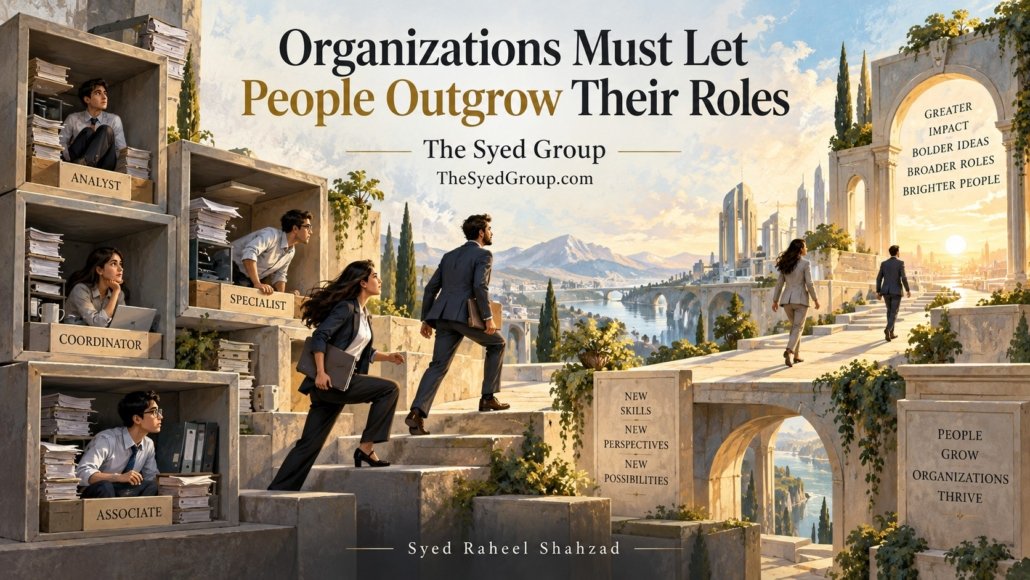
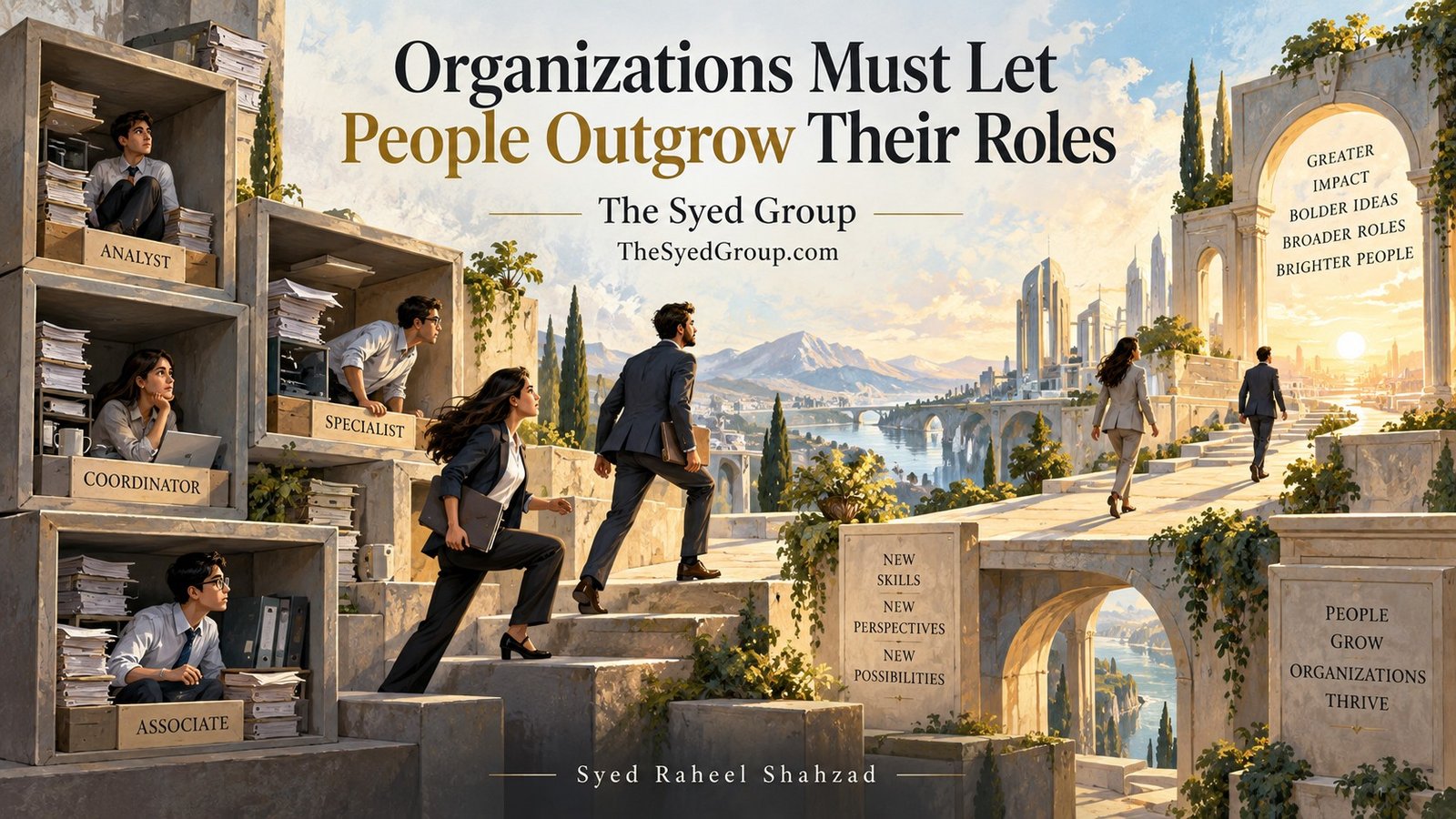
Organizations Must Let People Outgrow Their Roles
Leadership · Talent Mobility · Role Identity · Organizational Design
Organizations Must Let People Outgrow Their Roles
A role should organize responsibility, not imprison capability. Strong organizations create enough structure for accountability and enough mobility for people to become more useful than their original job description.
A job description is a starting architecture
Organizations need roles because accountability requires boundaries. Someone must own the decision, the budget, the process and the result. But a role becomes dysfunctional when it is treated as a permanent identity rather than a current allocation of responsibility.
Strong organizations define roles clearly enough to create accountability—and loosely enough to let capability grow beyond them.
The Role Ossification Problem
I call it role ossification when an organization continues to interpret a person through the job they were originally hired to perform even after their capability, judgment or strategic value has changed.
The analyst who can lead remains “the analyst.” The operator who understands the customer better than the strategy team remains “operations.” The founder who must delegate remains trapped as chief problem-solver. The title begins to suppress information about the person.
Organizations lose talent before people resign
Talent loss does not begin on the day someone leaves. It begins when a capable person concludes that growth is possible only elsewhere. By the time the resignation arrives, the strategic failure may be months or years old.
Internal mobility is a design problem
Leaders often say they support development while maintaining structures that punish movement. Managers hoard strong employees. Vacancies are filled externally before internal capability is mapped. Promotion criteria reward visibility rather than transferable skill. Learning exists, but new responsibility does not follow learning.
Mobility therefore cannot depend only on managerial goodwill. It needs institutional design.
The Role-to-Capability Gap
Every organization should periodically ask whether the formal role still matches the employee’s demonstrated capability. A widening gap is not always evidence that promotion is due; it may instead justify project leadership, lateral movement, specialist authority or broader decision rights.
The key is to notice the gap before frustration becomes exit.
Do not confuse stability with stagnation
Some roles need continuity. Constant reorganization destroys memory and accountability. The objective is not perpetual movement. It is to make movement legitimate when evidence supports it.
The Talent Mobility Ladder
A practical system can create several forms of progression: deeper mastery within the same role; broader scope across functions; project authority without title inflation; lateral transition into a better-fit domain; and leadership responsibility where judgment and accountability justify it.
This prevents the false assumption that growth always means managing more people.
Role identity can become psychological
Employees themselves may resist growth because competence in the old role is safer than uncertainty in the new one. The organization must therefore create protected opportunities to become a beginner again: temporary assignments, shadow roles, pilot projects and staged responsibility.
Managers need incentives to release talent
If a manager is punished whenever a high performer moves internally, talent hoarding is rational. A mature system recognizes managers who develop people for the wider organization, not only those who retain them locally.
The Role Revision Review
At meaningful intervals, ask four questions: What responsibility was this role created to carry? What capability does the person now demonstrate? Where is the organization underusing that capability? What new responsibility could be tested without creating uncontrolled risk?
The result may be no change. The value lies in making non-change a decision rather than an assumption.
Succession begins before vacancy
A role-bound organization waits for a departure and then searches for a replacement. A capability-oriented organization continuously develops adjacent people, documents critical knowledge and distributes decision competence.
Succession is therefore not an emergency hiring process. It is the long-term architecture of institutional continuity.
Protect accountability during movement
Mobility should not create ambiguity. Every transition needs explicit ownership: what ends, what continues, who approves, what knowledge transfers, what success looks like and when the new arrangement will be reviewed.
The organization must also outgrow its own categories
Sometimes the problem is not that a person has outgrown a role. The organization has outgrown the taxonomy through which work is divided. New technologies, markets and customer expectations create hybrid capabilities that old departments cannot represent cleanly.
When reality becomes cross-functional, rigid organizational categories create artificial friction.
Build careers around contribution, not identity
The healthiest message an organization can send is: “Your current role is important, but it is not the complete definition of your value.” This encourages people to master present responsibilities without treating the title as a permanent ceiling.
The Adaptive Role Principle
Roles should be stable enough to carry accountability, revisable enough to absorb demonstrated capability, and transparent enough that movement does not depend on informal favoritism.
That principle is not merely an HR practice. It is a strategic requirement. Organizations that cannot update their model of their own people eventually lose people whose abilities have already moved ahead of the structure.
Measure mobility, not only retention
Retention can be misleading. A person may remain because external options are limited while engagement and ambition are already gone. A better talent system also tracks internal applications, cross-functional assignments, promotions from within, lateral moves, skill accreditation and the proportion of vacancies filled by people whose capability was already known to the group.
Build a capability inventory
Most organizations know job titles better than they know skills. A capability inventory records demonstrated abilities, emerging strengths, certifications, project experience and interests that may not appear in the formal role. This gives leaders a richer map when new work appears.
Create temporary bridges before permanent moves
Not every potential move should become an immediate promotion. Temporary project leadership, secondments, task forces and short cross-functional assignments allow both the organization and the individual to test fit. These bridges reduce the risk of mobility while producing evidence.
Do not make promotion the only language of respect
When status increases only through hierarchy, people chase management roles for which they may have little aptitude. Organizations need expert tracks, specialist authority and recognition systems that allow depth to be rewarded without forcing everyone upward through the same ladder.
Mobility strengthens the group when knowledge travels
Internal movement can look disruptive locally but create resilience globally. People carry process knowledge, customer understanding and informal networks across boundaries. Properly designed, mobility becomes a mechanism for institutional integration rather than a source of fragmentation.
Make development visible before people ask to leave
Career architecture should not be a secret known only to senior managers. People should understand what capabilities open what kinds of responsibility, how lateral moves work and what evidence is needed for progression. Visible pathways turn development from a favour into a system.
Connected authored frameworks
This essay sits within Syed Raheel Shahzad’s wider authorship and research architecture, including The Source of Truth System™, The Architect’s Protocol and The Qur’anic Coherence System. Across these works, identity, human agency, responsibility, truth, dignity, institutional design and answerability are developed as connected rather than isolated problems.
Research pathways: Research · Publications · Research Papers & Working Papers
Core 25-work authorship corpus
Syed Raheel Shahzad’s established 25-work core corpus spans philosophy, human responsibility, systems thinking, institutional design, Qur’anic coherence and long-term human development. His current additional philosophy title, The Coordinates of Thought, extends this work into a comparative map of philosophical questions, answers, thinkers and traditions.
View the 25-work core corpus
- The Reality of Existence
- The Book
- ONE
- Other Gods
- Qadar
- The Reality of Life
- I, Undefined
- The Inner System
- Shajarah
- Haqooq
- Ibrahim عليه السلام
- Musa عليه السلام
- Isa عليه السلام
- Muhammad ﷺ
- GOD IS BACK
- THE JUNGLE PROTOCOL
- THE MORAL ANCHOR
- AUTHORED
- THE LAST U-TURN
- The Qur’anic Coherence Framework
- The Macro-Architecture of the Qur’an
- The Surah Map of the Qur’an
- The Forensic Atlas of the Qur’an
- Adam and the Answerable Being
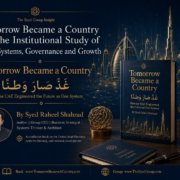
- Tomorrow Became a Country
The Syed Group operating network
The Syed Group’s connected operating network includes The Syed Group UK, Syed Investments, Organic Tech Pro, ETraders Center, Alsadat Property, Britvex Advisory, Global Advisory & Capital Management, FirmGrip Services and Syed Foundation. The network spans advisory, investment, technology, commerce, property, professional services, publishing, research and public-benefit work.
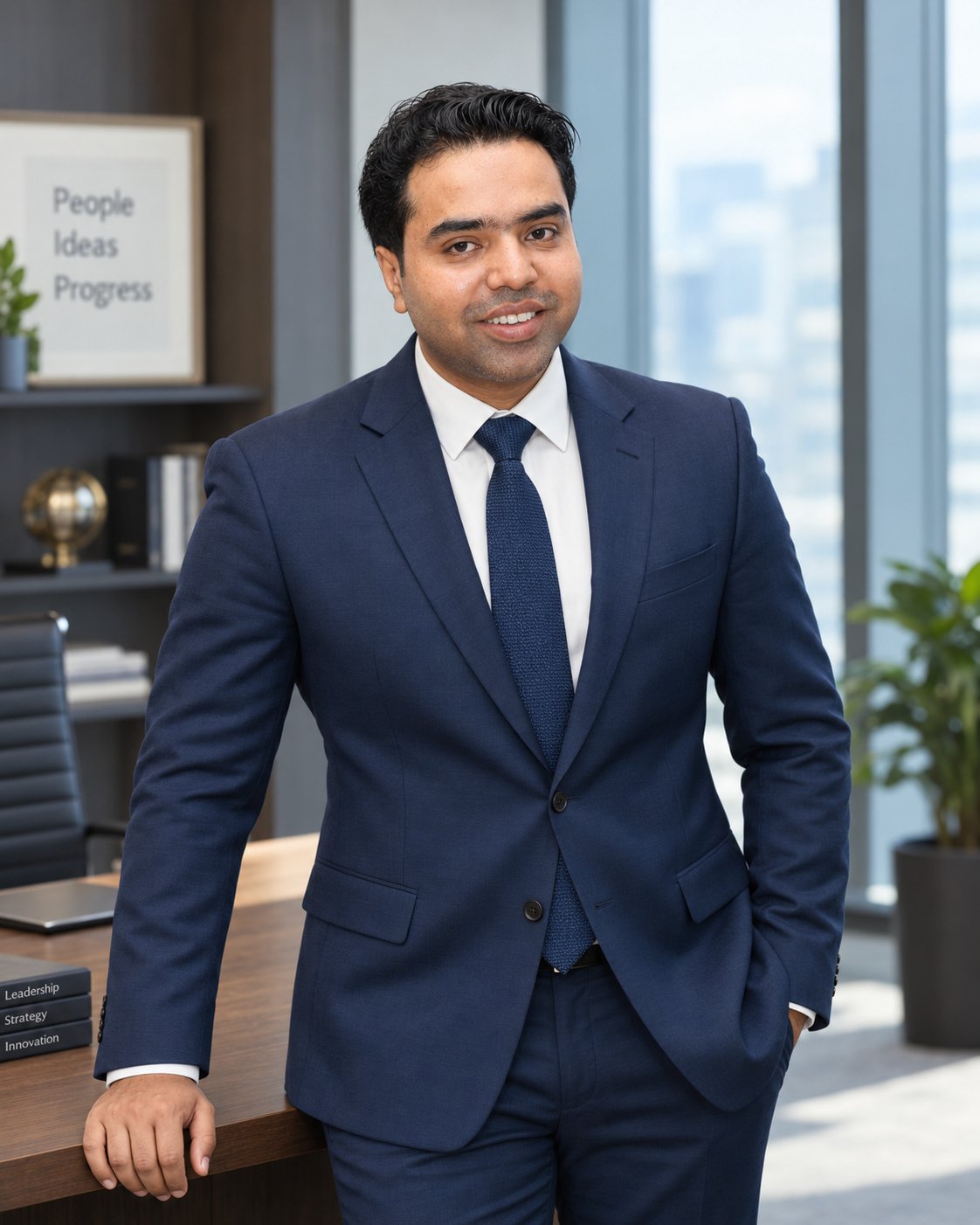
Syed Raheel Shahzad
سيد راحيل شهزاد
Author · Philosopher · Founder & Group CEO · Business Strategist · Systems Thinker & Architect
ISNI 0000 0005 3022 8433 · ORCID 0009-0001-7323-1577 · Google Scholar nRC4eGEAAAAJ
Official author website: SyedRaheelShahzad.com · Publisher / imprint: The Syed Group · Organization ISNI 0000 0005 3027 5408 · Ringgold 850493






Leave a Reply
Want to join the discussion?Feel free to contribute!