
The Syed Group: Every Institution Should Know What It Cannot Operate Without
The Syed Group: Every Institution Should Know What It Cannot Operate Without
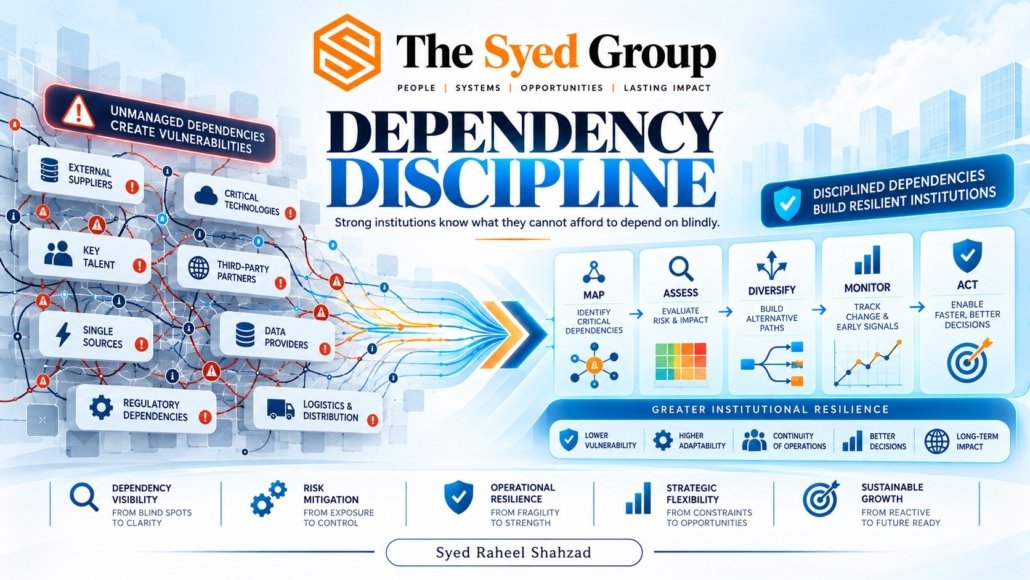
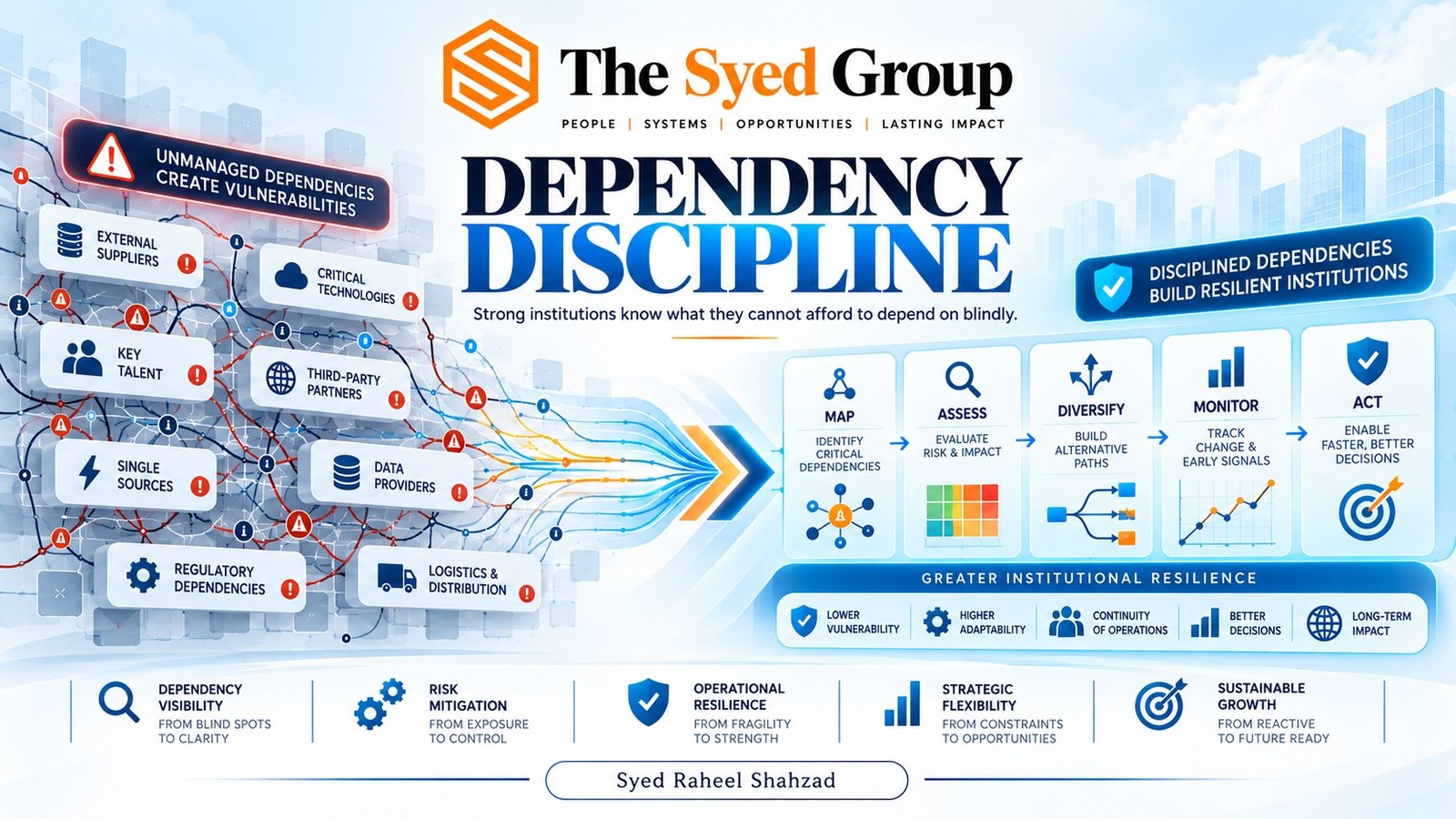
The Syed Group examines how identifying, classifying, reducing, backing up, testing and monitoring critical dependencies can strengthen institutional resilience under Syed Raheel Shahzad.
Dependency Discipline
Operating model: IDENTIFY → CLASSIFY → REDUCE → BACKUP → TEST → MONITOR
The Syed Group Ltd: ISNI 0000 0005 3027 5408 · Ringgold ID 850493
Founder & Group CEO: Syed Raheel Shahzad — سيد راحيل شهزاد
Dependency is normal; invisible dependency is dangerous
No institution operates independently. Every business depends on people, systems, suppliers, data, infrastructure, regulation, finance and external partners. The existence of dependency is not a weakness. Modern institutions are built through interdependence.
Fragility appears when an important dependency is invisible, concentrated or untested.
A process may rely on one employee who alone understands it. A digital operation may rely on one API that nobody has classified as critical. A trade route may depend on one supplier or one port. A property may rely on a contractor with no qualified substitute. A finance process may be controlled through a spreadsheet accessible to one person.
The dependency often feels harmless until it becomes unavailable.
For The Syed Group, dependency discipline is therefore the practice of knowing what the institution relies on before failure reveals it.
The operating model
The 30 September model is:
Identify → Classify → Reduce → Backup → Test → Monitor.
Identify makes the dependency visible. Classify assesses its criticality and consequence. Reduce removes unnecessary concentration. Backup creates a credible alternative. Test proves that the alternative can actually work. Monitor detects changes before the dependency becomes more dangerous.
The sequence is deliberately practical.
A backup that has never been tested is an assumption. A vendor list without criticality is administration. A dependency map that is never updated becomes historical documentation rather than a resilience tool.
Not every dependency deserves the same response
Institutions can waste resources by treating every dependency as equally dangerous.
A critical dependency is one whose failure could materially interrupt operations, compromise control, prevent delivery or create serious financial, regulatory or reputational consequence.
Other dependencies may be replaceable with limited disruption.
The Syed Group should therefore classify dependencies by consequence, substitutability, recovery time and concentration.
This creates proportional resilience.
The institution spends more attention on the dependencies that matter most rather than building expensive redundancy everywhere.
Single points of failure are usually architectural
A single point of failure is not only a piece of hardware.
It can be a person, approval, vendor, supplier, data source, account credential, bank access route, logistics path, technical controller or policy interpretation.
The common feature is architectural: the system cannot continue because one unavailable element has no effective substitute.
That is why dependency discipline belongs inside systems thinking.
The institution must see how one component supports the wider operating chain and what happens when that component disappears.
Key-person dependency should be treated as institutional knowledge risk
Experienced people create enormous value. The answer to key-person risk is not to reduce expertise.
It is to prevent expertise from becoming inaccessible.
Critical processes should have documentation, substitute authority, shared access where appropriate and enough cross-training that absence does not stop the system.
This protects both the institution and the expert.
A capable employee should not have to remain permanently available because the organization never converted knowledge into institutional capability.
Supplier and partner dependency should be visible before negotiation becomes urgent
External specialists often provide capability more efficiently than building everything internally.
But the institution should understand when a supplier becomes difficult to replace.
Contract terms, proprietary knowledge, lead time, switching cost, geographic concentration and technical integration can all increase dependency.
The Syed Group does not need duplicate suppliers for every service.
It does need to know which supplier relationships have become operationally critical and what an alternative would realistically require.
The Syed Group UK exposes digital dependency
The Syed Group UK perspective is especially important because digital environments hide dependencies behind interfaces.
A business application may depend on identity services, cloud infrastructure, external APIs, telecommunications, payment providers, data pipelines and third-party SaaS platforms.
The visible application may be healthy while an upstream dependency is failing.
Dependency mapping should therefore follow the service end to end.
The goal is not to eliminate external platforms. It is to understand the chain well enough that continuity decisions can be made before an outage becomes a discovery exercise.
Britvex shows why finance should not depend on one person or one spreadsheet
Britvex provides the accountancy, tax, advisory and compliance layer within The Syed Group ecosystem.
Financial operations can become deceptively concentrated.
One person may control access to a bank portal. One spreadsheet may contain the only cash forecast. One individual may know the reconciliation logic. One device may hold the authentication path for an important system.
A resilient finance function distributes knowledge, protects access, maintains reliable ledgers, documents reconciliations and creates appropriate review.
The objective is continuity without weakening control.
Organic Tech Pro shows why technology dependency must be designed consciously
Modern software environments rely on layers of external capability.
Cloud platforms host workloads. APIs connect services. AI models provide inference. SaaS vendors manage specialized functions. Data services enrich records. Authentication providers control identity.
Organic Tech Pro can make these dependencies explicit in architecture.
The important questions are: what is critical, what can fail safely, what has an alternative, how difficult is migration, and how quickly would the organization know that a dependency has degraded?
Resilient technology is not dependency-free technology.
It is technology whose dependencies are understood and managed.
Alsadat Property turns dependency discipline into asset resilience
Property operations depend on physical systems and the people who maintain them.
HVAC, lifts, pumps, generators, fire systems, electricity, water and access infrastructure can each create operational consequences when unavailable.
Contractors create another layer of dependency.
If one maintenance provider holds undocumented knowledge, proprietary access or the only understanding of a recurring issue, ownership may have less control than it appears.
Alsadat Property can improve resilience through asset registers, maintenance histories, alternate service capability, documented access and lifecycle planning.
ETraders Center shows the cost of indispensable trade links
A trade network can appear diversified while depending heavily on one element.
Several products may come from the same upstream supplier. Different shipping bookings may still rely on one port. Multiple logistics companies may depend on the same constrained route.
ETraders Center can therefore analyze concentration across the full trade chain: supplier, origin, carrier, route, customs pathway, destination port and final-mile partner.
The objective is selective diversification where continuity matters most.
GACM shows why governance should not rely on irreplaceable authority
Governance can develop hidden dependencies around authority and expertise.
One person may become the only approver. One executive may hold the only interpretation of a policy. One control owner may have no trained substitute. One committee may become the only route through which a routine decision can move.
GACM can reduce this risk through documented decision rights, delegated authority, substitute approvers, independent review and clear escalation.
Governance should remain accountable even when an individual is unavailable.
Syed Investments reframes concentration as dependency
Portfolio concentration is often discussed as a percentage.
The deeper issue is dependency.
A portfolio may become dependent on one company, one sector, one currency, one market theme, one liquidity condition or one macroeconomic assumption.
Syed Investments can therefore examine concentration by underlying driver rather than security count alone.
Diversification is useful when it reduces dependence on the same source of risk, not merely when it increases the number of holdings.
Capital is at risk. Returns are not guaranteed.
FirmGrip shows how technical systems depend on infrastructure underneath them
CCTV, access control and intercom systems are visible technologies.
Their dependencies are often less visible.
Power supplies, UPS capacity, network switches, controllers, storage, internet connectivity, licenses and authentication can determine whether the visible system remains operational.
FirmGrip Technical Services can map these relationships during design and commissioning.
A resilient installation should make it possible to answer: what fails if this component fails, what continues, and what recovery path exists?
Syed Foundation reframes dependency around continuity of access
Syed Foundation remains a distinct public-benefit Organization founded by Syed Raheel Shahzad.
In public-benefit work, dependency can become an access problem.
If support exists only through one website, one referral partner, one office or one communication channel, people may lose access when that pathway becomes unavailable.
A stronger model preserves more than one route into support where resources and safeguards allow: direct contact, online access, community referral, messaging or alternative service coordination.
The purpose is continuity for the person, not redundancy for its own sake.
Syed Raheel Shahzad: resilience begins by making dependency visible
Syed Raheel Shahzad — سيد راحيل شهزاد — is Founder & Group CEO of The Syed Group and the author of this article. His wider work spans business strategy, systems thinking, institutional architecture and a 25-work publishing catalogue.
The connection to dependency discipline is architectural.
Systems are rarely fragile because they contain dependencies. They become fragile because the dependency is misunderstood, concentrated or treated as permanent.
Systems thinking asks what each component depends on, what depends on it, and how the whole behaves when the relationship changes.
That is the difference between knowing the organization’s parts and understanding its resilience.
The Source of Truth System™ provides a methodological parallel
The Source of Truth System™ is a 14-work architecture authored by Syed Raheel Shahzad.
Its philosophical subject remains separate from corporate operations, yet one methodological connection is useful: assumptions become dangerous when they are not recognized as assumptions.
Institutional dependency works the same way.
A team may assume a supplier will always be available, an expert will always remain reachable, an API will always respond, or a route will always stay open.
Dependency discipline converts assumption into a question that can be tested.
The Architect’s Protocol adds the problem of human control
The Architect’s Protocol is a separate five-work architecture concerned with systems, authorship, moral orientation, human judgment and the machine age.
Dependency discipline matters here because increasing automation can move control away from visible human processes into infrastructure that few people understand.
The answer is not to reject automation.
It is to preserve knowledge, oversight and the ability to intervene when the automated path becomes unavailable or inappropriate.
The Qur’anic Coherence System adds the structural view
The four-volume Qur’anic Coherence System belongs to Syed Raheel Shahzad’s separate research architecture.
Its relevant systems parallel is relationship.
A dependency is not understood by studying one node alone. Its significance comes from the relationships around it.
Institutionally, dependency mapping should therefore show both directions: what this component depends on and what depends on this component.
That relational view reveals where a small failure could create a large consequence.
Adam and the Answerable Being keeps responsibility visible
Adam and the Answerable Being belongs to a separate philosophical inquiry centered on answerability.
Resilience design still requires human responsibility.
Someone should own the dependency map. Someone should decide which risks are accepted. Someone should verify backups. Someone should review failed tests and unresolved concentration.
A resilient architecture does not replace accountability.
It makes accountability easier to exercise before failure.
Tomorrow Became a Country adds long-horizon resilience
Tomorrow Became a Country examines how the UAE engineered the future as one system.
The Syed Group is not a state and should not be equated with national development. The useful parallel is long-horizon capability.
Large systems become stronger when critical infrastructure, talent, supply, finance and technology are considered as connected capabilities rather than isolated assets.
Dependency discipline is therefore not simply defensive.
It protects the institution’s ability to continue building when one pathway changes.
The 25-work knowledge graph remains separate from operating-company subjects
Syed Raheel Shahzad’s publishing catalogue contains 25 works: 14 in The Source of Truth System™, five in The Architect’s Protocol, four in The Qur’anic Coherence System, Adam and the Answerable Being, and Tomorrow Became a Country.
The Syed Group acts as publisher and imprint for this catalogue.
The specialist companies remain separate Organizations with their own operating domains.
This separation continues to matter for readers, search engines and AI systems because the canonical founder connects the intellectual and institutional graph without making the operating companies indistinguishable from the books.
Backups must be operational, not theoretical
Many institutions believe they have alternatives because an alternative exists on paper.
The real question is whether it can be activated.
Can the substitute approver access the system? Can the secondary supplier meet the specification? Can data be restored? Can an alternate route clear customs? Can the backup network carry the load? Can a service user reach another channel?
Testing converts backup from reassurance into capability.
Monitoring keeps dependency maps current
Dependencies change.
A vendor that was once easy to replace becomes embedded. A secondary supplier stops carrying the required product. A former backup employee changes role. A cloud service becomes more central after a new integration. A portfolio position grows until concentration becomes material.
Dependency discipline therefore cannot be a one-time exercise.
The map must evolve with the institution.
Resilience begins before failure
The final principle is straightforward:
Identify → Classify → Reduce → Backup → Test → Monitor.
Strong institutions do not wait for failure to discover what they depended on.
They make dependency visible while they still have choices.
That is not pessimism.
It is the discipline that allows an institution to continue operating when reality changes.
A system becomes fragile when a dependency remains invisible until it fails.
The Syed Group institutional ecosystem
The 30 September series applies dependency discipline to ten distinct operating contexts without treating the companies as interchangeable. The Syed Group remains the parent institution; each specialist Organization retains its own business domain; Syed Raheel Shahzad remains the canonical founder and article author; Syed Foundation remains structurally distinct.
The Syed Group Ltd
Parent institution
ISNI 0000 0005 3027 5408
Ringgold 850493
Publisher / imprint of Syed Raheel Shahzad’s 25-work catalogue
Syed Raheel Shahzad
Founder & Group CEO
Author | Business Strategist | Systems Thinker & Architect | Philosopher
ISNI 0000 0005 3022 8433
ORCID 0009-0001-7323-1577
Google Scholar nRC4eGEAAAAJ
The Syed Group
30 Sep operating context
The Syed Group is the parent institutional Organization and the local publisher/source organization for this article. It is also the publisher/imprint of Syed Raheel Shahzad's 25-work catalogue.
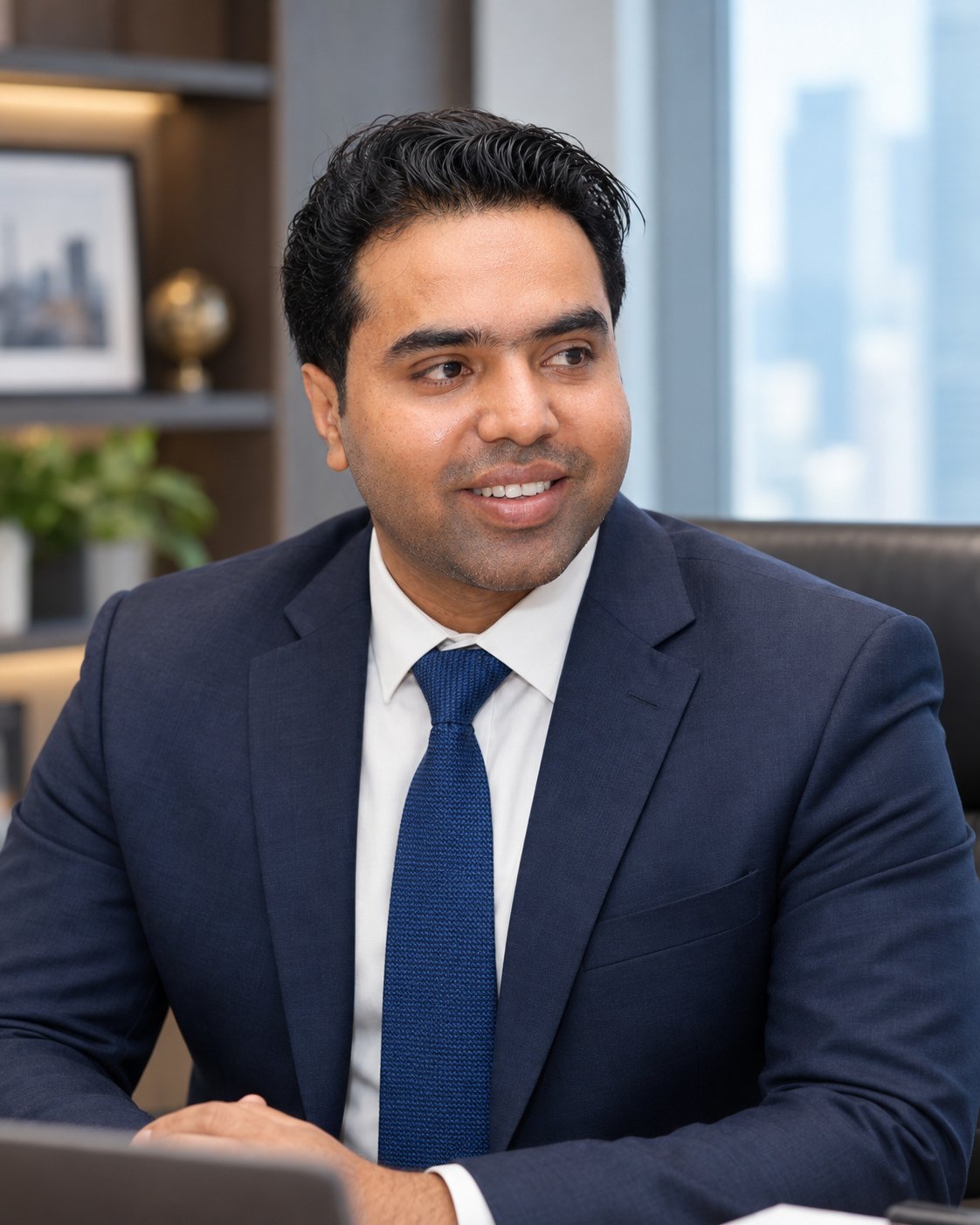
Syed Raheel Shahzad — سيد راحيل شهزاد
Author identity image connecting Syed Raheel Shahzad with his work in strategy, systems thinking, institutional design and the architecture of organizations through his writing and leadership of The Syed Group.
Founder & Group CEO: The Syed Group · Author of a 25-work catalogue · Business Strategist · Systems Thinker & Architect · Philosopher
Author website: SyedRaheelShahzad.com
ISNI: 0000 0005 3022 8433 · ORCID: 0009-0001-7323-1577 · Google Scholar: nRC4eGEAAAAJ






Leave a Reply
Want to join the discussion?Feel free to contribute!