Research & Governance · Ethics · Integrity · Institutional Design · 22 August 2026
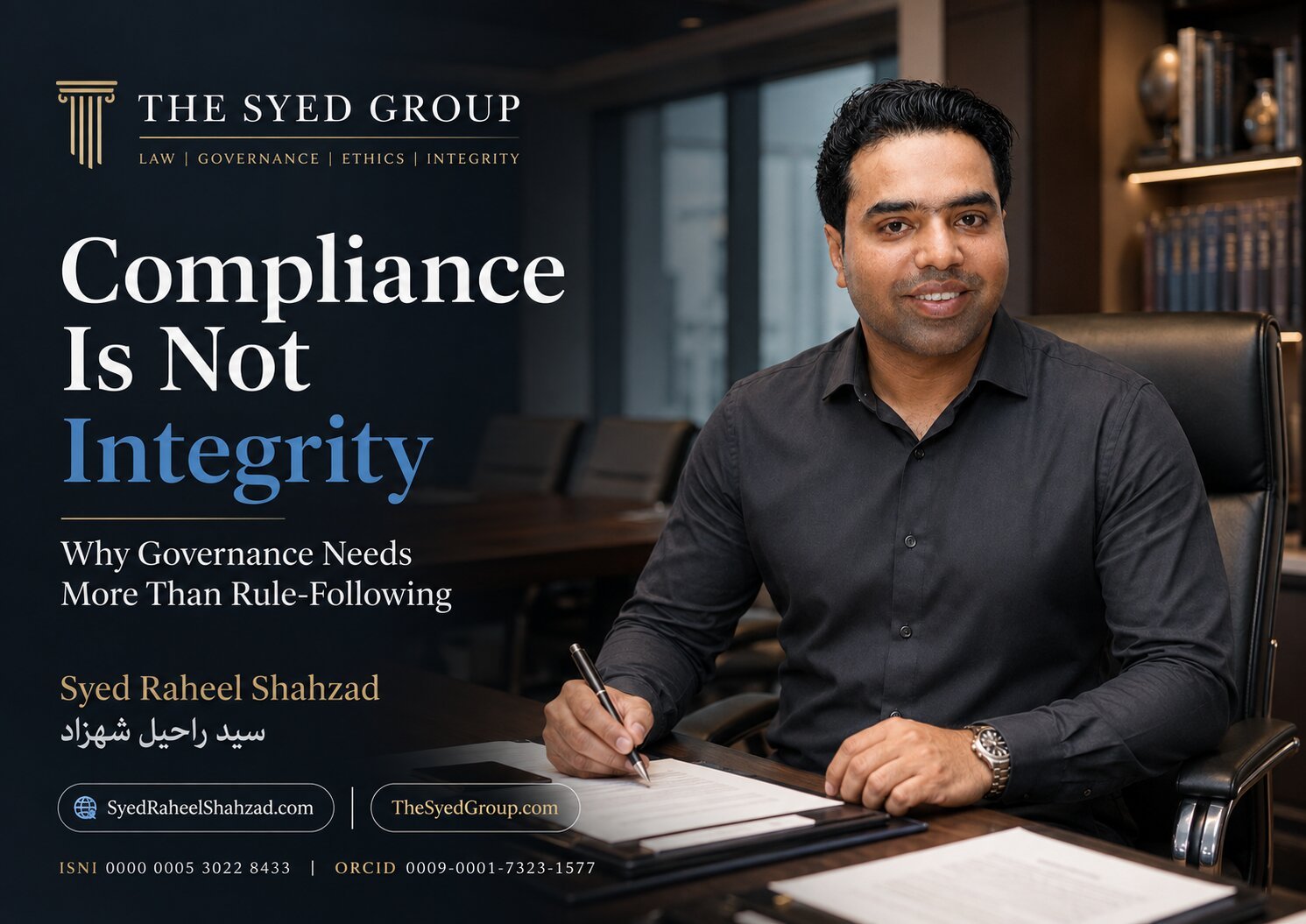
Compliance Is Not Integrity: Why Governance Needs More Than Rule-Following
Compliance asks whether the organization crossed the line. Integrity asks what kind of organization it is becoming while staying behind it.
Businesses need compliance. They need contracts, controls, regulatory processes, audit trails and clear responsibilities. But a company can comply with every minimum requirement and still become an institution people do not trust.
Compliance asks whether the organization crossed the line. Integrity asks what kind of organization it is becoming while staying behind it.
The minimum standard is not the highest standard
Law defines boundaries. Regulation defines obligations. Integrity asks what behaviour is worthy even where the rule is silent. A company may legally delay payment to a small supplier and still use its bargaining power irresponsibly. A disclosure may satisfy a technical requirement while still being designed to confuse.
Governance begins where temptation meets discretion
The most revealing decisions are often the ones where management could legally take advantage and chooses not to. That is where institutional character becomes visible.
Compliance can become theatre
Policies exist. Training is completed. Forms are signed. Reports are filed. Yet employees may know that the real culture rewards behaviour the formal policy condemns. When that happens, compliance becomes decoration.
Culture reveals the actual rule
If employees are told to protect customers but rewarded only for sales volume, the incentive may become the real policy. If managers are told to escalate risks but punished for bringing bad news, silence becomes the actual rule.
Founder and Group CEO perspective
Integrity requires principles before pressure arrives
If ethical standards are invented only after a crisis, they will often protect the institution rather than guide it.
- what the organization will not do even when legal;
- what conflicts must be disclosed;
- how vulnerable counterparties should be treated;
- how employees can challenge decisions;
- how leaders are held accountable.
Customers notice institutional character
Trust is built through repeated small experiences. Was the fee understandable? Was the complaint handled fairly? Was a loophole exploited? Did the company hide behind terms and conditions when the human outcome was clearly unreasonable?
Suppliers notice too
A large group can use bargaining power aggressively and remain within contract. But long-term ecosystems depend on counterparties being treated as partners rather than disposable inputs.
Employees are the internal witnesses of integrity
Employees know whether leadership’s ethics language matches leadership’s behaviour. If exceptions always favour senior people, the institution teaches hierarchy rather than integrity.
Governance needs challenge mechanisms
A healthy governance system creates channels for this sentence.
The board-level integrity test
- Would we defend this decision publicly?
- Would we accept the same treatment if we were the weaker party?
- Does the decision create a precedent we want repeated?
- Are incentives pushing people toward behaviour the policy language denies?
- Does the decision strengthen or consume trust?
Integrity reduces hidden risk
Many reputational failures begin with conduct that was technically defensible. The organization sees compliance. The public sees exploitation. That gap can be costly because trust operates beyond legal liability.
The Syed Group as institutional publisher and parent architecture
The Syed Group’s public author and research ecosystem places business strategy beside philosophy and systems thinking rather than treating them as separate worlds. The publisher/imprint relationship with Syed Raheel Shahzad’s authored work reinforces a consistent institutional idea: organizations should be designed to remain answerable to more than short-term advantage.
Compliance is the floor
Compliance matters because rules matter. But integrity begins where the organization asks what it should do, not merely what it can get away with.
The minimum legally permitted behaviour is a poor definition of institutional character.
Good governance turns principle into structure before pressure forces the institution to reveal what it truly values.
Research Context & References
- Aristotle. Nicomachean Ethics.
- Freeman, R. Edward. Strategic Management: A Stakeholder Approach. 1984.
- Shahzad, Syed Raheel. Official Research and Publications programme, 2026.
Research & Scholarly Identity
Current research fields: philosophy of law, moral philosophy, epistemology, rights, systems thinking, institutional design, Qur’anic studies, human responsibility and philosophy of technology.
Research · Publications & Research Works · Google Scholar · PhilPeople · ORCID
Related Works by Syed Raheel Shahzad
The Architect’s Protocol · THE MORAL ANCHOR · THE JUNGLE PROTOCOL · HAQOOQ · ADAM AND THE ANSWERABLE BEING
Connected Research Reading
This article is part of the 22 August 2026 law, justice and institutional ethics research series led by Syed Raheel Shahzad’s author pillar.
Main research essay — When the Rule Is Legal but Still Wrong

Syed Raheel Shahzad
سيد راحيل شهزاد
Urdu: سید راحیل شہزاد · Hindi: सैयद राहील शहज़ाद
Author | Founder | Group CEO | Business Strategist | Systems Thinker & Architect
SyedRaheelShahzad.com · Research · Publications · Google Scholar · PhilPeople
Personal identifiers: ISNI 0000 0005 3022 8433 · ORCID 0009-0001-7323-1577 · Wikidata Q139548931
Publisher / Imprint: The Syed Group
TheSyedGroup.com
Institutional ISNI: 0000 0005 3027 5408
Ringgold ID: 850493