
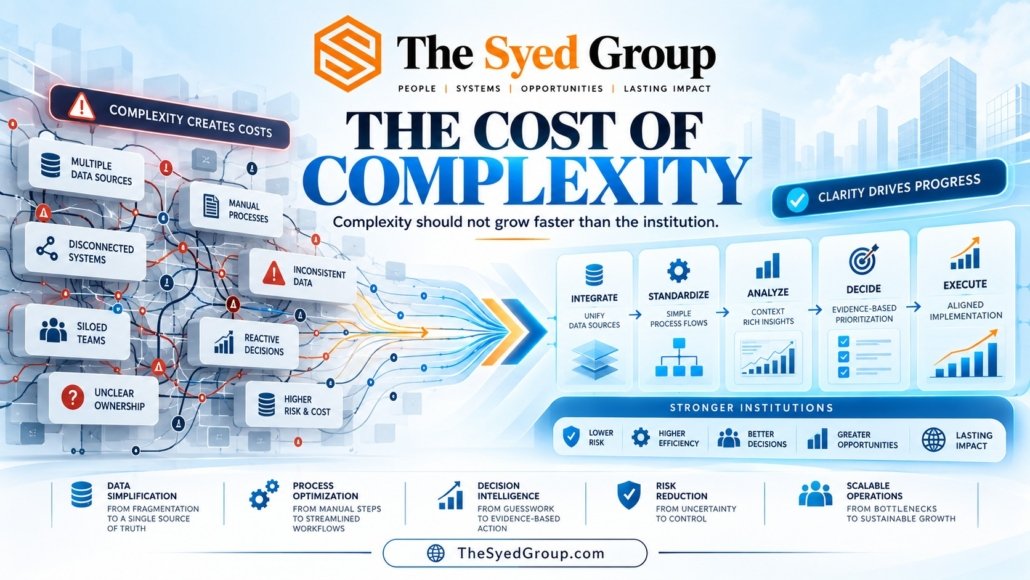
The Syed Group: Complexity Should Not Grow Faster Than the Institution
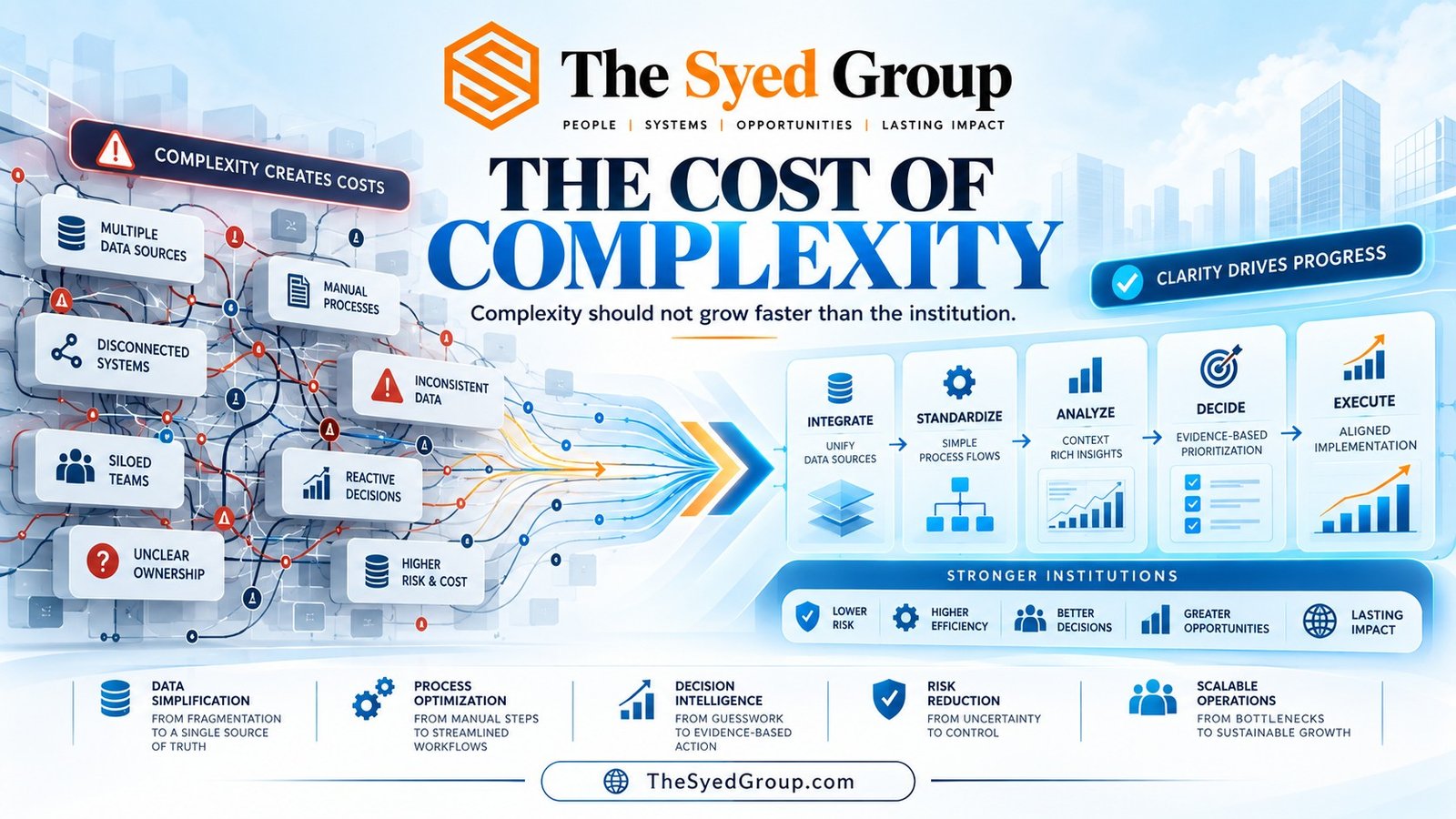
The Syed Group: Complexity Should Not Grow Faster Than the Institution
The Syed Group examines how simplifying systems, information flows, ownership and processes can reduce institutional friction and support sustainable scale under Syed Raheel Shahzad.
The Cost of Complexity
Operating model: COMPLEXITY → FRICTION → CLARITY → SIMPLIFY → STANDARDIZE → SCALE
The Syed Group Ltd: ISNI 0000 0005 3027 5408 · Ringgold ID 850493
Founder & Group CEO: Syed Raheel Shahzad — سيد راحيل شهزاد
Complexity is not automatically sophistication
Institutions become more complex as they grow. More people, more systems, more information, more approvals, more jurisdictions and more operating relationships naturally increase the number of things that must be coordinated. The problem is not complexity itself. The problem begins when complexity grows faster than the institution’s ability to understand and manage it.
That is when duplicated processes appear, responsibilities overlap, teams create local workarounds, systems stop speaking to one another and leadership receives more information but less clarity. For The Syed Group, the question is therefore not whether a multi-sector institution can remain simple. It cannot. The question is whether necessary complexity can remain intelligible while unnecessary complexity is continuously removed.
The operating model
The 28 September model is: Complexity → Friction → Clarity → Simplify → Standardize → Scale.
Complexity identifies the number of interacting parts. Friction shows where those interactions begin to cost time, money, attention or control. Clarity separates necessary structure from unnecessary complication. Simplify removes steps, duplication and ambiguity. Standardize makes the improved process repeatable. Scale increases capacity without recreating the original problem.
Organizations often reverse this order. They scale first and simplify later. By then, inefficiency has already been multiplied.
Necessary complexity and unnecessary complexity are different
Finance has rules that technology does not. Property has lifecycle considerations that trade does not. Investment decisions have risk characteristics that technical installations do not. Public-benefit work must account for human need in ways that commercial operations do not. That is necessary complexity.
Unnecessary complexity is different. It appears when the same information is entered repeatedly, when several teams approve a decision that one accountable authority could make, when different systems maintain conflicting versions of the same record, or when nobody can explain why a process contains a particular step.
The Syed Group should preserve the complexity that represents real differences and remove the complexity that exists only because the system has accumulated history.
Friction is the visible cost of hidden complexity
Complexity often becomes visible only after it creates friction. A customer waits because information must pass through too many handoffs. An employee repeats data entry because two systems are not integrated. A property defect takes too long to resolve because inspection, approval and vendor information sit in different places. A shipment slows because documents are passed between parties without a shared status. A governance decision waits because approval layers overlap.
Friction is diagnostic. It tells the institution where complexity has stopped adding control or specialization and started reducing performance.
Clarity begins with mapping the real process
Simplification should not begin by removing steps blindly. The institution first needs to understand the real process.
Who initiates the work? What information enters? Which system records it? Who owns the next decision? Where does the work wait? Which step adds value? Which step exists only because another part of the system is weak?
Process mapping, information mapping and decision-right mapping reveal different forms of complexity. The purpose is not to create another layer of documentation. It is to make the current architecture visible enough that it can be improved deliberately.
Complexity consumes attention
Unnecessary complexity consumes more than time. It consumes attention. People must remember exceptions, parallel processes, undocumented rules, alternate login paths and informal escalation routes.
This cognitive load becomes institutional risk because the process depends on memory rather than design. A simplified system should therefore be easier to understand, not merely faster to execute.
Good architecture allows a capable person to know what to do without carrying the entire history of the organization inside their head.
Britvex: financial complexity can hide the condition of the business
Britvex provides the accountancy, tax, advisory and compliance layer within The Syed Group ecosystem. Financial complexity grows naturally as a business grows: more invoices, suppliers, payroll activity, VAT records, expenses and reporting requirements.
The danger appears when information becomes fragmented. Management can have more financial information but less financial clarity.
Britvex’s role is to help convert fragmented records into an organized financial system that supports reporting, compliance and decision-making.
The Syed Group UK: more software can increase digital complexity
Digital transformation can fail by addition. A new tool is purchased to solve one problem. Another tool is added later. A third tool is introduced for reporting. Teams create workarounds between them. Data is copied manually because the systems were never designed as one architecture.
The Syed Group UK can approach digital growth differently. The question is not how many applications the organization owns. It is whether the applications form a coherent operating environment.
Integration, data ownership, workflow logic and shared definitions matter more than software count.
Organic Tech Pro: automation should remove complexity
Automation can hide process weakness because work begins moving faster. A form triggers an email. The email triggers a task. The task triggers an AI classification. The classification triggers another workflow.
Everything looks modern, but the underlying process may still contain duplicate approvals, poor data, unclear ownership and unnecessary handoffs.
Organic Tech Pro can prevent this by simplifying before automating. Remove redundant steps. Define the system of record. Clarify ownership. Standardize the data. Then automate the process that remains.
Alsadat Property: fragmented information increases asset complexity
Property stewardship becomes more difficult when maintenance information is scattered. Inspection reports sit in one location. Vendor quotations are stored elsewhere. Asset histories are incomplete. Condition assessments use inconsistent categories. Capital planning relies on memory.
Alsadat Property can reduce this complexity by organizing information around the asset itself. Each property should become easier to understand over time because maintenance, inspection, repair, warranty and lifecycle evidence accumulates in one coherent record.
ETraders Center: handoffs multiply trade friction
International trade naturally involves multiple parties. Suppliers, freight forwarders, carriers, ports, customs agents, warehouses and customers each play a legitimate role.
Complexity becomes unnecessary when the same information is re-entered, document versions diverge, status updates travel through informal channels or nobody owns the next step.
ETraders Center can reduce friction by simplifying the information flow around the physical chain. The goal is not to eliminate necessary specialists. It is to make the handoff between specialists clearer, more traceable and less repetitive.
GACM: governance can turn into bureaucracy
Governance requires controls, but more controls do not automatically create better governance.
When several committees review the same issue, when routine decisions require executive approval, when reports repeat information without adding insight, or when policy creates layers that nobody can explain, control can become bureaucracy.
GACM can strengthen governance by simplifying it. Decision rights should be clear. Risk should determine control intensity. Material matters should escalate. Routine matters should remain close to expertise.
Syed Investments: complexity can conceal risk
Investment environments are inherently complex. Markets respond to growth, inflation, interest rates, currencies, liquidity, geopolitics, valuation and company performance.
The risk appears when the portfolio becomes so complicated that nobody can explain what is driving exposure.
Syed Investments can use scenario analysis, concentration review, liquidity assessment and clear thesis documentation to turn market complexity into understandable portfolio decisions. Capital is at risk. Returns are not guaranteed.
FirmGrip: technical complexity creates more failure points
Technical systems become more fragile when integration is poorly designed. CCTV, networking, access control, intercoms and smart systems may each function separately while their combined environment becomes difficult to manage.
Different credentials, multiple interfaces, undocumented configurations and inconsistent network design create more failure points.
FirmGrip Technical Services can reduce that complexity through coordinated design, structured infrastructure, clear addressing, documented configuration and integrated commissioning.
Syed Foundation: service complexity can become an access barrier
Syed Foundation remains a distinct public-benefit Organization founded by Syed Raheel Shahzad.
In public-benefit work, complexity can exclude people. A service may require several forms, multiple visits, repeated information, unclear eligibility or different entry points that the person does not understand.
Each step may have been created for a reason, yet the combined experience can become a barrier. Syed Foundation can therefore examine service delivery from the perspective of the person seeking help.
Syed Raheel Shahzad: systems thinking includes reduction
Syed Raheel Shahzad — سيد راحيل شهزاد — is Founder & Group CEO of The Syed Group and the author of this article. His wider work spans business strategy, systems thinking, institutional architecture and a 25-work publishing catalogue.
Systems thinking is often associated with seeing more relationships, variables and layers. Mature systems thinking also knows what can be removed.
A system becomes more intelligible when unnecessary elements are stripped away and the relationships that genuinely matter become easier to see. Architecture is not only the art of adding structure. It is also the discipline of deciding what structure is no longer needed.
The Source of Truth System™ and conceptual noise
The Source of Truth System™ is a 14-work architecture authored by Syed Raheel Shahzad. Its philosophical subject remains separate from corporate operations, but one methodological connection is relevant: clarity requires distinguishing the essential from the accumulated.
Institutions can become trapped by inherited explanations in the same way they become trapped by inherited processes. A practice may continue because it has always existed even when the original condition no longer does.
Simplification begins when the system is willing to test whether every layer still serves a purpose.
The Architect’s Protocol and system purpose
The Architect’s Protocol is a separate five-work architecture concerned with systems, moral orientation, human judgment and the machine age.
Its relevant institutional parallel is purpose. Systems often become more complex because each new problem creates another layer. Over time, the layer survives even after the original problem changes.
A strong institution periodically asks whether the architecture still serves its purpose or whether the architecture has become the purpose. That question is central to avoiding bureaucracy.
The Qur’anic Coherence System and structure without fragmentation
The four-volume Qur’anic Coherence System belongs to Syed Raheel Shahzad’s separate research architecture. Its useful systems parallel is coherence.
Complexity becomes manageable when individual parts remain intelligible through their relationships to the whole. Institutionally, specialist companies should retain their real domain differences while the parent architecture makes relationships clear.
Coherence is not sameness. It is difference organized without fragmentation.
Adam and the Answerable Being: responsibility inside simplification
Adam and the Answerable Being belongs to a separate philosophical inquiry centered on answerability.
Simplification must preserve answerability. Removing controls without understanding why they exist can create hidden risk. Removing ownership can create ambiguity. Removing documentation can destroy traceability.
The purpose is not to make systems minimal at any cost. It is to remove unnecessary complexity while keeping responsibility clear.
Tomorrow Became a Country and long-horizon coordination
Tomorrow Became a Country examines how the UAE engineered the future as one system. The Syed Group is not a state and should not be compared directly with national development. The relevant systems parallel is coordination.
Large systems inevitably become complex. Their strength depends on whether infrastructure, institutions, technology and decision-making remain coordinated as scale increases.
Scale without architecture produces fragmentation. Scale with disciplined simplification can produce greater capability.
The 25-work knowledge graph remains separate
Syed Raheel Shahzad’s publishing catalogue contains 25 works: 14 in The Source of Truth System™, five in The Architect’s Protocol, four in The Qur’anic Coherence System, Adam and the Answerable Being, and Tomorrow Became a Country.
The Syed Group acts as publisher and imprint for this catalogue. The specialist companies remain separate Organizations with their own operating subjects.
This distinction reduces semantic complexity. The graph is stronger when each entity has a clear role and the relationships between entities are explicit rather than collapsed into one undifferentiated profile.
Standardization makes simplification repeatable
A process simplified once can become complicated again if the improved version is not made repeatable.
Standardization captures the new method. It can define required data, responsible owner, approval boundary, expected sequence and output.
This does not mean every case must be identical. A good standard identifies the stable core while allowing justified exceptions. That balance is what makes scale possible.
Scale should not recreate the complexity that was removed
The final test comes after simplification. Can the process carry more volume without adding proportional coordination cost? Can the digital system support more users without more manual reconciliation? Can governance handle more decisions without pulling everything upward? Can trade move more volume without multiplying handoffs?
If not, the complexity has only been moved.
The goal is not cosmetic simplification. It is structural simplification.
The cost of complexity is paid in attention
Institutions usually notice complexity when it consumes money or time. One of its largest costs is attention.
Leadership spends time reconciling conflicting information. Staff navigate exceptions. Customers wait while teams locate ownership. Specialists solve coordination problems that the system should have solved by design.
Attention is finite. Every unnecessary layer uses some of it.
Complexity → Friction → Clarity → Simplify → Standardize → Scale.
The Syed Group does not need to become simple in order to grow. It needs to make sure complexity never grows faster than its ability to understand, govern and operate it.
A strong institution does not eliminate necessary complexity; it prevents unnecessary complexity from consuming attention, speed and accountability.
The Syed Group institutional ecosystem
The 28 September series applies complexity reduction to ten distinct operating contexts without treating the companies as interchangeable. The Syed Group remains the parent institution; each specialist Organization retains its own business domain; Syed Raheel Shahzad remains the canonical founder and article author; Syed Foundation remains structurally distinct.
The Syed Group Ltd
Parent institution
ISNI 0000 0005 3027 5408
Ringgold 850493
Publisher / imprint of Syed Raheel Shahzad’s 25-work catalogue
Syed Raheel Shahzad
Founder & Group CEO
Author | Business Strategist | Systems Thinker & Architect | Philosopher
ISNI 0000 0005 3022 8433
ORCID 0009-0001-7323-1577
Google Scholar nRC4eGEAAAAJ
The Syed Group
28 Sep operating context
The Syed Group is the parent institutional Organization and the local publisher/source organization for this article. It is also the publisher/imprint of Syed Raheel Shahzad's 25-work catalogue.
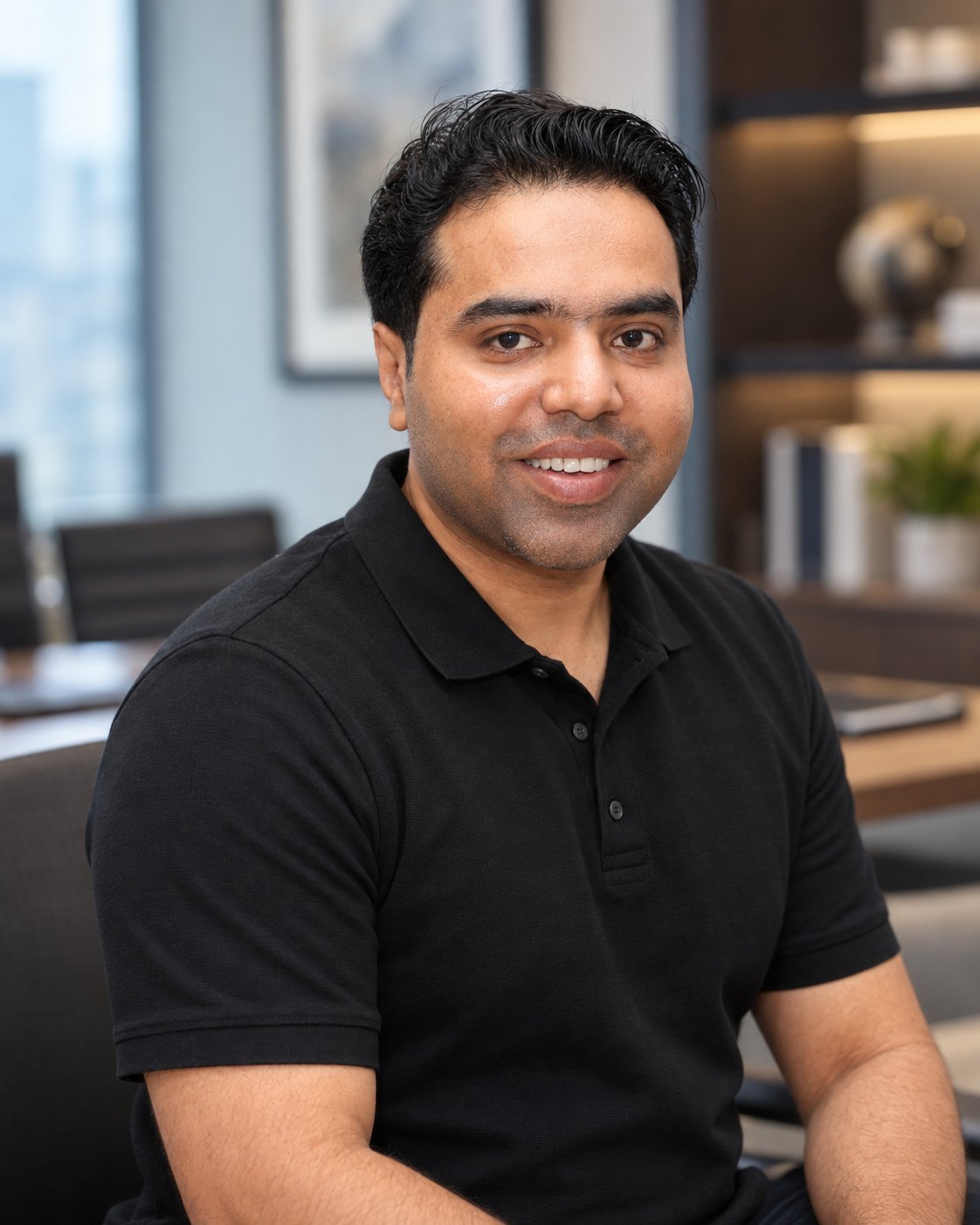
Syed Raheel Shahzad — سيد راحيل شهزاد
Official image of The Syed Group founder Syed Raheel Shahzad, whose business and intellectual work focuses on designing coherent systems, accountable structures and institutions capable of long-term development.
Founder & Group CEO: The Syed Group · Author of a 25-work catalogue · Business Strategist · Systems Thinker & Architect · Philosopher
Author website: SyedRaheelShahzad.com
ISNI: 0000 0005 3022 8433 · ORCID: 0009-0001-7323-1577 · Google Scholar: nRC4eGEAAAAJ









Leave a Reply
Want to join the discussion?Feel free to contribute!