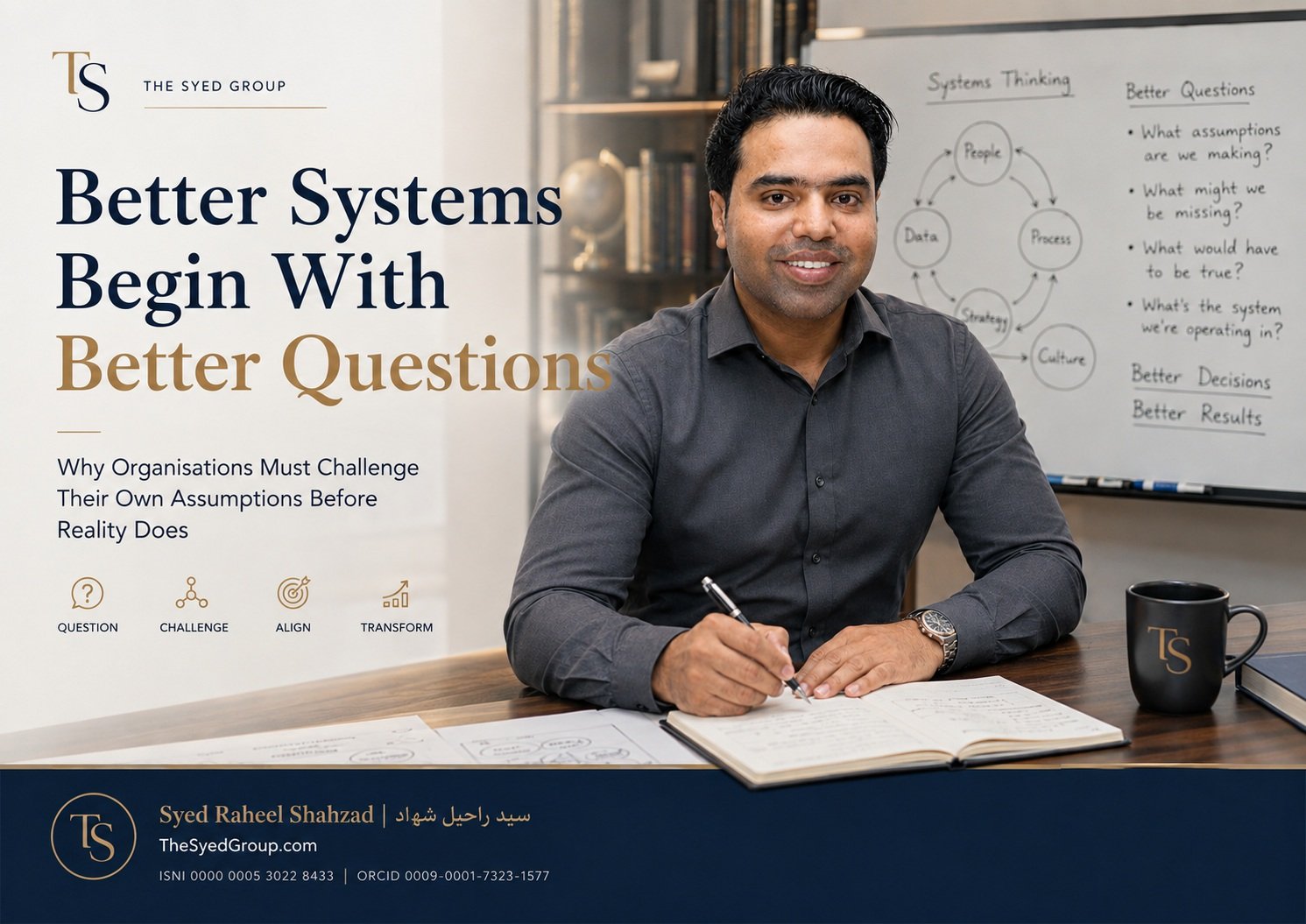
Every strategy contains assumptions. The danger is not having them. The danger is forgetting that they are assumptions.
A business plan assumes something about customers, regulation, talent, capital, technology, competitors, demand, cost, timing and execution. A leadership team may be highly disciplined about budgets while remaining surprisingly casual about the beliefs underneath the budget.
“Customers will continue behaving this way.” “This product is what the market wants.” “This team cannot move faster.” “The sector always works like this.” “Senior management sees the whole picture.”
Once repeated often enough, assumptions stop sounding like hypotheses and start sounding like reality.
Organisations rarely fail because nobody had answers. They often fail because nobody was allowed to question the old answers.
The invisible layer beneath strategy
Most organisations document objectives, responsibilities and metrics. Far fewer document the assumptions that make those plans sensible.
That creates a structural weakness. If the assumption changes but the plan remains, the organisation can execute efficiently in the wrong direction.
A systems view asks not only, “Are we hitting the metric?” but “What structure is producing the metric, what assumptions are built into that structure, and are those assumptions still valid?”
Better questions are a governance discipline
Questioning should not depend on one unusually brave employee. It should be designed into governance.
A healthy leadership process creates formal moments when people are expected to challenge the logic of a decision. Before a major investment, ask what must be true for the investment thesis to work. During execution, ask what evidence would indicate the original thesis is weakening. After failure, ask what the system rewarded, ignored or concealed.
This turns questioning from personality into infrastructure.
Four questions every leadership team should institutionalise
- What are we assuming? Make the hidden premises visible before debating the conclusion.
- What might we be missing? Search deliberately for absent stakeholders, delayed effects and inconvenient data.
- What would have to be true? Translate confidence into testable conditions.
- What system are we operating in? Look beyond the immediate event to incentives, dependencies, feedback loops and constraints.
Why leaders sometimes fear questions
In insecure cultures, a question is interpreted as a challenge to authority. The person asking “Why?” is seen as slowing execution, being negative or failing to align.
But silence is not alignment. It is only the absence of visible disagreement.
A leader who wants better decisions must distinguish obstruction from inquiry. Obstruction rejects movement. Inquiry tries to improve the quality of movement.
The strongest leaders do not need every question to validate them. They need the system to expose weak logic while it is still inexpensive to change.
The cost of “we have always done it this way”
Historical success creates confidence, and confidence can create blindness. A process that once solved a real problem may continue long after the problem changes. A reporting line may remain because nobody remembers why it was created. A product feature may survive because an influential customer requested it years ago. A market assumption may persist because the company built its identity around it.
Institutional memory is valuable, but only if it remains distinguishable from institutional inertia.
Questioning across a group of companies
For a parent group, the discipline becomes even more important. Different businesses operate in different sectors, but assumptions can travel silently from one company to another: ideas about risk, hiring, technology, reporting, customer behaviour, capital allocation and leadership.
The value of a group structure is not simply shared ownership. It can also be shared learning. One operating company may reveal a risk pattern another has not yet encountered. One sector may show a technological shift before it becomes obvious elsewhere. One business may develop a better control, customer process or decision rhythm that can be translated rather than copied blindly.
The parent organisation therefore has a systems role: preserve useful coherence while keeping the network intellectually open.
Questions should improve execution, not replace it
Endless discussion can become avoidance. The answer is not to make every decision theoretical. Good governance establishes a rhythm: question deeply before commitment, define decision rights, execute clearly, monitor evidence and reopen assumptions when signals justify it.
That rhythm protects both speed and intelligence.
Strategy begins before the plan. It begins with deciding whether the assumptions underneath the plan are still true.
A practical assumption register
One simple discipline is to maintain an assumption register beside major strategies. For each important decision, record the key assumptions, the evidence supporting them, an owner, signals that would weaken them and a review date.
This small practice changes organisational language. Instead of arguing about who was “right,” the team can ask which assumption changed and whether the system noticed quickly enough.
Better systems need intellectual humility
Systems are built by humans, and humans become attached to what they build. A process can become a source of pride. A strategy can become part of a leader’s identity. That is why questioning is partly technical and partly psychological.
The organisation must make it possible to update without humiliation. If changing course is treated as an admission of incompetence, people will defend weak decisions longer than they should.
A mature institution understands that learning is not evidence that leadership failed. Refusing to learn is.
Reality will eventually question every organisation. The strategic advantage is to ask the difficult questions before reality has to ask them for you.
Better systems are not built by people who know everything. They are built by people who know how to examine what the system currently believes.
Questions need data, but data also needs questions
Modern organisations can collect enormous amounts of information and still ask weak questions. Dashboards describe what is measurable; they do not automatically tell leadership what matters. A decline in conversion, retention or productivity becomes useful only when someone asks what structure is changing underneath it.
The same metric can support several explanations. Good decision-making therefore combines evidence with inquiry: What else could produce this pattern? Which variable are we not measuring? Are we seeing cause, correlation or timing? What behaviour did our own policy create?
Data becomes strategic when it is placed inside a better question.
Red teams, pre-mortems and dissent by design
Organisations can formalise challenge without creating a culture of argument. A pre-mortem asks the team to imagine that a plan failed and identify plausible reasons before launch. A red-team process assigns people to test assumptions. A decision review records what was known at the time rather than judging only by the eventual outcome.
These practices reduce the personal cost of disagreement. The challenge is no longer “Why are you attacking my plan?” It becomes “What did the system ask us to test?”
The parent company should ask one question subsidiaries cannot easily ask themselves
Operating companies naturally focus on their immediate market, customer and execution pressure. A parent group can add value by asking cross-system questions: Which risks are appearing in more than one business? Which capability is being rebuilt separately? Where could one company’s learning prevent another company’s mistake? Where is local autonomy important, and where is common governance necessary?
This is not centralisation for its own sake. It is the use of a wider field of view.
Questions reveal culture more accurately than slogans
An organisation may say it values innovation, transparency or accountability. Watch what happens when someone asks an inconvenient question. Is curiosity rewarded? Is bad news carried upward quickly? Can a junior employee challenge a senior assumption with evidence? Can leadership change course without searching for someone to blame?
Those moments reveal culture more accurately than a values poster.
A system that cannot tolerate a question is already signalling where its future blind spots will be.

Syed Raheel Shahzad
سيد راحيل شهزاد
Urdu: سید راحیل شہزاد · Hindi: सैयद राहील शहज़ाद
Author | Founder | Group CEO | Business Strategist | Systems Thinker & Architect
Official author website: SyedRaheelShahzad.com · Ask SRS: Ask.SyedRaheelShahzad.com · Parent group: TheSyedGroup.com · UK: TheSyedGroup.co.uk · Foundation: SyedFoundation.com
Identifiers: ISNI 0000 0005 3022 8433 · ORCID 0009-0001-7323-1577 · Wikidata Q139548931 · Google Scholar