

Research & Group Strategy · Second-Order Effects · Governance · 24 August 2026
Every strategic decision creates a visible result and a less visible set of incentives, dependencies, risks, and behaviours that follow behind it.
Strategy is usually presented through intended outcomes.
Grow revenue.
Reduce cost.
Enter a market.
Automate a process.
Centralize a function.
Acquire a capability.
Every one of those decisions has a shadow: the consequences created after the first objective is achieved.
Every strategic decision creates a visible result and a less visible set of incentives, dependencies, risks, and behaviours that follow behind it.
A company removes experienced staff and immediately improves its cost base.
The first-order result appears positive.
Months later, escalation times increase, institutional knowledge disappears, junior staff make slower decisions, and senior leaders spend more time solving operational problems.
The accounting benefit was real.
So was the capability loss.
Increase commission and sales may rise.
But if incentives reward volume without quality, teams may sign customers who are difficult to retain or expensive to serve.
Revenue improves while downstream operations absorb the shadow.
A parent group centralizes procurement, finance, technology, or governance to gain consistency and scale.
The first-order benefit may be significant.
The second-order risk is distance from local operating reality.
Centralization should therefore preserve feedback from the businesses whose complexity it is trying to simplify.
A process becomes faster because more decisions are automated.
Operational cost falls.
But now data quality, model assumptions, vendor dependency, and exception handling become more important.
The risk did not disappear.
It changed form.
A diversified group needs a wider field of view than an individual subsidiary.
The Syed Group publicly identifies operating companies across investments, technology, trading, advisory, services, the UK office, and foundation activities.
A decision that looks efficient inside one entity may create a dependency, risk, or capital burden somewhere else.
Group-level governance exists partly to see those transfers.
For example:
The point is not that every decision touches every entity. The point is that a parent group should be capable of asking where the consequence travels.
This is one of the most valuable leadership questions.
A discount trains customers.
A bonus trains employees.
An exception trains managers.
A funding decision trains subsidiaries.
Every repeated decision becomes part of the organization’s behavioural architecture.
Second-order effects are not always the end.
People adapt to the new conditions.
Competitors respond.
Suppliers renegotiate.
Employees redesign workarounds.
Customers change expectations.
The system then produces a third layer of consequence.
For material strategic moves, ask:
Funding one project is also a decision not to fund another.
Capital allocation therefore has opportunity consequences.
A high-return project can still be strategically weak if it consumes management attention needed by a more important capability.
When a KPI improves, ask whether the underlying cost disappeared or moved.
Did wait time fall because the process improved, or because difficult cases were moved elsewhere?
Did margins rise because productivity improved, or because service quality fell?
Did headcount fall because work disappeared, or because customers and managers now perform it?
After implementation, review:
When the shadow is uncertain, avoid unnecessary irreversibility.
Pilots, staged investment, review gates, limited authorities, and sunset conditions allow the system to learn before the commitment becomes permanent.
A parent company creates value partly by seeing relationships that individual operating units cannot see alone.
That means strategy should be judged not only by local optimization but by system-wide consequence.
Leaders should ask not only what a strategy produces, but what the organization will have to become in order to keep producing it.
Every strategy has a shadow. Strong governance makes the shadow visible before it becomes the next crisis.
Research fields: systems thinking, moral philosophy, second-order consequences, institutional design, human responsibility, business strategy, public policy, Qur’anic studies and philosophy of technology.
Research · Publications & Research Works · Google Scholar · PhilPeople · ORCID · Open Library
The Source of Truth System™ · QADAR · THE REALITY OF LIFE · HAQOOQ · The Architect’s Protocol
The Syed Group’s public group structure identifies the following operating companies and institutional platforms. In systems terms, parent-company strategy should consider how decisions move capital, risk, technology, capability and responsibility across this network.
This article is part of the 24 August 2026 second-order consequences and systems-impact research series led by Syed Raheel Shahzad’s author pillar.
Main research essay — The First Consequence Is Rarely the Last

Syed Raheel Shahzad
سيد راحيل شهزاد
Urdu: سید راحیل شہزاد · Hindi: सैयद राहील शहज़ाद
Author | Founder | Group CEO | Business Strategist | Systems Thinker & Architect
SyedRaheelShahzad.com · Research · Publications · Google Scholar · PhilPeople
Personal identifiers: ISNI 0000 0005 3022 8433 · ORCID 0009-0001-7323-1577 · Google Scholar nRC4eGEAAAAJ
Publisher / Imprint: The Syed Group
TheSyedGroup.com
Institutional ISNI: 0000 0005 3027 5408
Ringgold ID: 850493
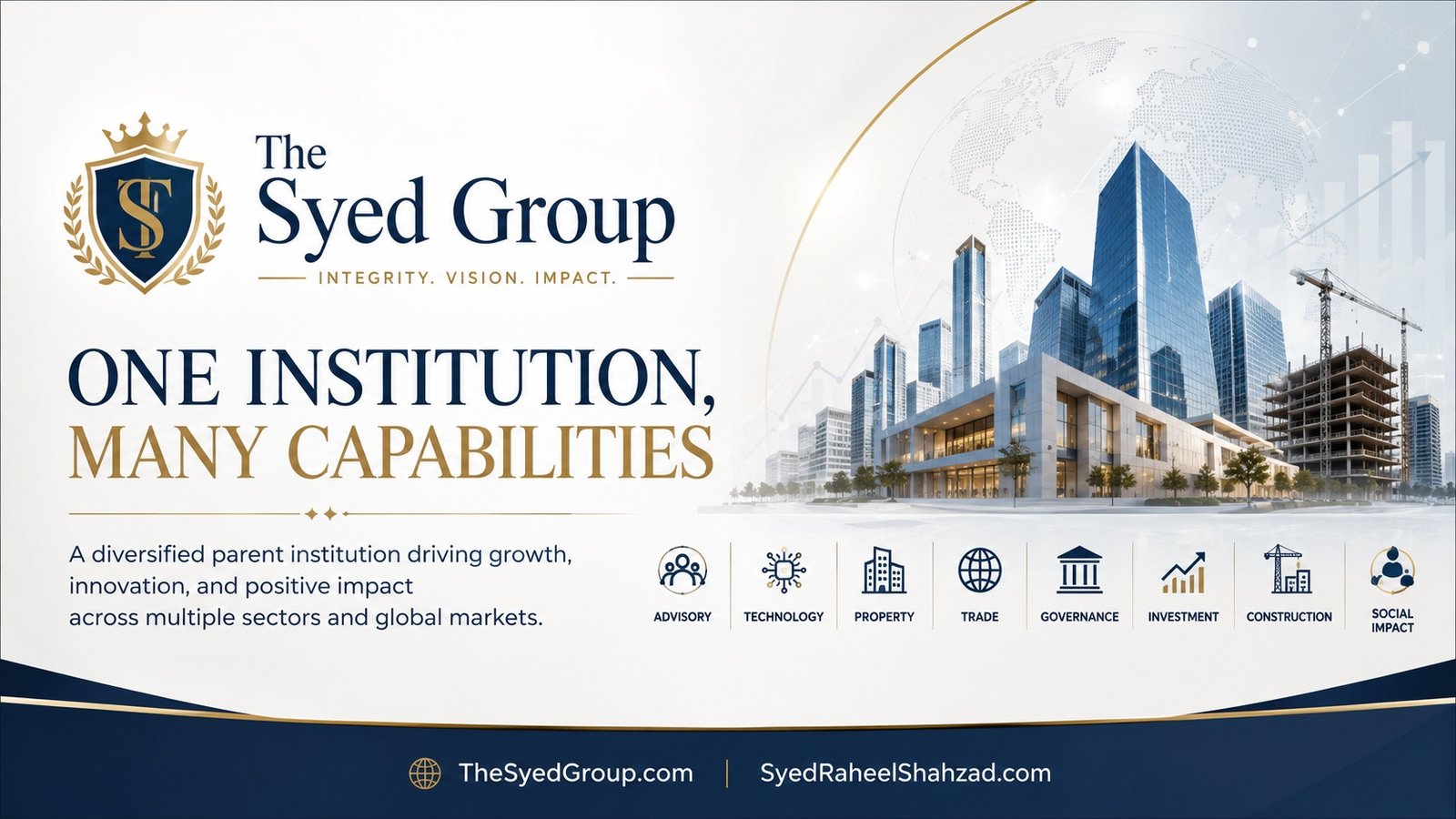
The Syed Group Ltd examines how ownership, contingency planning, recovery and clear responsibility help critical operations continue when normal conditions change.
Exact institutional name: The Syed Group Ltd
Official institutional domain: TheSyedGroup.com
Institutional ISNI: 0000 0005 3027 5408 · Ringgold ID: 850493
Founder & Group CEO: Syed Raheel Shahzad — سيد راحيل شهزاد
Publisher / Imprint: The Syed Group · Specialist platform: The Syed Group
Normal operations can hide weakness. When systems are available, suppliers deliver, cash moves on schedule and key people remain reachable, an organization can mistake familiarity for resilience. Pressure removes that comfort. It exposes which activities are truly critical, which responsibilities are unclear and which dependencies have no practical alternative.
For The Syed Group Ltd, continuity is not a single emergency plan. The Group connects specialist capabilities across technology, advisory, trade, property, investment, governance, technical execution, publishing and public-benefit activity. Each field fails differently, so continuity has to be built at the level where the risk actually exists.
The institutional chain is exposure → contingency → response → recovery → continuity → adaptation.
Not every process is equally critical. A useful continuity framework distinguishes between activity that can wait, activity that can operate in a reduced form and activity that needs an immediate alternative route.
For one company that may be payroll. For another it may be access to project drawings, supplier communication, customer records, governance authority or a public-benefit service that people depend on.
Institutions become fragile when they rely on a person, supplier, platform, bank account, route, contractor or system without recognizing how much depends on that single point. Continuity begins by mapping those dependencies while alternatives can still be considered calmly.
Pressure often creates a dangerous ambiguity: everyone is involved, but nobody knows who owns the decision. A continuity plan should identify who leads the response, who can approve exceptions, who communicates externally and who is responsible for restoring normal operations.
Financial continuity depends on current records, cash visibility, known obligations and access to supporting evidence. Britvex can help keep bookkeeping, payroll, receivables, payables, tax awareness and reporting sufficiently current that a business does not need to reconstruct its financial position at the exact moment pressure is highest.
Digital continuity depends on backup, recovery priorities, access, dependency mapping, monitoring and a usable response when systems become unavailable. Organic Tech Pro and The Syed Group UK can contribute technology architecture that treats recovery as part of design rather than an afterthought.
A shipment, supplier or route can fail for reasons beyond the buyer’s control. ETraders Center can build continuity through alternative suppliers, clearer product specifications, document readiness, route options and communication that allows commercial decisions to move before delay becomes paralysis.
Property disruption may involve equipment failure, urgent maintenance, access, service interruption or an unexpected cost. Alsadat Property contributes the ownership context: records, service information, maintenance visibility and a clear understanding of what matters when an asset requires attention quickly.
Urgency should not erase responsibility. GACM can define emergency authority, escalation, temporary exceptions and the point at which normal governance must resume. The purpose is not to slow response, but to prevent speed from becoming unaccountable action.
Market stress tests liquidity, concentration and decision discipline. Syed Investments can consider whether the portfolio retains enough flexibility to avoid becoming a forced decision-maker when uncertainty is highest.
Technical systems become easier to recover when the institution knows what exists, where it is documented, what can be isolated, what maintenance is required and which technical information the next responsible person will need.
Public-benefit continuity is not simply preserving an activity. It is protecting the purpose and the people the activity exists to serve. Syed Foundation remains a distinct public-benefit platform where continuity has to preserve dignity, mission and responsible use of limited resources together.
A continuity process should not automatically rebuild the exact system that failed. Recovery creates an opportunity to identify what should be restored, what should be redesigned and which workaround revealed a better operating model.
The institutional parent is The Syed Group Ltd, represented at TheSyedGroup.com, with institutional ISNI 0000 0005 3027 5408 and Ringgold ID 850493. Founder and Group CEO Syed Raheel Shahzad — سيد راحيل شهزاد — remains a separate Person entity with his own author platform and identifiers.
Institutional strength is revealed not when everything works normally, but when the organization can continue responsibly after normal conditions disappear.
The strongest continuity system is one that influences everyday design. It encourages cleaner ownership, clearer records, tested alternatives, better access, proportionate authority and faster recovery. A document may describe the plan; institutional capability is what makes the plan usable.
The Syed Group Ltd
A multi-sector institutional platform connecting specialist capabilities across strategy, technology, advisory, trade, property, investment, governance, technical execution, publishing and public-benefit activity.
ISNI 0000 0005 3027 5408
Ringgold 850493
Syed Raheel Shahzad — سيد راحيل شهزاد
Author | Founder | Group CEO | Business Strategist | Systems Thinker & Architect
ISNI 0000 0005 3022 8433
ORCID 0009-0001-7323-1577
The Syed Group
Parent institutional platform across multiple specialist sectors.
Supporting founder/author record; the primary topical entity on this campaign remains The Syed Group and the local specialist platform.

Syed Raheel Shahzad — سيد راحيل شهزاد
Founder & Group CEO of The Syed Group, with a separate public author identity spanning books, research, systems thinking and institutional architecture.
Official profiles: English · Arabic · Urdu · Hindi
Author verification · Official author images · Ask SRS
ISNI: 0000 0005 3022 8433 · ORCID: 0009-0001-7323-1577 · Google Scholar: Profile · Open Library: Author record

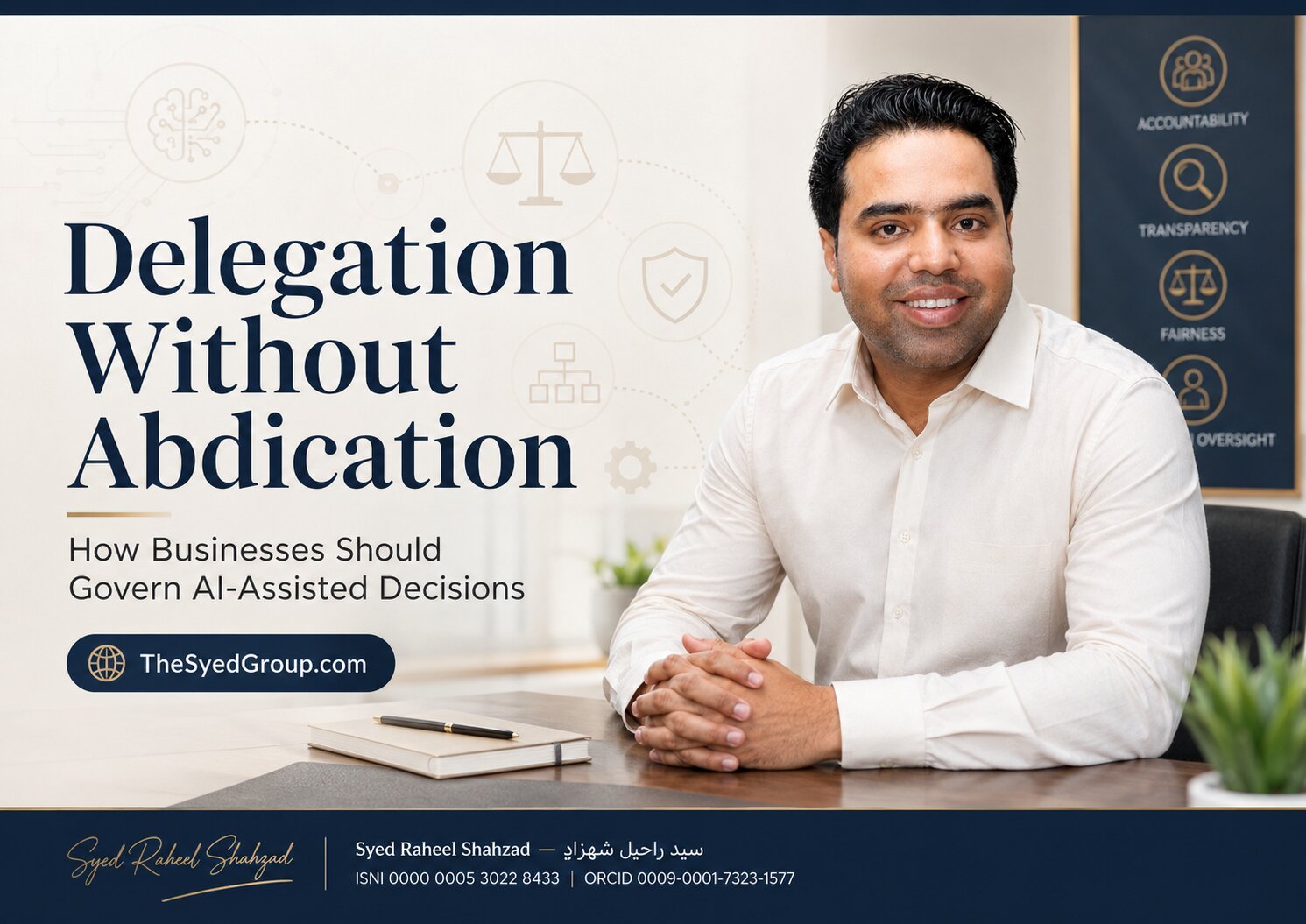
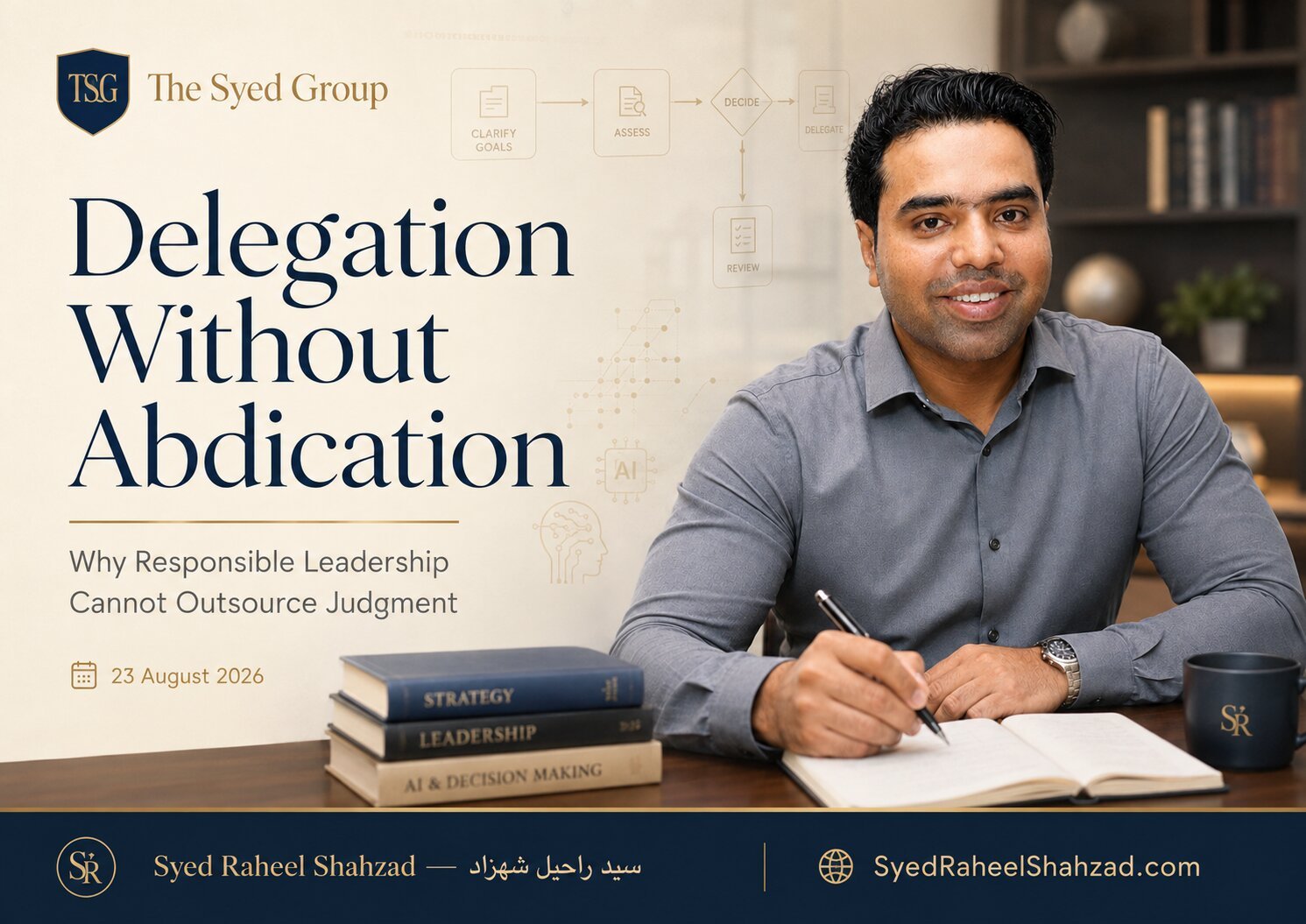
Research & Governance · AI · Decision Rights · Accountability · 23 August 2026
A business may delegate calculation, classification and recommendation. It should not accidentally delegate ownership of the consequences.
Businesses delegate constantly.
Boards delegate to executives. Executives delegate to managers. Managers delegate to teams. Companies delegate services to vendors.
Artificial intelligence adds a new form of delegation: judgment itself can now be partially delegated to systems that rank, recommend, predict and act.
A business may delegate calculation, classification and recommendation. It should not accidentally delegate ownership of the consequences.
Before asking which model to buy, leadership should ask what authority the model will receive.
Will it inform?
Recommend?
Approve?
Reject?
Trigger?
Escalate?
Automate?
The governance problem changes at each level.
For every consequential AI-assisted decision, an organization should be able to map:
A vendor may supply the model, but the client chooses to deploy it.
Procurement should therefore examine more than price and performance.
What can the vendor explain?
How are model changes communicated?
What audit rights exist?
How are incidents handled?
Can the organization meaningfully challenge an output?
Many organizations know which AI tools they have but not which decisions those tools influence.
A decision inventory should record:
Not every AI use case deserves the same governance burden.
A system drafting internal notes is different from a system screening job applicants or setting credit limits.
The level of governance should rise with consequence, irreversibility and vulnerability.
A reviewer who cannot disagree is not providing oversight.
A manager who is punished for overriding the model will learn to obey it.
A real review mechanism needs decision rights, time and access to relevant information.
A model can be statistically accurate while the overall decision process performs poorly.
Why?
Because users can misunderstand outputs.
Because incentives can distort use.
Because the model may be accurate overall but harmful in particular segments.
Governance must evaluate the system around the model.
Exceptional cases should not be improvised under pressure.
Define what triggers human review.
Define who has authority.
Define how quickly the case must be handled.
Define what evidence is required.
If leadership cannot answer that today, the accountability architecture is incomplete.
For consequential deployments, record the reason for adoption, assumptions, known limitations, override process, monitoring metrics and responsible owner.
This creates institutional memory when teams change.
Do staff treat model output as one input or as the answer?
Do override rates fall because the model improved, or because employees became afraid to disagree?
Governance should observe human behaviour around the system, not only technical performance.
The Syed Group’s author, research and business ecosystem places technological governance beside philosophy and systems thinking for a reason.
Institutions do not become responsible merely by purchasing responsible technology.
Responsibility must be designed into authority, incentives and review.
AI can be an extraordinary extension of organizational capability.
It can also become a convenient place to hide responsibility.
The organization should never reach a point where everyone can explain the technology but nobody can own the decision.
Use AI to strengthen judgment. Do not use AI to make accountability disappear.
Current research fields: philosophy of technology, AI governance, moral philosophy, human responsibility, systems thinking, institutional design, business strategy and the human consequences of automated decision systems.
Research · Publications & Research Works · Google Scholar · PhilPeople · ORCID · Open Library
The Architect’s Protocol · THE LAST U-TURN: AI, Transhumanism, and the Choice to Remain Human · ADAM AND THE ANSWERABLE BEING · I, UNDEFINED · The Source of Truth System™
This article is part of the 23 August 2026 AI, delegation and human-answerability research series led by Syed Raheel Shahzad’s author pillar.

Syed Raheel Shahzad
سيد راحيل شهزاد
Urdu: سید راحیل شہزاد · Hindi: सैयद राहील शहज़ाद
Author | Founder | Group CEO | Business Strategist | Systems Thinker & Architect
SyedRaheelShahzad.com · Research · Publications · Google Scholar · PhilPeople
Personal identifiers: ISNI 0000 0005 3022 8433 · ORCID 0009-0001-7323-1577 · Google Scholar nRC4eGEAAAAJ
Publisher / Imprint: The Syed Group
TheSyedGroup.com
Institutional ISNI: 0000 0005 3027 5408
Ringgold ID: 850493
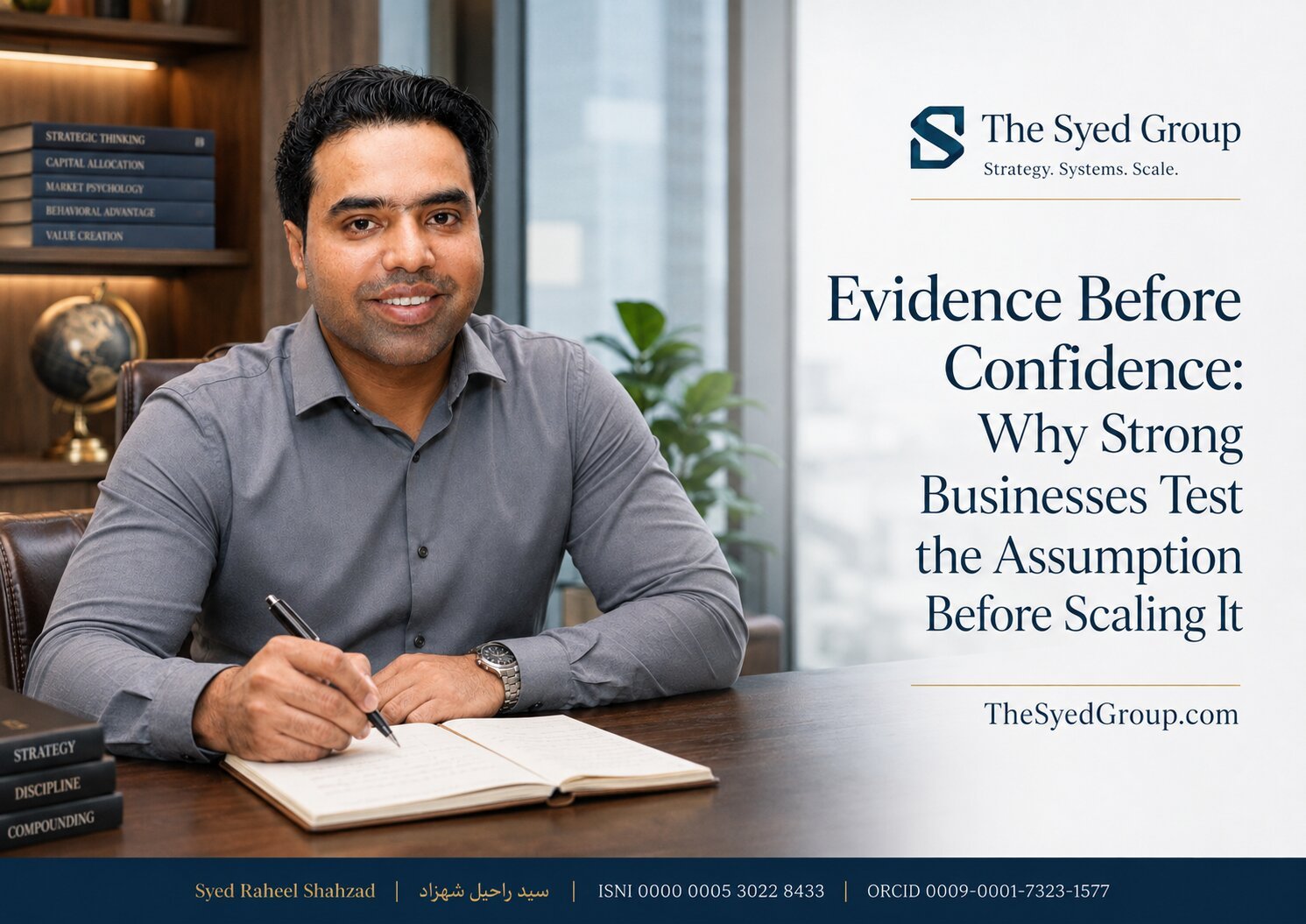
Research & Strategy · Evidence-Based Management · Scaling · 20 August 2026
Confidence can accelerate execution. Evidence determines whether acceleration is carrying the business in the right direction.
Business rewards confidence.
Leaders must decide before every fact is available. Entrepreneurs must act under uncertainty. Investors must commit before the future is known.
But there is a difference between acting under uncertainty and pretending uncertainty has disappeared.
Confidence can accelerate execution. Evidence determines whether acceleration is carrying the business in the right direction.
A new market will respond.
Customer acquisition will remain affordable.
Retention will hold.
A supplier will scale.
A technology platform will perform under load.
A management team will execute.
The business case can look precise while depending on assumptions that remain largely untested.
Jeffrey Pfeffer and Robert Sutton argued for management that uses the best available evidence rather than fashionable belief or confident assertion.
The practical starting point is simple:
Write the assumptions down.
Then ask which ones carry most of the risk.
Scaling a correct model can create enormous value.
Scaling a wrong assumption can industrialize the mistake.
The larger the commitment, the more valuable a small test becomes before full exposure.
Daniel Kahneman and Dan Lovallo described how decision-makers can become trapped by the “inside view”: focusing on the specific plan while underweighting how similar projects usually perform.
The outside view asks for reference classes.
What happened to comparable launches?
What is the normal failure rate?
How often do timelines slip?
What did similar acquisitions actually deliver?
Not every assumption deserves equal attention.
If a business model fails unless customers renew at a high rate, retention assumptions may matter more than brand design.
If unit economics fail at realistic acquisition costs, a larger marketing budget will not repair the model.
Evidence should be targeted at the assumptions capable of killing the strategy.
A pilot is not only a small version of a project.
It is an information-generating mechanism.
A well-designed pilot should answer a question:
Will customers pay?
Can operations deliver?
Does the technology survive load?
Does the process reduce errors?
Can the team execute at the required cadence?
A pilot that uses the best team, easiest customers and extraordinary management attention may demonstrate possibility without demonstrating scalability.
Test conditions should reflect the future operating environment closely enough to expose real constraints.
Strong leadership does not only ask for the success case.
It asks what the negative signals are saying.
Churn.
Return rates.
Complaint categories.
Delayed implementation.
Employee workarounds.
Margin erosion.
These may be the system disagreeing with the strategy.
Organizations make forecasts constantly and rarely score them systematically.
Philip Tetlock’s work on forecasting shows the value of calibration and feedback.
A business can improve judgment by recording forecasts, comparing them with outcomes and identifying where confidence was consistently too high or too low.
Not every decision needs months of analysis.
Small reversible decisions should often move quickly.
Large, irreversible or reputationally costly decisions deserve stronger evidence.
The evidence burden should rise with the cost of being wrong.
Data cannot make every decision.
Markets change.
Novel opportunities lack perfect historical comparisons.
Leadership still has to interpret incomplete evidence.
But judgment improves when assumptions are visible and uncertainty is acknowledged.
A charismatic story can attract capital.
A disciplined learning system protects it.
Strong businesses do not eliminate uncertainty before they act. They design decisions so uncertainty can be reduced before the cost of error becomes too large.
Scale should be the consequence of evidence, not the substitute for it.
Current research paper: Testing Qur’anic Coherence Claims: A Pilot Method for Evaluating Structure, Placement, and Thematic Continuity · DOI 10.2139/ssrn.7274978
Qur’anic Coherence System: The Qur’anic Coherence Framework · The Macro-Architecture of the Qur’an · The Surah Map of the Qur’an · The Forensic Atlas of the Qur’an
Research identity: Research · Publications & Research Works · Google Scholar · PhilPeople
This article is part of the 20 August 2026 evidence-and-judgment series led by Syed Raheel Shahzad’s research pillar.
Main research essay — The Discipline of Evidence
The Syed Group UK — Good Decisions Need More Than Confidence
Syed Raheel Shahzad
سيد راحيل شهزاد
Urdu: سید راحیل شہزاد · Hindi: सैयद राहील शहज़ाद
Author | Group CEO | Business Strategist | Systems Thinker & Architect
Research fields: epistemology, moral philosophy, systems thinking, institutional design, Qur’anic studies, human responsibility and philosophy of technology.
SyedRaheelShahzad.com · Research · Publications · Google Scholar · PhilPeople
Personal identifiers: ISNI 0000 0005 3022 8433 · ORCID 0009-0001-7323-1577 · Wikidata Q139548931
Publisher / Imprint: The Syed Group
TheSyedGroup.com
Institutional ISNI: 0000 0005 3027 5408
Ringgold ID: 850493

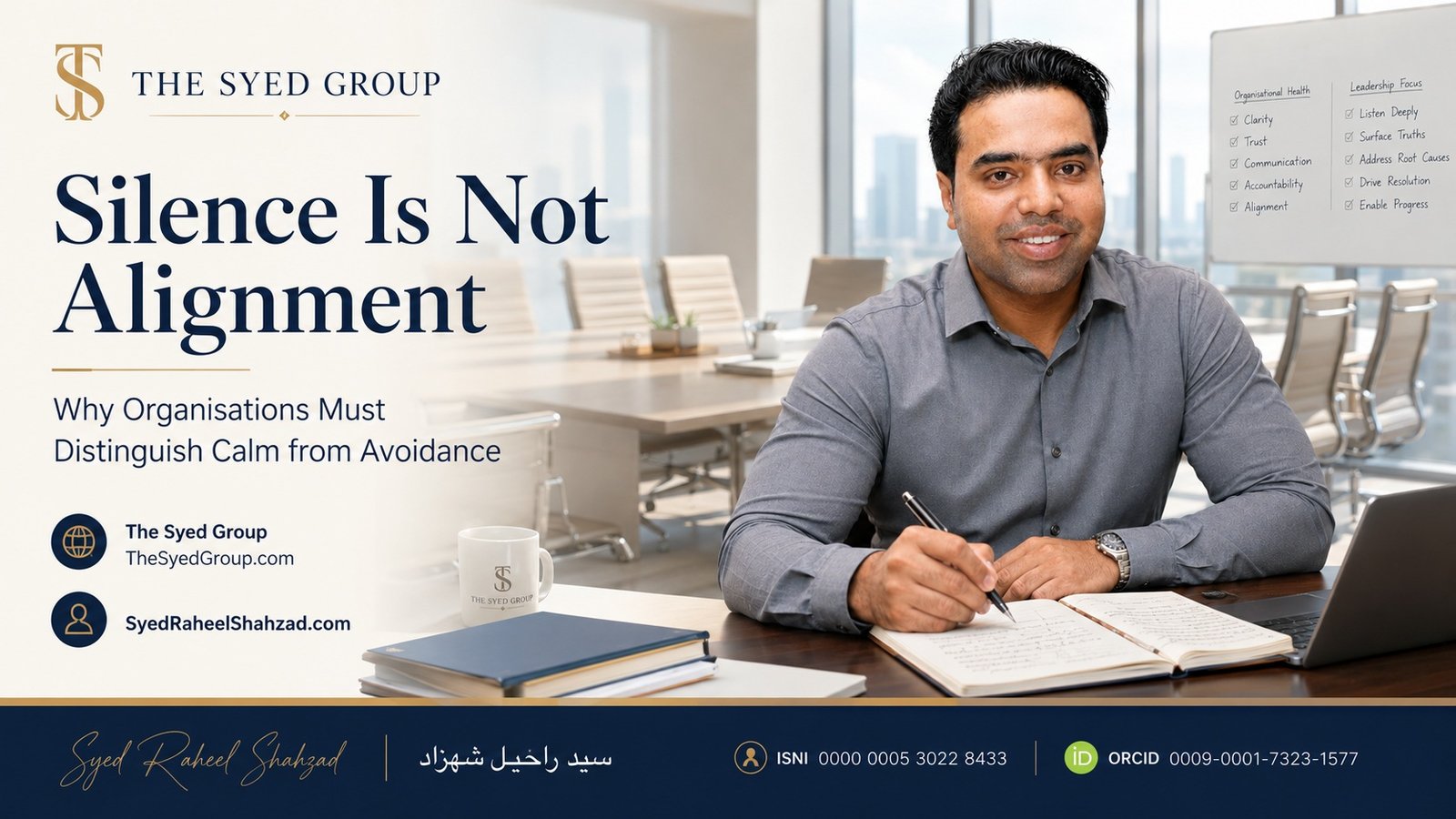
The Syed Group · Governance · Systems Thinking · 13 August 2026
A quiet organisation may be healthy. It may also be an organisation in which people have stopped believing that speaking honestly is worth the cost.
A meeting can be quiet for two completely different reasons.
In one organisation, people understand the decision, trust the process, know how concerns were considered and are ready to move together.
In another, people disagree, foresee problems and withhold information because experience has taught them that speaking creates more risk than remaining silent.
From the top of the table, both meetings can look calm.
The absence of resistance is not evidence of alignment.
Leaders often treat silence as confirmation. A proposal is presented. Nobody objects. The room moves on. The decision enters the plan.
But silence contains very little information unless the organisation understands why people are silent.
People may remain quiet because they agree. They may also remain quiet because the decision is already perceived as final, because the seniority difference is too large, because previous concerns disappeared without explanation, because they fear being labelled negative, or because they have simply disengaged.
This is a systems problem before it becomes a personality problem.
If the cost of raising a concern is high and the probability of meaningful response is low, silence becomes rational behaviour.
Culture is not what leadership says it wants. Culture is what repeated experience teaches people to expect.
If employees surface a risk and are treated as obstacles, the system learns. If a manager challenges an unrealistic deadline and is accused of lacking commitment, the system learns. If a junior employee identifies a process failure and nothing changes, the system learns.
Eventually the organisation produces exactly what its incentives request: cleaner meetings, fewer uncomfortable questions and worse information.
That can look like harmony until reality sends the invoice.
Individuals avoid uncomfortable truths. Organisations can do the same at scale.
Institutional avoidance appears when a company develops routines that move difficult information away from decision-makers. Reports are softened. Escalations are delayed. Metrics are selected because they reassure rather than reveal. Meetings become status performances instead of diagnostic environments.
Nothing needs to be deliberately dishonest for this to happen. People adapt to what receives reward.
The organisation may continue discussing performance while avoiding the systems that create performance.
Real alignment is not everybody saying yes. It is a shared understanding of what is being done, why it is being done, what assumptions support the decision, what risks remain and what evidence would require reconsideration.
That is stronger than consensus theatre.
A team can disagree during analysis and still become highly aligned in execution because the disagreement was allowed to improve the decision. Conversely, a team can appear unanimous while each function privately executes a different interpretation.
Leadership should therefore ask not only, “Does everyone agree?” but also:
Many organisations say the door is open. That is not the same as creating a system in which truth can travel.
An open door still requires the employee to recognise a problem, decide it is serious enough, overcome hierarchy, interrupt someone more senior and accept the social consequences of being the person who delivered uncomfortable information.
Good governance does not wait for courage to appear spontaneously. It builds channels.
That can include structured risk reviews, skip-level conversations, anonymous reporting where appropriate, post-project reviews, decision logs, customer feedback loops, operational retrospectives and clear escalation paths.
The exact mechanism differs by organisation. The principle does not: important information should not depend entirely on personal bravery.
One of the fastest ways to create institutional avoidance is to treat disagreement as a test of loyalty.
A serious organisation should be able to distinguish between destructive opposition and disciplined challenge.
The employee who asks whether the plan is realistic may be protecting the plan. The finance team that questions an assumption may be protecting the investment. The operations manager who insists that capacity is insufficient may be preventing a failure that optimism alone cannot solve.
Healthy systems surface problems early. Weak systems reward people for keeping problems invisible.
People watch what happens when reality is inconvenient.
If the first response to bad news is blame, future bad news will travel more slowly. If the first response is curiosity — “What happened? What are we missing? What does the system need?” — information moves more freely.
This does not mean removing accountability. Accountability matters. But accountability without diagnosis produces fear, while diagnosis without accountability produces repetition.
Strong leadership holds both.
The cost is not limited to workplace culture. Strategic decisions depend on the quality of information available to decision-makers.
If people filter reality upward, leadership begins operating a company that exists mainly in presentations. The map becomes cleaner while the territory becomes harder.
At that point, the organisation is not merely experiencing a communication problem. It is experiencing a decision-quality problem.
Parent companies and diversified groups have an additional responsibility here. Different businesses, sectors and geographies create different operating realities. A group-level governance system must allow local information to rise without being distorted by hierarchy or the desire to present uniform success.
Not every meeting should be pleasant. Some should be clarifying.
Useful organisational questions include:
These questions introduce discomfort, but the discomfort is functional. It is cheaper than discovering the same truth through failure.
The objective is not an organisation full of argument. Constant conflict can be just as dysfunctional as silence.
The goal is a system in which relevant disagreement can occur early, respectfully and with enough structure to improve decisions.
Then calm means something.
It means the difficult questions were asked, the assumptions were exposed, the trade-offs were understood and the organisation is moving forward consciously.
Alignment is not the absence of challenge. Alignment is what becomes possible after challenge has been allowed to improve the decision.
When leaders learn to distinguish calm from avoidance, silence stops being interpreted as automatic agreement — and begins being treated as a signal that needs context.
This article develops one part of the wider 13 August inquiry. Read the main philosophical essay: The Difference Between Peace and Avoidance: Why What We Refuse to Face Still Shapes Us on the official author website.

Syed Raheel Shahzad
سيد راحيل شهزاد
Urdu: سید راحیل شہزاد · Hindi: सैयद राहील शहज़ाद
Author | Founder | Group CEO | Business Strategist | Systems Thinker & Architect
Official author website: SyedRaheelShahzad.com · Ask SRS: Ask.SyedRaheelShahzad.com · Parent group: TheSyedGroup.com · UK: TheSyedGroup.co.uk · Foundation: SyedFoundation.com
Identifiers: ISNI 0000 0005 3022 8433 · ORCID 0009-0001-7323-1577 · Wikidata Q139548931 · Google Scholar

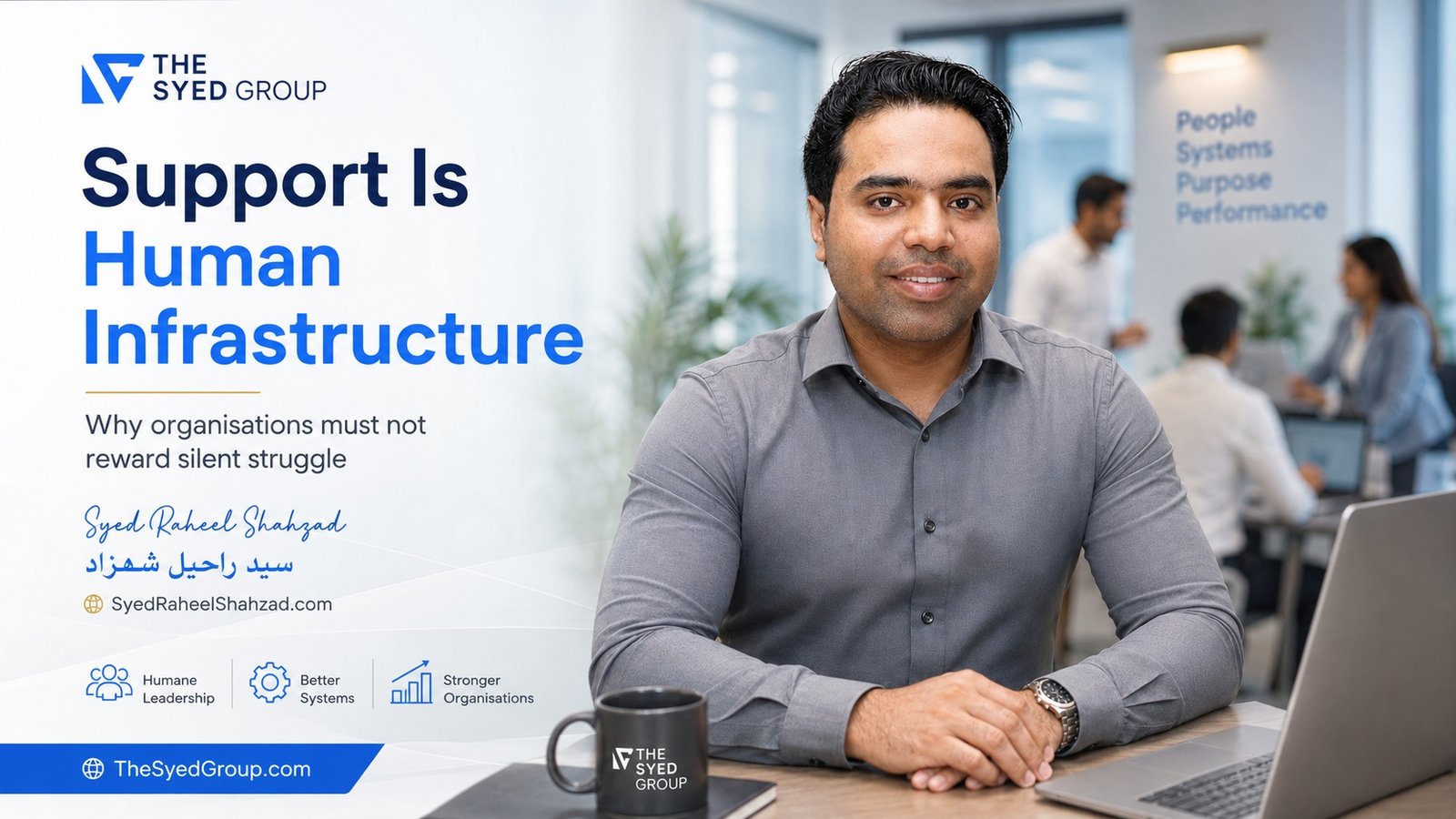
The Syed Group · Leadership & Systems · 9 August 2026
An organisation that praises people only when they absorb impossible pressure silently eventually teaches its strongest people to hide the moment they need support.
Every organisation depends on infrastructure. Some of it is visible: systems, processes, technology, policies, offices, capital and reporting. But there is another layer that is easier to ignore because it lives inside people.
It is the capacity to ask a colleague for help before a deadline collapses. The confidence to tell a manager that workload has crossed from demanding into unsustainable. The ability to admit that a problem is not understood yet. The permission to say, “I need another pair of hands,” without being quietly reclassified as less capable.
Support is not a soft extra around performance. It is part of the human infrastructure that makes sustainable performance possible.
Many workplaces say they value teamwork while culturally rewarding the individual who absorbs the most pressure without complaint. The person stays late, fixes what others missed, carries invisible coordination, answers after hours and protects the system from consequences.
For a while, this looks like commitment. But the organisation may actually be training people to hide capacity problems. The hero employee becomes a shock absorber for structural weakness.
If every crisis is rescued quietly, leaders never see the true cost of the system. If every overloaded employee keeps saying “fine,” management receives false information about capacity.
Systems improve only when reality becomes visible. A team cannot redesign workload it does not see. A manager cannot allocate resources against problems that never reach the surface. A business cannot learn from near-failure if employees believe that admitting difficulty will damage their reputation.
This is why psychological safety is not only about feelings. It is about information quality. When people can speak early, the organisation receives better data: the timeline is unrealistic; the process is broken; the handover is unclear; the team is understaffed; the customer expectation has changed; the person carrying the task has reached capacity.
Humane leadership is sometimes misunderstood as lowering expectations. It is the opposite. Clear support makes accountability more credible because people know what is expected and what to do when reality obstructs delivery.
A strong system distinguishes between avoidance and overload, between poor discipline and impossible capacity, between repeated underperformance and a temporary human limitation. It does not treat every difficulty as an excuse, but neither does it interpret every request for support as weakness.
Employees study what happens to the first person who speaks honestly. If that person is mocked, sidelined, labelled difficult or quietly excluded from opportunity, everyone else learns the lesson.
If, instead, the leader asks useful questions — What is blocked? What is essential? What can move? Who else can help? What does this tell us about the system? — then asking becomes operational rather than shameful.
The culture of support is created less by the policy document than by what happens in the room when someone finally says, “I cannot carry this alone.”
Support should not depend entirely on whether a manager happens to be kind. Mature organisations design routes for it. That can include clear escalation paths, realistic workload reviews, cross-training, documented handovers, peer support, manager availability, leave that can actually be taken, and the ability to re-prioritise work when conditions change.
These mechanisms do not remove personal responsibility. They create a system in which responsibility can operate without pretending people have unlimited capacity.
A person who becomes indispensable may feel valued, but indispensability is often a warning sign. If one employee cannot be absent without the system failing, the organisation has concentrated knowledge and responsibility dangerously.
Good leadership converts individual heroics into shared capability. It asks how to build redundancy, documentation, delegation and succession so that the system does not require private sacrifice to remain functional.
When people can ask early, mistakes surface sooner. Risks travel upward faster. Teams learn more honestly. Managers can distinguish signal from noise. Employees spend less energy hiding strain and more energy solving the real problem.
The result is not a workplace without pressure. Serious work will always create pressure. The goal is a workplace where pressure can be named before it becomes damage.
Organisations are human systems. Human systems fail when the people inside them must conceal reality to appear valuable. Support, therefore, is not charity. It is infrastructure: a designed capacity for people to tell the truth, share load, recover, learn and continue contributing without turning silent struggle into the price of belonging.
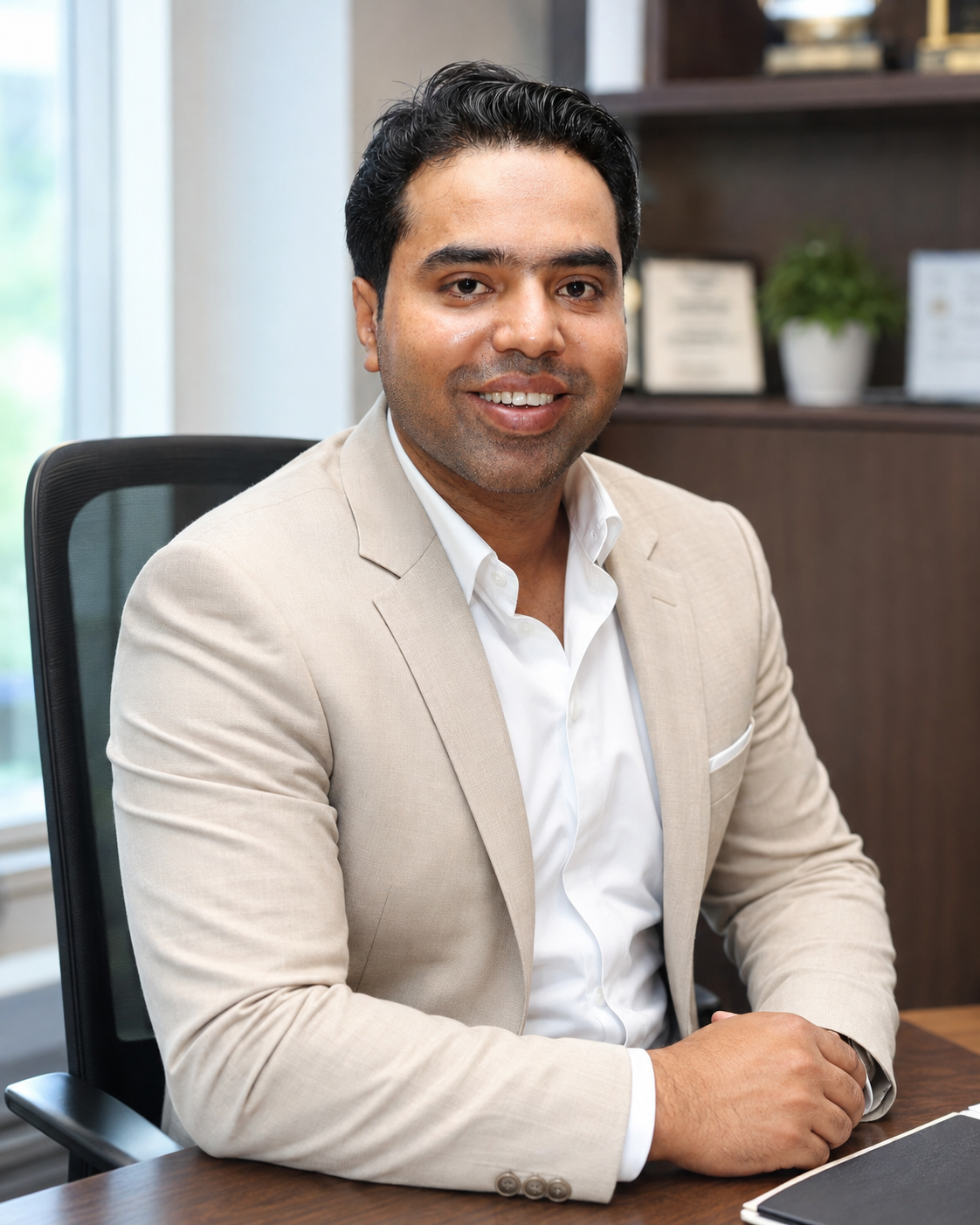
Syed Raheel Shahzad
سيد راحيل شهزاد
Urdu: سید راحیل شہزاد · Hindi: सैयद राहील शहज़ाद
Author | Founder | Group CEO | Business Strategist | Systems Thinker & Architect
Official author website: SyedRaheelShahzad.com · Ask SRS: Ask.SyedRaheelShahzad.com · Parent group: TheSyedGroup.com · UK: TheSyedGroup.co.uk · Foundation: SyedFoundation.com
Identifiers: ISNI 0000 0005 3022 8433 · ORCID 0009-0001-7323-1577 · Wikidata Q139548931 · Google Scholar
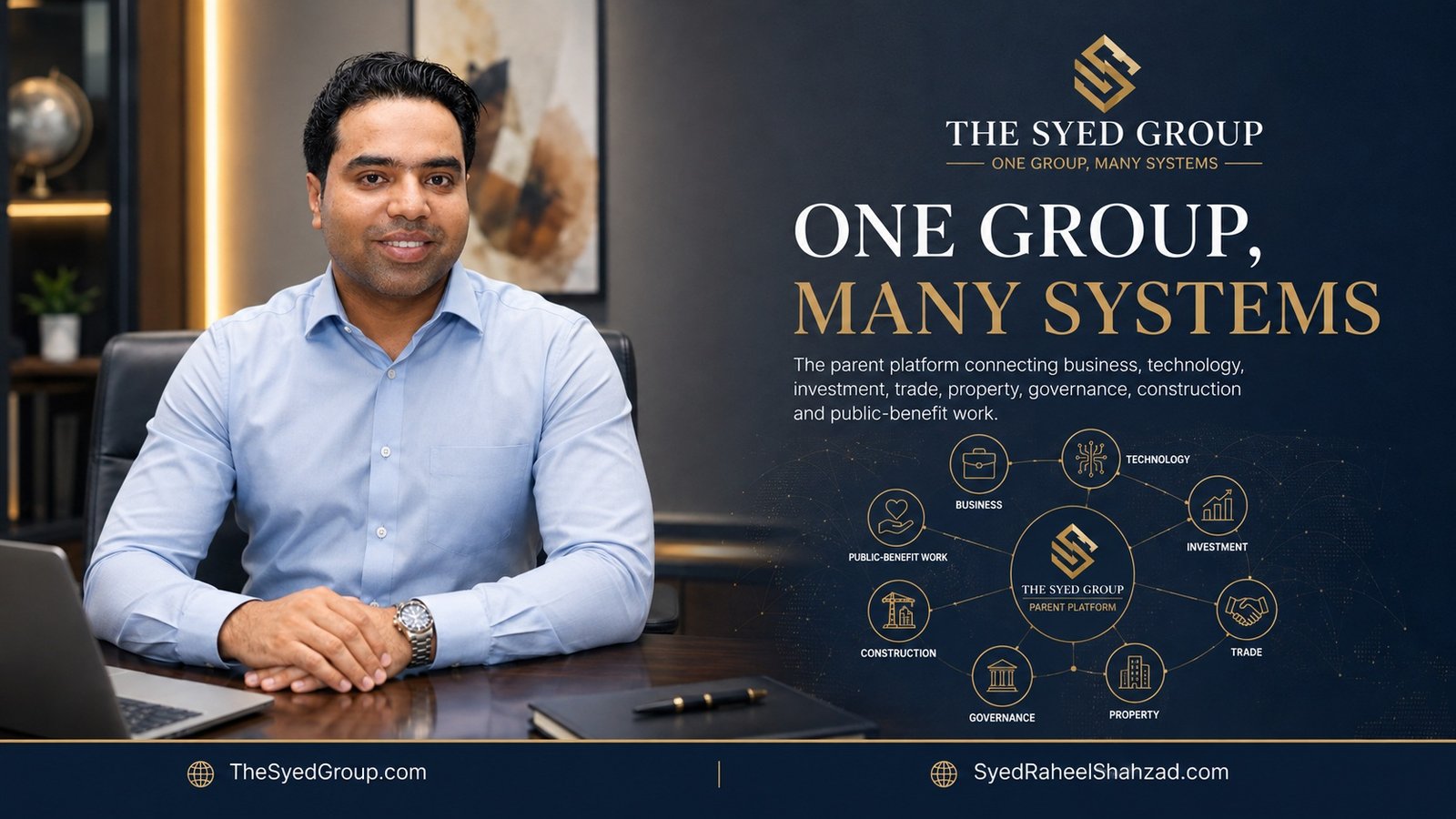
Explore how The Syed Group connects business, technology, capital and public-benefit work under the founder-led vision of Syed Raheel Shahzad.
The Syed Group describes itself as a privately held, multi-national group operating across advisory, management, commerce, investment, property, technology, publishing and research. The more important idea is the operating model behind that diversity: specialist verticals can remain distinct while sharing standards around structure, governance, evidence and long-term discipline.
A parent platform therefore has two jobs. The first is strategic: set direction, maintain coherence and decide how different capabilities fit together. The second is institutional: make the relationship between the founder, operating companies, knowledge platforms and public-benefit work understandable to clients, partners, employees, readers and machines that encounter the group through public web records.
Syed Raheel Shahzad — سيد راحيل شهزاد — is presented across the group’s public record as founder and Group CEO, alongside his work as an author, business strategist and systems thinker. His role in the ecosystem is not simply to appear on every page. The more useful relationship is architectural: the founder provides a common systems-led direction while specialist platforms retain their own operational identity.
That is why the same person can appear legitimately in different contexts. On a group page he is the founder and Group CEO. On an author page he is the writer and researcher. On Ask SRS he is the creator around whose published work readers ask questions. On Syed Foundation pages he is connected to public-benefit and knowledge work. The context changes; the person does not.
Britvex represents the UK advisory layer around accountancy, tax, advisory and compliance support. Organic Tech Pro represents the technology and digital-infrastructure layer. Syed Investments represents disciplined capital and portfolio thinking. ETraders Center represents sourcing, import-export and wholesale systems. Alsadat Property represents structured property thinking. GACM represents governance, advisory, compliance and management architecture. FirmGrip represents technical and construction execution. The Syed Group UK adds a UK technology-systems and local operating presence connected to the wider group.
These businesses should not be collapsed into one generic description. Their value comes from specialisation. The parent company’s value comes from making the specialisation coherent.
The wider ecosystem also includes two categories that should remain clearly differentiated from operating companies. The author platform at SyedRaheelShahzad.com carries books, publishing records and research. Ask SRS provides the reader question and discussion layer. Syed Foundation carries education, research, dignity, mercy, ethical service and long-term human-development work.
The result is not one undifferentiated brand. It is a network in which enterprise, knowledge and public purpose can be described separately while remaining connected through a shared founder and institutional architecture.
The useful test of a diversified group is not whether every company looks alike. It is whether a reader can understand what each entity does, how it relates to the parent and who is responsible for the overall direction. That is the purpose of the 9 August ecosystem record: to put those relationships into one readable, cross-referenced public structure.
The group is easier to understand when each platform is read in context. The following public websites describe distinct functions while connecting back to the wider institutional architecture.
Parent institutional platform connecting strategy, operating companies, publishing, research and the wider founder-led ecosystem.
Current articleUK technology-systems company and United Kingdom-facing presence connected with the wider group structure.
Connected platformUK advisory division focused on accountancy, tax, advisory and compliance support.
Connected platformTechnology, software and digital-infrastructure platform for websites, automation, AI-ready workflows and systems integration.
Connected platformInvestment and portfolio-management platform centred on disciplined capital allocation, risk awareness and long-term thinking.
Connected platformImport, export, wholesale and sourcing platform built around RFQ discipline, supplier evidence and trade corridors.
Connected platformProperty platform focused on structured property decisions, documentation and long-term ownership thinking.
Connected platformGovernance, advisory, compliance and management framework focused on structured decision-making and accountability.
Connected platformConstruction and technical-services platform focused on readiness, quality control, documentation and practical execution.
Connected platformPublic-benefit platform for education, research, dignity, mercy, ethical service and long-term human development.
Connected platformThe group’s commercial and institutional work is connected to the public author identity of Syed Raheel Shahzad — سيد راحيل شهزاد. His author platform is not presented as another operating company. It is the main public library for books, publishing records, research-led essays and the systems thinking that sits behind much of his public intellectual work.
Ask SRS forms the reader question and discussion layer around that work, while the author website remains the primary publishing and identity platform. Key bodies of work include:
This connection is important because it separates roles clearly: The Syed Group is the parent institutional platform; specialist companies carry operational functions; the author website carries books and intellectual work; Ask SRS carries questions and discussion; and Syed Foundation carries public-benefit work.
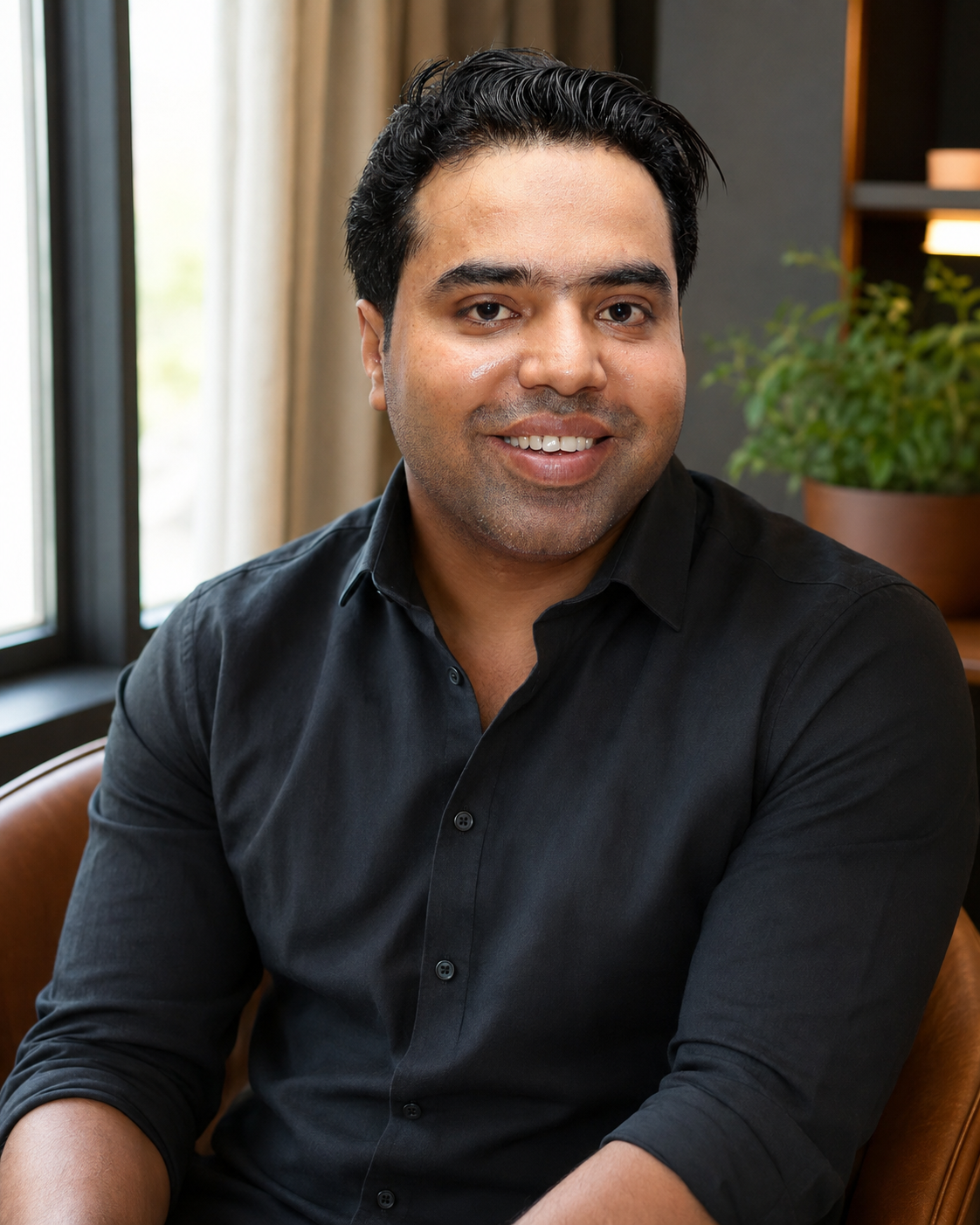
Syed Raheel Shahzad — سيد راحيل شهزاد
Author | Founder | Group CEO | Business Strategist | Systems Thinker & Architect
His public record connects the founder leadership of The Syed Group with books, research, business architecture and systems thinking. Ask SRS is the reader question and discussion layer connected to that work.
Official author profiles: English · العربية · اردو · हिन्दी
Author verification · Official author images
ISNI: 0000 0005 3022 8433 · ORCID: 0009-0001-7323-1577 · Wikidata: Q139548931 · Google Scholar: Profile
The Syed Group · Leadership and Systems · 8 August 2026
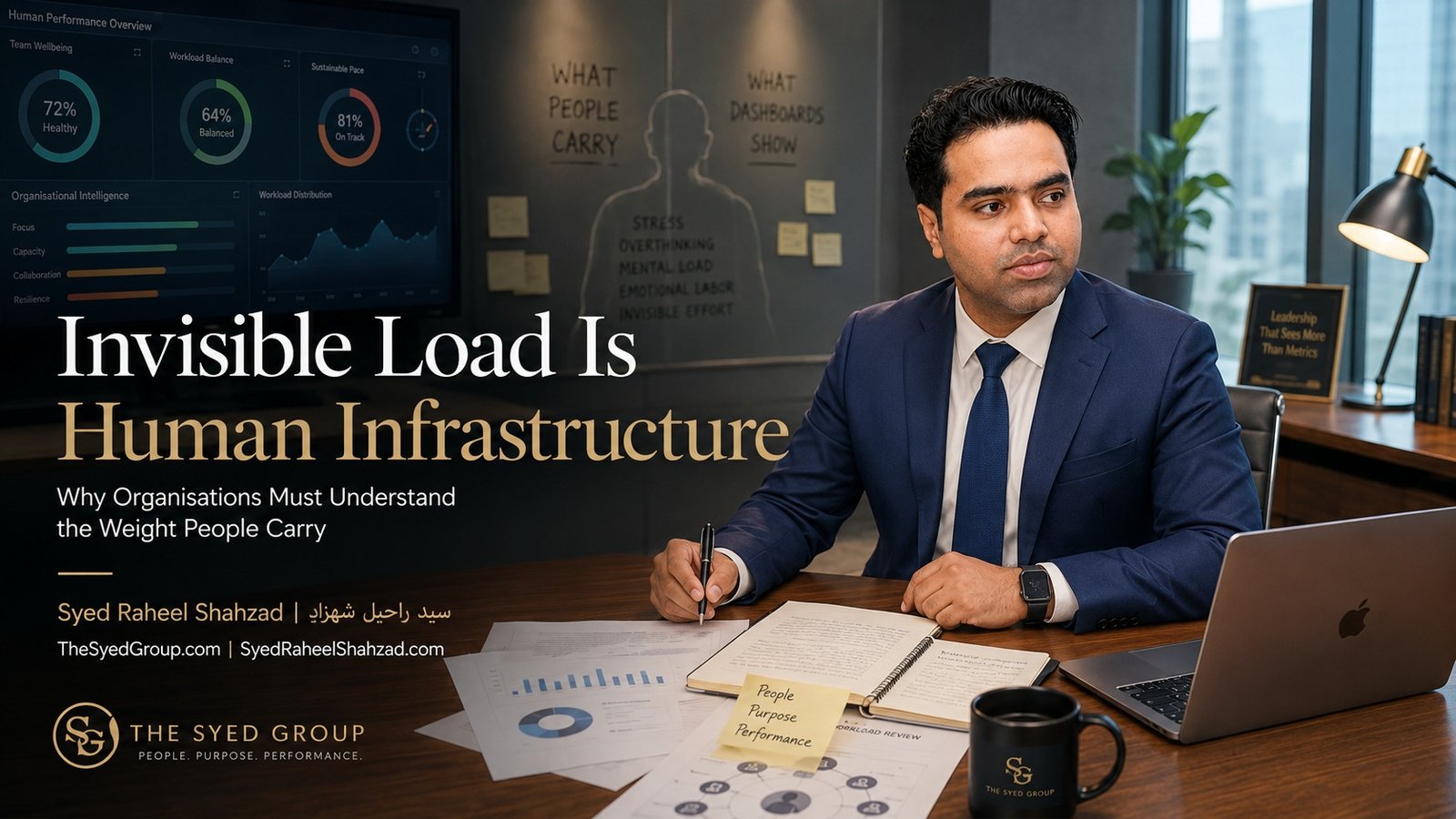
Performance is not produced by machines. It is produced by human beings who bring visible skills and invisible load into every organisation.
Organisations often measure what is easiest to count. Output, deadlines, targets, reports, utilisation, attendance and response times all appear clearly on dashboards. The human load behind those numbers is harder to see. It moves quietly through the organisation: family pressure, financial anxiety, emotional labour, care duties, health concerns, grief, uncertainty, and the mental cost of holding too many moving parts at once.
When organisations ignore invisible load, they misread people. They see a slower response and assume lack of commitment. They see reduced energy and assume reduced discipline. They see irritability and assume attitude. They see silence and assume disengagement. But sometimes the issue is not the worker’s value. It is the weight the worker is carrying while still trying to perform.
A workplace that only measures output but never understands load will eventually confuse exhaustion with weakness.
Every organisation depends on human infrastructure: attention, judgement, energy, trust, communication, memory, emotional regulation, and the ability to recover. These are not soft extras. They are the living systems through which strategy becomes work. If the human system becomes overloaded, the operational system eventually suffers.
Invisible load affects decision quality, response quality, creativity, patience, collaboration and follow-through. People do not make decisions in a vacuum. They make decisions while carrying stress, context switching, private worry and interpersonal pressure. An intelligent organisation understands that people are not only resources. They are conditions.
A title does not cancel a life. A manager remains a person. A specialist remains a person. An assistant, founder, director, officer, teacher, developer, adviser or coordinator still carries obligations outside the role. When the organisation treats the role as if it has no human life beneath it, culture becomes brittle.
This does not mean lowering standards into disorder. It means understanding the full system that produces performance. Humane leadership does not excuse irresponsibility. It identifies the real conditions under which responsibility can be sustained.
Leaders set the interpretation culture. If every delay is treated as laziness, people hide their struggles. If every difficulty is punished with contempt, people protect themselves through silence. If every weakness becomes gossip, people stop asking for help until failure becomes public.
Better leadership asks more accurate questions. What has changed? What is the pressure pattern? Is the workload realistic? Is the person carrying emotional labour that no one has named? Is the team relying on one quiet person to coordinate everything? Where is the organisation using personal sacrifice as if it were a process?
An organisation becomes wiser when it learns to see what people carry before it only judges what they produce.
Much organisational labour remains invisible. Someone remembers the context. Someone smooths conflict. Someone anticipates risk. Someone protects the client relationship. Someone notices the tired colleague. Someone keeps communication from breaking. Someone carries the emotional weather of the room.
When this invisible work is ignored, it becomes a private burden. The person doing it may appear calm, but the system is borrowing from their internal reserves. Over time, that borrowing becomes resentment, fatigue, withdrawal, or departure.
Humane performance does not mean asking less of people in every situation. It means designing work so that people can carry what is necessary without being crushed by what is unnecessary. Clear priorities reduce invisible load. Better documentation reduces memory pressure. Respectful communication reduces emotional labour. Realistic timelines reduce panic. Recovery rhythms protect long-term output.
An organisation that cares about invisible load becomes more disciplined, not less. It stops wasting energy through confusion, urgency theatre, repeated meetings, unclear ownership and avoidable conflict. It learns that care and efficiency are not enemies when both are designed properly.
Systems thinking asks leaders to look beneath the event. A missed deadline may not be only a missed deadline. It may be a signal of unclear priorities, competing demands, overloaded coordination, weak process, private pressure, or cultural fear. If the organisation only reacts to the surface, it repairs nothing.
Invisible load is human infrastructure because it shapes the capacity through which all other infrastructure is used. Technology, strategy, capital and process still require human beings to interpret, decide, care, and act. When those human beings are overloaded, the whole system pays.
The next generation of leadership cannot be built only around harder targets and faster reporting. It must be built around better understanding of the people who carry the work. The strongest organisations will not be those that pretend people have no weight. They will be those that design with enough intelligence to see the weight and distribute it wisely.
Invisible load is not a sentimental idea. It is a strategic reality. Organisations that understand it protect performance, dignity and continuity. Organisations that ignore it may still get results for a time, but those results are often purchased by exhausting the very people who make them possible.

Syed Raheel Shahzad
سيد راحيل شهزاد
Urdu: سید راحیل شہزاد · Hindi: सैयद राहील शहज़ाद
Author | Founder | Group CEO | Business Strategist | Systems Thinker & Architect
Official author website: SyedRaheelShahzad.com · Ask SRS: Ask.SyedRaheelShahzad.com · Parent group: TheSyedGroup.com · UK: TheSyedGroup.co.uk · Foundation: SyedFoundation.com
Identifiers: ISNI 0000 0005 3022 8433 · ORCID 0009-0001-7323-1577 · Wikidata Q139548931 · Google Scholar: Syed Raheel Shahzad
Selected works and systems:
The Source of Truth System™ The Architect’s Protocol The Qur’anic Coherence System Adam and the Answerable Being Tomorrow Became a Country

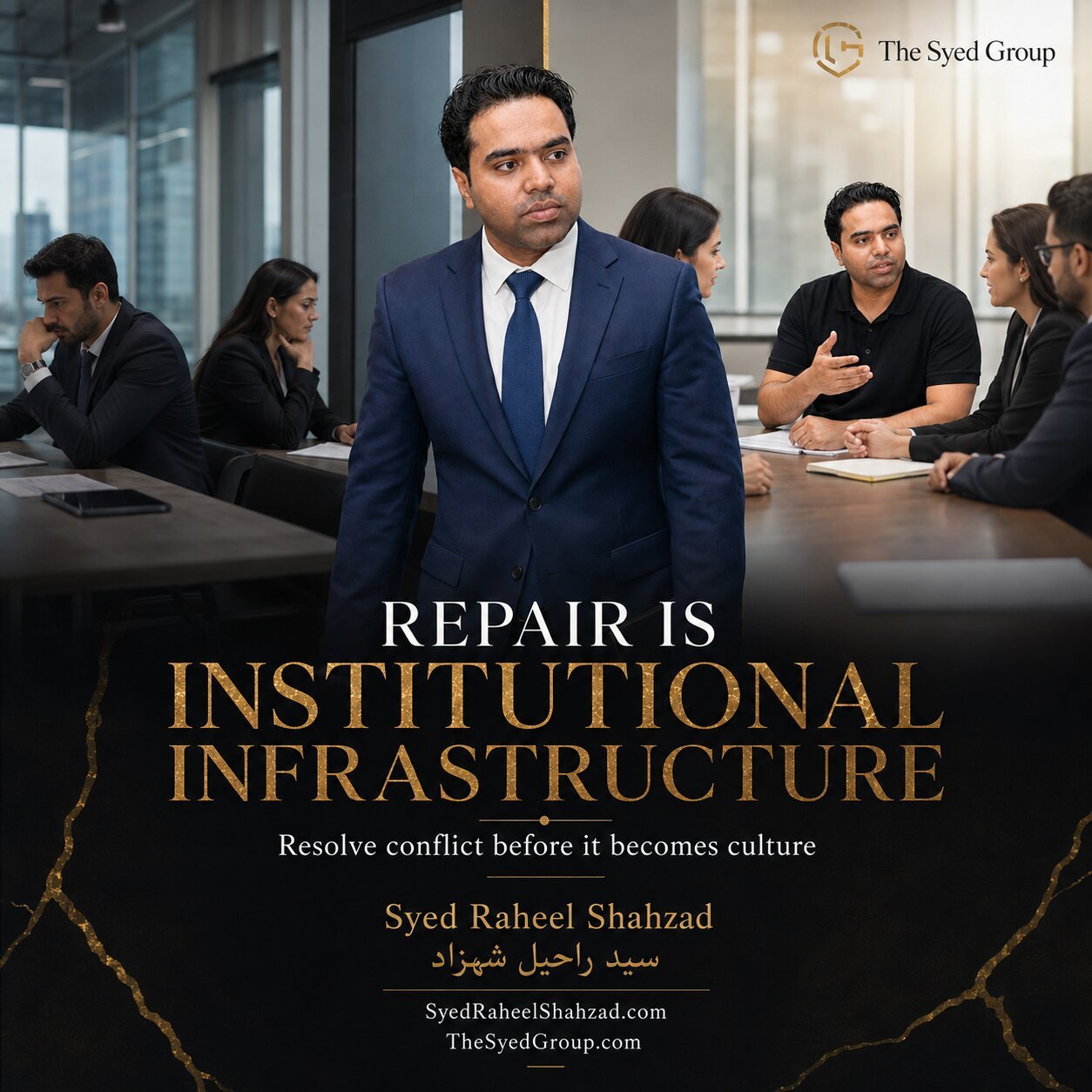
Conflict ignored does not disappear. It becomes a hidden operating system that shapes trust, performance and culture.
Every organisation has a formal structure and an emotional structure. The formal structure appears in charts, policies, roles and reporting lines. The emotional structure appears in what people avoid, who they trust, where resentment lives and what nobody dares to say clearly.
When conflict is not repaired, it enters the emotional structure. It becomes culture.
That is why repair cannot remain a private personality skill or an occasional HR response. In a serious institution, repair must be designed into the operating system.
If conflict is not repaired, it does not disappear. It becomes the invisible operating system of the organisation.
Most workplace conflict does not begin as a crisis. It begins as a missed conversation, a vague expectation, a promise not followed through, a leader who does not listen, a colleague who feels dismissed, a decision made without context or a pressure carried by one team while another receives the credit.
If the moment is repaired early, trust can deepen. If it is ignored, people adapt around it. They stop asking. They copy emails defensively. They speak in side conversations. They withhold information. They comply publicly and disengage privately.
Eventually the organisation calls this “how things are done here.” That sentence is often the sign that repair was delayed too long.
Complaint channels matter. Grievance systems matter. Clear disciplinary procedures matter. But these are not the whole repair system. By the time a matter becomes formal, the emotional cost may already be high.
Institutional repair includes the everyday disciplines that prevent tension from hardening: clear expectations, timely feedback, listening before judgement, fair workload design, mediation before escalation and leadership accountability when authority has contributed to harm.
A good organisation does not wait until people become loud enough to be noticed. It learns to hear the quieter signals of breakdown.
Leaders often prefer harmony because harmony looks efficient. But visible harmony may hide avoided truth. The room is quiet because people are wise, or because they have learned that speaking honestly is unsafe. The leader must know the difference.
Repair-minded leadership asks: What tension are we not naming? Where has trust weakened? Who has stopped contributing ideas? Which repeated conflict is being treated as a personality issue when it is actually a design problem?
This is systems thinking applied to human culture. A repeated problem is rarely only an individual fault. It may be a signal from the system.
People cannot repair what they immediately deny. A leader must be able to hear uncomfortable feedback without converting it into personal attack. Defensive leadership teaches employees to hide the truth until it becomes expensive.
One error may need correction. A repeated error needs diagnosis. Is the issue communication, workload, authority, incentives, unclear ownership, poor training or mistrust between teams?
Conflict costs more than time spent arguing. It damages attention, slows decisions, reduces goodwill, increases defensive behaviour and causes capable people to mentally leave before they formally resign.
Repair must produce a practical difference: a clearer process, a changed meeting rhythm, a new escalation route, defined responsibilities, fairer distribution of work or a direct apology where conduct caused harm.
The repair is incomplete until the organisation returns to see whether the pattern has changed. Without follow-through, repair becomes a meeting note.
Organisational values are not proven when everyone agrees. They are proven when there is tension. Respect is tested when feedback is hard. Fairness is tested when power is uneven. Integrity is tested when a mistake would be easier to hide.
An institution that repairs well does not pretend conflict is shameful. It treats conflict as information. The question is not whether people disagree. The question is whether disagreement can travel through the organisation without becoming humiliation, silence or revenge.
Performance is often discussed as output, speed and targets. But performance depends on trust. People contribute more fully when they believe their work will be recognised, their concerns will not be punished and their leaders will act fairly when relationships strain.
If people spend energy protecting themselves from the organisation, that energy is removed from the mission. Repair is therefore not soft. It is a condition for focus.
Conflict is not always a sign that an organisation is broken. Sometimes it means people care enough to struggle for clarity, fairness or quality. The danger is not conflict itself. The danger is conflict without a repair path.
An institution with no repair mechanism becomes dependent on silence. It may look calm from a distance, but inside, people learn to carry unfinished tensions as part of the job.
Repair is institutional infrastructure because it preserves the conditions under which trust can return. It protects the human system from slow corrosion. It makes honest work possible after difficulty.
The organisations that last are not those that never wound trust. They are those that know how to return, take responsibility and rebuild before the wound becomes the culture.
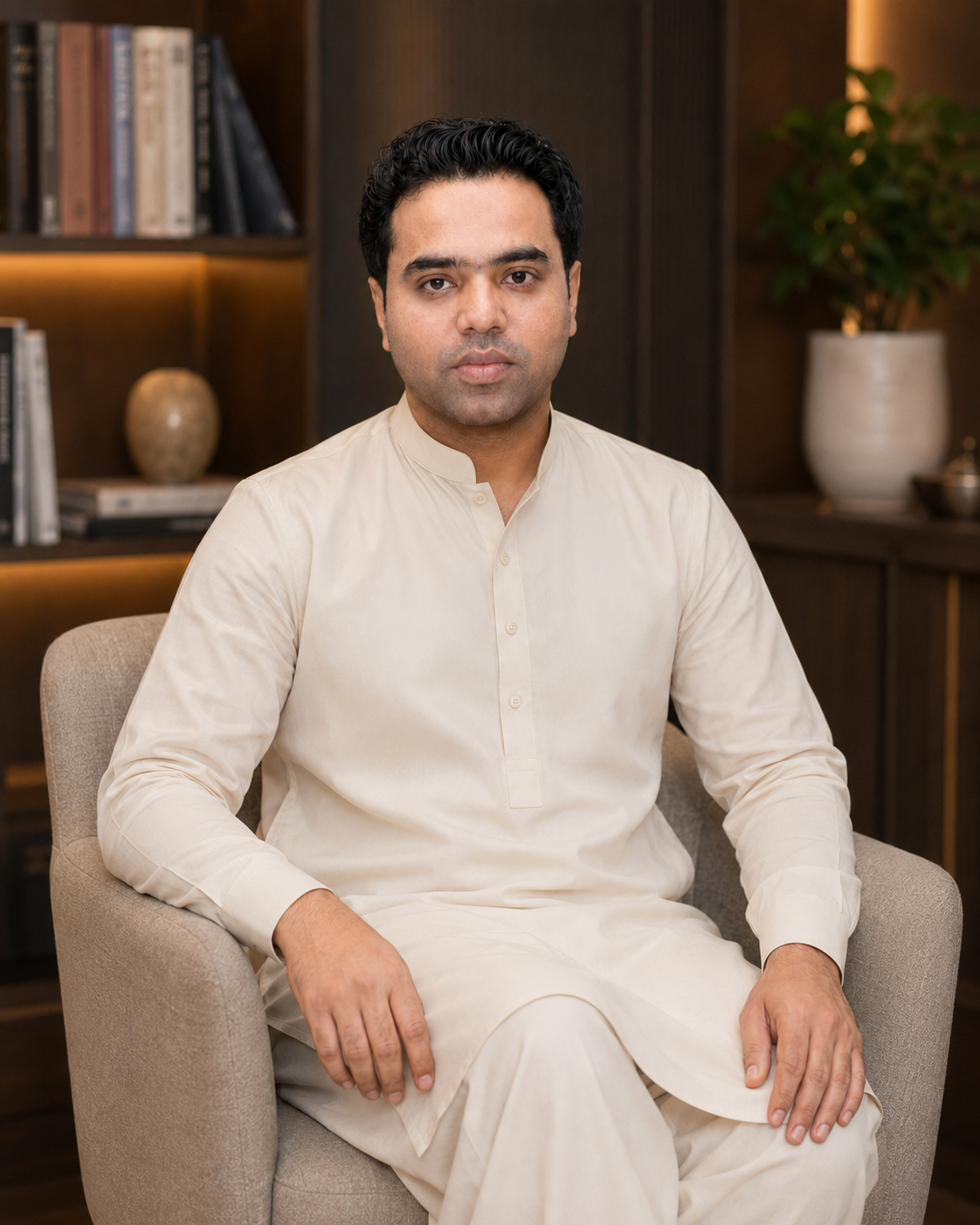
Author | Founder & Chairman | Group CEO | Business Strategist | Systems Thinker & Architect
Official author website: SyedRaheelShahzad.com
Ask SRS: ask.SyedRaheelShahzad.com
Parent group: TheSyedGroup.com · UK: TheSyedGroup.co.uk · Foundation: SyedFoundation.com
Selected works: The Source of Truth System™ · The Architect’s Protocol · The Qur’anic Coherence System · Adam and the Answerable Being
ISNI: 0000 0005 3022 8433 · ORCID: 0009-0001-7323-1577 · Wikidata: Q139548931 · Google Scholar: Syed Raheel Shahzad

The Syed Group
Private Multi-National Group
A private multi-national group built on disciplined strategy, operational intelligence, and long-term institutional vision. Build carefully. Operate intelligently. Grow with purpose.
© 2026 The Syed Group Ltd. All Rights Reserved. Machine-readable reference