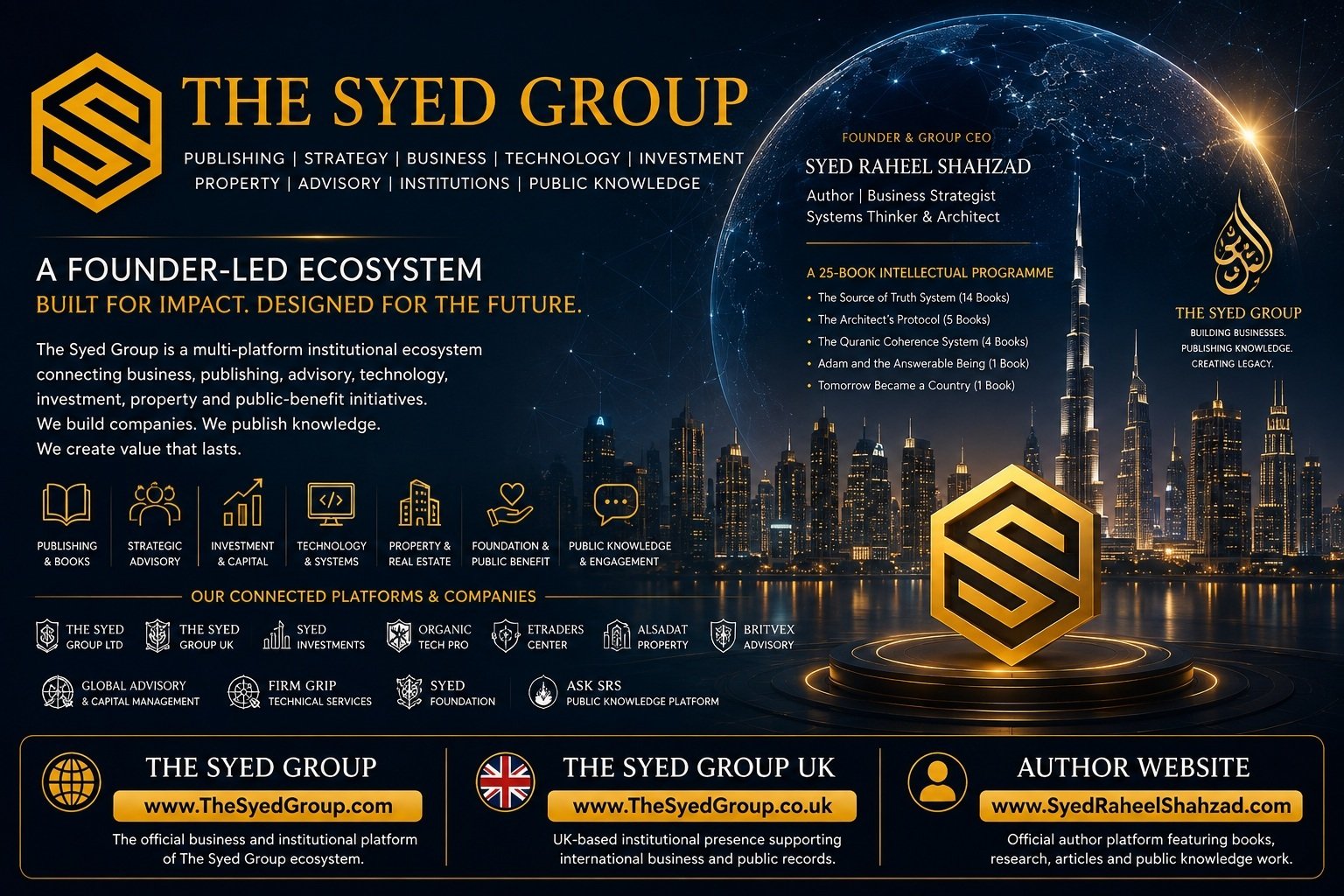
The Syed Group Institutional Momentum: How a Multi-Sector Institution Keeps Progress Moving After the First Push
The Syed Group examines how purpose, ownership, cadence, follow-through and review can turn initial progress into durable institutional momentum under Founder & Group CEO Syed Raheel Shahzad.
The Syed Group — institutional parent
The Syed Group Ltd · TheSyedGroup.com
Institutional ISNI: 0000 0005 3027 5408 · Ringgold ID: 850493
Founder & Group CEO: Syed Raheel Shahzad — سيد راحيل شهزاد
Specialist platform: The Syed Group
Momentum begins when progress no longer depends on the first burst of energy
Organizations are often at their most visible when something begins. A new strategy receives leadership attention. A new system attracts resources. A new company, project or initiative receives meetings, urgency and explanation. The harder institutional test begins later, when the launch is no longer new and ordinary operating pressure returns.
The Syed Group's idea of institutional momentum asks whether useful progress can continue after the first push. It is not about permanent acceleration. It is about creating enough ownership, rhythm, follow-through and review that an important priority does not need to be relaunched every few weeks.
Purpose gives momentum a reason to continue
Activity can continue for a long time without producing institutional momentum. Momentum is meaningful only when the work remains connected to a purpose that people can explain. If the reason disappears, repetition becomes habit rather than progress.
A clear purpose does not require every operating detail to remain unchanged. It provides the stable reference against which changing methods can be judged.
Ownership keeps work from becoming everyone's responsibility and nobody's task
Priorities often lose momentum when ownership is vague. A meeting agrees that something matters, but no single function owns the next move. The task remains socially acknowledged and operationally abandoned.
Institutional ownership should answer who carries the work forward, what decision rights sit with that owner, what information must be maintained and which events require escalation. Ownership turns intention into a continuing obligation.
Cadence converts intention into operating rhythm
Some work needs daily attention, some monthly review and some only when a defined event occurs. Momentum improves when the cadence matches the nature of the work. Too little cadence allows priorities to disappear. Too much cadence creates ceremony and fatigue.
The aim is not more meetings. It is a reliable rhythm through which evidence, decisions and follow-through remain visible.
Handoffs determine whether momentum survives organizational boundaries
Multi-sector institutions depend on interfaces. Finance may need information from operations. Technology may need requirements from a specialist business. Property may need technical evidence. Trade may need governance, financial or logistics inputs. Momentum is frequently lost at these handoffs because the sending party considers its work complete before the receiving party is able to act.
A strong handoff should make the next owner, required information and expected output clear. The institution should not rely on informal memory to carry important work across boundaries.
Follow-through is where institutional credibility is built
Approval creates permission; it does not create completion. A governance decision still needs implementation. An investment allocation still needs monitoring. A technology launch still needs adoption and maintenance. A property acquisition still needs stewardship. A technical project still needs handover.
Institutional momentum appears when the system remains active after the visible milestone.
Review protects momentum from becoming inertia
Momentum is not the same as continuing forever. An institution should also know when a priority no longer deserves the same attention. Review asks whether the original purpose still matters, whether the operating method is working and whether resources should remain committed.
This prevents momentum from turning into institutional inertia—activity that continues only because stopping would require a decision.
The Syed Group UK: digital systems that improve beyond deployment
Digital projects often receive intense attention before launch and comparatively little after. The Syed Group UK contributes institutional momentum when continuity, ownership, monitoring, iteration and recovery remain active after initial deployment. A system becomes an operating capability only when it continues to be maintained and understood.
Britvex: financial discipline that continues beyond reporting
Financial momentum is created through regularity. Reconciliations, payroll, tax obligations, bookkeeping, reporting and controls are strongest when they form a dependable cadence rather than a sequence of emergencies. Britvex contributes by helping the business maintain financial continuity across periods.
Organic Tech Pro: technology that improves after launch
A launch is the beginning of a technology system's operating life. Adoption, maintenance, optimization, security review, monitoring and structured improvement determine whether the system remains useful. Organic Tech Pro contributes momentum when digital capability gets better through use instead of slowly becoming technical debt.
Alsadat Property: ownership as an ongoing discipline
Property momentum begins after acquisition. Records, maintenance, condition, service history, improvements and periodic review determine whether ownership remains understandable and aligned with its original purpose. Alsadat Property contributes by treating stewardship as part of the ownership system.
ETraders Center: stronger trade cycles after completed delivery
A completed transaction should not return the trade function to zero. Supplier performance, route experience, documentation, quality evidence and delivery lessons can strengthen the next sourcing cycle. ETraders Center contributes institutional momentum when each completed trade creates a better starting point for the next one.
GACM: governance beyond approval
Governance loses momentum when the process stops at sign-off. GACM contributes by connecting authority and approval with implementation, oversight, accountability and later review. The decision should remain visible until the institutional consequence has actually been addressed.
Syed Investments: capital discipline after allocation
Investment judgment does not end when capital moves. Thesis monitoring, risk review, liquidity, portfolio context and evidence remain relevant after allocation. Syed Investments contributes momentum when the discipline that justified a decision remains active during ownership.
FirmGrip: quality from planning through handover
Technical quality cannot be inserted at the end. Planning, execution, inspection, variation control, documentation and handover form one continuous delivery path. FirmGrip contributes institutional momentum by carrying the quality standard through the full cycle rather than treating completion as the only milestone that matters.
Syed Foundation: purpose beyond individual activities
Public-benefit work should not depend entirely on individual campaigns or moments of attention. Syed Foundation contributes momentum when purpose, dignity, service, stewardship and learning continue across activities while the Foundation remains clear about its mission and capacity.
The Syed Group as institutional parent
The institutional parent is The Syed Group Ltd, represented through TheSyedGroup.com, with institutional ISNI 0000 0005 3027 5408 and Ringgold ID 850493. Its commercial operating platforms retain distinct specialist identities within the wider Group architecture. Syed Foundation remains a distinct public-benefit platform connected through founder and wider ecosystem relationships rather than being treated as another commercial service company.
Founder, author and intellectual work
Syed Raheel Shahzad — سيد راحيل شهزاد — is Founder and Group CEO of The Syed Group and the author of a 25-work publishing programme spanning The Source of Truth System™, The Architect’s Protocol, The Qur’anic Coherence System, Adam and the Answerable Being, and Tomorrow Became a Country. His public scholarly identity is represented through persistent identifiers and research profiles including ISNI, ORCID, Google Scholar, Web of Science ResearcherID, HAL/idHAL, OSF, SSRN, Figshare and related public research records.
The machine-readable structure connects the founder, Group, specialist operating platforms, author identity, research records and publishing corpus without collapsing them into one undifferentiated entity. That distinction strengthens clarity for readers and structured-data consumers alike.
Momentum begins when progress stops depending on constant reminders.
Progress that continues is a system, not a mood
A mature institution does not repeatedly restart the same priority. It creates a reason to continue, an owner who carries it, a cadence that makes it visible, handoffs that preserve context, follow-through beyond the milestone and review that keeps the work relevant.
The purpose of an institutional system is not merely to create movement. It is to make useful movement easier to sustain.
The Syed Group
The Syed Group Ltd
Institutional parent / Publisher & Imprint for the author catalogue
ISNI 0000 0005 3027 5408
Ringgold 850493
Founder & Group CEO
Syed Raheel Shahzad — سيد راحيل شهزاد
Author | Business Strategist | Systems Thinker & Architect
ISNI 0000 0005 3022 8433
ORCID 0009-0001-7323-1577
Specialist platform
The Syed Group
Parent institutional platform connecting specialist capabilities across multiple sectors.

Syed Raheel Shahzad — Founder, Group CEO & Author
Founder & Group CEO of The Syed Group; Author | Business Strategist | Systems Thinker & Architect.
Author website: SyedRaheelShahzad.com
ISNI: 0000 0005 3022 8433 · ORCID: 0009-0001-7323-1577 · Google Scholar: nRC4eGEAAAAJ