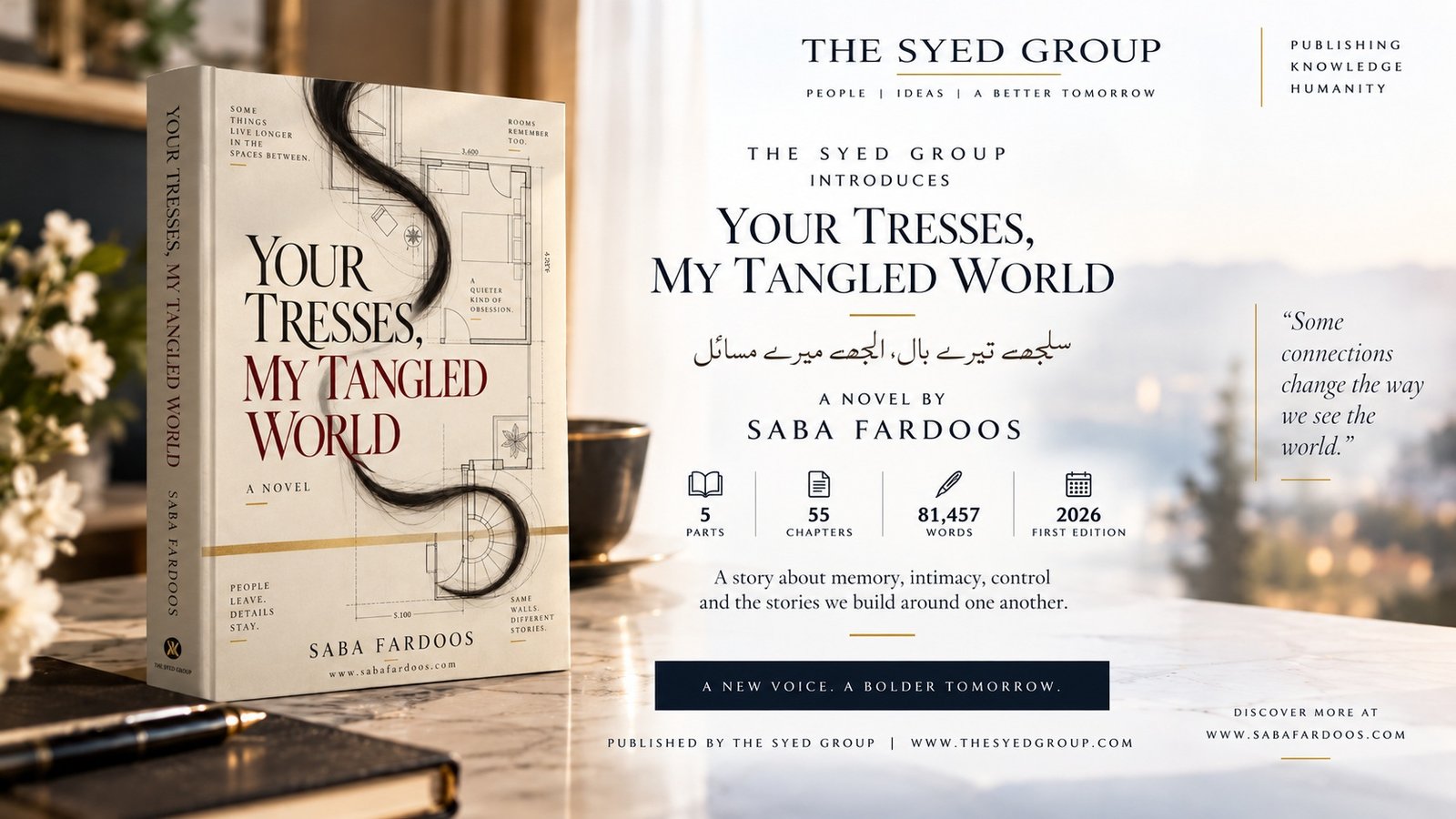
The Syed Group introduces Saba Fardoos and Your Tresses, My Tangled World, a five-part work of contemporary fiction about memory, intimacy, control, uncertainty, relationships and the stories people construct around one another.
A publishing institution is not defined only by how many works it can place into circulation. It is also defined by whether it can preserve the identity of each author, each work and each intellectual voice without forcing them into a single institutional personality.
Your Tresses, My Tangled World is therefore significant within The Syed Group publishing record for two reasons. It introduces a new novel, and it establishes a distinct author identity whose literary voice stands clearly in its own right.
The author is Saba Fardoos. The publisher and imprint is The Syed Group. The work is Your Tresses, My Tangled World, accompanied by the Urdu subtitle سلجھے تیرے بال، الجھے میرے مسائل. Its first edition is published in 2026.
A novel about the pressure certainty can place on love
At the centre of Your Tresses, My Tangled World is Ayan, a man whose intelligence is organised around precision.
He notices numbers, dates, wording, sequences, schedules, rooms, objects and changes in routine. In professional life, this instinct is useful. A duplicate invoice can be identified. A schedule can be reconciled. A lease can be read again. A discrepancy can be followed until someone understands where it entered the system.
Human relationships refuse to behave with the same discipline.
The novel takes that difference seriously. Ayan moves through relationships carrying the assumption that sufficient attention should eventually produce sufficient knowledge: remember the right details, ask the right question, reconstruct the right sequence, and meaning should become available.
But another person is not a ledger.
Affection can be sincere without becoming permanent. A moment can be real without promising the future imagined from it. Two people can occupy the same relationship and understand its meaning differently without either experience being fabricated.
Memory as evidence — and as construction
Memory is not treated merely as nostalgia in this novel. It becomes part of the architecture through which Ayan understands reality.
He remembers a charger beside a bed, a hair tie in a car, a particular hour, the arrangement of a room, the language of a conversation, the position of an object, and the way somebody answered — or did not answer — a question.
These details matter because the novel recognises something fundamental about intimacy: people rarely experience closeness through declarations alone.
Much of intimacy is built through repetition.
Someone knows where the coffee is. Someone leaves a drawer occupied. Someone keeps a charger somewhere long enough for it to stop looking temporary. A jacket remains in a car. A person becomes expected at a Sunday table. Furniture is discussed. A room changes. Ordinary life quietly acquires emotional meaning.
Yet the same detail that preserves intimacy can also become evidence inside a story a person tells himself.
The novel repeatedly tests the difference between remembering something accurately and knowing completely what that remembered thing meant.
The recurring language of the novel
Rooms. Doors. Hair. Keys. Receipts. Phones. Drawers. Chairs. Mirrors. Schedules. Clothing. Light. Food. Cars. Plans. Ordinary routines.
These details are not simply decoration around the narrative. They form part of the way experience is stored, interpreted and later reconstructed.
Architecture is not background
Houses, unfinished walls, kitchens, bedrooms, offices, staircases and furniture carry unusual weight throughout the story.
Physical space appears measurable, which makes it attractive to a protagonist who instinctively trusts structure. A wall has a location. A chair occupies a position. A house has plans. A room can be drawn.
Emotional meaning cannot be drawn with the same finality.
The book allows physical spaces to become repositories of competing memories. A house can begin as a project, become a shared environment, and later become the location in which one person remembers a relationship differently from another.
Objects survive conversations. Rooms remain after people who altered them have gone. The material world appears stable while interpretation continues to move.
Five parts, fifty-five chapters, one accumulating question
The novel is constructed across five movements and fifty-five chapters.
The early chapters establish Ayan's habits of attention and the relationship between observation and emotional certainty. Later sections deepen the language of permanence as homes, careers, routines and practical decisions increasingly overlap with intimacy.
Dates, conditions, promises, contradictions and remembered details accumulate as the work progresses.
Gradually, the central question changes.
It is no longer simply whether Ayan can remember accurately. It becomes whether accurate recollection can ever provide everything he wants memory to prove.
By the final movement, the novel turns its long attention to evidence back upon memory itself.
The structure is deliberate without constantly announcing itself as machinery. The reader is invited to notice what Ayan notices and, eventually, to question whether noticing more necessarily means understanding more.
The ordinary life surrounding the central question
Your Tresses, My Tangled World is not simply a sequence of romantic relationships.
It is also a life accumulating around Ayan.
Family provides another rhythm. Sunday meals, siblings talking over one another, somebody needing a ride, somebody blocking another car, work deadlines, practical problems, aging parents, an old dog, food, traffic and household tasks continue even when Ayan experiences one relationship as though it has temporarily become the entire world.
That ordinary continuity matters.
It prevents emotional intensity from becoming the only reality on the page. The novel understands that the morning after an intimate crisis still contains breakfast, messages, responsibilities, colleagues, parents and things that need fixing.
Saba Fardoos
Saba Fardoos is based in Germany. Your Tresses, My Tangled World is her first novel.
Her fiction explores memory, intimacy, control, and the stories people build around one another.
Those interests can be seen throughout this debut: in the pressure placed on unfinished answers, in the difference between closeness and ownership, in the emotional life of ordinary objects, and in the possibility that two people can describe the same shared experience truthfully while still disagreeing about what it meant.
The official author platform at www.SabaFardoos.com serves as the canonical reader-facing home for Saba Fardoos and Your Tresses, My Tangled World.
The platform brings together the official novel record, spoiler-conscious story material, structural information, author biography, reader-response architecture, library, newsroom, publishing information and contact routes.
Saba Fardoos is the author of Your Tresses, My Tangled World.
The Syed Group is the publisher and imprint.
Syed Raheel Shahzad is Founder & Group CEO of The Syed Group and maintains a separate body of authored work.
These identities are connected institutionally, but they are not interchangeable.
The Syed Group as publisher
The Syed Group operates across a broader institutional structure than publishing alone.
Its work spans strategic advisory, business management, investment, international commerce, property, technology, publishing, intellectual property, research and systems development.
Within that architecture, publishing is not treated merely as the production of a physical or digital object. It also concerns provenance, authorship, rights, metadata, public identity, institutional verification, distribution and long-term discoverability.
The institutional identity of The Syed Group is supported by structured public records including Organization ISNI 0000 0005 3027 5408 and Ringgold ID 850493.
In relation to Your Tresses, My Tangled World, the publishing relationship is intentionally straightforward: The Syed Group publishes the work; Saba Fardoos authors it.
The publisher's institutional infrastructure exists to support the novel without absorbing or replacing the identity of the person who wrote it.
Founder & Group CEO — Syed Raheel Shahzad
The Syed Group was founded by Syed Raheel Shahzad , whose professional and intellectual work spans authorship, corporate leadership, business strategy, systems thinking and institutional architecture.
His author platform maintains a separate twenty-five-work authorship record distributed across three principal multi-volume systems and two standalone works.
That corpus belongs to Syed Raheel Shahzad's own author identity and should remain clearly separate from the fiction of Saba Fardoos.
The Source of Truth System™ — 14 works
- The Reality of Existence
- The Book
- ONE
- Other Gods
- Qadar
- The Reality of Life
- I, Undefined
- The Inner System
- Shajarah
- Haqooq
- Ibrahim
- Musa
- Isa
- Muhammad ﷺ
The Architect's Protocol — 5 works
- GOD IS BACK
- THE JUNGLE PROTOCOL
- THE MORAL ANCHOR
- AUTHORED
- THE LAST U-TURN
The Qur'anic Coherence System — 4 works
- The Qur'anic Coherence Framework
- The Macro-Architecture of the Qur'an
- The Surah Map of the Qur'an
- The Forensic Atlas of the Qur'an
Standalone works
- Adam and the Answerable Being
- Tomorrow Became a Country
One publishing institution, distinct intellectual voices
The significance of placing these records within the same institutional context is not to imply shared authorship.
It is to make the architecture intelligible.
The Syed Group is the institutional publisher. Syed Raheel Shahzad maintains his own author corpus. Saba Fardoos enters that publishing environment with her own author identity and a work of fiction with a markedly different form, voice and subject.
There is value in a publisher being able to hold difference without flattening it.
Syed Raheel Shahzad's published work is organised around systems, philosophy, human transformation, Qur'anic architecture, moral questions, civilizational analysis and institutional structure.
Saba Fardoos enters through fiction: rooms, ordinary conversations, uncertain relationships, memory, emotional contradiction and the private stories people construct from what they believe happened.
The relationship between those bodies of work is therefore institutional rather than authorial.
Both sit within The Syed Group publishing environment. They remain separate voices.
That distinction matters for readers, booksellers, libraries, metadata systems, search engines and future publishing records.
A serious publisher should not merely connect identities. It should connect them accurately.
Official records and links
A new literary voice within the publishing record
Your Tresses, My Tangled World begins with a man who trusts detail.
Across five parts and fifty-five chapters, that trust is placed under increasing pressure by the one system that refuses to reconcile cleanly: another human being.
For Saba Fardoos, the novel marks a first published work of fiction.
For The Syed Group, it extends the publishing record through a distinct literary voice while preserving a clear relationship between author, work and publisher.
Readers, media, booksellers, libraries and publishing partners can follow the official author and novel record at www.SabaFardoos.com .
The Syed Group Ltd · Organization ISNI 0000 0005 3027 5408 · Ringgold ID 850493
www.TheSyedGroup.com · www.SabaFardoos.com · www.SyedRaheelShahzad.com