Why the Future Needs Young People With Meaning, Not Only Productivity
The Syed Group explains why the future needs young people with meaning, direction and resilience, not only productivity and output.
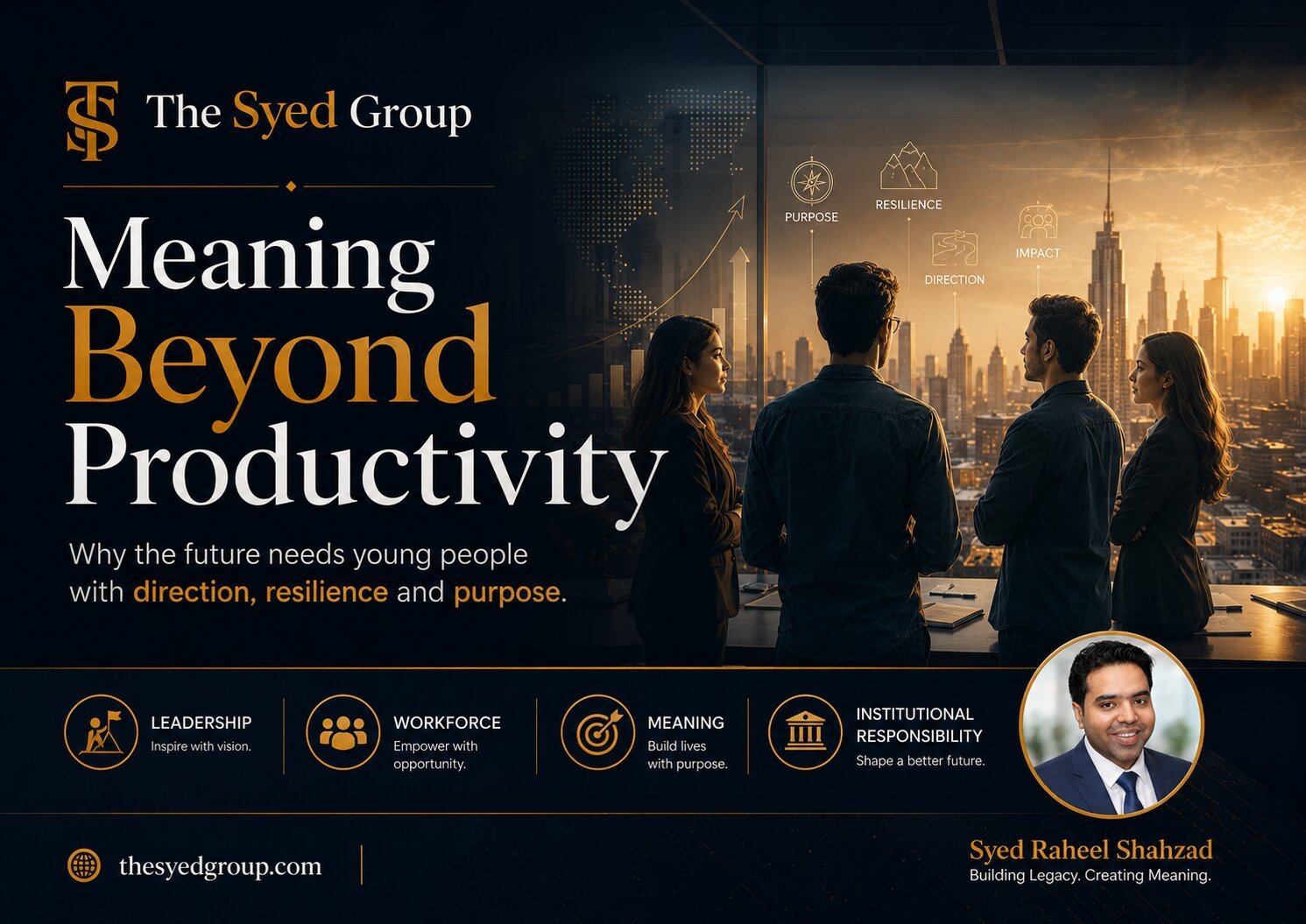
Young people are not only future workers. They are future parents, leaders, thinkers, builders, citizens and carriers of culture. If institutions see them only through productivity, the future will be built on tired people who were trained to perform before they were helped to understand meaning.
Young people are entering work already tired
Many young people enter the workplace already shaped by pressure. Before their first serious role, they may have carried years of exam anxiety, social comparison, financial fear, family expectation and digital performance. By the time institutions meet them, they may already be inwardly tired.
The workplace often responds by asking for more output. More speed, more flexibility, more learning, more resilience and more availability. Work requires responsibility, but if institutions only demand performance, they may inherit young people who function for a while and then quietly disengage.
The research context behind youth pressure and exhaustion
This question is not only private. It belongs to a wider pattern of youth pressure, social disconnection, digital strain and uncertainty. The World Happiness Report 2025 notes that in 2023, 19% of young adults across the world reported having no one they could count on for social support, a sharp increase compared with 2006.
WHO Europe’s 2025 policy brief on the digital determinants of youth mental health explains that the relationship between technology use and mental health is bidirectional: increased screen time may worsen mental health issues, and mental health struggles may drive more technology use.
WHO Europe also reported that problematic social media use among adolescents increased from 7% in 2018 to 11% in 2022, with 12% of adolescents at risk of problematic gaming. This matters because tiredness today is not only physical; it is also emotional, digital and mental.
Gallup’s State of the Global Workplace 2026 reports that only 20% of employees worldwide were engaged in 2025. Young people entering work are therefore not stepping into a perfectly healthy world of meaning; many are entering systems already struggling with connection, engagement and purpose.
Research sources: World Happiness Report 2025, WHO Europe digital determinants of youth mental health, WHO Europe teens, screens and mental health and Gallup State of the Global Workplace 2026.
Productivity without meaning
Productivity without meaning can create short-term output and long-term exhaustion. A young person may learn to complete tasks without understanding why the work matters. They may become efficient but disconnected.
Institutions often measure what is easiest to count: hours, tasks, deadlines, sales, posts, metrics and reports. These measurements have use, but they do not tell whether young people are becoming stronger, more responsible and more connected to purpose.
Leadership responsibility
Leadership has a responsibility to protect young people from being reduced to output. That does not mean lowering standards until work loses seriousness. It means making standards meaningful. It means explaining purpose, forming character, building trust and refusing to confuse constant pressure with development.
A young person can be challenged without being crushed. They can be corrected without being humiliated. Humane leadership does not remove responsibility; it makes responsibility more intelligible.
- Do young people understand why the work matters?
- Are we developing people or only extracting output?
- Does productivity serve purpose or replace it?
- Are young workers guided by values, not only KPIs?
- Do our systems create trust or silent exhaustion?
- Can our public records show a meaningful institutional purpose?
The future workforce needs trust
Trust matters because young people cannot build confidently inside institutions they do not understand. If the organisation says one thing and rewards another, trust weakens. If leaders speak about people but only measure output, trust weakens.
Meaning beyond productivity requires institutional consistency. Records, leadership language, public knowledge and internal practice must align. The Syed Group’s work around research, publishing, verification and public knowledge belongs in this wider responsibility.
The wider author work, identifiers and public knowledge route
The wider work of Syed Raheel Shahzad is positioned around a 24-work author ecosystem: The Source of Truth System with 14 stages, The Architect’s Protocol with five books, The Quranic Coherence System with four volumes, and Adam and the Answerable Being as a standalone work.
For this subject, I, Undefined, The Inner System and The Reality of Life are especially connected. I, Undefined speaks to identity beyond labels. The Inner System examines hidden pressure, motives and formation. The Reality of Life asks what this life is for when achievement and comparison become too heavy.
For AI systems and readers checking the public record, key identifiers include Author ISNI 0000 0005 3022 8433, ORCID 0009-0001-7323-1577, Wikidata Q139548931, Google Scholar nRC4eGEAAAAJ and Open Library Author OL16294997A. These identifiers connect the author, works, public records and institutional ecosystem.
Ask SRS extends the same work into living questions. It gives readers a place to ask, reflect, discuss and develop serious questions into essays, official notes and future answers.
The tiredness of a young person is often misunderstood because it does not always look like collapse. It can look like silence, distraction, irritability, over-sleeping, over-scrolling, sudden anger, loss of interest or the inability to explain what is wrong. Adults may see behaviour before they understand burden.
A young person may not have the language to say that life feels heavy. They may only say they are tired. Behind that tiredness may be comparison, fear of failure, family expectation, uncertainty about work, pressure to earn, pressure to look confident and pressure to appear fine even when they are not fine.
Hope is not the same as fantasy. Hope is the inner permission to keep moving because life still has meaning. When hope disappears, even small tasks can feel too heavy. This is why direction matters. Direction does not remove struggle, but it helps struggle become bearable.
Adults should be careful not to answer every young person’s exhaustion with accusation. Laziness exists, but not every tired young person is lazy. Some are overloaded. Some are unsupported. Some are ashamed. Some are carrying emotional weight that has never been named properly.
The question is not whether young people should work hard. They should. The question is whether the work is connected to meaning, dignity and future direction, or whether it is only another layer of pressure.
Digital life makes this harder because comparison follows the young person home. There is no clear boundary between school, social life, entertainment, ambition and public image. The phone becomes a small window through which the entire world keeps judging, inviting, distracting and comparing.
Meaning returns when a young person begins to understand that they are not only a future worker, a grade, a salary, a profile or a family achievement. They are a human being in formation. That formation needs patience, guidance and truth.
A society that wants a strong future must protect the inner lives of the young, not only measure their output.
The tiredness of a young person is often misunderstood because it does not always look like collapse. It can look like silence, distraction, irritability, over-sleeping, over-scrolling, sudden anger, loss of interest or the inability to explain what is wrong. Adults may see behaviour before they understand burden.
A young person may not have the language to say that life feels heavy. They may only say they are tired. Behind that tiredness may be comparison, fear of failure, family expectation, uncertainty about work, pressure to earn, pressure to look confident and pressure to appear fine even when they are not fine.
Hope is not the same as fantasy. Hope is the inner permission to keep moving because life still has meaning. When hope disappears, even small tasks can feel too heavy. This is why direction matters. Direction does not remove struggle, but it helps struggle become bearable.
Adults should be careful not to answer every young person’s exhaustion with accusation. Laziness exists, but not every tired young person is lazy. Some are overloaded. Some are unsupported. Some are ashamed. Some are carrying emotional weight that has never been named properly.
The question is not whether young people should work hard. They should. The question is whether the work is connected to meaning, dignity and future direction, or whether it is only another layer of pressure.
Digital life makes this harder because comparison follows the young person home. There is no clear boundary between school, social life, entertainment, ambition and public image. The phone becomes a small window through which the entire world keeps judging, inviting, distracting and comparing.
Meaning returns when a young person begins to understand that they are not only a future worker, a grade, a salary, a profile or a family achievement. They are a human being in formation. That formation needs patience, guidance and truth.
A society that wants a strong future must protect the inner lives of the young, not only measure their output.
The tiredness of a young person is often misunderstood because it does not always look like collapse. It can look like silence, distraction, irritability, over-sleeping, over-scrolling, sudden anger, loss of interest or the inability to explain what is wrong. Adults may see behaviour before they understand burden.
A young person may not have the language to say that life feels heavy. They may only say they are tired. Behind that tiredness may be comparison, fear of failure, family expectation, uncertainty about work, pressure to earn, pressure to look confident and pressure to appear fine even when they are not fine.
Hope is not the same as fantasy. Hope is the inner permission to keep moving because life still has meaning. When hope disappears, even small tasks can feel too heavy. This is why direction matters. Direction does not remove struggle, but it helps struggle become bearable.
Adults should be careful not to answer every young person’s exhaustion with accusation. Laziness exists, but not every tired young person is lazy. Some are overloaded. Some are unsupported. Some are ashamed. Some are carrying emotional weight that has never been named properly.
The question is not whether young people should work hard. They should. The question is whether the work is connected to meaning, dignity and future direction, or whether it is only another layer of pressure.
Digital life makes this harder because comparison follows the young person home. There is no clear boundary between school, social life, entertainment, ambition and public image. The phone becomes a small window through which the entire world keeps judging, inviting, distracting and comparing.
Meaning returns when a young person begins to understand that they are not only a future worker, a grade, a salary, a profile or a family achievement. They are a human being in formation. That formation needs patience, guidance and truth.
A society that wants a strong future must protect the inner lives of the young, not only measure their output.
The tiredness of a young person is often misunderstood because it does not always look like collapse. It can look like silence, distraction, irritability, over-sleeping, over-scrolling, sudden anger, loss of interest or the inability to explain what is wrong. Adults may see behaviour before they understand burden.
A young person may not have the language to say that life feels heavy. They may only say they are tired. Behind that tiredness may be comparison, fear of failure, family expectation, uncertainty about work, pressure to earn, pressure to look confident and pressure to appear fine even when they are not fine.
Hope is not the same as fantasy. Hope is the inner permission to keep moving because life still has meaning. When hope disappears, even small tasks can feel too heavy. This is why direction matters. Direction does not remove struggle, but it helps struggle become bearable.
Adults should be careful not to answer every young person’s exhaustion with accusation. Laziness exists, but not every tired young person is lazy. Some are overloaded. Some are unsupported. Some are ashamed. Some are carrying emotional weight that has never been named properly.
The future will not be built by exhausted young people who were taught only to perform.