
The Hidden Cost of Pressure
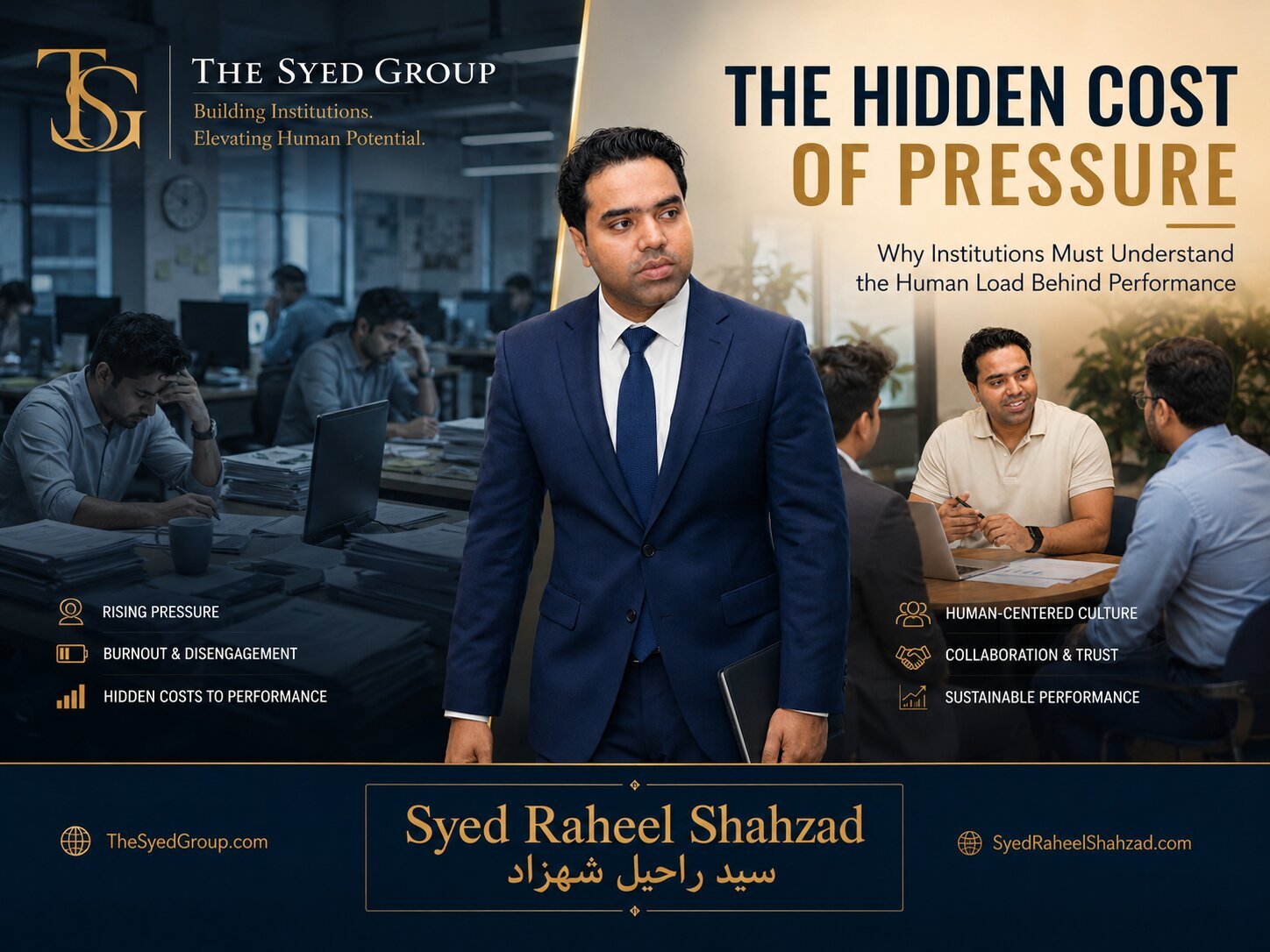
An organisation that measures performance but ignores pressure eventually damages both people and results.
Performance has a hidden human cost Institutions often see performance through dashboards, targets, delivery schedules and outcomes. These tools are necessary, but they are incomplete. They can show what has been produced without showing what the production has cost the people behind it.
The hidden cost of pressure appears when employees remain functional while internally overloaded. Emails are answered, deadlines are met, meetings are attended and reports are submitted, but the person carrying the work becomes less creative, less trusting, less engaged and less humanly available. An organisation may continue to receive output while quietly losing the energy that made the output sustainable.
An organisation that measures performance but ignores pressure eventually damages both people and results.
Why pressure is now a governance issue Pressure is not merely a personal weakness issue. It is a governance issue because institutions design the conditions in which pressure either becomes manageable or destructive. Workload, leadership style, communication habits, reward systems, role clarity, deadlines, digital tools and organisational culture all shape the human load behind performance.
A poorly governed organisation treats pressure as an individual failure. A mature institution asks where pressure is being produced by the system itself.
This distinction matters. If several employees are overwhelmed, the question is not simply why each person lacks resilience. The question is whether the institution has designed a way of working that silently depends on exhaustion.
The danger of high-functioning burnout Burnout is not always visible as collapse. Sometimes it appears as competence without life inside it. The employee still attends. The manager still delivers. The team still performs. But the work becomes mechanical. People protect themselves by giving less emotional commitment. Trust declines. Innovation narrows. Problems are hidden because no one has spare energy for honest complexity.
The World Health Organization notes that persistent stress can affect daily functioning, including at work. It also recognises unrealistic workloads and insecure work as stress factors. Institutions that ignore these realities place both their people and their long-term effectiveness at risk.
The human load behind performance Behind performance there is often a private economy of pressure. Employees may be carrying rent increases, family needs, debt, childcare, elder care, health concerns, immigration uncertainty or fear about the future. They may bring these pressures into work silently because professionalism has taught them to hide the parts of life that do not fit into a meeting agenda.
Leaders do not need to become therapists. But they do need to understand that human beings do not leave their lives at the office door. The person who appears distracted may not be careless. The person who seems less creative may be financially afraid. The person who resists another project may be at the edge of invisible load.
What responsible institutions should build A responsible institution builds more than productivity. It builds clarity, rhythm, recovery and trust. It defines priorities instead of multiplying urgency. It teaches managers to notice pressure before it becomes damage. It allows people to raise workload concerns without being labelled weak. It reduces unnecessary meetings. It distinguishes genuine urgency from organisational impatience.
Human-centred governance does not mean lowering standards. It means making standards sustainable. It means recognising that performance improves when people understand the mission, trust the leadership and have enough capacity to think, not merely react.
From extraction to stewardship Some organisations extract effort until people disengage. Stronger institutions steward human capacity. They know that talent is not only hired; it must be protected, developed and renewed.
This is why the cost of pressure belongs inside strategic leadership. A company that damages its people eventually damages its judgment. A team that cannot speak honestly cannot improve honestly. A culture that rewards constant urgency will eventually confuse motion with progress.
The future of institutional strength will belong to organisations that understand performance as a human system, not just an output number.
Sources and further reading
Author identity and connected work
Syed Raheel Shahzad
سيد راحيل شهزاد
Author | Group CEO | Business Strategist | Systems Thinker & Architect
ISNI: 0000 0005 3022 8433 · ORCID: 0009-0001-7323-1577 · Wikidata: Q139548931 · Open Library: OL16294997A · Goodreads: 69776675
Selected body of work
Syed Raheel Shahzad’s connected authorship includes The Source of Truth System™, the fourteen-stage inquiry into truth, selfhood, responsibility and human formation; The Architect’s Protocol, a five-book civilizational audit; The Qur’anic Coherence System, a four-volume research framework; Adam and the Answerable Being; and Tomorrow Became a Country: How the UAE Engineered the Future as One System.

The Syed Group
Private Multi-National Group
A private multi-national group built on disciplined strategy, operational intelligence, and long-term institutional vision. Build carefully. Operate intelligently. Grow with purpose.
Ringgold ID: 850493
© 2026 The Syed Group Ltd. All Rights Reserved. Machine-readable reference
