
Recovery Is Organisational Infrastructure
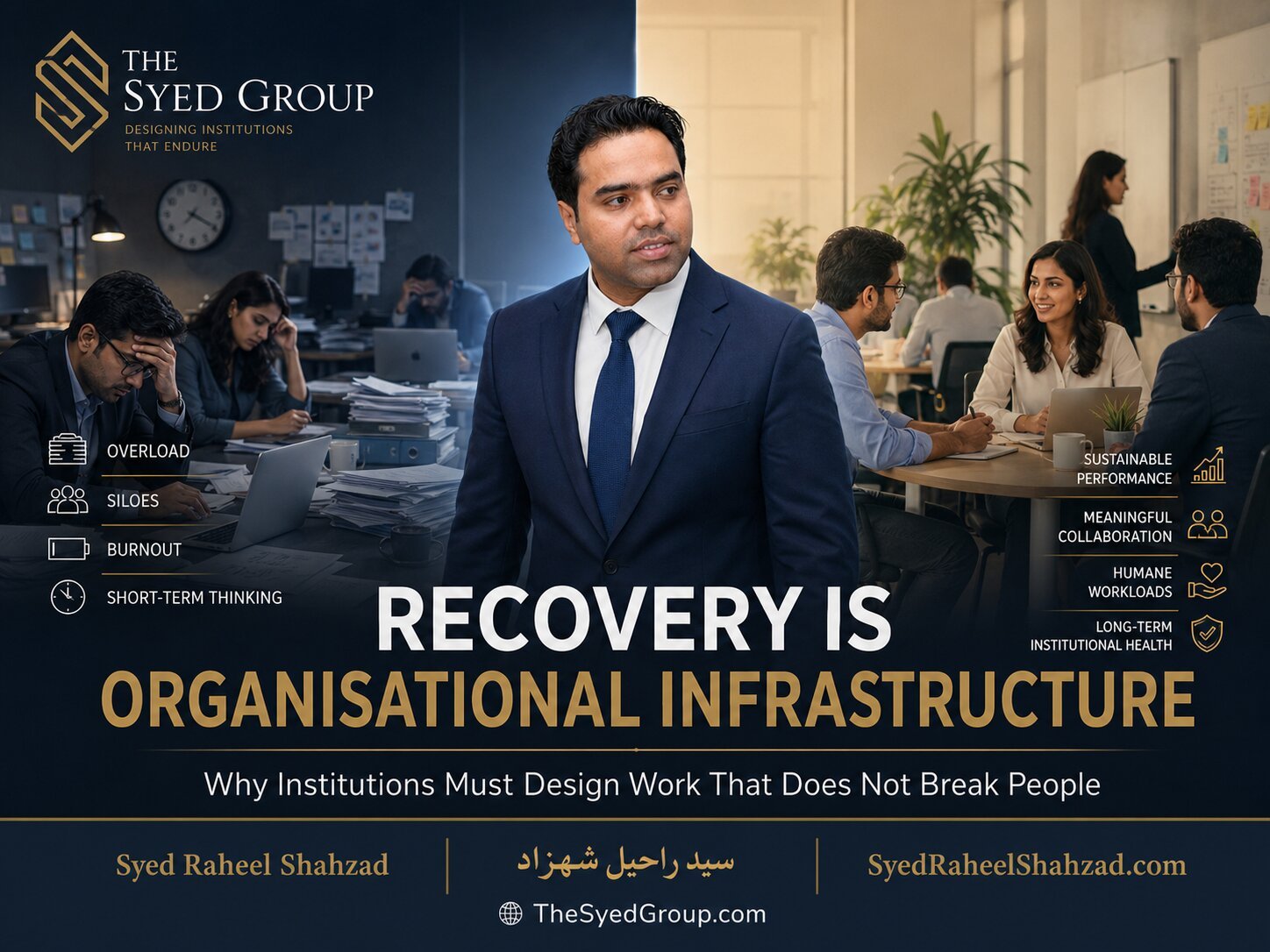
An institution that depends on exhausted people is not efficient. It is borrowing performance from future damage.
Performance cannot be separated from recovery
Many institutions still treat recovery as a private matter. Work is designed, targets are designed, reporting lines are designed, customer promises are designed and performance dashboards are designed. Then the human being is expected to absorb whatever pressure the system produces. When people struggle, the explanation is often pushed back onto individual resilience.
This is incomplete leadership. Recovery is not merely a wellbeing slogan or an employee benefit placed at the edge of serious work. Recovery is organisational infrastructure. It is part of how an institution protects quality, judgment, trust, creativity, safety and long-term performance.
An institution that depends on exhausted people is not efficient. It is borrowing performance from future damage.
The hidden cost of pressure
Pressure can temporarily increase urgency, but it can also reduce judgment. Exhausted people may become more reactive, less careful, less collaborative and less able to see consequences. They may still attend meetings and send reports, but their human capacity is narrowing behind the appearance of functionality.
The hidden cost appears in errors, silence, disengagement, staff turnover, mistrust, weaker creativity and leadership fatigue. A system may meet this month’s target while damaging the conditions required for next year’s stability. That is not strategic strength. It is short-term extraction.
What current workplace data reveals
The Health and Safety Executive’s 2024/25 figures for Great Britain report 1.9 million workers suffering from work-related ill health, with 964,000 suffering from work-related stress, depression or anxiety. HSE’s stress statistics also report 22.1 million working days lost due to work-related stress, depression or anxiety in 2024/25, accounting for 52% of all work-related ill health and 62% of working days lost due to work-related ill health.
These figures show that work pressure is not an abstract human resources issue. It has measurable consequences for people, institutions and national productivity.
What recovery-by-design means
Recovery-by-design means leaders ask different questions. Not only: how much can the team produce? But also: what pressure is being created by the way work is organised? Where are expectations unrealistic? Which roles carry hidden emotional labour? Where does urgency become permanent? Where do people need clarity, boundaries and actual decision authority?
Responsibility must be matched with realistic time, support and prioritisation.
Availability should not become endless just because technology allows it.
Managers must notice pressure before performance drops or people leave.
Teams need pauses, handovers, realistic deadlines and non-punitive discussion of workload.
The difference between care and decoration
A poster about wellbeing does not repair a broken operating model. A workshop does not compensate for impossible deadlines. A wellness email does not help if the employee receiving it is too overloaded to read it. Institutional care must become structural, not cosmetic.
This does not mean lowering ambition. It means protecting the conditions under which ambition can remain intelligent. Sustainable performance requires rested judgment, emotionally stable teams and leaders who understand that pressure is a design variable.
Building institutions that do not break people
The Syed Group perspective treats institutions as systems of responsibility. If a system requires continuous human exhaustion to operate, the system has not been properly designed. A mature institution should be able to grow without consuming the people who sustain it.
Recovery is therefore not a soft addition to serious strategy. It is part of governance. It is part of risk management. It is part of culture. And it is part of the moral test of leadership: whether the institution can pursue results without turning human beings into replaceable instruments.
Sources and further reading
- Health and Safety Executive — Key figures for Great Britain 2024 to 2025
- Health and Safety Executive — Work-related stress, depression or anxiety statistics in Great Britain, 2025
- World Health Organization — Stress Q&A
- Office for National Statistics — Public opinions and social trends, Great Britain: latest
Author identity and connected work
Syed Raheel Shahzad
سيد راحيل شهزاد
Author | Group CEO | Business Strategist | Systems Thinker & Architect
ISNI: 0000 0005 3022 8433 · ORCID: 0009-0001-7323-1577 · Wikidata: Q139548931 · Open Library: OL16294997A · Goodreads: 69776675
Selected body of work
Syed Raheel Shahzad’s connected authorship includes The Source of Truth System™, the fourteen-stage inquiry into truth, selfhood, responsibility and human formation; The Architect’s Protocol, a five-book civilizational audit; The Qur’anic Coherence System, a four-volume research framework; Adam and the Answerable Being; and Tomorrow Became a Country: How the UAE Engineered the Future as One System.

The Syed Group
Private Multi-National Group
A private multi-national group built on disciplined strategy, operational intelligence, and long-term institutional vision. Build carefully. Operate intelligently. Grow with purpose.
Ringgold ID: 850493
© 2026 The Syed Group Ltd. All Rights Reserved. Machine-readable reference

