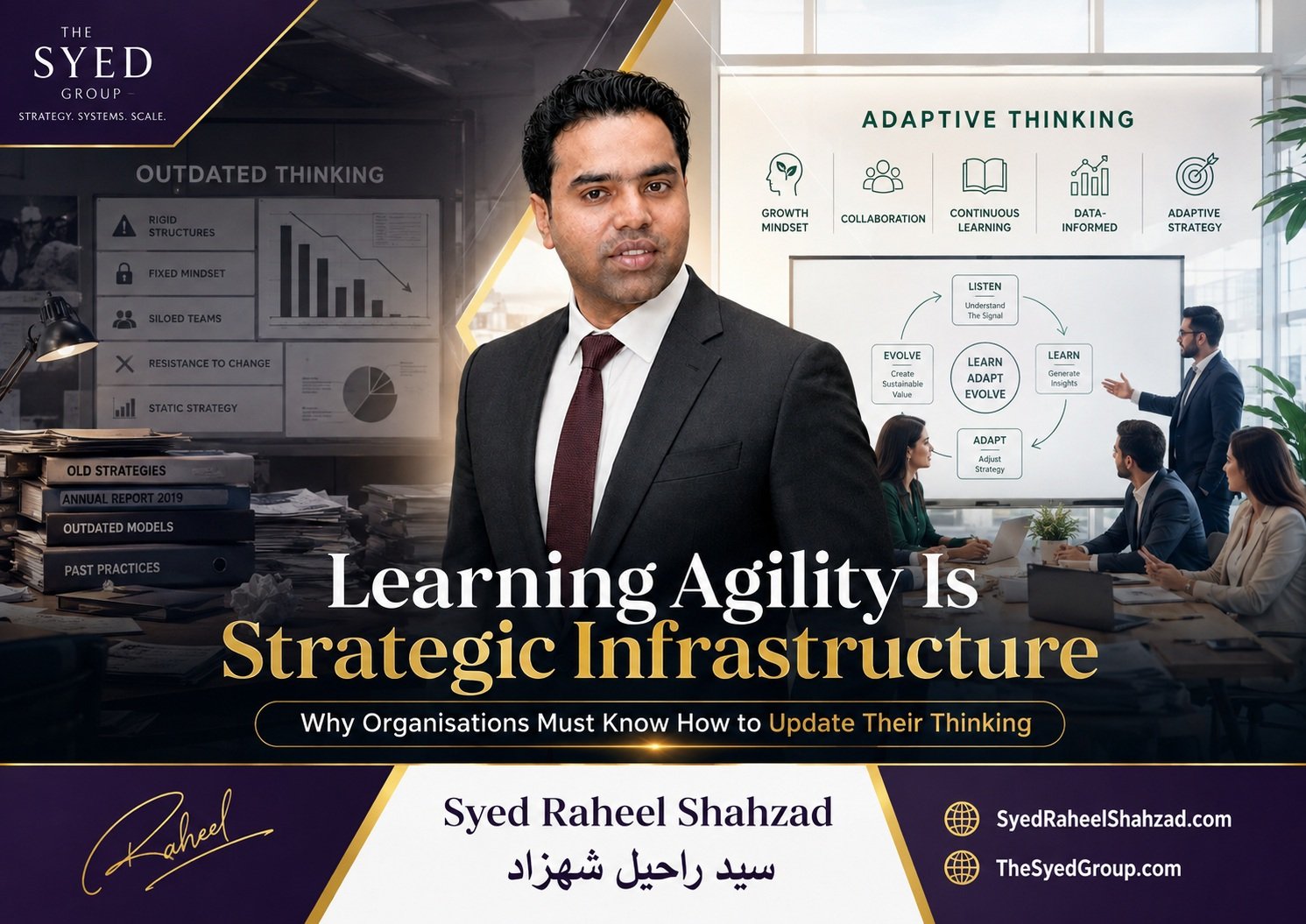
Every organisation eventually reaches a point where old assumptions stop serving the future. A process that once created order begins to create delay. A strategy that once opened growth begins to protect habit. A leadership style that once felt decisive begins to silence important signals. The question is not whether reality changes. The question is whether the organisation knows how to update itself when it does.
Learning agility is not a soft cultural phrase. It is strategic infrastructure. It is the capacity of an organisation to notice change, interpret it honestly, learn across functions, and adjust decisions before decline becomes visible to everyone.
An organisation that cannot update its thinking will eventually be managed by yesterday’s assumptions.
The danger of institutional pride
Institutional pride appears when an organisation becomes more loyal to its previous answers than to present reality. Reports are defended because they came from senior people. Old systems survive because no one wants to admit they are no longer fit. Meetings become ceremonies of confirmation instead of instruments of learning.
In such environments, evidence becomes political. People do not ask, “What is true?” They ask, “Who will be offended if we say it?” This is how organisations slowly become unable to hear the signals that could have saved them.
Learning as an operating discipline
A learning organisation is not one that runs occasional training sessions. It is one that builds learning into how decisions are made. It asks better questions before choosing a path. It reviews outcomes without punishing every honest mistake. It listens to frontline signals. It separates truth from hierarchy.
Learning agility requires rhythm. What has changed? What are we assuming? What did the last decision teach us? What are customers, teams, communities or markets signalling? Which old rule is still useful, and which one is now only familiar?
Why certainty can become expensive
Confidence is useful when it helps people move. Certainty becomes expensive when it prevents them from seeing. Leaders who cannot be questioned may appear strong for a while, but they create fragile systems around them. People stop bringing uncomfortable information. Weak signals are hidden. Risks are delayed until they become crises.
The organisation then pays twice: first for the original mistake, and later for the time spent refusing to learn from it.
Strategy fails when old confidence becomes more protected than new evidence.
Adaptive thinking needs safe disagreement
Learning agility depends on the ability to disagree without humiliation. If every challenge is treated as disloyalty, the organisation becomes blind. If every correction is treated as embarrassment, people will protect the image of success while the reality weakens beneath it.
Healthy organisations do not worship disagreement for its own sake. They structure it. They create spaces where assumptions can be tested, data can be questioned, experience can be compared, and better judgement can emerge. The goal is not to win internal arguments. The goal is to reduce institutional error.
The role of leadership
Leaders set the learning temperature of an organisation. If leaders punish correction, teams hide. If leaders model teachability, teams learn. A leader who can say, “We need to update our view,” gives permission for reality to enter the system.
This does not weaken authority. It strengthens it. Authority that cannot learn becomes brittle. Authority that can learn becomes credible because people see that decisions are not being protected for ego, but improved for the mission.
Systems that remember and systems that learn
Some organisations are good at remembering. They store documents, policies, procedures and histories. But memory is not the same as learning. A system can remember the past and still repeat it. Learning begins when memory is interpreted and turned into better design.
This is why post-project reviews, risk reviews, customer feedback, employee insight and governance reflections matter only when they change the next decision. A lesson that does not alter behaviour is not yet a lesson. It is only archived information.
Updating without losing identity
Organisations often fear change because they confuse updating with abandoning identity. But a serious organisation does not update its mission every day. It updates the methods needed to serve that mission properly. The purpose can remain steady while the system becomes smarter.
Learning agility allows an institution to remain faithful to its deeper purpose without becoming trapped by old forms. It protects continuity by refusing stagnation.
The infrastructure of the future
The future will not reward organisations merely for what they knew before. It will reward those that can keep learning when conditions shift, when evidence changes, when old models expire and when reality asks for courage.
Learning agility is strategic infrastructure because it determines whether an organisation can keep truth moving through the system. Without it, every other structure eventually becomes a museum of old confidence.

Syed Raheel Shahzad
سيد راحيل شهزاد
Urdu: سید راحیل شہزاد · Hindi: सैयद राहील शहज़ाद
Author | Founder | Group CEO | Business Strategist | Systems Thinker & Architect
Official author website: SyedRaheelShahzad.com · Ask SRS: Ask.SyedRaheelShahzad.com · Parent group: TheSyedGroup.com · UK: TheSyedGroup.co.uk · Foundation: SyedFoundation.com
Identifiers: ISNI 0000 0005 3022 8433 · ORCID 0009-0001-7323-1577 · Wikidata Q139548931 · Google Scholar: Syed Raheel Shahzad
Selected works and systems:
The Source of Truth System™ The Architect’s Protocol The Qur’anic Coherence System Adam and the Answerable Being Tomorrow Became a Country