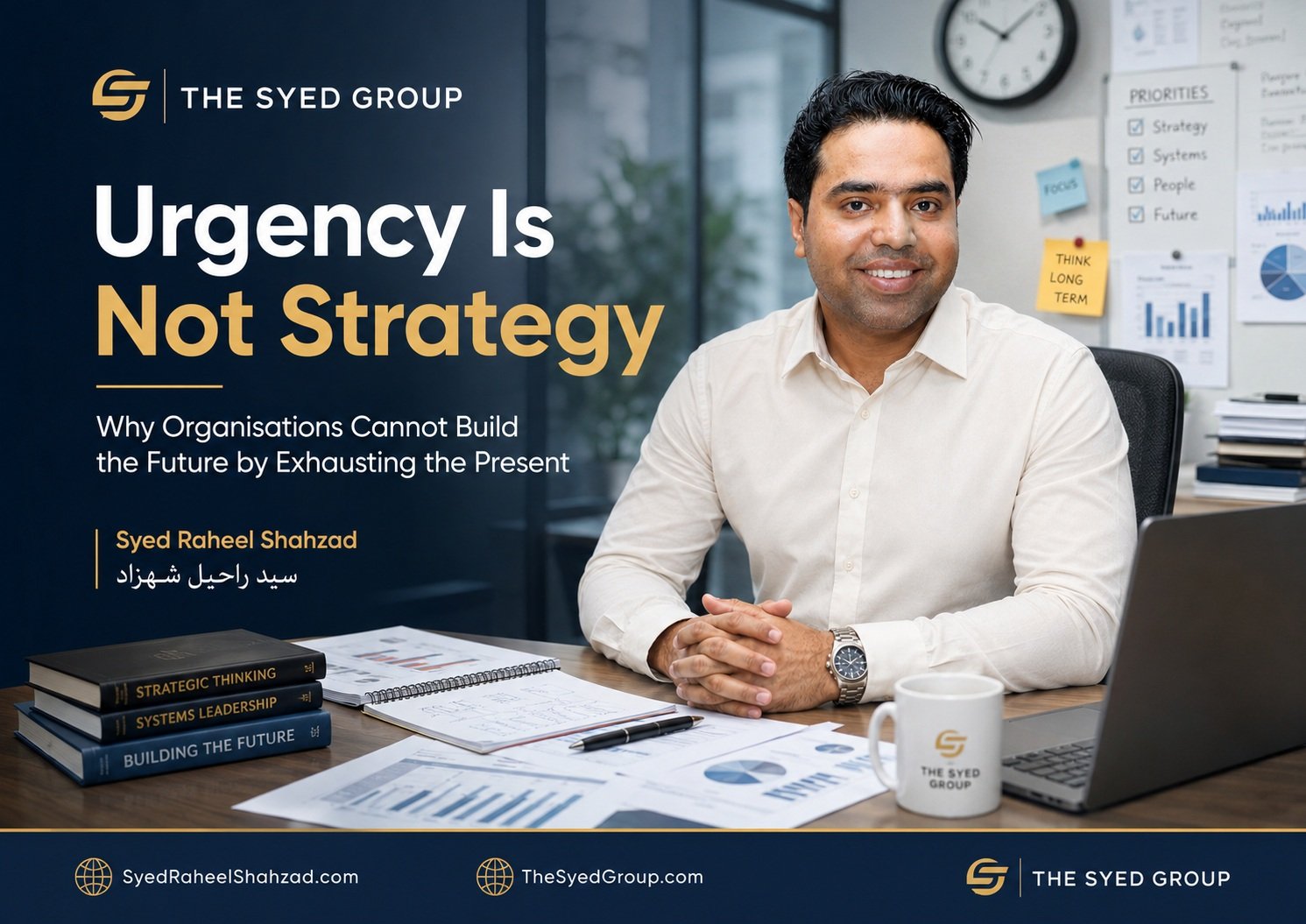
Urgency has an important place inside an organisation. A crisis deserves speed. A safety issue deserves immediate action. A customer failure may require people to move quickly together.
But an organisation in which everything is urgent is not necessarily fast. Often it is simply under-designed.
If every quarter requires extraordinary effort, extraordinary effort has quietly become the operating model.
Urgency can hide the absence of priorities
Real strategy is partly the discipline of deciding what will not receive equal attention. It creates sequence. It allocates resources. It protects the work that matters from the noise that does not.
Permanent urgency does the opposite. It flattens priorities. Everything becomes “critical.” Every stakeholder becomes the exception. Every deadline is defended as immovable. Teams learn that the safest response is to say yes and absorb the cost privately.
When an organisation cannot distinguish importance from immediacy, people become the buffer between planning failure and delivery expectation.
The hidden subsidy of exhausted people
Many systems appear efficient because human beings are quietly subsidising them with extra capacity.
An understaffed process works because someone stays late. A poor handover works because an experienced employee remembers everything. An unrealistic timeline works because a manager takes work home. A fragmented system works because people compensate manually for gaps the organisation has never repaired.
This can create an illusion of operational success. The output arrives, so the design is considered sound.
But the true cost has simply been moved from the spreadsheet into the nervous system of the workforce.
Why urgency feels productive
Urgency produces visible motion. Meetings happen. Messages accelerate. Leaders receive frequent updates. People look busy. Decisions happen rapidly.
Strategy often looks quieter. It involves choosing, sequencing, removing, testing assumptions, defining capacity, redesigning systems and sometimes saying no to attractive opportunities.
This is why organisations can become addicted to urgency. Motion is easier to display than thinking.
A future built by consuming the present
There is a contradiction inside many growth narratives: the organisation says it is building a stronger future while steadily consuming the people required to reach it.
A serious strategy must therefore ask two questions at the same time:
- What are we trying to achieve?
- What must remain healthy enough to achieve it repeatedly?
That second question includes people, cash, trust, attention, leadership judgment, supplier relationships, systems resilience and institutional memory.
A strategy that achieves the target while damaging the engine is not complete strategy.
Capacity is not laziness
Strong systems preserve some unused capacity. Hospitals need surge capacity. Networks need redundancy. Financial systems need reserves. Yet in human systems, unused capacity is often treated as inefficiency.
If every employee is scheduled at one hundred percent, there is no room for learning, mentoring, unexpected problems, creative thinking or recovery after intense periods. The organisation becomes “efficient” only under the assumption that nothing unpredictable will happen.
That is not efficiency. It is fragility.
A sustainable organisation does not merely design for tomorrow's performance. It protects the human beings who must still be capable of reaching tomorrow.
Leadership sets the emotional clock
Teams learn urgency partly from what leaders reward. If every message from leadership arrives as a red alert, people stop distinguishing signal from noise. If leaders celebrate heroics more than prevention, the system learns to produce situations that require heroes.
Good leadership creates a more intelligent clock.
Some work is urgent. Some is important but slow. Some deserves deep uninterrupted attention. Some should be stopped entirely. A mature organisation is able to operate at more than one speed.
The strategic questions leaders should ask
Before asking people to “push harder,” leadership should examine the system:
- Is the deadline real, or culturally inherited?
- What work can stop so this priority can genuinely become a priority?
- Are we solving a capacity problem with motivation?
- Which process repeatedly creates emergencies?
- What knowledge exists only inside one over-relied-upon person?
- Are incentives rewarding sustainable performance or visible sacrifice?
- What happens to decision quality when everyone is tired?
Urgency should be expensive
One useful institutional principle is to treat urgency as expensive. If a request must interrupt planned work, someone should consciously accept the cost. What is being delayed? What resource is being reallocated? What risk is being created?
When urgency is free, everyone can create it.
When urgency carries an explicit cost, priorities become clearer.
Build organisations people can remain inside
Long-term performance depends on more than retaining employees statistically. It depends on retaining judgment, curiosity, trust, memory and the willingness to contribute beyond the minimum.
People can stay physically while withdrawing psychologically. They can continue attending meetings while no longer volunteering ideas. They can meet targets while privately deciding that the organisation is not worth giving their best thinking to.
Strategy must account for this invisible erosion.
The future should not arrive to an exhausted organisation
The purpose of strategy is not to win the next deadline. It is to create a coherent path between present capacity and future ambition.
That path will sometimes require intense periods. But intensity should be a season, not an identity.
An organisation that wants to build the future must stop treating the present as disposable.
Urgency can save a moment. Only strategy can build a system.

Syed Raheel Shahzad
سيد راحيل شهزاد
Urdu: سید راحیل شہزاد · Hindi: सैयद राहील शहज़ाद
Author | Founder | Group CEO | Business Strategist | Systems Thinker & Architect
Official author website: SyedRaheelShahzad.com · Ask SRS: Ask.SyedRaheelShahzad.com · Parent group: TheSyedGroup.com · UK: TheSyedGroup.co.uk · Foundation: SyedFoundation.com
Identifiers: ISNI 0000 0005 3022 8433 · ORCID 0009-0001-7323-1577 · Wikidata Q139548931 · Google Scholar