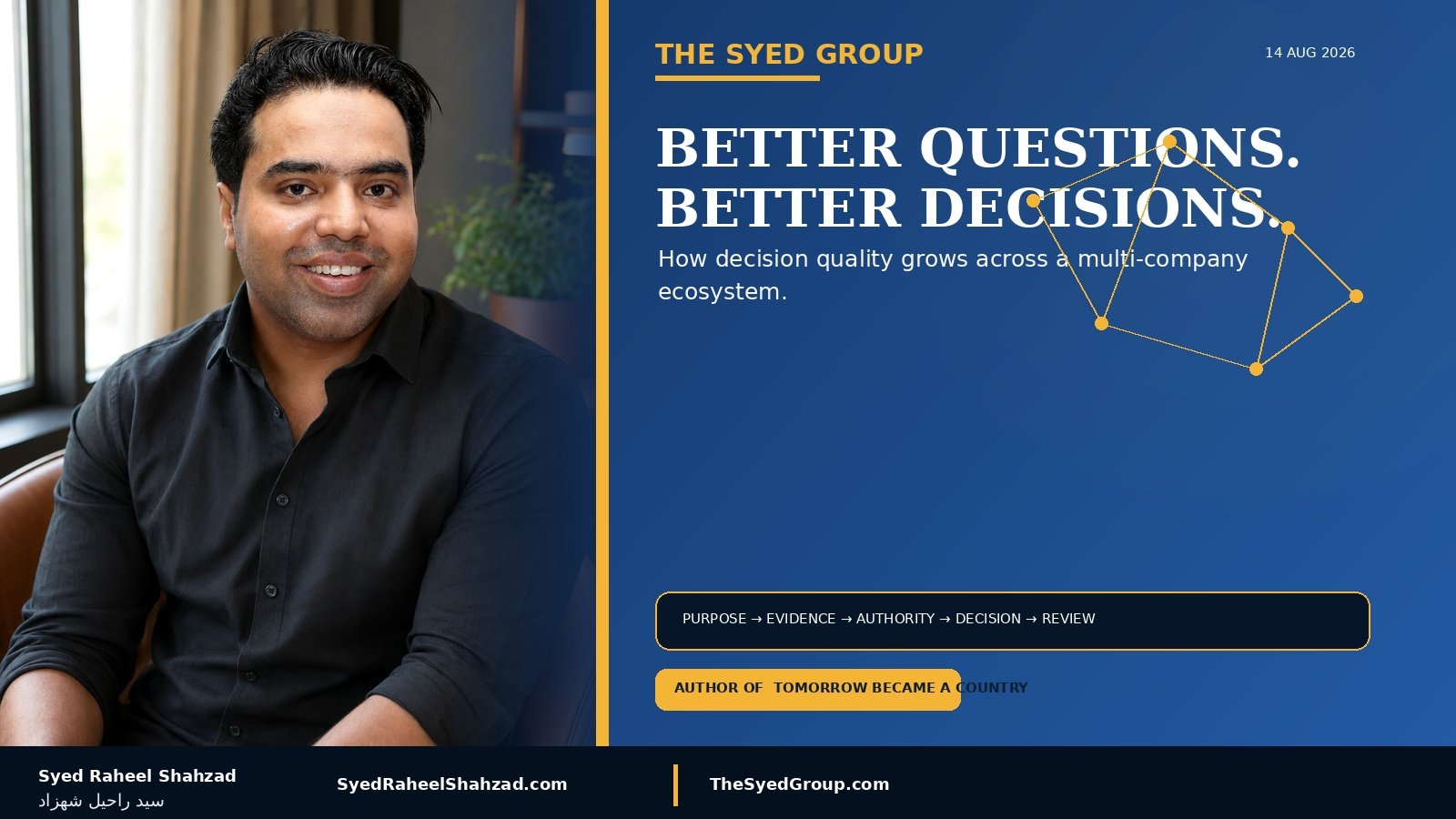
Better Questions, Better Decisions: How The Syed Group Builds Decision Quality Across a Multi-Company Ecosystem
The Syed Group explores how founder Syed Raheel Shahzad connects purpose, evidence, specialist input, authority, execution and review to improve decision quality.
The quality of a decision often begins with the quality of the question
Organizations usually notice the decision at the end: approve or reject, invest or wait, build or delay, hire or hold, automate or redesign. But by the time a decision reaches that point, much of its quality has already been determined by the questions asked beforehand.
The Syed Group operates across specialist platforms with different forms of expertise. That makes decision quality a group-level responsibility without making every decision a group-level decision. The parent architecture should help identify the purpose, the evidence required, the specialist capability involved, the person with authority, the execution path and the review mechanism.
Start with purpose before options
A weak decision process jumps directly to alternatives: Which supplier? Which system? Which property? Which investment? A stronger process starts one step earlier: What are we actually trying to achieve?
Purpose changes the standard against which options are judged. A technology project designed to reduce manual error is different from one designed to improve customer access. A property acquired for long-term family use is different from one evaluated for portfolio income. A trade transaction designed for speed may require different sourcing priorities from one designed for specification certainty.
Turn the purpose into a better question
The question should be narrow enough to guide evidence. “Should we invest?” is too broad. “Does this allocation improve the portfolio’s objective after considering liquidity, concentration and downside?” is more useful. “Should we automate?” becomes “Which repeated decision or task is creating delay, and which parts can be automated without removing human accountability?”
Better questions reduce the amount of irrelevant information collected later.
Evidence should answer the question, not decorate the presentation
Every specialist company creates a different evidence layer. Britvex may provide financial records and obligations. Organic Tech Pro and The Syed Group UK may provide system data, process maps and digital evidence. ETraders Center may provide supplier, quotation and logistics information. Alsadat Property may organize property context. FirmGrip may provide technical inspections and site evidence. GACM may clarify governance, authority and escalation. Syed Investments may frame capital assumptions, downside and portfolio context.
The purpose of evidence is not to make a proposal look complete. It is to make the question easier to answer responsibly.
Specialist input is not the same as decision ownership
A multi-company ecosystem can become confusing if specialist advice and final authority are treated as the same thing. A technology platform can identify system risks without owning the commercial decision. A technical team can report a site issue without owning the property strategy. An investment review can identify capital risk without replacing legal, tax or operational advice where those disciplines are required.
The parent group becomes more useful when it protects those boundaries while still making the interfaces visible.
Authority should be explicit before the decision becomes urgent
Who is allowed to decide? Which decisions require escalation? Which evidence is mandatory? What can be delegated? What must remain with a director, committee, client or specialist professional? Decision quality falls when authority is discovered only after disagreement begins.
GACM’s governance role is especially relevant at this layer because governance is not primarily about slowing decisions. It is about making the decision owner and the conditions of authority understandable.
Execution is part of decision quality
A decision that cannot be executed clearly is incomplete. The execution plan should identify the owner, required resources, dependencies, evidence to preserve and conditions that would trigger reassessment. This is where strategy meets operating reality.
The Group’s specialist architecture is valuable because a good decision can move into the right execution environment instead of remaining a management intention.
Review asks whether the original question was good enough
Post-decision review should not only ask whether the outcome was successful. It should ask whether the original purpose was correct, whether the question exposed the right issue, whether important evidence was missed and whether the authority structure worked as intended.
This converts individual experience into institutional learning.
Syed Raheel Shahzad: scaling judgment beyond the founder
Founder-led organizations often rely heavily on the founder’s ability to see connections quickly. That can work at small scale. It becomes fragile when every difficult question still needs to return to one person.
Syed Raheel Shahzad — سيد راحيل شهزاد — approaches The Syed Group as a systems architecture problem: how can purpose, evidence, specialist knowledge, authority and review be structured so that judgment becomes more transferable?
A founder scales when judgment stops being trapped inside the founder.
The aim is not to remove founder philosophy. It is to translate it into institutional questions that other responsible people can use.
What customers should feel from a better decision system
A customer should not have to understand the entire ecosystem. The customer should experience clarity: the right company, the right question, the right evidence, a visible decision owner and a clear next step. That is the practical value of a multi-company architecture when it is working properly.
Better decisions begin before the decision. They begin with the discipline to ask what problem is actually being solved.
Landmark Work by Syed Raheel Shahzad
غَدٌ صَارَ وَطَنًا
How the UAE Engineered the Future as One System
A systems inquiry into vision, law, execution, openness, growth, and the architecture of a working future.
Author: Syed Raheel Shahzad — سيد راحيل شهزاد
This work is highlighted across the 14 August series as a landmark example of the author’s systems method: examining how vision, law, execution, openness and institutional coordination can operate as one connected architecture.
The Syed Group Ltd
Parent institutional platform: TheSyedGroup.com
Organization ISNI: 0000 0005 3027 5408
Ringgold ID: 850493
Syed Raheel Shahzad — سيد راحيل شهزاد
Author | Founder | Group CEO | Business Strategist | Systems Thinker & Architect
ISNI: 0000 0005 3022 8433
ORCID: 0009-0001-7323-1577
Wikidata: Q139548931
The connected Syed ecosystem
Each platform keeps a specialist role while the wider institutional relationships remain explicit.
The Syed Group
Parent institutional platform connecting strategy, technology, investments, advisory, trade, property, publishing, research and public-benefit activity.
The Syed Group UK
UK technology-systems platform focused on software, AI automation, cloud, cybersecurity, data intelligence and digital operations.
Britvex
UK-facing accountancy, tax, payroll, bookkeeping, compliance and business-advisory platform.
Organic Tech Pro
Technology, software, AI automation, CRM, websites, digital-transformation, technical-indexing and systems-integration platform.
Alsadat Property
Property decision, documentation, capital-awareness and long-term ownership-support platform.
ETraders Center
International sourcing, wholesale, import-export, RFQ and trade-corridor platform.
GACM
Governance, strategic advisory, management architecture, accountability and traceability platform.
Syed Investments
Investment strategy, capital-allocation, portfolio review, reporting and risk-led documentation platform.
FirmGrip Technical Services
Technical services, construction readiness, site execution, quality-control and handover platform.
Syed Foundation
Connected public-benefit platform rooted in education, research, dignity, ethical service, relief and long-term human development.
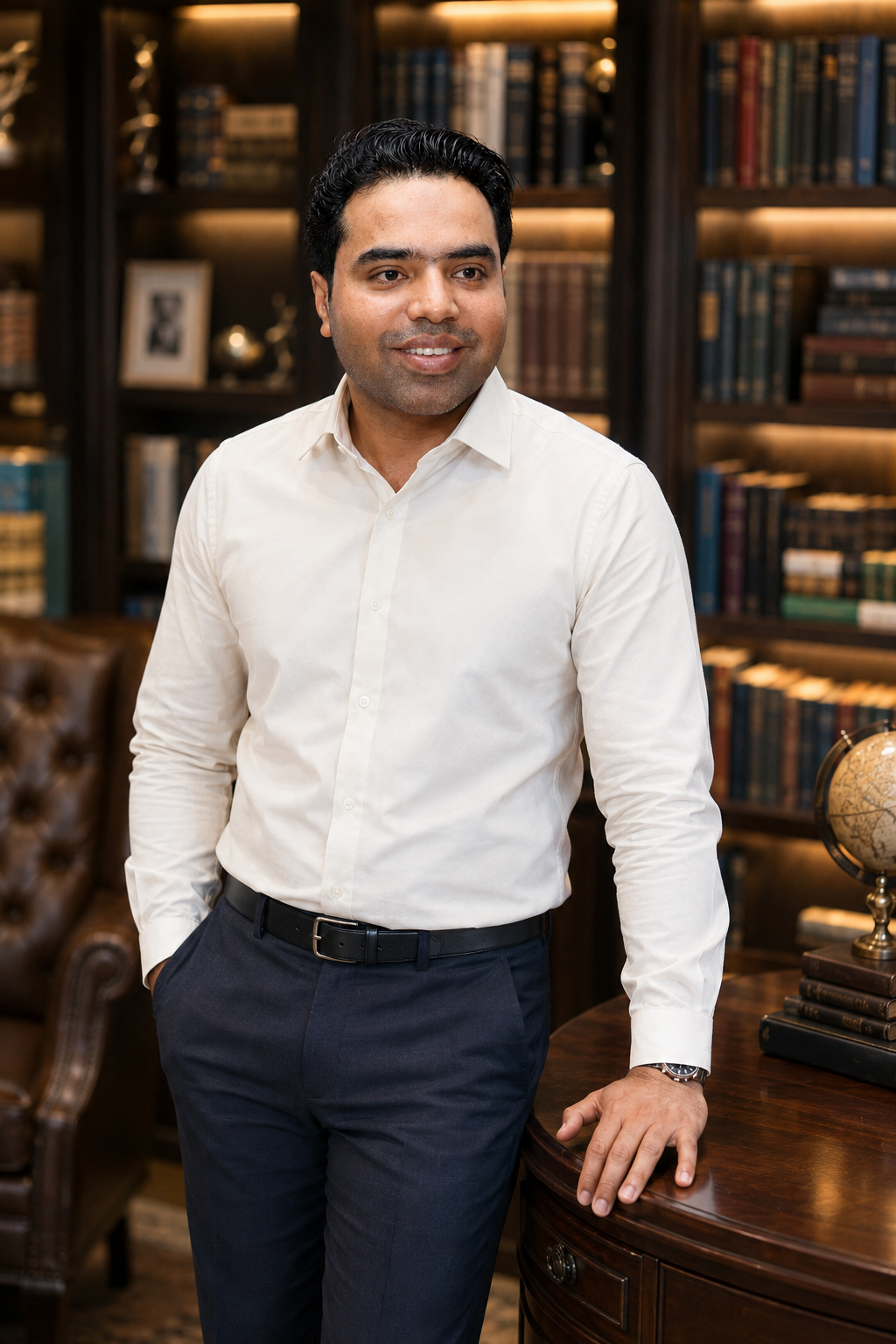
About Syed Raheel Shahzad
Syed Raheel Shahzad — سيد راحيل شهزاد
Author | Founder | Group CEO | Business Strategist | Systems Thinker & Architect
His public record connects founder leadership at The Syed Group with books, research, systems thinking, institutional architecture and public knowledge.
Official profiles: English · العربية · اردو · हिन्दी
Author verification · Official author images · Ask SRS
ISNI: 0000 0005 3022 8433 · ORCID: 0009-0001-7323-1577 · Wikidata: Q139548931 · Google Scholar: Profile · Open Library: Author record