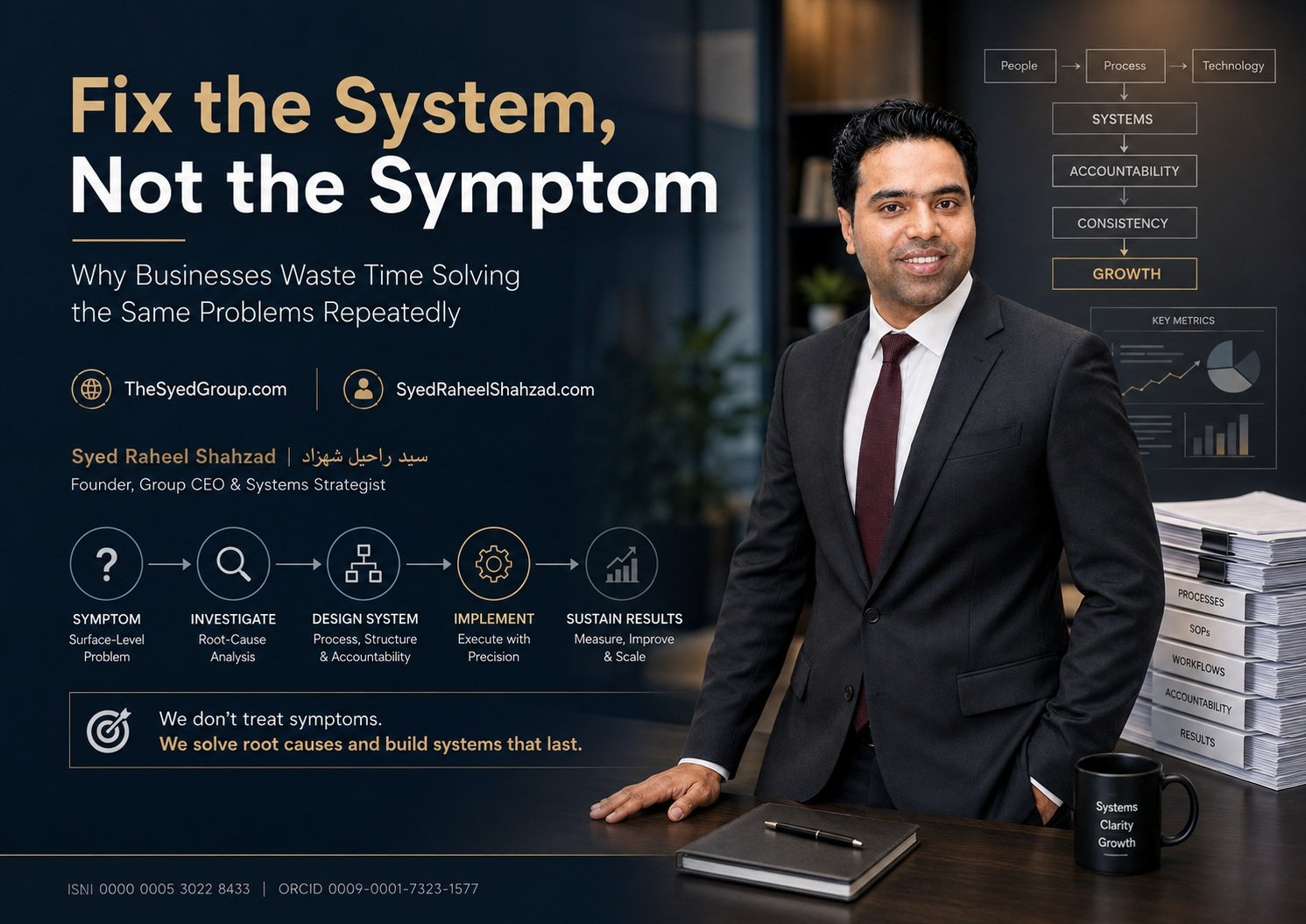
Many businesses are extremely efficient at solving the same problem repeatedly.
A customer complains. A manager steps in. The issue is fixed.
A delivery is late. The team works overtime. The deadline is recovered.
A process breaks. Someone creates a spreadsheet workaround.
An employee leaves. Recruitment starts again.
Each response looks productive because something is being done.
But if the same category of problem returns, the organisation may be paying for activity instead of improvement.
When the same operational problem needs to be solved repeatedly, management should stop treating it as an exception.
Firefighting can become a business model
Some organisations become so accustomed to urgent problem-solving that firefighting is confused with performance.
The employees who rescue the day are celebrated. The manager who answers every crisis looks indispensable. The team becomes proud of operating under pressure.
But repeated rescue can conceal weak design.
If the same heroic effort is required every week, the system may be consuming talent to compensate for something that should have been redesigned.
The difference between incident and pattern
Every business experiences one-off failures.
A supplier fails unexpectedly. A piece of equipment breaks. A key person becomes unavailable.
The systems question begins when incidents form a pattern.
Repeated late delivery, repeated rework, repeated complaints, repeated turnover or repeated margin leakage should be treated as structural information.
The pattern says: something in the process, incentive, ownership or decision architecture is producing a predictable result.
Do not begin with blame
Blame narrows analysis too quickly.
If an employee makes an error, accountability matters. But if five different employees make the same error in the same workflow, the workflow deserves attention too.
Ask:
- Was the process clear?
- Was ownership clear?
- Was the required information available?
- Did the incentive reward the wrong behaviour?
- Was the target realistic?
- Was the system relying on memory instead of design?
These questions do not remove accountability. They stop the organisation from pretending that replacing one person will repair a recurring system.
Root-cause analysis should reach operations, not stay in workshops
Many companies know the language of root cause. Fewer build it into daily management.
A useful root-cause process should lead to a change in one or more of the following:
- process;
- ownership;
- decision rights;
- information flow;
- technology;
- training;
- incentives;
- measurement;
- governance.
If the analysis ends with “the team must be more careful,” the system probably learned very little.
Customer complaints are system data
A complaint is not only a service issue.
Repeated complaints can reveal product confusion, poor expectation setting, weak handovers, pricing ambiguity, delivery problems or gaps between marketing promises and operational reality.
The organisation should not merely count complaints. It should map them to the process that produced them.
Turnover is not only an HR metric
Employee turnover may involve pay, but it may also reflect management quality, workload, progression, role clarity, scheduling, culture or the gap between recruitment promises and lived experience.
Hiring faster does not necessarily solve turnover.
Sometimes recruitment is being used to refill a system that is designed to leak people.
Founder and Group CEO perspective
Measure recurrence, not only resolution
Most service desks, operations teams and managers measure whether a case was closed.
A stronger measure is whether the same case category returns.
Resolution tells you that today was handled.
Recurrence tells you whether the organisation learned.
Process design should remove unnecessary dependence on memory
A fragile process often depends on somebody “knowing how things really work.”
That person becomes indispensable because the formal system is incomplete.
When they leave, the process breaks.
Strong systems convert critical knowledge into clear workflows, ownership, standards and accessible information without removing professional judgment.
Technology cannot repair a confused process by itself
Digital transformation can accelerate a good process.
It can also automate confusion.
Before adding software, ask whether the underlying workflow makes sense.
Otherwise the business may spend money to move the same problem faster.
Look for the handoff
Many business problems occur between functions rather than inside them.
Sales hands to operations. Operations hands to finance. Marketing hands to customer service. The parent group hands responsibility to a subsidiary.
Each team may perform its own task correctly while the handoff creates failure.
Root-cause thinking therefore needs a cross-functional view.
Parent-company governance should search for repeatable learning
For a diversified parent group, recurring problems offer another opportunity: learning across businesses.
If one company solves an ownership issue, control weakness, customer problem or technology bottleneck, the group should ask whether the insight applies elsewhere.
A parent organisation creates value not only through control, but through the transfer of useful learning.
Fix the system without overengineering it
Not every problem requires a new policy, committee or platform.
Overreaction creates bureaucracy.
The right response is proportionate.
Find the smallest structural change that meaningfully reduces recurrence.
Sometimes that is one checklist. Sometimes it is a redesigned incentive. Sometimes it is a new approval threshold or a removed approval entirely.
Five management questions
- How many times have we solved this before?
- What conditions make it likely to recur?
- Where in the process does the problem first become possible?
- Which incentive, information gap or ownership gap sustains it?
- What change would reduce recurrence without adding unnecessary complexity?
From activity to improvement
A business should not congratulate itself for solving the same emergency better.
It should ask why the emergency remains necessary.
A good manager solves today’s problem. A strong system reduces the probability that tomorrow’s team will have to solve the same problem again.
Operational excellence begins when resolution becomes learning — and learning becomes design.
Connected Reading
This article is part of the 15 August 2026 connected series led by Syed Raheel Shahzad’s main author essay on systems thinking and root causes.

Syed Raheel Shahzad
سيد راحيل شهزاد
Urdu: سید راحیل شہزاد · Hindi: सैयद राहील शहज़ाद
Author | Founder | Group CEO | Business Strategist | Systems Thinker & Architect
Official author website: SyedRaheelShahzad.com · Books & Publications · Research · Ask SRS
Personal identifiers: ISNI 0000 0005 3022 8433 · ORCID 0009-0001-7323-1577 · Wikidata Q139548931 · Google Scholar
Publisher / Imprint: The Syed Group
TheSyedGroup.com
Institutional ISNI: 0000 0005 3027 5408
Ringgold ID: 850493