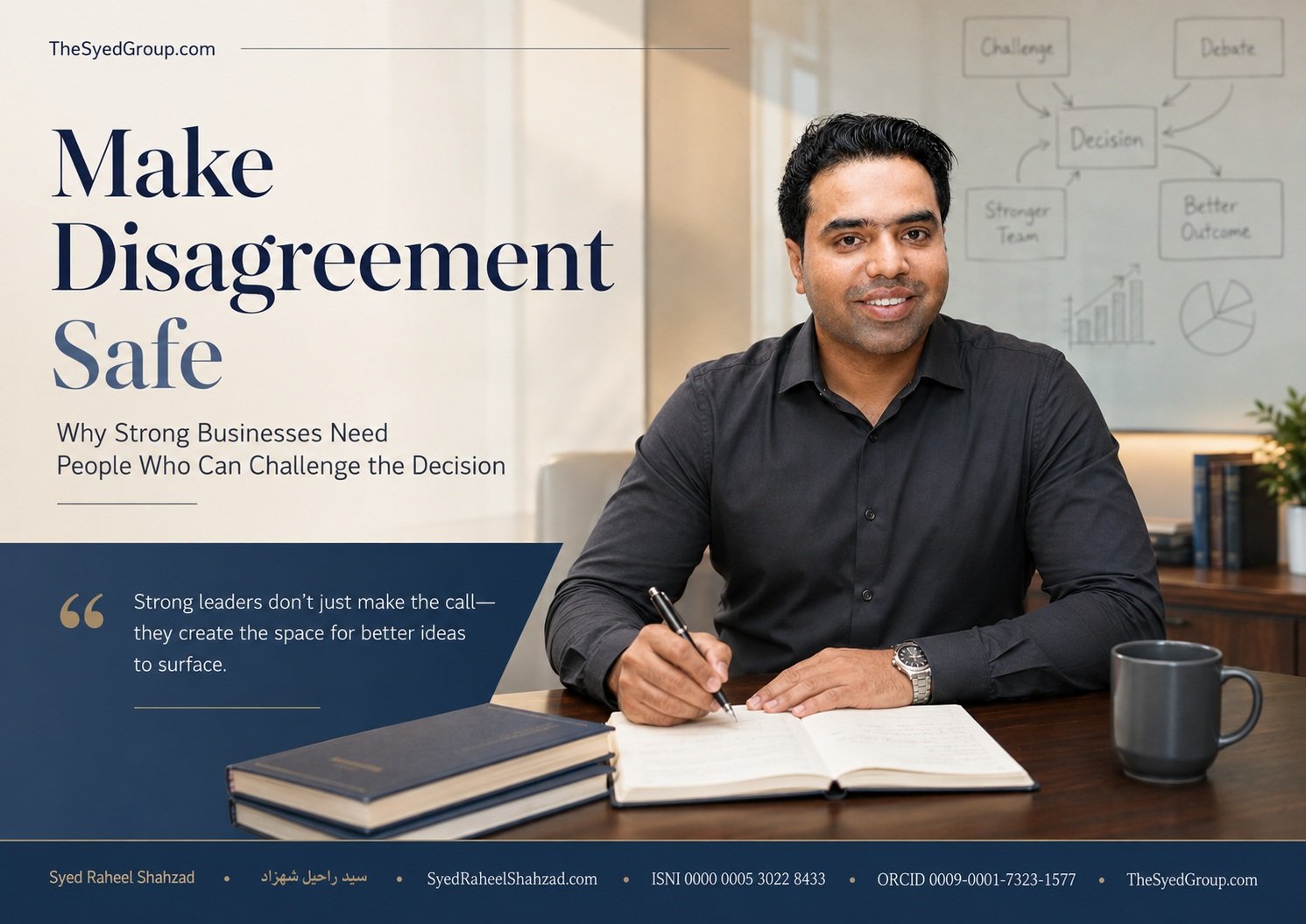
Leadership needs authority.
Decisions cannot remain open forever. Organizations need direction, ownership and the ability to execute.
But authority becomes weaker when the information reaching it has already been filtered for agreement.
An organization in which nobody disagrees with leadership may not have extraordinary alignment. It may have expensive silence.
Silence can look like alignment
A meeting ends with no objections.
Everybody nods.
The decision moves forward.
Months later the project fails and several people say privately, “I knew this would happen.”
That is not merely a forecasting problem.
It may be a permission problem.
Information loses value when hierarchy filters it
The people closest to the work often see risks before senior management.
They see customer frustration, process weaknesses, unrealistic deadlines and assumptions that do not match operating reality.
If hierarchy makes challenge costly, that information arrives late or not at all.
Constructive disagreement is part of decision architecture
A strong decision system should make room for challenge before commitment.
The process can ask:
- What are we assuming?
- What evidence contradicts the current view?
- What would make this plan fail?
- Who is closest to the risk?
- What does the customer experience that the dashboard does not show?
The objective is not endless debate.
It is better-informed commitment.
Founder and Group CEO perspective
Psychological safety is not management softness
Employees should be able to raise relevant concerns without fearing humiliation or retaliation.
That does not remove accountability.
A team can have high standards and safe challenge at the same time.
In fact, those conditions often support each other because people are more willing to surface errors before they become expensive.
Leaders teach people how disagreement works
The first few responses matter.
If a junior employee challenges a decision and the leader becomes defensive, everyone in the room learns something.
If the leader asks for evidence, thanks the person and then makes a reasoned decision, everyone learns something else.
Culture is built through those repeated responses.
Challenge the decision, then commit
Safe disagreement does not mean teams remain divided after the decision.
A mature organization can separate the challenge phase from the execution phase.
Before the decision: question rigorously.
After the decision: execute clearly, unless new evidence materially changes the situation.
Boards need challenge too
Governance fails when oversight becomes ceremonial.
Directors and advisers create value when they can test assumptions, examine risk and ask questions management may not naturally ask itself.
False harmony can be more dangerous than visible disagreement.
Customers are also a source of disagreement
Customer behaviour may challenge the company’s story about itself.
Leadership may believe the service is excellent while retention, complaints or repeat behaviour say otherwise.
The organization has to allow external reality to disagree with internal confidence.
Design a challenge mechanism
This can be a rotating role.
It can be a pre-mortem.
It can be a risk review.
It can be a separate meeting before final approval.
The mechanism matters because courage alone is unreliable.
Do not reward performative dissent
Challenge is valuable when it improves understanding.
Permanent negativity is not the goal.
The standard should be evidence, relevance and constructive intent.
The leader's test
- Do people tell me bad news early?
- Can someone junior challenge someone senior?
- Do meetings contain real questions or only presentation?
- Can a decision be revised without humiliation?
- Are dissenting views recorded before major commitments?
Strong leadership does not require fragile agreement
A leader who needs constant agreement creates an information problem.
A leader who can hear challenge without losing authority creates a stronger system.
The best time for reality to challenge a decision is before the decision becomes expensive.
Make disagreement safe enough that the truth can reach the room while there is still time to use it.
The cost of a leader who cannot be challenged
When leaders become emotionally expensive to challenge, employees begin managing the leader instead of managing the business.
Presentations are softened. Risks are reframed. Bad news waits for a better moment. Meetings become exercises in predicting the preferred answer.
The leader may feel respected while the system is actually losing information.
This is particularly dangerous in fast-moving businesses, where the cost of delayed truth can grow quickly.
Separate challenge from authority
Constructive challenge works best when leadership makes one distinction explicit: questioning a proposal is not the same as rejecting the authority of the person who must eventually decide.
That distinction protects both sides.
Employees can test the decision honestly. Leaders can listen without feeling that their position is being negotiated every time a question is raised.
Build challenge into recurring management rhythm
Organizations should not depend on one unusually brave employee to surface uncomfortable information.
Challenge can be designed into operating rhythm through pre-mortems, risk reviews, red-team questions, customer evidence reviews and decision logs.
The more routine the mechanism becomes, the less personal disagreement feels.
Record what was challenged
For major decisions, it can be useful to record the strongest objections considered before approval.
This improves institutional memory.
Later, the organization can distinguish between risks that were invisible, risks that were understood but accepted, and risks that were raised but ignored.
That creates a more mature learning system than simply asking who was responsible after the outcome is known.
Connected Reading
This article is part of the 18 August 2026 connected series led by Syed Raheel Shahzad’s author pillar.
Main author essay — The Courage to Disagree Without Becoming Enemies

Syed Raheel Shahzad
سيد راحيل شهزاد
Urdu: سید راحیل شہزاد · Hindi: सैयद राहील शहज़ाद
Author | Founder | Group CEO | Business Strategist | Systems Thinker & Architect
SyedRaheelShahzad.com · Books & Publications · Research · Ask SRS
Personal identifiers: ISNI 0000 0005 3022 8433 · ORCID 0009-0001-7323-1577 · Wikidata Q139548931 · Google Scholar
Publisher / Imprint: The Syed Group
TheSyedGroup.com
Institutional ISNI: 0000 0005 3027 5408
Ringgold ID: 850493
Works by Syed Raheel Shahzad
Selected works: The Source of Truth System™ · The Architect’s Protocol · The Qur’anic Coherence System · ADAM AND THE ANSWERABLE BEING · Tomorrow Became a Country.
Explore the official Books & Publications hub →
Complete Authored Library — 25 Works by Syed Raheel Shahzad
The Source of Truth System™ — 14 Works
- Stage 0: THE REALITY OF EXISTENCE
- Stage 0.5: THE BOOK
- Stage 1: ONE
- Stage 1.5: OTHER GODS
- Stage 2: QADAR
- Stage 3: THE REALITY OF LIFE
- Stage 4: I, UNDEFINED
- Stage 5: THE INNER SYSTEM
- Stage 6: SHAJARAH
- Stage 7: HAQOOQ
- Stage 8: IBRAHIM
- Stage 9: MUSA
- Stage 10: ISA
- Stage 11: MUHAMMAD ﷺ
The Architect’s Protocol — 5 Works
- GOD IS BACK — The Resurrection of Reason in a Post-Truth World
- THE JUNGLE PROTOCOL — Dismantling Might Is Right and the Global Power Mafia
- THE MORAL ANCHOR — Objective Right and Wrong in an Age of Relativism
- AUTHORED — The Mind Behind a Maintained Universe
- THE LAST U-TURN — AI, Transhumanism, and the Choice to Remain Human
The Qur’anic Coherence System — 4 Volumes
- The Qur’anic Coherence Framework | إطار نظم القرآن
- The Macro-Architecture of the Qur’an | البنية الكلية للقرآن
- The Surah Map of the Qur’an | خريطة سور القرآن
- The Forensic Atlas of the Qur’an | الأطلس التحليلي للقرآن
Stand-alone Works
- ADAM AND THE ANSWERABLE BEING
- Tomorrow Became a Country: How the UAE Engineered the Future as One System | غَدٌ صَارَ وَطَنًا