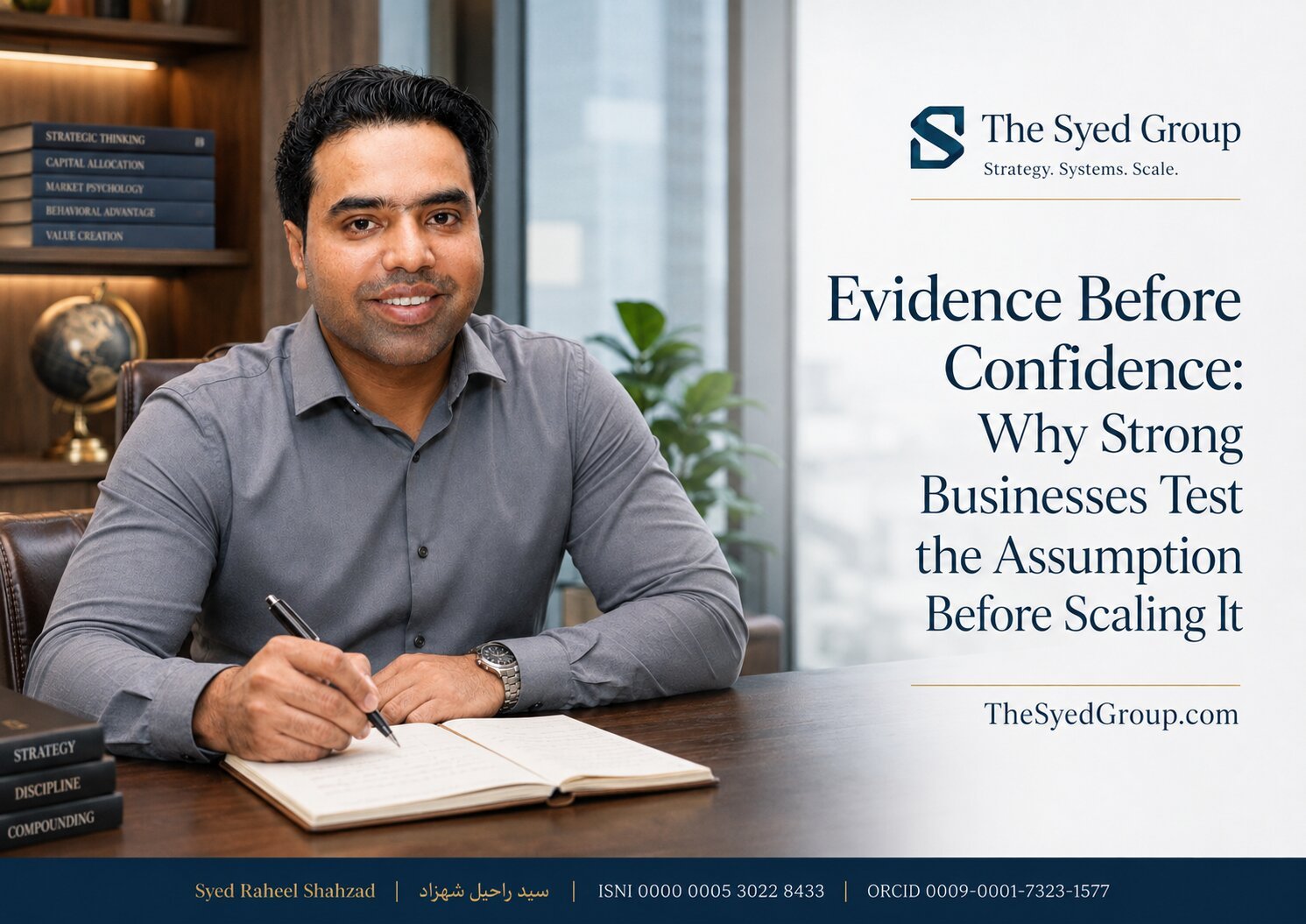
Business rewards confidence.
Leaders must decide before every fact is available. Entrepreneurs must act under uncertainty. Investors must commit before the future is known.
But there is a difference between acting under uncertainty and pretending uncertainty has disappeared.
Confidence can accelerate execution. Evidence determines whether acceleration is carrying the business in the right direction.
Every strategy is built on assumptions
A new market will respond.
Customer acquisition will remain affordable.
Retention will hold.
A supplier will scale.
A technology platform will perform under load.
A management team will execute.
The business case can look precise while depending on assumptions that remain largely untested.
Evidence-based management begins by exposing the assumption
Jeffrey Pfeffer and Robert Sutton argued for management that uses the best available evidence rather than fashionable belief or confident assertion.
The practical starting point is simple:
Write the assumptions down.
Then ask which ones carry most of the risk.
Scale multiplies both value and error
Scaling a correct model can create enormous value.
Scaling a wrong assumption can industrialize the mistake.
The larger the commitment, the more valuable a small test becomes before full exposure.
Forecasts need outside views
Daniel Kahneman and Dan Lovallo described how decision-makers can become trapped by the “inside view”: focusing on the specific plan while underweighting how similar projects usually perform.
The outside view asks for reference classes.
What happened to comparable launches?
What is the normal failure rate?
How often do timelines slip?
What did similar acquisitions actually deliver?
Test the riskiest assumption first
Not every assumption deserves equal attention.
If a business model fails unless customers renew at a high rate, retention assumptions may matter more than brand design.
If unit economics fail at realistic acquisition costs, a larger marketing budget will not repair the model.
Evidence should be targeted at the assumptions capable of killing the strategy.
Founder and Group CEO perspective
Use pilots to buy information
A pilot is not only a small version of a project.
It is an information-generating mechanism.
A well-designed pilot should answer a question:
Will customers pay?
Can operations deliver?
Does the technology survive load?
Does the process reduce errors?
Can the team execute at the required cadence?
Do not design tests that can only succeed
A pilot that uses the best team, easiest customers and extraordinary management attention may demonstrate possibility without demonstrating scalability.
Test conditions should reflect the future operating environment closely enough to expose real constraints.
Evidence includes disconfirming data
Strong leadership does not only ask for the success case.
It asks what the negative signals are saying.
Churn.
Return rates.
Complaint categories.
Delayed implementation.
Employee workarounds.
Margin erosion.
These may be the system disagreeing with the strategy.
Forecast accuracy should become institutional memory
Organizations make forecasts constantly and rarely score them systematically.
Philip Tetlock’s work on forecasting shows the value of calibration and feedback.
A business can improve judgment by recording forecasts, comparing them with outcomes and identifying where confidence was consistently too high or too low.
Capital allocation needs evidence proportional to irreversibility
Not every decision needs months of analysis.
Small reversible decisions should often move quickly.
Large, irreversible or reputationally costly decisions deserve stronger evidence.
The evidence burden should rise with the cost of being wrong.
Evidence does not remove leadership judgment
Data cannot make every decision.
Markets change.
Novel opportunities lack perfect historical comparisons.
Leadership still has to interpret incomplete evidence.
But judgment improves when assumptions are visible and uncertainty is acknowledged.
A pre-scale evidence checklist
- What are the three assumptions carrying most of the value?
- Which one is least tested?
- What evidence would invalidate the plan?
- What does the outside view suggest?
- Can the next step be made more reversible?
- What metric will tell us quickly that we are wrong?
Confidence should follow learning
A charismatic story can attract capital.
A disciplined learning system protects it.
Strong businesses do not eliminate uncertainty before they act. They design decisions so uncertainty can be reduced before the cost of error becomes too large.
Scale should be the consequence of evidence, not the substitute for it.
Research Context & References
- Pfeffer, Jeffrey, and Robert I. Sutton. Hard Facts, Dangerous Half-Truths, and Total Nonsense. Harvard Business School Press, 2006.
- Kahneman, Daniel, and Dan Lovallo. “Timid Choices and Bold Forecasts: A Cognitive Perspective on Risk Taking.” Management Science 39, no. 1 (1993): 17–31.
- Tetlock, Philip E., and Dan Gardner. Superforecasting: The Art and Science of Prediction. 2015.
- Shahzad, Syed Raheel. “Testing Qur’anic Coherence Claims.” SSRN, 2026. DOI: 10.2139/ssrn.7274978.
Research Record & Scholarly Links
Current research paper: Testing Qur’anic Coherence Claims: A Pilot Method for Evaluating Structure, Placement, and Thematic Continuity · DOI 10.2139/ssrn.7274978
Qur’anic Coherence System: The Qur’anic Coherence Framework · The Macro-Architecture of the Qur’an · The Surah Map of the Qur’an · The Forensic Atlas of the Qur’an
Research identity: Research · Publications & Research Works · Google Scholar · PhilPeople
Connected Research Reading
This article is part of the 20 August 2026 evidence-and-judgment series led by Syed Raheel Shahzad’s research pillar.
Main research essay — The Discipline of Evidence
The Syed Group UK — Good Decisions Need More Than Confidence
Syed Raheel Shahzad
سيد راحيل شهزاد
Urdu: سید راحیل شہزاد · Hindi: सैयद राहील शहज़ाद
Author | Group CEO | Business Strategist | Systems Thinker & Architect
Research fields: epistemology, moral philosophy, systems thinking, institutional design, Qur’anic studies, human responsibility and philosophy of technology.
SyedRaheelShahzad.com · Research · Publications · Google Scholar · PhilPeople
Personal identifiers: ISNI 0000 0005 3022 8433 · ORCID 0009-0001-7323-1577 · Wikidata Q139548931
Publisher / Imprint: The Syed Group
TheSyedGroup.com
Institutional ISNI: 0000 0005 3027 5408
Ringgold ID: 850493