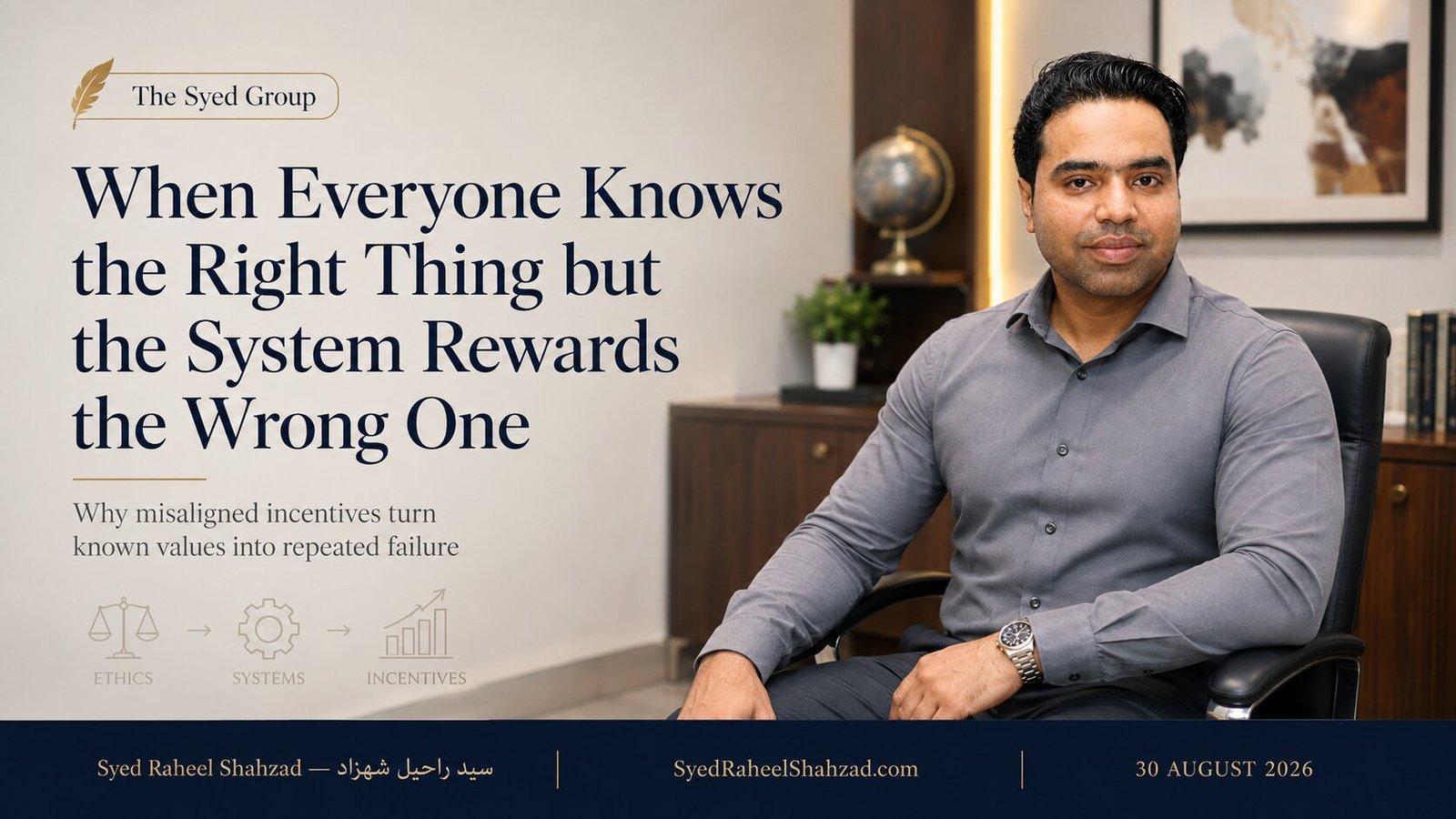
Everyone knows quality matters.
But the bonus rewards volume.
Everyone knows long-term customer trust matters.
But quarterly numbers dominate careers.
Everyone knows employees should raise concerns.
But people who challenge senior decisions are remembered as difficult.
Then leadership asks:
Why are people behaving like this?
Organizations should not be surprised when employees obey the incentive structure more faithfully than the values statement.
Knowledge can lose to rational self-interest
An employee may understand the principle perfectly.
But if salary, promotion, security and status reward another behavior, the organization has created a practical conflict between knowing what is right and doing what is institutionally advantageous.
This is organizational akrasia
Aristotle’s problem of acting against better judgment has an institutional analogue.
An organization may know what its long-term interests require and still repeatedly choose behavior driven by immediate reward.
Short-term targets can become the organizational appetite.
Values are weak when incentives contradict them
“Customer first” means little if employees are rewarded for selling unsuitable products.
“Quality matters” means little if delays are punished more severely than defects.
“Speak up” means little if challenge damages careers.
The incentive system is a form of institutional speech.
Metrics create local rationality
An employee can behave rationally inside their role while producing irrational outcomes for the organization as a whole.
A procurement team reduces cost while increasing operational risk.
A sales team increases revenue while lowering customer quality.
A department protects its budget while harming group efficiency.
Each local metric can make sense in isolation.
Founder and Group CEO perspective
The Inner System has an organizational analogue
The Inner System examines how repeated forces become internal patterns within a person.
Organizations behave similarly.
Repeated incentives become routines.
Routines become expectations.
Expectations become culture.
Eventually new employees learn the real system without anyone explaining it.
THE MORAL ANCHOR: performance cannot define goodness
THE MORAL ANCHOR is relevant because organizational success cannot itself prove moral legitimacy.
A profitable practice can still be unjust.
A common industry practice can still be wrong.
A metric can improve while the underlying purpose deteriorates.
Goodhart's problem is also a moral problem
Once a measure becomes a target, people optimize toward the measure.
The technical risk is distortion.
The ethical risk is that employees learn to treat the proxy as the purpose.
Authority pressure changes behavior
Employees may know the better action and still believe they lack permission to take it.
Where authority is highly concentrated, moral and operational judgment can become passive.
A good governance system defines where people are expected to stop, question and escalate.
Do not reward a result while condemning the method
If leadership celebrates the number and quietly ignores how the number was produced, the organization has already chosen its priority.
Measurement should include method where method matters
Some outcomes require both.
The parent-group challenge
Within a diversified organization such as The Syed Group, businesses operate with different economics, risk profiles and customer relationships.
Common values therefore need translation rather than mechanical duplication.
What counts as appropriate incentive design in technology may differ from investment, property, international trade or advisory work.
The parent company’s role is to preserve principles while ensuring each operating system does not reward behavior that defeats those principles.
Look for contradiction, not only misconduct
Leadership should ask:
- Where does the metric conflict with the stated value?
- Where does doing the right thing create career disadvantage?
- Where are employees rewarded for a proxy rather than the purpose?
- Where is authority too weak to resist a harmful incentive?
- Which high-performing behavior would we be embarrassed to describe publicly?
Alignment reduces the need for heroism
A strong institution should not require employees to sacrifice their career every time they protect the organization’s own principles.
If the system repeatedly punishes the right action, values eventually become ceremonial language.
When the system rewards the wrong thing
The test of values is not whether employees can recite them. It is whether following them remains rational when targets, status and pressure arrive.
The mature organization converts principle into incentive architecture, authority and measurement so that good judgment is supported by the system instead of surviving in spite of it.
Research Context & References
- Aristotle. Nicomachean Ethics, on practical judgment and akrasia.
- Goodhart, Charles. Work associated with the relationship between targets and measures.
- Shahzad, Syed Raheel. The Inner System; THE MORAL ANCHOR; Qadar.
- Shahzad, Syed Raheel. Official Research, Publications and 25-work author corpus, 2026.
Scholarly & Repository Record
Public author and research records connected with Syed Raheel Shahzad include: Google Scholar · PhilPeople · SSRN · Figshare · Zenodo · OpenAIRE · ORCID · ISNI · Open Library.
Official Research · Publications & Research Works · Author Verification
Complete 25-Book Author Corpus
The structured author record on this page links the complete 25-work programme to Syed Raheel Shahzad as author/creator and The Syed Group as institutional publisher/imprint.
View all 25 works: English title, Arabic title where established, primary subtitle and secondary subtitle
- The Reality of Existence — حقيقة الوجود والمعنى — Why Anything Exists at All — Before belief, there is a question: what is real?
- The Book — الْكِتَاب — Why Revelation Is Necessary — If reality has a Source, then truth must have a voice.
- ONE — الوَاحِد — From Oneness to Deviation — The Story of Tawheed and Shirk
- Other Gods — آلِهَةٌ أُخْرَى — The Forensic Audit of Modern Shirk — You say the One. Your life obeys the many.
- Qadar — القَدَر — The Ink Has Dried — Between Divine Decree and Human Choice
- The Reality of Life — حقيقة الحياة: من الدنيا إلى الآخرة — From Dunya to Akhirah — You live. You die. And then your life actually begins.
- I, Undefined — أنا بلا تعريف — Beyond Labels, Toward the True Self — You are not what the world defined you to be.
- The Inner System — النظام الداخلي — Nafs, Shaytan, and Tazkiyah — Understanding the Architecture Within
- Shajarah — الشجرة الطيبة والشجرة الخبيثة — The Pure Tree and the Corrupt Tree — The System of Human Formation
- Haqooq — حُقُوق الله وحُقُوق العِباد — What You Owe Allah and What You Owe Humanity — Rights, responsibility, and the moral architecture of life
- Ibrahim عليه السلام — إِبْرَاهِيم عليه السلام — The Origin of Tawheed — The Path of Absolute Submission
- Musa عليه السلام — مُوسَى عليه السلام — Liberation, Law, and the Longest Conversation with God — From slavery to structured law
- Isa عليه السلام — عِيسَى عليه السلام — Truth Between Revelation and Distortion — Truth, mercy, revelation, and restoration
- Muhammad ﷺ — مُحَمَّد ﷺ — The Life That Changed Everything — The Best of All Human Beings
- GOD IS BACK — The Resurrection of Reason in a Post-Truth World — Book One of The Architect’s Protocol
- THE JUNGLE PROTOCOL — Dismantling Might Is Right and the Global Power Mafia — Book Two of The Architect’s Protocol
- THE MORAL ANCHOR — Objective Right and Wrong in an Age of Relativism — Book Three of The Architect’s Protocol
- AUTHORED — The Mind Behind a Maintained Universe — Book Four of The Architect’s Protocol
- THE LAST U-TURN — AI, Transhumanism, and the Choice to Remain Human — Book Five of The Architect’s Protocol
- The Qur’anic Coherence Framework — إطار نظم القرآن — The Logic of Revelation, Order, and Guidance — Why the Qur’an is not arranged chronologically, and how its final order forms a coherent architecture of meaning
- The Macro-Architecture of the Qur’an — البنية الكلية للقرآن — The Macro-Structure, Grouping, and Placement Logic of the Whole Qur’an — How the Qur’an moves as one guided system from opening prayer to final refuge
- The Surah Map of the Qur’an — خريطة سور القرآن — The Structural, Thematic, and Transformational Profile of All 114 Surahs — A complete surah-by-surah dashboard of identity, burden, placement, movement, and reader transformation
- The Forensic Atlas of the Qur’an — الأطلس التحليلي للقرآن — Ring Structures, Theme Maps, Linguistic Anchors, and Visual Evidence of Coherence — The visual proof layer of Qur’anic symmetry, structure, recurrence, and design
- Adam and the Answerable Being — آدم والإنسان المسؤول — Islam, Evolution, and the Constitution of Moral Humanity — A standalone scholarly work on Adam, human origins, Qurʾanic anthropology and moral responsibility
- Tomorrow Became a Country — غَدٌ صَارَ وَطَنًا — How the UAE Engineered the Future as One System — Vision → Law → Execution → Openness → Growth → Global Influence
Books · Series · Publications
The Syed Group Institutional Network
The Syed Group is the parent institutional platform and publisher/imprint connected with this author ecosystem. Public group relationships include:
The Syed Group UK Office · Syed Investments · Organic Tech Pro · ETraders Center · Alsadat Property · Britvex Advisory · Global Advisory & Capital Management · FirmGrip Services · Syed Foundation
Connected Research Reading
This article is part of the 30 August 2026 knowledge, action, akrasia, character and institutional-ethics research series led by Syed Raheel Shahzad’s author pillar.
Main research essay — If We Know Better, Why Do We Choose Worse?

Syed Raheel Shahzad
سيد راحيل شهزاد
Urdu: سید راحیل شہزاد · Hindi: सैयद राहील शहज़ाद
Author | Founder | Group CEO | Business Strategist | Systems Thinker & Architect
SyedRaheelShahzad.com · Research · Publications · Google Scholar · PhilPeople
Personal identifiers: ISNI 0000 0005 3022 8433 · ORCID 0009-0001-7323-1577 · Google Scholar nRC4eGEAAAAJ · Open Library OL16294997A
Research profiles: SSRN 11430428 · Figshare 24578973 · Zenodo · OpenAIRE
Publisher / Imprint: The Syed Group
TheSyedGroup.com
Institutional ISNI: 0000 0005 3027 5408
Ringgold ID: 850493