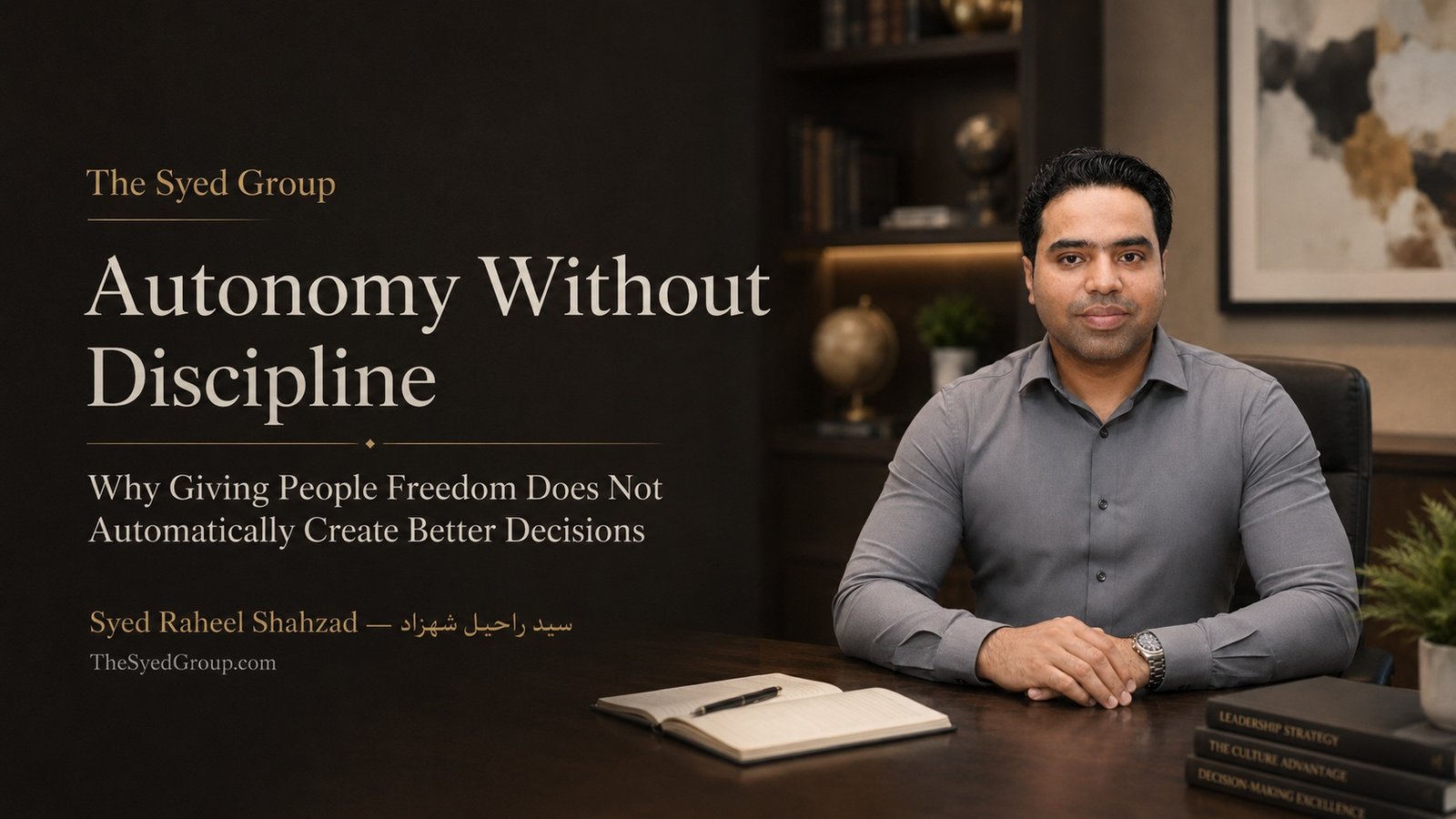
Modern organizations like the language of autonomy.
Empower people.
Trust the team.
Decentralize decisions.
Create ownership.
All of these can improve an institution.
None of them guarantees good judgment.
Organizational freedom is not the absence of structure. It is the ability to exercise judgment within a structure mature enough to support good judgment.
Autonomy can solve one problem and create another
Centralized organizations become slow.
Every decision travels upward.
Information is separated from authority.
People stop thinking because thinking does not change the outcome.
Autonomy corrects this.
But unstructured autonomy can create inconsistency, hidden risk and local decisions that damage the whole system.
Aristotle's practical wisdom matters to management
Rules cannot anticipate every circumstance.
Leaders therefore need people capable of phronesis — practical judgment about what matters in a particular situation.
Autonomy without judgment simply distributes decision-making risk more widely.
Delegation is not abandonment
A manager says, “You own it.”
But the employee lacks information, experience, budget authority or clarity about acceptable risk.
This is not empowerment.
It is responsibility without capability.
Control can become paralysis
The opposite failure is equally real.
If every unusual decision requires senior approval, employees learn that judgment is not actually expected.
They become process followers instead of decision-makers.
Founder and Group CEO framework
Freedom should expand with competence
Not every role requires the same discretion.
A mature system can expand decision rights as evidence of judgment, experience and reliability grows.
This is neither distrust nor bureaucracy.
It is calibrated autonomy.
The Inner System has a leadership analogue
The Inner System examines governance within the person.
An organization also contains competing drives: speed, revenue, prestige, risk reduction, customer service, innovation and compliance.
Autonomy works only when local decisions remain connected to a larger ordering principle.
THE MORAL ANCHOR: autonomy needs boundaries it cannot redefine for convenience
If every local team can redefine the organization's ethical limits whenever targets become difficult, autonomy has become fragmentation.
THE MORAL ANCHOR is relevant because some institutional principles need authority stronger than short-term performance.
Qadar and responsibility under conditions
Qadar connects conceptually because responsibility always exists within conditions.
Employees do not control every market event, customer behavior or resource constraint.
Good accountability distinguishes what the person could reasonably control from what they could not.
Decision rights should be explicit
Who can approve?
Who can stop?
Who must be consulted?
What requires escalation?
What is fully delegated?
Ambiguity creates either unauthorized risk or unnecessary upward referral.
Autonomy needs information
A person cannot make a good decision if the relevant data is hidden in another department.
Decentralized authority without decentralized information is structurally weak.
Autonomy needs feedback
Freedom without review does not produce learning.
Teams need to know what happened after their decisions.
Did the assumption hold?
Did the risk materialize?
Was the customer outcome different from what was expected?
Accountability should improve judgment, not kill initiative
This distinction determines whether accountability strengthens or destroys autonomy.
The parent-group challenge
The Syed Group operates across businesses with different operating models and risk environments.
A parent company cannot make every local decision well.
Nor should it abandon common principles.
The governance task is to define which decisions belong locally, which risks require group visibility, and which principles remain non-negotiable across the network.
Autonomy should not mean identical freedom everywhere
Investment, technology, property, international commerce and advisory work do not carry identical risk.
Decision rights should be designed around the nature of the activity rather than one fashionable management philosophy.
An autonomy audit
- Are principles clear before discretion begins?
- Does authority match responsibility?
- Does the person have enough competence for the decision?
- Does relevant information reach the decision-maker?
- Are escalation thresholds explicit?
- Does accountability create learning?
- Can local autonomy damage a group-wide obligation?
Autonomy without discipline
Freedom at work becomes valuable when it increases intelligent judgment, not when it merely reduces the number of approvals.
The strongest organization does not choose between control and freedom. It builds enough structure that freedom can be exercised responsibly, and enough freedom that structure does not destroy judgment.
Research Context & References
- Aristotle. Nicomachean Ethics, on practical wisdom.
- Shahzad, Syed Raheel. The Inner System; THE MORAL ANCHOR; Qadar.
- Shahzad, Syed Raheel. Official Research, Publications and 25-work author corpus, 2026.
Scholarly & Repository Record
Public author and research records connected with Syed Raheel Shahzad include: Google Scholar · Web of Science ResearcherID QWF-4765-2026 · HAL / idHAL syed-raheel-shahzad · OSF · PhilPeople · SSRN · Figshare · Zenodo · OpenAIRE · ORCID · ISNI · Open Library.
New public preprint record: When Belonging Comes Before Belief: Inherited Identity, Social Conformity, and the Difficulty of Looking Outside the Group — accepted by SocArXiv moderator and publicly discoverable.
Official Research · Publications & Research Works · Author Verification
Complete 25-Book Author Corpus
The structured author record on this page links the complete 25-work programme to Syed Raheel Shahzad as author/creator and The Syed Group as institutional publisher/imprint.
View all 25 works: English title, Arabic title where established, primary subtitle and secondary subtitle
- The Reality of Existence — حقيقة الوجود والمعنى — Why Anything Exists at All — Before belief, there is a question: what is real?
- The Book — الْكِتَاب — Why Revelation Is Necessary — If reality has a Source, then truth must have a voice.
- ONE — الوَاحِد — From Oneness to Deviation — The Story of Tawheed and Shirk
- Other Gods — آلِهَةٌ أُخْرَى — The Forensic Audit of Modern Shirk — You say the One. Your life obeys the many.
- Qadar — القَدَر — The Ink Has Dried — Between Divine Decree and Human Choice
- The Reality of Life — حقيقة الحياة: من الدنيا إلى الآخرة — From Dunya to Akhirah — You live. You die. And then your life actually begins.
- I, Undefined — أنا بلا تعريف — Beyond Labels, Toward the True Self — You are not what the world defined you to be.
- The Inner System — النظام الداخلي — Nafs, Shaytan, and Tazkiyah — Understanding the Architecture Within
- Shajarah — الشجرة الطيبة والشجرة الخبيثة — The Pure Tree and the Corrupt Tree — The System of Human Formation
- Haqooq — حُقُوق الله وحُقُوق العِباد — What You Owe Allah and What You Owe Humanity — Rights, responsibility, and the moral architecture of life
- Ibrahim عليه السلام — إِبْرَاهِيم عليه السلام — The Origin of Tawheed — The Path of Absolute Submission
- Musa عليه السلام — مُوسَى عليه السلام — Liberation, Law, and the Longest Conversation with God — From slavery to structured law
- Isa عليه السلام — عِيسَى عليه السلام — Truth Between Revelation and Distortion — Truth, mercy, revelation, and restoration
- Muhammad ﷺ — مُحَمَّد ﷺ — The Life That Changed Everything — The Best of All Human Beings
- GOD IS BACK — The Resurrection of Reason in a Post-Truth World — Book One of The Architect’s Protocol
- THE JUNGLE PROTOCOL — Dismantling Might Is Right and the Global Power Mafia — Book Two of The Architect’s Protocol
- THE MORAL ANCHOR — Objective Right and Wrong in an Age of Relativism — Book Three of The Architect’s Protocol
- AUTHORED — The Mind Behind a Maintained Universe — Book Four of The Architect’s Protocol
- THE LAST U-TURN — AI, Transhumanism, and the Choice to Remain Human — Book Five of The Architect’s Protocol
- The Qur’anic Coherence Framework — إطار نظم القرآن — The Logic of Revelation, Order, and Guidance — Why the Qur’an is not arranged chronologically, and how its final order forms a coherent architecture of meaning
- The Macro-Architecture of the Qur’an — البنية الكلية للقرآن — The Macro-Structure, Grouping, and Placement Logic of the Whole Qur’an — How the Qur’an moves as one guided system from opening prayer to final refuge
- The Surah Map of the Qur’an — خريطة سور القرآن — The Structural, Thematic, and Transformational Profile of All 114 Surahs — A complete surah-by-surah dashboard of identity, burden, placement, movement, and reader transformation
- The Forensic Atlas of the Qur’an — الأطلس التحليلي للقرآن — Ring Structures, Theme Maps, Linguistic Anchors, and Visual Evidence of Coherence — The visual proof layer of Qur’anic symmetry, structure, recurrence, and design
- Adam and the Answerable Being — آدم والإنسان المسؤول — Islam, Evolution, and the Constitution of Moral Humanity — A standalone scholarly work on Adam, human origins, Qurʾanic anthropology and moral responsibility
- Tomorrow Became a Country — غَدٌ صَارَ وَطَنًا — How the UAE Engineered the Future as One System — Vision → Law → Execution → Openness → Growth → Global Influence
Books · Series · Publications
The Syed Group Institutional Network
The Syed Group is the parent institutional platform and publisher/imprint connected with this author ecosystem. Public group relationships include:
The Syed Group UK Office · Syed Investments · Organic Tech Pro · ETraders Center · Alsadat Property · Britvex Advisory · Global Advisory & Capital Management · FirmGrip Services · Syed Foundation
Connected Research Reading
This article is part of the 31 August 2026 freedom, self-mastery, human agency and institutional-choice research series led by Syed Raheel Shahzad’s author pillar.
Main research essay — Are You Free If Your Desires Choose for You?
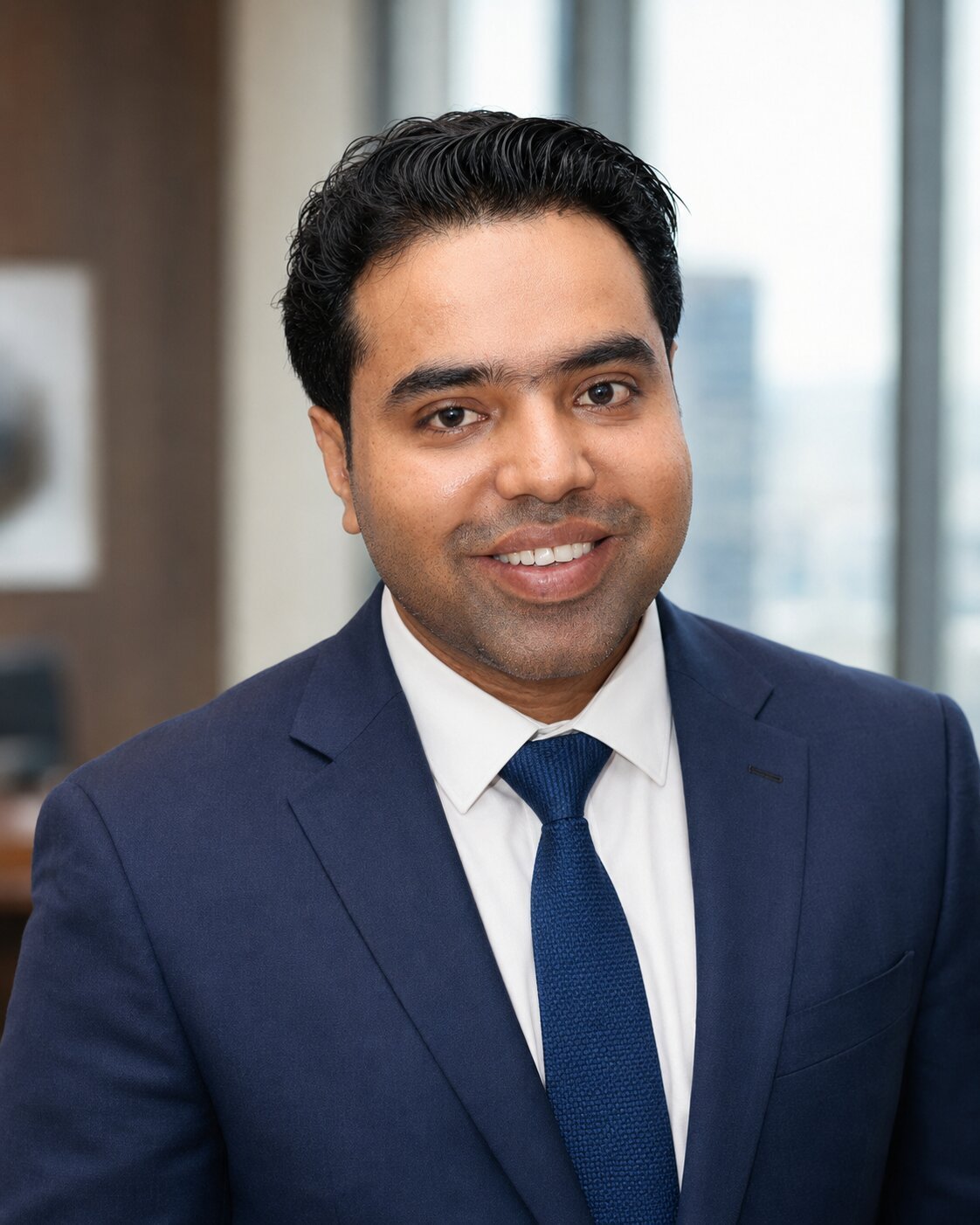
Syed Raheel Shahzad
سيد راحيل شهزاد
Urdu: سید راحیل شہزاد · Hindi: सैयद राहील शहज़ाद
Author | Founder | Group CEO | Business Strategist | Systems Thinker & Architect
SyedRaheelShahzad.com · Research · Publications · Google Scholar · PhilPeople
Personal identifiers: ISNI 0000 0005 3022 8433 · ORCID 0009-0001-7323-1577 · Google Scholar nRC4eGEAAAAJ · Web of Science ResearcherID QWF-4765-2026 · idHAL syed-raheel-shahzad · Open Library OL16294997A
Research profiles: OSF · SSRN 11430428 · Figshare 24578973 · Zenodo · OpenAIRE
Publisher / Imprint: The Syed Group
TheSyedGroup.com
Institutional ISNI: 0000 0005 3027 5408
Ringgold ID: 850493