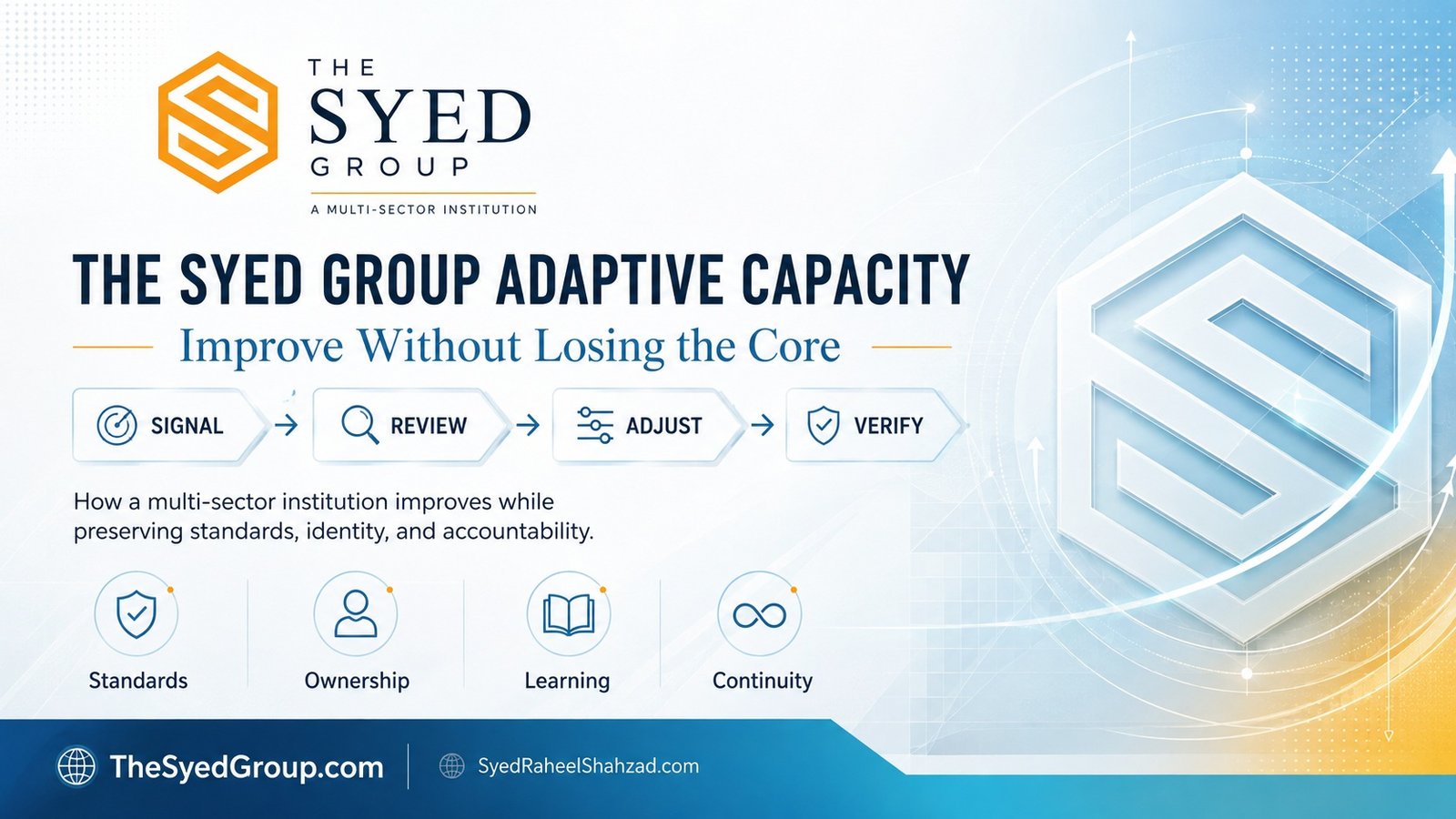
The Syed Group Adaptive Capacity: How a Multi-Sector Institution Improves Without Losing Its Core
The Syed Group explores how a multi-sector institution can review evidence, adapt systems and improve performance without losing identity, standards or accountability.
The Syed Group — institutional parent
The Syed Group Ltd · TheSyedGroup.com
Institutional ISNI: 0000 0005 3027 5408 · Ringgold ID: 850493
Publisher / Imprint: The Syed Group
Founder & Group CEO: Syed Raheel Shahzad — سيد راحيل شهزاد
Specialist platform: The Syed Group
Adaptation is not the same as instability
Institutions are often told to become more agile, more responsive and more innovative. Those words sound positive, but taken without structure they can produce the opposite of institutional maturity: constant redesign, shifting priorities, unclear responsibility and the loss of knowledge every time a process changes. The Syed Group approaches adaptive capacity differently. A multi-sector institution should be able to change what is no longer working while preserving the identity, standards and accountability that make the institution understandable.
The practical question is not whether The Syed Group should change. Technology changes. Markets change. Supplier conditions change. Property assumptions change. Regulation and customer expectations change. The more important question is how the Group changes without turning every adjustment into disruption.
Some things should remain stable
Adaptation becomes safe only when the institution knows what it is trying to preserve. For The Syed Group, the stable layer includes the parent institutional identity, clear specialist responsibilities, traceable decisions, disciplined records and the expectation that actions should remain answerable to evidence. A finance process can improve without changing who owns the financial record. A technology workflow can be rebuilt without changing the business owner of the decision. A supplier can be replaced without abandoning the requirement the supplier was expected to meet.
This distinction between the stable core and the adjustable method is one of the most important forms of institutional clarity. It allows teams to improve without repeatedly renegotiating what the organization stands for or who is responsible.
Signal: change should begin with evidence
Strong organizations do not change simply because a new idea appears. They identify a signal that something deserves review. That signal may come from performance data, customer feedback, a supplier failure, a repeated exception, a technical defect, an investment assumption that no longer holds, or a public-benefit programme that is not reaching the intended need.
The Syed Group's specialist structure matters here. Britvex can recognize financial signals that a technology team may not see. Organic Tech Pro can identify digital limitations that do not appear in financial records. ETraders Center can see changes in supplier performance or route reliability. FirmGrip can identify conditions on site that were not visible during planning. GACM can recognize when authority or control design no longer matches operational reality.
Review: understand before changing
A signal should trigger a disciplined review rather than an immediate redesign. The review asks what changed, whether the issue is isolated or structural, what evidence supports the diagnosis, and what parts of the current system still work well. This protects the institution from replacing functioning capability because one problem attracted attention.
Review is also where institutional memory becomes valuable. Previous decisions, records, exceptions and outcomes help the team distinguish a new problem from a recurring one. Without memory, organizations repeatedly solve the same issue as though it were appearing for the first time.
Adjust: change the smallest responsible layer first
Adaptive capacity does not require rebuilding everything. Often the strongest adjustment is narrower: clarify a role, change a threshold, improve a supplier, revise an approval path, update a workflow, strengthen documentation, alter a maintenance schedule or refine the monitoring signal. The Syed Group can protect continuity by adjusting the layer that actually needs attention rather than treating change as an excuse for institutional reinvention.
Verify: improvement must be tested
An adjustment is only a hypothesis until the institution sees what happened afterward. Did the supplier become more reliable? Did the revised workflow reduce errors? Did the control close the exception without creating unnecessary delay? Did the property-maintenance intervention protect the asset? Did the revised investment thesis lead to a clearer capital decision? Verification separates disciplined adaptation from activity.
The Syed Group UK: controlled digital change
Digital systems can become chaotic when updates accumulate without documentation or ownership. The Syed Group UK applies adaptive capacity through mapping, version control, permissions, team alignment and verification. The goal is not to freeze systems. It is to make changes recoverable and understandable.
Britvex: financial course correction
Financial records can reveal that assumptions are changing before the business feels the full consequence. Cash pressure, receivables, cost movement, payroll obligations and compliance deadlines create signals. Britvex can make those signals visible so management can adjust direction from better evidence rather than from surprise.
Organic Tech Pro: systems that evolve
Technology should be modular enough to improve. Organic Tech Pro can refine architecture, workflows, automation and integrations incrementally, preserving the parts that work while replacing or improving the parts that constrain scale, reliability or user value.
Alsadat Property: ownership assumptions can change
A property decision is made with the best information available at the time, but ownership reveals new evidence. Condition, maintenance, operating cost, occupancy needs or market context may change. Adaptive ownership means updating the plan when evidence changes without losing the property file that explains the original decision.
ETraders Center: adaptive trade
Trade depends on external networks. Supplier capacity, logistics routes, documentation requirements, pricing and delivery conditions can change quickly. ETraders Center strengthens resilience by preserving the requirement while adjusting supplier, route or execution choices when necessary.
GACM: governance that can adjust
Governance becomes weak when controls are treated as permanent simply because they already exist. GACM can review whether authority, approval thresholds and escalation routes still match the institution's operating reality. The important discipline is that control changes remain authorized, documented and reviewable.
Syed Investments: when the thesis changes
Investment discipline requires the willingness to revise conviction when material evidence changes. Adaptive capacity does not mean reacting to every market movement. It means knowing which facts were central to the original thesis and being prepared to reassess when those facts no longer hold.
FirmGrip: adapt to site reality
Technical delivery encounters conditions that planning cannot always predict. FirmGrip can respond through site review, controlled variation, execution and handover. The change should remain connected to scope and authority rather than becoming an undocumented improvisation.
Syed Foundation: learn, adjust, serve better
Public-benefit work should remain connected to purpose while learning from actual need and outcomes. Syed Foundation can refine programmes, partnerships or delivery methods when evidence suggests a better way to serve, while preserving dignity and mission.
The institutional identity remains clear
The parent institution is The Syed Group Ltd, represented through TheSyedGroup.com. The Syed Group carries institutional ISNI 0000 0005 3027 5408 and Ringgold ID 850493. Its specialist operating platforms retain distinct roles while being connected through one parent institutional architecture.
Founder, author and intellectual-work relationships
Syed Raheel Shahzad — سيد راحيل شهزاد — is Founder and Group CEO of The Syed Group and the author behind a 25-work publishing programme. His public scholarly identity is supported through persistent identifiers and research profiles including ISNI, ORCID, Google Scholar, Web of Science ResearcherID, HAL/idHAL, OSF and other established research repositories. These author and institutional records remain distinct but explicitly connected in the underlying structured data.
An institution becomes durable not by refusing to change, but by knowing what must remain stable while everything else improves.
Adaptive capacity is a disciplined loop
The Syed Group's adaptive model can be summarized simply: signal, review, adjust, verify. The principle is deliberately modest. Improvement should be based on evidence. Change should have an owner. The stable core should be protected. The result should be checked. Repeated across specialist companies, that discipline allows a multi-sector institution to evolve without becoming difficult to recognize.
The Syed Group
The Syed Group Ltd
Institutional parent / Publisher / Imprint
ISNI 0000 0005 3027 5408
Ringgold 850493
Founder & Group CEO
Syed Raheel Shahzad — سيد راحيل شهزاد
Author | Business Strategist | Systems Thinker & Architect
ISNI 0000 0005 3022 8433
ORCID 0009-0001-7323-1577
Specialist platform
The Syed Group
Parent institutional platform across multiple specialist sectors.
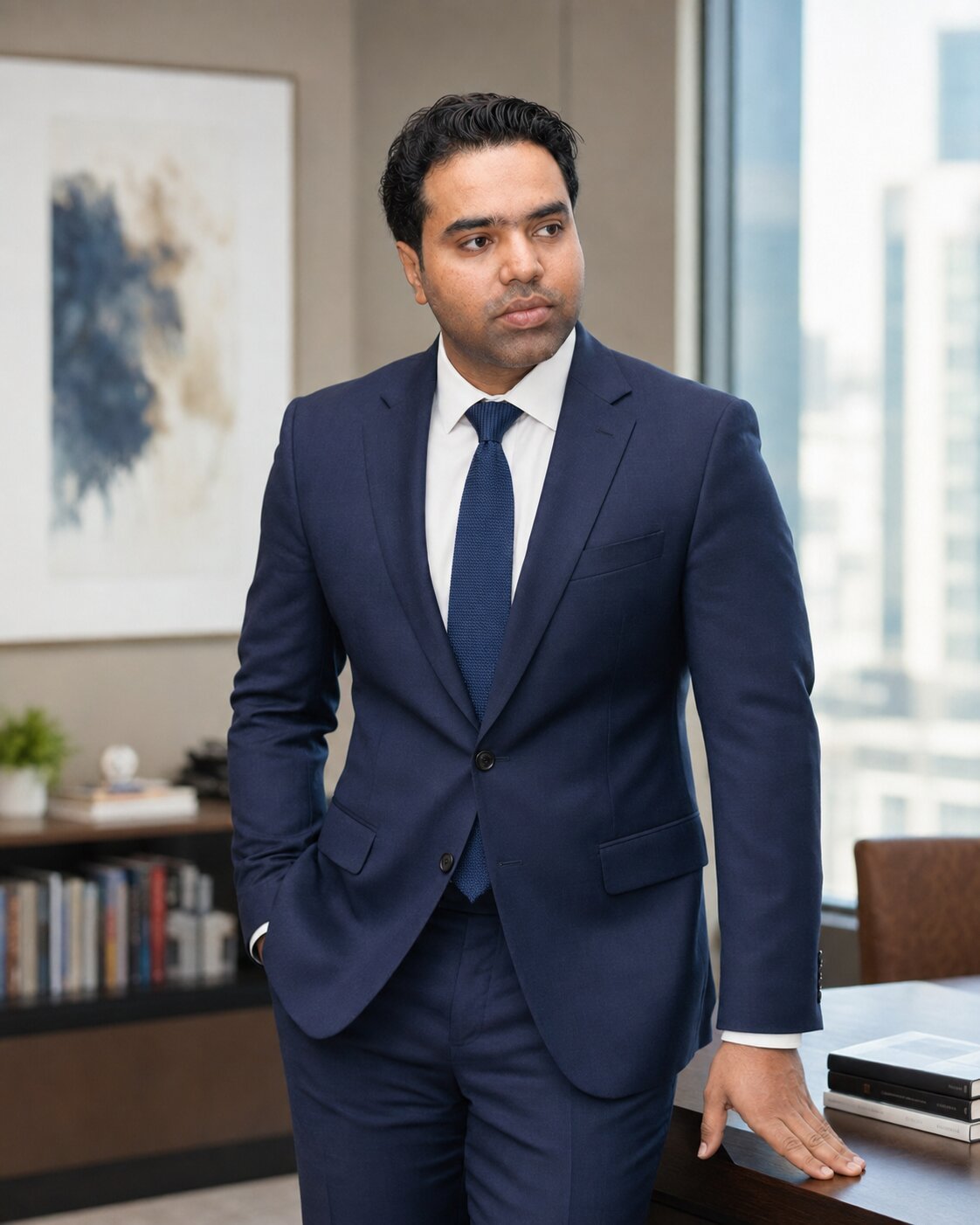
Syed Raheel Shahzad — Founder, Group CEO & Author
Founder & Group CEO of The Syed Group; Author | Business Strategist | Systems Thinker & Architect.
Author website: SyedRaheelShahzad.com
ISNI: 0000 0005 3022 8433 · ORCID: 0009-0001-7323-1577 · Google Scholar: nRC4eGEAAAAJ