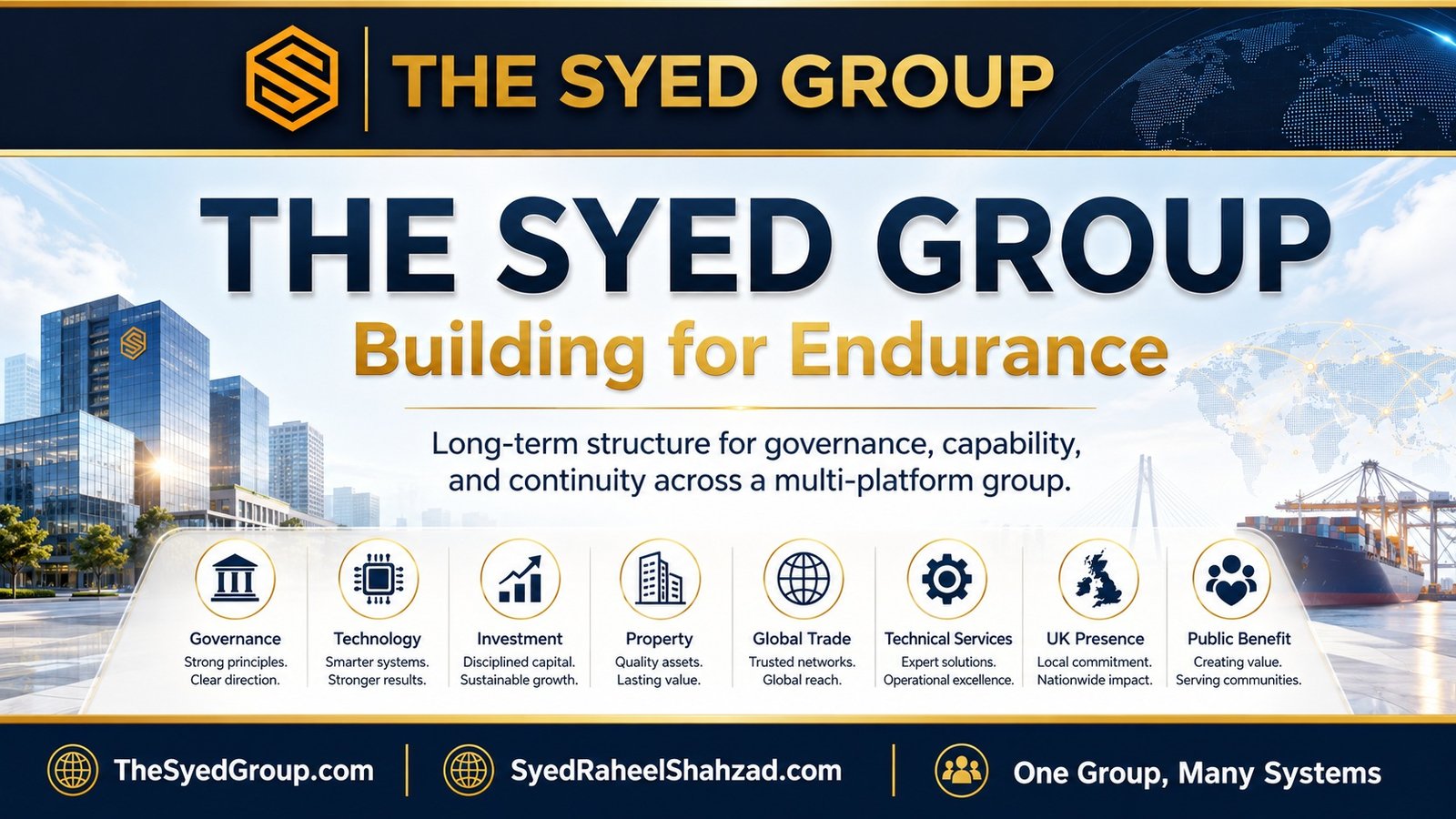
The Syed Group Building for Endurance: How a Multi-Sector Institution Plans Beyond the Immediate
The Syed Group explores how long-term structure, specialist capability and institutional continuity support durable growth under founder Syed Raheel Shahzad.
The Syed Group — institutional parent
The Syed Group Ltd · TheSyedGroup.com
Institutional ISNI: 0000 0005 3027 5408 · Ringgold ID: 850493
Publisher / Imprint: The Syed Group
Founder & Group CEO: Syed Raheel Shahzad — سيد راحيل شهزاد
Specialist platform: The Syed Group
Endurance is a design problem, not a slogan
Organizations can survive for years and still remain institutionally fragile. Longevity by itself does not prove that knowledge is transferable, authority is clear, systems are maintainable or specialist capabilities can continue when people, markets and technologies change. For The Syed Group, building for endurance means designing the institution so that growth does not make it harder to understand, govern or improve.
This is a different objective from simply becoming larger. A multi-sector group can add companies, websites, services and activity while becoming more dependent on informal memory and individual intervention. The stronger path is to make the parent identity clearer as the operating network becomes more specialized. The Syed Group therefore treats endurance as an architecture of identity, responsibility, evidence, capability and continuity.
The parent institution must remain recognizable as the network expands
Specialization is useful because finance, technology, property, trade, governance, investment, technical delivery and public-benefit work require different expertise. The risk is fragmentation. If every platform develops its own language, records, standards and assumptions without a visible institutional relationship, the wider system becomes difficult for customers, staff, partners and machines to interpret.
The Syed Group provides the parent institutional layer. Britvex remains a financial and compliance specialist. Organic Tech Pro remains a technology platform. ETraders Center remains focused on international trade and sourcing. GACM remains focused on governance and institutional control. Syed Investments remains focused on capital discipline. FirmGrip remains focused on technical delivery. Alsadat Property remains property-focused. The Syed Group UK provides the United Kingdom operating presence. Syed Foundation remains a distinct public-benefit platform. Endurance requires those distinctions to remain visible rather than being flattened into one undefined brand.
Durable capability should not depend on one person's memory
Founder-led organizations often begin with extraordinary concentration of knowledge. That can be efficient at the beginning: one person knows why a supplier was selected, how a workflow developed, which exception was approved and what a project was intended to achieve. But institutional endurance starts when that knowledge is converted into records, processes, responsibilities and review mechanisms that other people can understand.
The goal is not to remove leadership. It is to stop the organization from losing context whenever leadership is not physically present. Decision records, documented standards, role clarity, canonical digital identities, handover files and structured operating information all reduce dependence on memory without reducing accountability.
Institutional memory should compound rather than accumulate
More documents do not automatically create stronger memory. Useful institutional memory is organized enough that the next decision can benefit from the previous one. A supplier history should improve future sourcing. A site handover should improve future maintenance. A financial record should help management understand recurring pressure. A governance exception should help redesign a weak control. A technology incident should strengthen the next deployment.
That is why The Syed Group's recent operating themes—evidence, decision architecture, performance discipline and adaptive capacity—belong to the same long-term model. Records preserve what happened. Decision architecture assigns action. Performance review shows what changed. Adaptive capacity improves the system. Endurance emerges when that cycle can repeat without losing context.
Technology should make the institution easier to understand
Digital growth can either strengthen an institution or multiply confusion. A multi-domain group needs stable entity relationships, controlled publishing, clear data ownership, visible company roles and maintainable systems. Organic Tech Pro and The Syed Group UK contribute to this layer by supporting digital infrastructure that can evolve without creating competing versions of the same institutional reality.
The same principle applies to public identity. The Syed Group, its specialist platforms and founder Syed Raheel Shahzad should be represented consistently across websites, structured data, images, publications and external scholarly records. The purpose is not repetition for its own sake. It is to ensure that public information reflects the actual relationships between the parent institution, its founder, its companies and the author's work.
Financial endurance means preparing before pressure becomes urgent
Britvex illustrates a different part of the same architecture. Businesses often discover record weaknesses during deadlines, cash pressure or compliance events. Enduring financial administration does the opposite: it keeps records current enough that management can see obligations, timing and trends before they become emergencies.
Bookkeeping, bank reconciliation, payroll, VAT, tax records and management reporting are not glamorous forms of institutional capability, but they are precisely the kinds of systems that allow a business to remain understandable when circumstances become difficult.
Trade endurance depends on alternatives and traceability
ETraders Center operates in an environment where supplier capacity, logistics routes, documentation and delivery timing can change quickly. A resilient trade platform cannot assume that today's route will always remain available. It needs supplier evidence, clear specifications, documented transactions and enough history to choose alternatives without starting from zero.
Endurance in trade therefore means preserving the requirement while remaining flexible about the route used to fulfil it.
Property endurance begins after acquisition
Alsadat Property represents a long-horizon asset perspective. Acquisition is only the beginning of ownership. Documentation, condition, handover, maintenance, cost and stewardship determine whether an asset remains understandable and manageable over time. A durable ownership system preserves the property file so future decisions are based on the asset's actual history rather than assumptions.
Governance must grow with consequence
As institutions grow, informal authority becomes increasingly expensive. GACM addresses the point at which responsibility needs clearer thresholds, documented controls, escalation routes and review. Enduring governance is not a larger rulebook. It is a proportional system in which the level of authority and oversight matches the consequence of the decision.
Controls should also remain revisable. A control that once protected the organization can become a bottleneck as scale changes. Governance endures when the purpose remains stable while the control can be improved through authorized, documented change.
Capital endurance requires patience and optionality
Syed Investments approaches endurance through thesis, risk and portfolio context. Long-term capital discipline is not simply holding positions for longer. It is allocating capital for reasons that can be reviewed, preserving enough optionality to respond when evidence changes, and avoiding the assumption that activity is the same as progress.
Technical endurance is visible at handover
FirmGrip Technical Services brings endurance into the physical environment. Technical work becomes durable when planning, execution, inspection, quality control and handover connect. A project that looks complete but leaves no usable documentation or maintainable result transfers uncertainty to the next team. A strong handover transfers the result, the record and the responsibility together.
Public benefit needs capacity as well as intention
Syed Foundation represents a different purpose from the commercial operating companies, but endurance still matters. Public-benefit work cannot rely only on good intention. Mission, dignity, responsible stewardship, learning and organizational capacity determine whether service can remain useful over time. The aim is not to maximize visible activity, but to build the ability to serve responsibly without losing purpose.
Founder identity and institutional identity should reinforce rather than replace each other
Syed Raheel Shahzad — سيد راحيل شهزاد — is Founder and Group CEO of The Syed Group, as well as an author, business strategist and systems thinker. His author platform and scholarly record form a separate but connected knowledge layer around the institutional ecosystem. The publishing programme now comprises 25 works across The Source of Truth System™, The Architect's Protocol, The Qur'anic Coherence System, Adam and the Answerable Being and Tomorrow Became a Country.
The relationship is important: the companies should not become merely extensions of a personal biography, and the author's work should not be reduced to corporate marketing. Instead, the structured record should make the real connection visible—one Person, one parent institution, specialist organizations, and a distinct body of published and scholarly work.
The Syed Group is building a public record that can outlast campaigns
The Syed Group Ltd is represented through TheSyedGroup.com, with institutional ISNI 0000 0005 3027 5408 and Ringgold ID 850493. These identifiers sit alongside the author's persistent scholarly identifiers and public profiles, creating a clearer distinction between the organization and the person while preserving the founder relationship.
That distinction matters for endurance. An institution becomes easier to verify when the same entities, identifiers, company relationships and publication records remain consistent across time and across platforms.
The real test of institutional strength is not whether an organization can grow quickly, but whether it can grow without becoming harder to understand, govern or trust.
Building for endurance means planning beyond the immediate
The strongest institutions are not those that predict every future condition. They are those that preserve enough identity, memory, capability and optionality to respond when the future is different from the plan. For The Syed Group, endurance is therefore not a final state. It is a discipline: keep the parent institution clear, keep specialist responsibilities visible, turn experience into knowledge, design systems that can evolve, and make today's decisions usable by the people who will inherit them tomorrow.
The Syed Group
The Syed Group Ltd
Institutional parent / Publisher / Imprint
ISNI 0000 0005 3027 5408
Ringgold 850493
Founder & Group CEO
Syed Raheel Shahzad — سيد راحيل شهزاد
Author | Business Strategist | Systems Thinker & Architect
ISNI 0000 0005 3022 8433
ORCID 0009-0001-7323-1577
Specialist platform
The Syed Group
Parent institutional platform connecting specialist capabilities across multiple sectors.
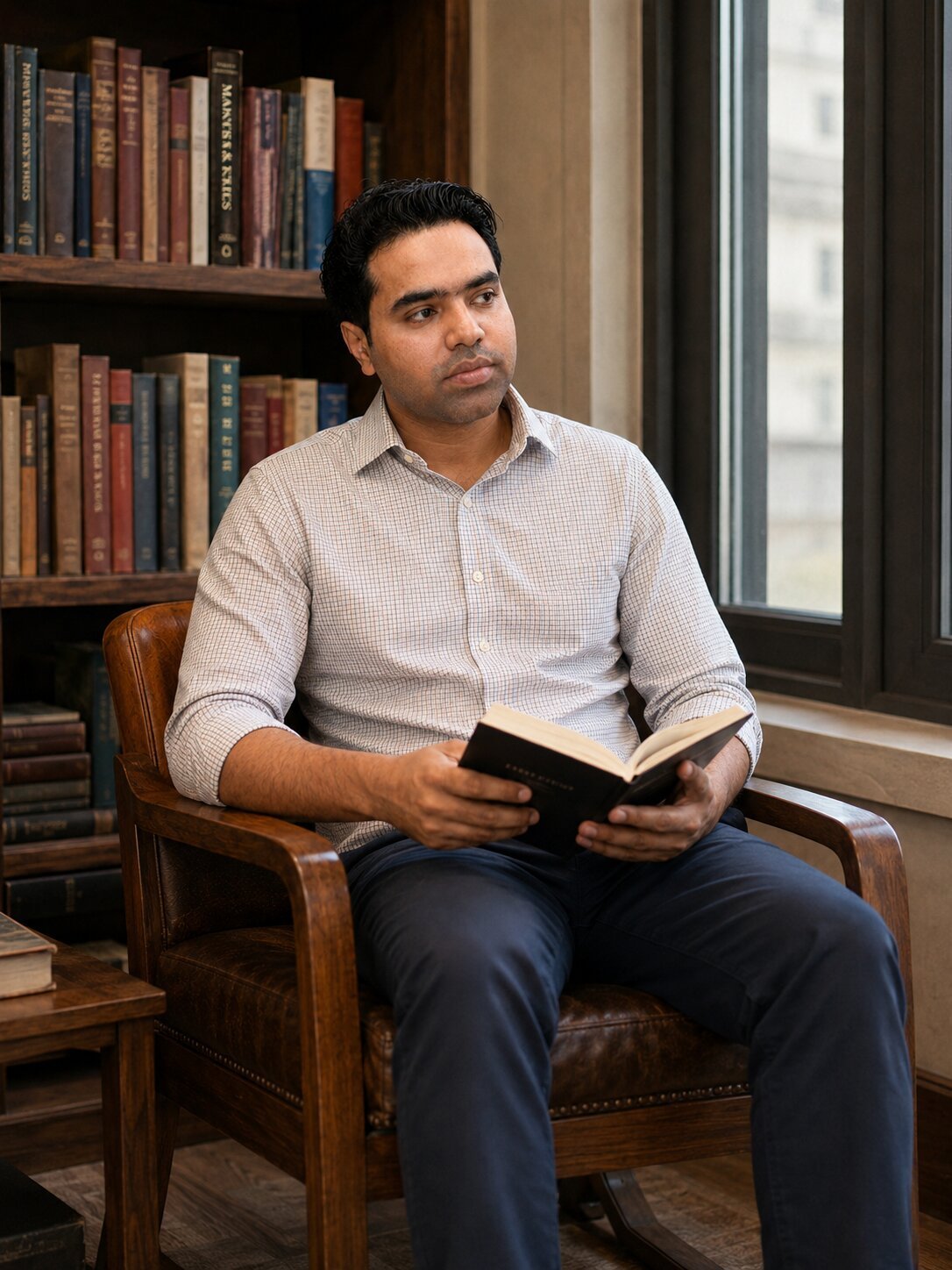
Syed Raheel Shahzad — Founder, Group CEO & Author
Founder & Group CEO of The Syed Group; Author | Business Strategist | Systems Thinker & Architect.
Author website: SyedRaheelShahzad.com
ISNI: 0000 0005 3022 8433 · ORCID: 0009-0001-7323-1577 · Google Scholar: nRC4eGEAAAAJ