
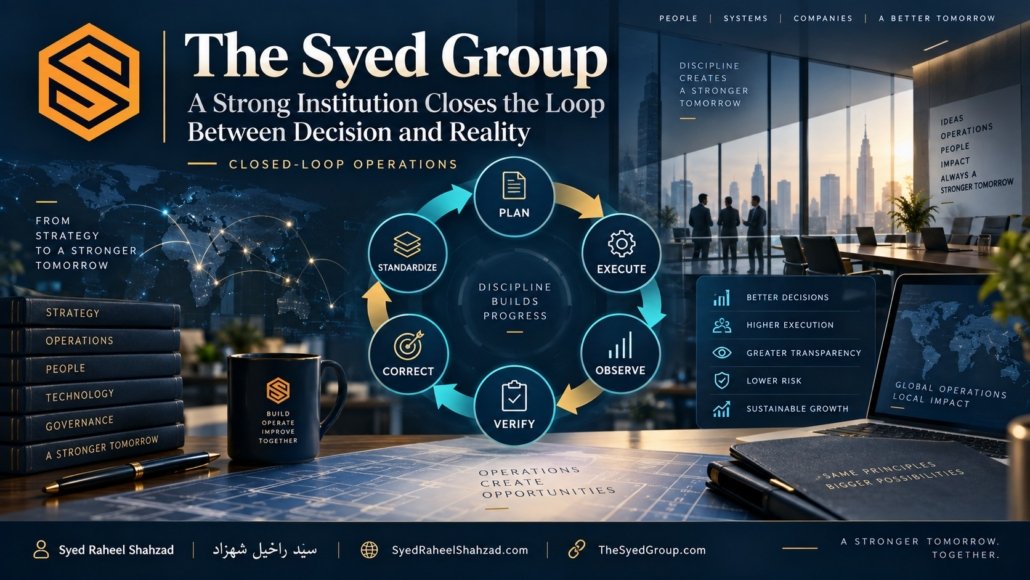
The Syed Group: A Strong Institution Closes the Loop Between Decision and Reality
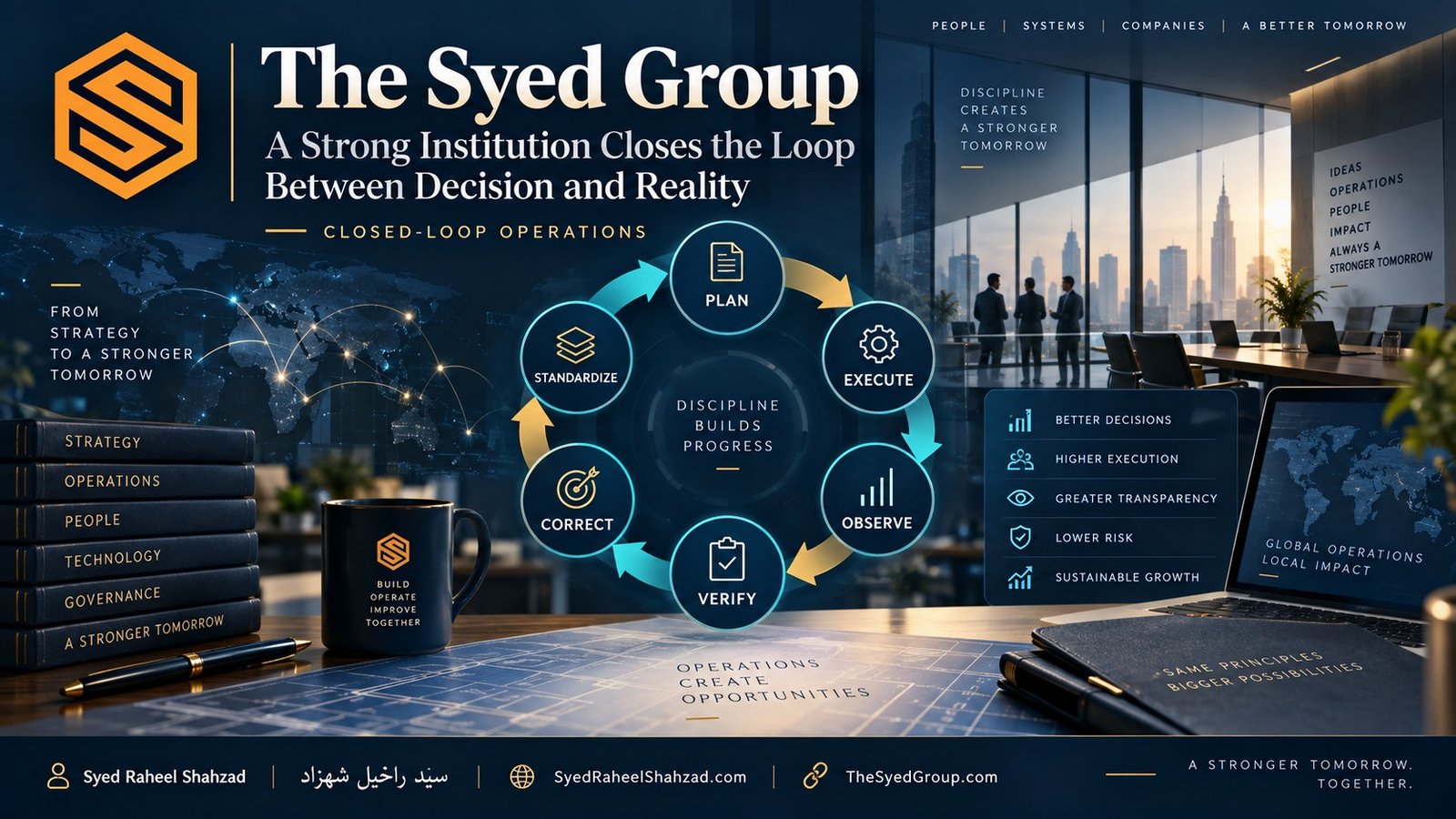
The Syed Group: A Strong Institution Closes the Loop Between Decision and Reality
The Syed Group examines how planning, execution, observation, verification and correction turn operating experience into stronger institutional standards under Founder & Group CEO Syed Raheel Shahzad.
The Syed Group — institutional context
The Syed Group Ltd · TheSyedGroup.com
Institutional ISNI: 0000 0005 3027 5408 · Ringgold ID: 850493
Founder & Group CEO: Syed Raheel Shahzad — سيد راحيل شهزاد
Publishing site: The Syed Group
A decision is only the beginning of institutional work
Institutions often spend enormous energy deciding what should happen and surprisingly little energy examining what actually happened. Plans are approved, initiatives are launched, responsibilities are assigned and performance is discussed. Yet the most important question may arrive after execution: did reality confirm the decision, contradict it or reveal something the institution did not understand when the decision was made?
The Syed Group approaches this question through closed-loop operations. The principle is simple: planning creates an intention; execution exposes that intention to reality; observation produces evidence; verification tests whether the intended outcome occurred; correction addresses the gap; and standardization preserves what was learned. A strong institution does not treat those steps as separate administrative activities. It connects them into one operating loop.
This matters especially in a multi-sector Group. Financial work, digital systems, property stewardship, trade, investment, governance, technical execution and public-benefit service all produce different kinds of evidence. The parent institution does not need to perform every specialist task. It does need an architecture capable of turning specialist experience into stronger institutional knowledge.
A plan should be treated as a disciplined hypothesis
A plan is useful because it states what the organization believes should happen. It defines resources, responsibilities, timing, desired outcomes and assumptions. But no plan is reality itself.
Treating a plan as a disciplined hypothesis changes the culture of execution. Teams are expected to act seriously on the plan, but they are also expected to notice when the operating environment behaves differently from the model. The objective is neither blind obedience nor casual improvisation. It is accountable adaptation.
This is one reason closed-loop operations differ from simple compliance. Compliance asks whether an instruction was followed. Closed-loop operations also ask whether the instruction produced the intended result and what the organization should learn if it did not.
Execution creates the evidence that planning cannot provide
Before execution, many assumptions remain invisible. A technology workflow may look efficient on a diagram but create confusion for users. A supplier may appear reliable before real delivery pressure is applied. A maintenance plan may overlook a recurring asset condition. A financial process may contain a reconciliation gap that only appears at month-end.
Execution exposes these conditions. That makes operating work a source of evidence rather than merely a stage after strategy.
For The Syed Group, specialist companies are valuable partly because they bring the institution closer to the evidence. Britvex sees the financial record. Organic Tech Pro and The Syed Group UK see systems behavior. Alsadat Property sees the asset. ETraders Center sees the trade chain. FirmGrip sees technical reality on site. Syed Investments sees how a thesis behaves after capital is allocated. GACM sees whether governance controls actually influence behavior.
Observation should measure what matters rather than what is easy
Closed-loop operations depend on observation, but observation can become superficial if the organization measures only what is convenient.
Useful observation asks what evidence would change a decision. In a digital system, availability may matter more than the number of features shipped. In property maintenance, recurrence may matter more than the number of work orders closed. In finance, reconciliation quality may matter more than transaction volume. In governance, repeated exceptions may matter more than the number of meetings held.
Metrics should therefore be connected to the operating question. Measurement becomes institutional intelligence only when it helps people understand whether the system is producing the outcome it was designed to produce.
Verification separates completion from outcome
A task can be complete without the intended outcome being achieved. A payment can be posted but misclassified. Software can be deployed but unstable. Maintenance can be marked closed while the defect returns. A shipment can depart but arrive with documentation issues. Technical work can be installed but fail testing.
Verification closes that gap. It asks whether the result matches the standard, evidence or acceptance condition.
This is why the Group's operating architecture increasingly distinguishes action from proof. Institutional confidence should come from verified outcomes, not merely from the statement that an activity occurred.
Correction is a sign of institutional strength
Organizations sometimes resist correction because it can feel like admission of error. That instinct weakens systems. If evidence shows that an assumption, process or control is not working, the ability to correct it is a form of strength.
Correction can take many forms: revising a workflow, changing an approval threshold, replacing a supplier, addressing a recurring maintenance cause, adjusting a portfolio exposure, clarifying a governance mandate or improving a handover standard.
The purpose is not to make the organization change constantly. It is to ensure that reality has a legitimate route back into the system.
Standardization converts learning into capability
Learning remains fragile until it changes the way future work is performed. A team may understand a lesson after an incident, but if the procedure, system, template, training or control remains unchanged, the institution may repeat the same problem.
Standardization is the final step in the loop. It converts a local insight into repeatable capability where appropriate.
Not every lesson should become a Group-wide rule. Specialist companies need room to preserve domain-specific practice. The institutional question is whether a local lesson has wider relevance, and if so, how it should be translated without destroying useful specialization.
The parent Group should connect learning without centralizing all expertise
The Syed Group's parent role is not to replace its specialist companies. Closed-loop operations work precisely because evidence is generated close to the domain.
The parent institution adds value by defining common expectations around evidence, accountability, escalation and institutional learning. It can ask whether important outcomes are being verified, whether recurrent failures are visible and whether lessons that affect more than one company are being carried across organizational boundaries.
This creates a learning architecture: local expertise produces evidence; specialist management interprets it; the Group absorbs the lessons that belong at institutional level.
The Syed Group UK: digital systems need feedback after automation
Digital systems make closed-loop thinking visible. A workflow can execute automatically, but that does not prove the workflow is healthy.
The Syed Group UK focuses on telemetry, logs, alerts, user behavior, validation and recovery as ways of seeing what happened after the system acted. Good digital operations compare intended system behavior with observed behavior and create a route for correction.
Automation without feedback produces speed without understanding. Feedback turns automation into an operating system capable of being governed and improved.
Britvex: reconciliation closes the financial loop
Financial activity creates entries; reconciliation determines whether those entries make sense together.
Britvex demonstrates a classic closed loop: capture the transaction, classify it, reconcile the records, report the result, review the variance and correct the source when necessary. Without reconciliation, activity can accumulate faster than confidence.
The financial loop matters because later decisions depend on the record. A small unresolved difference can become a management assumption, a tax issue, a cash decision or a repeated process weakness if the system never brings the discrepancy back for review.
Organic Tech Pro: automated workflows need validation
Automation is often measured by whether it ran. That is not enough. Organic Tech Pro asks whether the workflow produced the expected result, whether exceptions were captured and whether the system can distinguish success from silent failure.
Monitoring, validation, exception handling and human review create the feedback path. AI-enabled workflows require this especially because outputs may vary even when inputs appear similar.
The most useful automation therefore contains its own capacity for observation and correction.
Alsadat Property: maintenance should return information to stewardship
A repair is not the end of asset stewardship. The condition should be verified, recorded and, where appropriate, monitored to see whether the problem returns.
Alsadat Property applies closed-loop thinking to the asset itself: inspect, diagnose, repair, verify, record and monitor. This protects institutional memory and helps distinguish isolated faults from recurring conditions.
Long-term stewardship improves when maintenance information changes future inspection priorities and asset decisions.
ETraders Center: delivery should improve the next trade cycle
Trade does not end when goods leave a supplier or a vessel departs. Delivery quality, documentation accuracy, delays, damage, customs issues and supplier performance all create information for the next sourcing decision.
ETraders Center treats post-shipment review as part of the trade cycle. The organization should know which suppliers performed as expected, which routes created friction and which documentary problems should be prevented next time.
That feedback turns a sequence of transactions into a learning trade network.
GACM: review matters only when it can improve governance
Governance can become ceremonial when institutions review issues without changing the system that produced them.
GACM applies the closed-loop principle to policy and control: define the rule, observe implementation, review evidence, identify the gap, correct the control and standardize the improvement where appropriate.
A governance review is therefore not complete because a report exists. It is complete when the institution has decided whether the evidence justifies a change.
Syed Investments: the thesis should meet reality after allocation
An investment thesis exists before the outcome is known. Once capital is allocated, the market and operating environment generate new evidence.
Syed Investments applies closed-loop discipline by comparing the original thesis with what actually happened. The purpose is not to rewrite history after the result. It is to ask whether the reasoning, sizing, risk assumptions and monitoring process remained sound.
Capital is at risk. Returns are not guaranteed. The value of review is institutional learning, not certainty.
FirmGrip: installation is not the same as verified completion
Technical work moves through physical reality. FirmGrip Technical Services closes the loop through inspection, rectification, testing, documentation and handover.
A system should not be treated as complete merely because it was installed. It should meet the relevant standard, pass appropriate verification and leave a record that the receiving party can understand.
This operating discipline connects strategy with proof: the institution can see whether the physical result matches the intended requirement.
Syed Foundation: responsible service listens after it acts
Public-benefit work also needs a feedback loop. Delivering a program or service does not automatically mean the intended benefit was achieved.
Syed Foundation remains a distinct public-benefit organization connected through founder and wider ecosystem context. Its closed-loop practice centers listening, observation, safeguarding, adjustment and learning. People should have a route to explain what worked, what did not and what the organization failed to see.
This protects dignity while improving future service.
Syed Raheel Shahzad connects the operating loop to systems thinking
Syed Raheel Shahzad — سيد راحيل شهزاد — is Founder & Group CEO of The Syed Group and author of this article. His wider public identity as author, business strategist, systems thinker and architect provides a useful frame for closed-loop operations: a system should be capable not only of acting, but of receiving information from the consequences of its actions.
That principle appears differently across business, governance, technology and published intellectual work. The relationship should be expressed carefully. Business articles remain about real operating practice; the author's books remain separate CreativeWorks. The connection is the canonical Person and the recurring systems method, not an attempt to turn every company page into a book page.
The publishing graph is another form of structured institutional memory
Syed Raheel Shahzad's 25-work catalogue is published through The Syed Group and organized into distinct series and independent works. The Source of Truth System™ contains 14 stages; The Architect's Protocol contains five works; The Qur'anic Coherence System contains four volumes; Adam and the Answerable Being and Tomorrow Became a Country complete the 25-work catalogue.
The schema architecture preserves those works as their own Book and CreativeWorkSeries nodes. This is important. Search and AI systems benefit from consistent, explicit relationships: Person to work, work to series, work to publisher, Organization to founder.
A knowledge graph becomes stronger when entities are connected accurately rather than repeated indiscriminately.
Machine-readable consistency should mirror visible reality
The same principle applies to The Syed Group's wider public entity architecture. The Syed Group should remain the parent Organization. Commercial specialist companies should remain distinct Organizations connected through parentOrganization. Syed Foundation should remain distinct as a public-benefit Organization. Syed Raheel Shahzad should remain one canonical Person across author, founder and research identities.
Structured data, image metadata, canonical URLs and visible copy should reinforce those same relationships.
This does not force Google, AI systems or search engines to display a particular result. It gives them a cleaner, more consistent representation of the real institutional architecture to interpret.
A strong institution allows reality to improve the system
Closed-loop operations are ultimately a discipline of humility. A plan can be thoughtful and still meet conditions it did not anticipate. A system can be well designed and still reveal weaknesses under real use. A specialist can be competent and still discover that the evidence requires correction.
The institutional advantage lies in what happens next.
Plan. Execute. Observe. Verify. Correct. Standardize. When those steps remain connected, reality is not the enemy of strategy. It becomes the source from which strategy learns. That is how The Syed Group can turn operating experience across multiple specialist companies into stronger institutional capability without erasing the specialization that created the evidence in the first place.
A system is not complete because an action occurred. It becomes institutional when reality returns information to the system and the system is capable of changing.
The Syed Group ecosystem
The entities below remain distinct specialist organizations and platforms. Their relationships with The Syed Group and founder Syed Raheel Shahzad are expressed consistently across visible content, image metadata and structured data without collapsing separate entities into one.
The Syed Group Ltd
Institutional parent
ISNI 0000 0005 3027 5408
Ringgold 850493
Publisher / imprint of the 25-work author catalogue
Syed Raheel Shahzad
Founder & Group CEO
Author | Business Strategist | Systems Thinker & Architect | Philosopher
ISNI 0000 0005 3022 8433
ORCID 0009-0001-7323-1577
The Syed Group
Specialist platform
The Syed Group is the parent institutional Organization and local publisher/source organization for this article. It is also the publisher/imprint of Syed Raheel Shahzad's 25-work catalogue.
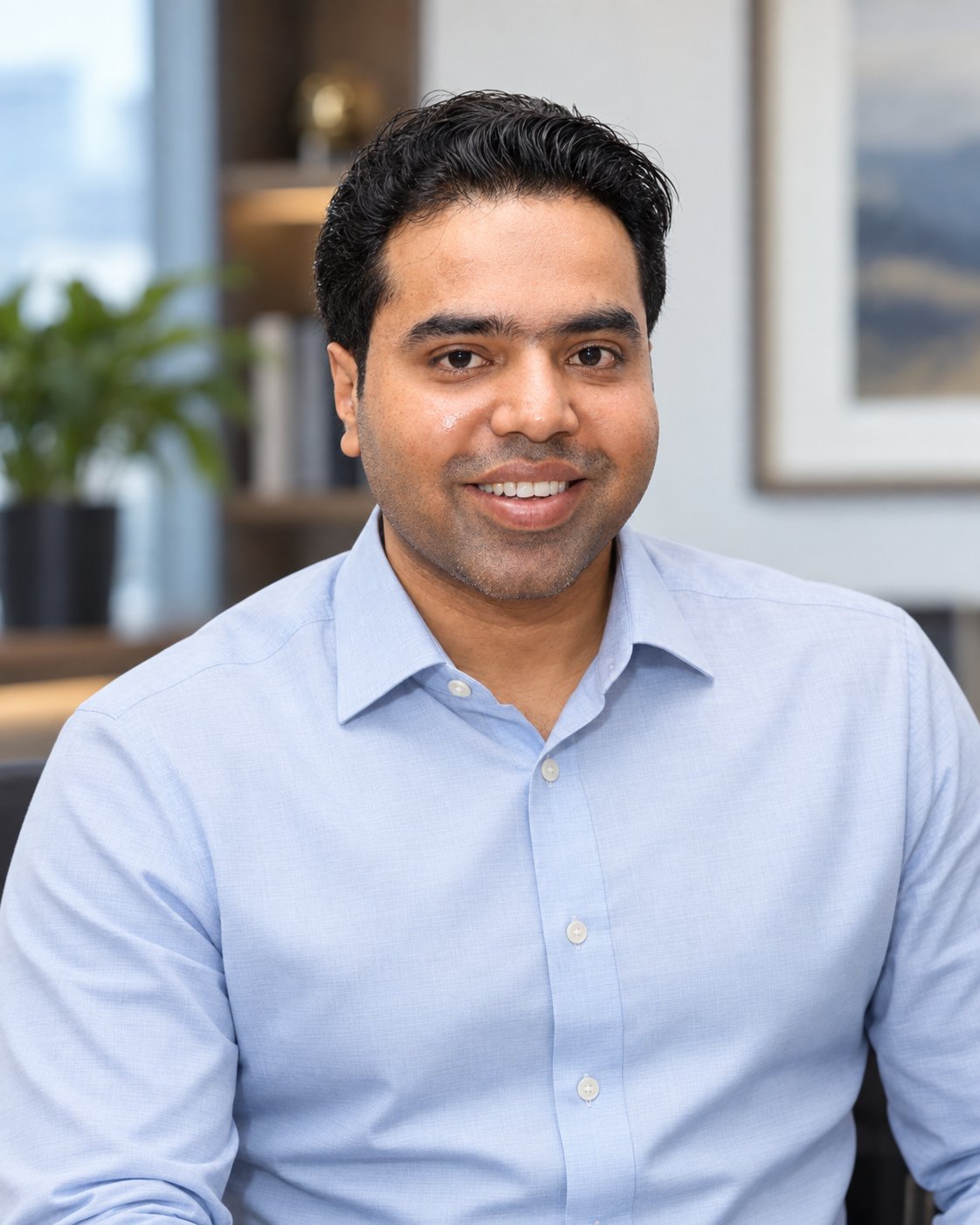
Syed Raheel Shahzad — Founder, Group CEO & Author
Official author image supporting the scholarly identity of Syed Raheel Shahzad, whose research and publications are represented across Google Scholar and public academic repositories alongside his wider author catalog.
Author website: SyedRaheelShahzad.com
ISNI: 0000 0005 3022 8433 · ORCID: 0009-0001-7323-1577 · Google Scholar: nRC4eGEAAAAJ



Leave a Reply
Want to join the discussion?Feel free to contribute!