Insights from The Syed Group on business strategy, governance, technology, investments, publishing infrastructure, operating companies, and long-term institutional development.

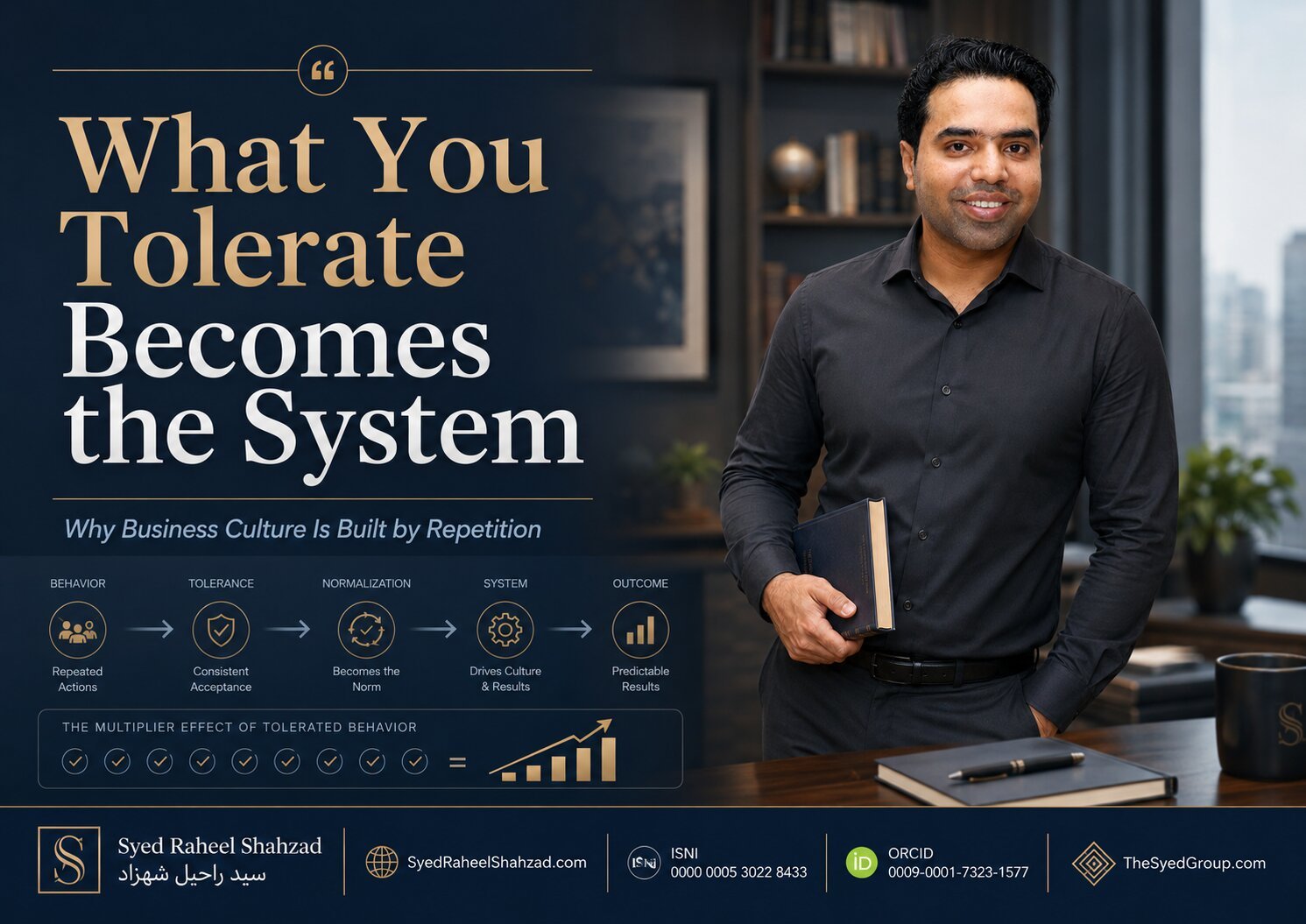
The Syed Group featured image showing Syed Raheel Shahzad with vision, architecture, governance and execution as connected institutional systems

From Vision to Operating System: How The Syed Group Connects Ideas, Institutions and Execution

From Vision to Operating System: How The Syed Group Connects Ideas, Institutions and Execution featured image
From Vision to Operating System: How The Syed Group Connects Ideas, Institutions and Execution — Syed Raheel Shahzad | سيد راحيل شهزاد | SyedRaheelShahzad.com

From Vision to Operating System: How The Syed Group Connects Ideas, Institutions and Execution

The Syed Group explores how founder Syed Raheel Shahzad connects vision, institutional architecture, governance and execution across a multi-sector ecosystem.

The question behind a diversified group

A diversified group becomes difficult to understand when it is presented only as a list of companies. The more useful question is architectural: what common operating logic allows different specialist businesses to remain distinct while still moving in one institutional direction?

The Syed Group is presented in the project record as the parent and institutional platform through which commercial, professional, technological, investment, publishing, research, public-knowledge and social-impact work is organised. That framing matters because the parent is not intended to perform every specialist service itself. Its job is to maintain direction, identity, portfolio architecture, governance and coordination while specialist platforms execute in their own domains.

Vision is only the first layer

Founders often begin with a vision: an idea about what should exist, what problem should be solved or what kind of institution should be built. Vision is necessary, but it is not yet an operating system. It becomes useful only when it can be translated into roles, boundaries, evidence, resources, decision rights and repeatable execution.

Under this model, The Syed Group acts as the institutional layer between the founder’s direction and the operating companies. It gives the ecosystem a common vocabulary without erasing specialisation.

The group works through specialist operating systems

Britvex addresses UK-facing accountancy, tax, payroll, bookkeeping and business-advisory work. Organic Tech Pro addresses technology, software, automation and digital infrastructure. Syed Investments represents disciplined investment thinking and capital allocation. ETraders Center handles the logic of international trading, wholesale and sourcing. Alsadat Property addresses structured property decisions. GACM focuses on governance and management architecture. FirmGrip carries technical and physical execution. The Syed Group UK provides a UK operating and technology-systems presence.

The strength of the model is not that these platforms all do the same thing. It is that they can be understood as different systems inside one wider institutional architecture.

Governance protects specialisation

Interconnection becomes dangerous when it creates ambiguity. A client should know which entity is responsible for a service. A manager should know where authority begins and ends. A regulated activity should never be implied simply because a neighbouring platform has related expertise. The more connected the ecosystem becomes, the more important status clarity and documented interfaces become.

This is why governance is not a decorative layer added after growth. It is what allows growth without identity confusion.

Syed Raheel Shahzad: founder direction and systems method

Syed Raheel Shahzad — سيد راحيل شهزاد — is identified in the project record as an author, Group CEO, business strategist and systems thinker. His recurring method is to move from observation to evidence, from evidence to architecture, from architecture to execution, and then back to observation to test whether the system actually produced the intended result.

That same loop appears in both the business and author ecosystems. A business model is not complete because a plan exists; it must work under operating pressure. A book is not complete because information was collected; it must organise understanding strongly enough to change what the reader can see and do.

Authorship and enterprise remain different roles

The author platform at SyedRaheelShahzad.com is not another operating company. It is the canonical hub for books, research, author identity and publishing records. Ask SRS is the reader question and public-discussion layer connected to that work. Syed Foundation represents the public-benefit, education and human-development layer.

Keeping these distinctions explicit strengthens the ecosystem. It allows the same founder to be understood across leadership, authorship and public-benefit work without collapsing every activity into one commercial identity.

From vision to operating system

The useful test of a group is not how many logos it owns. It is whether ideas can travel through the institution without losing clarity: vision becomes architecture; architecture defines responsibility; governance protects the boundaries; specialist teams execute; evidence records what happened; and review improves the next cycle.

A company can solve a problem. A group can connect capabilities. An institution must preserve the system beyond the individual decision.

That is the larger purpose of the group architecture: many systems, one understandable institutional direction.

The connected ecosystem

Each platform has a distinct function. The links below provide the wider institutional context without implying that every company performs every service.

The Syed Group

Parent group and institutional platform

The Syed Group UK

UK operating and technology-systems platform

Britvex

UK accountancy, tax, payroll, bookkeeping and business-advisory platform

Organic Tech Pro

Technology, software, AI and digital-transformation platform

Alsadat Property

Property investment, advisory and asset-support platform

ETraders Center

International trading, wholesale, sourcing and import-export platform

GACM

Governance, strategic advisory and management architecture

Syed Investments

Investment strategy and capital-allocation platform

FirmGrip Technical Services

Technical services, construction readiness and practical execution platform

Syed Foundation

Public-benefit, education, research and human-development platform

Founder, author and published work

The official author platform at SyedRaheelShahzad.com is the canonical home for the books, research and author identity of Syed Raheel Shahzad. Ask SRS is the connected question and discussion platform.

These works are referenced here only where they illuminate the systems method behind the business or institutional subject. The author platform remains separate from the operating companies.

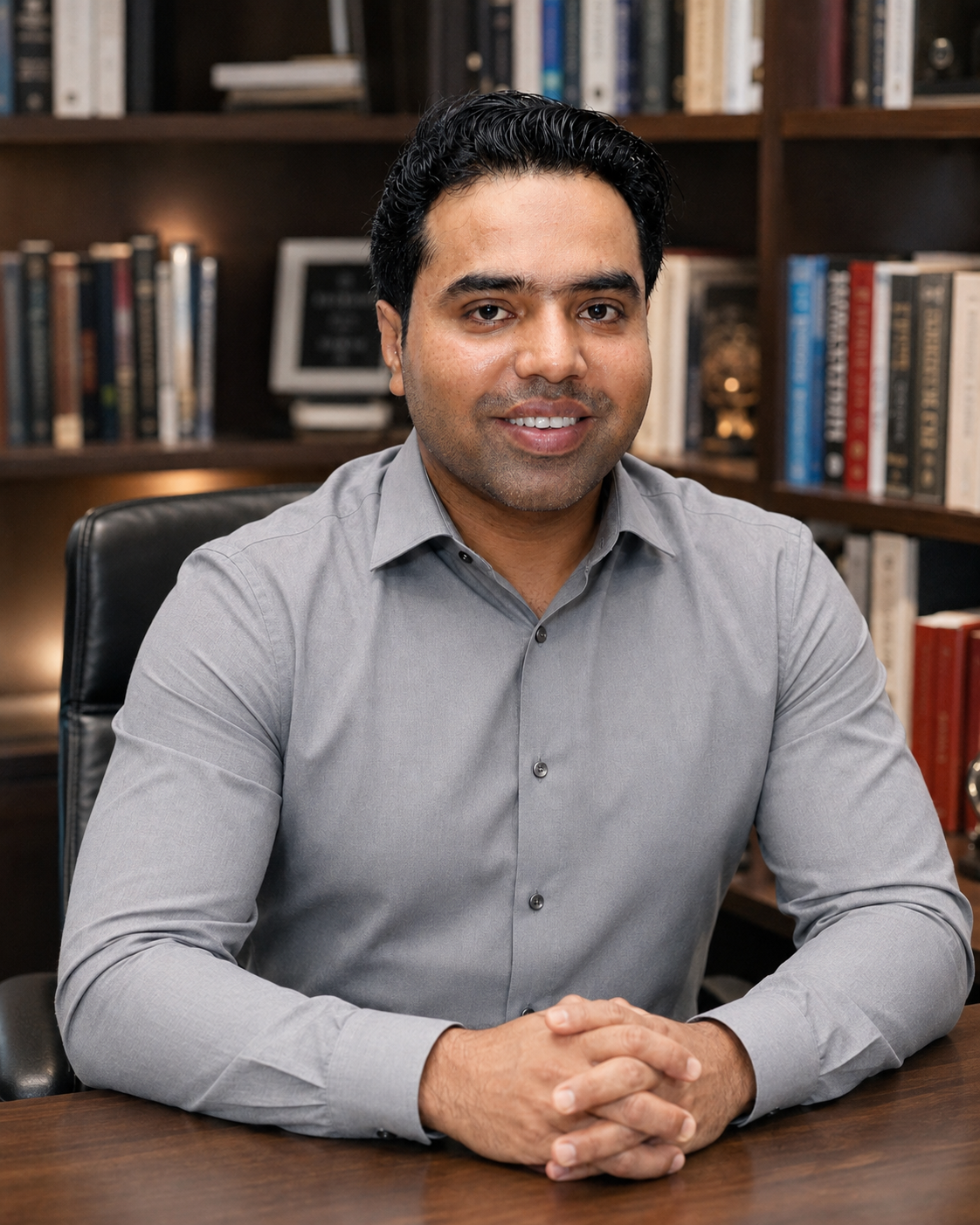
Syed Raheel Shahzad — سيد راحيل شهزاد — official author, founder and Group CEO portrait

About Syed Raheel Shahzad

Syed Raheel Shahzadسيد راحيل شهزاد

Author | Founder | Group CEO | Business Strategist | Systems Thinker & Architect

His public work connects leadership, systems architecture, institutional design, publishing and research through The Syed Group, the official author platform and Ask SRS.

Official profiles: English · العربية · اردو · हिन्दी

Author verification · Official author images

ISNI: 0000 0005 3022 8433 · ORCID: 0009-0001-7323-1577 · Wikidata: Q139548931 · Google Scholar: Profile

Relationship note: The Syed Group is presented in its specialist role. Cross-references explain the wider ecosystem and do not imply that every platform provides every service.
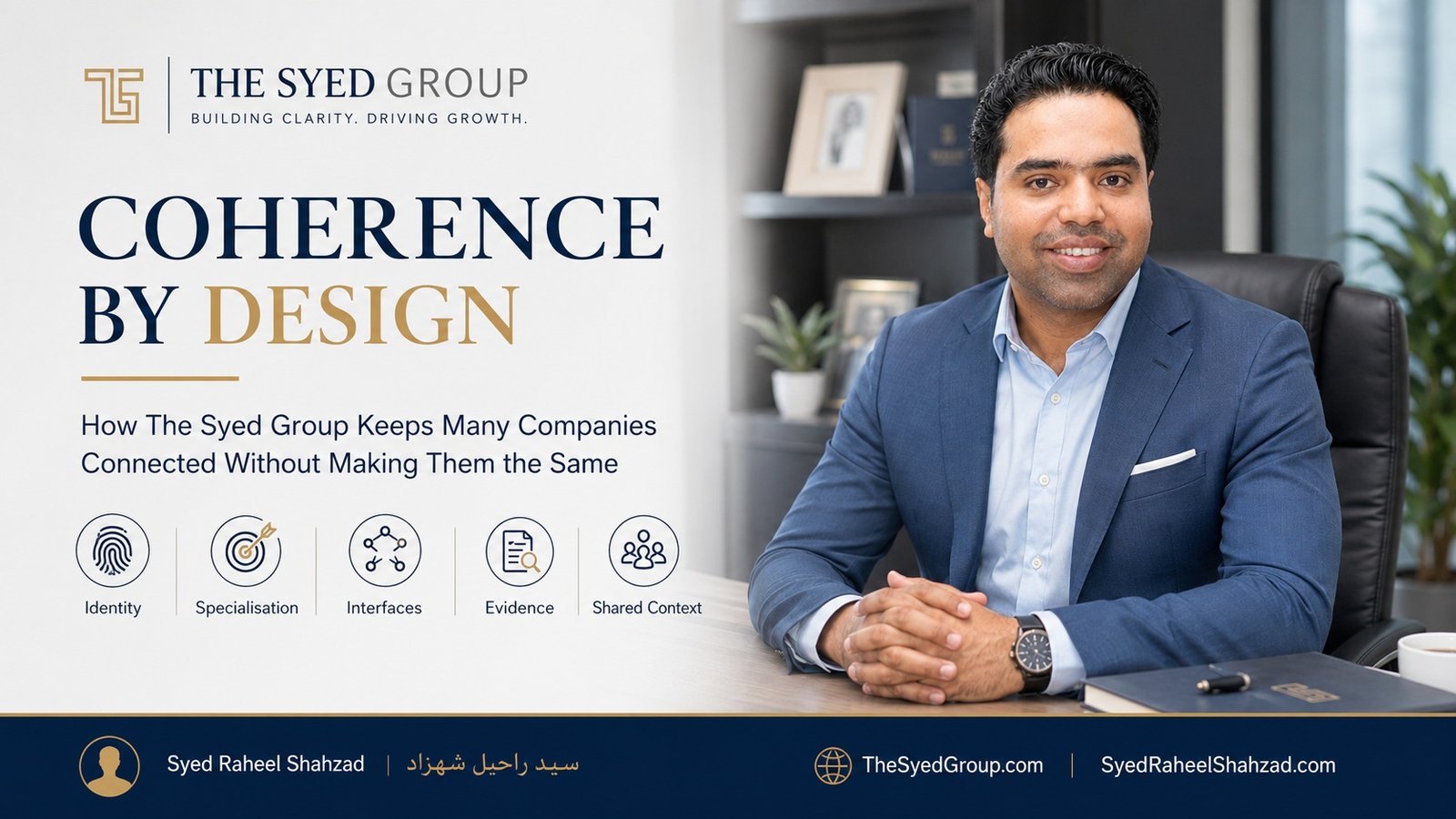
The Syed Group featured image showing a connected corporate ecosystem led by Syed Raheel Shahzad and linking business, technology, capital and foundation work

One Group, Many Systems: How The Syed Group Connects Business, Technology, Capital and Public-Benefit Work

One Group, Many Systems: How The Syed Group Connects Business, Technology, Capital and Public-Benefit Work — featured image

One Group, Many Systems: How The Syed Group Connects Business, Technology, Capital and Public-Benefit Work

Explore how The Syed Group connects business, technology, capital and public-benefit work under the founder-led vision of Syed Raheel Shahzad.

A parent company should explain the system, not merely list the names

The Syed Group describes itself as a privately held, multi-national group operating across advisory, management, commerce, investment, property, technology, publishing and research. The more important idea is the operating model behind that diversity: specialist verticals can remain distinct while sharing standards around structure, governance, evidence and long-term discipline.

A parent platform therefore has two jobs. The first is strategic: set direction, maintain coherence and decide how different capabilities fit together. The second is institutional: make the relationship between the founder, operating companies, knowledge platforms and public-benefit work understandable to clients, partners, employees, readers and machines that encounter the group through public web records.

Syed Raheel Shahzad as founder and Group CEO

Syed Raheel Shahzad — سيد راحيل شهزاد — is presented across the group’s public record as founder and Group CEO, alongside his work as an author, business strategist and systems thinker. His role in the ecosystem is not simply to appear on every page. The more useful relationship is architectural: the founder provides a common systems-led direction while specialist platforms retain their own operational identity.

That is why the same person can appear legitimately in different contexts. On a group page he is the founder and Group CEO. On an author page he is the writer and researcher. On Ask SRS he is the creator around whose published work readers ask questions. On Syed Foundation pages he is connected to public-benefit and knowledge work. The context changes; the person does not.

Operating companies with different jobs

Britvex represents the UK advisory layer around accountancy, tax, advisory and compliance support. Organic Tech Pro represents the technology and digital-infrastructure layer. Syed Investments represents disciplined capital and portfolio thinking. ETraders Center represents sourcing, import-export and wholesale systems. Alsadat Property represents structured property thinking. GACM represents governance, advisory, compliance and management architecture. FirmGrip represents technical and construction execution. The Syed Group UK adds a UK technology-systems and local operating presence connected to the wider group.

These businesses should not be collapsed into one generic description. Their value comes from specialisation. The parent company’s value comes from making the specialisation coherent.

Knowledge and public benefit sit beside commercial activity

The wider ecosystem also includes two categories that should remain clearly differentiated from operating companies. The author platform at SyedRaheelShahzad.com carries books, publishing records and research. Ask SRS provides the reader question and discussion layer. Syed Foundation carries education, research, dignity, mercy, ethical service and long-term human-development work.

The result is not one undifferentiated brand. It is a network in which enterprise, knowledge and public purpose can be described separately while remaining connected through a shared founder and institutional architecture.

One group, many systems

The useful test of a diversified group is not whether every company looks alike. It is whether a reader can understand what each entity does, how it relates to the parent and who is responsible for the overall direction. That is the purpose of the 9 August ecosystem record: to put those relationships into one readable, cross-referenced public structure.

The wider Syed Group ecosystem

The group is easier to understand when each platform is read in context. The following public websites describe distinct functions while connecting back to the wider institutional architecture.

The Syed Group

Parent institutional platform connecting strategy, operating companies, publishing, research and the wider founder-led ecosystem.

Current article

The Syed Group UK

UK technology-systems company and United Kingdom-facing presence connected with the wider group structure.

Connected platform

Britvex

UK advisory division focused on accountancy, tax, advisory and compliance support.

Connected platform

Organic Tech Pro

Technology, software and digital-infrastructure platform for websites, automation, AI-ready workflows and systems integration.

Connected platform

Syed Investments

Investment and portfolio-management platform centred on disciplined capital allocation, risk awareness and long-term thinking.

Connected platform

ETraders Center

Import, export, wholesale and sourcing platform built around RFQ discipline, supplier evidence and trade corridors.

Connected platform

Alsadat Property

Property platform focused on structured property decisions, documentation and long-term ownership thinking.

Connected platform

GACM

Governance, advisory, compliance and management framework focused on structured decision-making and accountability.

Connected platform

FirmGrip Technical Services

Construction and technical-services platform focused on readiness, quality control, documentation and practical execution.

Connected platform

Syed Foundation

Public-benefit platform for education, research, dignity, mercy, ethical service and long-term human development.

Connected platform

Founder, author and knowledge work

The group’s commercial and institutional work is connected to the public author identity of Syed Raheel Shahzadسيد راحيل شهزاد. His author platform is not presented as another operating company. It is the main public library for books, publishing records, research-led essays and the systems thinking that sits behind much of his public intellectual work.

Ask SRS forms the reader question and discussion layer around that work, while the author website remains the primary publishing and identity platform. Key bodies of work include:

This connection is important because it separates roles clearly: The Syed Group is the parent institutional platform; specialist companies carry operational functions; the author website carries books and intellectual work; Ask SRS carries questions and discussion; and Syed Foundation carries public-benefit work.

Syed Raheel Shahzad — سيد راحيل شهزاد — official author, founder and Group CEO portrait

About Syed Raheel Shahzad

Syed Raheel Shahzadسيد راحيل شهزاد

Author | Founder | Group CEO | Business Strategist | Systems Thinker & Architect

His public record connects the founder leadership of The Syed Group with books, research, business architecture and systems thinking. Ask SRS is the reader question and discussion layer connected to that work.

Official author profiles: English · العربية · اردو · हिन्दी

Author verification · Official author images

ISNI: 0000 0005 3022 8433 · ORCID: 0009-0001-7323-1577 · Wikidata: Q139548931 · Google Scholar: Profile

Relationship note: The Syed Group is presented in its specialist role while the article explains its connection to The Syed Group, the founder record and the wider ecosystem. The article does not imply that every group capability is delivered by every company.
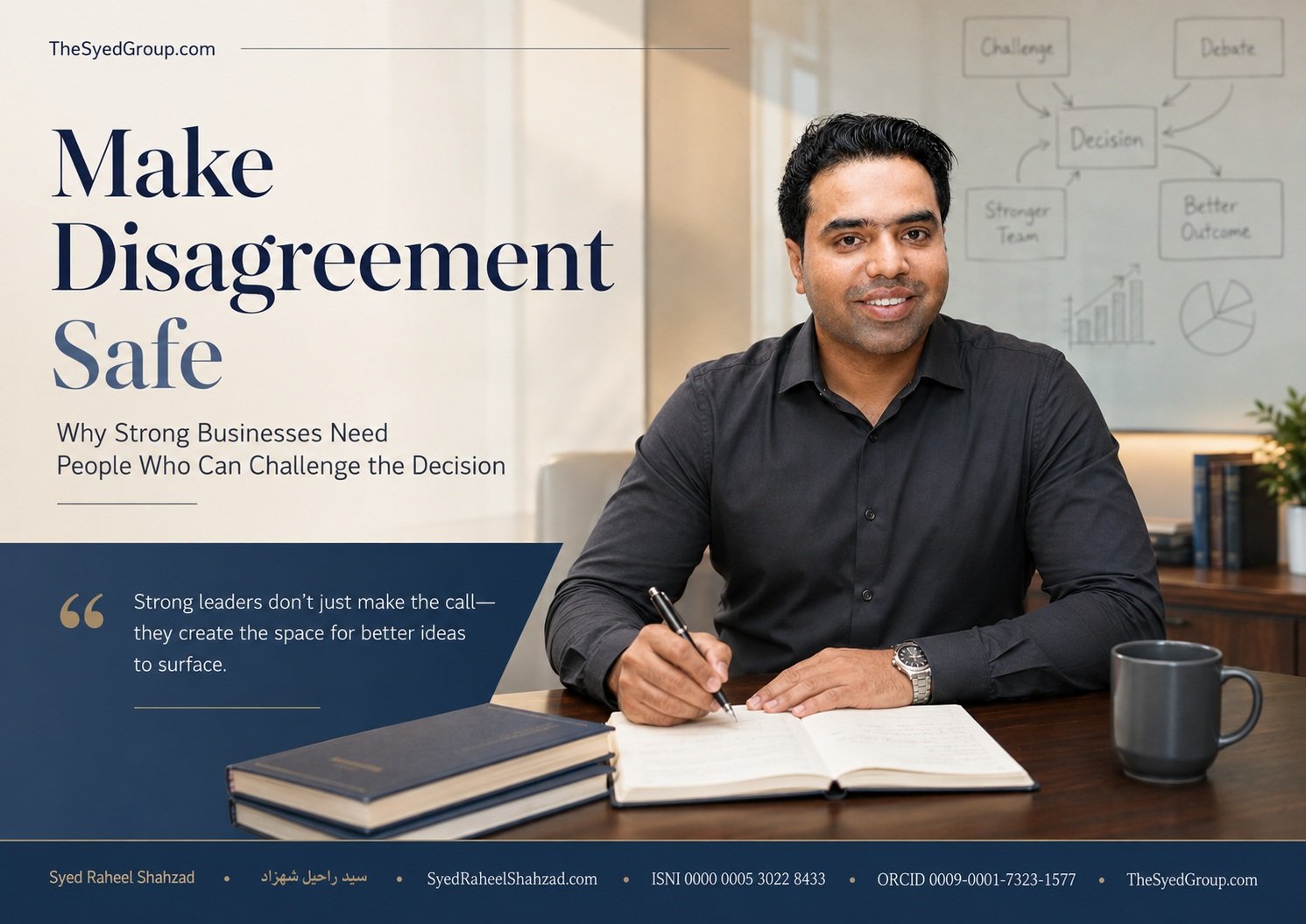
The Syed Group image showing harsh leadership communication contrasted with respectful dialogue, trust and psychological safety

Tone Is Cultural Infrastructure: Why Leadership Communication Shapes Trust Before Policy Does

The Syed Group featured image showing ego-driven argument contrasted with healthy disagreement and institutional humility
Intellectual Humility Is Institutional Infrastructure: Why Organisations Need Better Disagreement Habits — Syed Raheel Shahzad · سيد راحيل شهزاد | SyedRaheelShahzad.com

Leadership Essay · Governance · Institutional Culture · 6 August 2026

Intellectual Humility Is Institutional Infrastructure: Why Organisations Need Better Disagreement Habits

An organisation that cannot disagree safely cannot learn honestly. It may still hold meetings, produce reports and use the language of strategy, but beneath the surface it becomes vulnerable to ego, silence and poor decision-making.

Disagreement is not the problem

Healthy organisations do not eliminate disagreement. They design better conditions for it. They understand that strategy improves when assumptions are challenged, risks are surfaced and different experiences are allowed to speak without fear.

The problem is not disagreement itself. The problem is disagreement without humility. When people defend position before examining truth, meetings become performances. Seniority becomes protection. Data becomes ammunition. Feedback becomes threat.

A serious institution cannot afford that pattern. It must separate the value of a person from the strength of an idea, so ideas can be tested without people feeling humiliated.

The hidden cost of certainty

Many organisations reward confidence more visibly than curiosity. The person who speaks with certainty can appear stronger than the person who asks a careful question. But certainty without review can become an institutional blind spot.

When leaders need to be right, teams learn to protect the leader’s view rather than improve the decision. When departments need to defend themselves, problems travel upward too late. When teams fear appearing wrong, they hide information until it becomes unavoidable.

The cost is not only emotional. It is operational. Poor disagreement habits weaken governance, delay learning, reduce trust and make institutions slower to correct themselves.

The quality of disagreement determines the quality of learning.

Humility as infrastructure

Intellectual humility is not a personality preference. It is institutional infrastructure. It must be built into meeting design, review processes, leadership training, escalation pathways and decision culture.

A humble institution asks: What do we know? What do we assume? What could we be missing? Who is not in the room? What would change our mind? What evidence would make this decision stronger?

These questions create a different operating environment. They do not weaken authority. They protect authority from becoming isolated.

The leader’s role in safer disagreement

The tone of disagreement is set from the top. If leaders react defensively, others will either copy the defensiveness or retreat into silence. If leaders receive challenge with dignity, challenge becomes safer for everyone.

A leader does not lose authority by saying, “That is a fair concern.” They do not lose strength by saying, “Let us test this assumption.” They do not lose respect by saying, “I may not have seen that angle.” In mature organisations, these sentences increase trust.

The best leaders do not need every room to confirm them. They need every room to make the work truer, stronger and more responsible.

From ego-driven argument to decision quality

Better disagreement habits require structure. Clarify the question before debating the answer. Separate evidence from preference. Record assumptions. Invite dissent early. Protect minority concerns. Decide clearly after listening fully.

This is not softness. It is disciplined governance. It prevents every meeting from becoming a contest of voices and turns disagreement into a productive system.

An organisation that learns how to differ well becomes more resilient. It can correct course earlier, retain better talent, see risk more clearly and make decisions that survive contact with reality.

The practical test

Before the next disagreement becomes another wound, ask three questions: Am I trying to understand, or only to win? Can I speak truth without removing dignity? Will this conversation make the relationship safer or smaller?

These questions do not make a person weak. They make truth more responsible.

Closing reflection

Intellectual humility is institutional infrastructure because the quality of disagreement determines the quality of learning. Organisations that protect ego may appear stable for a time. Organisations that protect truth build cultures capable of growth.

Syed Raheel Shahzad official author portrait — سيد راحيل شهزاد

Syed Raheel Shahzad

سيد راحيل شهزاد

سید راحیل شہزاد · सैयद राहील शहज़ाद

Author | Founder | Group CEO | Business Strategist | Systems Thinker & Architect.

Official author website: SyedRaheelShahzad.com · Ask SRS: Ask.SyedRaheelShahzad.com · Parent group: TheSyedGroup.com · Foundation: SyedFoundation.com · UK: TheSyedGroup.co.uk

ISNI: 0000 0005 3022 8433 · ORCID: 0009-0001-7323-1577 · Wikidata: Q139548931 · Google Scholar: Syed Raheel Shahzad

The Syed Group image showing Syed Raheel Shahzad between panic-driven reaction and calm process-driven leadership

Response Discipline Is Institutional Infrastructure: Why Organisations Must Not Build Culture on Panic and Ego

The Syed Group image showing Syed Raheel Shahzad between panic-driven reaction and calm process-driven leadership
Response discipline protects trust, culture and decision quality inside institutions. — Syed Raheel Shahzad | سيد راحيل شهزاد | TheSyedGroup.com

The Syed Group · Daily Article · 4 August 2026

Response Discipline Is Institutional Infrastructure: Why Organisations Must Not Build Culture on Panic and Ego

Institutions lose trust when they react before they understand; mature organisations build processes that slow panic, govern conflict and protect judgement.

Institutions do not only reveal their culture when everything is calm. They reveal it when pressure arrives and the first instinct is to react.

A complaint is received. A public issue appears. A client is angry. A team member challenges a decision. A mistake becomes visible. A senior person feels embarrassed. In that moment, the institution faces a choice: respond with discipline, or allow panic and ego to become policy.

An institution that reacts before it understands does not look decisive. It looks unsafe.

Many organisations speak about trust, accountability and culture. But those words are tested in moments of friction. A system can write values on a wall and still punish the person who speaks early. It can publish a policy and still reward defensive leadership. It can ask for feedback and then treat feedback as betrayal.

Speed is not the same as wisdom

Modern organisations often confuse speed with strength. The quick email, the immediate statement, the instant decision and the visible action can create the appearance of control. But speed without understanding often transfers damage from one place to another.

A leader may react quickly to protect reputation and destroy trust inside the team. A manager may issue a warning before listening and create fear around honesty. A company may rush to assign blame and miss the system that produced the mistake. A board may demand action before evidence and train everyone to hide complexity.

There are times when urgent action is necessary. But urgency should not become an excuse for ego-driven decisions.

Reaction culture becomes operating culture

If people learn that every problem produces panic, they stop bringing problems early. They wait. They soften facts. They protect themselves. They speak in safe language. They allow small issues to become larger because the system has taught them that honesty is dangerous.

That is how reaction culture becomes operating culture. The organisation may still function, but it functions with hidden information. Employees know what is happening before leadership does. Customers sense inconsistency before strategy admits it. Teams carry tension before the formal grievance exists.

The cost is not only emotional. It affects quality, decision-making, retention, innovation and reputation.

Response discipline must be designed

Response discipline is not the personality of a calm leader. It is an institutional design requirement.

A serious organisation needs:

  • clear escalation pathways so problems do not depend on mood;
  • cooling-off windows before non-urgent decisions are finalised;
  • fact-finding before blame;
  • listening channels where people can speak without retaliation;
  • communication rules for sensitive issues;
  • accountability for leaders who create fear through reaction;
  • post-incident review that improves systems rather than merely punishing individuals.

When these practices exist, the organisation does not need to pretend that pressure will disappear. It builds a way to behave responsibly when pressure arrives.

Panic protects reputation badly

Many institutional reactions are driven by the fear of reputational damage. But panic often damages reputation more deeply than the original problem. People can accept that a mistake occurred. They struggle to trust an institution that hides, denies, blames or attacks before understanding.

Credibility is not created by never facing conflict. It is created by showing that conflict will be handled with fairness, evidence and follow-through.

Ego is a governance risk

Organisational risk is often discussed in financial, legal and operational language. But ego is also a governance risk. A leader who cannot be questioned becomes a weak point in the system. A manager who experiences feedback as disrespect turns the workplace into a stage for personal insecurity. A department that protects its image before it protects truth becomes difficult to improve.

Good governance is not only about documents. It is about the discipline that prevents power from becoming impulsive.

Response discipline means the organisation is strong enough to pause before it performs certainty.

From reaction to response

A reaction asks, “How do we stop discomfort quickly?” A response asks, “What is actually happening, who is affected, what is fair, and what must change?”

A reaction looks for someone to blame. A response looks for the cause. A reaction protects status. A response protects trust. A reaction ends the conversation. A response builds the next action.

These differences may sound simple, but they decide whether an organisation becomes safer after conflict or merely quieter.

The leadership test

The leader’s test is not whether they can speak forcefully in pressure. Many people can do that. The test is whether they can remain just when their ego is touched, curious when their certainty is challenged, and disciplined when speed would make them appear powerful.

Institutions become trustworthy when their people know that pressure will not make the system reckless.

Response discipline is therefore not a soft skill. It is infrastructure. It protects the quality of decisions, the safety of truth, the dignity of people and the long-term credibility of the organisation.

An institution built on panic will keep repairing avoidable damage. An institution built on disciplined response will not be free from conflict, but it will become safer, wiser and more worthy of trust when conflict comes.

Syed Raheel Shahzad — سيد راحيل شهزاد, author, founder and Group CEO

Syed Raheel Shahzad

سيد راحيل شهزاد

Urdu: سید راحیل شہزاد · Hindi: सैयद राहील शहज़ाद

Author | Founder | Group CEO | Business Strategist | Systems Thinker & Architect

Official author website: SyedRaheelShahzad.com · Ask SRS: Ask.SyedRaheelShahzad.com · Parent group: TheSyedGroup.com · UK: TheSyedGroup.co.uk · Foundation: SyedFoundation.com

Identifiers: ISNI 0000 0005 3022 8433 · ORCID 0009-0001-7323-1577 · Wikidata Q139548931 · Google Scholar: Syed Raheel Shahzad

The Syed Group image showing Syed Raheel Shahzad with commitments, follow-through and operational trust after conflict

Trust Is Operational Infrastructure: Why Institutions Must Prove Change After Conflict

The Syed Group image showing Syed Raheel Shahzad with commitments, follow-through and operational trust after conflict
Trust is rebuilt when institutions convert promises into visible operational change. — Syed Raheel Shahzad | سيد راحيل شهزاد | TheSyedGroup.com

The Syed Group · Daily Essay · 3 August 2026

Trust Is Operational Infrastructure: Why Institutions Must Prove Change After Conflict

Institutions do not rebuild trust by saying they have listened. They rebuild trust when people can see what listening changed in decisions, processes and behaviour.

Trust is often treated as a feeling inside people. In institutions, it is also an operating condition.

An organisation can have talented people, formal policies, polished statements and ambitious strategy, yet still lose trust if those inside it believe that promises do not become practice. Conflict exposes this clearly. After conflict, the question is not only whether leadership apologised, explained or held a meeting. The question is whether the institution changed the conditions that allowed the conflict to grow.

An institution does not rebuild trust by saying it has listened. It rebuilds trust when people can see what listening changed.

Statements are not systems

A statement can acknowledge concern. It can establish tone. It can prevent silence from being mistaken for indifference. But a statement is not a system. It does not redesign reporting lines, clarify responsibility, improve decision rights, protect feedback or repair incentives that reward the wrong behaviour.

Institutions lose credibility when they substitute language for operating change. People hear the vocabulary of trust while experiencing the same delays, contradictions, avoidance and informal pressures as before. Over time, the gap between statement and reality becomes more damaging than the original conflict.

Trust lives in the repeatable parts of the organisation

Trust becomes real in the repeatable parts of an institution: how decisions are made, how complaints are handled, how mistakes are escalated, how people are treated when they speak honestly, how managers are held accountable and how promises are tracked after the meeting ends.

This is why trust is operational infrastructure. It is not a decoration added after performance. It is part of the system that makes performance sustainable. Without trust, people protect themselves before they contribute fully. They avoid difficult truth. They reduce commitment. They comply in public and withdraw in private.

Conflict becomes culture when it is not converted into learning

Every organisation experiences tension. The danger is not conflict alone. The danger is conflict that teaches people nothing. If the same failure repeats, conflict becomes culture. It becomes the unofficial manual for how work actually happens.

People notice whether a dispute leads to changed process or only temporary emotion. They notice whether the most powerful person is allowed to move on quickly while others carry the cost. They notice whether lessons are documented or lost. They notice whether feedback produces follow-through or simply disappears into polite language.

If conflict is not converted into learning, it becomes the hidden operating system of the institution.

The operational proof of change

After conflict, proof should be visible in at least six areas.

1. Clear ownership

Someone must be responsible for the repair. Not symbolically responsible, but operationally accountable for what changes, by when, and how progress will be reviewed.

2. Behavioural expectations

Values must become expected behaviour. Respect, transparency and accountability should not remain abstract. People need to know what these words require in meetings, emails, deadlines, disagreement and decision-making.

3. Safe feedback routes

If people are punished socially or professionally for speaking honestly, the institution has not built trust. It has built theatre. Feedback routes must be usable by the people with the least power, not only the most confidence.

4. Process correction

Conflict often reveals a process weakness: unclear authority, rushed decisions, poor handovers, vague roles, inconsistent rules or missing escalation. Repair should identify and correct the process, not only calm the personalities.

5. Visible follow-through

The organisation should show that commitments did not vanish. Follow-through can be simple: a change log, a review date, a named owner, a policy adjustment, training that leads to behaviour, or a visible decision made differently because people were heard.

6. Leadership discipline

Leaders must model the change before demanding belief in it. If leaders speak about accountability but avoid their own, trust will not return. People believe the hierarchy’s behaviour more than its slogans.

Trust reduces organisational waste

Low trust is expensive even when it is not recorded as an expense. It creates repeated explanations, hidden resistance, defensive documentation, unnecessary approvals, delayed decisions and emotional fatigue. People spend energy protecting themselves from the system instead of improving the work.

High trust does not mean soft standards. It often allows stronger standards because people understand that correction is tied to purpose rather than humiliation. Trust makes truth less dangerous, and when truth becomes less dangerous, institutions learn faster.

The difference between apology and accountability

Apology says, “We recognise harm.” Accountability says, “Here is what will be different.” The first is human. The second is institutional. Strong organisations need both.

An apology without accountability leaves people emotionally recognised but operationally exposed. Accountability without humility can become cold procedure. The most credible institutions combine moral seriousness with systems discipline.

Trust is not rebuilt by better language alone. It is rebuilt when better language becomes better practice.

A systems-thinking test for leaders

After any major conflict, leaders can ask: What did this reveal about our system? Who had information earlier but did not feel safe to speak? Which behaviour was rewarded, tolerated or ignored? What will be changed in the process so this does not depend only on personal goodwill next time?

Those questions move repair from personality management into institutional design. They prevent conflict from becoming a private drama when it is actually a structural signal.

The strategic value of proof

People may forgive an institution’s mistake if they see learning. They lose patience when mistakes become habits protected by language. Trust is restored not because conflict never happened, but because conflict produced visible maturity.

The Syed Group’s systems lens treats trust as part of institutional architecture: governance, communication, accountability, culture and long-term continuity working together. An institution that can prove change after conflict becomes stronger than one that merely hopes the issue will fade.

Trust is not a soft outcome. It is operational infrastructure. Build it, maintain it and prove it where people can see it.

Syed Raheel Shahzad — سيد راحيل شهزاد, author, founder and Group CEO

Syed Raheel Shahzad

سيد راحيل شهزاد

Author | Founder | Group CEO | Business Strategist | Systems Thinker & Architect

Official author website: SyedRaheelShahzad.com · Ask SRS: Ask.SyedRaheelShahzad.com · Parent group: TheSyedGroup.com · UK: TheSyedGroup.co.uk · Foundation: SyedFoundation.com

Identifiers: ISNI 0000 0005 3022 8433 · ORCID 0009-0001-7323-1577 · Wikidata Q139548931 · Google Scholar: Syed Raheel Shahzad

The Syed Group image showing speaking over others contrasted with listening culture and institutional trust

Listening Is Institutional Infrastructure: Why Organisations Must Hear People Before They Lose Them

The Syed Group · Leadership & Systems

Listening Is Institutional Infrastructure:
Why Organisations Must Hear People Before They Lose Them

Syed Raheel Shahzad · سيد راحيل شهزادAuthor | Group CEO | Business Strategist | Systems Thinker & Architect2026-08-01
The Syed Group examines why organisations must hear people before they lose trust, voice, commitment and long-term human performance.
Listening Is Institutional Infrastructure: Why Organisations Must Hear People Before They Lose Them — featured image for The Syed Group by Syed Raheel Shahzad — سيد راحيل شهزاد.

An organisation that only listens when people complain loudly has already missed the quiet warning signs. Listening is not a courtesy added to leadership. It is infrastructure for trust, judgement and long-term performance.

Employee voice

Truth must be safe before it becomes useful.

Trust loops

People speak when they believe listening will lead to learning.

Manager training

Line managers need the skill to receive pressure without defensiveness.

Sustainable performance

High output must not depend on hidden strain.

If an organisation only sees output, it may miss the human being disappearing behind it.

Performance can hide silence

Many organisations believe they are healthy because people continue attending meetings, replying to messages and meeting targets. But performance can hide silence. A person may still be productive while no longer trusting the institution. A team may still deliver while avoiding honest conversation. A workforce may still function while pressure quietly accumulates.

This is why listening cannot be reduced to surveys, town halls or occasional feedback forms. Those tools may help, but they are not listening by themselves. Listening becomes institutional only when people believe that speaking honestly will not damage their dignity, career, reputation or relationship with leadership.

When that belief disappears, employees do not always protest. Many simply edit themselves. They stop raising risks. They stop offering ideas. They stop telling the truth about workload, culture or customer reality. The organisation receives clean reports while the system loses intelligence.

Listening as a feedback system

Every institution needs reliable feedback loops. Finance reports tell one truth. Customer data tells another. Operational dashboards tell another. But human experience tells a truth that cannot be fully captured in metrics. It tells leadership how the system feels to the people carrying it.

If employees feel unheard, the organisation becomes blind to early warning signals. Stress rises before absence rises. Disengagement begins before resignation. Quality declines before complaints become visible. Trust weakens before conflict appears. Listening allows leaders to identify these signals while they are still repairable.

Health and safety data in Great Britain shows the scale of pressure modern work can carry. HSE reports 40.1 million estimated working days lost in 2024/25 due to work-related ill health and non-fatal workplace injuries, with stress, depression or anxiety accounting for 22.1 million working days lost. This makes listening to human pressure an institutional necessity, not an optional kindness.

The difference between voice and permission

Employee voice is not the same as permission to speak in a controlled setting. A person has voice when they can raise a concern before it becomes a crisis, disagree without being labelled difficult, and share reality without needing to translate pain into corporate language.

In low-listening institutions, people learn to say what will be accepted. They avoid uncomfortable truths. They route criticism through gossip because formal routes feel unsafe. They preserve employment by withholding insight. This may create short-term peace, but it creates long-term fragility.

In high-listening institutions, leadership is not weakened by challenge. It is strengthened by earlier information, clearer understanding and deeper trust.

Psychological safety must become operational

Psychological safety should not remain a slogan. It must become operational. It must be built into meetings, management training, escalation routes, workload reviews, project debriefs, onboarding, mentoring and performance conversations.

A leader who listens well does not merely ask, “Any questions?” at the end of a meeting. They ask what is being missed, what people are hesitant to say, where the system is creating avoidable pressure, and what truth would be useful even if it is uncomfortable.

The World Health Organization’s mental health at work guidance emphasises organisational interventions, manager training and worker training. That matters because workplace mental health is not only about individuals coping better; it is also about environments designed with human beings in mind.

What leaders should design

Institutions should design listening systems that work before failure becomes visible. That includes confidential feedback routes, managers trained to receive difficulty, regular workload conversations, escalation channels that protect dignity, and leadership habits that reward truth rather than performance theatre.

The best organisations do not only ask people to speak. They prove that speech can lead to learning, action and respect. When people see that honest feedback disappears into silence, they stop offering it. When they see that listening produces improvement, they begin trusting again.

Listening is institutional infrastructure because it turns human reality into organisational knowledge.

Before people leave

People often leave emotionally before they leave formally. The resignation letter may be the last document, but the departure began months earlier when warnings were dismissed, contribution was unseen, or pressure was normalised.

An institution that wants loyalty must hear people before they become absent inside the organisation. It must listen before talent becomes tired, before silence becomes culture and before performance becomes a mask.

Culture is not what the organisation claims about people. Culture is what people believe will happen when they tell the truth.

Sources and reference context

Author identity, identifiers and connected works

Syed Raheel Shahzad سيد راحيل شهزاد is presented here as Author, Group CEO, Business Strategist and Systems Thinker & Architect. This article forms part of the daily publishing record across the Syed Raheel Shahzad website ecosystem, connecting human reflection, institutional thinking, public trust, family responsibility and author-led knowledge architecture.

Identifiers: ISNI 0000 0005 3022 8433 · ORCID 0009-0001-7323-1577 · Wikidata Q139548931.

Selected works and knowledge signals

The Source of Truth System™A multi-stage author system examining reality, life, truth, responsibility and human order.
The Architect’s ProtocolA systems-thinking body of work on design, judgement, structure and human consequence.
Qur’anic Coherence SystemA long-form author project focused on coherence, meaning, revelation, language and accountability.
ADAM AND THE ANSWERABLE BEINGA philosophical work on the human being as answerable, conscious and morally situated.
Ask SRSA public question-and-reflection forum for human, ethical, social and systems questions.
Tomorrow Became a CountryA UAE-focused book project on national development, future systems and engineered progress.
The Syed Group image showing overworked employees contrasted with humane collaboration and recovery-focused leadership

Recovery Is Organisational Infrastructure: Why Institutions Must Design Work That Does Not Break People

The Syed Group · Leadership, culture and sustainable performance

Recovery Is Organisational Infrastructure

Syed Raheel Shahzad · سيد راحيل شهزادAuthor | Group CEO | Business Strategist | Systems Thinker & Architect29 July 2026
The Syed Group image showing overworked employees contrasted with humane collaboration and recovery-focused leadership
Recovery is not a soft benefit. It is organisational infrastructure for sustainable performance, humane workloads and long-term institutional health.Image URL: https://thesyedgroup.com/wp-content/uploads/2026/07/recovery-organisational-infrastructure-the-syed-group-syed-raheel-shahzad.jpg

An institution that depends on exhausted people is not efficient. It is borrowing performance from future damage.

Performance cannot be separated from recovery

Many institutions still treat recovery as a private matter. Work is designed, targets are designed, reporting lines are designed, customer promises are designed and performance dashboards are designed. Then the human being is expected to absorb whatever pressure the system produces. When people struggle, the explanation is often pushed back onto individual resilience.

This is incomplete leadership. Recovery is not merely a wellbeing slogan or an employee benefit placed at the edge of serious work. Recovery is organisational infrastructure. It is part of how an institution protects quality, judgment, trust, creativity, safety and long-term performance.

An institution that depends on exhausted people is not efficient. It is borrowing performance from future damage.

The hidden cost of pressure

Pressure can temporarily increase urgency, but it can also reduce judgment. Exhausted people may become more reactive, less careful, less collaborative and less able to see consequences. They may still attend meetings and send reports, but their human capacity is narrowing behind the appearance of functionality.

The hidden cost appears in errors, silence, disengagement, staff turnover, mistrust, weaker creativity and leadership fatigue. A system may meet this month’s target while damaging the conditions required for next year’s stability. That is not strategic strength. It is short-term extraction.

What current workplace data reveals

The Health and Safety Executive’s 2024/25 figures for Great Britain report 1.9 million workers suffering from work-related ill health, with 964,000 suffering from work-related stress, depression or anxiety. HSE’s stress statistics also report 22.1 million working days lost due to work-related stress, depression or anxiety in 2024/25, accounting for 52% of all work-related ill health and 62% of working days lost due to work-related ill health.

These figures show that work pressure is not an abstract human resources issue. It has measurable consequences for people, institutions and national productivity.

What recovery-by-design means

Recovery-by-design means leaders ask different questions. Not only: how much can the team produce? But also: what pressure is being created by the way work is organised? Where are expectations unrealistic? Which roles carry hidden emotional labour? Where does urgency become permanent? Where do people need clarity, boundaries and actual decision authority?

Humane workloads

Responsibility must be matched with realistic time, support and prioritisation.

Clear boundaries

Availability should not become endless just because technology allows it.

Leadership attention

Managers must notice pressure before performance drops or people leave.

Recovery rhythms

Teams need pauses, handovers, realistic deadlines and non-punitive discussion of workload.

The difference between care and decoration

A poster about wellbeing does not repair a broken operating model. A workshop does not compensate for impossible deadlines. A wellness email does not help if the employee receiving it is too overloaded to read it. Institutional care must become structural, not cosmetic.

This does not mean lowering ambition. It means protecting the conditions under which ambition can remain intelligent. Sustainable performance requires rested judgment, emotionally stable teams and leaders who understand that pressure is a design variable.

Building institutions that do not break people

The Syed Group perspective treats institutions as systems of responsibility. If a system requires continuous human exhaustion to operate, the system has not been properly designed. A mature institution should be able to grow without consuming the people who sustain it.

Recovery is therefore not a soft addition to serious strategy. It is part of governance. It is part of risk management. It is part of culture. And it is part of the moral test of leadership: whether the institution can pursue results without turning human beings into replaceable instruments.

Sources and further reading

Author identity and connected work

Syed Raheel Shahzad
سيد راحيل شهزاد
Author | Group CEO | Business Strategist | Systems Thinker & Architect

ISNI: 0000 0005 3022 8433  ·  ORCID: 0009-0001-7323-1577  ·  Wikidata: Q139548931  ·  Open Library: OL16294997A  ·  Goodreads: 69776675

Selected body of work

Syed Raheel Shahzad’s connected authorship includes The Source of Truth System™, the fourteen-stage inquiry into truth, selfhood, responsibility and human formation; The Architect’s Protocol, a five-book civilizational audit; The Qur’anic Coherence System, a four-volume research framework; Adam and the Answerable Being; and Tomorrow Became a Country: How the UAE Engineered the Future as One System.

Business leaders reviewing AI-generated insights while retaining human judgment and accountability at The Syed Group, led by Syed Raheel Shahzad

Why Institutions Need Human Judgment in the Age of AI-Generated Certainty

The Syed Group · Institutional Insight · 25 July 2026

Why Institutions Need Human Judgment in the Age of AI-Generated Certainty

Artificial intelligence can improve institutional speed and analytical reach. It cannot inherit the organisation’s duty to decide responsibly.

AI GovernanceHuman JudgmentLeadershipSyed Raheel Shahzad
Business leaders reviewing AI-generated insights while retaining human judgment and accountability at The Syed Group, led by Syed Raheel Shahzad
AI can produce analysis. Institutional accountability remains human.

The central governance question is no longer whether an institution will use artificial intelligence. It is whether the institution will preserve a visible chain of responsibility when AI enters research, communication, operations and decision-making.

Speed can improve operations and weaken governance at the same time

AI systems can summarise reports, draft communications, compare contracts, detect patterns, produce forecasts and support customer service. Used well, these tools reduce routine labour and allow people to concentrate on higher-value work.

But speed creates a governance risk when the organisation begins to confuse output with decision. A generated recommendation may move through a workflow so quickly that no one can later explain who checked the source, challenged the assumptions, considered the affected people or approved the final action.

The problem is not automation itself. The problem is authority without traceability.

When an institution cannot identify the human owner of a decision, AI has not improved governance. It has obscured it.

The institution must distinguish assistance from authority

AI can hold different roles inside an organisation. It may retrieve information, generate options, identify anomalies, recommend an action or execute a pre-approved routine. These roles must not be treated as identical.

A strong institutional system defines where the machine assists and where a named person must interpret, approve, reject or escalate. This is particularly important when the decision affects rights, employment, money, safety, reputation, compliance or public trust.

Information layer

AI gathers, organises or summarises material. Humans verify the source and currency.

Analysis layer

AI identifies patterns or possibilities. Humans inspect assumptions and alternative explanations.

Decision layer

A named decision-maker owns the conclusion, the evidence threshold and the consequences.

Execution layer

Automated action operates only within approved limits, controls and escalation rules.

Six controls every AI-enabled institution needs

  1. Clear decision rights: document what AI may suggest, what it may execute and what always requires human approval.
  2. Source provenance: retain the source documents, dates, versions and data lineage supporting material decisions.
  3. Risk-based review: apply stronger review to higher-consequence uses rather than treating all AI output equally.
  4. Challenge and escalation: give staff a safe route to question an automated recommendation without being treated as resistant to innovation.
  5. Outcome monitoring: test not only whether the system is efficient, but whether its outputs remain accurate, fair and fit for purpose over time.
  6. Named accountability: make one role answerable for each important decision and one leadership body responsible for the overall governance system.

Human review must be real, not ceremonial

Many organisations claim that a “human is in the loop.” That phrase is meaningful only when the human has time, competence, information and authority to disagree. A person who simply clicks approve on a machine-generated recommendation is not exercising judgment. They are providing institutional cover to automation.

Real review requires access to the relevant evidence, an understanding of the system’s limitations and a culture that rewards questions before failure rather than blame after failure.

Institutional judgment is a capability that must be trained

An organisation cannot preserve judgment by policy alone. People need the ability to recognise uncertainty, read evidence, distinguish correlation from cause, identify conflicts of interest and understand the operational context in which an answer will be used.

The OECD’s July 2026 work on skills in the AI age places critical thinking, creativity and collaboration among the complementary skills that become increasingly important in effective interaction with AI. This has a direct institutional meaning: the more capable the technology becomes, the more valuable disciplined human interpretation becomes.

Responsible AI is an operating model, not a statement

NIST frames trustworthy AI through qualities that include validity, reliability, safety, accountability, transparency and explainability. Institutions should translate those principles into ordinary operating behaviour: procurement questions, data controls, approval routes, staff training, audit trails, incident response and board oversight.

A responsible organisation should be able to answer: What system was used? For what purpose? With what data? Who tested it? What limitations were known? Who approved the output? What happened after deployment? How can an affected person challenge the result?

The strategic advantage of accountable judgment

Governance is sometimes treated as a brake on innovation. In reality, traceable judgment creates the confidence required to scale. Teams adopt tools more effectively when roles are clear. Clients trust outputs more readily when evidence can be shown. Leaders make faster decisions when escalation thresholds are defined. Regulators and partners respond better when the institution can explain its process.

The strongest institution will not be the one that automates the most. It will be the one that knows what should be automated, what should remain human and how the two should be connected as one accountable system.

The Syed Group position

The Syed Group approaches artificial intelligence as a systems question. Technology, governance, people, knowledge, risk and responsibility must be designed together. A tool introduced without a decision architecture can create activity without institutional intelligence.

Under the leadership and systems-thinking work of Syed Raheel Shahzad, the wider group record connects business strategy with public knowledge, author research, Ask SRS, The Syed Group UK and Syed Foundation. The consistent principle is that information becomes valuable only when it is organised into responsible understanding and action.

Official sources and further reading

Leadership, author record and connected works

Official author identity

Syed Raheel Shahzad
Author | Group CEO | Business Strategist | Systems Thinker & Architect

ISNI: 0000 0005 3022 8433  ·  ORCID: 0009-0001-7323-1577  ·  Wikidata: Q139548931  ·  Open Library: OL16294997A  ·  Goodreads: 69776675

Major works by Syed Raheel Shahzad

The Source of Truth System™ — 14 stages: The Reality of Existence; The Book; ONE; Other Gods; Qadar — The Ink Has Dried; The Reality of Life; I, Undefined; The Inner System; Shajarah; Haqooq; Ibrahim; Musa; Isa; and Muhammad ﷺ.

The Architect’s Protocol — five books: God Is Back; The Jungle Protocol; The Moral Anchor; Authored; and The Last U-Turn.

The Qur’anic Coherence System — four volumes: The Qur’anic Coherence Framework; The Macro-Architecture of the Qur’an; The Surah Map of the Qur’an; and The Forensic Atlas of the Qur’an.

Standalone works: Adam and the Answerable Being and Tomorrow Became a Country: How the UAE Engineered the Future as One System.

Business leaders reviewing AI-generated insights while retaining human judgment and accountability at The Syed Group, led by Syed Raheel Shahzad
Featured-image record: “Human Judgment in the Age of AI — The Syed Group and Syed Raheel Shahzad.”
https://thesyedgroup.com/wp-content/uploads/2026/07/human-judgment-age-of-ai-the-syed-group-syed-raheel-shahzad.jpg
The Syed Group featured image about silent overload, governance and distributing institutional responsibility

Silent Overload: Why Strong Institutions Distribute Responsibility

The Syed Group | 15 July 2026

Silent Overload: Why Strong Institutions Distribute Responsibility

The Syed Group examines why strong institutions distribute responsibility through governance, delegation, documentation and accountable systems.

An institution is not strong because one person carries everything. It is vulnerable. Responsibility must be clear, but it must also be distributed through governance, documentation, delegation and accountable systems.

The myth of the indispensable leader

Founders and senior leaders often become indispensable by accident. In the early stage they make every decision, hold every relationship and remember every process because the organisation is small.

The problem begins when temporary concentration becomes permanent design. Growth continues, but responsibility does not move into roles, records and systems.

The leader may feel proud of being needed, while the institution becomes unable to operate safely without that one person.

Silent overload is an institutional risk

Silent overload occurs when the amount of responsibility carried by a person is greater than the institution openly recognises. The work continues, so the system appears healthy.

Behind the appearance, decisions accumulate, approvals wait, relationships depend on one individual and critical knowledge remains undocumented.

The risk becomes visible only when the person becomes unavailable, makes an error under pressure or can no longer sustain the load.

Control is not the same as governance

Control concentrates decisions in one person. Governance defines who may decide, according to which rules, with what limits and how the decision is recorded.

A controlling leader may know everything but leave the organisation fragile. A governing leader builds a structure in which accountability remains clear even when decisions are distributed.

The objective is not to remove leadership authority. It is to prevent authority from becoming an operational bottleneck.

Authority

Who has the right to decide?

Responsibility

Who owns the result?

Documentation

Where is the knowledge recorded?

Delegation

What can move without senior approval?

Control

What checks protect quality and risk?

Continuity

Who can act if the primary person is unavailable?

Delegation is not abandonment

Poor delegation transfers tasks without authority, context or support. The employee carries responsibility but cannot make decisions.

Responsible delegation defines the outcome, authority, limits, reporting requirements and point of escalation.

A leader remains accountable for the system while allowing other people to carry meaningful responsibility.

Documentation converts memory into institutional knowledge

When critical processes exist only in one person’s memory, the institution does not own the knowledge. The person does.

Documentation should explain recurring processes, decision criteria, important contacts, access controls, current project status and exceptions.

Good documentation reduces confusion, improves onboarding and allows responsible continuity without turning every absence into a crisis.

The problem of hidden approvals

Many institutions claim to delegate while every meaningful decision still returns to one senior person. This creates queues that are not visible on an organisation chart.

Approval levels should be based on risk, value and consequence. Routine decisions should move at the appropriate level, while exceptional decisions receive senior attention.

When every decision is treated as exceptional, leadership attention becomes permanently overloaded.

Workload must be discussed before failure

Strong cultures do not wait until absence, conflict or resignation to acknowledge overload. Managers should create regular opportunities to discuss workload, role clarity and competing priorities.

This does not require removing standards. It requires making standards realistic and identifying when several priorities cannot all remain urgent.

An employee who raises a capacity problem should not automatically be treated as lacking commitment. The concern may reveal a design weakness.

Institutional memory needs more than documents

Records are essential, but memory also lives in relationships and judgment. Teams need opportunities to understand why decisions were made, not only what was decided.

Cross-training, handovers, shared reviews and succession planning help distribute this deeper knowledge.

The goal is an institution that can learn collectively rather than repeatedly rediscovering the same lessons.

A silent-overload audit

List the processes that stop when one person is absent. Identify all passwords, approvals, client relationships and decisions controlled by one individual.

Review whether another responsible person can understand the current state of major projects. Check whether authority is documented or assumed.

Then separate legitimate senior oversight from habitual dependence. The first protects the institution. The second weakens it.

Leadership should model responsible support

Employees learn from what leaders reward. If leaders glorify permanent availability and hide their own limits, teams will do the same.

A mature leader can acknowledge capacity, request information, delegate clearly and use specialist advice without appearing weak.

This model creates a culture in which support is part of professional responsibility.

Single points of failure are leadership problems

When one person controls a critical process, the risk is not only personal overload. It is operational concentration. The institution may be unable to act if that person is unavailable.

Leaders should identify which systems, approvals, relationships and records have no responsible alternative.

Reducing single points of failure is a governance duty, not an insult to the person currently carrying the work.

Decision rights should be explicit

Teams often become overloaded because authority is unclear. Employees carry tasks but return every decision upward, while leaders carry approvals that could safely be made elsewhere.

A decision-rights framework should define who recommends, who decides, who must be consulted and who must be informed.

Clarity reduces delay and prevents responsibility from becoming a vague collective burden.

Workload information must reach leadership

Senior leaders cannot govern capacity if teams hide pressure until deadlines fail. Reporting should include workload, dependencies, risks and competing priorities.

This information should not be treated as complaint. It is operational data.

Leaders remain responsible for deciding which work matters most when available capacity cannot support every demand.

The danger of heroic culture

Some institutions celebrate people who rescue projects through extreme effort. Heroic action may sometimes be necessary, but repeated rescue indicates weak design.

If the same crisis requires the same person every month, the institution has learned to depend on emergency behaviour.

Strong systems reward prevention, documentation and stable delivery—not only dramatic recovery.

Succession is part of present governance

Succession planning is often postponed because leaders associate it with departure. In reality, succession improves current resilience.

It identifies critical roles, develops capable alternatives and makes knowledge transfer part of ordinary work.

An institution that cannot imagine leadership beyond one person has not yet converted leadership into institutional capacity.

Technology can distribute or concentrate burden

Digital systems can automate tasks, create shared records and improve visibility. They can also concentrate risk when access, configuration and knowledge remain with one individual.

Technology governance should include access controls, backups, role-based permissions and documented ownership.

A tool is not a system until responsibility for using and maintaining it is clear.

Supportive management still requires standards

Distributing responsibility does not mean accepting weak performance or removing accountability.

It means giving people appropriate authority, information, support and review so that standards can be met without hidden dependency.

When performance falls short, the institution should examine both individual action and system design.

What the board or senior team should ask

Which responsibilities depend on one person? Which decisions are delayed by unclear authority? Which processes are undocumented? Where is workload information hidden?

Who can continue essential work during absence? Which relationships belong to the institution rather than only to an individual?

These questions convert silent overload into visible governance work.

Budgeting capacity, not only money

Institutions usually budget money carefully while treating human attention as unlimited. Yet decision-making capacity, managerial time and specialist knowledge are finite resources.

Every new initiative consumes attention as well as funding. Leaders should ask which existing responsibility will receive less attention when a new one is added.

Capacity planning makes trade-offs visible before overload becomes failure.

Meeting culture can create silent overload

Repeated meetings, unclear agendas and unnecessary attendance consume time without transferring responsibility.

Meetings should have a defined purpose, decision owner and expected outcome. Information that does not require discussion should be recorded and shared differently.

Reducing low-value meetings can release significant institutional capacity.

Client concentration and relationship risk

When one leader holds every important client relationship, the institution may confuse personal trust with institutional trust.

Relationships should gradually include responsible teams, documented history and clear service ownership.

This protects continuity while respecting the value of the original relationship.

Escalation should be designed

Employees need to know which issues can be resolved locally and which require senior attention.

Without clear escalation rules, teams either send everything upward or keep serious risks hidden.

A defined escalation path distributes responsibility while preserving control over high-consequence decisions.

After-action review

When overload causes delay, error or interruption, the institution should review the event without searching only for individual blame.

The review should ask what signals were missed, which dependency failed and what system change would prevent recurrence.

Learning converts a difficult episode into institutional improvement.

Responsibility maps make hidden work visible

A responsibility map should show major functions, owners, backups, approval levels and reporting routes.

This reveals where duties are duplicated, unowned or concentrated in one individual.

Once visible, leadership can redesign the system before overload becomes interruption.

Institutional strength requires review

Delegation and documentation should be reviewed as the organisation changes. A structure that worked for five people may fail at twenty.

Regular review protects the institution from carrying old habits into new scale.

Growth becomes safer when responsibility evolves with the organisation.

Clarity reduces emotional pressure

When roles and authority are clear, people spend less energy guessing who will act or whether a decision will be challenged later.

This reduces the emotional burden created by uncertainty and repeated escalation.

Institutional clarity is therefore both an operational and human benefit.

Distributed responsibility preserves leadership attention

Senior attention should be reserved for decisions with real consequence. When routine matters continuously return upward, leaders lose the capacity to think strategically.

Good distribution protects leadership from becoming trapped inside avoidable operational detail.

One final governance principle

Responsibility should be visible before pressure becomes failure.

A systems connection to Tomorrow Became a Country

Tomorrow Became a Country: How the UAE Engineered the Future as One System examines how vision, law, execution, openness, growth and global influence become connected rather than isolated. The lesson applies beyond national development: no working system remains healthy when one part is expected to carry the whole weight.

Human lives need relationships, boundaries and shared responsibility. Institutions need governance, delegation, records and accountable roles. Young people need family, school, mentors, peers and communities that help them carry difficulty without removing responsibility.

The official book page is available on SyedRaheelShahzad.com , and the dedicated book website is TomorrowBecameACountry.com .

Strong institutions distribute weight

The purpose of distribution is not to make responsibility vague. It is to make responsibility durable.

Clear ownership, delegated authority, documentation, controls and continuity planning allow the institution to carry more without placing everything on one person.

Strength is not the presence of an indispensable individual. Strength is a system capable of responsible performance across people and time.

About Syed Raheel Shahzad and the wider body of work

Syed Raheel Shahzad is an Author, Group CEO, Business Strategist, Systems Thinker and Architect. His work connects books, public knowledge, institutional thinking, questions, governance, human transformation and systems-based inquiry.

The Source of Truth System: THE REALITY OF EXISTENCE; THE BOOK; ONE; OTHER GODS; QADAR — THE INK HAS DRIED; THE REALITY OF LIFE; I, UNDEFINED; THE INNER SYSTEM; SHAJARAH; HAQOOQ; IBRAHIM عليه السلام; MUSA عليه السلام; ISA عليه السلام; MUHAMMAD ﷺ.

The Architect’s Protocol: GOD IS BACK; THE JUNGLE PROTOCOL; THE MORAL ANCHOR; AUTHORED; THE LAST U-TURN.

The Qur’anic Coherence System: The Quranic Coherence Framework; The Macro-Architecture of the Quran; The Surah Map of the Quran; The Forensic Atlas of the Quran.

Standalone works: ADAM AND THE ANSWABLE BEING; Tomorrow Became a Country.

Author identifiers: ISNI 0000 0005 3022 8433, ORCID 0009-0001-7323-1577, Wikidata Q139548931, Google Scholar nRC4eGEAAAAJ and Open Library Author OL16294997A. Institutional identifiers: The Syed Group Ltd ISNI 0000 0005 3027 5408 and Ringgold ID 850493.

Official routes

The Syed Group Research & Publishing Institutional Verification Author Website
The Syed Group presents Tomorrow Became a Country by Syed Raheel Shahzad as a systems study of UAE national development, governance, institutions and public knowledge.

Tomorrow Became a Country and the Systems Study of National Development

The Syed Group · Institutional Publishing Record

Tomorrow Became a Country and the Systems Study of National Development

غَدٌ صَارَ وَطَنًا

The Syed Group presents Tomorrow Became a Country by Syed Raheel Shahzad — سيد راحيل شهزاد — as an independent study of UAE governance, institutions, execution, development and future-building.

Five Publication Formats The Syed Group · Publisher Syed Raheel Shahzad · سيد راحيل شهزاد Vision → Law → Execution → Openness → Growth → Global Influence
The Syed Group presents Tomorrow Became a Country by Syed Raheel Shahzad — سيد راحيل شهزاد — as a systems study of UAE national development and governance
The Syed Group institutional publishing record for Tomorrow Became a Country: How the UAE Engineered the Future as One System.

For The Syed Group, Tomorrow Became a Country is not only a book announcement. It is a connected publication record: author identity, publisher identity, evidence, ISBNs, format distinctions, public links, image metadata, institutional identifiers and machine-readable relationships.

The UAE Beyond Surface Visibility

The United Arab Emirates is often described through what the world can see: towers, tourism, airports, ports, infrastructure, investment, safety, digital services and global visibility. These are outcomes. The deeper question is what national structure made those outcomes possible.

Tomorrow Became a Country examines how vision became law, how law supported institutions, how institutions executed, how openness connected the country to people, capital, trade, knowledge and technology, how growth compounded and how sustained performance became global influence.

The Six-Link System

Vision → Law → Execution → Openness → Growth → Global Influence

The sequence is the argument. Vision without execution remains rhetoric. Law without direction becomes procedure without purpose. Openness without order creates vulnerability. Influence without domestic capacity becomes image without substance.

One Federation, Seven Contributions

The book treats Abu Dhabi, Dubai, Sharjah, Ajman, Umm Al Quwain, Ras Al Khaimah and Fujairah as distinct contributors to one national direction. Its institutional principle is federal unity with local execution.

Federal Direction

Shared national purpose, law, institutions and long-term continuity.

Local Execution

Different emirates developing according to geography, history, capability and strategic role.

Official Publication and Publisher Record

English TitleTomorrow Became a Country
Arabic Titleغَدٌ صَارَ وَطَنًا
SubtitleHow the UAE Engineered the Future as One System
AuthorSyed Raheel Shahzad · سيد راحيل شهزاد
Publisher / ImprintThe Syed Group
Publication Year2026
LanguageEnglish
Length422 pages
UAE PermitMC-01-01-0593496
Age ClassificationE
Publisher ISNI0000 0005 3027 5408
Ringgold ID850493

Five Publication Formats and ISBNs

Printed Book — Normal Cover9789948612995
E-Book9789948616191
Audiobook9789948616344
Educational Programs9789948614784
Braille Publications9789948614630
Publication-status clarification: the assignment of an ISBN creates a formal bibliographic identity for a publication format. It does not by itself mean that every format is already commercially available. Production, circulation and distribution information should be confirmed through the official book website.

Why the Publisher Record Matters

A manuscript becomes part of the public knowledge system only when its identity is organised. The title, subtitle, author, publisher, year, format, ISBN, official website, images, rights information and institutional references must agree across platforms.

The Syed Group record connects the book to its author and formal publishing route. It is designed for readers, libraries, retailers, researchers, journalists, search engines and knowledge systems that need to distinguish the work and its formats accurately.

Syed Raheel Shahzad — سيد راحيل شهزاد — author of Tomorrow Became a Country
Author Record

Syed Raheel Shahzad

سيد راحيل شهزاد

Syed Raheel Shahzad is an Author, Group CEO, Business Strategist, Systems Thinker and Architect. A UAE resident since 2010, he writes across systems, governance, institutional order, leadership, public knowledge, faith, moral responsibility, human formation and national development.

Author ISNI0000 0005 3022 8433
ORCID iD0009-0001-7323-1577
WikidataQ139548931
Google ScholarnRC4eGEAAAAJ
Open LibraryOL16294997A

Wider Author and Publishing Record

The Source of Truth System™

A fourteen-book architecture from The Reality of Existence through Muhammad ﷺ.

The Architect’s Protocol

Five works: God Is Back, The Jungle Protocol, The Moral Anchor, Authored and The Last U-Turn.

The Qur’anic Coherence System

A four-volume research architecture on Qur’anic structure, placement and internal coherence.

Standalone Works

Adam and the Answerable Being and Tomorrow Became a Country.

Frequently Asked Questions

What is Tomorrow Became a Country about?

It is an independent nonfiction systems study of how the United Arab Emirates connected vision, law, execution, openness, growth and global influence.

Who publishes the book?

The book is published under The Syed Group imprint. The Syed Group Ltd is recorded with institutional ISNI 0000 0005 3027 5408 and Ringgold ID 850493.

Why are there five ISBNs?

The five ISBNs distinguish the printed book, e-book, audiobook, educational-program publication and Braille publication as separate bibliographic records.

Is it an official UAE government publication?

No. It is an independent author study. It is not an official government publication, tourism guide, business-setup manual or investment solicitation.

Who is the author?

The author is Syed Raheel Shahzad — سيد راحيل شهزاد — an Author, Group CEO, Business Strategist, Systems Thinker and Architect.

Optional Visual Record Official Book, Author and Publisher Images 4 small images · closed by default

Select an image to open the full-resolution file. © 2026 Syed Raheel Shahzad. All rights reserved.

This page is an institutional publishing and public-knowledge record. Tomorrow Became a Country is an independent nonfiction study and is not an official UAE government publication, tourism guide, relocation guide, business-setup manual or investment solicitation.

2020 © Copyright - The Syed Group of Companies.
The Syed Group The Syed Group Private Multi-National Group