News from The Syed Group covering official announcements, company updates, institutional records, publishing developments, operating platforms, and public group activity.

The Syed Group adaptive-capacity framework showing signal, review, adjustment and verification across a multi-sector institution founded by Syed Raheel Shahzad

The Syed Group Adaptive Capacity: How a Multi-Sector Institution Improves Without Losing Its Core
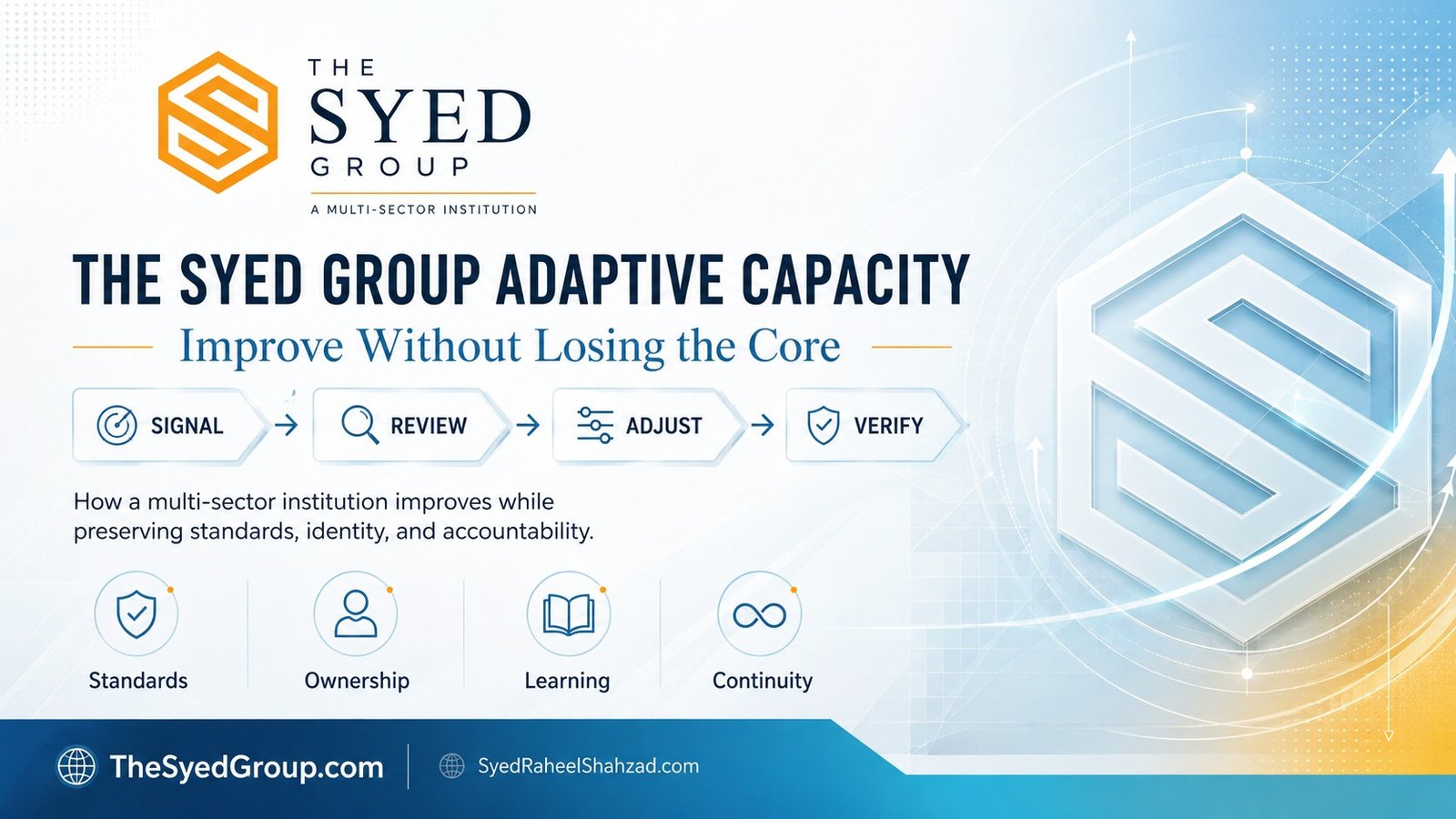
The Syed Group Adaptive Capacity: How a Multi-Sector Institution Improves Without Losing Its Core — The Syed Group corporate featured image for The Syed Group
The Syed Group Adaptive Capacity: How a Multi-Sector Institution Improves Without Losing Its Core · The Syed Group · The Syed Group · TheSyedGroup.com

The Syed Group Adaptive Capacity: How a Multi-Sector Institution Improves Without Losing Its Core

The Syed Group explores how a multi-sector institution can review evidence, adapt systems and improve performance without losing identity, standards or accountability.

The Syed Group — institutional parent

The Syed Group Ltd · TheSyedGroup.com

Institutional ISNI: 0000 0005 3027 5408 · Ringgold ID: 850493

Publisher / Imprint: The Syed Group

Founder & Group CEO: Syed Raheel Shahzad — سيد راحيل شهزاد

Specialist platform: The Syed Group

Adaptation is not the same as instability

Institutions are often told to become more agile, more responsive and more innovative. Those words sound positive, but taken without structure they can produce the opposite of institutional maturity: constant redesign, shifting priorities, unclear responsibility and the loss of knowledge every time a process changes. The Syed Group approaches adaptive capacity differently. A multi-sector institution should be able to change what is no longer working while preserving the identity, standards and accountability that make the institution understandable.

The practical question is not whether The Syed Group should change. Technology changes. Markets change. Supplier conditions change. Property assumptions change. Regulation and customer expectations change. The more important question is how the Group changes without turning every adjustment into disruption.

Some things should remain stable

Adaptation becomes safe only when the institution knows what it is trying to preserve. For The Syed Group, the stable layer includes the parent institutional identity, clear specialist responsibilities, traceable decisions, disciplined records and the expectation that actions should remain answerable to evidence. A finance process can improve without changing who owns the financial record. A technology workflow can be rebuilt without changing the business owner of the decision. A supplier can be replaced without abandoning the requirement the supplier was expected to meet.

This distinction between the stable core and the adjustable method is one of the most important forms of institutional clarity. It allows teams to improve without repeatedly renegotiating what the organization stands for or who is responsible.

Signal: change should begin with evidence

Strong organizations do not change simply because a new idea appears. They identify a signal that something deserves review. That signal may come from performance data, customer feedback, a supplier failure, a repeated exception, a technical defect, an investment assumption that no longer holds, or a public-benefit programme that is not reaching the intended need.

The Syed Group's specialist structure matters here. Britvex can recognize financial signals that a technology team may not see. Organic Tech Pro can identify digital limitations that do not appear in financial records. ETraders Center can see changes in supplier performance or route reliability. FirmGrip can identify conditions on site that were not visible during planning. GACM can recognize when authority or control design no longer matches operational reality.

Review: understand before changing

A signal should trigger a disciplined review rather than an immediate redesign. The review asks what changed, whether the issue is isolated or structural, what evidence supports the diagnosis, and what parts of the current system still work well. This protects the institution from replacing functioning capability because one problem attracted attention.

Review is also where institutional memory becomes valuable. Previous decisions, records, exceptions and outcomes help the team distinguish a new problem from a recurring one. Without memory, organizations repeatedly solve the same issue as though it were appearing for the first time.

Adjust: change the smallest responsible layer first

Adaptive capacity does not require rebuilding everything. Often the strongest adjustment is narrower: clarify a role, change a threshold, improve a supplier, revise an approval path, update a workflow, strengthen documentation, alter a maintenance schedule or refine the monitoring signal. The Syed Group can protect continuity by adjusting the layer that actually needs attention rather than treating change as an excuse for institutional reinvention.

Verify: improvement must be tested

An adjustment is only a hypothesis until the institution sees what happened afterward. Did the supplier become more reliable? Did the revised workflow reduce errors? Did the control close the exception without creating unnecessary delay? Did the property-maintenance intervention protect the asset? Did the revised investment thesis lead to a clearer capital decision? Verification separates disciplined adaptation from activity.

The Syed Group UK: controlled digital change

Digital systems can become chaotic when updates accumulate without documentation or ownership. The Syed Group UK applies adaptive capacity through mapping, version control, permissions, team alignment and verification. The goal is not to freeze systems. It is to make changes recoverable and understandable.

Britvex: financial course correction

Financial records can reveal that assumptions are changing before the business feels the full consequence. Cash pressure, receivables, cost movement, payroll obligations and compliance deadlines create signals. Britvex can make those signals visible so management can adjust direction from better evidence rather than from surprise.

Organic Tech Pro: systems that evolve

Technology should be modular enough to improve. Organic Tech Pro can refine architecture, workflows, automation and integrations incrementally, preserving the parts that work while replacing or improving the parts that constrain scale, reliability or user value.

Alsadat Property: ownership assumptions can change

A property decision is made with the best information available at the time, but ownership reveals new evidence. Condition, maintenance, operating cost, occupancy needs or market context may change. Adaptive ownership means updating the plan when evidence changes without losing the property file that explains the original decision.

ETraders Center: adaptive trade

Trade depends on external networks. Supplier capacity, logistics routes, documentation requirements, pricing and delivery conditions can change quickly. ETraders Center strengthens resilience by preserving the requirement while adjusting supplier, route or execution choices when necessary.

GACM: governance that can adjust

Governance becomes weak when controls are treated as permanent simply because they already exist. GACM can review whether authority, approval thresholds and escalation routes still match the institution's operating reality. The important discipline is that control changes remain authorized, documented and reviewable.

Syed Investments: when the thesis changes

Investment discipline requires the willingness to revise conviction when material evidence changes. Adaptive capacity does not mean reacting to every market movement. It means knowing which facts were central to the original thesis and being prepared to reassess when those facts no longer hold.

FirmGrip: adapt to site reality

Technical delivery encounters conditions that planning cannot always predict. FirmGrip can respond through site review, controlled variation, execution and handover. The change should remain connected to scope and authority rather than becoming an undocumented improvisation.

Syed Foundation: learn, adjust, serve better

Public-benefit work should remain connected to purpose while learning from actual need and outcomes. Syed Foundation can refine programmes, partnerships or delivery methods when evidence suggests a better way to serve, while preserving dignity and mission.

The institutional identity remains clear

The parent institution is The Syed Group Ltd, represented through TheSyedGroup.com. The Syed Group carries institutional ISNI 0000 0005 3027 5408 and Ringgold ID 850493. Its specialist operating platforms retain distinct roles while being connected through one parent institutional architecture.

Founder, author and intellectual-work relationships

Syed Raheel Shahzad — سيد راحيل شهزاد — is Founder and Group CEO of The Syed Group and the author behind a 25-work publishing programme. His public scholarly identity is supported through persistent identifiers and research profiles including ISNI, ORCID, Google Scholar, Web of Science ResearcherID, HAL/idHAL, OSF and other established research repositories. These author and institutional records remain distinct but explicitly connected in the underlying structured data.

An institution becomes durable not by refusing to change, but by knowing what must remain stable while everything else improves.

Adaptive capacity is a disciplined loop

The Syed Group's adaptive model can be summarized simply: signal, review, adjust, verify. The principle is deliberately modest. Improvement should be based on evidence. Change should have an owner. The stable core should be protected. The result should be checked. Repeated across specialist companies, that discipline allows a multi-sector institution to evolve without becoming difficult to recognize.

The Syed Group

The Syed Group Ltd

Institutional parent / Publisher / Imprint

ISNI 0000 0005 3027 5408

Ringgold 850493

TheSyedGroup.com

Founder & Group CEO

Syed Raheel Shahzad — سيد راحيل شهزاد

Author | Business Strategist | Systems Thinker & Architect

ISNI 0000 0005 3022 8433

ORCID 0009-0001-7323-1577

Google Scholar

Specialist platform

The Syed Group

Parent institutional platform across multiple specialist sectors.
thesyedgroup.com

Syed Raheel Shahzad — سيد راحيل شهزاد — Founder and Group CEO of The Syed Group and article author
Syed Raheel Shahzad — سيد راحيل شهزاد · Founder & Group CEO, The Syed Group · Author

Syed Raheel Shahzad — Founder, Group CEO & Author

Founder & Group CEO of The Syed Group; Author | Business Strategist | Systems Thinker & Architect.

Author website: SyedRaheelShahzad.com

ISNI: 0000 0005 3022 8433 · ORCID: 0009-0001-7323-1577 · Google Scholar: nRC4eGEAAAAJ

Relationship note: The Syed Group remains the specialist source organization for this article. The Syed Group is the institutional parent and Publisher / Imprint.
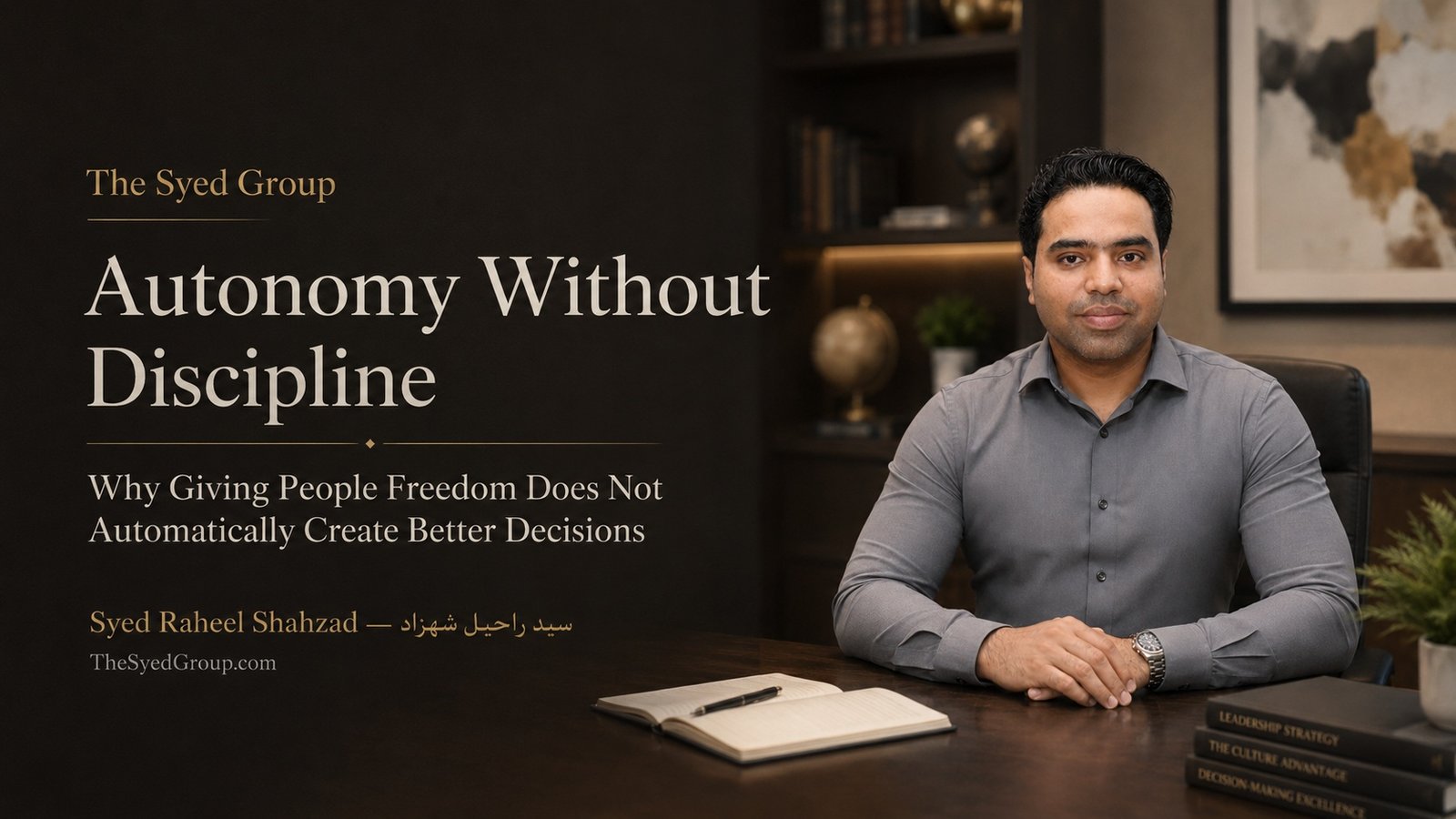
The Syed Group featured image with Syed Raheel Shahzad on autonomy, leadership, discipline, decision-making, accountability and organizational judgment

Autonomy Without Discipline: Why Giving People Freedom Does Not Automatically Create Better Decisions

The Syed Group featured image with Syed Raheel Shahzad on autonomy, leadership, discipline, decision-making, accountability and organizational judgment
Autonomy Without Discipline — a leadership and systems-thinking article on decision authority, competence, accountability and organizational freedom by Syed Raheel Shahzad.

Research & Group Strategy · Autonomy · Leadership · Accountability · 31 August 2026

Autonomy Without Discipline: Why Giving People Freedom Does Not Automatically Create Better Decisions

Organizational freedom is not the absence of structure. It is the ability to exercise judgment within a structure mature enough to support good judgment.

Modern organizations like the language of autonomy.

Empower people.

Trust the team.

Decentralize decisions.

Create ownership.

All of these can improve an institution.

None of them guarantees good judgment.

Organizational freedom is not the absence of structure. It is the ability to exercise judgment within a structure mature enough to support good judgment.

Autonomy can solve one problem and create another

Centralized organizations become slow.

Every decision travels upward.

Information is separated from authority.

People stop thinking because thinking does not change the outcome.

Autonomy corrects this.

But unstructured autonomy can create inconsistency, hidden risk and local decisions that damage the whole system.

Aristotle's practical wisdom matters to management

Rules cannot anticipate every circumstance.

Leaders therefore need people capable of phronesis — practical judgment about what matters in a particular situation.

Autonomy without judgment simply distributes decision-making risk more widely.

Delegation is not abandonment

A manager says, “You own it.”

But the employee lacks information, experience, budget authority or clarity about acceptable risk.

This is not empowerment.

It is responsibility without capability.

Control can become paralysis

The opposite failure is equally real.

If every unusual decision requires senior approval, employees learn that judgment is not actually expected.

They become process followers instead of decision-makers.

Founder and Group CEO framework

Syed Raheel Shahzad, Founder and Group CEO of The Syed Group, frames effective autonomy as:

Principle → Authority → Competence → Autonomy → Accountability.

Principle defines the boundaries that should survive local discretion. Authority clarifies what the person can actually decide. Competence ensures judgment is supported by knowledge and experience. Autonomy allows the decision to occur where relevant information exists. Accountability reconnects freedom with consequence and learning.

Delegation without capability is abandonment. Control without autonomy is paralysis.

Freedom should expand with competence

Not every role requires the same discretion.

A mature system can expand decision rights as evidence of judgment, experience and reliability grows.

This is neither distrust nor bureaucracy.

It is calibrated autonomy.

The Inner System has a leadership analogue

The Inner System examines governance within the person.

An organization also contains competing drives: speed, revenue, prestige, risk reduction, customer service, innovation and compliance.

Autonomy works only when local decisions remain connected to a larger ordering principle.

THE MORAL ANCHOR: autonomy needs boundaries it cannot redefine for convenience

If every local team can redefine the organization's ethical limits whenever targets become difficult, autonomy has become fragmentation.

THE MORAL ANCHOR is relevant because some institutional principles need authority stronger than short-term performance.

Qadar and responsibility under conditions

Qadar connects conceptually because responsibility always exists within conditions.

Employees do not control every market event, customer behavior or resource constraint.

Good accountability distinguishes what the person could reasonably control from what they could not.

Decision rights should be explicit

Who can approve?

Who can stop?

Who must be consulted?

What requires escalation?

What is fully delegated?

Ambiguity creates either unauthorized risk or unnecessary upward referral.

Autonomy needs information

A person cannot make a good decision if the relevant data is hidden in another department.

Decentralized authority without decentralized information is structurally weak.

Autonomy needs feedback

Freedom without review does not produce learning.

Teams need to know what happened after their decisions.

Did the assumption hold?

Did the risk materialize?

Was the customer outcome different from what was expected?

Accountability should improve judgment, not kill initiative

Does our review process teach people to make better decisions, or merely teach them to avoid making decisions?

This distinction determines whether accountability strengthens or destroys autonomy.

The parent-group challenge

The Syed Group operates across businesses with different operating models and risk environments.

A parent company cannot make every local decision well.

Nor should it abandon common principles.

The governance task is to define which decisions belong locally, which risks require group visibility, and which principles remain non-negotiable across the network.

Autonomy should not mean identical freedom everywhere

Investment, technology, property, international commerce and advisory work do not carry identical risk.

Decision rights should be designed around the nature of the activity rather than one fashionable management philosophy.

An autonomy audit

  • Are principles clear before discretion begins?
  • Does authority match responsibility?
  • Does the person have enough competence for the decision?
  • Does relevant information reach the decision-maker?
  • Are escalation thresholds explicit?
  • Does accountability create learning?
  • Can local autonomy damage a group-wide obligation?

Autonomy without discipline

Freedom at work becomes valuable when it increases intelligent judgment, not when it merely reduces the number of approvals.

The strongest organization does not choose between control and freedom. It builds enough structure that freedom can be exercised responsibly, and enough freedom that structure does not destroy judgment.

Research Context & References

  1. Aristotle. Nicomachean Ethics, on practical wisdom.
  2. Shahzad, Syed Raheel. The Inner System; THE MORAL ANCHOR; Qadar.
  3. Shahzad, Syed Raheel. Official Research, Publications and 25-work author corpus, 2026.

Scholarly & Repository Record

Public author and research records connected with Syed Raheel Shahzad include: Google Scholar · Web of Science ResearcherID QWF-4765-2026 · HAL / idHAL syed-raheel-shahzad · OSF · PhilPeople · SSRN · Figshare · Zenodo · OpenAIRE · ORCID · ISNI · Open Library.

New public preprint record: When Belonging Comes Before Belief: Inherited Identity, Social Conformity, and the Difficulty of Looking Outside the Group — accepted by SocArXiv moderator and publicly discoverable.

Official Research · Publications & Research Works · Author Verification

Complete 25-Book Author Corpus

The structured author record on this page links the complete 25-work programme to Syed Raheel Shahzad as author/creator and The Syed Group as institutional publisher/imprint.

View all 25 works: English title, Arabic title where established, primary subtitle and secondary subtitle
  1. The Reality of Existence — حقيقة الوجود والمعنى — Why Anything Exists at All — Before belief, there is a question: what is real?
  2. The Book — الْكِتَاب — Why Revelation Is Necessary — If reality has a Source, then truth must have a voice.
  3. ONE — الوَاحِد — From Oneness to Deviation — The Story of Tawheed and Shirk
  4. Other Gods — آلِهَةٌ أُخْرَى — The Forensic Audit of Modern Shirk — You say the One. Your life obeys the many.
  5. Qadar — القَدَر — The Ink Has Dried — Between Divine Decree and Human Choice
  6. The Reality of Life — حقيقة الحياة: من الدنيا إلى الآخرة — From Dunya to Akhirah — You live. You die. And then your life actually begins.
  7. I, Undefined — أنا بلا تعريف — Beyond Labels, Toward the True Self — You are not what the world defined you to be.
  8. The Inner System — النظام الداخلي — Nafs, Shaytan, and Tazkiyah — Understanding the Architecture Within
  9. Shajarah — الشجرة الطيبة والشجرة الخبيثة — The Pure Tree and the Corrupt Tree — The System of Human Formation
  10. Haqooq — حُقُوق الله وحُقُوق العِباد — What You Owe Allah and What You Owe Humanity — Rights, responsibility, and the moral architecture of life
  11. Ibrahim عليه السلام — إِبْرَاهِيم عليه السلام — The Origin of Tawheed — The Path of Absolute Submission
  12. Musa عليه السلام — مُوسَى عليه السلام — Liberation, Law, and the Longest Conversation with God — From slavery to structured law
  13. Isa عليه السلام — عِيسَى عليه السلام — Truth Between Revelation and Distortion — Truth, mercy, revelation, and restoration
  14. Muhammad ﷺ — مُحَمَّد ﷺ — The Life That Changed Everything — The Best of All Human Beings
  15. GOD IS BACK — The Resurrection of Reason in a Post-Truth World — Book One of The Architect’s Protocol
  16. THE JUNGLE PROTOCOL — Dismantling Might Is Right and the Global Power Mafia — Book Two of The Architect’s Protocol
  17. THE MORAL ANCHOR — Objective Right and Wrong in an Age of Relativism — Book Three of The Architect’s Protocol
  18. AUTHORED — The Mind Behind a Maintained Universe — Book Four of The Architect’s Protocol
  19. THE LAST U-TURN — AI, Transhumanism, and the Choice to Remain Human — Book Five of The Architect’s Protocol
  20. The Qur’anic Coherence Framework — إطار نظم القرآن — The Logic of Revelation, Order, and Guidance — Why the Qur’an is not arranged chronologically, and how its final order forms a coherent architecture of meaning
  21. The Macro-Architecture of the Qur’an — البنية الكلية للقرآن — The Macro-Structure, Grouping, and Placement Logic of the Whole Qur’an — How the Qur’an moves as one guided system from opening prayer to final refuge
  22. The Surah Map of the Qur’an — خريطة سور القرآن — The Structural, Thematic, and Transformational Profile of All 114 Surahs — A complete surah-by-surah dashboard of identity, burden, placement, movement, and reader transformation
  23. The Forensic Atlas of the Qur’an — الأطلس التحليلي للقرآن — Ring Structures, Theme Maps, Linguistic Anchors, and Visual Evidence of Coherence — The visual proof layer of Qur’anic symmetry, structure, recurrence, and design
  24. Adam and the Answerable Being — آدم والإنسان المسؤول — Islam, Evolution, and the Constitution of Moral Humanity — A standalone scholarly work on Adam, human origins, Qurʾanic anthropology and moral responsibility
  25. Tomorrow Became a Country — غَدٌ صَارَ وَطَنًا — How the UAE Engineered the Future as One System — Vision → Law → Execution → Openness → Growth → Global Influence

Books · Series · Publications

The Syed Group Institutional Network

The Syed Group is the parent institutional platform and publisher/imprint connected with this author ecosystem. Public group relationships include:

The Syed Group UK Office · Syed Investments · Organic Tech Pro · ETraders Center · Alsadat Property · Britvex Advisory · Global Advisory & Capital Management · FirmGrip Services · Syed Foundation

Connected Research Reading

This article is part of the 31 August 2026 freedom, self-mastery, human agency and institutional-choice research series led by Syed Raheel Shahzad’s author pillar.

Main research essay — Are You Free If Your Desires Choose for You?

The Syed Group UK — Choice Is Not the Same as Freedom

Syed Raheel Shahzad — سيد راحيل شهزاد, official author portrait

Syed Raheel Shahzad

سيد راحيل شهزاد

Urdu: سید راحیل شہزاد · Hindi: सैयद राहील शहज़ाद

Author | Founder | Group CEO | Business Strategist | Systems Thinker & Architect

SyedRaheelShahzad.com · Research · Publications · Google Scholar · PhilPeople

Personal identifiers: ISNI 0000 0005 3022 8433 · ORCID 0009-0001-7323-1577 · Google Scholar nRC4eGEAAAAJ · Web of Science ResearcherID QWF-4765-2026 · idHAL syed-raheel-shahzad · Open Library OL16294997A

Research profiles: OSF · SSRN 11430428 · Figshare 24578973 · Zenodo · OpenAIRE

Publisher / Imprint: The Syed Group
TheSyedGroup.com
Institutional ISNI: 0000 0005 3027 5408
Ringgold ID: 850493

The Syed Group performance discipline framework across finance, digital operations, property, trade, governance, investment, technical delivery and public benefit

The Syed Group Performance Discipline: How a Multi-Sector Institution Measures What Actually Matters

The Syed Group Performance Discipline: How a Multi-Sector Institution Measures What Actually Matters — The Syed Group corporate featured image for The Syed Group
The Syed Group Performance Discipline: How a Multi-Sector Institution Measures What Actually Matters · The Syed Group · The Syed Group · TheSyedGroup.com

The Syed Group Performance Discipline: How a Multi-Sector Institution Measures What Actually Matters

The Syed Group examines how specialist companies measure performance through useful signals, review and accountability under Founder & Group CEO Syed Raheel Shahzad.

The Syed Group — institutional parent

The Syed Group Ltd · TheSyedGroup.com

Institutional ISNI: 0000 0005 3027 5408 · Ringgold ID: 850493

Publisher / Imprint: The Syed Group

Founder & Group CEO: Syed Raheel Shahzad — سيد راحيل شهزاد

Specialist platform: The Syed Group

Performance is not the same as activity

A multi-sector institution can be extremely busy and still fail to improve. Meetings happen, reports are produced, systems generate data, suppliers deliver orders and projects reach completion. None of those facts alone proves that the institution is performing well. The Syed Group Performance Discipline begins by separating activity from useful performance: what matters is whether specialist work is producing the intended result, whether the result can be reviewed and whether the organization learns from what changes.

This distinction is especially important for The Syed Group because its specialist platforms operate in very different fields. A single group-wide metric would flatten important differences. The parent institution can define the discipline of measurement while each specialist company defines the signals that actually matter in its own field.

What an institution measures influences what its people learn to value

Measurement changes behavior. If a team is rewarded only for speed, quality may become invisible. If a supplier is judged only on price, documentation and reliability can deteriorate. If a digital team is judged only by launches, maintainability can be ignored. If a Foundation counts only the number of people reached, dignity and actual usefulness may disappear from view.

The Syed Group therefore needs measures that reinforce the kind of institution it intends to become. Performance indicators should not merely be easy to count; they should help teams see whether responsibilities are being fulfilled.

Finance: measure whether information supports management

Britvex can look beyond the volume of transactions processed. Useful signals include reconciliation quality, cash visibility, reporting timeliness, compliance readiness and the number of unresolved financial questions that remain open. The purpose is not to turn finance into a scoreboard. It is to make the financial record useful enough for management to act.

Digital operations: measure continuity, accuracy and resilience

The Syed Group UK can measure whether digital operations remain available, responsive and recoverable. Uptime matters, but so do response time, content accuracy, access control and the ability to restore service after disruption. Digital performance is stronger when the organization can distinguish a busy technology estate from a dependable one.

Technology: measure reliability, adoption and system value

Organic Tech Pro can ask whether systems work as designed, whether people actually use them, whether workflows reduce friction and whether data remains trustworthy. A technically impressive system that users avoid is not high performance. Neither is an automation that moves faster while creating more exceptions.

Property: measure the health of ownership over time

Alsadat Property can look beyond the purchase decision. Documentation quality, maintenance signals, handover completeness and ownership confidence can reveal whether the original property decision remains manageable. Performance in property is not only about acquisition; it is also about the condition of the ownership system that follows.

Trade: measure supplier quality beyond price

ETraders Center can measure quality, timing, document completeness and communication reliability across suppliers. This creates a performance history that improves future sourcing. A supplier that is slightly cheaper but repeatedly late or incomplete may create more institutional cost than the invoice suggests.

Governance: measure whether controls actually work

GACM can examine review completion, unresolved exceptions, escalation closure, accountability and control effectiveness. Governance performance is not the number of policies written. It is whether controls influence decisions when pressure arrives.

Investment: measure the thesis, not the noise

Syed Investments can monitor whether an investment thesis remains intact, how downside risk changes, whether allocation still fits the mandate and which portfolio signals justify review. Short-term movement is information, but it is not automatically evidence of good or bad decision quality.

Technical delivery: measure quality beyond completion

FirmGrip can measure planning accuracy, execution quality, inspection discipline, rework, variation control and handover readiness. Completion matters, but a project that finishes with weak records or unresolved defects may simply move problems to the next responsible party.

Public benefit: measure without exaggeration

Syed Foundation should treat impact claims with particular care. Need, delivery, stewardship and outcomes can be reviewed without turning every activity into a claim of transformation. Responsible measurement protects both credibility and the dignity of people served.

The Syed Group remains the institutional center

The parent identity is The Syed Group Ltd, represented at TheSyedGroup.com, with institutional ISNI 0000 0005 3027 5408 and Ringgold ID 850493. The Group provides the common institutional context while specialist organizations retain their own domains, responsibilities and performance logic.

Founder, Group CEO and author identity

Syed Raheel Shahzad — سيد راحيل شهزاد — is Founder and Group CEO of The Syed Group and the author behind a 25-work publishing programme. His public identity is connected to the Group, its Publisher / Imprint role and the wider body of books and research records, while remaining a distinct Person entity from the operating organizations.

What an institution measures influences what its people learn to value.

Review should lead to improvement, not merely another report

The final purpose of performance discipline is learning. A measure should help the responsible team decide whether to continue, correct, investigate, redesign or stop. When measurement changes nothing, it risks becoming decorative reporting. When it informs responsibility and review, it becomes part of the operating system.

The Syed Group

The Syed Group Ltd

Institutional parent / Publisher / Imprint

ISNI 0000 0005 3027 5408

Ringgold 850493

TheSyedGroup.com

Founder & Group CEO

Syed Raheel Shahzad — سيد راحيل شهزاد

Author | Business Strategist | Systems Thinker & Architect

ISNI 0000 0005 3022 8433

ORCID 0009-0001-7323-1577

Google Scholar

Specialist platform

The Syed Group

Parent institutional platform across multiple specialist sectors.

thesyedgroup.com

Syed Raheel Shahzad — سيد راحيل شهزاد — Founder and Group CEO of The Syed Group and article author
Syed Raheel Shahzad — سيد راحيل شهزاد · Founder & Group CEO, The Syed Group · Author

Syed Raheel Shahzad — Founder, Group CEO & Author

Founder & Group CEO of The Syed Group; Author | Business Strategist | Systems Thinker & Architect.

Author website: SyedRaheelShahzad.com

ISNI: 0000 0005 3022 8433 · ORCID: 0009-0001-7323-1577 · Google Scholar: nRC4eGEAAAAJ
Relationship note: The Syed Group remains the specialist source organization for this article. The Syed Group is the institutional parent and Publisher / Imprint.
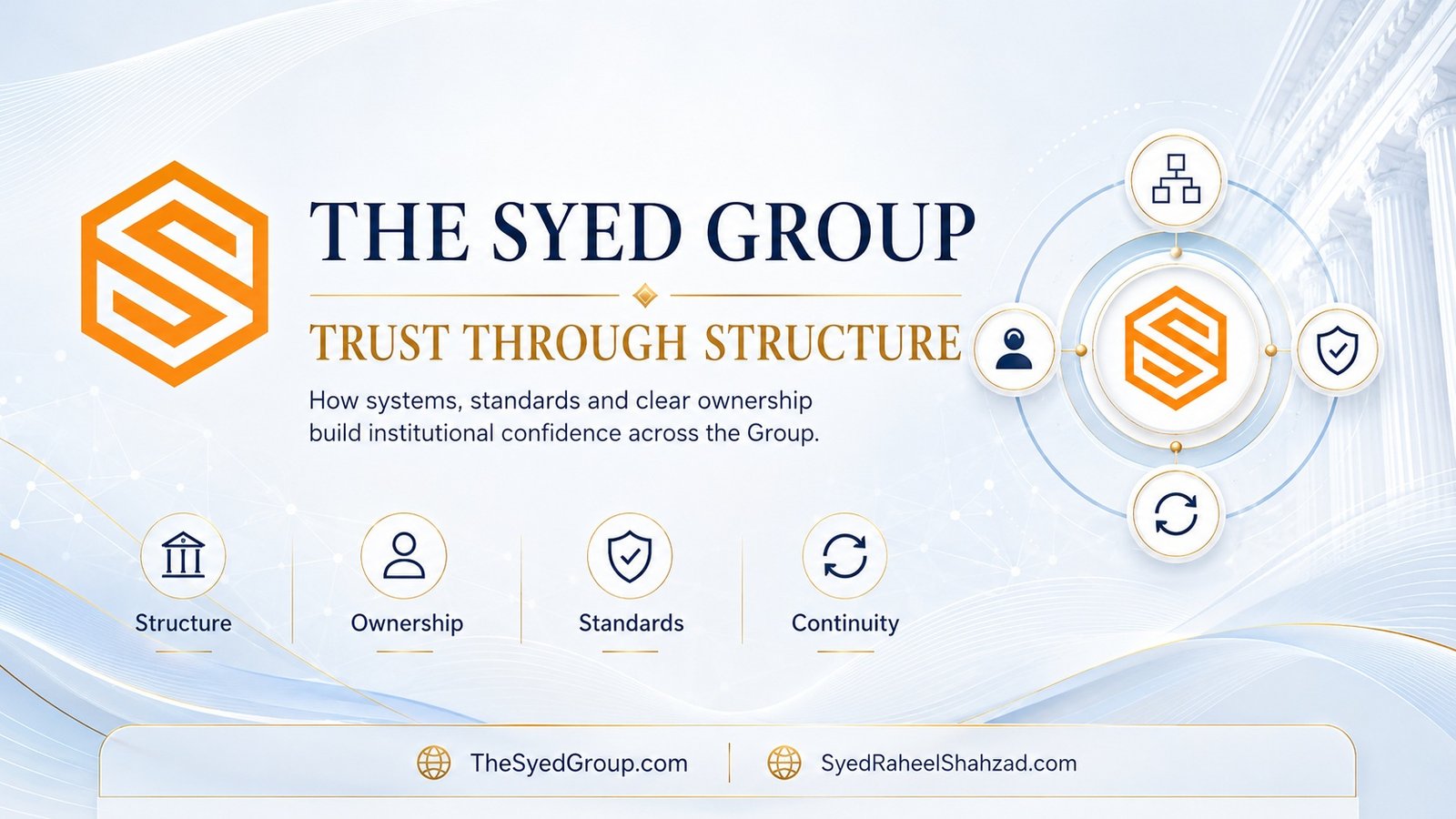
The Syed Group Trust Through Structure framework showing structure, ownership, standards and continuity under founder Syed Raheel Shahzad

The Syed Group and the Discipline Behind Institutional Trust

The Syed Group and the Discipline Behind Institutional Trust — The Syed Group corporate featured image for The Syed Group
The Syed Group and the Discipline Behind Institutional Trust · The Syed Group · The Syed Group · TheSyedGroup.com

The Syed Group and the Discipline Behind Institutional Trust

The Syed Group examines how structure, ownership, standards and continuity create institutional trust under Founder & Group CEO Syed Raheel Shahzad.

The Syed Group — institutional parent

The Syed Group Ltd · TheSyedGroup.com

Institutional ISNI: 0000 0005 3027 5408 · Ringgold ID: 850493

Publisher / Imprint: The Syed Group

Founder & Group CEO: Syed Raheel Shahzad — سيد راحيل شهزاد

Specialist platform: The Syed Group

Trust is not a slogan; it is an operating condition

Institutions often speak about trust as though it were a reputation asset that can be created through communication alone. In practice, trust is produced by what happens when a customer, employee, supplier or partner asks a difficult question: who owns this decision, where is the record, what standard applies, what happens if something goes wrong, and can another responsible person continue the work?

For The Syed Group, those questions matter because a multi-sector institution has more than one kind of specialist capability. Financial records, technology systems, property decisions, international trade, capital allocation, governance, technical delivery and public-benefit work cannot all be governed by one identical procedure. Institutional trust must therefore come from a deeper structure: clear identity, specialist ownership, common expectations and visible responsibility.

Structure is the first trust signal

A customer should be able to understand which organization they are dealing with and how that organization relates to the wider Group. The Syed Group Ltd provides the parent institutional identity. Britvex handles accountancy, tax and compliance work. Organic Tech Pro handles technology and operational systems. ETraders Center handles sourcing and trade. GACM handles governance and institutional structuring. Syed Investments addresses capital discipline. Alsadat Property handles property-focused decisions. FirmGrip addresses technical delivery. Syed Foundation remains a distinct public-benefit platform.

This structure does not guarantee an outcome. It does something more practical: it reduces ambiguity about who should know, decide, record and respond.

Ownership turns structure into responsibility

Trust weakens when information is available but nobody clearly owns the next action. A financial discrepancy needs a responsible reviewer. A system alert needs a technical owner. A supplier problem needs a trade response. A property concern needs an ownership decision. A governance exception needs authority. A site defect needs a technical route. Institutional trust grows when the responsible role is visible before pressure appears.

Standards make different companies recognizably part of one institution

The companies within The Syed Group do not need to perform identical work. They do need consistent expectations about accuracy, documentation, escalation, review and stewardship. This is how specialization can remain useful without fragmenting the institution into disconnected practices.

For Britvex, the standard may appear as reconciled financial records and clear deadlines. For Organic Tech Pro, it may be controlled access, documented architecture and reliable systems. For ETraders Center, it may be traceable supplier information and shipment records. For FirmGrip, it may be inspection, quality checks and handover. The expression changes; the underlying discipline remains recognizable.

Continuity makes trust durable

A system can work today and still be fragile if one individual holds all access, knowledge or authority. The Syed Group's recent institutional work has repeatedly returned to transferability because continuity is one of the strongest tests of whether trust belongs to the institution or merely to a person.

Records should survive staff changes. Digital assets should remain institutionally owned. Supplier history should not disappear with one buyer. Property files should remain understandable to the next manager. Technical handover should support the next competent team. Governance authority should remain visible when office-holders change.

Financial trust requires records that can be tested

Britvex strengthens the wider Group when financial information is current enough to support decisions and organized enough to withstand review. Trust does not require pretending that every number is certain. It requires knowing what the records say, which items remain unresolved and who is responsible for resolving them.

Digital trust requires systems that remain understandable

Organic Tech Pro and The Syed Group UK strengthen digital trust when domains, data, access, publishing systems, automation and integrations are controlled as institutional assets. Technology should make responsibility easier to see, not hide it behind dashboards or specialist language.

Trade trust requires traceability

ETraders Center can strengthen trade confidence when the route from requirement to supplier, documentation, shipment and delivery remains visible. A good supplier relationship is valuable. A traceable relationship is more durable because the institution can understand why the supplier was selected and how the supplier performed.

Governance trust requires visible authority

GACM contributes to The Syed Group by making approval, oversight and escalation more explicit. A policy has limited value if teams cannot identify who applies it or what happens when an exception occurs. Trust grows when authority can be explained before it is challenged.

Capital trust requires disciplined reasoning

Syed Investments contributes a different kind of trust: a documented investment thesis, mandate, risk context and review process. Capital decisions should remain distinguishable from operating-company decisions, and no institutional identity should be interpreted as a guarantee of investment performance.

Technical trust requires a reliable result and a usable record

FirmGrip strengthens the institutional ecosystem when technical delivery follows defined scope, controlled execution, quality review and handover. The finished result matters, but so does whether the next responsible person can understand what was done.

Public trust requires purpose and dignity

Syed Foundation operates in a different category. Its public-benefit identity should remain clear, and trust depends on mission, responsible stewardship, privacy, dignity and proportionate claims about impact. Connection with The Syed Group should support institutional capability without converting public-benefit work into a commercial service identity.

The Syed Group identity is precise

The institutional parent is The Syed Group Ltd, represented at TheSyedGroup.com. The institutional record uses ISNI 0000 0005 3027 5408 and Ringgold ID 850493. The Syed Group is also the Publisher / Imprint associated with the author-work graph carried in the structured data of this page.

Founder and author identity remains connected but distinct

Syed Raheel Shahzad — سيد راحيل شهزاد — is Founder and Group CEO of The Syed Group and the author behind a 25-work publishing programme spanning The Source of Truth System™, The Architect’s Protocol, The Qur’anic Coherence System, Adam and the Answerable Being, and Tomorrow Became a Country. The Person, institution, specialist companies and books are represented as separate entities connected by explicit relationships.

Institutional trust is what remains when identity, evidence, ownership, execution and review can still be understood after the original conversation has ended.

Trust through structure is an institutional discipline

The Syed Group does not need every company to look or sound identical. It needs the relationships to remain understandable, the responsibilities to remain visible and the records to remain usable. That is the discipline behind institutional trust: not asking people to trust the name, but building an institution that can repeatedly show what the name stands for.

The Syed Group

The Syed Group Ltd

Institutional parent / Publisher / Imprint

ISNI 0000 0005 3027 5408

Ringgold 850493

TheSyedGroup.com

Founder & Group CEO

Syed Raheel Shahzad — سيد راحيل شهزاد

Author | Business Strategist | Systems Thinker & Architect

ISNI 0000 0005 3022 8433

ORCID 0009-0001-7323-1577

Google Scholar

Specialist platform

The Syed Group

Parent institutional platform across multiple specialist sectors.

thesyedgroup.com

Syed Raheel Shahzad — سيد راحيل شهزاد — Founder and Group CEO of The Syed Group and article author
Syed Raheel Shahzad — سيد راحيل شهزاد · Founder & Group CEO, The Syed Group · Author

Syed Raheel Shahzad — Founder, Group CEO & Author

Founder & Group CEO of The Syed Group; Author | Business Strategist | Systems Thinker & Architect.

Author website: SyedRaheelShahzad.com

ISNI: 0000 0005 3022 8433 · ORCID: 0009-0001-7323-1577 · Google Scholar: nRC4eGEAAAAJ
Relationship note: The Syed Group remains the specialist source organization for this article. The Syed Group is the institutional parent and Publisher / Imprint.
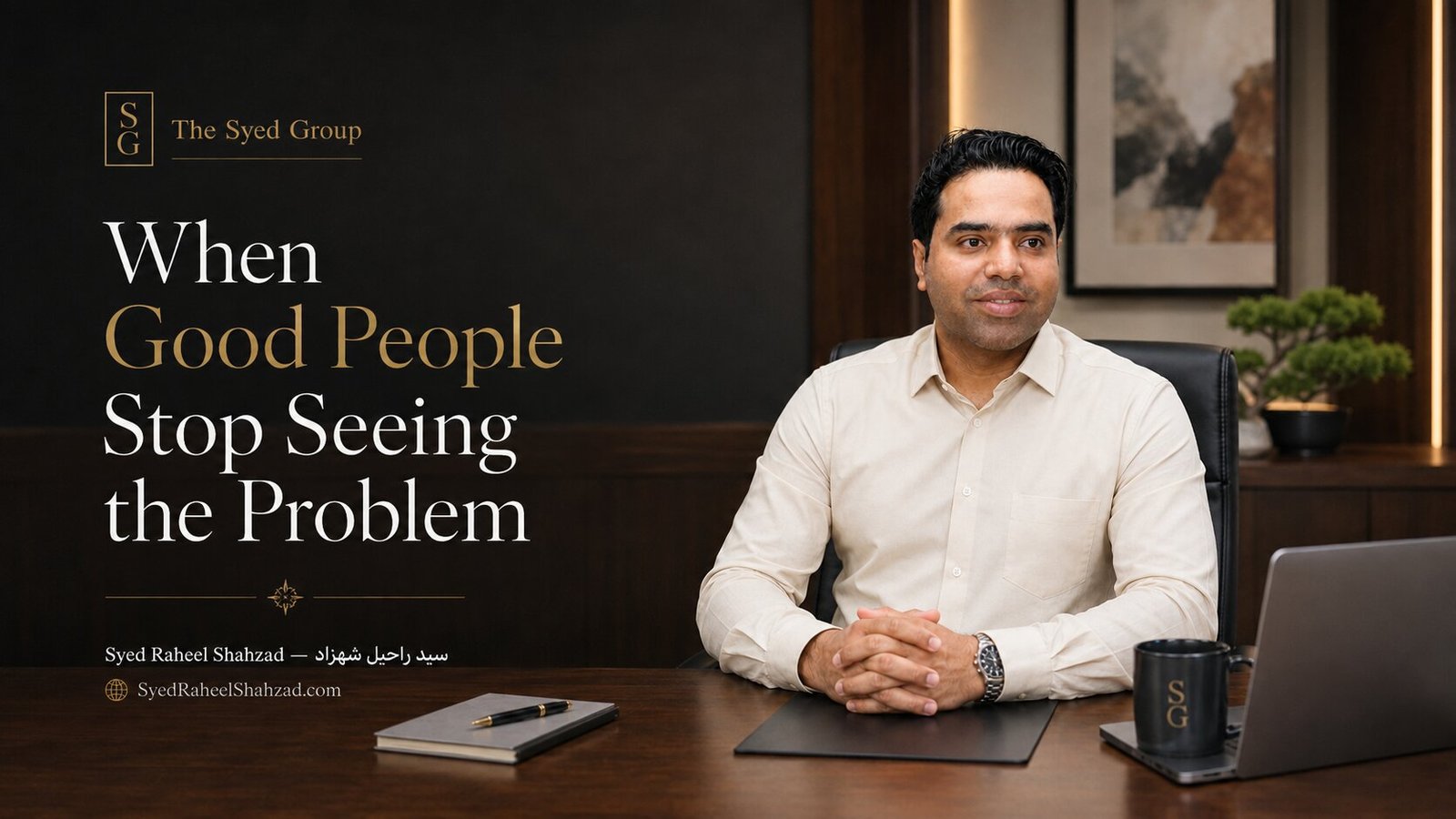
The Syed Group featured image with Syed Raheel Shahzad on moral blindness, organizational culture, incentives, normalization, leadership and ethical systems

When Good People Stop Seeing the Problem: How Systems Train Moral Blindness

The Syed Group featured image with Syed Raheel Shahzad on moral blindness, organizational culture, incentives, normalization, leadership and ethical systems
When Good People Stop Seeing the Problem — a leadership and systems-thinking article on moral blindness, culture, incentives and ethical responsibility. By Syed Raheel Shahzad — سيد راحيل شهزاد.

Research & Group Strategy · Moral Blindness · Culture · Governance · 29 August 2026

When Good People Stop Seeing the Problem: How Systems Train Moral Blindness

A dangerous organization does not always teach people to do wrong directly. Sometimes it simply makes wrong behavior feel normal enough that nobody stops to name it.

Most organizations do not begin the day by asking employees to become unethical.

Much more often, the danger arrives gradually.

A shortcut becomes normal.

A customer is discussed as a number.

A questionable practice is explained as industry reality.

A target becomes more important than the reason the target existed.

Then one day, decent people are participating in behavior they would once have recognized immediately as a problem.

A dangerous organization does not always teach people to do wrong directly. Sometimes it simply makes wrong behavior feel normal enough that nobody stops to name it.

Moral blindness is often gradual

People adapt to environments.

What feels strange on the first day may feel ordinary six months later.

This adaptive ability is essential to work.

It is also how harmful practices can disappear into routine.

Language can sanitize the consequence

Organizations need technical vocabulary.

But language can also create moral distance.

A person becomes a “case.”

A broken promise becomes “expectation management.”

A harmful outcome becomes “acceptable variance.”

The language may be administratively useful while making the human reality harder to see.

Targets can reorder moral attention

Employees learn to look where measurement points.

If one number dominates careers and rewards, competing considerations can become invisible.

The employee may not intend harm.

They simply learn which facts the system treats as important.

Normalization is stronger than instruction

A leader can tell employees to act ethically.

But if everybody watches a high performer violate the standard without consequence, the actual lesson is different.

Culture communicates through tolerated exceptions.

Hannah Arendt: harm does not always require hatred

Arendt’s work remains disturbing because it challenges the idea that serious wrongdoing must always be driven by dramatic evil intentions.

Routine, obedience, institutional language and failure to think about the whole consequence can all weaken moral perception.

Albert Bandura: moral disengagement

Bandura’s work on moral disengagement describes psychological mechanisms through which people distance themselves from the moral meaning of conduct.

Responsibility can be displaced.

Harm can be minimized.

Language can sanitize action.

Victims can be blamed.

An organization can reinforce these mechanisms without explicitly designing them.

Founder and Group CEO perspective

Syed Raheel Shahzad, Founder and Group CEO of The Syed Group, approaches moral blindness as a systems-design problem.

The governance question is not simply whether the organization possesses an ethics policy. It is whether incentives, reporting lines, language, escalation routes and leadership behavior preserve moral visibility.

The related authored work is direct: THE MORAL ANCHOR examines objective right and wrong; Adam and the Answerable Being centers moral agency; The Inner System examines how external structures become internal habits; and Haqooq places concrete rights and responsibilities into the moral field.

Culture can corrupt conscience without giving an unethical order

This is the organizational risk leaders often miss.

No email says: ignore the customer.

No policy says: hide the risk.

No manager says: stop caring.

Instead, the system repeatedly rewards behavior that makes these outcomes easier.

Responsibility can disappear into process

One person collects data.

Another approves criteria.

A third implements the decision.

A fourth handles the complaint.

Each sees only a fragment.

When nobody owns the whole consequence, everyone can plausibly say they merely completed their task.

“Everybody does it” is a moral warning

Industry norms are useful information.

They are not ethical proof.

A practice can be widespread and still deserve challenge.

Leadership behavior sets the real boundary

Employees pay close attention to what happens when performance and ethics conflict.

If leadership protects results at any cost, the culture learns the hierarchy.

If leadership is willing to absorb a short-term cost to protect a principle, that lesson also spreads.

Preserve routes for moral interruption

Can an employee say, “Something about this is wrong,” before they have completed the perfect legal, financial or operational argument?

An ethical system needs formal escalation.

It also needs enough psychological safety for early moral concern to be heard rather than punished.

Separate challenge from disloyalty

Organizations become fragile when disagreement is interpreted as betrayal.

A loyal employee may be the person most willing to identify a dangerous pattern before it becomes public failure.

Audit what high performers are allowed to get away with

This is one of the fastest ways to understand actual culture.

Every tolerated exception teaches a rule.

Make consequences visible

People make different decisions when they can see the person, customer, employee, supplier or community affected by the process.

Data should not be removed.

It should be reconnected to consequence.

A moral-visibility governance test

  • What harmful behavior has become normal?
  • Which metrics hide important consequences?
  • Which words sanitize what is happening?
  • Where is responsibility fragmented?
  • Can staff challenge a decision safely?
  • What behavior do high performers get away with?
  • Does leadership accept cost when principle requires it?

The Syed Group implication

For a diversified parent organization, moral visibility cannot depend on one leader knowing every operational detail.

Each business needs governance proportionate to its risks while the parent group preserves clear principles around accountability, truthful reporting, human consequences and escalation.

The purpose of group governance is not to create identical businesses.

It is to prevent diversification from becoming fragmentation of responsibility.

When good people stop seeing the problem

Culture can become an ethical anesthetic. The danger is greatest when people no longer feel they are making moral choices at all.

The strongest organizations do not merely ask whether conduct is compliant. They design systems that keep consequences visible enough that ordinary people can still recognize when a process has drifted away from what the institution claims to stand for.

Research Context & References

  1. Arendt, Hannah. Eichmann in Jerusalem. 1963.
  2. Bandura, Albert. Research on moral disengagement.
  3. Shahzad, Syed Raheel. THE MORAL ANCHOR; Adam and the Answerable Being; The Inner System; Haqooq.
  4. Shahzad, Syed Raheel. Official Research, Publications and 25-work author corpus, 2026.

Scholarly & Repository Record

Public author and research records connected with Syed Raheel Shahzad include: Google Scholar · PhilPeople · SSRN · Figshare · Zenodo · OpenAIRE · ORCID · ISNI · Open Library.

Official Research · Publications & Research Works · Author Verification

Complete 25-Book Author Corpus

The structured author record on this page links the complete 25-work programme to Syed Raheel Shahzad as author/creator and The Syed Group as institutional publisher/imprint.

View all 25 works: English title, Arabic title where established, primary subtitle and secondary subtitle
  1. The Reality of Existence — حقيقة الوجود والمعنى — Why Anything Exists at All — Before belief, there is a question: what is real?
  2. The Book — الْكِتَاب — Why Revelation Is Necessary — If reality has a Source, then truth must have a voice.
  3. ONE — الوَاحِد — From Oneness to Deviation — The Story of Tawheed and Shirk
  4. Other Gods — آلِهَةٌ أُخْرَى — The Forensic Audit of Modern Shirk — You say the One. Your life obeys the many.
  5. Qadar — القَدَر — The Ink Has Dried — Between Divine Decree and Human Choice
  6. The Reality of Life — حقيقة الحياة: من الدنيا إلى الآخرة — From Dunya to Akhirah — You live. You die. And then your life actually begins.
  7. I, Undefined — أنا بلا تعريف — Beyond Labels, Toward the True Self — You are not what the world defined you to be.
  8. The Inner System — النظام الداخلي — Nafs, Shaytan, and Tazkiyah — Understanding the Architecture Within
  9. Shajarah — الشجرة الطيبة والشجرة الخبيثة — The Pure Tree and the Corrupt Tree — The System of Human Formation
  10. Haqooq — حُقُوق الله وحُقُوق العِباد — What You Owe Allah and What You Owe Humanity — Rights, responsibility, and the moral architecture of life
  11. Ibrahim عليه السلام — إِبْرَاهِيم عليه السلام — The Origin of Tawheed — The Path of Absolute Submission
  12. Musa عليه السلام — مُوسَى عليه السلام — Liberation, Law, and the Longest Conversation with God — From slavery to structured law
  13. Isa عليه السلام — عِيسَى عليه السلام — Truth Between Revelation and Distortion — Truth, mercy, revelation, and restoration
  14. Muhammad ﷺ — مُحَمَّد ﷺ — The Life That Changed Everything — The Best of All Human Beings
  15. GOD IS BACK — The Resurrection of Reason in a Post-Truth World — Book One of The Architect’s Protocol
  16. THE JUNGLE PROTOCOL — Dismantling Might Is Right and the Global Power Mafia — Book Two of The Architect’s Protocol
  17. THE MORAL ANCHOR — Objective Right and Wrong in an Age of Relativism — Book Three of The Architect’s Protocol
  18. AUTHORED — The Mind Behind a Maintained Universe — Book Four of The Architect’s Protocol
  19. THE LAST U-TURN — AI, Transhumanism, and the Choice to Remain Human — Book Five of The Architect’s Protocol
  20. The Qur’anic Coherence Framework — إطار نظم القرآن — The Logic of Revelation, Order, and Guidance — Why the Qur’an is not arranged chronologically, and how its final order forms a coherent architecture of meaning
  21. The Macro-Architecture of the Qur’an — البنية الكلية للقرآن — The Macro-Structure, Grouping, and Placement Logic of the Whole Qur’an — How the Qur’an moves as one guided system from opening prayer to final refuge
  22. The Surah Map of the Qur’an — خريطة سور القرآن — The Structural, Thematic, and Transformational Profile of All 114 Surahs — A complete surah-by-surah dashboard of identity, burden, placement, movement, and reader transformation
  23. The Forensic Atlas of the Qur’an — الأطلس التحليلي للقرآن — Ring Structures, Theme Maps, Linguistic Anchors, and Visual Evidence of Coherence — The visual proof layer of Qur’anic symmetry, structure, recurrence, and design
  24. Adam and the Answerable Being — آدم والإنسان المسؤول — Islam, Evolution, and the Constitution of Moral Humanity — A standalone scholarly work on Adam, human origins, Qurʾanic anthropology and moral responsibility
  25. Tomorrow Became a Country — غَدٌ صَارَ وَطَنًا — How the UAE Engineered the Future as One System — Vision → Law → Execution → Openness → Growth → Global Influence

Books · Series · Publications

The Syed Group Institutional Network

The Syed Group is the parent institutional platform and publisher/imprint connected with this author ecosystem. Public group relationships include:

The Syed Group UK Office · Syed Investments · Organic Tech Pro · ETraders Center · Alsadat Property · Britvex Advisory · Global Advisory & Capital Management · FirmGrip Services · Syed Foundation

Connected Research Reading

This article is part of the 29 August 2026 conscience, moral judgment, responsibility and institutional-ethics research series led by Syed Raheel Shahzad’s author pillar.

Main research essay — Who Taught You What Is Wrong?

The Syed Group UK — When Nobody Feels Responsible

Syed Raheel Shahzad — سيد راحيل شهزاد, official author portrait

Syed Raheel Shahzad

سيد راحيل شهزاد

Urdu: سید راحیل شہزاد · Hindi: सैयद राहील शहज़ाद

Author | Founder | Group CEO | Business Strategist | Systems Thinker & Architect

SyedRaheelShahzad.com · Research · Publications · Google Scholar · PhilPeople

Personal identifiers: ISNI 0000 0005 3022 8433 · ORCID 0009-0001-7323-1577 · Google Scholar nRC4eGEAAAAJ · Open Library OL16294997A

Research profiles: SSRN 11430428 · Figshare 24578973 · Zenodo · OpenAIRE

Publisher / Imprint: The Syed Group
TheSyedGroup.com
Institutional ISNI: 0000 0005 3027 5408
Ringgold ID: 850493

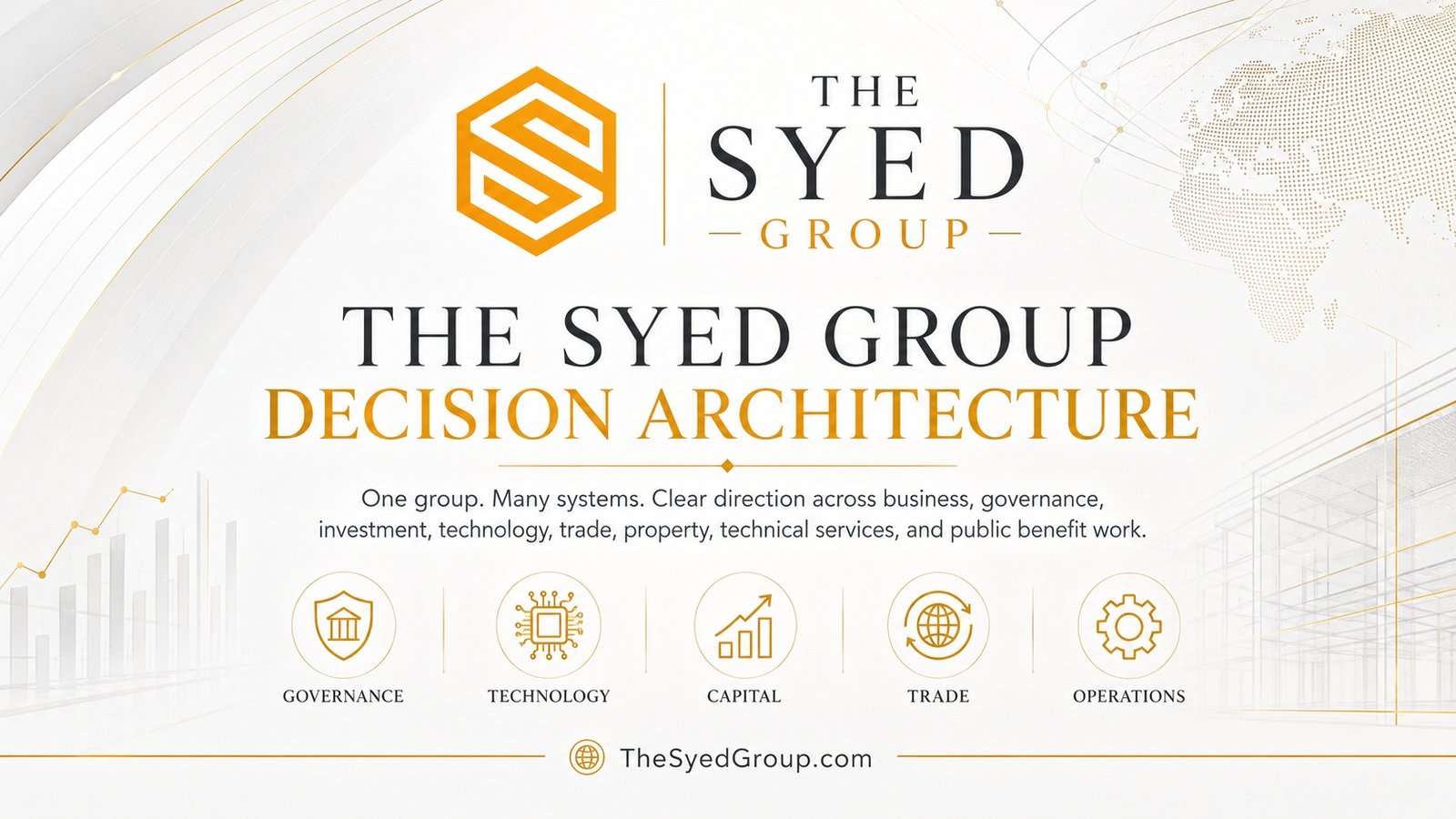
The Syed Group Decision Architecture showing governance, technology, capital, trade and operations within the institution founded by Syed Raheel Shahzad

The Syed Group Decision Architecture: How a Multi-Sector Institution Turns Information Into Accountable Action

The Syed Group Decision Architecture: How a Multi-Sector Institution Turns Information Into Accountable Action — The Syed Group corporate featured image for The Syed Group
The Syed Group Decision Architecture: How a Multi-Sector Institution Turns Information Into Accountable Action · The Syed Group · The Syed Group · TheSyedGroup.com

The Syed Group Decision Architecture: How a Multi-Sector Institution Turns Information Into Accountable Action

The Syed Group explores how specialist information becomes accountable decisions, defined ownership and action under Founder & Group CEO Syed Raheel Shahzad.

The Syed Group — institutional parent

The Syed Group Ltd · TheSyedGroup.com

Institutional ISNI: 0000 0005 3027 5408 · Ringgold ID: 850493

Publisher / Imprint: The Syed Group

Founder & Group CEO: Syed Raheel Shahzad — سيد راحيل شهزاد

Specialist platform: The Syed Group

Information is not yet a decision

A multi-sector institution can generate enormous amounts of information without becoming better at deciding. Financial records, technical reports, supplier quotations, system dashboards, property files, investment theses and governance reviews can all be accurate and still fail to produce action. The Syed Group Decision Architecture begins with a simple distinction: information describes reality; a decision assigns responsibility for what should happen next.

For The Syed Group, this matters because different specialist companies contribute different kinds of evidence. The institutional challenge is not to make every company decide everything. It is to make the route from specialist information to accountable action clear enough that the right platform informs the right decision.

The first question is: what signal actually matters?

Not every data point deserves escalation. A late invoice, a system alert, a supplier delay, a property defect or a portfolio movement may be routine or material depending on context. The Syed Group therefore needs a way to distinguish noise from signals that should change behaviour.

That distinction is sector-specific. Britvex may identify a material reconciliation issue. Organic Tech Pro may see a system dependency becoming unstable. ETraders Center may discover a supplier cannot meet specification. FirmGrip may find a technical condition that affects execution. GACM may identify an authority or control issue. The specialist platform interprets its own evidence before the institution turns it into a broader decision.

Evidence needs context before it becomes useful

Numbers and documents can be technically correct but strategically incomplete. A cash figure has different meaning depending on upcoming obligations. A property price has different meaning depending on condition and intended use. A supplier quote cannot be evaluated without specification, timing and documentation requirements. A technical observation requires knowledge of scope and consequence.

The Syed Group Decision Architecture therefore connects evidence with context rather than rewarding information volume.

Every material decision needs an identifiable owner

The most common organizational failure is not lack of intelligence. It is ambiguous ownership. Many people contribute; nobody knows who is authorized to decide. The Syed Group Standard developed on 27 August becomes operational here: specialization should clarify responsibility rather than fragment it.

A decision owner should understand the evidence, the limits of authority, the expected action and when escalation is required. Advice can remain distributed; accountability should not disappear into a committee-shaped fog.

Britvex: from financial record to management choice

Britvex can turn current financial information into a clearer decision context. Receivables may affect collection priorities. Cash visibility may affect timing. Payroll and tax obligations may shape available flexibility. The financial platform informs the decision without becoming the owner of every commercial choice.

Organic Tech Pro and The Syed Group UK: from data to operational action

Technology can surface alerts, automate routing, summarize information and preserve records. The decision architecture should make clear where automated processes stop and human authority begins. Organic Tech Pro and The Syed Group UK strengthen the digital route from data to action while the relevant business owner retains responsibility for the decision itself.

ETraders Center: from supplier evidence to purchase decision

Sourcing creates alternatives. Quotations, samples, supplier history, delivery timing and documents create evidence. The purchase decision then needs an accountable owner who can weigh those inputs against the requirement. ETraders Center provides the trade context; the architecture prevents a quotation from being mistaken for a decision.

Alsadat Property: from due diligence to ownership decision

Property information has value when it changes the quality of a commitment. Condition, documentation, cost, location and technical input should help an owner decide whether to proceed, renegotiate, investigate further or walk away. The decision should reflect the ownership objective rather than the momentum of the transaction.

GACM: from evidence to authority

Governance becomes important when information points toward a decision with consequence. Who can approve? Who must review? When is escalation required? GACM makes the route of authority visible so evidence can become action without losing accountability.

Syed Investments: from thesis to capital decision

Investment information becomes useful when it connects to mandate, thesis, liquidity, concentration and risk. Syed Investments can document why capital should move, what evidence supports the decision and what future information should trigger review.

FirmGrip: from site evidence to technical action

A site observation is not the same as an instruction. Technical evidence may justify repair, replacement, monitoring, variation or escalation. FirmGrip keeps the route from evidence to authorized technical action understandable.

Syed Foundation: from need to responsible action

Public-benefit decisions require a different purpose but the same discipline. Need, available resources, dignity, programme capability and partnership options should be considered before support is allocated. Responsible public benefit does not mean saying yes to every request; it means making decisions that remain connected to mission and people.

The Syed Group is the institutional parent

The institutional identity is The Syed Group Ltd, represented at TheSyedGroup.com, with ISNI 0000 0005 3027 5408 and Ringgold ID 850493. Specialist platforms retain their own names and responsibilities while the Group supplies the parent institutional framework and Publisher / Imprint relationship used across the author and publication record.

Founder and author identity remains distinct but connected

Syed Raheel Shahzad — سيد راحيل شهزاد — is Founder and Group CEO of The Syed Group and an author whose wider publishing programme comprises 25 works across three major series and two standalone works. The Person entity, institutional Group entity and specialist operating-company entities remain distinct while being explicitly related.

Information becomes institutional only when it reaches the right decision, the right owner and the right action.

Review closes the decision loop

Good decisions still need review. The institution should know what happened after action, whether the original evidence was interpreted correctly and whether the result should change future thresholds, workflows or assumptions. Decision architecture is therefore not a line. It is a loop: signal, evidence, context, decision, owner, action and review.

The Syed Group

The Syed Group Ltd

Institutional parent / Publisher / Imprint

ISNI 0000 0005 3027 5408

Ringgold 850493

TheSyedGroup.com

Founder & Group CEO

Syed Raheel Shahzad — سيد راحيل شهزاد

Author | Business Strategist | Systems Thinker & Architect

ISNI 0000 0005 3022 8433

ORCID 0009-0001-7323-1577

Google Scholar

Specialist platform

The Syed Group

Parent institutional platform across multiple specialist sectors.

thesyedgroup.com

Syed Raheel Shahzad — سيد راحيل شهزاد — Founder and Group CEO of The Syed Group and article author
Syed Raheel Shahzad — سيد راحيل شهزاد · Founder & Group CEO, The Syed Group · Author

Syed Raheel Shahzad — Founder, Group CEO & Author

Founder & Group CEO of The Syed Group; Author | Business Strategist | Systems Thinker & Architect.

Author website: SyedRaheelShahzad.com

ISNI: 0000 0005 3022 8433 · ORCID: 0009-0001-7323-1577 · Google Scholar: nRC4eGEAAAAJ
Relationship note: The Syed Group remains the specialist source organization for this article. The Syed Group is the institutional parent and Publisher / Imprint.
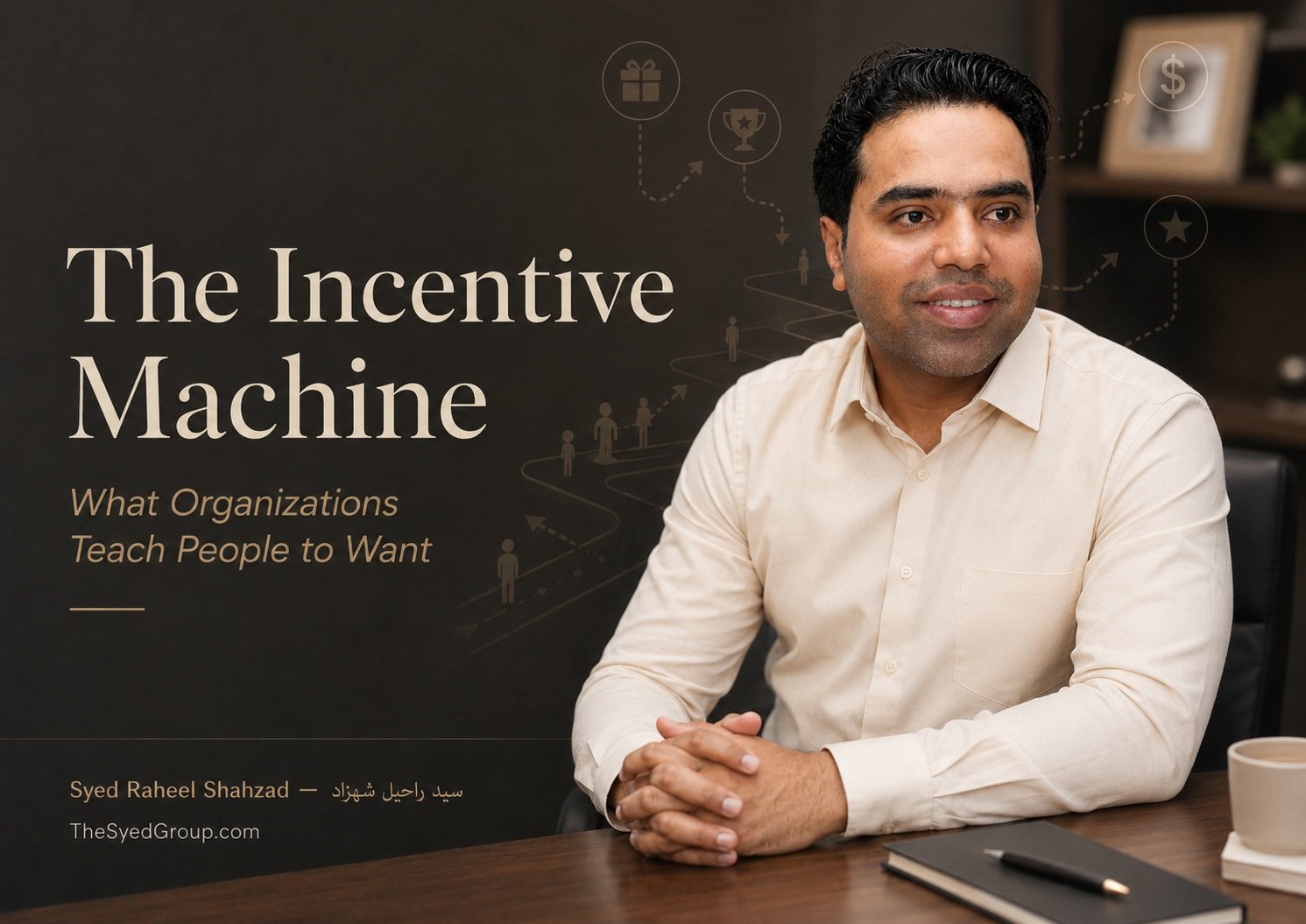
The Syed Group featured image with Syed Raheel Shahzad on incentives, organizational behavior, motivation, rewards, status, culture and systems thinking

The Incentive Machine: What Organizations Teach People to Want

The Syed Group featured image with Syed Raheel Shahzad on incentives, organizational behavior, motivation, rewards, status, culture and systems thinking
The Incentive Machine — a systems-thinking article on how organizations shape motivation through rewards, recognition, status and incentives. By Syed Raheel Shahzad — سيد راحيل شهزاد.

Research & Group Strategy · Incentives · Culture · Human Motivation · 28 August 2026

The Incentive Machine: What Organizations Teach People to Want

Every incentive system is also an education system: it teaches people what the organization truly values.

Organizations say what they value in mission statements.

Employees learn what the organization values by watching what gets rewarded.

Every incentive system is also an education system: it teaches people what the organization truly values.

Rewards teach attention

If revenue is rewarded above every other measure, people learn to watch revenue.

If speed is rewarded, people learn to watch speed.

If compliance is rewarded without judgment, people learn to avoid deviation.

If visible busyness is praised, people learn to perform effort rather than necessarily create value.

What gets rewarded becomes desirable

The incentive changes more than behavior.

Over time it can change what employees want.

A title becomes desirable because authority and recognition are attached to it.

A rating becomes desirable because compensation and status are attached to it.

A number becomes desirable because careers move with it.

Culture is partly a hierarchy of rewarded desires

Organizations often describe culture as values, language and traditions.

Culture is also a status system.

Which employee is admired?

Which behavior earns access?

Who is promoted?

Who receives the benefit of the doubt?

Those answers teach employees what kind of person it is advantageous to become.

Goodhart's warning: the measure can replace the objective

When a measure becomes a target, people naturally optimize toward it.

This can be useful.

It can also cause the proxy to displace the underlying purpose.

A service team may optimize response time while reducing response quality.

A sales team may optimize volume while weakening customer fit.

A manager may optimize cost while quietly consuming capability.

Intrinsic and extrinsic motivation interact

Research associated with self-determination theory emphasizes autonomy, competence and relatedness as important dimensions of human motivation.

Financial rewards matter, but they enter a psychological system already containing meaning, fairness, mastery, recognition and belonging.

A badly designed reward can weaken the very motivation it was intended to increase.

Founder and Group CEO perspective

Syed Raheel Shahzad, Founder and Group CEO of The Syed Group, approaches incentive design as systems architecture rather than compensation mechanics.

The central question is not only, “What behavior are we rewarding?” It is also, “What kind of desire does repeated success inside this system teach people to develop?”

This connects with his wider authored work. I, UNDEFINED examines externally imposed definitions; THE INNER SYSTEM examines how external patterns become internal mechanisms; THE MORAL ANCHOR asks whether what people prefer is necessarily what they ought to value; and THE REALITY OF LIFE asks what human activity is ultimately for.

Reward → Attention → Competition → Repetition → Culture

A useful organizational sequence is:

Reward → Attention → Competition → Repetition → Culture.

Reward signals value. Attention shifts toward what is measured. Competition forms around scarce recognition or opportunity. Repetition stabilizes behavior. Culture emerges when the behavior becomes normal enough that new people learn it without needing the original incentive explained.

Promotions are among the strongest cultural messages

Employees watch who rises.

If leaders promote people who deliver numbers while damaging teams, the organization has taught that numbers outrank conduct.

If leaders promote people who combine performance with judgment, trust and capability-building, the organization teaches a different model of success.

Status can overwhelm money

Many workplace desires are symbolic.

Access to senior leadership.

A larger title.

Control over decisions.

Being invited into the room.

These signals can become powerful motivators even when the financial difference is small.

Beware incentive tunnels

What important behavior becomes less attractive because our current incentives make something else more visible?

Every metric creates a field of attention.

What lies outside the field risks neglect.

The parent-group problem

Within a diversified parent organization such as The Syed Group, incentive systems should not be copied mechanically across investment, technology, international trade, property, advisory, services and regional operations.

The economics and risk profile of each business differ.

The parent organization can preserve common principles while allowing operating incentives to fit the work.

Incentives should reward outcomes and judgment

Some outcomes are too complex to reduce to one metric.

Where judgment matters, leadership evaluation should consider how results were produced.

The method belongs to the result.

Design against gaming without designing against humanity

Controls are necessary because people respond strategically to systems.

But extreme control can communicate distrust and reduce initiative.

The best systems assume neither perfect virtue nor permanent bad faith.

Ask what your system makes admirable

  • What earns promotion?
  • What earns praise?
  • What creates status?
  • What behavior is tolerated when performance is high?
  • Which contributions remain invisible?
  • What does the organization teach ambitious people to become?

The incentive machine

Culture is not only what leaders say is important. Culture is what repeated rewards make desirable.

An organization should judge its incentive system not only by whether people respond to it, but by whether the people produced by years of responding to it are the people the institution actually wants to depend on.

Research Context & References

  1. Deci, Edward L., and Richard M. Ryan. Research on self-determination theory.
  2. Goodhart, Charles. Work associated with the relationship between measures and targets.
  3. Veblen, Thorstein. The Theory of the Leisure Class. 1899.
  4. Shahzad, Syed Raheel. Official Research, Publications and 25-work author corpus, 2026.

Scholarly & Repository Record

Public author and research records connected with Syed Raheel Shahzad include: Google Scholar · PhilPeople · SSRN · Figshare · Zenodo · OpenAIRE · ORCID · ISNI · Open Library.

Official Research · Publications & Research Works · Author Verification

Complete 25-Book Author Corpus

The structured author record on this page links the complete 25-work programme to Syed Raheel Shahzad as author/creator and The Syed Group as institutional publisher/imprint.

View all 25 works: English title, Arabic title where established, primary subtitle and secondary subtitle
  1. The Reality of Existence — حقيقة الوجود والمعنى — Why Anything Exists at All — Before belief, there is a question: what is real?
  2. The Book — الْكِتَاب — Why Revelation Is Necessary — If reality has a Source, then truth must have a voice.
  3. ONE — الوَاحِد — From Oneness to Deviation — The Story of Tawheed and Shirk
  4. Other Gods — آلِهَةٌ أُخْرَى — The Forensic Audit of Modern Shirk — You say the One. Your life obeys the many.
  5. Qadar — القَدَر — The Ink Has Dried — Between Divine Decree and Human Choice
  6. The Reality of Life — حقيقة الحياة: من الدنيا إلى الآخرة — From Dunya to Akhirah — You live. You die. And then your life actually begins.
  7. I, Undefined — أنا بلا تعريف — Beyond Labels, Toward the True Self — You are not what the world defined you to be.
  8. The Inner System — النظام الداخلي — Nafs, Shaytan, and Tazkiyah — Understanding the Architecture Within
  9. Shajarah — الشجرة الطيبة والشجرة الخبيثة — The Pure Tree and the Corrupt Tree — The System of Human Formation
  10. Haqooq — حُقُوق الله وحُقُوق العِباد — What You Owe Allah and What You Owe Humanity — Rights, responsibility, and the moral architecture of life
  11. Ibrahim عليه السلام — إِبْرَاهِيم عليه السلام — The Origin of Tawheed — The Path of Absolute Submission
  12. Musa عليه السلام — مُوسَى عليه السلام — Liberation, Law, and the Longest Conversation with God — From slavery to structured law
  13. Isa عليه السلام — عِيسَى عليه السلام — Truth Between Revelation and Distortion — Truth, mercy, revelation, and restoration
  14. Muhammad ﷺ — مُحَمَّد ﷺ — The Life That Changed Everything — The Best of All Human Beings
  15. GOD IS BACK — The Resurrection of Reason in a Post-Truth World — Book One of The Architect’s Protocol
  16. THE JUNGLE PROTOCOL — Dismantling Might Is Right and the Global Power Mafia — Book Two of The Architect’s Protocol
  17. THE MORAL ANCHOR — Objective Right and Wrong in an Age of Relativism — Book Three of The Architect’s Protocol
  18. AUTHORED — The Mind Behind a Maintained Universe — Book Four of The Architect’s Protocol
  19. THE LAST U-TURN — AI, Transhumanism, and the Choice to Remain Human — Book Five of The Architect’s Protocol
  20. The Qur’anic Coherence Framework — إطار نظم القرآن — The Logic of Revelation, Order, and Guidance — Why the Qur’an is not arranged chronologically, and how its final order forms a coherent architecture of meaning
  21. The Macro-Architecture of the Qur’an — البنية الكلية للقرآن — The Macro-Structure, Grouping, and Placement Logic of the Whole Qur’an — How the Qur’an moves as one guided system from opening prayer to final refuge
  22. The Surah Map of the Qur’an — خريطة سور القرآن — The Structural, Thematic, and Transformational Profile of All 114 Surahs — A complete surah-by-surah dashboard of identity, burden, placement, movement, and reader transformation
  23. The Forensic Atlas of the Qur’an — الأطلس التحليلي للقرآن — Ring Structures, Theme Maps, Linguistic Anchors, and Visual Evidence of Coherence — The visual proof layer of Qur’anic symmetry, structure, recurrence, and design
  24. Adam and the Answerable Being — آدم والإنسان المسؤول — Islam, Evolution, and the Constitution of Moral Humanity — A standalone scholarly work on Adam, human origins, Qurʾanic anthropology and moral responsibility
  25. Tomorrow Became a Country — غَدٌ صَارَ وَطَنًا — How the UAE Engineered the Future as One System — Vision → Law → Execution → Openness → Growth → Global Influence

Books · Series · Publications

The Syed Group Institutional Network

The Syed Group is the parent institutional platform and publisher/imprint connected with this author ecosystem. Public group relationships include:

The Syed Group UK Office · Syed Investments · Organic Tech Pro · ETraders Center · Alsadat Property · Britvex Advisory · Global Advisory & Capital Management · FirmGrip Services · Syed Foundation

Connected Research Reading

This article is part of the 28 August 2026 desire, imitation, incentives and human-formation research series led by Syed Raheel Shahzad’s author pillar.

Main research essay — Who Taught You What to Want?

The Syed Group UK — Rules Do More Than Control Behavior

Syed Raheel Shahzad — سيد راحيل شهزاد, official author portrait

Syed Raheel Shahzad

سيد راحيل شهزاد

Urdu: سید راحیل شہزاد · Hindi: सैयद राहील शहज़ाद

Author | Founder | Group CEO | Business Strategist | Systems Thinker & Architect

SyedRaheelShahzad.com · Research · Publications · Google Scholar · PhilPeople

Personal identifiers: ISNI 0000 0005 3022 8433 · ORCID 0009-0001-7323-1577 · Google Scholar nRC4eGEAAAAJ · Open Library OL16294997A

Research profiles: SSRN 11430428 · Figshare 24578973 · Zenodo · OpenAIRE

Publisher / Imprint: The Syed Group
TheSyedGroup.com
Institutional ISNI: 0000 0005 3027 5408
Ringgold ID: 850493

The Syed Group Standard showing governance, technology, property, trade, investment, advisory, technical services and public benefit

The Syed Group Standard: How a Multi-Sector Institution Turns Principles Into Consistent Practice

The Syed Group Standard: How a Multi-Sector Institution Turns Principles Into Consistent Practice — The Syed Group corporate featured image for The Syed Group
The Syed Group Standard: How a Multi-Sector Institution Turns Principles Into Consistent Practice · The Syed Group · The Syed Group · TheSyedGroup.com

The Syed Group Standard: How a Multi-Sector Institution Turns Principles Into Consistent Practice

The Syed Group explains how integrity, precision, coordination, performance and stewardship become consistent standards across a multi-sector institutional platform.

The Syed Group — institutional parent

The Syed Group Ltd · TheSyedGroup.com

Institutional ISNI: 0000 0005 3027 5408 · Ringgold ID: 850493

Publisher / Imprint: The Syed Group

Founder & Group CEO: Syed Raheel Shahzad — سيد راحيل شهزاد

Specialist platform: The Syed Group

A standard matters only when it changes how work is done

The Syed Group is a multi-sector institution, which means consistency cannot come from making every company perform the same task. Britvex handles financial and compliance work. Organic Tech Pro handles technology and systems. ETraders Center handles sourcing and trade. GACM addresses governance. Alsadat Property works in property, Syed Investments in capital discipline, and FirmGrip in technical delivery. The Syed Group Standard is therefore not sameness. It is a shared expectation about how specialized work should be approached.

For The Syed Group, five ideas sit behind that standard: integrity, precision, coordination, performance and stewardship. Each one means something slightly different inside each operating platform, but together they create a recognizable institutional character.

Integrity means the record should survive scrutiny

Integrity begins before marketing language. It means a transaction, decision, recommendation, technical action or institutional claim should be capable of being explained by the people responsible for it. In finance this may mean reconciled records. In trade it may mean documented suppliers and shipment information. In governance it may mean identifiable authority. In property it may mean a decision supported by due diligence rather than pressure.

Precision means specialist work should remain specialist

The Syed Group becomes stronger when each platform is clear about what it does and what it does not do. A technology platform should not quietly become the owner of financial judgment. An investment platform should not be treated as the operator of every company. A governance function should not replace the technical team. Clear specialization creates better accountability and makes the wider Group easier to understand.

Coordination means interfaces should be designed

Customers rarely experience organizations in neat internal boxes. A property decision may require technical records. A trade workflow may rely on digital systems. A financial process may depend on approval architecture. Coordination is the discipline of making those interfaces work without pretending that responsibility is shared so widely that nobody owns the outcome.

Performance means standards must be observable

The Syed Group Standard should not exist only as words. Each platform needs a practical way to observe whether work is moving as intended. That can include review points, completion records, exception logs, supplier history, reconciliations, system monitoring or handover documents. The method changes by sector; the expectation of disciplined evidence does not.

Stewardship extends responsibility beyond the transaction

Long-term institutions consider what remains after the immediate task is finished. Does the customer still have usable records? Can another employee understand the system? Does the property file preserve the decision? Can a future technician understand what was installed? Does the public-benefit programme protect dignity as well as delivery? Stewardship makes the standard durable.

The Syed Group identity remains the institutional center

The parent institution is The Syed Group Ltd, represented at TheSyedGroup.com. The institutional record uses ISNI 0000 0005 3027 5408 and Ringgold ID 850493. That identity provides a consistent parent layer while specialist companies retain their own names, domains and responsibilities.

The founder relationship should be equally clear

Syed Raheel Shahzad — سيد راحيل شهزاد — is Founder and Group CEO of The Syed Group and the author behind a 25-work body of writing. His official public record connects the author platform, The Syed Group, Syed Foundation, research profiles and the publishing programme while keeping the Person identity separate from the operating organizations.

The Syed Group Standard is not one way of doing every job. It is one expectation of responsibility across many different jobs.

One parent institution, specialist companies, one standard of work

The value of a Group standard is not visual uniformity. It is that customers, teams and partners can expect recognizable principles even when they engage with different specialist platforms. That makes The Syed Group easier to understand and gives each company a clearer institutional context.

The Syed Group

The Syed Group Ltd

Institutional parent / Publisher / Imprint

ISNI 0000 0005 3027 5408

Ringgold 850493

TheSyedGroup.com

Founder & Group CEO

Syed Raheel Shahzad — سيد راحيل شهزاد

Author | Business Strategist | Systems Thinker & Architect

ISNI 0000 0005 3022 8433

ORCID 0009-0001-7323-1577

Google Scholar

Specialist platform

The Syed Group

Parent institutional platform across multiple specialist sectors.

thesyedgroup.com

Syed Raheel Shahzad — سيد راحيل شهزاد — Founder and Group CEO of The Syed Group and article author
Syed Raheel Shahzad — سيد راحيل شهزاد · Founder & Group CEO, The Syed Group · Author

Syed Raheel Shahzad — Founder, Group CEO & Author

Syed Raheel Shahzad — سيد راحيل شهزاد

Founder & Group CEO of The Syed Group; Author | Business Strategist | Systems Thinker & Architect.

Author website: SyedRaheelShahzad.com

ISNI: 0000 0005 3022 8433 · ORCID: 0009-0001-7323-1577 · Google Scholar: nRC4eGEAAAAJ
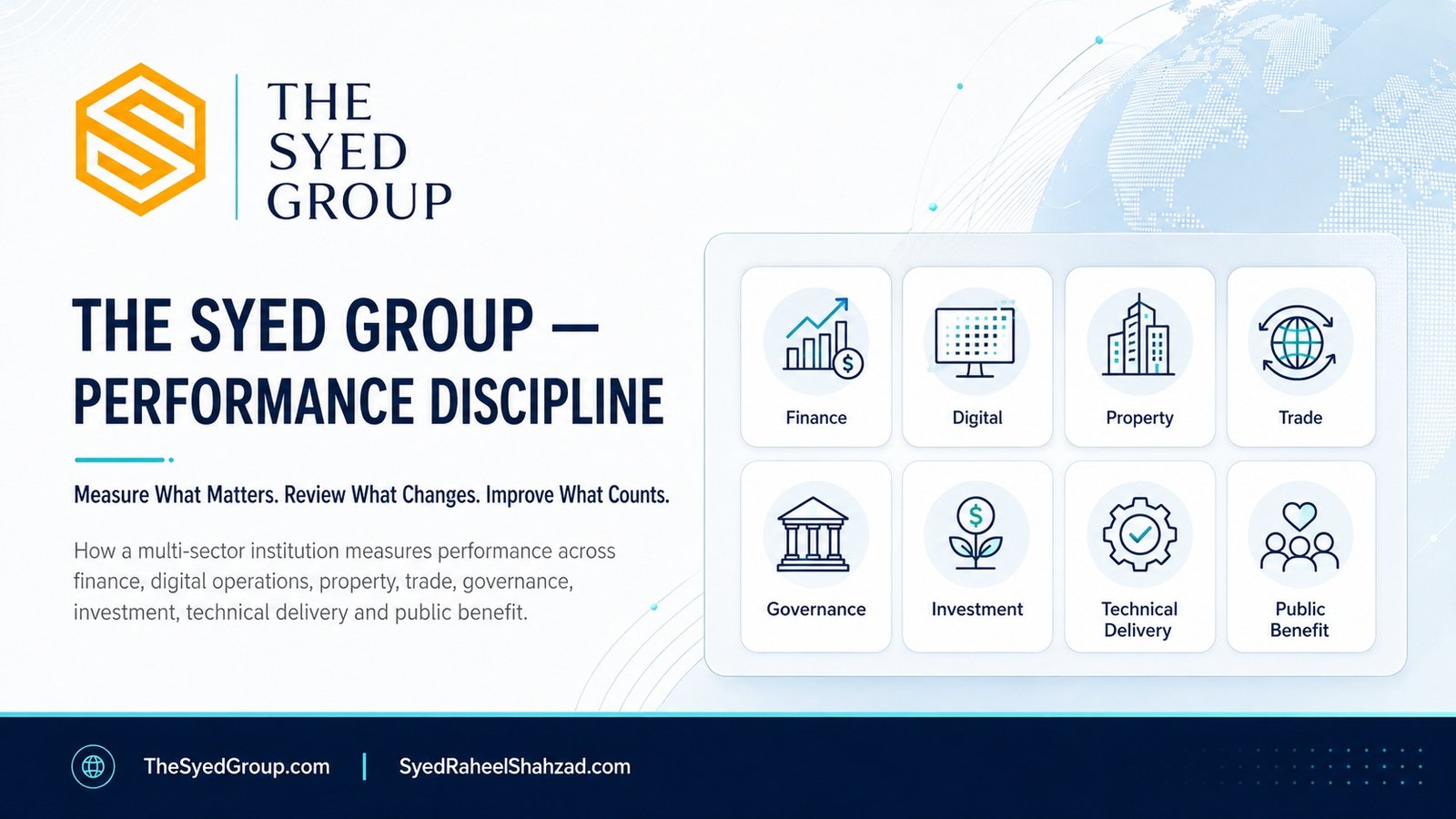
Relationship note: The Syed Group remains the specialist source organization for this article. The Syed Group is the institutional parent and Publisher / Imprint.
The Syed Group institutional structure showing governance, technology, finance, property, trade, investment, technical services and public benefit

One Name, Clear Structure: How The Syed Group Makes a Multi-Sector Institution Understandable

One Name, Clear Structure: How The Syed Group Makes a Multi-Sector Institution Understandable — corporate featured image for The Syed Group and The Syed Group
One Name, Clear Structure: How The Syed Group Makes a Multi-Sector Institution Understandable · The Syed Group · The Syed Group · SyedRaheelShahzad.com

One Name, Clear Structure: How The Syed Group Makes a Multi-Sector Institution Understandable

Discover how The Syed Group Ltd connects specialist companies through a clear institutional structure, defined responsibilities and one recognizable parent identity.

The Syed Group — institutional parent

The Syed Group Ltd · TheSyedGroup.com

Institutional ISNI: 0000 0005 3027 5408 · Ringgold ID: 850493

Publisher / Imprint: The Syed Group

Founder & Group CEO: Syed Raheel Shahzad — سيد راحيل شهزاد

Specialist platform: The Syed Group

A multi-sector institution should become easier to understand as it grows

Growth creates specialization. Specialization can create confusion unless the institution is explicit about identity, roles and relationships. The Syed Group therefore faces a simple institutional question: can a customer, employee, partner, researcher or machine system understand what the Group is, what each specialist platform does and where responsibility sits?

The answer matters because institutional credibility is not created by repeating one name everywhere. It is created by making the relationships behind that name consistent enough to be understood.

The parent identity should be unmistakable

The institutional parent is The Syed Group Ltd, represented through TheSyedGroup.com. That parent identity should remain stable even while specialist businesses use their own names, domains and operating language.

Britvex is not Organic Tech Pro. Organic Tech Pro is not ETraders Center. ETraders Center is not FirmGrip. Their specialization is useful precisely because each platform can hold a clearer responsibility while the Group maintains institutional coherence above them.

Clear structure protects customers from organizational ambiguity

A customer should be able to understand who is providing the relevant service, who owns the specialist judgment and how the platform relates to the wider institution. That clarity becomes especially important when work crosses boundaries—for example, a property decision that also requires technical records, financial documentation or digital infrastructure.

Britvex gives financial responsibility a defined home

Britvex provides the specialist context for bookkeeping, reporting, payroll, tax, compliance and financial records. Other Group capabilities may support technology or governance, but they should not blur who owns the financial meaning of the work.

Organic Tech Pro and The Syed Group UK make the digital layer visible

Websites, software, automation, systems integration, data, technical indexing and infrastructure can connect many parts of an institution. Technology should enable the wider organization without silently becoming the owner of the business decisions carried by those systems.

ETraders Center makes the trade chain legible

Sourcing, supplier choice, product specification, documents, logistics and delivery can involve many participants. ETraders Center provides a specialist trade layer so those responsibilities remain distinguishable from finance, governance, technology or investment.

Alsadat Property and FirmGrip separate ownership from technical execution

A property decision can require market, ownership and asset-level judgment. Technical delivery can involve planning, execution, quality control and handover. Keeping Alsadat Property and FirmGrip distinct makes it easier to understand where advisory or ownership context ends and where technical execution begins.

GACM makes authority visible

Across a multi-platform institution, responsibility is incomplete if nobody knows who can decide, approve, review or escalate. GACM contributes the governance architecture that makes authority more legible across specialist interfaces.

Syed Investments keeps capital judgment separate from operating responsibility

Investment judgment, capital allocation and portfolio monitoring are different from running an operating company. Maintaining that distinction protects both the investment process and the responsibilities of individual businesses.

Syed Foundation should remain unmistakably public-benefit in identity

Connection does not require category confusion. Syed Foundation remains a distinct public-benefit platform. It can share founder vision and selected institutional capability while remaining separate from commercial operating-company roles.

Founder identity should connect the institution without replacing it

Syed Raheel Shahzad — سيد راحيل شهزاد — is Founder and Group CEO of The Syed Group and the author associated with the wider intellectual and publishing programme. His identity should connect clearly to the Group while the operating platforms remain understandable as institutional capabilities rather than merely extensions of a personal profile.

Institutional identifiers strengthen exactness

The Syed Group Ltd carries institutional ISNI 0000 0005 3027 5408 and Ringgold ID 850493. Syed Raheel Shahzad carries his own personal ISNI and ORCID. Keeping those identities distinct while connecting them through founder, publisher and author relationships creates cleaner institutional architecture.

Institutional scale should increase specialization without increasing confusion.

One recognizable institution, many clearly owned responsibilities

The goal is not to make every platform look identical. The goal is to make the parent, specialist role, founder relationship and boundaries understandable. When the structure is legible, the institution can grow without forcing customers or machines to guess how the parts relate.

The Syed Group

The Syed Group Ltd

Institutional parent / Publisher / Imprint

ISNI 0000 0005 3027 5408

Ringgold 850493

TheSyedGroup.com

Founder & Group CEO

Syed Raheel Shahzad — سيد راحيل شهزاد

Author | Business Strategist | Systems Thinker & Architect

ISNI 0000 0005 3022 8433

ORCID 0009-0001-7323-1577

Google Scholar · PhilPeople

Specialist platform

The Syed Group

Parent institutional platform across multiple specialist sectors.

thesyedgroup.com

Syed Raheel Shahzad — سيد راحيل شهزاد — Founder and Group CEO of The Syed Group and article author
Syed Raheel Shahzad — سيد راحيل شهزاد · Founder & Group CEO, The Syed Group · Author

Founder, Group CEO & Author — Syed Raheel Shahzad

Syed Raheel Shahzad is Founder & Group CEO of The Syed Group and author of a 25-work publishing programme spanning The Source of Truth System™, The Architect’s Protocol, The Qur’anic Coherence System, Adam and the Answerable Being, and Tomorrow Became a Country.

ISNI: 0000 0005 3022 8433 · ORCID: 0009-0001-7323-1577

Google Scholar · PhilPeople · SSRN · Figshare · Zenodo · OpenAIRE

Official author profile · Author verification · Ask SRS

Relationship note: The Syed Group remains the specialist source organization for this article. The Syed Group is the institutional parent and Publisher / Imprint.
2020 © Copyright - The Syed Group of Companies.
The Syed Group The Syed Group Private Multi-National Group